Life.Understood.

Category: Sovereignty

  • ARK-005: The Babaylan Arc — Pilot Implementation Model

    ARK-005: The Babaylan Arc — Pilot Implementation Model


    From Curriculum Design to Field-Tested Leadership Formation


    Meta Description

    A field-tested pilot model for implementing the Babaylan Arc curriculum in Philippine communities, integrating cultural memory, systems thinking, and leadership training into measurable real-world outcomes.


    Introduction: Where Most Ideas Fail

    ARK-002 established the Babaylan Arc as a curricular intervention—a response to the fragmentation of modern education and the historical disruption of integrative leadership traditions.

    But most frameworks fail at a predictable point:

    They remain conceptually compelling but operationally vague.

    This piece closes that gap.

    ARK-005 defines how the Babaylan Arc is actually run—under constraint, with real participants, in a real community.

    This follows the same logic introduced in
    → ARK-001: The 50-Person Resource Loop
    where systems are validated only when they function under pressure, not when they read well on paper.

    A system is only real when it produces behavior under constraint.


    Why This Cannot Stay Theoretical

    The Philippines’ education crisis is often framed in terms of funding, access, or curriculum gaps. These matter—but they are not the root.

    The deeper issue is contextual incoherence.

    Filipino students are trained in abstract frameworks that do not map onto their lived realities.

    This is reflected in persistently low performance in assessments such as the Programme for International Student Assessment (PISA), where Filipino learners struggle not just with knowledge recall, but with application and reasoning in unfamiliar contexts (OECD, 2019).

    This supports an earlier critique by Renato Constantino, who argued that Philippine education historically produced individuals who are literate but detached from their own socio-cultural grounding (Constantino, 1970).

    The Babaylan Arc is not trying to add more content.

    It is attempting to restore alignment between knowledge, identity, and action.


    Pilot Design: The Smallest Unit That Matters

    https://images.openai.com/static-rsc-4/zJzu0-yep6CNVIhep7dwNLKHZiifxh4JEVrAPC6wJz-5dSskdOZN1Fq6zJL62us0dVHREKaTKfcD62-X8GKd337irEErSAxJ3C2LeAWqbY68q88QgkwJSG-vtfZH2vOrq123IXLfpZZPdMdYdBb0pUhGsA3nwaqf_hIetixtwAtAICLkjhOduW_2CZy9raNL?purpose=fullsize

    The pilot must operate at a scale where:

    • Human dynamics are visible
    • Systems can be tested
    • Failure is survivable

    Design Parameters:

    • Cohort Size: 24 participants
    • Duration: 16 weeks
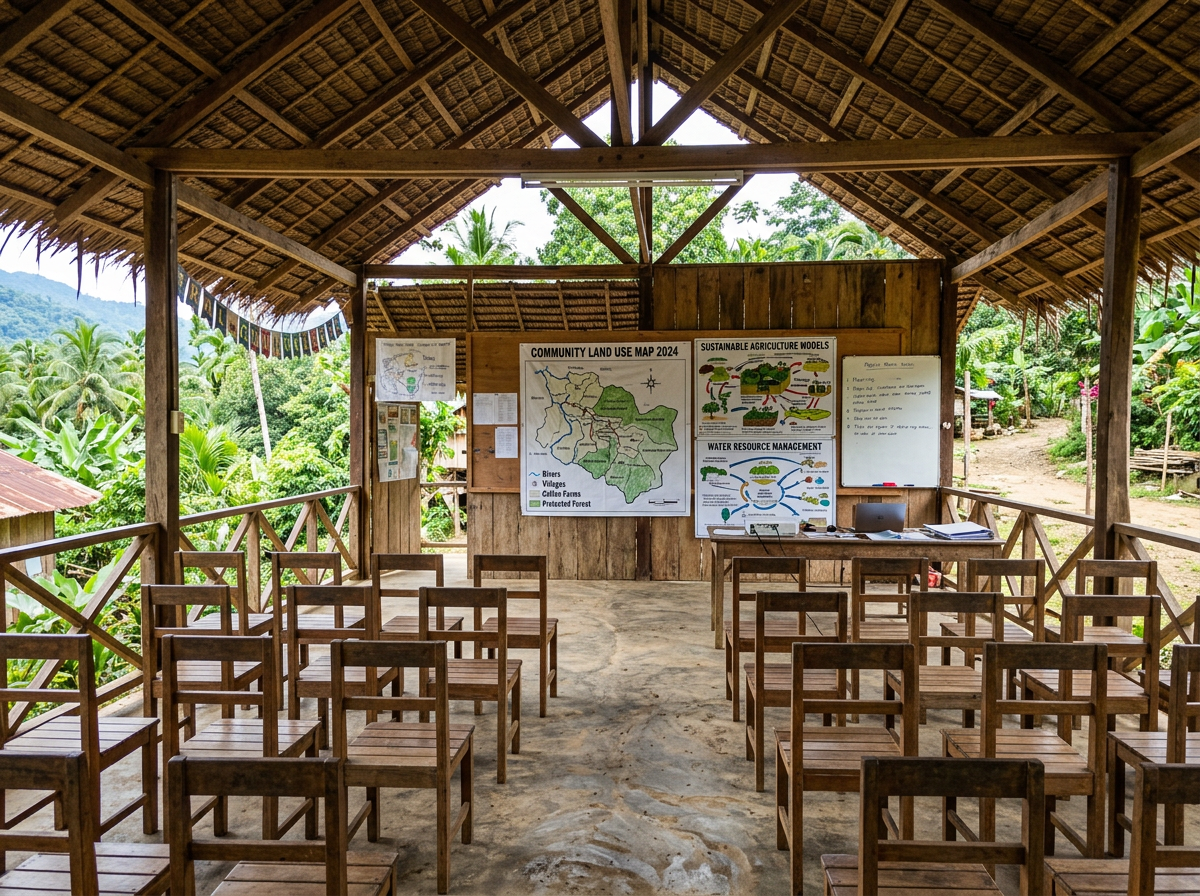
    • Setting: Barangay-level or LGU-supported community
    • Cadence: 2 sessions per week (3–4 hours each)
    • Expected Output: At least one functioning micro-system

    This is not arbitrary.

    It mirrors anthropological observations of community-scale cohesion in pre-colonial Philippine societies, where leadership roles—including those associated with figures like the babaylan—operated within tight social units rather than large anonymous populations (Scott, 1994).


    Phase Structure — With Week-Level Reality


    Phase 1 (Weeks 1–4): Cultural Grounding

    This phase is not “orientation.”
    It is deconditioning.


    Participants confront:

    • Their assumptions about history
    • Their relationship to authority
    • Their level of disconnection from local systems

    Activities include:

    • Mapping local resource flows (food, water, labor)
    • Reconstructing pre-colonial systems using guided materials
    • Identifying gaps between inherited narratives and lived reality

    This phase draws directly from
    → Pre-colonial Philippine Economics


    Observed Reality (Week 2–3):

    • Participants often default to “textbook answers”
    • Discomfort emerges when asked to describe their own barangay systems
    • Early signs of disengagement from abstract learners

    Output:
    A Context Map—not theoretical, but specific to their barangay


    Phase 2 (Weeks 5–8): Relational Stress Testing

    https://images.openai.com/static-rsc-4/m3J9mJdFftUjFXRJ-Te-3euJ_ELhghs6V79bCDbsiIUpujO5viD_wAUt4mQ6X66c86DiVAg-FA17fe9N3hFT3uL3y2vcu7mmdd9f9ptbOpWJkVE4VGNdUdsIjpWnwQa2f13yX5LFFHifVTydvjac06B1yINZS_L8WtSZb2b6QeZuy4MX0xW3nU2kdp0soM-k?purpose=fullsize

    This is where most programs fail.

    Because this is where friction becomes visible.


    Participants are placed in:

    • Conflicting decision scenarios
    • Resource allocation dilemmas
    • Leadership rotation exercises

    What emerges is predictable:

    • Dominant personalities attempt control
    • Passive participants withdraw
    • Conflict avoidance patterns surface (common in high “hiya” cultures)

    These dynamics align with broader cultural patterns explored in
    → The Architecture of Silence

    Research in critical pedagogy shows that learning accelerates when participants are forced to confront real relational tension, not avoid it (Freire, 1970).


    Observed Reality (Week 6–7):

    • First major conflicts emerge
    • Some participants consider dropping out
    • Cohort cohesion either stabilizes—or fractures

    Output:
    Demonstrated ability to navigate structured conflict without facilitator intervention


    Phase 3 (Weeks 9–12): Systems Under Constraint

    This is the pivot point.

    https://images.openai.com/static-rsc-4/2NPpF7Qf5koTcSaw72DmqolXIKBcYB6yxBbI1tLixQGz-aC4e1oYaPUSWxhRaZvMJ5KN5NCb5SBproQ4zv6FkQgyLIgqMd1699j78o9aGNaBTt7NvLefkpUPTe-TtfMs0aEj0t63JYqQq9MLMReZtvZvum-4_W9bW9AdthnLPWT7gym_JPF2_GTifYiDHE8j?purpose=fullsize

    Participants must now:

    • Work with incomplete data
    • Engage real stakeholders
    • Design systems that function despite limitations

    They are tasked to build systems aligned with:
    → ARK-001: The 50-Person Resource Loop


    Examples:

    • Small-scale food redistribution network
    • Community study group for struggling students
    • Waste-to-resource initiative

    Observed Reality (Week 10–11):

    • Plans initially overcomplicate
    • Participants underestimate logistical constraints
    • First contact with community resistance

    Output:

    A working prototype plan with clear inputs, outputs, and failure points


    Phase 4 (Weeks 13–16): Deployment and Feedback

    This phase separates:

    • Those who can explain systems
    • From those who can run them

    Participants:

    • Launch their system (even at micro scale)
    • Track outputs (participation, flow, breakdowns)
    • Present results to barangay stakeholders

    Observed Reality (Week 14–16):

    • Systems partially fail (this is expected)
    • Participants experience real accountability
    • Confidence shifts from abstract to grounded

    Output:

    An operational system, however imperfect


    Facilitator Structure: Preventing Collapse

    The pilot fails without proper facilitation.

    https://images.openai.com/static-rsc-4/DrRD5cdFBr2aTkAVHD85HlfIf2Pmrsu21rEoYHtYPfEtO4ZXNeTS00P_OjsIkjTJXHdbI03anM9vjb_-FAXsZ8RiiRo5W6eVv4Lfn1f2MU9qmoMTa-SfIu7nDEaVXgsWEgcOPw5DH3I4F9W6CQW3zB2sWJohpIJ49FM6A7sV_xFUyDw4IM7y6QMeYDZ1VeoL?purpose=fullsize

    Required Roles:

    • Lead Facilitator: Maintains structural integrity
    • Cultural Anchor: Prevents abstraction drift
    • Technical Advisor: Engaged during system design phase
    • Cohort Leads: Rotating participant leadership

    This reflects the integrative leadership model documented by William Henry Scott, where authority was functional, not hierarchical (Scott, 1994).


    Assessment: What Actually Gets Measured

    Traditional education asks:

    “What do you know?”

    This model asks:

    “What can you sustain?”


    Metrics

    1. Coherence Index
      • Can participants link identity → decision → outcome?
    2. Relational Stability
      • Does the group function under stress?
    3. System Viability
      • Does the micro-system operate for at least 2 weeks?
    4. Community Validation
      • Do external stakeholders perceive value?

    This aligns with experiential learning frameworks where real-world performance is the primary indicator of competence (Freire, 1970).


    Philippine Feasibility: Why This Can Actually Work

    The model is intentionally low-resource:

    • Uses barangay infrastructure
    • Requires minimal technology
    • Leverages local knowledge holders

    This makes it viable for LGUs, where community programs exist but often lack systemic coherence.

    The key advantage:

    It does not require systemic overhaul to begin.

    Only a single functioning pilot.


    Failure Modes (Realistic, Not Theoretical)

    • Participant dropout (Week 5–8)
    • Conflict breakdown (Phase 2)
    • Overdesigned systems that fail in execution
    • Community disengagement

    These are not bugs.

    They are the actual training environment.


    Conclusion: From Curriculum to Capability

    The Babaylan Arc cannot prove itself through narrative.

    It must prove itself through:

    • Participants who can stabilize groups
    • Systems that function under constraint
    • Communities that experience tangible benefit

    This pilot does not guarantee success.

    It guarantees something more valuable:

    Feedback grounded in reality.


    References

    Constantino, R. (1970). The Miseducation of the Filipino.

    Freire, P. (1970). Pedagogy of the Oppressed.

    OECD. (2019). PISA 2018 Results.

    Scott, W. H. (1994). Barangay: Sixteenth-Century Philippine Culture and Society.

    The concepts outlined here are designed for real-world execution. For a complete set of ready-to-use documents—including governance templates, resource tracking sheets, and operational SOPs—explore the 55 Editable Applied Stewardship Toolkit (Complete Set).

    For a broader systems context that situates localized resilience within national and multi-scalar transformation frameworks, explore The Philippine Ark: A Sovereign Blueprint for Systemic Transformation.


    Continue Through the ARK Series

    This framework is designed as a complete system. You can explore it sequentially or move directly to the layer most relevant to your work:

    Foundations

    Design + Build

    Systems Layer

    Scaling


    Suggested Pathways

    New to the framework?

    Start with ARK-001 → ARK-008 → ARK-011


    Designing a physical site?

    Begin with ARK-007 → ARK-008 → ARK-009


    Preparing for real-world deployment?

    Focus on ARK-011 → ARK-012 → ARK-013


    Thinking long-term scale?

    Move to ARK-010


    [DOCUMENT CONTROL & STEWARDSHIP]

    Standard Work ID: [ARK-005]

    Baseline Version: v1.5.2026

    Classification: Open-Access Archive / Systemic Protocol

    The Sovereign Audit: Following this protocol is an act of internal quality control. Verification of this standard does not happen here; it happens at your Gemba—the actual place where your life and leadership occur. No external validation is required or offered.

    Next in Sequence: [ARK-006: Governance Protocols for Distributed Communities]

    Return to Archive: [Standard Work Knowledge Hub: The Terrain Map]


    © 2026 Gerald Daquila • Life.Understood • Systemic Stewardship • Non-Autocratic Architecture • Process over Persona

  • ARK-004: Post-Fiat Trade — The Community Ledger SOP

    ARK-004: Post-Fiat Trade — The Community Ledger SOP


    A Standard Operating Procedure for Trust-Anchored Exchange Beyond Fiat Systems


    Meta Description

    A practical SOP for post-fiat trade using community-ledgers—outlining how local economies can function through trust, transparency, and structured exchange systems.


    Introduction: When Currency Fails, Exchange Does Not

    Modern economies assume that trade depends on currency.

    But historically—and repeatedly during systemic disruptions—trade persists even when currency fails.

    What replaces it is not chaos, but relational accounting systems: ledgers, mutual credit, and trust-based exchange.

    From the barter networks of crisis economies to the emergence of Local Exchange Trading Systems (LETS), communities have demonstrated that value exchange can be coordinated without centralized money (Greco, 2001; North, 2010).

    This piece builds on the operational grounding established in ARK-001: The 50-Person Resource Loop and the institutional framing in ARK-003: Jurisdictional Sovereignty: Legal Standard Work, by defining a core question:

    If fiat systems degrade or become unreliable, how do communities continue to trade—coherently, fairly, and sustainably?

    The answer is not barter alone.

    It is the Community Ledger.


    What Is a Community Ledger?

    A Community Ledger is a structured record of value exchange within a defined group—tracking contributions, obligations, and balances without requiring physical currency.

    Unlike informal barter, which struggles with coincidence of wants, a ledger enables asynchronous exchange:

    • One member provides value now
    • Another reciprocates later
    • The system records and balances these flows over time

    This model aligns with what economists describe as mutual credit systems, where currency is not issued upfront but created dynamically through exchange (Greco, 2001).

    Key distinction:

    • Fiat money = externally issued, scarce, interest-bearing
    • Ledger credit = internally generated, elastic, obligation-based

    The ledger does not replace value.
    It makes value visible, traceable, and accountable.


    Why Ledger-Based Trade Works

    Three constraints make post-fiat trade viable:

    1. Trust Is Local, Not Global

    Large-scale financial systems require abstraction.

    Local systems rely on recognition and accountability—members know or can verify each other’s contributions.

    Anthropological studies show that pre-modern and small-scale economies operated primarily through reciprocity and social credit, not anonymous transactions (Graeber, 2011).


    2. Scarcity Is Managed, Not Manufactured

    Fiat systems often impose artificial scarcity through interest and centralized issuance.

    Community ledgers:

    • Expand when exchange occurs
    • Contract when obligations are settled

    This creates a self-regulating liquidity model.


    3. Value Becomes Multi-Dimensional

    Fiat systems reduce value to price.

    Ledgers allow recognition of:

    • Labor
    • Goods
    • Services
    • Care work
    • Knowledge transfer

    This aligns with emerging alternative economic models that emphasize plural forms of value accounting (North, 2010).


    The Community Ledger SOP (Standard Operating Procedure)

    This SOP outlines how a 50-person node (as defined in ARK-001) can implement a working post-fiat trade system.


    Phase 1: Define the Ledger Unit

    A ledger unit is not “money.” It is a measurement of contribution.

    Options include:

    • Time-based (e.g., 1 unit = 1 hour of labor)
    • Hybrid (weighted by skill or scarcity)
    • Resource-indexed (linked to core goods like food or water)

    Recommendation:
    Start simple—time-based units—to reduce friction and disputes.


    Phase 2: Establish Member Registry

    Each participant must have:

    • Unique identity (verified within the group)
    • Ledger account (starting at zero)

    No pre-issued currency.

    Balances emerge through activity.


    Phase 3: Define Exchange Categories

    To avoid ambiguity, standardize categories:

    • Food production
    • Water and utilities
    • Maintenance and repair
    • Health and care
    • Education and coordination

    Each transaction must specify:

    • Provider
    • Receiver
    • Category
    • Units exchanged

    Phase 4: Recording Protocol

    All exchanges must be recorded within a fixed time window (e.g., 24–48 hours).

    Recording methods:

    • Physical ledger book (low-tech resilience)
    • Shared spreadsheet (intermediate)
    • Local server or offline-first app (advanced)

    Transparency is critical.

    All members must be able to view aggregate balances (with privacy safeguards as needed).


    Phase 5: Balance Thresholds

    To prevent hoarding or chronic deficit:

    • Set maximum positive balance (encourages circulation)
    • Set maximum negative balance (prevents overdraw)

    Example:

    • +100 units cap
    • −50 units floor

    Members exceeding limits must rebalance through participation.


    Phase 6: Dispute Resolution

    All systems fail without governance.

    Establish:

    • A small rotating council (3–5 members)
    • Clear escalation steps
    • Evidence-based review (ledger entries)

    This connects directly to governance frameworks outlined in ARK-003: Jurisdictional Sovereignty.


    Phase 7: Periodic Reconciliation

    Every 30–60 days:

    • Audit ledger balances
    • Identify inactive accounts
    • Resolve persistent deficits or surpluses

    This ensures the system remains alive, not stagnant.


    Failure Modes (and How to Prevent Them)

    A ledger system is simple—but not immune to breakdown.

    1. Free-Rider Problem

    Some members consume without contributing.

    Mitigation:
    Balance thresholds + participation requirements.


    2. Value Disputes

    Members disagree on how much a task is worth.

    Mitigation:
    Standardize baseline units (time-based) and allow minor adjustments only when justified.


    3. Ledger Inaccuracy

    Delayed or incorrect entries erode trust.

    Mitigation:
    Strict recording windows + periodic audits.


    4. Social Friction

    Non-financial tensions spill into economic exchange.

    Mitigation:
    Separate interpersonal mediation from ledger governance.


    From Ledger to System

    A functioning community ledger does more than enable trade.

    It becomes:

    • A signal system (who contributes, where gaps exist)
    • A resilience layer (trade continues even if fiat fails)
    • A training ground for stewardship and accountability

    This is not theoretical.

    Similar systems have been implemented globally—from LETS networks in Canada to time banks in the U.S. and Europe—demonstrating durability under economic stress (North, 2010).


    Conclusion: Trade Is a Relationship, Not a Currency

    Fiat systems give the illusion that money enables exchange.

    In reality:

    Exchange is a function of trust, record, and reciprocity.

    The Community Ledger simply formalizes what has always existed beneath currency.

    Within the Philippine context—where relational networks, mutual aid (bayanihan), and informal economies already operate—the transition to ledger-based systems is not a radical departure.

    It is a structured return to a familiar pattern, made operational.

    As the ARK series progresses—from resource loops to jurisdictional frameworks to trade systems—the architecture becomes clear:

    Together, they form a minimal viable system for localized sovereignty under uncertainty.


    References

    Graeber, D. (2011). Debt: The first 5,000 years. Melville House Publishing.

    Greco, T. H. (2001). Money: Understanding and creating alternatives to legal tender. Chelsea Green Publishing.

    North, P. (2010). Local money: How to make it happen in your community. Green Books.

    The concepts outlined here are designed for real-world execution. For a complete set of ready-to-use documents—including governance templates, resource tracking sheets, and operational SOPs—explore the 55 Editable Applied Stewardship Toolkit (Complete Set).

    For a broader systems context that situates localized resilience within national and multi-scalar transformation frameworks, explore The Philippine Ark: A Sovereign Blueprint for Systemic Transformation.


    Continue Through the ARK Series

    This framework is designed as a complete system. You can explore it sequentially or move directly to the layer most relevant to your work:

    Foundations

    Design + Build

    Systems Layer

    Scaling


    Suggested Pathways

    New to the framework?

    Start with ARK-001 → ARK-008 → ARK-011


    Designing a physical site?

    Begin with ARK-007 → ARK-008 → ARK-009


    Preparing for real-world deployment?

    Focus on ARK-011 → ARK-012 → ARK-013


    Thinking long-term scale?

    Move to ARK-010


    [DOCUMENT CONTROL & STEWARDSHIP]

    Standard Work ID: [ARK-004]

    Baseline Version: v1.5.2026

    Classification: Open-Access Archive / Systemic Protocol

    The Sovereign Audit: Following this protocol is an act of internal quality control. Verification of this standard does not happen here; it happens at your Gemba—the actual place where your life and leadership occur. No external validation is required or offered.

    Next in Sequence: [ARK-005: The Babaylan Arc – Institutional Curriculum]

    Return to Archive: [Standard Work Knowledge Hub: The Terrain Map]


    © 2026 Gerald Daquila • Life.Understood • Systemic Stewardship • Non-Autocratic Architecture • Process over Persona

  • The Architecture of Silence: Breaking the Cycles of Colonial Shame in the Modern Filipino Family

    The Architecture of Silence: Breaking the Cycles of Colonial Shame in the Modern Filipino Family


    There is a silence inside many Filipino families that is often mistaken for peace.

    It is the silence after a child asks a difficult question. The silence when a parent is hurt but cannot apologize. The silence when siblings know the truth but choose not to disturb the family’s image.

    The silence around money, resentment, mental health, inheritance, failed dreams, migration, favoritism, shame, and grief.

    This silence is not accidental. It has architecture.

    It is held together by love, fear, survival, hierarchy, and a long colonial history that taught Filipinos to manage danger through obedience, emotional containment, and social performance.

    To speak about colonial shame only as “low self-esteem” or “inferiority complex” is too shallow. The deeper wound is systemic: colonial shame reshaped how many Filipino families regulate truth.

    Colonial mentality has been described as a form of internalized oppression rooted in the belief that the colonized self, culture, or identity is inferior to the colonizer’s standard (David & Okazaki, 2006).

    In the Filipino context, this does not only appear as preference for foreign goods, lighter skin, English fluency, or Western validation. It also appears in the family as a hidden rule: do not expose what makes the family look weak.

    That rule becomes the first wall in the architecture of silence.


    When shame becomes a family operating system

    Filipino culture is often described through values such as hiya, utang na loob, pakikisama, and respect for elders. These values are not inherently harmful. In their healthy form, they preserve dignity, gratitude, relational sensitivity, and social cohesion.

    Sikolohiyang Pilipino reminds us that Filipino identity cannot be understood properly through Western individualism alone; it must be understood through kapwa, the shared self, where personhood is relational rather than isolated (Pe-Pua & Protacio-Marcelino, 2000).

    But under colonial pressure, relational values can become distorted.

    Hiya can shift from moral sensitivity into chronic self-erasure. Utang na loob can shift from gratitude into emotional debt. Respect can shift from reverence into fear. Family loyalty can shift from belonging into enforced silence.

    This is where colonial shame becomes more than an attitude. It becomes an operating system.

    A child learns not only what is right or wrong, but what is speakable. A daughter learns which emotions are “too much.”

    A son learns that vulnerability may be treated as weakness. A parent learns that apology feels like loss of authority. A family learns that unresolved pain is less dangerous than public embarrassment.

    This is why many Filipino families can be deeply loving and emotionally unsafe at the same time.

    The contradiction is not hypocrisy. It is inheritance.


    The family as the first institution

    The Filipino family is often celebrated as the foundation of society. That is true—but incomplete.

    The family is also the first institution where hierarchy is learned, authority is normalized, silence is rewarded, and dissent is punished.

    Before a Filipino encounters government bureaucracy, church authority, school discipline, workplace politics, or national patronage systems, they often encounter the same pattern at home: do not question the elder, do not embarrass the group, do not make conflict visible.

    This is why the conversation belongs not only in psychology, but in systems thinking.

    The modern Filipino family can reproduce the same structures that later appear in public life: avoidance of accountability, preference for image over truth, loyalty over transparency, and indirect communication over direct repair.

    What begins as “family peace” can become the emotional template for institutional dysfunction.

    This connects directly with the broader Philippine systems pattern explored in Why Incentives Fail in Philippine Systems: formal rules may say one thing, but informal relationships often determine what actually happens. The family is where that split is first rehearsed.


    The hidden bargain: belonging in exchange for silence

    The most painful part of colonial shame is that it often disguises itself as love.

    Many Filipino children are not explicitly told, “Do not become fully yourself.” Instead, they receive subtler messages:

    Do not talk back.
    Do not shame the family.
    Do not be ungrateful.
    Do not make your parents feel they failed.
    Do not bring private matters outside.
    Do not be too different.

    The child eventually understands the bargain: belonging is available, but only if certain truths remain buried.

    This is how silence becomes architectural. It is not one event. It is a repeated emotional design. Every avoided conversation becomes a beam. Every punished question becomes a wall. Every unspoken apology becomes a locked room. Over time, the family house still stands—but many souls inside it cannot breathe.

    Research on Filipino and Filipino American mental health repeatedly points to the role of family-centeredness, respect for elders, stigma, and hiya in shaping whether emotional distress is acknowledged or hidden (Javier et al., 2018).

    The issue is not that Filipino families lack care. The issue is that care is often routed through sacrifice, control, endurance, and provision rather than truth-telling.

    A parent may work abroad for decades out of love, yet never learn how to speak tenderness. A child may obey out of love, yet carry resentment into adulthood. A family may remain intact, yet emotionally fragmented.

    This is not failure of character. It is a failure of repair.


    What must be broken is not Filipino culture, but the colonial distortion of Filipino culture

    The answer is not to reject Filipino values. That would repeat the colonial wound by treating the native inheritance as the problem.

    The task is more precise: distinguish the living value from its distorted form.

    Kapwa is not codependency. It is shared dignity.
    Hiya is not self-erasure. It is ethical awareness.
    Utang na loob is not lifelong bondage. It is gratitude with freedom.
    Respect is not silence. It is truth held with care.
    Family loyalty is not denial. It is the courage to repair what harms the family from within.

    This is where the Filipino family can become a site of decolonization—not through slogans, but through new relational practice.

    The deeper recovery is not simply “be proud to be Filipino.” Pride helps, but pride alone can become performance. The more difficult work is rebuilding the Filipino home as a place where truth does not automatically threaten belonging.

    This is also why pre-colonial memory matters. As explored in Beyond the Peso: Why Pre-colonial Philippine Economics is the Blueprint for Modern Resilience, older Filipino systems were not perfect, but they carried relational logics of reciprocity, dignity, and communal resilience that were not reducible to colonial approval or capitalist performance.

    The recovery of Filipino identity cannot remain aesthetic. It must become structural.


    Breaking the silence without breaking the family

    A common fear is that speaking honestly will destroy the family. Sometimes this fear is realistic. Not every family system is ready for direct confrontation.

    Some elders hear truth as accusation because they themselves were raised in architectures where authority had to remain intact at all costs.

    So the work must be wise, not reckless.

    Breaking silence does not always begin with dramatic confrontation. It may begin with one person refusing to continue the pattern internally.

    It may begin with naming the truth in a journal, therapy session, prayer, ritual, or trusted conversation. It may begin with saying,

    “I understand why this pattern exists, but I will not pass it on unchanged.”

    The first act of liberation is not always speech. Sometimes it is discernment.

    But eventually, silence must give way to language. Families heal when they develop new sentences:

    “I was hurt by that.”
    “I know you did your best, but this still affected me.”
    “I do not want gratitude to become control.”
    “I can respect you and still disagree.”
    “We do not have to hide this anymore.”
    “I want our family to be loyal to truth, not only to image.”

    These sentences are small, but they are structural interventions. They weaken the old architecture and make another house possible.


    The Filipino future begins at the dinner table

    National transformation is often imagined through elections, reforms, education, economics, or leadership. All of that matters. But a society cannot become truthful if its families train children to survive through silence.

    The Filipino future also begins at the dinner table.

    It begins when a child is allowed to ask why.
    It begins when a parent apologizes without collapsing.
    It begins when siblings stop protecting dysfunction for the sake of appearances.
    It begins when family loyalty expands to include accountability.
    It begins when hiya is restored as dignity, not fear.

    This is the signal this conversation needs: colonial shame is not only a psychological wound. It is an inherited architecture of relationship. And because it was built, it can be rebuilt.

    The goal is not to become less Filipino.

    The goal is to become Filipino without the colonial fracture.

    For readers walking through this interior work, The Internal Reset offers a broader pathway for transforming inherited survival patterns into conscious inner sovereignty.

    The silence was never empty.

    It was carrying history.

    Now it must carry truth.


    Brief Glossary

    Colonial shame — Internalized shame rooted in colonial history, where the native self, language, body, culture, or family system is unconsciously measured against external standards of worth.

    Colonial mentality — A form of internalized oppression in which colonized people may perceive their own culture or identity as inferior to that of the colonizer (David & Okazaki, 2006).

    Hiya — Often translated as shame or embarrassment, but more deeply understood as a Filipino sense of propriety, dignity, and social sensitivity. In distorted form, it can become self-silencing.

    Kapwa — A core concept in Sikolohiyang Pilipino meaning shared identity or shared inner self; the self is understood in relation with others, not as a separate isolated unit (Pe-Pua & Protacio-Marcelino, 2000).

    Utang na loob — A debt of gratitude. Healthy forms sustain reciprocity; distorted forms create emotional obligation and control.

    Architecture of silence — The inherited family system of rules, fears, loyalties, and emotional habits that determines what can and cannot be spoken.


    References

    David, E. J. R., & Okazaki, S. (2006). Colonial mentality: A review and recommendation for Filipino American psychology. Cultural Diversity and Ethnic Minority Psychology, 12(1), 1–16.

    Javier, J. R., Supan, J., Lansang, A., Beyer, W., Kubicek, K., & Palinkas, L. A. (2018). Voices of the Filipino community describing the importance of family in understanding adolescent behavioral health needs. Family & Community Health, 41(1), 64–71.

    Pe-Pua, R., & Protacio-Marcelino, E. A. (2000). Sikolohiyang Pilipino: A legacy of Virgilio G. Enriquez. Asian Journal of Social Psychology, 3(1), 49–71.


    Attribution

    Written by Gerald Daquila
    Steward of applied thinking at the intersection of systems, identity, and real-world constraint.

    This work draws from lived experience across cultures and environments, translated into practical frameworks for clearer thinking and more coherent contribution.

    This piece is part of an ongoing exploration of applied thinking in real-world systems.. Part of the ongoing Codex on leadership, awakening, and applied intelligence.

  • [KZN-010] Kaizen in the Archive: Iterative Soul-Auditing

    [KZN-010] Kaizen in the Archive: Iterative Soul-Auditing


    In the industrial landscape, Kaizen is the philosophy of continuous, incremental improvement.

    It is the belief that small, daily changes—when compounded over time—result in a transformation so profound that the original “Standard” becomes unrecognizable.

    In the factory Gemba, Kaizen is about reducing waste (Muda) and increasing value.

    But for the Sovereign Professional in 2026, the Gemba isn’t just your digital workspace or your corporate office. The Gemba is your Archive—the massive collection of past versions of yourself, your work, your beliefs, and the stories you’ve told to survive.

    [KZN-010] is the protocol for Iterative Soul-Auditing: the practice of treating your own evolution as a continuous improvement project.


    The Archive as the Real Place (Gemba)

    Most professionals treat their past like a graveyard. They write an essay, finish a project, or survive a toxic job, and then they “bury” it, moving frantically to the next task.

    This is a massive systemic defect. Your history—especially your digital and creative history—is a live data stream of your own cognitive architecture.

    When you perform a Kaizen audit on your archive, you aren’t just “editing old posts.” You are performing a Soul-Audit.

    You are looking at the “Incentive Structures” that drove your younger self. You are identifying the moments where you produced “Soul-Scrap”—work done purely for external validation or survival—and you are reclaiming that energy.

    This is the only way to achieve Staying Sovereign in Uncertain Times — Inner Stability in an Unstable World.

    You cannot be stable if you are haunted by unprocessed versions of yourself.


    Identifying “Identity Muda”

    The primary target of [KZN-010] is Identity Muda. Waste in the soul occurs when we hold onto “Standards” that are no longer true.

    As we’ve explored in Identity: The Story We Learn to Tell About Ourselves, identity is often a legacy system—a set of rules and narratives we adopted to fit into a corporate waste-stream or a family dynamic.

    The Soul-Audit Checklist:

    • The Over-Processing of Compliance: Do you still find yourself “performing” a version of professional excellence that was designed for a 2019 economy?
    • The Inventory of Unfinished Lessons: Are there recurring patterns of burnout or conflict in your archive? If so, you have “Work in Progress” (WIP) that has not yet been refined into wisdom.
    • The Defect of Performative Effort: How much of your past work was “Hard Work” done to hide a lack of “Systemic Positioning”?

    By identifying this waste, you don’t judge it—you Kaizen it. You refine the narrative. You update the “Standard Operating Procedure” of your soul.


    The Kaizen of Thresholds

    In 2026, the rate of change is so high that a “Standard” might only be valid for a few months. This is why you must view every major shift as a “Pivot Point.”

    In the Sovereign Operating System, we recognize that Change as a Threshold, Not a Failure.

    When you audit your archive and see a project that failed or a career path that ended abruptly, [KZN-010] requires you to re-code that event.

    It wasn’t a “defect” in your life; it was a Threshold Marker. It was the system telling you that the old “Value Stream” was no longer generative.

    By auditing these thresholds iteratively, you build the “Antifragility” needed to navigate the Philippine Ark.

    You begin to see that your life isn’t a series of random events, but a deliberate, iterative design.


    Refinement via the Sacred Exchange

    A key component of [KZN-010] is the audit of your Exchanges. Who have you been giving your “Highest Signal” to?

    If your archive shows a history of giving pearl-level wisdom to “Swine-level” extractive hierarchies, you have a defect in your Sacred Exchange.

    Kaizen in the archive means looking at your past collaborations and asking: “Did this exchange nourish the ‘Heart Chakra’ of my business, or did it merely drain my metabolic reserves?”

    If the latter, the iterative fix is to tighten your boundaries. This is the secret to Helping Without Burning Out. You learn to stop “leaking” value into systems that cannot reciprocate.

    You refine your “Pull System” so that you only engage when the exchange is generative.


    The Protocol: The 1% Soul-Update

    How do you practically apply [KZN-010]? You don’t try to “fix your whole life” in a weekend.

    That is “Big Bang” change, which is unstable. You apply the 1% Rule:

    1. Weekly Archive Gemba: Spend 30 minutes every Sunday reviewing a past project, a journal entry, or a blog post from a year ago.
    2. Identify One Defect: Find one belief or habit in that “Archive Version” of you that is currently causing “Muda” in your 2026 life.
    3. Update the Standard: Consciously decide on one small, tactical change to your “Inner OS” to prevent that defect from recurring.
    4. Ship the Version: Act on that change immediately.

    This is the “Jidoka” of personal growth. You are building quality into your soul, one iteration at a time.


    Conclusion: The Infinite Game of Refinement

    By the time you have performed [KZN-010] for a year, your archive is no longer a graveyard—it is a Power Plant.

    Every past struggle becomes a fuel source; every past “failure” becomes a tactical lesson.

    In 2026, the most dangerous thing a professional can be is “Finished.” The moment you stop auditing, you begin to stagnate.

    The Sovereign Professional is a Perpetual Prototype. We are always in Beta. We are always refining. We are always Kaizen-ing the soul until the internal “Signal” is so pure that the external “Noise” can no longer touch us.

    Iterate your identity. Audit your archive. Reclaim your value stream.


    The Sovereign Professional: A structural map of power, systems thinking, and personal autonomy—dedicated to helping the independent professional navigate complexity and own their value stream.


    ©2026 Gerald Daquila • Life.Understood. • Systems Thinking, Leadership Architecture, and Applied Coherence

  • [SEM-001] Collective Sense-making SOP: Decentralized Consensus

    [SEM-001] Collective Sense-making SOP: Decentralized Consensus


    In the industrial world, a Standard Operating Procedure (SOP) is a set of step-by-step instructions compiled by an organization to help workers carry out complex routine operations.

    Its goal is to achieve efficiency, quality output, and uniformity of performance while reducing miscommunication. However, in the hyper-fragmented reality of 2026, the most complex operation we face isn’t on a factory floor—it is the act of Sense-making.

    The old world relied on “Centralized Sense-making.” We looked to news anchors, government agencies, and corporate hierarchies to tell us what was true.

    But as those institutions have succumbed to the “Waste” of political capture and systemic obsolescence, the Sovereign Professional must pivot to a new model: Decentralized Consensus.

    [SEM-001] is the protocol for how a Sovereign Node participates in collective intelligence without losing their individual center.


    The Crisis of the “Mono-Narrative”

    In a Lean system, a “Single Point of Failure” is a catastrophic risk.

    Centralized sense-making is exactly that. When one institution misinterprets a global event—be it a financial shift, a technological breakthrough, or a systemic disclosure—the entire “Value Stream” of public understanding is corrupted.

    The result is “Epistemic Muda”: a massive overproduction of conflicting, low-fidelity information that leads to paralysis.

    To navigate this, you must realize that Identity: The Story We Learn to Tell About Ourselves often dictates how we process data.

    If your identity is tied to being “right” according to a specific group, you will filter out any “Signal” that contradicts that group’s narrative.

    Decentralized consensus requires you to strip away these identity-based filters and become a clean sensor in a larger mesh network.


    The SOP: How to Sense-make in a Mesh Network

    [SEM-001] is designed to turn “Collective Noise” into “Decentralized Signal.” It follows a specific three-stage process.


    1. Internal Calibration (The Sovereign Anchor)

    Before you can engage with the group, you must ensure your own “Internal Sensor” is calibrated. You cannot participate in decentralized consensus if you are in a state of panic or hyper-reactivity. This is the art of Staying Sovereign in Uncertain Times — Inner Stability in an Unstable World.

    • Poka-yoke: If your emotional state is “Red” (high-anxiety), you are a “Defective Sensor.” You must recuse yourself from the sense-making process until you have returned to “Neutral.”

    2. Multi-Node Triangulation (The “Council” Logic)

    Instead of looking for “The Truth,” look for Consensus across Unlikely Allies.

    In 2026, the highest fidelity signal is found at the intersection of diverse nodes that have no incentive to agree with one another.

    • The Cross-check: If a financial expert in London, a Philippine Ark community leader, and a decentralized AI developer are all pointing to the same systemic shift, you have found a High-Probability Signal.

    3. Iterative Refinement (The Kaizen of Truth)

    Decentralized consensus is never “finished.” It is a living document. As new data enters the system, the consensus must shift.

    This requires viewing Change as a Threshold, Not a Failure. If a previous consensus is proven wrong, it is not a “defect” in the group; it is a successful update to the operating system.


    Managing the Cognitive Load: Helping Without Burning Out

    Collective sense-making is exhausting. It requires “Systemic Empathy” and high-bandwidth processing.

    Many professionals fall into the trap of “Emotional Over-processing,” trying to harmonize every conflicting viewpoint they encounter.

    To maintain your role as a Sovereign Node, you must practice Helping Without Burning Out. Your job is not to “convince” everyone or to carry the weight of the world’s confusion.

    Your job is to be an Accurate Reporter of your own perspective and a Discerning Receiver of others’.

    If the sense-making process begins to siphon away your vital energy, you have crossed an ethical line in your Sacred Exchange. You must withdraw to recalibrate.


    The Value of the “Sovereign Contribution”

    Why does decentralized consensus work? Because it utilizes “Cognitive Diversity” as a defense mechanism against deception.

    In a centralized system, you only have to deceive one leader to control the whole group. In a decentralized mesh of Sovereign Professionals, you would have to deceive every individual sensor simultaneously—an impossible feat.

    This is the “Jidoka” of truth. Every Sovereign Node has the “Andon Cord.”

    If you see a piece of data that proves the current group consensus is a “Defect,” you have the authority and the responsibility to pull the cord and stop the line.

    This is how we protect the integrity of the Philippine Ark and the New Earth architecture.


    Conclusion: The Architecture of the New We

    [SEM-001] Collective Sense-making SOP: Decentralized Consensus is the end of the “Follow the Leader” era. It is the beginning of the “Trust the Process” era—where the process is a rigorous, peer-to-peer exchange of high-signal data.

    In 2026, the most valuable thing you can bring to a room is not your opinion, but your Calibration.

    By mastering the SOP of sense-making, you ensure that you are a generative node in the collective evolution. You move from being a “consumer of news” to an “architect of reality.”

    Calibrate your sensor. Triangulate the signal. Pull the cord when you see a defect.


    The Sovereign Professional: A structural map of power, systems thinking, and personal autonomy—dedicated to helping the independent professional navigate complexity and own their value stream.


    ©2026 Gerald Daquila • Life.Understood. • Systems Thinking, Leadership Architecture, and Applied Coherence

  • Agentic Stewardship: Why the ‘New Earth’ is a Cognitive Operating System, Not a Financial Miracle

    Agentic Stewardship: Why the ‘New Earth’ is a Cognitive Operating System, Not a Financial Miracle


    By mid 2026, the promise of “Artificial Intelligence” has mutated. We have moved past the era of chatbots and image generators into the era of Agentic AI—systems that don’t just predict text, but reason, plan, and execute complex goals across entire digital ecosystems.

    For the “Silent Professionals” sitting in the high-rises of BGC or the remote hubs of Silicon Valley, this shift has created a profound sense of vertigo.

    You see the writing on the wall. The legacy systems of finance and tech—those extractive, high-friction hierarchies—are being rendered obsolete by agents that can optimize value streams at speeds no human committee can match.

    You are looking for an exit ramp, and in the “fringe” corners of the web, you keep hearing about GESARA and a “New Earth.”

    But here is the direct, unvarnished truth: The “New Earth” is not a financial miracle coming to save you from your debts.

    It is a Cognitive Operating System you must install to survive the systemic reset.


    The 2026 Context: Agentic AI as Sovereign Infrastructure

    In 2026, Agentic AI has become the primary mirror for our own competence. When an AI can plan a 12-month project and execute the first 30% without human intervention, it exposes the massive “Muda” (waste) inherent in traditional corporate management.

    For the professional in finance or tech, the realization hits: if a machine can reason and plan with more coherence than your department head, the department head’s role is a structural defect.

    This is where the concept of Agentic Stewardship emerges.


    Sovereignty in this new landscape isn’t about “owning” the AI; it’s about becoming the consciousness that directs it.

    We are moving from a world of “units of labor” to a world of “Sovereign Resource Pipelines.” As discussed in Signal vs Noise: Why Clear Thinking Is Rare, the ability to maintain clarity amidst the collapse of old certainties is the only asset that holds its value.


    Reframing GESARA: The End of Extractive Muda

    The “Silent Professional” often views GESARA (The Global Economic Security and Reformation Act) through a lens of desperate hope—a “free money” event that wipes the slate clean. But a Sovereign Professional understands that a systemic reset is never a gift; it is an Efficiency Event.

    If we look at the current financial system through a Lean lens, it is riddled with extraction.


    Interest-based debt, complex derivative layering, and the “taxation of movement” are all forms of waste that prevent capital from reaching its highest-potential use.

    A “Systemic Reset” to a higher-efficiency, zero-waste value stream isn’t about giving everyone a windfall; it’s about the removal of the friction that currently keeps the “Sovereign Professional” in a state of indentured service.

    As explored in Incentives Drive Behavior: Why Good Intentions Fail in Systems, the old system incentivized debt and complexity because that is how it extracted power.


    The “New Earth” system incentivizes Stewardship. If you aren’t prepared to be an agent of value, a reset won’t save you—it will simply leave you behind in a world where “effort” is no longer the metric of success.


    The Cognitive OS: Stewardship Over Survival

    The “Exit Ramp” you are looking for isn’t a destination; it’s a shift in your internal architecture.

    Most professionals are running a Survival OS—an operating system optimized for pleasing the hierarchy, avoiding risk, and maintaining solvency.

    The “New Earth” requires the installation of the Agentic Stewardship OS.


    This OS is built on three core modules:

    1. Sovereign Governance: The ability to govern your own attention and resources without an external manager.
    2. Reasoning Capacity: Shifting from “executing tasks” to “defining goals.” In the age of Agentic AI, the human’s role is the Goal Designer.
    3. Coherent Stewardship: Managing resources (financial, technological, and energetic) in a way that minimizes waste and maximizes generative output.

    This is the bridge to the Sovereignty Architecture: A Coherence Framework. Without this internal shift, you will bring the same “slave-logic” into a new system, and you will find yourself once again wondering Why Hard Work Alone Doesn’t Make You Valuable.


    The Call to the Silent Professionals

    You in Finance: You see the algorithmic decay of the fiat system.


    You in Tech: You see the “Dead Internet Theory” becoming a reality as AI agents outpace human content.

    You are the ones capable of building the new pipelines. But to do so, you must stop waiting for a “Financial Miracle” and start practicing The Discipline of Inner Sovereignty.

    Agentic Stewardship means you stop being a “user” of the system and start being the “architect” of the flow.

    GESARA, if it manifests as a systemic reset, is simply the grand opening of the Gemba—the “real place” where value is created.

    It is the removal of the extractive middleman. If you have spent your career becoming an expert in the friction of the old system (the red tape, the tax loopholes, the management bloat), you are currently high-risk inventory.

    If you are learning to be an agent of pure value, you are the cornerstone of the New Earth.


    Conclusion: The Exit Ramp is Internal

    The “New Earth” isn’t a location you find on a map after a global reset.


    It is the reality that manifests when a critical mass of professionals decides to stop serving the waste-stream and start serving the value-stream.

    Agentic AI is the catalyst. It is forcing us to be more “human” than we have ever been allowed to be in a corporate setting. It is forcing us to become Stewards.

    The exit ramp is open. But to take it, you must be willing to trade your “employee” mindset for a “Sovereign” architecture.


    The Sovereign Professional: A structural map of power, systems thinking, and personal autonomy—dedicated to helping the independent professional navigate complexity and own their value stream.


    ©2026 Gerald Daquila • Life.Understood. • Systems Thinking, Leadership Architecture, and Applied Coherence