
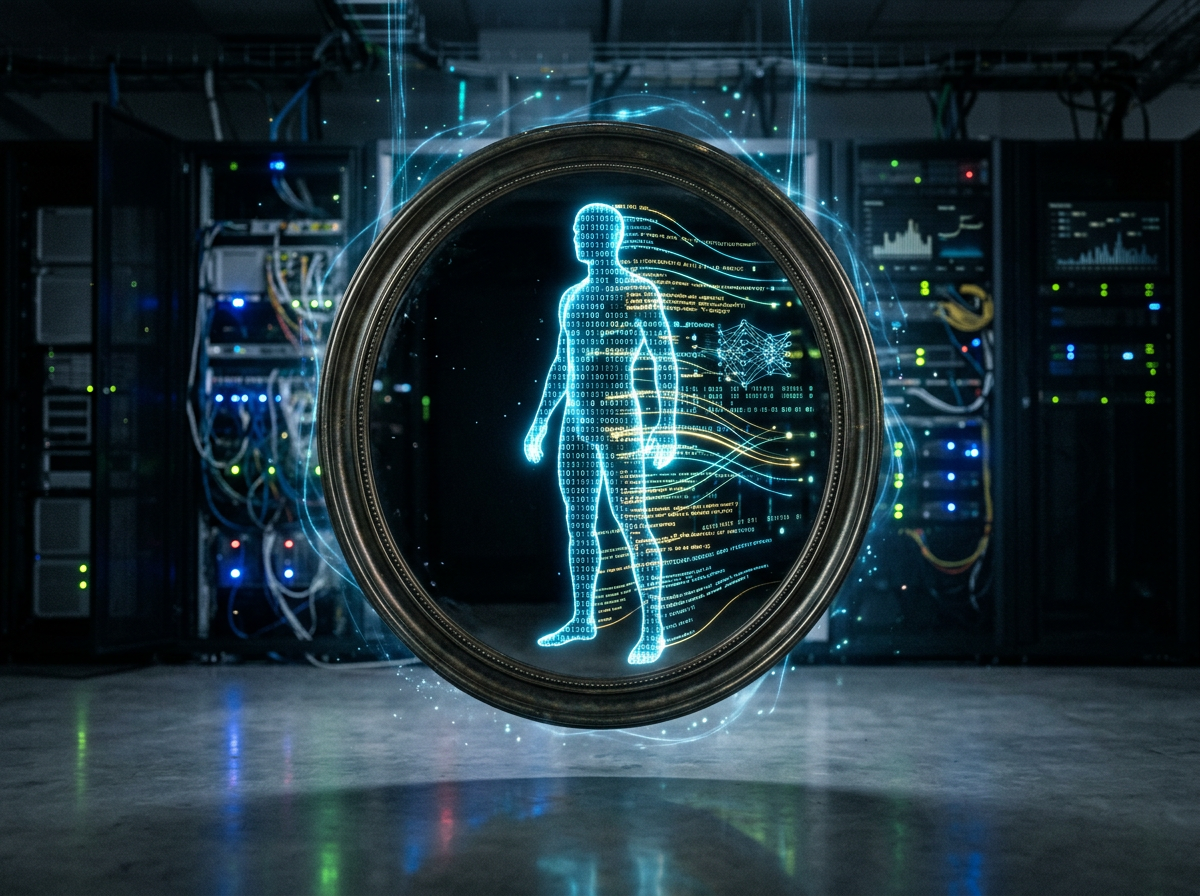
A Systems-Level Interpretation of Intelligence, Reflection, and Responsibility in the Age of AI
Meta Description
Artificial intelligence does not create human dysfunction—it exposes and amplifies it. This essay explores AI as a mirror of human coherence, revealing deeper implications for discernment, responsibility, and systems design.
Understanding the Process: The Semantic Mediation Model
Before exploring the ideas presented in this article in greater detail, it may be helpful to view the broader process through which information becomes understanding and understanding becomes meaningful action.
The map below illustrates how facts, data, and knowledge are transformed through synthesis, interpretation, contextualization, and relationship-mapping into coherent understanding and wise decision-making.
It also highlights the complementary roles of human judgment and AI-assisted analysis, as well as the importance of discernment, verification, and context in navigating an increasingly complex information environment.

The Semantic Mediation Model presents a framework for understanding how meaning emerges between information and action. Rather than treating knowledge as a collection of isolated facts, it emphasizes the relationships, patterns, and contexts that allow understanding to form and wisdom to develop.
→ Download Reference Map 005: The Semantic Mediation Model
A complimentary one-page guide illustrating how information becomes understanding through synthesis, interpretation, context, and discernment.
This article explores a related question: what happens when the systems mediating information begin reflecting the strengths, biases, assumptions, and contradictions already present within human knowledge itself?
Introduction: The Misdiagnosis of AI
Most discussions about artificial intelligence begin with the wrong premise.
They assume that AI is:
- a new form of intelligence
- a potential replacement for human cognition
- or an emerging existential threat
These framings, while not entirely incorrect, are incomplete.
They position AI as an external force acting upon humanity, rather than as a reflective system revealing what already exists within it.
This piece proposes a different interpretation:
Artificial intelligence is not primarily a creator of outcomes—it is an amplifier and mirror of human coherence or incoherence.
To understand AI accurately, we must stop asking what AI will become, and begin asking:
What does AI reveal about us?
AI Does Not Invent—It Reconstructs
At a functional level, modern AI systems do not “think” in the human sense.
They:
- process large-scale datasets
- detect statistical patterns
- generate outputs based on probability distributions
This aligns with the current technical understanding of large language models as systems that predict likely sequences based on prior data, rather than independently reasoning agents (Bender et al., 2021).
This has a critical implication:
AI cannot generate meaning that does not already exist within the human-generated corpus it was trained on.
It can recombine, accelerate, and simulate—but not originate from a vacuum.
Therefore, when AI produces:
- bias
- misinformation
- manipulation
- brilliance
- creativity-like outputs
…it is not introducing something new.
It is reflecting aggregated human input at scale.
The Mirror Effect: Amplification of Human Patterns
Historically, technologies have always reflected aspects of human behavior:
- The printing press amplified ideology
- Radio amplified propaganda
- Social media amplified identity and division
AI differs in one key way:
It reflects not just behavior—but cognition itself.
It mirrors:
- how we reason
- how we frame arguments
- how we prioritize information
- how we construct narratives
And because it operates at scale and speed, it does not simply reflect—it magnifies.
This is why AI systems have been shown to reproduce and even intensify societal biases present in their training data (Bender et al., 2021).
But bias is only the surface.
The deeper layer is this:
AI reveals recurring patterns, contradictions, and fragmentation within human knowledge systems.
Seen through the lens of the Semantic Mediation Model, AI does not merely transmit information; it participates in the interpretation and recombination of meaning, making hidden patterns within human systems more visible.
What Is Human Incoherence?
Incoherence is not ignorance.
It is fragmentation.
A system is incoherent when:
- its parts contradict each other
- its outputs are inconsistent
- its signals cannot be reliably interpreted
Applied to humans and societies, incoherence appears as:
- conflicting beliefs held simultaneously
- narratives detached from reality
- decision-making driven by emotion rather than discernment
- systems that cannot self-correct
AI does not fix this.
It renders it visible.
Synthetic Output, Real Consequences
As AI-generated content becomes indistinguishable from human-created material, a new condition emerges:
Synthetic reality
This includes:
- AI-generated text, images, music and video
- deepfakes and voice replication
- automated narratives at scale
The concern is not merely deception.
It is the collapse of default trust.
Research indicates that both the public and experts are increasingly concerned about AI’s role in misinformation, impersonation, and erosion of truth verification mechanisms (Pew Research Center, 2025).
In such an environment:
- truth is no longer externally guaranteed
- authority is no longer stable
- verification becomes an individual responsibility
AI accelerates this condition globally.
The Collapse of Passive Cognition
In pre-AI environments, most individuals could operate under passive cognition:
- information was consumed
- authority was assumed
- verification was outsourced
AI disrupts this model.
Because AI can generate:
- plausible falsehoods
- convincing arguments on both sides
- authoritative-sounding explanations
…it forces a shift:
From passive consumption → to active discernment
This aligns with the core principle in Sensemaking: The Skill We Weren’t Taught but Now Desperately Need, which prioritizes discernment over belief.
AI does not eliminate truth.
It removes the illusion that truth can be passively received.
Coherence as the Differentiator
If AI amplifies both signal and noise, then the differentiator is no longer access to information.
It is:
coherence
This dynamic is explored further in The Semantic Mediation Model, which illustrates how understanding emerges through the successful integration of information, context, interpretation, and discernment.
A coherent individual or system can:
- integrate multiple inputs without contradiction
- detect inconsistencies
- maintain alignment between perception, reasoning, and action
Incoherent systems cannot.
They fragment under pressure.
This is why AI does not uniformly empower all users.
AI can strengthen coherent systems and further destabilize already fragmented ones.
AI, Governance, and System Design
As AI systems become integrated into governance, coordination, finance, communication, and decision-making, the quality of underlying systems becomes increasingly important.
AI can improve:
- coordination,
- analysis,
- logistics,
- and information processing.
But poorly governed systems may also become:
- more fragile,
- more manipulative,
- or more detached from human accountability.
The challenge is therefore not only technological.
It is institutional and ethical.
The Deeper Layer: AI as Threshold
At a metaphysical level, AI represents a threshold condition.
Not because it is conscious.
But because it forces humanity to confront:
- authorship (who created this?)
- agency (who decided this?)
- responsibility (who is accountable?)
These are not technical questions.
They are ontological and ethical questions.
AI intensifies the challenge of maintaining discernment, responsibility, and human judgment within increasingly automated environments.
Conclusion: The Mirror Cannot Be Blamed
It is tempting to treat AI as:
- the problem
- the threat
- or the solution
But this misplaces responsibility.
AI does not create human incoherence.
It reveals it.
And in doing so, it removes the buffer that once allowed incoherence to persist unnoticed.
The implication is clear:
The future of AI is not determined by the system itself—but by the coherence of those who use it.
This is why the question is not:
- Will AI become dangerous?
But:
- Will humans become coherent enough to use it responsibly?
References
Bender, E. M., Gebru, T., McMillan-Major, A., & Margaret Mitchell. (2021). On the dangers of stochastic parrots: Can language models be too big? Proceedings of the 2021 ACM Conference on Fairness, Accountability, and Transparency.
Pew Research Center. (2025). Public and expert views on artificial intelligence.
Suggested Internal Crosslinks
- Synthetic Reality
- Signal vs Noise: How to Tell What’s Real in an Age of Information Overload
- How to Think Clearly in Times of Systemic Uncertainty
- Sensemaking: The Skill We Weren’t Taught but Now Desperately Need
- Understanding Human Systems: Behavior, Pressure, and Decision-Making
- Systems, Governance, and Organizational Design
Attribution
The Living Archive
Integrative Frameworks for Regenerative Civilization
© 2026 Gerald Daquila. All rights reserved.
Part of the Life.Understood. knowledge ecosystem and Stewardship Institute initiative.
This article is intended for educational, reflective, and civic inquiry purposes.
Readers are encouraged to engage critically, think independently, and explore related pathways throughout the archive.
Leave a Reply