
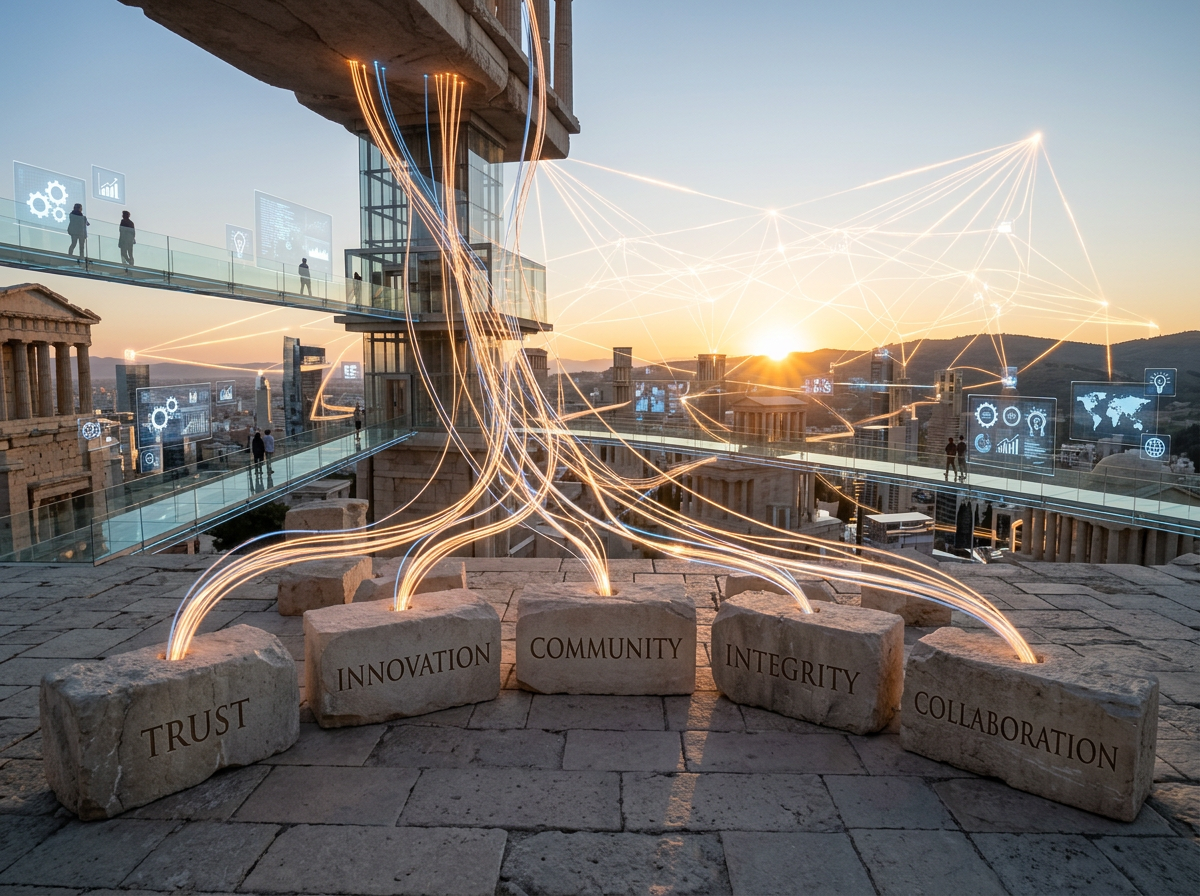
Twelve Lenses for Understanding Systems, Meaning, Governance, Intelligence, and Human Flourishing
Meta Description
Explore the 12 Cornerstone Hubs of the Living Archive: a framework for understanding governance, trust, complexity, AI, collective intelligence, meaning, stewardship, and the future of human flourishing.
The Living Archive contains over a thousand essays, frameworks, analyses, and explorations.
Yet beneath this growing body of work, certain themes appear again and again.
- Questions about trust.
- Questions about governance.
- Questions about meaning.
- Questions about intelligence.
- Questions about human development.
- Questions about how societies remain coherent while navigating change.
Over time, these recurring themes began to organize themselves into a smaller set of foundational lenses.
These lenses became the 12 Cornerstone Hubs.
- They are not categories.
- They are not disciplines.
- They are not ideological positions.
- They are ways of seeing.
Each Cornerstone represents a recurring pattern that appears across multiple domains of life, from personal development and community design to governance, economics, technology, education, and civilization itself.
Together, they form an interpretive framework for navigating complexity.
Why Cornerstones?
Most modern knowledge systems are organized around subjects.
- Economics.
- Politics.
- Psychology.
- Technology.
- Education.
While useful, these categories often separate ideas that are deeply connected in reality.
The Living Archive approaches understanding differently.
Rather than asking:
“Which subject does this belong to?”
it often asks:
“What larger pattern is this expressing?”
The Cornerstones were created to help reveal those larger patterns.
- They act as bridges between disciplines, helping readers recognize connections that might otherwise remain hidden.
- Each hub gathers essays, frameworks, analyses, and reference maps that explore a common underlying principle expressed across multiple domains.
The Twelve Cornerstones
Although each Cornerstone focuses on a distinct domain of inquiry, none exists in isolation.
The Living Archive approaches knowledge as an interconnected ecology in which governance, culture, intelligence, economics, technology, meaning, and human development continuously influence one another.
The map below illustrates this broader landscape and provides context for understanding how the twelve Cornerstones function as interconnected lenses within a larger system of relationships.

Figure 1. The Knowledge Ecology Map: Understanding the Relationships Between Knowledge, Culture, Governance, Technology, and Human Development
→ Download Reference Map 023: Knowledge Ecology
A systems-level visualization of how major domains of knowledge interact across governance, culture, technology, economics, learning, meaning, and collective development.
Rather than treating disciplines as isolated silos, the map illustrates the living relationships through which ideas influence, reinforce, and transform one another over time.
1. Beyond Bureaucracy
How institutions evolve beyond compliance, administration, and control toward adaptability, stewardship, and living systems.
Themes: Governance, institutions, organizational design, complexity, stewardship.
2. Trust Architecture
The invisible structures that enable cooperation, coordination, legitimacy, and collective resilience.
Themes: Trust, governance, social capital, cooperation, civic health.
3. Collective Nervous Systems
How societies sense, process, communicate, and respond to information.
Themes: Communication, networks, feedback loops, collective intelligence, resilience.
4. Living Between Worlds
Navigating periods of transition when old systems no longer function fully and new systems have not yet stabilized.
Themes: Transition, uncertainty, liminality, transformation, adaptation.
5. What Is Overflow?
Understanding the conditions that allow individuals, institutions, and societies to move beyond survival toward flourishing.
Themes: Abundance, coherence, stewardship, resilience, human flourishing.
6. Regenerative Economics
Economic systems designed to strengthen communities, ecosystems, and long-term well-being rather than merely increase extraction or consumption.
Themes: Regeneration, economics, sustainability, stewardship, prosperity.
7. Living Archives
Knowledge systems that evolve, adapt, learn, and remain useful across changing contexts.
Themes: Knowledge stewardship, memory systems, learning, archives, civilization.
8. Knowledge Stewardship in the AI Era
How humanity preserves wisdom, discernment, and meaning within increasingly intelligent information environments.
Themes: AI, knowledge, education, wisdom, governance.
9. AI as Mirror
Understanding artificial intelligence not merely as a technology, but as a reflection of human values, assumptions, strengths, and limitations.
Themes: AI, cognition, ethics, psychology, self-understanding.
10. Institutional Consciousness
The ways institutions develop identities, behaviors, incentives, blind spots, and forms of collective intelligence.
Themes: Governance, institutions, systems thinking, culture, psychology.
11. Coherence vs Truth
Exploring the relationship between factual accuracy, narrative stability, meaning, and social coordination.
Themes: Sensemaking, epistemology, information, culture, governance.
12. Civilizations Run on Stories
Why narratives, myths, symbols, and shared meaning systems shape collective behavior as much as material conditions.
Themes: Myth, identity, culture, governance, civilization.
How the Cornerstones Work Together
The Cornerstones are not intended to function as isolated knowledge domains.
Each intersects with multiple others, creating pathways through which ideas, frameworks, and questions continuously inform one another.
The Living Archive Atlas provides a broader view of these relationships, helping readers understand how the Cornerstones connect within the larger architecture of the archive and where additional pathways of exploration may emerge.

Figure 2. The Living Archive Atlas: A Navigational Overview of the Archive’s Major Hubs, Pathways, and Knowledge Domains
→ Download Reference Map 031: Living Archive Atlas
The atlas helps readers move between domains while maintaining awareness of the larger patterns linking governance, meaning, intelligence, stewardship, culture, and human flourishing.
Although each Cornerstone can be explored independently, they are designed to function as an interconnected system.
- Trust influences governance.
- Governance shapes institutions.
- Institutions influence information flows.
- Information flows affect collective intelligence.
- Collective intelligence shapes culture.
- Culture shapes stories.
- Stories influence identity.
- Identity affects cooperation.
- Cooperation influences prosperity.
- Prosperity creates the conditions for stewardship.
The Cornerstones are therefore best understood not as separate subjects but as interconnected dimensions of a larger living system.
Where to Begin
Readers may enter through any Cornerstone.
There is no required sequence.
However, many readers find the following pathways helpful:
Governance & Institutions
Meaning & Culture
Intelligence & Knowledge
Flourishing & Regeneration
The Purpose of the Cornerstones
The goal of the Cornerstones is not to provide definitive answers.
The goal is to improve orientation.
Orientation precedes understanding. Understanding precedes action.
In a world of accelerating complexity, understanding often depends less on accumulating information and more on recognizing patterns.
The Cornerstones provide a framework for seeing those patterns.
They invite readers to move beyond isolated topics and toward a more integrated understanding of systems, society, and human development.
Each hub is an ongoing exploration.
Together, they form one possible map for navigating the emerging landscape of the twenty-first century.
The Twelve Cornerstones
Explore the interconnected hubs that form the interpretive framework of the Living Archive.
- Trust Architecture
- Collective Nervous Systems
- Living Between Worlds
- What is Overflow?
- Institutional Consciousness
- Regenerative Economics
- Living Archives
- Knowledge Stewardship in the AI Era
- Beyond Bureaucracy
- AI as Mirror
- Coherence vs Truth
- Civilizations Run on Stories
Continue Exploring
- Foundation Map
- The Architecture of the Living Archive
- Living Archive Atlas
- Degree Pathways
- Subject Index
- Core Frameworks
- Canon Collections
Search the Living Archive
The Living Archive is designed to be explored through pathways, frameworks, and connected ideas. If you are looking for a specific concept, question, theme, or relationship, AI Search can help surface relevant articles, maps, hubs, and resources from across the archive.
Ask a question, explore a topic, or follow a thread of inquiry.
The Living Archive
The 12 Cornerstone Hubs
Foundational Domains of Inquiry Across the Living Archive
© 2026 Gerald Daquila. All rights reserved.
Part of the Life.Understood. knowledge ecosystem and Stewardship Institute initiative.
Life.Understood. • www.geralddaquila.com