
Structured Stewardship Formation Through Reflective Case Learning
Meta Description
Explore the Stewardship Institute’s twelve Learning Arcs—guided pathways that cultivate discernment through interconnected case studies. Each Arc develops practical judgment across recurring patterns of leadership, governance, and complex human systems.
Leadership rarely unfolds through isolated events.
Conflict returns in different forms. Questions of governance reappear across organizations.
Growth introduces recurring structural pressures.
Succession, trust, authority, and change emerge again and again throughout the life of teams, communities, and institutions.
The Learning Arcs were created to help readers recognize these recurring stewardship patterns before they become crises.
Rather than presenting individual case studies in isolation, each Learning Arc guides readers through a carefully curated sequence of interconnected situations that reveal how structural patterns emerge, evolve, and interact across complex human systems.
The goal is not simply to understand stewardship.
It is to cultivate the discernment required to practice it.
Constitutional Responsibility
Governing Question
How do we cultivate the judgment required to recognize recurring stewardship patterns across diverse human situations?
Institutional Responsibility
The Learning Arcs provide the Stewardship Institute’s structured developmental pathway for reflective case learning.
Their responsibility is to organize interconnected case studies into coherent educational journeys that strengthen systems awareness, practical judgment, and pattern recognition across leadership, governance, and institutional life.
While individual case studies illuminate particular situations, the Learning Arcs develop the capacity to recognize recurring stewardship patterns wherever they appear.
Why the Learning Arcs Exist
Real stewardship develops through repeated encounters with recurring patterns rather than through isolated examples.
A single case study may illuminate one leadership dilemma.
A Learning Arc reveals how the same underlying pattern reappears across different organizations, communities, institutions, and contexts.
This progression enables readers to move beyond solving individual problems toward recognizing the deeper structures that generate them.
What the Learning Arcs Develop
Through sustained engagement with the Learning Arcs, readers cultivate the ability to:
- Recognize recurring stewardship patterns before they escalate.
- Diagnose structural challenges with greater clarity.
- Make thoughtful decisions under uncertainty and constraint.
- Understand the relationship between individual behavior and broader system outcomes.
- Intervene in ways that strengthen rather than destabilize living systems.
The emphasis is not simply on acquiring knowledge.
It is on cultivating practical judgment within complex human environments.
Learning Arcs and the Institute Case Library
The Stewardship Institute’s Case-Based Learning branch offers two complementary ways to engage with reflective case learning.
The Institute Case Library functions as a reference collection, allowing readers to explore individual case studies according to their immediate questions, leadership challenges, or areas of interest.
The Learning Arcs provide structured developmental pathways.
Rather than presenting isolated situations, each Arc gathers related case studies around a recurring stewardship pattern—such as conflict, governance, trust, growth, succession, or institutional complexity—allowing readers to deepen their understanding through deliberate progression.
Both resources draw from the same educational ecosystem while serving distinct learning purposes.
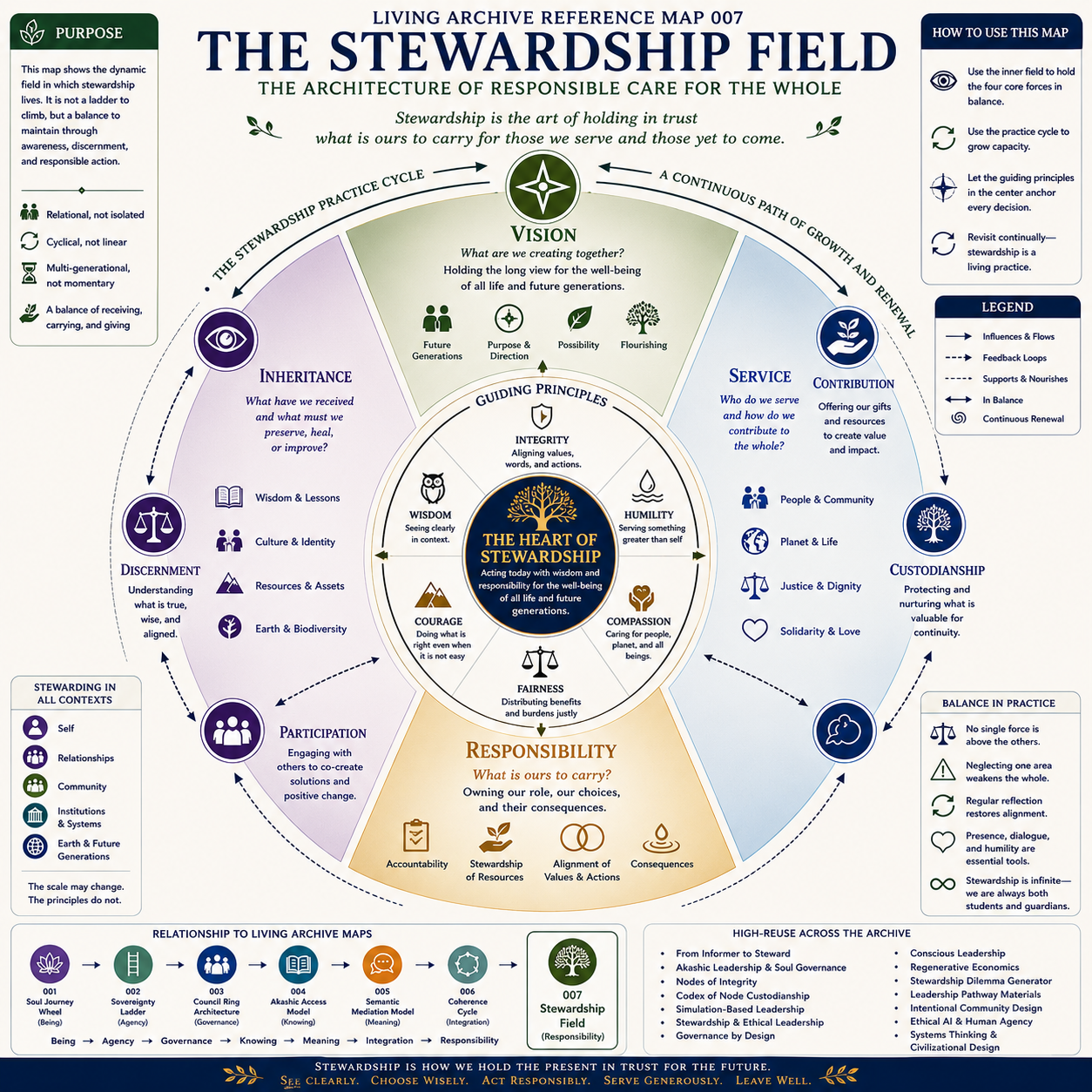
The Stewardship Field
Before entering the individual Learning Arcs, it can be helpful to understand the broader landscape they collectively cultivate.
The Stewardship Field presents stewardship as a dynamic balance of vision, responsibility, service, inheritance, awareness, discernment, participation, contribution, and custodianship.
While each Learning Arc focuses on a particular structural challenge, together they develop the wider capacities required for responsible participation within complex human systems.

→ Download Reference Map 007: The Stewardship Field
How the Learning Arcs Work
Each Learning Arc includes:
- Five interconnected case studies
- A structured developmental progression
- Integration guidance
- Applied stewardship tools and protocols
Readers are not simply progressing through information.
They are progressing through increasingly sophisticated ways of perceiving recurring stewardship patterns.
How to Engage
The Learning Arcs are designed to be experienced deliberately rather than completed quickly.
Begin with the stewardship pattern most closely aligned with your present questions or responsibilities.
Work through the complete Arc before moving to another.
As similar situations emerge in new contexts, return to the relevant Arc and observe how your understanding continues to deepen through repeated engagement.
The Twelve Learning Arcs
I. Conflict & Trust Breakdown
From Avoidance to Alignment
Work with tension directly.
Rebuild trust without suppressing disagreement.
→ Enter Arc
II. Decision-Making & Alignment
From Gridlock to Clarity
Design decision processes that hold under pressure.
→ Enter Arc
III. Growth & Structural Stress
From Expansion to Balance
Adapt systems as scale increases without loss of coherence.
→ Enter Arc
IV. Authority & Legitimacy
From Power Struggles to Trusted Leadership
Clarify authority so leadership is recognized—not imposed.
→ Enter Arc
V. Founder Transition
From Dependency to Continuity
Shift from personality-driven leadership to system continuity.
→ Enter Arc
VI. Culture & Integrity
From Drift to Alignment
Align values, behavior, and structure across the system.
→ Enter Arc
VII. Psychological Dynamics
From Projection to Clarity
See how internal patterns shape external outcomes.
→ Enter Arc
VIII. Governance Design
From Ambiguity to Structure
Build governance systems that function under real conditions.
→ Enter Arc
IX. Commons & Resource Stewardship
From Tension to Fair Contribution
Design sustainable systems for shared resources.
→ Enter Arc
X. Legacy & Succession
From Inheritance to Stewardship
Prepare systems to outlast individual leadership.
→ Enter Arc
XI. Change & Resistance
From Pushback to Transformation
Introduce change without fragmenting the system.
→ Enter Arc
XII. Complexity & Systems Thinking
From Blind Spots to System Awareness
Work effectively within complex, interdependent systems.
→ Enter Arc
Relationship to the Institute Case Library
The Learning Arcs form the structured developmental pathway within the Stewardship Institute’s Case-Based Learning branch.
The Institute Case Library provides a rich collection of individual reflective case studies.
The Leadership Challenge Navigator helps readers identify the stewardship patterns most relevant to their present circumstances.
Access the Institute Case Library explains the available pathways into the collection.
The Learning Arcs extend this foundation by guiding readers through carefully sequenced developmental journeys that cultivate enduring judgment rather than isolated insight.
Together these resources transform reflective case learning from a library of individual publications into an integrated educational architecture for stewardship formation.
Continue Exploring
Discover the educational philosophy behind reflective case learning and the constitutional purpose of the collection.
Leadership Challenge Navigator
Identify the stewardship patterns most closely aligned with your current leadership, governance, or systems questions.
Access the Institute Case Library
Choose the access pathway that best supports your present stage of learning.
Continue into implementation resources that extend reflective insight into organizational and institutional practice.
Stewardship Institute
The Learning Arcs provide the Stewardship Institute’s structured developmental pathway for reflective case learning. By organizing interconnected case studies into guided educational journeys, they cultivate the judgment, systems awareness, and pattern recognition required for responsible stewardship across leadership, governance, and complex human systems.
©2025-2026 The Living Archive. All rights reserved.