
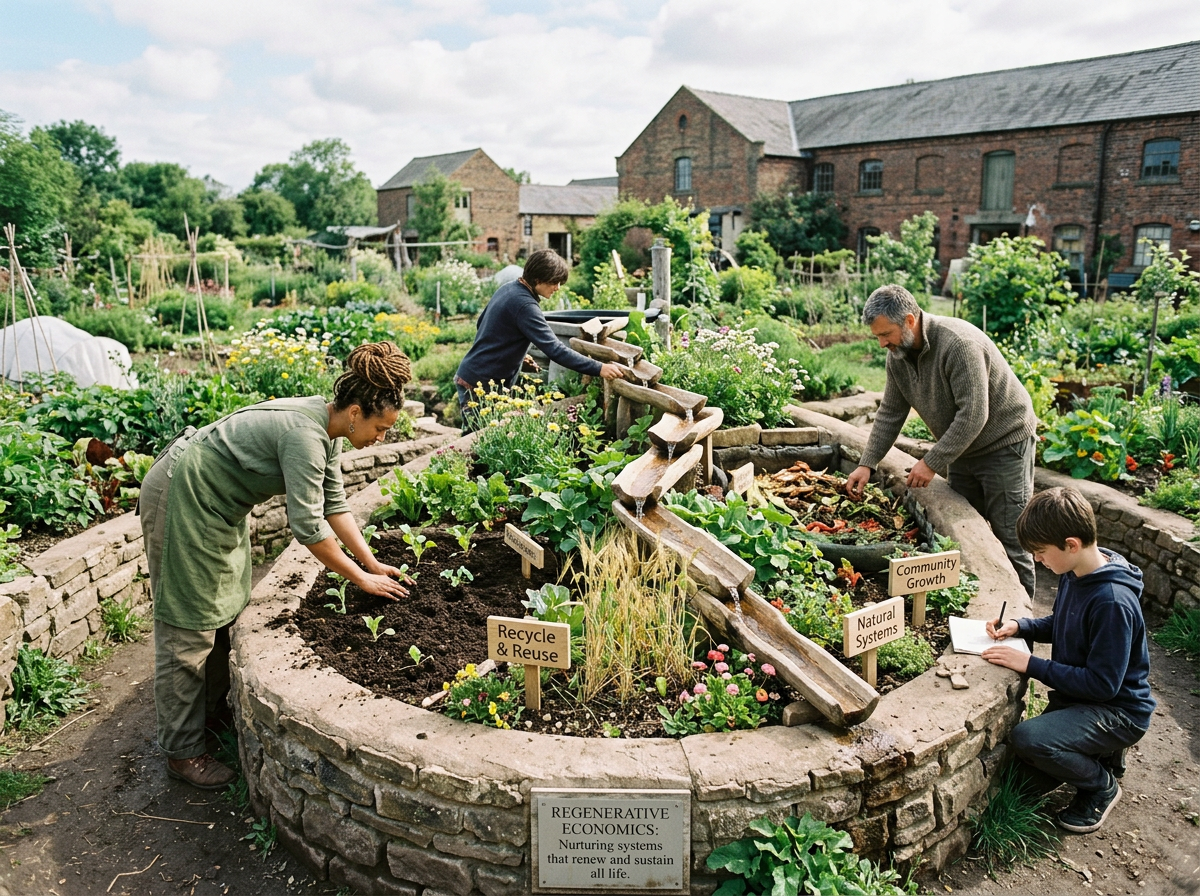
How Value Flows Through Living Systems
Meta Description
Modern economies excel at measuring production and consumption, yet often struggle to account for resilience, trust, stewardship, and long-term flourishing. This cornerstone explores regenerative economics as the study of how living systems create, circulate, preserve, and renew value across individuals, communities, institutions, and civilizations.
Invocation
“The economy is a wholly owned subsidiary of the environment, not the reverse.”
— Herman Daly
Throughout history, human beings have depended upon systems that transform resources into flourishing.
- Food becomes nourishment.
- Knowledge becomes capability.
- Trust becomes cooperation.
- Land becomes habitat.
- Communities become cultures.
Civilizations become vehicles through which human potential can unfold.
These transformations are often described in economic terms.
- Production.
- Exchange.
- Growth.
- Wealth.
- Markets.
Yet beneath these familiar concepts lies a deeper reality.
Every enduring system depends upon its capacity to create value without destroying the conditions that make value creation possible.
- Forests regenerate nutrients.
- Watersheds regenerate water.
- Healthy communities regenerate trust.
- Living cultures regenerate meaning.
- Adaptive institutions regenerate capability.
- When these regenerative processes remain intact, systems flourish.
- When they weaken, decline begins long before collapse becomes visible.
This principle applies as much to economies as it does to ecosystems.
Yet modern economic conversations often focus on outputs while paying less attention to renewal.
- We measure production more easily than resilience.
- We track transactions more readily than trust.
- We monitor growth more closely than regeneration.
The result is a recurring pattern.
Systems appear successful while quietly consuming the foundations upon which their success depends.
This cornerstone explores a different perspective.
- Not economics as the management of money.
- Not economics as an ideological debate.
- But economics as the study of how value moves through living systems.
The question is not merely how wealth is created.
The question is whether the conditions that create wealth remain capable of renewal.
The Central Question
How do living systems create, circulate, and renew value?
This question extends far beyond finance.
- It applies to forests and watersheds.
- Families and communities.
- Institutions and organizations.
- Nations and civilizations.
Every living system depends upon flows.
- Resources move.
- Energy moves.
- Information moves.
- Relationships evolve.
- Value circulates.
When these flows remain healthy, systems tend to grow in capability.
When they become blocked, distorted, or depleted, decline begins.
The challenge is that value is often easier to consume than regenerate.
- A forest can be harvested faster than it regrows.
- Trust can be depleted faster than it is rebuilt.
- Institutions can exhaust legitimacy faster than they restore it.
- Knowledge can be fragmented faster than it is integrated.
- Short-term gains frequently conceal long-term losses.
- This is why many societies repeatedly encounter the same dilemma.
Success in one period creates fragility in the next.
The very processes that generate prosperity begin undermining the foundations that made prosperity possible.
The deeper challenge is therefore not simply production.
It is renewal.
- How can systems create value while preserving the conditions that allow value creation to continue?
- How can communities flourish without exhausting their social foundations?
- How can institutions grow without becoming brittle?
- How can economies generate prosperity without consuming the future?
These questions sit at the heart of regenerative economics.
The Core Thesis
Every enduring system depends upon regenerative flows.
Value is not created once and permanently secured.
It must be continually renewed.
Healthy economies function less like machines and more like ecosystems.
- They depend upon relationships rather than isolated transactions.
- They depend upon circulation rather than accumulation alone.
- They depend upon renewal rather than extraction.
The long-term health of any economy depends not merely upon what it produces, but upon whether it replenishes the conditions that make production possible.
These conditions extend beyond material resources.
- They include trust.
- Knowledge.
- Institutional legitimacy.
- Social cohesion.
- Ecological health.
- Human capability.
- Meaning.
When these foundations remain strong, prosperity becomes resilient.
When they deteriorate, apparent wealth often masks hidden fragility.
The central challenge of economics is therefore not maximizing extraction.
- It is sustaining regeneration.
- A civilization flourishes not because it consumes the most value.
- It flourishes because it renews the sources from which value arises.
Why This Cornerstone Exists
Many of the archive’s recurring themes converge around a common concern.
- Stewardship.
- Trust.
- Governance.
- Knowledge.
- Human flourishing.
- Collective intelligence.
- Institutional resilience.
At first glance, these appear to belong to different conversations.
Yet each ultimately concerns value.
- How value is created.
- How value circulates.
- How value is preserved.
- And whether value remains capable of renewal.
Modern economic discourse often narrows these questions to finance, markets, and policy.
These subjects matter.
But they sit within a larger system.
Economics is ultimately about the conditions that allow life to flourish.
This cornerstone exists because many of the challenges facing modern societies can be understood as failures of regeneration.
- Trust is consumed faster than it is rebuilt.
- Attention is extracted faster than it is restored.
- Communities weaken faster than they are renewed.
- Natural systems are depleted faster than they recover.
- The result is a growing gap between visible prosperity and underlying resilience.
Regenerative economics explores how that gap emerges.
And how it might be closed.
Value
What Wealth Actually Represents
Most economic systems measure value through money.
Money matters.
Yet money is ultimately a representation rather than the thing itself.
- A thriving community possesses value.
- A healthy ecosystem possesses value.
- A trusted institution possesses value.
- A skilled population possesses value.
- None can be fully reduced to financial metrics.
This distinction becomes increasingly important as societies grow more complex.
What creates flourishing is rarely a single resource.
- Human beings depend upon multiple forms of capital simultaneously.
- Natural capital provides ecological foundations.
- Social capital provides trust and cooperation.
- Knowledge capital provides learning and innovation.
- Institutional capital provides coordination.
- Financial capital helps facilitate exchange.
Each contributes to the larger capacity of a system to thrive.
This suggests a broader understanding of wealth.
Wealth is not merely accumulated assets.
It is accumulated capability.
- The ability to generate future flourishing.
- A healthy forest is wealthy because it continually produces life.
- A healthy community is wealthy because it continually produces trust.
- A healthy institution is wealthy because it continually produces coordination and capability.
The most enduring forms of wealth generate conditions from which further value can emerge.
They create capacity rather than merely storing resources.
The Shadow of Value
One of the recurring failures of economic systems is the tendency to confuse measurement with reality.
- Price becomes mistaken for worth.
- Financial value becomes mistaken for human value.
- What can be measured receives attention.
- What cannot be easily measured often becomes invisible.
- The result is not merely economic distortion.
- It is perceptual distortion.
A society that consistently mistakes price for value eventually struggles to recognize what truly sustains flourishing.
Related Essays
- Conscious Capital: Redefining Wealth and Impact
- The Psychology of Enough
- Economic Sovereignty for Communities
- Akashic Ledger of Generational Wealth
- Beyond the Clock: Reimagining Work-Life Balance as a Triune Path to Eudaimonic Flourishing
Reference Maps

→ Human Needs and Flourishing Map 026

→ Wealth Stewardship Cycle Map 009
Exchange
How Value Moves
Value rarely emerges in isolation.
Human beings survive and flourish through exchange.
- Knowledge is shared.
- Resources are traded.
- Services are provided.
- Trust is extended.
- Responsibilities are distributed.
Every society depends upon countless acts of reciprocity occurring across scales.
This is why exchange occupies such a central place within economic systems.
Exchange allows specialization.
- It allows cooperation.
- It allows individuals and communities to accomplish together what would be impossible alone.
- At its best, exchange creates mutual benefit.
Value flows between participants in ways that increase capability for everyone involved.
- A farmer produces food.
- A teacher develops understanding.
- An engineer creates infrastructure.
- A healer restores health.
Each contributes something that others need.
Exchange becomes the mechanism through which diverse forms of value circulate throughout the larger system.
Yet exchange is never merely transactional.
- Beneath every transaction lies a relationship.
- The healthier the relationship, the lower the friction.
- The greater the trust, the lower the cost of coordination.
This principle appears repeatedly throughout human history.
- Communities with strong social trust often require fewer controls.
- Organizations with high trust frequently adapt more quickly.
- Societies with healthy relational foundations often demonstrate greater resilience during periods of uncertainty.
Trust functions as an invisible economic asset.
- It reduces complexity.
- Accelerates cooperation.
- Expands possibility.
This is one reason economic systems cannot be understood solely through money.
- Money facilitates exchange.
- Trust makes exchange sustainable.
When trust weakens, systems compensate through contracts, monitoring, enforcement, bureaucracy, and control.
- These mechanisms may be necessary under certain conditions.
- Yet they often represent substitutes for relational health rather than sources of it.
- The result is a useful distinction.
Healthy economies depend not merely upon transactions.
- They depend upon relationships capable of supporting ongoing exchange.
- Value moves most effectively when trust remains intact.
Exchange as Circulation
Living systems teach an important lesson.
Health depends upon circulation.
- Water flows.
- Nutrients circulate.
- Energy moves.
- When circulation stops, vitality declines.
Economic systems operate similarly.
Value that circulates supports vitality.
- Value that becomes excessively concentrated often generates fragility.
- This does not imply that accumulation is inherently problematic.
- Resources sometimes need to be stored.
- Capital sometimes needs to be concentrated for large-scale projects.
The challenge emerges when circulation weakens.
- When resources stop moving.
- When opportunity becomes restricted.
- When exchange becomes increasingly one-directional.
- At that point, the system begins losing adaptive capacity.
The health of an economy therefore depends not simply on how much value exists.
It depends upon how effectively value moves.
A thriving community is often characterized by dense networks of exchange.
- Knowledge circulates.
- Support circulates.
- Opportunity circulates.
- Trust circulates.
- The result is not merely economic activity.
- It is resilience.
The Shadow of Exchange
Exchange can generate mutual benefit.
It can also generate extraction.
- Relationships can become transactional.
- Reciprocity can become exploitation.
- Value can flow disproportionately toward those already possessing advantage.
The challenge is therefore not exchange itself.
It is the quality of the relationships shaping exchange.
Healthy exchange expands capability for multiple participants.
- Unhealthy exchange transfers value while degrading the conditions that made the exchange possible.
The distinction matters.
One creates resilience.
- The other creates dependency.
One strengthens the larger system.
- The other gradually weakens it.
Related Essays
- Sacred Exchange in Times of Crisis
- Ethics of Soul Exchange — Overflow vs. Extraction
- Fear-Based Systems vs Trust-Based Systems: Two Civilizational Architectures
- Building Trust-Centered Organizations
- From Hierarchies to Stewardship: The Rise of Distributed Human Systems
Reference Maps

→ Value Creation and Exchange Ecosystem Map 021

→ Sacred Exchange and Reciprocity Map 013
Extraction
When Economies Consume Their Foundations
Every system consumes resources.
- No organism survives without drawing energy from its environment.
- No institution functions without resources.
- No civilization develops without transforming the materials available to it.
The challenge is not consumption itself.
The challenge is whether consumption exceeds renewal.
Extraction occurs when systems remove value faster than value can be regenerated.
- At first, this process often appears successful.
- Outputs increase.
- Growth accelerates.
- Short-term gains become visible.
- The underlying costs remain largely hidden.
- This is what makes extraction so difficult to recognize.
The damage frequently appears long after the benefits have been enjoyed.
- A forest may continue producing timber for years while ecological health declines beneath the surface.
- An institution may appear efficient while exhausting the people who sustain it.
- A society may experience economic growth while gradually weakening the trust, cohesion, and resilience upon which long-term prosperity depends.
The visible indicators remain positive.
The foundations quietly deteriorate.
This pattern appears repeatedly throughout history.
Civilizations rarely collapse because they suddenly run out of resources.
More often they lose the regenerative capacities that once sustained them.
- Natural systems become depleted.
- Institutional legitimacy erodes.
- Social trust weakens.
- Knowledge fragments.
- Adaptive capacity declines.
- The symptoms emerge long after the causes begin.
This dynamic helps explain why apparent prosperity can coexist with growing fragility.
- Economic indicators may improve.
- Living systems may simultaneously weaken.
The distinction is critical.
Growth and health are not always the same thing.
A system can expand while becoming increasingly vulnerable.
Extraction Beyond Resources
Extraction is often associated with environmental degradation.
The concept extends much further.
- Trust can be extracted.
- Attention can be extracted.
- Communities can be extracted.
Institutions can extract legitimacy from past accomplishments while failing to renew current performance.
Organizations can extract energy from employees without investing in long-term capability.
Information systems can extract attention without contributing understanding.
These forms of depletion are frequently more difficult to measure than material resource extraction.
Yet their consequences can be equally significant.
- A society that depletes trust becomes harder to govern.
- A community that depletes belonging becomes harder to sustain.
- An institution that depletes credibility becomes harder to lead.
- The principle remains consistent.
- Systems weaken when consumption persistently exceeds renewal.
The Illusion of Success
One of the defining features of extraction is its ability to disguise itself as success.
- The indicators look positive.
- The balance sheet improves.
- The outputs increase.
- The deeper costs remain hidden.
This is why regenerative economics places such importance on long-term feedback.
Short-term outcomes rarely reveal the full condition of a system.
Only over time does the distinction between extraction and regeneration become visible.
The question is not whether value is being produced.
The question is whether the conditions that produce value are becoming stronger or weaker.
The Shadow of Extraction
Extraction is not always malicious.
- It often emerges from incentives.
- Pressure.
- Urgency.
- Short time horizons.
Systems optimized for immediate results frequently consume future capacity without recognizing the trade-off.
The challenge is therefore not simply identifying bad actors.
It is recognizing patterns.
- Patterns through which success quietly becomes depletion.
- Patterns through which growth becomes fragility.
- Patterns through which prosperity consumes its own foundations.
- Recognizing those patterns is the first step toward regeneration.
Related Essays
- Attention Stewardship in the Digital Age
- Beyond Bureaucracy: Why Industrial Governance Systems Are Failing Human Complexity
- Governance Failure Patterns
- Agentic Stewardship: Why the New Earth is a Cognitive Operating System, Not a Financial Miracle
- Global Economic Reform Explained
Reference Maps

→ Resilience and Regeneration Cycle Map 017

→ Systems Change and Leverage Points Map 020
Regeneration
How Living Systems Sustain Themselves
If extraction asks how value is consumed, regeneration asks how value is renewed.
This distinction sits at the heart of the cornerstone.
Most economic systems are designed to increase production.
Far fewer are designed to strengthen the conditions that make production possible.
Yet every living system depends upon regeneration.
A forest does not survive because it produces.
It survives because it continually renews the conditions that allow production to continue.
- Nutrients cycle through the soil.
- Water moves through watersheds.
- Diversity strengthens resilience.
- Feedback supports adaptation.
- Waste from one process becomes input for another.
- The system remains alive because renewal is built into its operation.
Human systems face a similar challenge.
- Communities require the renewal of trust.
- Institutions require the renewal of legitimacy.
- Organizations require the renewal of capability.
- Civilizations require the renewal of meaning.
- Economies require the renewal of the social, ecological, and cultural foundations upon which prosperity depends.
When renewal falls behind consumption, decline begins.
When renewal exceeds consumption, resilience grows.
This principle provides a different lens through which to evaluate success.
Rather than asking only how much value a system produces, regenerative economics asks whether the system leaves its foundations stronger than before.
- Does the community become more capable?
- Does trust deepen?
- Does knowledge accumulate?
- Does ecological health improve?
- Does adaptive capacity increase?
These questions reveal forms of wealth that conventional economic metrics often overlook.
The health of a system depends not merely on its outputs but on its capacity to sustain future flourishing.
Regenerative Feedback Loops
Regeneration is not a single activity.
It is a pattern.
Living systems continually learn from consequences.
- They adapt to changing conditions.
- They redistribute resources where needed.
- They maintain relationships that support resilience.
- These processes occur through feedback.
Healthy feedback allows systems to recognize deterioration before collapse occurs.
- It allows correction before failure becomes catastrophic.
- It allows learning to accumulate.
This principle applies equally to organizations and civilizations.
- A company that learns from mistakes becomes more capable over time.
- A community that resolves conflict effectively becomes more resilient.
- A society that responds constructively to emerging challenges strengthens its long-term adaptability.
The opposite is equally true.
When feedback weakens, systems become disconnected from reality.
- Problems accumulate beneath the surface.
- Adaptation slows.
- Fragility grows.
The eventual crisis often appears sudden even though the underlying causes developed gradually over many years.
Regeneration therefore depends upon awareness.
- Systems cannot renew what they cannot perceive.
This insight connects regenerative economics directly to Collective Nervous Systems, Living Archives, and Institutional Consciousness.
Renewal begins with awareness.
Regenerative Organizations
Most organizations devote significant attention to performance.
Far fewer devote equal attention to renewal.
Yet performance without renewal is ultimately unsustainable.
An organization may achieve impressive short-term results while exhausting the people responsible for those results.
- It may expand rapidly while weakening its culture.
- It may increase efficiency while reducing adaptability.
- These dynamics often remain invisible until capability begins to decline.
Regenerative organizations recognize that human beings are not interchangeable components within a machine.
Capability emerges through learning.
- Trust.
- Purpose.
- Relationships.
Healthy organizations invest in these foundations because they understand that long-term performance depends upon them.
The question shifts from:
“How much can we extract from the system?”
to:
“How can the system become more capable over time?”
This shift changes leadership.
- Governance.
- Incentives.
- Decision-making.
- The focus moves from consumption toward renewal.
Regenerative Communities
The same principle applies at the level of community.
Strong communities are not merely collections of individuals pursuing private interests.
- They are networks of reciprocity.
- People contribute.
- People receive support.
- Knowledge circulates.
- Trust accumulates.
- Belonging deepens.
These processes create forms of wealth that rarely appear in conventional economic accounting.
Yet they often determine whether communities remain resilient during periods of disruption.
When hardship emerges, communities with strong relational foundations tend to adapt more effectively.
- The resources available to them extend beyond finances.
- They possess social capital.
- Collective memory.
- Shared responsibility.
- Mutual support.
These forms of wealth are regenerative because they grow through use rather than depletion.
- Trust often strengthens when exercised.
- Knowledge expands when shared.
- Relationships deepen through participation.
- The result is a positive feedback loop.
The community becomes more capable because people invest in one another.
Regenerative Civilizations
At the largest scale, regeneration becomes a civilizational challenge.
How does a society renew the conditions that support flourishing across generations?
This question cannot be answered through economics alone.
- It requires governance.
- Education.
- Culture.
- Stewardship.
- Meaning.
Civilizations remain healthy when they continually renew the capacities that allow adaptation.
- Knowledge must remain accessible.
- Institutions must remain responsive.
- Communities must remain connected.
- Ecological systems must remain viable.
Future generations must inherit sufficient capacity to navigate the challenges they will face.
- This is why regenerative economics ultimately extends beyond finance.
- It concerns the long-term vitality of the systems upon which civilization depends.
The challenge is not simply creating prosperity.
It is creating prosperity that remains capable of renewal.
The Shadow of Regeneration
- Regeneration can be misunderstood.
- Some people treat it as a return to an idealized past.
Others imagine that regenerative systems eliminate trade-offs, conflict, or scarcity.
Neither assumption is accurate.
Living systems remain dynamic.
- They face constraints.
- They encounter disruption.
- They require continual adaptation.
- Regeneration does not eliminate difficulty.
It increases the capacity to respond to difficulty without consuming the foundations of future flourishing.
- The goal is not perfection.
- The goal is resilience.
- Not permanence.
- But the ability to renew.
Related Essays
- Codex of Regenerative Economies
- Babaylan Economics: Resource Stewardship Through the Motherline
- Beyond the Peso: Why Pre-colonial Philippine Economics is the Blueprint for Modern Resilience
- Elemental Intelligence and Earth Stewardship
- Economic Sovereignty for Communities
Reference Maps

→ Adaptive Systems Map 024

→ Resilience and Regeneration Cycle Map 017
Stewardship
The Responsibility of Renewal
Regeneration does not occur automatically.
Every system eventually confronts a stewardship question.
- Who is responsible for maintaining the conditions that allow value to emerge?
- Who protects long-term capacity when short-term incentives dominate?
- Who preserves resources, relationships, knowledge, and trust for those who come later?
These questions reveal why stewardship sits at the center of regenerative economics.
- A steward does not simply manage assets.
- A steward protects generative capacity.
The distinction matters.
Management often focuses on performance.
Stewardship focuses on continuity.
Management asks how resources can be utilized effectively.
Stewardship asks whether the sources of value remain healthy enough to continue producing value in the future.
This perspective changes how success is understood.
The steward evaluates decisions across longer time horizons.
Consequences extending beyond immediate outcomes become visible.
- The impact on future generations becomes relevant.
- The health of relationships becomes economically significant.
- The preservation of trust becomes economically significant.
- The maintenance of ecological systems becomes economically significant.
Stewardship widens the frame.
The question is no longer:
“What can be gained?”
It becomes:
“What must be renewed?”
This question appears repeatedly throughout the archive.
- It appears in governance.
- In leadership.
- In knowledge stewardship.
- In institutional design.
- In community building.
And it appears here because economics ultimately concerns the conditions that support flourishing.
The steward understands that every form of wealth carries responsibility.
- Natural wealth.
- Social wealth.
- Knowledge wealth.
- Institutional wealth.
- Financial wealth.
Each must be maintained if it is to remain productive.
The challenge of the twenty-first century may therefore be less about creating new forms of wealth than about learning how to steward the wealth already available.
- Humanity possesses extraordinary resources.
- Extraordinary knowledge.
- Extraordinary technological capability.
The deeper question is whether these capacities can be directed toward renewal rather than depletion.
Stewardship exists to help answer that question.
Related Essays
- Stewardship vs Control
- Stewardship Decision-Making Framework
- Codex of Overflow Stewardship
- AI vs Human Stewardship: Why Conscious Guidance Matters More Than Ever
- Curriculum for Planetary Stewardship
Reference Maps

→ Stewardship Field Map 007

→ Stewardship Maturity Ladder Map 022
Wealth
Beyond Accumulation
Few ideas exert greater influence over modern economic thinking than wealth.
Yet few ideas are more poorly understood.
For many people, wealth is synonymous with accumulation.
- More assets.
- More resources.
- More possessions.
- More financial security.
These aspirations are understandable.
- Material stability matters.
- Economic security matters.
- The ability to meet one’s needs matters.
The challenge emerges when accumulation becomes detached from purpose.
At that point, wealth risks becoming an end rather than a means.
The deeper question is not whether wealth matters.
The deeper question is what wealth is for.
Throughout history, societies have answered this question differently.
- Some viewed wealth primarily as power.
- Others viewed it as status.
- Others viewed it as security.
- Still others viewed it as responsibility.
These differences shape how economic systems evolve.
A culture that understands wealth primarily as accumulation often organizes itself differently from a culture that understands wealth as stewardship.
- One emphasizes ownership.
- The other emphasizes responsibility.
- One focuses on possession.
- The other focuses on continuity.
Regenerative economics begins from a broader understanding.
- Wealth is not merely the possession of resources.
- It is the capacity to generate flourishing across time.
This definition changes the conversation.
- A healthy watershed is wealthy because it continues producing life.
- A resilient community is wealthy because it continues generating trust and cooperation.
- A capable institution is wealthy because it continues supporting collective action.
- A civilization is wealthy because it possesses the resources, knowledge, relationships, and adaptive capacity necessary to navigate uncertainty.
Financial capital remains important within this framework.
- But it becomes one form of wealth among many.
- Not the sole measure of prosperity.
The significance of wealth therefore lies not only in what exists today.
It lies in what remains possible tomorrow.
Enough
One of the most neglected questions in economics concerns sufficiency.
How much is enough?
Modern systems often assume that more is inherently better.
- More growth.
- More consumption.
- More accumulation.
Yet human experience suggests a more complicated reality.
Beyond a certain threshold, increasing quantity does not necessarily produce increasing flourishing.
- People can become wealthier while remaining dissatisfied.
- Organizations can become larger while becoming less adaptive.
- Societies can become more productive while experiencing declining trust and meaning.
This observation does not imply that wealth is unimportant.
It suggests that wealth must be understood within a larger context.
- The purpose of prosperity is not accumulation alone.
- The purpose of prosperity is the expansion of human possibility.
A healthy economic system therefore helps individuals and communities move beyond scarcity without becoming trapped in endless acquisition.
It creates the conditions for contribution.
- Creativity.
- Learning.
- Stewardship.
Meaningful participation in collective life.
This is where wealth begins to reconnect with flourishing.
Wealth Across Generations
The most important economic questions often emerge across time.
- What will future generations inherit?
- Will they possess greater capability than those who came before?
- Will they inherit healthy institutions?
- Healthy ecosystems?
- Healthy communities?
Or will they inherit depleted foundations disguised as prosperity?
This perspective transforms wealth from a personal concern into a civilizational concern.
The steward recognizes that every generation receives inheritances it did not create.
- Knowledge.
- Infrastructure.
- Culture.
- Resources.
- Institutions.
The question is whether those inheritances are strengthened or weakened before being passed forward.
- Regenerative wealth increases future possibility.
- Extractive wealth consumes it.
The distinction may ultimately determine whether prosperity remains sustainable.
The Shadow of Wealth
Wealth can support flourishing.
It can also distort priorities.
- Status competition.
- Concentration of power.
- Fear of loss.
- Identity built around possession.
These tendencies have accompanied wealth throughout history.
The challenge is therefore not wealth itself.
It is the relationship people develop with wealth.
When wealth becomes disconnected from stewardship, accumulation often becomes self-reinforcing.
When wealth remains connected to stewardship, resources become tools for renewal.
The difference shapes not only individual lives but entire civilizations.
Related Essays
- Akashic Ledger of Generational Wealth
- Conscious Capital: Redefining Wealth and Impact
- Codex of Stewardship: Holding in Trust the Wealth of Worlds
- Financial Stewardship Codex + Constitution
- The Psychology of Enough
Reference Maps

→ Wealth Stewardship Cycle Map 009

→ Stewardship Maturity Ladder Map 022
Beyond Growth
Growth matters.
- Healthy systems grow.
- Children grow.
- Communities grow.
- Knowledge grows.
- Capability grows.
The challenge is that growth alone tells us very little about health.
- A forest can grow while becoming less diverse.
- An institution can grow while becoming more fragile.
- An economy can grow while consuming the foundations upon which future prosperity depends.
Growth measures expansion.
It does not necessarily measure vitality.
This distinction may become increasingly important during the twenty-first century.
Humanity already possesses extraordinary productive capacity.
The deeper challenge is ensuring that this capacity remains compatible with long-term flourishing.
The question is not whether value can be created.
The question is whether value can be created in ways that strengthen the systems from which value emerges.
This is the central insight of regenerative economics.
Healthy economies do more than produce.
- They renew.
- They strengthen trust rather than consume it.
- They deepen capability rather than exhaust it.
- They cultivate resilience rather than merely maximize efficiency.
- They leave future generations with greater possibilities rather than fewer.
The future may belong to societies that learn this distinction.
Not because growth becomes irrelevant.
But because growth becomes embedded within a larger commitment to renewal.
A civilization ultimately flourishes not when it extracts the greatest amount of value.
It flourishes when it continually regenerates the conditions from which value arises.
This is why regenerative economics matters.
- Not as an alternative economic theory.
- But as a broader way of understanding how living systems sustain themselves across time.
The challenge is not simply creating prosperity.
The challenge is creating prosperity that remains capable of renewal.
Everything else follows from that.
Living Archive Companion
Every Cornerstone forms part of a larger architecture of inquiry. The Living Archive Companion situates this essay within the broader Living Archive by highlighting its scholarly context, methodological foundations, scope, continuing questions, and related pathways for exploration. As the Living Archive evolves, this companion may expand to reflect new research, historical casework, instruments, and practical applications.
Comparative Perspectives
Where this essay sits within the broader conversation
Regenerative Economics asks a foundational question: What is an economy ultimately for? Rather than measuring success primarily through production, consumption, or financial growth, this essay explores how economic systems can be designed to cultivate long-term human flourishing, ecological resilience, and institutional stewardship. It reframes economics as the architecture of relationships that sustain life rather than merely the management of markets.
Ecological Economics
Thinkers such as Herman Daly challenged the assumption that endless material growth is compatible with finite ecological systems. This essay builds on that tradition by emphasizing regeneration, resilience, and stewardship rather than perpetual extraction.
Regenerative Design
John T. Lyle, Bill Reed, and practitioners of regenerative development argue that healthy systems do more than minimize harm—they actively restore the ecological and social conditions that allow life to flourish. This essay extends that principle beyond environmental design into the architecture of entire economic systems.
Institutional Economics
Institutional economists have long argued that markets operate within broader systems of governance, law, culture, and social norms. This essay similarly presents economies as institutional ecosystems whose long-term health depends upon trust, cooperation, learning, and responsible stewardship rather than market efficiency alone.
Systems Thinking
Systems thinking emphasizes that sustainable outcomes emerge from healthy relationships, reinforcing feedback, and adaptive capacity. The essay applies these insights by examining economies as living systems that should regenerate the resources—human, social, ecological, and institutional—upon which they ultimately depend.
The Living Archive’s distinctive contribution
The Living Archive synthesizes ecological economics, systems thinking, governance, human development, and stewardship into a unified architectural framework. Rather than asking how economies maximize output, it asks how they cultivate the conditions under which people, communities, institutions, and ecosystems can flourish together across generations.
Evidence & Foundations
Knowledge domains informing this essay
Primary disciplines
- Ecological Economics
- Institutional Economics
- Systems Thinking
- Regenerative Design
- Sustainability Science
- Governance Studies
- Human Development
- Complexity Science
Representative thinkers
- Herman Daly
- Kate Raworth
- Elinor Ostrom
- Donella Meadows
- John T. Lyle
- Bill Reed
- E. F. Schumacher
- Carl Folke
Nature of the evidence
✓ Integrative synthesis across multiple disciplines
✓ Systems-based conceptual architecture
✓ Ecological and institutional economics scholarship
✓ Comparative interpretation of regenerative systems
◻ Stewardship metrics for regenerative institutions (planned)
◻ Comparative longitudinal implementation studies (future)
This essay presents an integrative architectural synthesis informed by multiple disciplines, historical observation, and lived experience. It is intended to support orientation rather than serve as a comprehensive empirical theory. As the Living Archive evolves, this framework may be refined through comparative scholarship, practical instrumentation, historical casework, and empirical research.
Boundaries & Limitations
This essay presents regenerative economics as an architectural framework for understanding economic purpose rather than as a comprehensive economic doctrine or policy prescription.
Accordingly, it should not be interpreted as:
- a rejection of markets, entrepreneurship, or innovation;
- a complete replacement for existing schools of economic thought;
- a universal blueprint applicable without regard to historical, cultural, or institutional context;
- an assertion that regeneration can be achieved through economic policy alone.
Instead, the framework invites readers to examine how economic systems interact with governance, ecology, culture, institutions, and human development. It proposes that lasting prosperity depends not only upon wealth creation but also upon the capacity of systems to renew the human and ecological foundations upon which prosperity ultimately rests.
Questions for Further Inquiry
Regenerative economics raises important questions for future interdisciplinary research.
Readers may wish to explore:
- Which economic indicators best reflect long-term human flourishing rather than short-term production?
- How can institutions encourage regeneration without reducing it to compliance or certification?
- What governance models most effectively align ecological resilience with economic opportunity?
- How might artificial intelligence reshape regenerative production, resource stewardship, and economic coordination?
- How could future stewardship frameworks responsibly evaluate regenerative capacity across communities, institutions, and nations?
These questions continue to shape the Living Archive’s evolving research agenda.
Continue Exploring
If you’re exploring economies that cultivate human flourishing…
- Why GDP Fails Human Flourishing
- The Post-Scarcity City: Designing Communities Around Human Flourishing
- From Scarcity to Abundance: Redesigning Systems for a New Human Reality
If you’re interested in stewardship, governance, and regenerative systems…
- Regenerative Governance: What Comes After Extraction-Based Systems?
- From Hierarchies to Stewardship: The Rise of Distributed Human Systems
- Designing Human-Scale Institutions for the 21st Century
If you’re examining the deeper architecture of flourishing…
- The Human System
- Institutional Consciousness: Can Systems Evolve Beyond Survival Logic?
- Collective Nervous Systems: How Cultures Regulate Human Coherence
The Living Archive
Regenerative Economics is part of the Twelve Cornerstone Hubs of the Living Archive.
Curated and developed by Gerald Daquila as part of the ongoing Life.Understood. and Living Archive initiatives exploring governance, stewardship, intelligence, meaning, and human flourishing.
© 2026 Gerald Daquila. All rights reserved.
Search the Living Archive
The Living Archive is designed to be explored through pathways, frameworks, and connected ideas. If you are looking for a specific concept, question, theme, or relationship, AI Search can help surface relevant articles, maps, hubs, and resources from across the archive.
Ask a question, explore a topic, or follow a thread of inquiry.