
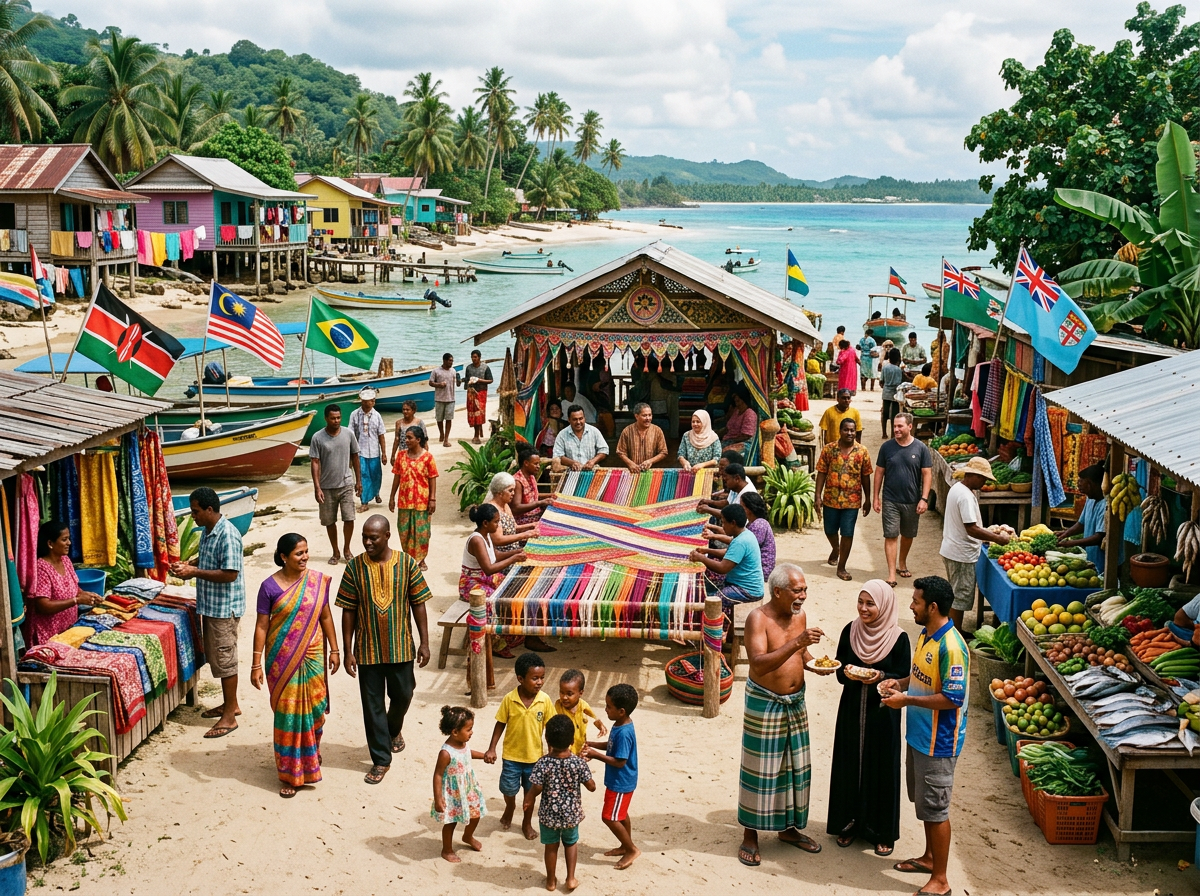
A Systems Portrait of History, Identity, and Renewal
Philippines • Systems Thinking • Institutions • Culture • Stewardship • Human Development
Meta Description
Why does modern Filipino society often appear so full of contradictions? This cornerstone essay explores Philippine history, institutions, culture, and development through a systems lens, revealing how adaptive behaviors emerge—and how stewardship offers a path toward renewal.
Opening Epigraph
People do not merely inherit cultures. They inherit environments that quietly teach them which behaviors are rewarded, which risks are punished, and which dreams appear possible. Over generations, these adaptations become customs. Customs become institutions. Institutions, in turn, shape the next generation.
SECTION I
The Questions Beneath the Questions
We Often Mistake Behaviors for Causes
Few societies appear as internally contradictory as the modern Philippines.
Visitors encounter extraordinary warmth alongside institutional frustration. Economists point to sustained growth while many families continue to experience chronic insecurity.
Overseas Filipinos are celebrated for competence across the world, yet often return home to systems that struggle to reward the very qualities for which they are admired abroad.
The country produces world-class professionals, artists, entrepreneurs, scientists, and caregivers while continuing to wrestle with governance challenges that seem remarkably resistant to reform.
For many observers, these contradictions seem irreconcilable.
They ask:
Why does corruption persist despite widespread public frustration?
Why do political dynasties endure election after election?
Why does celebrity often outweigh demonstrated competence?
Why do many Filipinos exhibit remarkable resilience while accepting conditions that should never require such resilience?
Why do ideals of family loyalty sometimes strengthen communities and, at other times, reinforce patronage or dependency?
Why do symbols of success—from imported brands to skin-whitening products, luxury consumption, and curated online identities—carry such powerful social meaning?
They are compelling questions—but they point to symptoms more readily than they reveal causes.
Most attempts to answer them begin by examining the character of a people. This essay begins somewhere else.
Culture Is Accumulated Adaptation
Human beings continuously adapt to the worlds they inhabit.
Families adapt to economic uncertainty. Communities adapt to institutions they cannot fully trust. Organizations adapt to the incentives that reward some behaviors while quietly discouraging others.
Across generations, these adaptations accumulate into cultural norms that often outlive the conditions that originally gave rise to them (Boyd & Richerson, 1985; North, 1990).
From this perspective, culture is not simply inherited tradition.
It is accumulated adaptation.
The Philippines offers one of the clearest illustrations of this process.
Few nations have experienced such a prolonged layering of colonial rule, foreign administration, revolution, war, dictatorship, labor migration, globalization, digital transformation, and environmental vulnerability within a relatively compressed historical period (Abinales & Amoroso, 2017).
Each era introduced new institutions, new incentives, and new strategies for survival. Rather than replacing one another, these historical layers accumulated, leaving behind behavioral patterns that continue to shape the present.
A society, then, is not merely a snapshot in time. It is a living record of the environments to which its people have repeatedly adapted.
The Question Changes Everything
The purpose of this essay is therefore not to diagnose a national personality.
Nations do not possess fixed personalities.
They develop evolving patterns of behavior shaped by history, institutions, incentives, ecological realities, and collective memory (North, 1990).
Accordingly, this essay does not ask whether Filipinos are uniquely resilient, excessively relational, insufficiently disciplined, or overly deferential to authority. Such questions risk mistaking outcomes for causes.
Instead, it asks a more fundamental question:
What kinds of historical, institutional, developmental, and economic conditions reliably produce the behaviors we observe today?
This shift—from judging people to examining systems—changes everything.
- Corruption becomes more than a moral failure; it becomes an institutional problem. Colonial mentality becomes more than a psychological inheritance; it becomes one adaptation among many.
- Consumerism becomes more than vanity; it reflects an economy in which symbols often function as signals of belonging, credibility, and aspiration.
- Most importantly, this perspective suggests that societies are not trapped by their histories.
If environments shape adaptation, then different environments can cultivate different behaviors.
The Philippines is the case study.
The Philippines provides the lens. The underlying pattern is profoundly human.
The deeper question belongs to every society.
How do human communities become what they are—and under what conditions can they become something better?
II. History Never Truly Leaves
Beyond Colonial Mentality
Among the many explanations offered for contemporary Filipino society, few have become as familiar as colonial mentality.
The term has helped illuminate preferences for foreign products, the prestige attached to Western education, the persistence of colorism, and the tendency to measure progress against external standards. It remains an important concept because it draws attention to the psychological consequences of prolonged colonial rule (David & Okazaki, 2006; Strobel, 2001).
Yet it is not, by itself, a complete explanation.
Colonial mentality describes one consequence of history. It does not fully explain the mechanisms through which history continues to shape behavior long after formal colonial rule has ended.
History rarely survives as memory alone.
It survives through the institutions, incentives, and habits that successive generations inherit.
Related Reading: Beyond Colonial Narratives: What Was Actually Lost in the Philippines explores how successive colonial regimes reshaped indigenous systems of governance, education, and cultural continuity, laying many of the foundations discussed here.
Institutions Remember What People Forget
Historical events eventually pass.
Institutions often do not.
This distinction helps explain why societies often continue exhibiting behaviors whose original causes have long disappeared. Political systems, educational models, economic arrangements, and social expectations possess remarkable continuity, transmitting ways of thinking and acting across generations (North, 1990; Acemoglu & Robinson, 2012).
The Philippines illustrates this process with unusual clarity.
Spanish administration reorganized local governance around centralized authority and religious institutions. American rule expanded public education and democratic ideals while deepening integration into a global economy.
War, post-war reconstruction, authoritarian rule, labor migration, and globalization each introduced new institutional arrangements without fully replacing those that came before (Abinales & Amoroso, 2017).
History, in other words, accumulated.
Rather than inheriting a single colonial legacy, the Philippines inherited multiple layers of governance, values, economic incentives, and social expectations that continue to coexist.
Modern Filipino society reflects this layered inheritance, where different historical logics still shape how people understand authority, family, opportunity, and risk.
Adaptation Outlives the Environment
One of the most enduring observations across the social sciences is that adaptive behaviors often persist long after the environments that produced them have changed (Boyd & Richerson, 1985; North, 1990).
Families who survive prolonged scarcity may continue practicing habits of conservation even after material security improves. Organizations retain procedures whose original purpose has disappeared. Individuals carry coping strategies into adulthood that once ensured survival but later become limiting.
Societies are no different.
Communities gradually learn which behaviors are rewarded, which risks are punished, and which relationships provide security when formal institutions cannot. Over time, these repeated adaptations become normalized. Eventually they are experienced not as responses to history, but simply as “the way things are” (Boyd & Richerson, 1985).
This perspective reframes many familiar debates.
- Trusting family before institutions becomes understandable where institutions have historically proven unreliable.
- Visible symbols of success become more than vanity when they also communicate credibility, opportunity, or belonging.
- Deference to authority becomes easier to understand where challenging authority has long carried significant personal risk.
Culture, then, is neither destiny nor accident.
It is the accumulated memory of successful adaptation.
The challenge is not to erase that memory, but to understand the environments that continue to sustain it.
III. Every Society Learns What Survival Requires
Behaviors Follow Environments
No society wakes each morning and consciously decides what kind of culture it wishes to become.
Cultures emerge through repetition. Behaviors that improve survival are repeated. Behaviors that consistently produce desirable outcomes are rewarded. Over time, these repeated responses become habits, habits become expectations, and expectations become culture.
What later appears as national character often began as practical adaptation to particular historical and institutional conditions (Boyd & Richerson, 1985).
The Philippines is no exception.
Many of the behaviors that attract admiration—or criticism—today make far more sense when understood as responses to environments that demanded flexibility rather than certainty, relationships rather than institutions, and improvisation rather than predictability.
Seen this way, Filipino society reflects not a fixed identity but an accumulated repertoire of adaptive strategies.
Families Become the First Institutions
Where formal institutions are inconsistent, families inevitably assume greater responsibility.
Across generations, Filipino families have served not only as sources of affection and identity, but also as systems of welfare, employment, finance, education, childcare, eldercare, and emotional support.
Kinship networks often provide forms of security that public institutions cannot consistently guarantee. Under such conditions, investing in relationships becomes both emotionally meaningful and economically rational (Ostrom, 1990).
This helps explain why personal trust frequently outweighs institutional trust (Ostrom, 1990).
Recommendations carry unusual weight. Family businesses remain common. Hiring through trusted networks feels safer than relying solely on formal credentials. Political loyalties often mirror personal relationships more closely than ideological commitments.
These behaviors are frequently criticized as obstacles to meritocracy.
More accurately, they are adaptations to environments where trust has historically been earned personally before it could be extended institutionally.
Related Reading: Why Trust Breaks Down in Philippine Systems explores how institutional trust is cultivated, eroded, and restored.
Improvisation Becomes Intelligence
Visitors to the Philippines often remark upon Filipino resourcefulness.
Whether navigating congested cities, recovering from natural disasters, stretching limited household budgets, or solving practical problems with remarkable ingenuity, Filipinos have developed an exceptional capacity to adapt under changing conditions.
Psychologists describe this as resilience, but resilience is rarely an abstract personality trait. It emerges through repeated exposure to challenge combined with the necessity of finding workable solutions (Masten, 2014).
Improvisation is therefore not simply creativity.
It is learned competence under uncertainty.
Yet every adaptation carries trade-offs.
The skills that enable individuals to succeed within unpredictable environments do not always produce the kinds of institutions that reduce unpredictability itself.
A society can become exceptionally skilled at adapting to instability while investing comparatively less in preventing instability from recurring.
This distinction matters.
Resilience should never become an excuse for avoidable dysfunction.
The highest expression of stewardship is not producing people who endure every crisis, but building institutions that make unnecessary crises increasingly rare.
Adaptation Is Not Destiny
Understanding adaptation changes how we interpret behavior.
It invites explanation without excusing failure.
Recognizing why a behavior emerged does not mean preserving it indefinitely. Every society eventually reaches moments when yesterday’s successful adaptations become tomorrow’s constraints.
The question, then, is no longer whether Filipinos have adapted.
They have.
The more important question is whether the environments that shaped those adaptations continue to serve the future the country hopes to build.
That question leads naturally to one of the deepest paradoxes of modern Filipino society.
Many of the qualities that enable societies to flourish under one set of conditions become more complicated under another.
Understanding that transition is the next step in understanding the adaptive Filipino.
Understanding those trade-offs is where systems thinking becomes stewardship.
IV. Every Virtue Carries a Trade-off
Context Determines Character
The qualities for which a society is admired are often inseparable from the challenges it continues to face.
This is one of the central paradoxes of adaptation.
A behavior that improves survival under one set of conditions may become less beneficial when those conditions change. Virtues do not exist independently of their environments. They acquire their character through the problems they evolved to solve.
Many of the traits most closely associated with the Filipino experience illustrate this dynamic.
Strong family loyalty provides emotional security, practical support, and resilience during periods of uncertainty.
Yet the same instinct can become more complicated when public responsibilities compete with private obligations. A recommendation offered in good faith may gradually become preferential treatment. Gratitude may become indebtedness. Loyalty may become patronage.
What begins as a moral economy of reciprocity can, under weaker institutions, become an informal economy of obligation.
Likewise, pakikisama encourages cooperation by preserving social harmony.
Communities function more easily when people know how to accommodate one another. Yet harmony can become costly when maintaining relationships discourages necessary disagreement.
Difficult conversations are postponed. Poor decisions remain unchallenged. Accountability quietly yields to accommodation.
The challenge is not to weaken these cultural strengths, but to build institutions that preserve their gifts while reducing their unintended costs.
Even resilience deserves closer examination.
The Filipino capacity to recover from adversity is rightly celebrated. Typhoons, economic hardship, political upheaval, migration, and family sacrifice have cultivated extraordinary adaptability across generations. But resilience answers a particular question:
How do people recover after disruption?
Stewardship asks a different one:
How do we reduce the need for disruption in the first place? (Masten, 2014).
- These are not competing values.
- They represent different stages of societal development.
- Resilience enables survival.
- Stewardship enables continuity.
The challenge, therefore, is not abandoning cultural virtues but creating institutions that allow their strengths to flourish while reducing the circumstances in which their unintended consequences become normalized.
Related Reading: Why Incentives Fail in Philippine Systems explores how institutional incentives can either amplify or moderate the trade-offs embedded within otherwise healthy cultural values.
V. The Economy of Aspiration
When Success Becomes Symbolic
Every society develops its own language of success.
- Some reward mastery.
- Others reward wealth.
- Others reward service, influence, lineage, or reputation.
The modern Philippines speaks several of these languages at once.
This helps explain why contemporary debates about skin-whitening products, foreign-sounding brands, luxury brands, celebrity politics, inherited privilege, influencer culture, and conspicuous consumption often generate more heat than clarity.
These are not isolated phenomena. They are different expressions of the same underlying question:
How does a society recognize success?
Modern Philippine society illustrates this tension vividly.
Skin-whitening products, celebrity culture, inherited political influence, conspicuous consumption, and carefully curated digital identities are often discussed as isolated social phenomena.
Viewed through a systems lens, however, they reveal a deeper pattern.
Each reflects an environment in which visibility frequently functions as a proxy for credibility, and where symbolic markers of success can become more immediately legible than slower demonstrations of competence or public service.
This helps explain why celebrity, inherited visibility, and aspirational branding can sometimes command greater public attention than quieter forms of expertise, craftsmanship, or civic contribution.
Where institutions consistently reward competence, achievement gradually becomes the strongest signal of status (Frank, 1985).
Where opportunities appear less predictable, symbols themselves become valuable. Brands communicate aspiration. Appearance signals belonging.
Visibility itself becomes a form of influence. Public recognition may seem more attainable than structural mobility because it is immediately observable.
This is not uniquely Filipino.
It reflects a broader dynamic found across many rapidly modernizing societies navigating widening inequalities, global media, and digital platforms. Social media has not invented aspiration; it has accelerated its visibility.
The danger lies not in aspiration itself.
Every society needs aspiration.
The danger arises when appearances become easier to reward than contribution, when inherited visibility overshadows demonstrated competence, or when success is measured primarily by recognition rather than responsibility.
Healthy societies eventually learn to align status with stewardship.
- They make contribution more visible than performance.
- They make competence more durable than celebrity.
- And they make service more admirable than spectacle.
VI. Institutions Teach More Than Values
People Adapt to What Is Repeatedly Rewarded
- Parents teach values.
- Schools teach values.
- Religious communities teach values.
- Institutions teach consequences.
Institutions rarely persuade people through philosophy alone.
They persuade through repetition. Every promotion, election, hiring decision, public recognition, or unchallenged abuse quietly communicates what a society truly values. Over time, these accumulated signals become more influential than formal mission statements or civic ideals.
Whenever these lessons diverge, consequences usually become the more powerful teacher (North, 1990).
This is why institutional design matters.
A society may publicly celebrate honesty while quietly rewarding connections over competence. It may praise public service while structuring political incentives around short-term visibility. It may encourage civic participation while making trust costly and cynicism practical (Acemoglu & Robinson, 2012).
People notice.
Most do not consciously abandon their values.
They adapt.
Over time, these adaptations become normalized, passed to children not as ideals but as practical advice about how the world actually works.
This helps explain why meaningful reform rarely succeeds through moral appeals alone.
Cultures change most durably when institutions begin rewarding the behaviors they have long encouraged in principle. Integrity becomes easier where transparency is expected. Merit becomes credible where opportunities are visibly fair. Trust grows where accountability is consistent rather than exceptional.
Institutions, in this sense, are society’s teachers.
Every day, they instruct citizens which behaviors are worth repeating.
Related Reading: The Philippine Renewal Framework examines how institutional stewardship can gradually realign incentives toward long-term public trust and civic flourishing.
VII. Stewardship Begins With Better Environments
Beyond Blame
If societies become what their environments repeatedly reward, then renewal begins by redesigning those environments.
This shifts the conversation beyond both optimism and pessimism.
The Philippines is neither condemned by its history nor rescued by sentiment alone.
Like every society, it carries the accumulated wisdom of countless adaptations alongside the unfinished work of deciding which of those adaptations still serve the future.
Some deserve preservation.
Others deserve gratitude for helping previous generations survive before being thoughtfully set aside.
This is the work of stewardship.
- Not erasing history.
- Learning from it.
- Not condemning culture.
- Cultivating it.
Not demanding that individuals become extraordinary simply to compensate for ordinary institutional failures.
Building institutions that make ordinary integrity increasingly possible.
When integrity becomes the easier path rather than the exceptional one, cultures begin to change almost imperceptibly—but profoundly.
The Philippines offers no universal blueprint for the Global South.
What it offers is something perhaps more valuable.
A living reminder that cultures are neither fixed identities nor permanent destinies. They are evolving relationships between people, institutions, history, and the environments they continually create for one another.
The future, then, will be shaped less by the values societies proclaim than by the behaviors they repeatedly reward.
And stewardship begins with choosing those rewards wisely.
Continue the Journey
The ideas explored in this essay are developed further throughout the Living Archive.
If you wish to explore the historical foundations, institutional dynamics, and stewardship pathways introduced here, the following essays provide natural points of continuation.
Historical Foundations
- Beyond Colonial Narratives: What Was Actually Lost in the Philippines?
- The Ghosts of the Galleon Trade
- The Architecture of Silence
- The Diaspora Wound
Institutions and Society
- Why Trust Breaks Down in Philippine Systems
- Why Incentives Fail in Philippine Systems
- Breaking the Loop
- The Philippine Renewal Framework
Personal and Cultural Renewal
A Final Reflection
Every generation inherits a society it did not create.
Its institutions, habits, assumptions, and cultural narratives are already in motion long before any individual begins to question them. Much of what appears natural has simply become familiar through repetition. The challenge, therefore, is not deciding whether history will influence the future. It always will.
The more important question is whether we become conscious participants in that inheritance.
Stewardship begins at precisely this point.
It asks us to distinguish between the adaptations that continue to serve human flourishing and those that deserve gratitude for helping previous generations survive before being thoughtfully set aside.
It reminds us that cultures are neither monuments to preserve unchanged nor problems to solve once and for all. They are living relationships continuously shaped by the environments people create together.
The Philippines is one expression of this larger human story.
Its history is distinctive, but the adaptive dynamics explored here are not.
Across much of the world, societies are wrestling with the same questions of identity, institutional trust, historical memory, economic aspiration, and cultural renewal. The details differ. The underlying dynamics often do not.
Perhaps the most hopeful implication of a systems perspective is this:
Societies are not ultimately defined by the histories they inherit, but by the environments they choose to create for those who come after them.
The future, then, will be shaped less by the values we proclaim than by the behaviors our institutions repeatedly reward.
That is the quiet work of stewardship.
References
Abinales, P. N., & Amoroso, D. J. (2017). State and society in the Philippines (2nd ed.). Rowman & Littlefield.
Acemoglu, D., & Robinson, J. A. (2012). Why nations fail: The origins of power, prosperity, and poverty. Crown.
Boyd, R., & Richerson, P. J. (1985). Culture and the evolutionary process. University of Chicago Press.
David, E. J. R., & Okazaki, S. (2006). Colonial mentality: A review and recommendation for Filipino American psychology. Cultural Diversity and Ethnic Minority Psychology, 12(1), 1–16.
Frank, R. H. (1985). Choosing the right pond: Human behavior and the quest for status. Oxford University Press.
Masten, A. S. (2014). Ordinary magic: Resilience in development. Guilford Press.
North, D. C. (1990). Institutions, institutional change and economic performance. Cambridge University Press.
Ostrom, E. (1990). Governing the commons: The evolution of institutions for collective action. Cambridge University Press.
Strobel, L. M. (2001). Coming full circle: The process of decolonization among post-1965 Filipino Americans. Giraffe Books.
About this Essay
The Adaptive Filipino: A Systems Portrait of History, Identity, and Renewal is a Cornerstone Essay within the Philippine collection of the Living Archive.
Drawing upon history, institutional economics, cultural psychology, developmental science, and systems thinking, it examines contemporary Filipino society not as a fixed national character but as a living system shaped by centuries of adaptation.
While the Philippines serves as the primary case study, the framework presented here is intended to illuminate broader patterns across societies navigating colonial legacies, institutional transformation, and the challenges of modern development.
The Living Archive approaches culture as an evolving relationship between people, institutions, incentives, and stewardship. Its aim is not merely to explain the world as it is, but to illuminate the conditions under which societies become what they are—and how stewardship can help them become something better.
Gerald A. Daquila is a researcher, writer, and founder of the Living Archive and the Stewardship Institute, where his work explores the intersection of systems thinking, governance, human development, and long-term stewardship in an age of accelerating complexity.
© 2026 Gerald A. Daquila · Life.Understood. · The Living Archive · Stewardship Institute · All rights reserved.
Leave a Reply