
Understanding Where Responsibility Emerges
Meta Description
Explore Stewardship Architecture, the conceptual map of the environments in which stewardship responsibility emerges. Discover how responsibility expands from personal relationships to organizations, institutions, communities, and society.
Every person participates in systems that shape the lives of others.
Some are intimate and immediate. Others extend across organizations, institutions, communities, and society itself.
As these environments increase in scale and consequence, so too does the responsibility they place upon those who participate within them.
Stewardship Architecture examines these environments and the relationships between them.
Rather than prescribing a single model of leadership or governance, it provides a conceptual map through which responsibility becomes easier to recognize, understand, and navigate.
Constitutional Responsibility
Governing Question
Where does stewardship responsibility emerge within human systems?
Institutional Responsibility
Stewardship Architecture illuminates the environments in which responsibility arises and the relationships between those environments. Its purpose is to help readers understand how stewardship expands as influence extends from personal life into increasingly complex human systems.
Why Stewardship Architecture Exists
Responsibility is rarely confined to individuals alone.
Every decision exists within a wider context of relationships, organizations, institutions, cultures, and systems whose consequences often extend far beyond their point of origin.
Understanding stewardship therefore requires more than examining individual character or leadership behavior.
It requires understanding the architecture of the environments within which responsibility operates.
Stewardship Architecture provides that orientation.
The Architecture of Responsibility
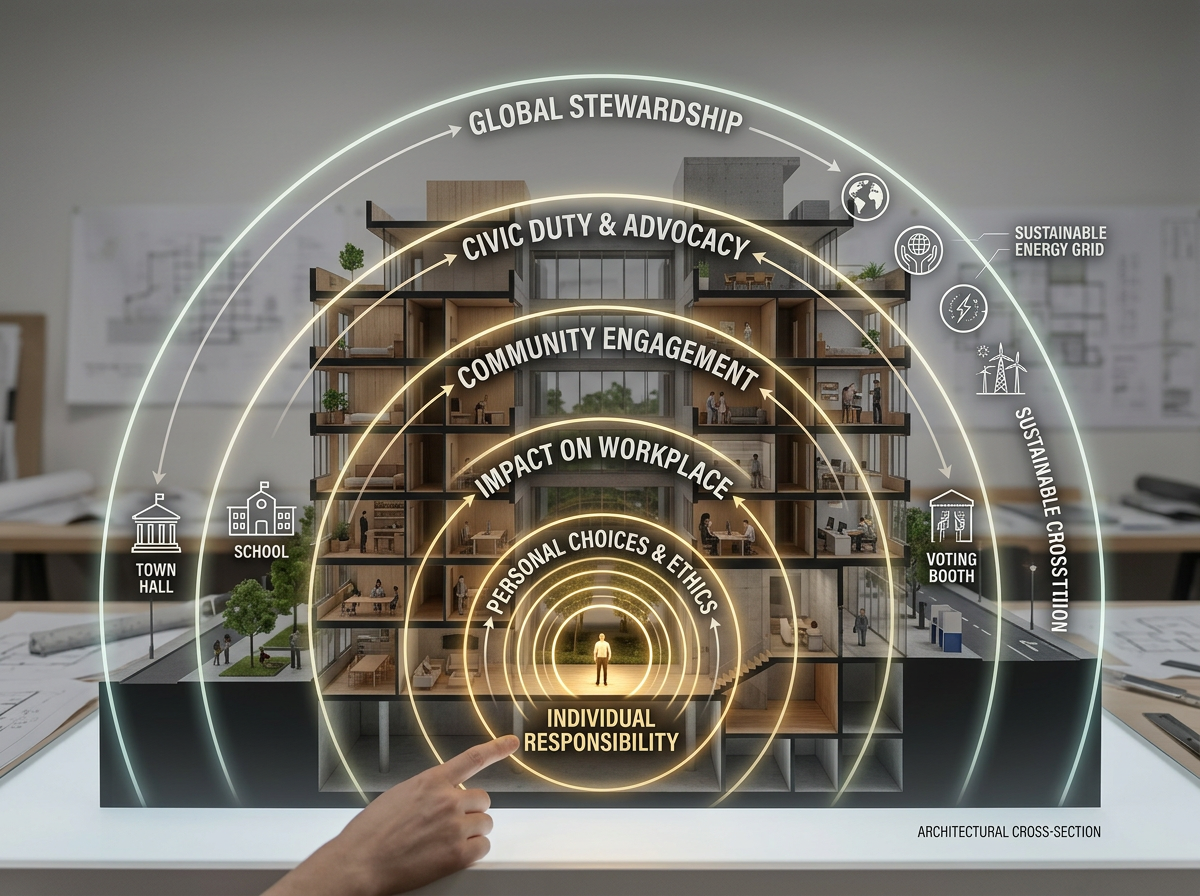
Stewardship unfolds across interconnected environments rather than isolated roles.
Each environment introduces new forms of responsibility while remaining connected to every other level of the architecture.
Personal Life
Stewardship begins with the choices individuals make regarding their own conduct, learning, health, commitments, and integrity.
Relationships
Responsibility expands through families, friendships, partnerships, and other enduring human relationships where trust and mutual care are cultivated.
Organizations
As people collaborate toward shared purposes, stewardship begins to involve coordination, leadership, decision-making, and collective responsibility.
Institutions
Institutions preserve values, distribute authority, establish norms, and shape behavior across generations. Stewardship at this level concerns legitimacy, continuity, accountability, and public trust.
Communities
Communities weave together relationships and institutions within particular places and shared identities, requiring stewardship that balances individual wellbeing with the common good.
Society
Stewardship increasingly concerns the systems, cultures, economies, and public structures that influence millions of lives, often across generations.
Increasing Scale, Increasing Responsibility
Responsibility does not simply become larger as influence expands.
It becomes qualitatively different as the consequences of our participation extend further beyond ourselves.
Decisions affecting oneself require different forms of discernment than decisions affecting families, organizations, institutions, or societies.
As stewardship moves outward through these environments, greater influence requires broader perspective, deeper humility, stronger accountability, and more disciplined judgment.
Understanding this progression helps explain why stewardship cannot be reduced to personal virtue alone.
It is always exercised within systems whose complexity shapes both opportunities and consequences.
Institutional Expression
The Stewardship Institute expresses this architecture through three complementary environments, each serving a distinct constitutional purpose.
The Living Archive
Provides conceptual understanding, language, orientation, and systems thinking that help readers make sense of stewardship across human life.
Learning Pathways
Support the gradual development of stewardship through guided reflection, disciplined practice, and lifelong formation.
Stewardship Readiness Institute (SRI)
Provides structured assessment instruments, behavioral calibration, and accountability frameworks where greater responsibility requires greater discernment.
Each environment strengthens the others while remaining constitutionally distinct.
- Understanding informs development.
- Development cultivates practice.
- Assessment strengthens accountability.
None should replace or subsume the others.
Stewardship Across Human Systems
No single environment can cultivate stewardship in isolation.
- Understanding finds its fullest expression through practice.
- Practice without reflection risks becoming habitual rather than intentional.
- Assessment without understanding can reduce stewardship to performance rather than responsibility.
Healthy stewardship emerges when understanding, development, and accountability remain distinct while continually informing one another.
Relationship to the Stewardship Framework
Stewardship Architecture is one of the conceptual domains within the broader Stewardship Framework.
While the Framework establishes the shared language and conceptual foundations of stewardship, Stewardship Architecture maps the environments in which stewardship responsibility emerges.
Together they help readers understand not only what stewardship is, but where it operates throughout human life.
Continue Exploring
Within the Stewardship Framework
Continue to Other Institute Domains
- Stewardship Archive
- Applied Stewardship Case Library
- Governance
- Coherent Leadership Selection System (CLSS)
- Stewardship Practice
Stewardship Institute
Understanding responsibility across human systems.
Stewardship Architecture illuminates the environments in which responsibility emerges, helping readers understand how influence, accountability, and participation expand from personal life into the wider systems that shape communities, institutions, and society.
© 2025–2026 Gerald Alba Daquila. All rights reserved.