

What Education Must Still Teach
A Living Archive Cornerstone
Meta Description
When knowledge is abundant and increasingly generated by machines, education must do more than transmit information. This Cornerstone argues that its deeper purpose is to cultivate orientation, judgment, discernment, responsibility, and the capacity to participate wisely in complex human systems.
The purpose of education is not simply to make people knowledgeable. It is to make them capable of understanding what they are part of, judging what the situation requires, and assuming responsibility for how they participate.
When Knowledge Is Everywhere
There was a time when one of education’s central problems was scarcity.
Knowledge was difficult to obtain. Books were scarce. Libraries were scarce. Teachers and institutions were scarce. Access to accumulated human understanding depended heavily upon proximity to people and institutions that possessed it.
That world has changed.
Knowledge is now abundant, searchable, portable, reproducible, and increasingly generable on demand. Artificial intelligence can summarize books, explain concepts, compare arguments, translate languages, generate examples, write code, and produce plausible responses to questions that once required substantial research.
The educational problem has therefore not disappeared.
It has changed.
When information was scarce, education could reasonably be organized around transmission: acquire knowledge, develop relevant skills, master a field, and enter the world prepared to use what you have learned.
When information becomes abundant, another question becomes unavoidable:
What enables a human being to know what matters, distinguish what is reliable, understand what it means, and decide what to do with it?
That question takes us beyond information.
It takes us into orientation.
The OECD’s Learning Compass 2030 makes a related move by framing education around learner agency and the capacity to navigate unfamiliar contexts rather than simply follow predetermined instructions. Its metaphor of a compass is deliberately about developing the capacity to find direction in changing circumstances while pursuing individual and collective well-being (OECD, 2019).
UNESCO’s work on the futures of education similarly argues that education must be reconsidered in light of profound social, technological, ecological, and political change, and that education has a role in shaping peaceful, just, and sustainable futures rather than merely adapting learners to an existing order (International Commission on the Futures of Education, 2021).
The Living Archive begins within this larger conversation but asks a particular question:
What kind of understanding enables responsible participation in a complex world?
I. Education Has Always Been More Than Information
Education has never actually been reducible to the transfer of information.
To educate a person is to change their capacity to perceive, understand, judge, relate, create, and participate.
John Dewey argued that education is inseparable from experience and democratic life: learning is not simply preparation for participation in society but part of the process through which people learn how to participate in shared life (Dewey, 1916).
Paulo Freire likewise rejected the conception of learners as passive containers into which knowledge is deposited. For Freire, education involves dialogue, reflection, agency, and the capacity to perceive and transform one’s circumstances (Freire, 1970).
These traditions point toward a proposition that remains important:
Education changes the learner’s relationship to the world, not merely the quantity of information the learner possesses.
That distinction becomes increasingly important as information itself becomes easier to obtain.
A person may know a great deal and still misunderstand the situation they are in.
They may possess technical expertise and lack judgment.
They may have strong opinions and weak evidence.
They may be highly educated within a discipline and unable to recognize how their decisions affect systems beyond it.
They may be capable of optimizing a system without asking whether the system is optimizing the right thing.
The question is therefore not whether knowledge matters.
It does.
The question is whether knowledge alone is sufficient.
It is not.
II. The Educational Problem Has Changed
The contemporary learner increasingly enters systems whose relationships cannot be understood through a single discipline or scale.
Climate, artificial intelligence, biotechnology, financial systems, geopolitics, digital culture, organizational behavior, ecological systems, human psychology, and governance interact continuously.
The problem is not merely complexity.
It is participation in complexity without adequate orientation.
This produces a gap between capability and judgment.
A person can know how to persuade without knowing whether persuasion serves truth.
They can know how to exercise authority without understanding stewardship.
They can know how to produce economic value without recognizing what their definition of value excludes.
They can know how to deploy technology without understanding its second- and third-order consequences.
They can know how to win an argument without understanding the system of relationships in which the argument is occurring.
Education therefore faces a problem that cannot be solved simply by adding another subject to the curriculum.
It requires a broader conception of what learning is for.
Developmental theorists have long examined this movement from simpler toward more complex ways of making meaning. Kegan’s constructive-developmental account, for example, describes adult development as increasing complexity in the ways people organize meaning, relationships, responsibility, and selfhood (Kegan, 1994). Mezirow’s theory of transformative learning similarly emphasizes the possibility that adults can critically examine previously taken-for-granted assumptions and develop more complex frames of reference (Mezirow, 1991).
The Living Archive extends this developmental concern beyond the question of how a person makes meaning.
It asks:
How does a person’s developing capacity for understanding change the quality of their participation in the systems around them?
III. From Knowledge to Understanding
The Living Archive distinguishes knowledge from understanding.
- Knowledge can be accumulated.
- Understanding develops.
- Knowledge can tell us that something happens.
- Understanding asks how the parts relate.
- Knowledge can provide an answer.
Understanding asks whether the answer fits the wider reality.
Knowledge can increase capability.
Understanding asks what that capability should serve.
This distinction is foundational to the Living Archive’s educational philosophy. Its public vocabulary treats development as an increasing integration of understanding, judgment, responsibility, and participation rather than as accumulation alone (Daquila, 2026a).
The resulting trajectory can be expressed simply:
Knowledge → Understanding → Integration → Orientation → Judgment → Responsibility → Stewardship
The sequence matters.
Knowledge without integration can produce fragmentation.
Integration without judgment can produce sophisticated confusion.
Judgment without responsibility can become manipulation.
Responsibility without understanding can become good intention without adequate perception.
Stewardship therefore represents more than ethical behavior.
It represents the maturation of understanding into responsible participation.
IV. Orientation Is an Educational Outcome
Orientation is not the same as certainty.
A person is oriented when they can recognize:
- what kind of situation they are facing;
- what they actually know;
- what remains uncertain;
- which assumptions influence their interpretation;
- which relationships and systems matter;
- what consequences may follow from different choices;
- and what responsibility belongs to them.
Orientation does not eliminate ambiguity.
It makes ambiguity more navigable.
This is one reason the Living Archive organizes inquiry around questions rather than simply subjects. Its underlying proposition is that people often encounter complexity first as an unsettled question and only later discover which disciplines, methods, or frameworks may help them understand it.
This is also consistent with the direction of contemporary educational thought. The OECD Learning Compass explicitly uses the metaphor of navigation because learners must increasingly find direction in unfamiliar contexts rather than simply receive fixed instructions (OECD, 2019).
The Living Archive takes that metaphor one step further.
It asks whether orientation itself should be treated as an educational outcome.
Not:
Did you learn the material?
But also:
Can you recognize what kind of situation you are in?
Can you determine what you know and do not know?
Can you recognize the assumptions shaping your judgment?
Can you identify the responsibilities created by what you now understand?
These are not substitutes for knowledge.
They are capacities that determine how knowledge is used.
V. Learning to Distinguish Before Learning to Conclude
An educational institution that teaches interdisciplinary thinking faces a serious danger.
Everything can begin to look like everything else.
Psychology, physics, mythology, personal experience, history, spirituality, systems theory, social science, and symbolism can be blended into a grand synthesis that sounds comprehensive while quietly erasing the differences between kinds of claims.
The Living Archive’s response is methodological distinction.
- Observation is not inference.
- Inference is not explanation.
- Explanation is not meaning.
- Experience is not universal proof.
- A symbolic interpretation is not an empirical finding.
- A philosophical proposition is not automatically a scientific claim.
- A useful model is not necessarily a description of reality itself.
The Living Archive’s Rules of Reasoning therefore distinguish observation from inference, privilege coherence without treating it as certainty, acknowledge methodological limits, and make revision part of inquiry (Daquila, 2026b).
Its Evidence Standards similarly distinguish different forms of inquiry and evidence rather than assuming that every question can or should be answered by the same method (Daquila, 2026c).
This is not merely an editorial preference.
It is an educational proposition:
Before teaching people what to think, teach them to recognize what kind of claim they are encountering.
That proposition becomes particularly important when artificial intelligence can produce convincing language without guaranteeing that the resulting claims are true, appropriate, adequately supported, or relevant to the actual question.
UNESCO’s guidance on generative AI in education and research therefore emphasizes a human-centred approach, including ethical validation, pedagogical design, human capacity, privacy, safety, equity, and meaningful educational use (Miao & Holmes, 2023).
The implication is not that humans should compete with machines at producing information.
It is that humans remain responsible for judging what information means and what should be done with it.
VI. Education Must Teach Movement Between Scales
Human beings rarely experience the consequences of their actions at only one level.
- A personal habit can become a relational pattern.
- A relational pattern can become organizational culture.
- Organizational culture can become institutional practice.
- Institutional practice can shape communities.
- Communities participate in larger economic, political, technological, ecological, and civilizational systems.
Urie Bronfenbrenner’s ecological systems theory made an important contribution by showing how development is shaped by nested environmental systems rather than by individual characteristics alone (Bronfenbrenner, 1979).
Systems thinking extends a similar insight into the behavior of complex systems. Meadows demonstrated that outcomes often depend less on isolated components than on relationships, feedback, information, rules, goals, and underlying paradigms (Meadows, 2008).
Peter Senge’s work on learning organizations likewise emphasizes systems thinking, mental models, shared vision, and learning as conditions for organizational transformation (Senge, 1990).
The Living Archive brings these traditions into a broader educational question:
Can people learn to move between the individual, relational, organizational, institutional, and civilizational scales at which their decisions operate?
This is not an argument against specialization.
Specialization remains indispensable.
It is an argument for cultivating the integrative capacity around specialization.
The physician needs more than medical knowledge when deciding within a family, hospital, or public-health system.
The engineer needs more than technical competence when designing infrastructure whose consequences extend across generations.
The executive needs more than managerial expertise when exercising power over people and resources.
The policymaker needs more than policy knowledge when acting within systems whose consequences cannot be fully predicted.
The citizen needs more than information when deciding what to trust, what evidence to accept, and how to act when legitimate values conflict.
Education must therefore cultivate the ability to move between parts and wholes, immediate effects and systemic consequences, individual agency and collective responsibility.
VII. From Agency to Stewardship
Agency is essential.
A person must possess the capacity to act.
But agency by itself is morally incomplete.
A capable person can use agency to create, serve, exploit, manipulate, dominate, extract, or destroy.
The educational question therefore cannot end with:
Can you act?
It must also ask:
What are you responsible for when you act?
This is where stewardship becomes educationally significant.
Stewardship begins with a different conception of power.
- Influence is not ownership.
- Authority is not entitlement.
- Capability is not permission.
What we possess may also be something entrusted to our care.
The Living Archive’s foundations of stewardship describe responsibility in terms of what human beings hold in trust: their lives, relationships, communities, institutions, and resources (Daquila, 2026d).
The educational implication is significant.
The educated person is not simply someone who has become more capable.
The educated person becomes increasingly capable of being entrusted with capability.
That distinction places stewardship beyond conventional competency.
It asks what happens when knowledge, authority, intelligence, technology, wealth, institutional power, or social influence become available to a human being.
The question is no longer merely:
What can you do?
It becomes:
What should you do, for whom, under what conditions, and with what responsibility for consequences?
VIII. Education as Formation for Civic Life
Education is often discussed as preparation for employment.
That is necessary but insufficient.
People do not spend their lives only as workers.
They become parents, neighbours, citizens, colleagues, leaders, voters, creators, institution-builders, custodians, decision-makers, and participants in communities they did not design.
Education therefore has a public dimension.
UNESCO’s Reimagining Our Futures Together argues for a renewed social contract in which education is understood as a public endeavour and common good, grounded in human dignity, social justice, solidarity, reciprocity, and care (International Commission on the Futures of Education, 2021).
The Living Archive’s contribution to that conversation is narrower.
It asks:
What capacities must individuals develop if they are to participate responsibly in the common world?
Its answer begins with understanding.
A society cannot reliably produce responsible institutions from people who lack the capacity to examine assumptions, distinguish evidence from interpretation, recognize systemic consequences, revise their thinking, and exercise power with restraint.
Civic education therefore cannot be limited to knowledge about institutions.
It must also cultivate the qualities of participation upon which institutions depend.
Trust requires trustworthy behavior.
Democracy requires judgment.
Governance requires responsibility.
Pluralism requires the capacity to remain in relationship across difference.
Stewardship requires the ability to hold something larger than oneself without treating it as one’s possession.
Education participates in the formation of all of these.
IX. An Educational Institution Must Apply Its Own Standards to Itself
If the Living Archive is to describe itself as an educational institution—or to grow into one—it must apply its own principles to itself.
- If it teaches discernment, learners should be given opportunities to practice discernment.
- If it teaches methodological humility, its own materials must distinguish levels of claim.
- If it teaches learner sovereignty, learners must remain free to question the Archive itself.
- If it teaches revision, the institution must visibly revise its own explanations when stronger understanding emerges.
- If it teaches stewardship, its educational structures must demonstrate responsibility rather than merely describe it.
- If it teaches integration, its curriculum must connect disciplines without pretending that their differences do not matter.
This is why the Living Archive makes its method public.
Its First Principles are presented as commitments open to examination rather than doctrines beyond criticism (Daquila, 2026e).
Its Revision Protocol treats correction and revision as components of institutional integrity rather than failures of authority (Daquila, 2026f).
Its Charter describes understanding, discernment, responsibility, and stewardship as enduring commitments while preserving the possibility of continued development (Daquila, 2026g).
The result is an important institutional test:
The institution cannot demand from learners a standard of intellectual honesty that it does not demand from itself.
That is the beginning of educational integrity.
X. The Difference Between a Philosophy and an Educational Model
There is an important limitation that must be acknowledged.
A compelling educational philosophy is not the same thing as demonstrated educational efficacy.
The Living Archive can articulate a philosophy of:
knowledge → understanding → orientation → judgment → responsibility → stewardship
without yet having established, through independent longitudinal research, that its particular educational architecture reliably produces those outcomes.
That distinction matters.
There is substantial scholarship supporting many of the component ideas: learner agency, developmental complexity, transformative learning, reflective practice, systems thinking, ecological development, civic education, and education as a public good.
But the existence of supporting scholarship does not constitute empirical validation of the Living Archive’s particular synthesis.
The Living Archive therefore has an educational research question before it:
Can the capacities it describes be cultivated through its Pathways, curricula, instruments, cases, and institutional practices—and can that development be demonstrated without reducing complex human maturity to simplistic metrics?
That question cannot be answered by self-reference.
It requires pedagogical experimentation, learner evidence, longitudinal observation, external critique, and—where appropriate—independent evaluation.
This is not a weakness in the proposition.
It is the appropriate boundary between educational philosophy and educational evidence.
XI. The Question Education Should Leave Us With
Perhaps one of education’s deepest failures would be to produce people who can answer questions but cannot recognize which questions matter.
- A technically accomplished person can still be badly oriented.
- A highly informed society can still make destructive choices.
- A sophisticated institution can still optimize the wrong thing.
- A powerful civilization can still misunderstand the conditions upon which its own flourishing depends.
Education therefore has a responsibility that precedes specialization:
to cultivate people capable of asking better questions of the world, of themselves, and of the systems they inhabit.
This is where the Living Archive’s various forms of work become educational rather than merely informational.
Essays explore questions deeply.
Maps make relationships visible.
Pathways are designed to change orientation.
Methods make the conditions of inquiry explicit.
Cases allow abstract principles to encounter lived situations.
The Stewardship Institute seeks to carry understanding toward formation and practice.
Taken together, these suggest an educational ecology rather than a conventional curriculum.
The point is not for someone to become knowledgeable about the Living Archive.
The point is for the learner to become increasingly capable of seeing without premature reduction, reasoning without false certainty, integrating without conflation, and acting without abandoning responsibility.
XII. A Civic Contribution, Not a Claim to Authority
The Living Archive does not need to claim that its answer is the answer.
Its contribution is stronger if it does not.
Education is too important to belong to one institution, one discipline, one ideology, or one worldview.
The appropriate civic posture is therefore not:
We have solved education.
It is:
Here is the question we believe education must confront. Here is the response we have developed. Here are the intellectual traditions with which it is in conversation. Here are the principles by which we have constructed it. Here are its limits. Examine it. Challenge it. Improve it.
That is a more defensible form of institutional authority.
A living educational tradition should not depend upon permanent agreement with its founder.
It should become capable of inquiry beyond its founder.
This is also why the Living Archive’s method should remain public rather than proprietary. The purpose is not to secure agreement but to cultivate clearer observation, careful reasoning, responsible inquiry, and greater capacity to navigate human complexity (Daquila, 2026h).
The measure of success, therefore, cannot ultimately be how many people know the name Living Archive.
It must be whether people who encounter its work become more capable of understanding without becoming more certain than the evidence permits; more capable of acting without becoming more entitled to power; more capable of integrating complexity without collapsing meaningful difference; and more capable of holding responsibility without mistaking responsibility for control.
XIII. What Education Must Still Teach
Knowledge will continue to become more abundant.
Expertise will continue to become more specialized.
Artificial intelligence will continue to make answers cheaper.
Complexity will continue to make consequences harder to predict.
None of these developments makes education less important.
They make its deeper purpose harder to avoid.
The central educational problem is no longer simply:
How do we give people enough knowledge to function?
It is increasingly:
How do we cultivate people capable of orienting themselves within a world they cannot fully know, systems they cannot fully control, and futures they cannot fully predict?
The answer cannot be certainty.
It cannot be ideology.
It cannot be technological dependence.
It cannot be expertise without judgment.
And it cannot be information without integration.
It must be understanding.
- Understanding that remains open to revision.
- Understanding that distinguishes evidence from interpretation.
- Understanding that recognizes systems without erasing persons.
- Understanding that expands rather than diminishes responsibility.
- And ultimately, understanding that becomes capable of stewardship.
This is the educational proposition of the Living Archive.
Not that people need to learn everything.
Not that one institution can provide a final map of reality.
But that human beings can become better at finding their bearings.
Perhaps that is what education has always been at its best:
not the delivery of certainty,
but the cultivation of people capable of entering an uncertain world with enough understanding, humility, judgment, and responsibility to help care for what comes next.
Living Archive Position
This Cornerstone is a public statement of educational philosophy, not a claim of educational finality.
The Living Archive understands education as the development of increasingly integrated capacities for understanding, judgment, responsibility, and participation. It therefore treats orientation as an educational outcome and stewardship as a mature expression of responsible understanding.
The institution remains accountable to the same methodological principles it asks readers to examine: distinction among levels of claim, proportionality of evidence, acknowledgement of limits, openness to criticism, and willingness to revise.
The argument presented here should therefore be read as a public proposition for examination, not a doctrine for acceptance.
References
Bronfenbrenner, U. (1979). The ecology of human development: Experiments by nature and design. Harvard University Press.
Daquila, G. (2026a). Public vocabulary. Living Archive.
Daquila, G. (2026b). Rules of reasoning. Living Archive.
Daquila, G. (2026c). Evidence standards. Living Archive.
Daquila, G. (2026d). Foundations of stewardship. Living Archive.
Daquila, G. (2026e). First principles. Living Archive.
Daquila, G. (2026f). Revision protocol. Living Archive.
Daquila, G. (2026g). Charter of the Living Archive. Living Archive.
Daquila, G. (2026h). Why a method? Living Archive.
Dewey, J. (1916). Democracy and education: An introduction to the philosophy of education. Macmillan.
Freire, P. (1970). Pedagogy of the oppressed. Continuum.
International Commission on the Futures of Education. (2021). Reimagining our futures together: A new social contract for education. UNESCO.
Kegan, R. (1994). In over our heads: The mental demands of modern life. Harvard University Press.
Meadows, D. H. (2008). Thinking in systems: A primer. Chelsea Green Publishing.
Mezirow, J. (1991). Transformative dimensions of adult learning. Jossey-Bass.
Miao, F., & Holmes, W. (2023). Guidance for generative AI in education and research. UNESCO.
OECD. (2019). OECD Future of Education and Skills 2030: OECD Learning Compass 2030. OECD Publishing.
Schön, D. A. (1983). The reflective practitioner: How professionals think in action. Basic Books.
Senge, P. M. (1990). The fifth discipline: The art and practice of the learning organization. Doubleday.
Living Archive Companion
Every Cornerstone forms part of a larger architecture of inquiry.
The Living Archive Companion situates this essay within its broader intellectual and methodological landscape. It identifies relevant scholarly traditions, distinguishes the evidence supporting the educational problem from the evidence supporting the Living Archive’s own response, states the limits of the argument, identifies questions for further research, and provides curated pathways into the wider Archive.
The Companion is not a second essay.
Its purpose is transparency.
Comparative Perspectives
Where This Cornerstone Sits Within the Broader Conversation
This Cornerstone participates in several established conversations about the purpose and future of education.
It shares with John Dewey an understanding of education as preparation for and participation in democratic life rather than simple information transfer (Dewey, 1916).
It shares with Paulo Freire an emphasis on dialogue, reflection, agency, and the learner’s capacity to perceive and transform the conditions in which they live (Freire, 1970).
It shares with Jack Mezirow an interest in how adults can critically examine assumptions and develop more complex frames of reference through transformative learning (Mezirow, 1991).
It shares with Robert Kegan a developmental interest in increasingly complex structures of meaning-making and responsibility (Kegan, 1994).
It shares with Donald Schön the recognition that competent action in uncertain environments requires reflective practice rather than the mechanical application of abstract rules (Schön, 1983).
It shares with Urie Bronfenbrenner an understanding of human development as embedded within nested social environments (Bronfenbrenner, 1979).
It shares with Donella Meadows and systems thinkers a concern with relationships, feedback, system structure, information, goals, and paradigms rather than isolated variables (Meadows, 2008).
It shares with Peter Senge an interest in systems awareness, mental models, organizational learning, and the capacity of people and institutions to learn from their own patterns (Senge, 1990).
It also enters the contemporary policy conversation represented by the OECD Learning Compass, particularly around learner agency and the capacity to navigate unfamiliar contexts, and by UNESCO’s work on education as a public endeavour and common good in an uncertain future (International Commission on the Futures of Education, 2021; OECD, 2019).
Where the Living Archive Differs
The Living Archive does not claim to replace these traditions.
Its distinctive proposition is architectural.
It asks whether these different educational concerns can be connected through a developmental sequence:
understanding → orientation → judgment → responsibility → stewardship
The central unit is therefore neither a discipline nor a single educational theory.
It is the human being trying to orient within complexity.
Evidence & Foundations
Knowledge Domains Informing This Cornerstone
Primary fields
- Educational philosophy
- Developmental psychology
- Transformative learning
- Systems thinking
- Ecological systems theory
- Reflective practice
- Organizational learning
- Civic education
- Human development
- Artificial intelligence and education
Representative thinkers and institutions
- John Dewey
- Paulo Freire
- Jack Mezirow
- Robert Kegan
- Donald Schön
- Urie Bronfenbrenner
- Donella Meadows
- Peter Senge
- OECD
- UNESCO
What Evidence Supports the Educational Problem?
The educational problem addressed here is supported by substantial existing scholarship and institutional inquiry concerning:
- learner agency;
- developmental complexity;
- transformative learning;
- reflective practice;
- systems thinking;
- ecological approaches to development;
- education’s relationship to democracy and civic life;
- education as a public and common good;
- the changing implications of artificial intelligence for teaching and learning.
UNESCO’s current work explicitly frames education as needing to respond to rapid technological and societal change while preserving human-centred educational purposes.
The OECD’s Learning Compass similarly frames future-oriented education around agency, well-being, competencies, and navigation through unfamiliar circumstances.
These sources support the problem space.
They do not independently validate the Living Archive’s specific educational architecture.
What Evidence Supports the Living Archive’s Response?
The Living Archive’s response currently consists primarily of:
✓ Integrative conceptual synthesis
✓ Philosophical argument
✓ Systems-based architecture
✓ Developmental interpretation
✓ Methodological and epistemic design
✓ Curated educational pathways
✓ Applied frameworks and casework
◻ Independent pedagogical evaluation
◻ Longitudinal learner-outcome research
◻ Independent replication across educational settings
◻ Validated instruments specifically measuring Living Archive learning outcomes
The distinction is deliberate.
The Living Archive has a developing educational model; it does not yet claim to possess comprehensive empirical validation of that model.
What Would Count as Evidence?
If the Living Archive claims that education can cultivate orientation, judgment, responsibility, and stewardship, what would demonstrate that these capacities have actually developed?
Potential evidence could include:
- learner work demonstrating improved distinction between evidence, inference, interpretation, and assumption;
- demonstrated ability to identify relationships across multiple systems and scales;
- reflective evidence of changed frames of reference;
- improved quality of complex decision analysis;
- demonstrated ability to identify uncertainty and methodological limits;
- behavioral evidence of increased responsibility in relevant contexts;
- peer, mentor, or multi-rater observations where appropriate;
- longitudinal evidence of developmental change;
- successful application of learning within organizations or communities;
- independent evaluation of Guided Pathways and educational interventions.
No single measure would be sufficient.
The capacities described by this Cornerstone are multidimensional and should not be reduced to a single score simply for the sake of measurement.
The research challenge is therefore not merely to measure more.
It is to determine what forms of evidence can responsibly demonstrate meaningful development without distorting the phenomenon being measured.
This remains an open educational research question.
Boundaries & Limitations
Every educational model clarifies certain aspects of learning while leaving others outside its scope.
This Cornerstone presents a philosophical and integrative perspective on education.
It does not claim to be:
- a comprehensive theory of education;
- a complete account of learning science;
- a substitute for discipline-specific educational research;
- a predictive model of human development;
- an empirical demonstration of the efficacy of Living Archive pedagogy;
- evidence that all learners develop through one universal pathway;
- a claim that systems thinking can replace specialized expertise.
It also does not claim that different modes of knowing have identical evidentiary status.
The Living Archive’s methodological position is that different questions require appropriate methods, and that claims should remain proportionate to the evidence available.
The educational philosophy therefore remains open to correction by stronger evidence, better pedagogy, alternative interpretations, and independent criticism.
Questions for Further Inquiry
The Cornerstone leaves several questions intentionally open:
- Which pedagogical conditions most effectively cultivate orientation rather than merely describe it?
- How can judgment and stewardship be assessed without reducing them to simplistic metrics?
- How can education preserve disciplinary expertise while cultivating genuine interdisciplinary integration?
- What does learner sovereignty require institutionally?
- How should educators distinguish empirical, philosophical, experiential, contemplative, and symbolic modes of inquiry?
- How should education change when artificial intelligence can generate information, explanations, and plausible reasoning at scale?
- What forms of human judgment become more important as automated systems become more capable?
- How can educational institutions demonstrate that their own practices embody the responsibility they teach?
- Can stewardship be developed as a transferable human capacity rather than merely taught as a value?
- What evidence would justify claiming that an educational institution has actually improved the quality of human participation in complex systems?
These questions are not defects in the educational model.
They are part of its research agenda.
Continue Exploring
Begin with the Educational Question
The Question Beneath the Questions
Explore the deeper questions that often precede the questions people consciously ask.
When Knowledge Is Everywhere
This Cornerstone.
Explore Human Development
Becoming Fully Human
Examine human development as a process of increasing integration and participation.
The Architecture of Identity
Explore the relationship between identity, development, and the systems through which people understand themselves.
The Crisis of Meaning
Examine the conditions under which inherited frameworks of meaning cease to provide adequate orientation.
Explore the Epistemic Architecture
First Principles
The foundational propositions governing the Living Archive’s inquiry.
Rules of Reasoning
The distinctions and reasoning commitments used to examine claims.
Evidence Standards
How different forms of inquiry are evaluated.
Boundary Conditions
Where methods, models, and claims reach their limits.
Revision Protocol
How the Archive remains open to correction and development.
Explore Systems and Institutions
Trust Architecture
Examine trust as a structural condition of human systems.
Collective Nervous Systems
Explore how patterns of perception, regulation, and response can operate across groups and institutions.
Civilizations Run on Stories
Examine the relationship between meaning, narrative, institutions, and civilization.
Explore the Visual Architecture
Learning & Transformation Spiral — Reference Map 015
A visual representation of learning and developmental transformation.

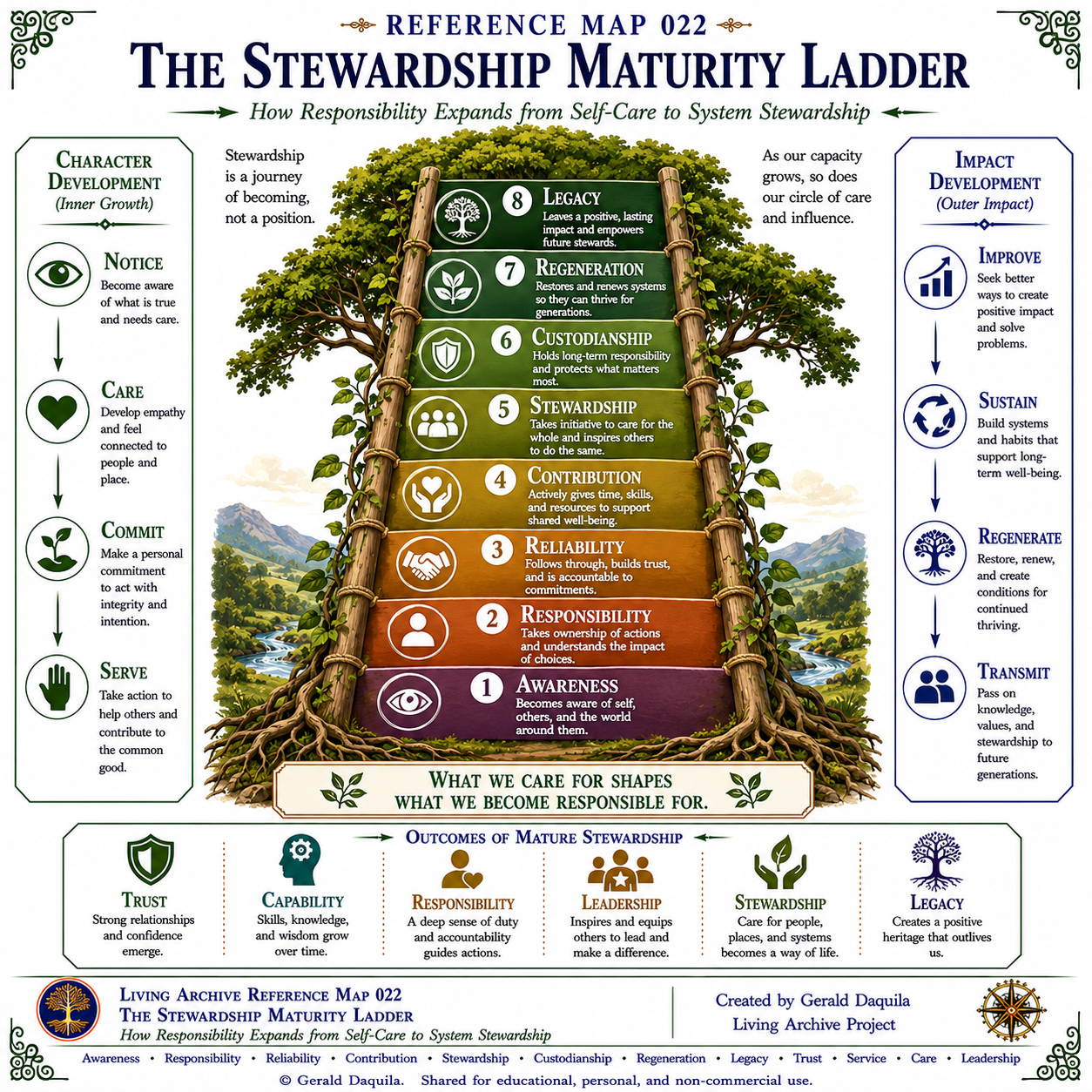
Stewardship Maturity Ladder — Reference Map 022
A visual framework for increasing responsibility and stewardship capacity.
Continue Into Practice
Guided Pathways
Structured experiences designed around genuine human questions and changes in orientation.
Stewardship Institute
The applied educational environment in which understanding can become formation, practice, and responsible institutional participation.
Institutional Accountability
This Cornerstone establishes an educational proposition.
It should therefore also establish a standard against which the Living Archive can be judged.
If the Archive claims that education develops orientation, its learning experiences should demonstrate orientation.
If it claims that learners should develop discernment, its pedagogy should cultivate discernment.
If it claims methodological humility, its institution should acknowledge uncertainty and limits.
If it claims learner sovereignty, learners should remain free to question its conclusions.
If it claims stewardship, its educational practices should demonstrate responsible use of authority.
If it claims that understanding is revisable, the Archive itself must remain capable of revision.
The institution should therefore be judged not only by the elegance of its educational philosophy, but by the degree to which its practice embodies the capacities it seeks to cultivate.
That is the appropriate test.
Document Type
Series: Cornerstones
Knowledge Domain: Education · Human Development · Sensemaking · Civic Life · Stewardship
Methodological Mode: Integrative / Philosophical / Civic Inquiry
Primary Question: What is education for when knowledge is abundant, expertise is fragmented, artificial intelligence can generate plausible answers on demand, and human beings increasingly make consequential decisions within complex systems?
Canonical Role
This Cornerstone articulates the educational philosophy underlying the Living Archive and considers its implications for human development and civic life. It does not claim to present a complete theory of education or empirical validation of the Living Archive’s educational model. It offers a public proposition for examination, criticism, and further inquiry.
Attribution
Author: Gerald Daquila
Publication: Living Archive
Series: Cornerstones
Institutional Context: Life.Understood. / Stewardship Institute
© 2026 Gerald Daquila. All rights reserved.
Understanding begins where certainty ends.