
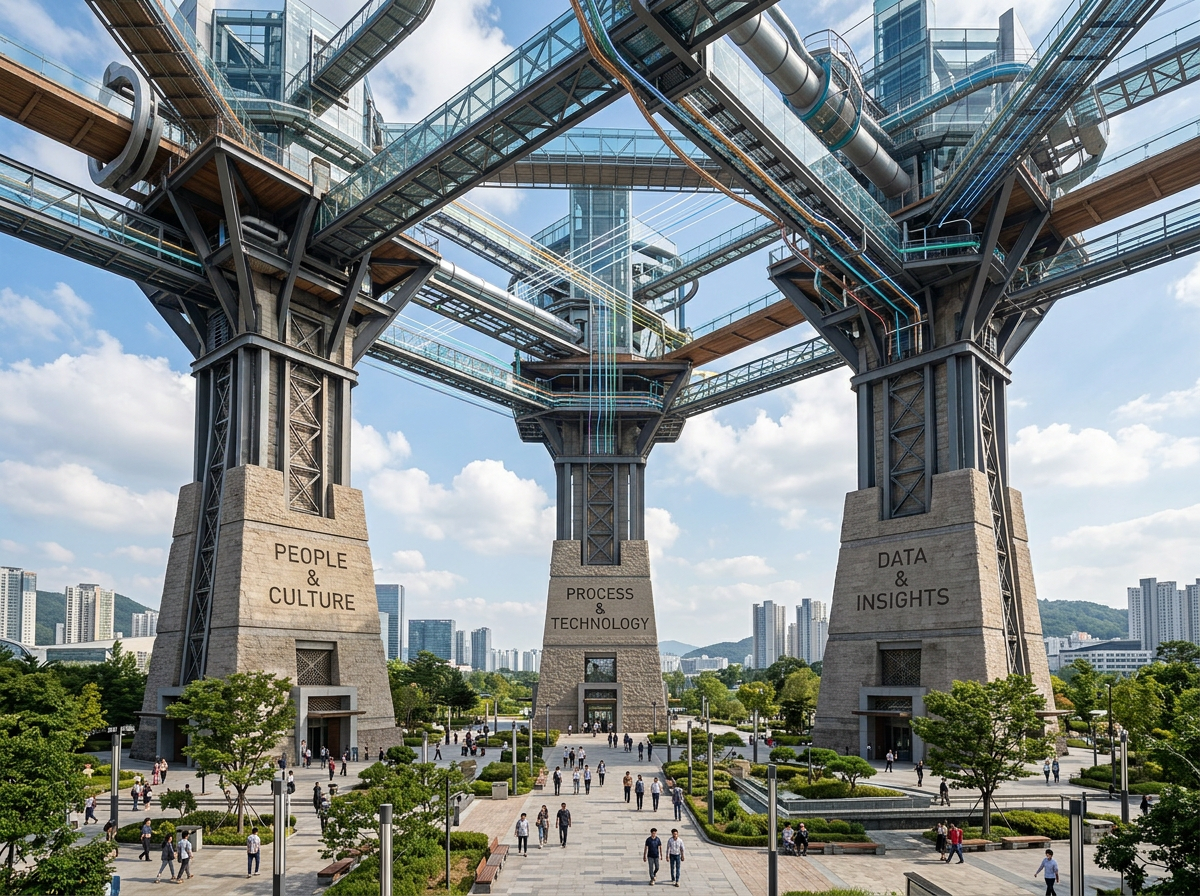
Systemic Integration and the Architecture of Interdependence
Architect’s Note: We use the term ‘Batching’ because nature herself operates in waves. We are reclaiming the efficiency of the machine to serve the rhythm of the heart.
“In a high-fidelity system, the strength of the network is not found in the central command, but in the standardized integrity of its interfaces.”
The Rationale: From Individual Baseline to Collective Flow
If Batch 1 was about stabilizing the Internal Gemba (the individual and the household), Batch 2 is about Systemic Integration.
As sovereign nodes emerge, the risk of “Systemic Friction” increases. Without Standard Work for how these nodes interact, we risk replicating the very power dynamics we are exiting.
In this layer, we introduce advanced Lean frameworks—
- Hoshin Kanri (Strategy Deployment),
- Jidoka (Autonomation), and
- Catchball—to ensure that the “Philippine Ark” and its global counterparts remain decentralized, ethical, and high-performing.
The Framework: The 3 Pillars of Collective Stewardship
Layer 2 protocols focus on the “Operational Glue” that allows independent nodes to function as a unified organism without a central autocrat.
1. Strategic Alignment (Hoshin Kanri)
Standardizing how personal soul missions align with community goals.
Focus: Eliminating “Mission Muda” and ensuring that individual sovereignty strengthens the collective value stream rather than competing with it.
2. Network Integrity (Jidoka & Poka-yoke)
The “Autonomation” of ethics. Protocols for identifying and “stopping the line” when systemic defects—such as power-grabbing, ego-dominance, or resource hoarding—occur.
Focus: Decentralized conflict resolution and ethical error-proofing (Poka-yoke) for governance.
3. The Diaspora Exchange (Catchball Protocol)
Establishing high-fidelity feedback loops between the North American “R&D Nodes” and the Philippine “Gemba Prototypes.”
Focus: Professional “Catchball” sessions, heritage-innovation loops, and the standardized transfer of Lean expertise across borders.
The Terrain Map: Layer 2 Protocols (Integration Phase)
The following protocols are designed to scale the prototype from a single node to a resilient network.
| Protocol ID | Title | Value Stream | Status |
| HK-001 | Hoshin Kanri: Aligning Missions in a Sovereign Node | Integration | Published |
| JID-001 | The Jidoka of Ethics: Protocols for Systemic Integrity | Governance | Published |
| CATCH-001 | The Diaspora Catchball: Transnational Knowledge Flow | Network | Published |
| SEM-001 | Collective Sense-making SOP: Decentralized Consensus | Governance | Published |
| KZN-010 | Kaizen in the Archive: Iterative Soul-Auditing | Coherence | Published |
Operationalizing Batch 2
Implementation of this layer requires a stable Batch 1 baseline.
- Stabilize the Node: Ensure all individual protocols (SWI-001, etc.) are at a “Mature” state.
- Open the Interface: Begin the Catchball process with adjacent nodes or the diaspora network.
- Audit the Flow: Use Jidoka to monitor the ethical health of the integration. If friction occurs, stop the line, identify the root cause, and update the Standard Work.
We are not building a movement. We are deploying an Operating System.
[DOCUMENT CONTROL & STEWARDSHIP]
Standard Work ID: HUB-002
Baseline Version: v1.4.2026
Classification: Open-Access Archive / Prototype Blueprint
The Sovereign Audit:
Verification of this standard occurs at the Gemba—the physical site of the prototype. No external validation is required.
© 2026 Gerald Daquila • Life.Understood • Systemic Stewardship • Non-Autocratic Architecture • Process over Persona