
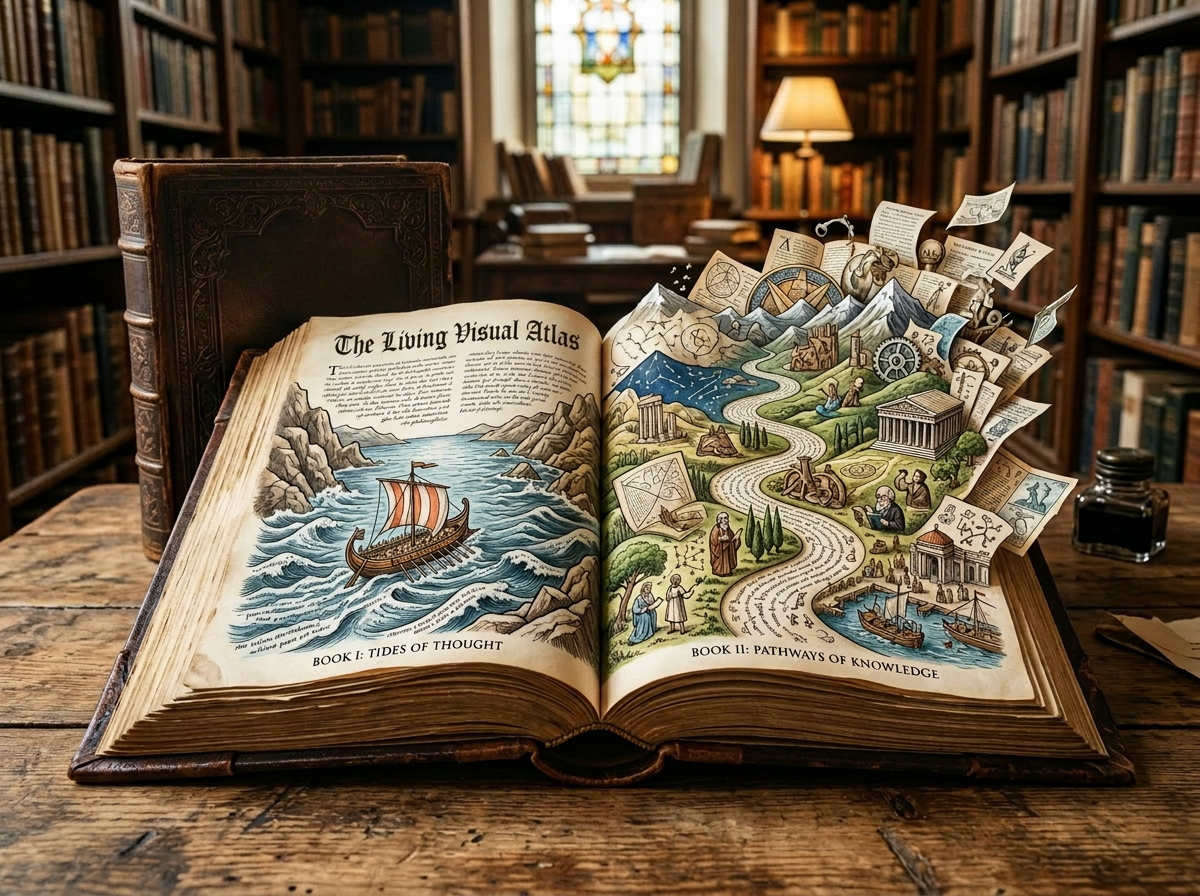
Complete Collection of Reference Maps
Meta Description
Explore The Living Archive Visual Atlas, a complete collection of thirty-one original Reference Maps that reveal the visual architecture of human development, systems thinking, governance, stewardship, implementation, and regenerative civilization through interconnected conceptual frameworks.
A Visual Atlas for Understanding Complexity
The Living Archive has grown into an interconnected body of essays, Reference Maps, Knowledge Hubs, frameworks, and companion publications exploring human development, stewardship, governance, systems thinking, and societal transformation.
As the archive expanded, a new challenge emerged—not simply navigating information, but recognizing the relationships that connect seemingly separate ideas into coherent systems.

The Living Archive Visual Atlas was created to make those relationships visible.
Rather than presenting isolated diagrams or infographics, this complete collection brings together the Living Archive’s thirty-one Reference Maps into a single visual companion. Each map serves as a conceptual landmark, revealing patterns, structures, and recurring principles that extend across disciplines while helping readers establish their bearings before exploring the wider Living Archive.
What You’ll Find Inside
The Visual Atlas brings together every Living Archive Reference Map published to date.
It includes:
- Thirty-one original Reference Maps
- Six interconnected knowledge domains
- Visual frameworks for understanding complex systems
- Conceptual models spanning individuals, institutions, communities, and civilizations
- Cross-disciplinary patterns connecting psychology, governance, stewardship, systems thinking, and regeneration
- A premium illustrated PDF reference designed for continual exploration
Rather than functioning as a conventional book, the Atlas serves as an enduring visual reference that readers can revisit repeatedly as their understanding grows.
The Six Domains of the Atlas
The collection is organized into six interconnected domains that together form the conceptual architecture of the Living Archive.
Human Development
Exploring awareness, identity, learning, transformation, and the capacities that support wise stewardship.
Governance & Sovereignty
Examining institutions, civic responsibility, decentralization, trust, leadership, and resilient governance.
Knowledge & Sensemaking
Understanding how knowledge is created, organized, interpreted, and stewarded through inquiry, discernment, systems thinking, and collective intelligence.
Stewardship & Exchange
Exploring reciprocity, regenerative economics, value creation, stewardship, and healthy systems of exchange.
Implementation & Systems Change
Tracing how ideas become experiments, organizations, institutions, and lasting systems capable of creating meaningful change.
Regeneration & Network Architecture
Examining resilience, ecological thinking, distributed networks, community stewardship, and the long-term renewal of living systems.
Together these six domains provide a visual framework for understanding the interconnected architecture of the Living Archive.
Who This Atlas Is For
The Living Archive Visual Atlas is designed for readers who think visually and seek to understand complexity through relationships rather than isolated facts.
It is especially suited for those interested in:
- Systems thinking
- Human development
- Leadership and governance
- Organizational design
- Regenerative economics
- Ecological thinking
- Community resilience
- Visual learning
- Knowledge architecture
- Stewardship and civilization design
Whether used for personal study, teaching, research, or leadership development, the Atlas provides a lasting visual companion for exploring complex systems with greater clarity.
Relationship to the Living Archive
The Living Archive remains the primary and continually evolving body of work.
The Visual Atlas is designed to accompany that wider ecosystem—not replace it.
Readers are encouraged to move between the Atlas and the online archive, using the Reference Maps to establish orientation before exploring essays, Knowledge Hubs, Cornerstone Hubs, the Living Archive Navigator series, and companion publications in greater depth.
A Companion to the Living Archive Navigator
While the Living Archive Navigator series guides readers through six major domains using curated reading pathways and Guide Notes, the Visual Atlas presents the complete collection of Reference Maps in one unified volume.
Together they provide complementary ways of exploring the Living Archive.
- The Visual Atlas helps readers see the architecture.
- The Navigator helps readers navigate it.
Available through the Stewardship Institute Publisher
Purchase the digital edition of The Living Archive Visual Atlas – Complete Collection.
🛍️ View Publication
About the Author
Gerald Daquila is the creator of the Living Archive—an evolving interdisciplinary body of work exploring human development, systems thinking, governance, stewardship, technology, and regenerative futures. His work integrates research, lived experience, and practical frameworks to help readers navigate complexity with greater clarity, discernment, and responsibility.
About The Living Archive Visual Atlas
The Living Archive Visual Atlas is a companion publication to the Living Archive.
Designed to complement—not replace—the online archive, it brings together the complete collection of Living Archive Reference Maps into a single visual reference that reveals the relationships between ideas across the archive’s major domains.
Explore the complete Living Archive online, or browse the complete collection of Navigators, Field Guides, Study Guides, Structural Simulations, Leadership Development Arcs, and companion publications through the Stewardship Institute Publications.
© 2025–2026 Gerald Alba Daquila. All rights reserved.
The Living Archive®, Life.Understood., and associated publications form an evolving interdisciplinary knowledge ecosystem dedicated to human development, systems thinking, stewardship, governance, regenerative civilization, and lifelong learning.