

A Systems View of Human Development
Human Development • Systems Thinking • Leadership • Stewardship • Meaning
Meta Description
What does it mean to become fully human? Discover a systems view of development that integrates biology, psychology, ethics, leadership, and meaning.
Excerpt
Human development is often studied through separate disciplines—biology, psychology, leadership, ethics, or meaning. This essay argues that these are not independent domains but interconnected expressions of one developmental architecture. Through a systems perspective, Becoming Fully Human explores how integration, rather than accumulation, shapes maturity, responsibility, and stewardship.
Introduction: Beyond Fragmented Understandings
Few questions are more important—or more misunderstood—than how human beings develop.
For centuries, different disciplines have attempted to answer this question from their own perspectives. Biology explains the body. Psychology explores the mind. Neuroscience investigates the brain. Sociology studies culture and institutions. Economics examines incentives. Education focuses on learning. Philosophy asks how we ought to live, while spiritual traditions explore questions of meaning, purpose, and consciousness.
Each perspective contributes something valuable.
Yet each also describes only one part of a much larger whole.
The result is a fragmented understanding of what it means to become fully human. We inherit countless models of growth, but few explain how those models relate to one another. Personal development becomes separated from leadership. Leadership becomes separated from ethics. Ethics becomes separated from systems. Systems become separated from meaning. As knowledge becomes increasingly specialized, the person at the center of that knowledge often disappears (Morin, 2008).
This fragmentation is not merely an academic concern. It shapes how societies educate children, train leaders, design institutions, respond to trauma, and measure success. When development is understood only through isolated disciplines, solutions often address symptoms while overlooking the larger developmental process from which those symptoms emerge.
Throughout the Living Archive, this question has been approached from many directions.
Essays on systems thinking, stewardship, trauma, governance, identity, culture, adaptation, leadership, meaning, and consciousness each illuminate different dimensions of human experience. Read individually, they offer valuable insights. Read together, they suggest something more profound.
Perhaps these are not separate subjects at all.
Perhaps they are different windows onto the same developmental architecture.
This essay explores that possibility. Its central proposition is simple yet far-reaching:
Human development is the lifelong integration of biological, psychological, relational, ethical, systemic, and existential capacities, enabling individuals to participate more wisely, responsibly, and adaptively in an increasingly complex world.
Seen this way, human development is not another academic discipline to be placed alongside psychology, sociology, leadership, or systems theory.
It is the architecture that allows each of those disciplines to find its proper place within a larger understanding of what it means to become fully human.
Related reading: The End of Siloed Knowledge: Why Interdisciplinary Thinking Is Rising
I. The Fragmentation Problem
One of the defining characteristics of modern civilization is specialization.
The ability to divide complex problems into increasingly focused disciplines has produced extraordinary advances in medicine, engineering, science, technology, and the social sciences. Few would wish to reverse this progress. Our capacity to examine the world in ever finer detail has dramatically expanded human knowledge and improved countless aspects of life.
Yet specialization carries an often-overlooked cost.
As knowledge becomes increasingly precise, it also becomes increasingly compartmentalized.
Experts become fluent within their own disciplines while gradually losing sight of how those disciplines relate to the larger whole. We become exceptionally skilled at understanding parts while finding it increasingly difficult to perceive the systems those parts collectively create (Simon, 1962; Morin, 2008).
Human development illustrates this dilemma with unusual clarity.
A neuroscientist may explain neural plasticity without addressing meaning. A psychologist may understand trauma while giving little attention to institutions. An economist may analyze incentives while overlooking character. A leadership scholar may teach influence without examining maturity. A philosopher may explore ethics without considering nervous system regulation.
Each perspective is internally coherent.
None is sufficient on its own.
This is not because any discipline is fundamentally flawed. Rather, it reflects the complexity of the human condition itself. Human beings are simultaneously biological organisms, psychological selves, relational participants, ethical agents, institutional actors, and meaning-making creatures. Remove any one of these dimensions and the picture becomes incomplete (Bronfenbrenner, 1979).
The question, then, is not which discipline offers the correct explanation of human development.
The more important question is how these explanations fit together.
This is where systems thinking offers a fundamentally different perspective.
Rather than isolating components, systems thinking asks how relationships give rise to larger patterns. It shifts attention from individual parts to interactions, feedback loops, adaptation, and emergence. Instead of asking, What is the correct explanation?, it asks, How do these different explanations participate in the same living system? (Meadows, 2008).
This shift is subtle, but its implications are profound.
Biology, psychology, culture, ethics, governance, and meaning cease to be competing accounts of human development. They become interdependent expressions of a single unfolding process.
Understanding human development therefore requires more than collecting insights from multiple disciplines.
It requires discovering the architecture that connects them.
Continue exploring: Why Human Understanding Is Becoming More Networked Than Hierarchical
II. Human Development as an Adaptive System
Every living system faces the same fundamental challenge: how to remain viable within a changing environment.
Forests adapt to shifting climates. Species evolve in response to ecological pressures. Organizations either learn or become obsolete. Civilizations flourish when they successfully respond to changing conditions and decline when they cannot.
Human beings are no exception.
Development is often mistaken for the accumulation of knowledge, credentials, wealth, or experience. While each may accompany growth, none adequately defines it. Information can increase without wisdom. Skill can expand without character. Achievement can coexist with profound immaturity (Kegan, 1982).
The distinguishing feature of development is not what a person possesses but the growing capacity to respond wisely to increasing complexity.
Viewed through this lens, development is best understood as an expanding capacity to adapt without losing coherence.
Consider the arc of an ordinary life. A young child gradually learns emotional regulation. An adolescent begins constructing an independent identity. An adult discovers that healthy relationships require empathy rather than mere competence. Later in life, many come to realize that enduring influence arises less from control than from judgment, presence, and service.
Each stage represents more than the acquisition of new knowledge.
It reflects a qualitative transformation in how the individual perceives reality, integrates competing demands, and responds to an increasingly complex world (Kegan, 1994).
This understanding fundamentally changes what we mean by maturity.
Maturity is not perfection. Nor is it the absence of failure.
It is the growing capacity to remain responsive, grounded, and adaptive as life becomes more complex.
Seen from this perspective, resilience, emotional regulation, ethical judgment, systems awareness, and meaningful purpose are not separate achievements. They are different expressions of a single developmental movement toward greater integration.
Development therefore resembles a living ecosystem far more than a ladder to be climbed.
Growth in one domain inevitably influences every other. Biological health shapes emotional stability. Emotional stability affects relationships. Relationships influence identity. Identity informs ethical choices. Ethical choices shape institutions. Institutions, in turn, influence the developmental possibilities available to future generations (Bronfenbrenner, 1979).
The relationship is recursive.
We do not simply grow within systems.
We are continually shaped by them, even as we participate in shaping them in return.
At this point, the distinction between personal growth and systems thinking begins to dissolve. The individual and the larger system are no longer separate stories. Each develops through continuous interaction with the other.
Understanding human development therefore requires more than understanding individuals.
It requires understanding the dynamic relationship between persons and the living systems of which they are always a part.
Related essay: The Optimization Trap: Why Adaptive Systems Outlast Efficient Ones
III. The Six Interdependent Layers of Human Development
If human development is an integrated process rather than a collection of isolated disciplines, an obvious question follows.
What, precisely, is being integrated?
The answer cannot be reduced to intelligence, emotional health, professional achievement, or spiritual insight alone. Human beings mature across many dimensions simultaneously. Progress within one dimension often accelerates—or constrains—progress within another. Development is therefore less like assembling independent pieces and more like cultivating a living ecosystem whose elements continually influence one another (Bronfenbrenner, 1979).
For clarity, we can distinguish six broad layers within this architecture. They are presented separately only because language requires us to describe them one at a time. In lived experience they remain inseparable.
The first is biological.
Every developmental journey begins with the body. Long before we construct identity, make ethical decisions, or contemplate life’s meaning, we inhabit a nervous system continuously interpreting the world for signs of safety and danger. Our physiology quietly establishes the conditions under which every higher capacity either flourishes or struggles (Porges, 2011).
When the body is chronically overwhelmed, perception narrows. Attention contracts toward immediate survival. Creativity diminishes, empathy becomes more difficult, and long-term thinking gives way to short-term protection. These responses are not moral failures. They are adaptive strategies developed in response to perceived threat.
Conversely, biological regulation expands possibility. A rested body supports clearer perception. Emotional regulation becomes more accessible. Curiosity replaces vigilance, learning becomes easier, and relationships become less governed by fear. The body therefore provides far more than physical health. It creates the conditions within which every subsequent layer of development can emerge.
Yet biology alone cannot explain the human story.
As experience accumulates, the mind begins organizing that experience into an increasingly coherent understanding of reality.
This is the psychological layer.
Experiences become memories. Memories gradually become narratives. Narratives become identity.
Every individual constructs an implicit answer to enduring questions: Who am I? What kind of world do I inhabit? Can other people be trusted? What gives life meaning?
These answers are rarely chosen consciously. They emerge over years through relationships, education, culture, success, disappointment, belonging, exclusion, love, and loss. In this sense, identity is less a fixed possession than an ongoing interpretation of experience (Kegan, 1994).
Healthy psychological development therefore involves more than emotional stability. It requires the continuing ability to revise one’s understanding of oneself without losing one’s center. Maturity does not eliminate uncertainty.
Rather, it increases our capacity to hold complexity without immediately collapsing it into simplistic certainty. Curiosity gradually becomes stronger than defensiveness. Learning becomes easier because identity no longer depends upon always being right.
Yet even our most private psychological life develops in relationship with others.
No human being becomes fully human in isolation.
From infancy onward, every important capacity is shaped through relationship. Attachment precedes autonomy. Trust precedes collaboration. Belonging precedes contribution. Even the sense of an independent self emerges through continuous interaction with parents, families, teachers, communities, and cultures (Bowlby, 1969/1982).
Relationships therefore do far more than provide companionship.
They become developmental environments.
Healthy relationships expand emotional range, deepen empathy, refine communication, and cultivate reciprocity. Harmful relationships often transmit fear, shame, distrust, or patterns of domination that continue shaping perception long after the original circumstances have passed. Families, schools, workplaces, neighborhoods, and communities all function as ecosystems that either nourish or constrain development.
Seen from a systems perspective, relationships are not simply one aspect of life.
They are among the primary mechanisms through which human development occurs.
As awareness continues to expand, another transformation quietly begins.
Questions of competence gradually give way to questions of responsibility.
Knowledge alone no longer seems sufficient. Intelligence without integrity begins to appear incomplete. Influence without humility reveals its dangers.
The question subtly shifts from What am I capable of doing? to What ought I to do with the capacities I have been given?
This is the ethical layer of development.
Ethics is often misunderstood as obedience to external rules. In reality, ethical maturity reflects an increasing capacity to perceive the wider consequences of one’s choices and to act responsibly within increasingly complex situations. Responsibility grows alongside awareness. The more clearly we perceive interdependence, the more naturally stewardship begins to replace self-interest as an organizing principle (Kohlberg, 1984).
Ethical development therefore represents a deepening relationship between freedom and responsibility. Greater capacity is accompanied by greater accountability.
Eventually this widening perspective extends beyond individual relationships altogether.
Every person participates simultaneously in families, organizations, economies, institutions, cultures, technologies, and ecosystems. None of us stands outside these systems. We inherit them, contribute to them, and pass them forward in altered form.
This is the systems layer.
One of the clearest signs of maturity is the gradual ability to think beyond isolated events and begin recognizing recurring patterns. Problems once attributed solely to individuals are understood within broader contexts.
Leadership shifts from reacting to symptoms toward redesigning underlying structures. Education becomes less about transferring information and more about cultivating developmental environments. Organizations become learning systems rather than mechanisms of control (Meadows, 2008).
Systems thinking is therefore much more than an intellectual skill.
It is an expansion of perspective.
The individual gradually learns to perceive relationships rather than fragments, patterns rather than incidents, and long-term consequences rather than immediate outcomes.
Yet even systems thinking leaves one question unanswered.
- To what end?
- Why develop at all?
Sooner or later every human life encounters questions no technical discipline can fully resolve. Love, mortality, beauty, injustice, suffering, and wonder each draw us toward questions of purpose and meaning that resist purely analytical answers (Frankl, 2006).
This is the existential layer.
Related reading: Adaptive Meaning Systems: How Humans Navigate Rapid Cultural Change
Meaning becomes the quiet force that integrates every other dimension of development.
Without meaning, knowledge easily becomes accumulation. Achievement becomes performance. Relationships become transactions. Power becomes an end in itself.
Meaning does not remove uncertainty.
It makes continued participation possible despite uncertainty.
Gradually the central question changes.
Instead of asking, What can I gain from life?, we begin asking, How can my life become a meaningful contribution to something larger than myself?
At this point, the six layers begin dissolving back into one another.
- The body supports the mind.
- The mind shapes relationships.
- Relationships cultivate ethical responsibility.
- Ethical responsibility expands systems awareness.
- Systems awareness deepens meaning.
- Meaning, in turn, reshapes how we inhabit every previous layer.
What first appeared to be six distinct dimensions is revealed as one continuously unfolding process.
Human development is not the pursuit of six separate goals.
It is the lifelong work of integrating them into a coherent way of being in the world.

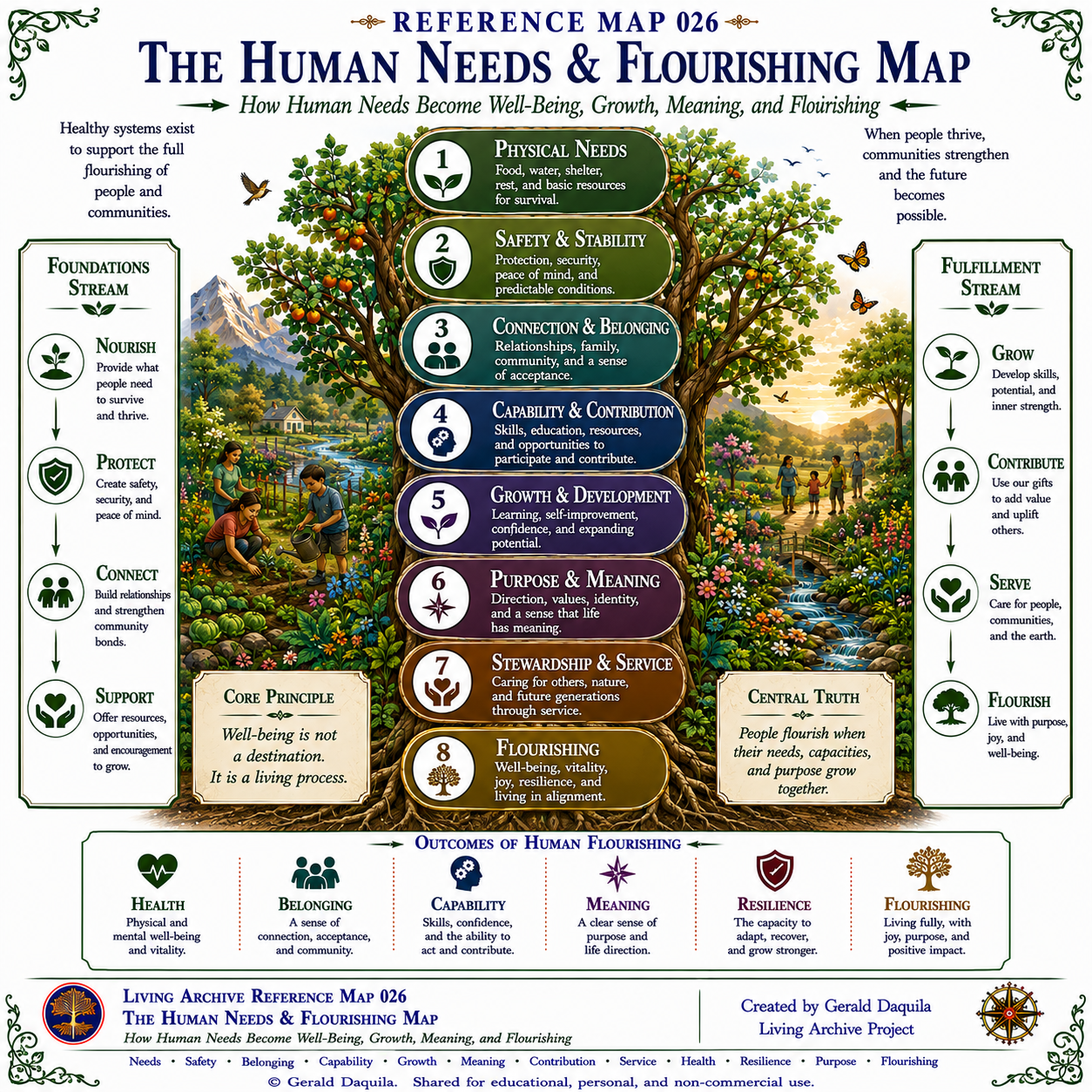
The Human Needs & Flourishing Map visualizes the integrated architecture of human development. Rather than treating biological, psychological, relational, ethical, systemic, and existential capacities as separate domains, it illustrates how they continually interact to support human flourishing as a coherent developmental process.
Continue exploring: Collective Nervous Systems: How Cultures Regulate Human Coherence
IV. Development Through Challenge, Feedback, and Integration
If development is the gradual integration of increasingly complex capacities, an important question remains.
How does that integration actually occur?
Time alone is not enough.
Children do not automatically become wise adults, nor does experience inevitably produce maturity. Some individuals emerge from difficulty with greater compassion and discernment, while others become increasingly fearful, rigid, or cynical. Age, knowledge, and experience all matter, but none guarantees development. Something more fundamental is taking place.
Every adaptive system develops through interaction with its environment.
Muscles strengthen by responding to resistance. The immune system learns through exposure. Scientific understanding advances by testing ideas against reality. Healthy organizations improve through reflection, experimentation, and correction. Growth arises not from passive existence but from continuous engagement with feedback (Meadows, 2008).
Human development follows the same principle.
Throughout life we encounter circumstances that exceed our present capacities. Sometimes they expose limitations we did not know we possessed. Sometimes they invite abilities that have not yet been cultivated. Sometimes they simply reveal that the ways we once understood ourselves are no longer sufficient for the realities we now face.
Challenge, however, is not the same as growth.
This distinction deserves careful attention.
Modern culture often romanticizes adversity, as though suffering itself were inherently transformative. Yet history and ordinary experience suggest otherwise. Hardship can just as easily produce despair, resentment, withdrawal, or violence. Trauma can narrow perception rather than expand it. Loss can harden the heart as easily as deepen compassion (Tedeschi & Calhoun, 2004; Frankl, 2006).
Difficulty alone develops no one.
What matters is whether experience becomes integrated.
Integration is the quiet work through which experience is gradually transformed into understanding. It is the process by which pain becomes wisdom rather than bitterness, failure becomes discernment rather than shame, and responsibility becomes something freely embraced rather than externally imposed.
This process rarely happens in isolation.
It is supported by relationships capable of providing safety, honesty, and encouragement. It requires reflection, because experience that remains unexamined often repeats itself rather than teaching anything new. It requires humility, because growth frequently begins with the recognition that our previous ways of understanding the world are no longer adequate.
Development therefore unfolds through recurring cycles of challenge, feedback, reflection, adaptation, and renewed participation.
Each cycle subtly reshapes the whole person.
The body learns new forms of regulation. Identity becomes more flexible. Relationships deepen. Ethical judgment becomes less reactive and more discerning. Systems previously perceived as fixed reveal themselves to be dynamic and capable of transformation. Even one’s sense of meaning evolves as life is interpreted through an increasingly expansive perspective.
Seen this way, mistakes assume a different significance.
- Failure becomes information rather than identity.
- Conflict becomes an opportunity to strengthen relationships rather than merely to win arguments.
- Uncertainty becomes an invitation to learn rather than a threat to certainty.
- Even success changes its meaning. It is no longer valued simply as proof of competence but as evidence that certain capacities have become sufficiently integrated to carry greater responsibility.
The goal of development, then, is neither comfort nor perpetual struggle.
It is increasing coherence.
A coherent person remains capable of learning without becoming fragmented by experience. Such individuals are not untouched by difficulty, nor are they defined by it. They become increasingly able to transform the full range of human experience—joy and grief, success and failure, certainty and doubt—into deeper wisdom and more responsible participation in the world.
Development is therefore measured not by how much life happens to us, but by how deeply life becomes integrated into who we are becoming.
Related essay: Change, the Nervous System, and the Pace of Meaning
V. From Development to Stewardship
If integration is the defining movement of human development, stewardship emerges almost naturally.
Every stage of maturity enlarges the horizon of concern.
Children gradually learn to regulate themselves. Adolescents begin discovering identity beyond dependence. Adults assume responsibility for relationships, families, vocations, and communities. With continued development, perspective expands still further. Decisions are no longer evaluated solely by their immediate outcomes but by the worlds they help create.
At some point, a subtle transformation occurs.
Development ceases to be primarily about becoming a more capable individual.
It becomes about becoming a more responsible participant.
The distinction is profound.
Capability without responsibility can amplify harm. History offers countless examples of brilliant individuals lacking wisdom, influential leaders lacking integrity, and powerful institutions whose capacities outpaced their maturity. Human development therefore cannot culminate in competence alone (Greenleaf, 1977).
Its natural fulfillment is stewardship.
Stewardship begins with a simple recognition: we do not stand outside the systems that sustain us.
We participate in them.
Families shape us long before we influence them. Communities nurture us before we contribute to them. Civilizations inherit the consequences of decisions made by generations who came before, just as future generations will inherit the consequences of ours.
This awareness changes the questions we ask.
Rather than asking, What can I gain from life?, stewardship asks, What has been entrusted to my care?
The question extends far beyond environmental responsibility. It encompasses character, relationships, knowledge, organizations, institutions, culture, and the countless visible and invisible systems upon which human flourishing depends.
Stewardship is therefore not an additional stage beyond development.
It is development expressed outwardly.
Individuals who have learned to regulate themselves become less governed by impulse. Those who understand their own identities become less threatened by difference. Those who cultivate ethical judgment exercise power with greater restraint. Those who perceive systems recognize that meaningful change rarely comes through isolated action but through the patient cultivation of healthier patterns.
Influence gradually becomes service.
Knowledge matures into wisdom.
Achievement finds its fulfillment in contribution.
At its deepest expression, human development ceases to revolve around self-improvement.
Its purpose becomes participation in the ongoing flourishing of life itself.
Continue exploring: Stewardship vs Management vs Leadership
Conclusion: Becoming More Fully Human
Modern society often measures development through visible achievements—education, professional success, financial security, status, productivity. Each has genuine value, yet none adequately captures what it means to mature as a human being.
A person may possess extraordinary intelligence while remaining emotionally reactive. Another may achieve considerable influence while lacking ethical judgment. Entire societies may generate remarkable technological innovation while neglecting the relational and moral capacities required to use that innovation wisely.
A systems view of human development asks a different question.
Not simply,
What have we accomplished?
But,
Who are we becoming?
This shift changes the conversation entirely.
Development is no longer understood as a series of disconnected goals to be pursued independently—health, knowledge, relationships, ethics, leadership, meaning, or civic responsibility.
Each represents one expression of a larger movement toward integration. The body learns regulation. The mind learns understanding. Relationships cultivate participation. Responsibility deepens character. Systems thinking expands perspective. Meaning gives direction to the whole.
Together they form an increasingly coherent way of inhabiting the world.
This coherence should not be mistaken for perfection.
Life remains uncertain. Growth remains unfinished. Every new horizon reveals further questions alongside deeper understanding. The mature person is therefore not someone who has eliminated uncertainty but someone who has learned to remain open to reality without becoming fragmented by it.
Such people become stabilizing presences within their families, trusted colleagues within organizations, wise leaders within institutions, and faithful stewards of the communities and systems they inhabit. Their influence arises less from authority than from the quiet integration of their lives.
Perhaps this is the deepest purpose of human development.
Not simply to improve ourselves.
But to become people through whom life itself becomes more coherent, more compassionate, more responsible, and more capable of flourishing.
If this is so, then human development is not merely one subject among many.
It is the living architecture through which biology, psychology, relationships, ethics, leadership, governance, and meaning gradually converge into a single question that accompanies every human life:
How shall we participate in the world we are helping to create?
References & Foundational Works
The following works informed the intellectual development of this essay. Some are directly cited throughout the manuscript, while others are included because they represent foundational contributions to the broader conversations on systems thinking, human development, neuroscience, leadership, ethics, and meaning. Together they provide readers with a guided pathway for exploring the ideas developed here.
The works below are listed alphabetically by author.
Bowlby, J. (1982). Attachment and Loss: Vol. 1. Attachment (2nd ed.). Basic Books. (Original work published 1969)
A landmark in attachment theory, Bowlby demonstrated that human development begins in relationship. His work fundamentally reshaped psychology by showing that early attachment patterns influence emotional regulation, identity formation, resilience, and interpersonal trust throughout life. The relational layer of this essay draws upon this developmental foundation.
Bronfenbrenner, U. (1979). The Ecology of Human Development. Harvard University Press.
Bronfenbrenner’s ecological systems theory transformed developmental psychology by demonstrating that human growth occurs within nested environments—from family and school to institutions and culture. This essay extends that ecological perspective by integrating biological, psychological, ethical, systemic, and existential dimensions into a unified developmental architecture.
Frankl, V. E. (2006). Man’s Search for Meaning. Beacon Press. (Original work published 1946)
Frankl’s exploration of meaning under conditions of profound suffering remains one of the twentieth century’s most influential contributions to existential psychology. This manuscript draws upon his central insight that meaning is not the absence of suffering, but one of the primary capacities through which suffering may be integrated into a meaningful life.
Greenleaf, R. K. (1977). Servant Leadership. Paulist Press.
Greenleaf challenged conventional models of authority by arguing that genuine leadership begins with service rather than power. His work provides an important intellectual foundation for the manuscript’s discussion of stewardship as the natural outward expression of mature human development.
Kegan, R. (1982). The Evolving Self: Problem and Process in Human Development. Harvard University Press.
Kegan’s constructive-developmental theory provides one of the manuscript’s principal developmental foundations. Rather than treating growth as the accumulation of knowledge or skills, he demonstrated that maturity involves increasingly sophisticated ways of constructing meaning. Many of the manuscript’s discussions of adaptive integration and developmental transformation reflect this perspective.
Kegan, R. (1994). In Over Our Heads: The Mental Demands of Modern Life. Harvard University Press.
Expanding his earlier work, Kegan argued that modern societies increasingly demand higher levels of cognitive and emotional complexity than many institutions were designed to cultivate. His work reinforces the manuscript’s argument that development involves expanding one’s capacity to navigate complexity without losing coherence.
Kohlberg, L. (1984). Essays on Moral Development, Volume II: The Psychology of Moral Development. Harper & Row.
Kohlberg’s stage theory of moral development remains one of the foundational frameworks for understanding ethical maturation. Although subsequent scholarship has expanded and critiqued aspects of his model, his work established the principle that ethical reasoning itself develops through increasingly complex structures of judgment.
Meadows, D. H. (2008). Thinking in Systems: A Primer. Chelsea Green Publishing.
Perhaps the most accessible introduction to systems thinking, Meadows demonstrates how feedback loops, emergence, leverage points, and interconnected relationships shape the behavior of complex systems. This manuscript adopts systems thinking not merely as an analytical tool but as a way of understanding human development itself.
Morin, E. (2008). On Complexity. Hampton Press.
Morin has been one of the leading philosophical voices arguing against fragmentation in modern knowledge. His work advocates integrative thinking capable of holding complexity without reducing it to isolated disciplines. The opening chapters of this essay owe much to this broader intellectual orientation.
Porges, S. W. (2011). The Polyvagal Theory: Neurophysiological Foundations of Emotions, Attachment, Communication, and Self-Regulation. W. W. Norton.
Porges’ work highlights the central role of the autonomic nervous system in shaping emotional regulation, safety, social engagement, and adaptive functioning. While aspects of Polyvagal Theory continue to be debated, its emphasis on physiological regulation as a prerequisite for higher-order functioning provides an important biological perspective for understanding development.
Simon, H. A. (1962). “The Architecture of Complexity.” Proceedings of the American Philosophical Society, 106(6), 467–482.
This seminal paper introduced one of the foundational ideas of complexity science: that complex systems can often be understood as hierarchies of interacting subsystems. Simon’s insights continue to influence systems thinking, organizational theory, cognitive science, and interdisciplinary research, providing an important conceptual backdrop for this essay’s discussion of fragmentation and integration.
Tedeschi, R. G., & Calhoun, L. G. (2004). “Posttraumatic Growth: Conceptual Foundations and Empirical Evidence.” Psychological Inquiry, 15(1), 1–18.
Tedeschi and Calhoun challenged the assumption that adversity automatically produces either pathology or resilience. Their research demonstrates that meaningful psychological growth following hardship is possible, but neither inevitable nor universal. This distinction underpins the manuscript’s argument that development arises not from suffering itself, but from the successful integration of experience.
Further Reading by Theme
Readers wishing to explore adjacent conversations may also find the following works valuable. While not directly cited in this essay, they complement its interdisciplinary perspective and provide deeper treatment of specific dimensions of human development.
- Antonio Damasio, Descartes’ Error and Self Comes to Mind — embodied cognition, emotion, and consciousness.
- Erik Erikson, Childhood and Society — psychosocial development across the lifespan.
- Carol Gilligan, In a Different Voice — ethics of care and moral development.
- Jean Piaget, The Origins of Intelligence in Children — cognitive development.
- Martin Seligman, Flourish — positive psychology and human flourishing.
- Peter Senge, The Fifth Discipline — organizational learning and systems thinking.
- Paul T. P. Wong, The Psychology of Meaning — meaning-centered psychology and flourishing.
- Irvin D. Yalom, Existential Psychotherapy — existential psychology and the human condition.
Living Archive Companion
Every Cornerstone forms part of a larger architecture of inquiry. The Living Archive Companion situates this essay within the broader Living Archive by highlighting its scholarly context, methodological foundations, scope, continuing questions, and related pathways for exploration. As the Living Archive evolves, this companion may expand to reflect new research, historical casework, instruments, and practical applications.
Comparative Perspectives
Where this essay sits within the broader conversation
The Architecture of Human Development explores how human growth unfolds across multiple, interconnected dimensions rather than through isolated milestones. Instead of treating development as the accumulation of knowledge, skills, or achievements alone, the essay proposes that mature development involves the progressive integration of identity, emotional capacity, relationships, meaning, systems awareness, and stewardship. Human flourishing emerges not from maximizing a single dimension but from cultivating coherence across the whole person. This framework serves as one of the organizing architectures for the Human Development branch of the Living Archive.
Developmental Psychology
Developmental psychology has long examined how cognition, identity, emotional maturity, and moral reasoning evolve across the lifespan. This essay builds upon those traditions by integrating multiple developmental domains into a unified architectural framework rather than treating them as separate lines of inquiry.
Systems Thinking
Systems thinking emphasizes that complex systems derive their properties from relationships among their parts rather than from isolated components. This essay applies that principle to human development, suggesting that lasting maturity emerges through the integration of psychological, relational, institutional, and cultural dimensions rather than through optimization of any single capacity.
Human Flourishing
Research in positive psychology and flourishing increasingly recognizes that well-being encompasses meaning, relationships, contribution, resilience, and purpose alongside subjective happiness. This essay extends that perspective by situating flourishing within a lifelong developmental process that naturally culminates in stewardship.
Institutional and Cultural Development
Human development never occurs in isolation. Families, schools, communities, institutions, and cultures all shape developmental pathways. The essay therefore examines personal growth as inseparable from the environments that cultivate—or constrain—it.
The Living Archive’s distinctive contribution
The Living Archive synthesizes developmental psychology, systems thinking, human flourishing, institutional development, and stewardship into a coherent developmental architecture. Rather than presenting human development as preparation for success alone, it frames development as the gradual cultivation of the capacities required for responsible participation in increasingly complex human systems. Stewardship becomes the mature expression of an integrated life rather than an external obligation.
Evidence & Foundations
Knowledge domains informing this essay
Primary disciplines
- Developmental Psychology
- Human Development
- Systems Thinking
- Positive Psychology
- Moral Development
- Organizational Learning
- Sociology
- Human Flourishing Studies
Representative thinkers
- Robert Kegan
- Erik Erikson
- Jean Piaget
- Carol Gilligan
- Martin Seligman
- Peter Senge
- Urie Bronfenbrenner
- Mihaly Csikszentmihalyi
Nature of the evidence
✓ Integrative synthesis across multiple disciplines
✓ Systems-based interpretation of lifelong human development
✓ Comparative engagement with developmental and flourishing research
✓ Integration of identity, relationships, meaning, and stewardship
◻ Comparative longitudinal studies of integrated developmental architectures (future)
◻ Practical developmental assessment and stewardship instrumentation (planned)
This essay presents an integrative architectural synthesis informed by multiple disciplines, historical observation, and lived experience. It is intended to support orientation rather than serve as a comprehensive empirical theory. As the Living Archive evolves, this framework may be refined through comparative scholarship, practical instrumentation, historical casework, and empirical research.
Boundaries & Limitations
This essay presents an integrative framework for understanding human development rather than a comprehensive replacement for established developmental theories.
Accordingly, it should not be interpreted as:
- a universal stage model applicable to every individual or culture;
- a comprehensive psychological theory explaining every aspect of human growth;
- a claim that development proceeds through identical pathways for all people;
- an assertion that personal development alone resolves institutional or societal challenges.
Instead, the framework offers an orienting architecture that brings together multiple dimensions of development into a coherent whole. It emphasizes relationships, systems, meaning, and stewardship while remaining open to continued refinement through research, lived experience, and interdisciplinary dialogue.
Questions for Further Inquiry
The Architecture of Human Development raises important questions for future interdisciplinary research.
Readers may wish to explore:
- Which developmental capacities most strongly support wise stewardship across changing life stages?
- How do families, educational systems, and institutions shape long-term developmental trajectories?
- What distinguishes growth that increases personal achievement from growth that increases responsibility and contribution?
- How can societies intentionally cultivate developmental environments that support human flourishing?
- Which forms of assessment can evaluate integrated human development without reducing it to simplistic metrics?
These questions continue to shape the Living Archive’s evolving research agenda.
Continue Exploring
If you’re exploring the foundations of human development…
- Becoming Fully Human
- The Architecture of Identity
- The Life We Inherit: Becoming the Author of a Conscious Life
If you’re interested in development, meaning, and stewardship…
If you’re examining human development within larger systems…
- The Human System
- Living Between Worlds
- The Stewardship Age: Why Stewardship Will Define the Twenty-First Century
About This Essay
This essay is part of the Living Archive’s Cornerstone Series—long-form syntheses that integrate research across disciplines to explore enduring questions of human development, systems thinking, stewardship, and meaning. Rather than introducing a new discipline, these essays seek to reveal the underlying architecture connecting diverse fields of inquiry into a coherent understanding of human flourishing.
Research Note
This manuscript is an interdisciplinary synthesis informed by developmental psychology, systems theory, neuroscience, moral philosophy, leadership studies, and existential psychology. This essay is intended as an integrative synthesis rather than an exhaustive review of the scholarly literature. Citations reference foundational works that support the essay’s central propositions while preserving readability for a broad audience.
The Living Archive
Becoming Fully Human is part of the Cornerstone Collection of the Living Archive.
Curated and developed by Gerald Daquila as part of the ongoing Life.Understood. and Living Archive initiatives exploring governance, stewardship, intelligence, meaning, and human flourishing.
© 2026 Gerald Daquila. All rights reserved.
Search the Living Archive
The Living Archive is designed to be explored through pathways, frameworks, and connected ideas. If you are looking for a specific concept, question, theme, or relationship, AI Search can help surface relevant articles, maps, hubs, and resources from across the archive.
Ask a question, explore a topic, or follow a thread of inquiry.
Leave a Reply