How to pursue meaning, growth, and transcendence without losing touch with reality, responsibility, and everyday life.
Meta Description
Spiritual awakening can provide meaning, purpose, and transformation. Yet spiritual narratives can also become forms of escapism. Explore how to balance transcendence with grounded responsibility in an age of uncertainty.
Periods of social uncertainty often produce periods of spiritual searching.
When familiar institutions lose credibility, when cultural narratives weaken, and when rapid change creates confusion, people naturally seek frameworks that help explain what is happening.
Throughout history, spiritual traditions have served this purpose. They have offered meaning during upheaval, guidance during uncertainty, and hope during times of transition.
The contemporary world is no exception.
Across cultures, increasing numbers of people are exploring spirituality, consciousness, personal transformation, meditation, energy practices, mysticism, ancestral traditions, and alternative models of human development.
Social media, digital communities, and global connectivity have accelerated the spread of these ideas, making spiritual exploration more accessible than ever before.
This renewed interest reflects something deeply human.
People want meaning.
They want coherence.
They want to understand their place within a rapidly changing world.
Yet spiritual exploration also contains risks.
One of the most significant is the temptation to use spirituality not as a tool for engaging reality, but as a means of escaping it.
The challenge is not whether spirituality is valuable.
The challenge is how to pursue it without losing contact with the responsibilities and realities of human life.
Why Awakening Narratives Become Attractive
Periods of uncertainty create psychological discomfort.
Human beings naturally seek explanations that reduce ambiguity and restore a sense of order.
Awakening narratives often provide exactly this function.
They offer frameworks that explain why existing systems appear unstable.
They provide stories that connect individual experiences to larger transformations. They often suggest that confusion, disruption, and change are not random but part of a broader developmental process.
This can be deeply reassuring.
A coherent narrative helps people make sense of uncertainty.
Psychologists have long observed that human beings possess a fundamental need for meaning and cognitive coherence (Frankl, 1959/2006).
When conventional explanations appear inadequate, alternative frameworks often become more appealing.
The attraction is understandable.
The danger emerges when the narrative becomes more important than reality itself.
The Difference Between Meaning and Certainty
Healthy spirituality often helps people engage uncertainty more skillfully.
Unhealthy spirituality often promises to eliminate uncertainty altogether.
This distinction is critical.
Many awakening narratives offer explanations for complex social, political, economic, and personal events.
Some of these interpretations may contain valuable insights. Others may oversimplify realities that are inherently complex.
The problem is not spirituality.
The problem is certainty.
Complex systems rarely yield simple explanations.
Human societies are influenced by countless interacting factors, many of which remain difficult to predict or fully understand.
Attempts to compress these dynamics into single explanatory narratives can create false confidence rather than genuine understanding.
Meaning can coexist with uncertainty.
Wisdom often requires it.
Spiritual Bypassing and the Avoidance of Reality
Psychologist John Welwood (2000) introduced the concept of spiritual bypassing to describe the tendency to use spiritual beliefs or practices to avoid unresolved emotional, psychological, or practical challenges.
Examples may include:
Avoiding grief through positive-thinking doctrines
Ignoring relationship problems in favor of spiritual ideals
Neglecting personal responsibility while focusing on cosmic explanations
Dismissing difficult emotions as signs of insufficient consciousness
Replacing critical thinking with unquestioned belief
These patterns can emerge in any spiritual tradition.
The issue is not the specific belief system.
The issue is how beliefs are being used.
When spirituality becomes a substitute for emotional processing, accountability, or engagement with reality, it can limit growth rather than support it.
Awakening Does Not Eliminate Human Life
One common misconception found across many spiritual communities is the assumption that growth means transcending ordinary human concerns.
Yet most wisdom traditions suggest something different.
Mature development does not eliminate the challenges of human existence.
People still experience uncertainty.
Relationships still require effort.
Communities still require stewardship.
Bodies still require care.
Responsibilities still exist.
Growth often increases awareness of these realities rather than reducing them.
The goal is not escaping human life.
The goal is participating in it more consciously.
In this sense, spirituality is less about leaving the world and more about learning how to inhabit it wisely.
The Importance of Discernment
The digital age has dramatically increased access to spiritual information.
This creates opportunities.
It also creates challenges.
Individuals now encounter teachings, interpretations, predictions, and claims from thousands of sources with varying levels of credibility, expertise, and integrity.
Discernment therefore becomes essential.
Discernment is not cynicism.
Nor is it blind acceptance.
It is the ability to evaluate claims thoughtfully while remaining open to learning.
Healthy discernment asks questions such as:
What evidence supports this claim?
Does this interpretation acknowledge complexity?
Is uncertainty allowed?
Are alternative explanations considered?
Does this framework encourage responsibility or dependency?
Does it strengthen engagement with reality or encourage withdrawal from it?
These questions help distinguish exploration from unquestioning belief.
Community Matters More Than Ideology
One of the overlooked aspects of spiritual development is the importance of community.
Many people seek awakening experiences while neglecting the relationships that sustain human flourishing.
Yet research consistently shows that social connection contributes significantly to psychological well-being, resilience, and meaning (Putnam, 2000).
Communities provide feedback.
They provide accountability.
They provide opportunities to practice compassion, cooperation, patience, and stewardship.
Without these relational dimensions, spirituality can become highly individualistic.
The focus shifts toward personal insight while neglecting collective responsibility.
Human development, however, occurs not only within the self but also through relationships with others.
Staying Grounded During Transformation
Periods of personal or societal transformation often generate strong emotions.
Excitement.
Hope.
Confusion.
Fear.
Anticipation.
These experiences are normal.
The challenge is remaining grounded while navigating them.
Grounding does not mean rejecting spiritual experiences.
It means maintaining connection with practical reality.
Grounded spirituality includes:
Caring for physical health
Maintaining relationships
Meeting responsibilities
Engaging with community
Practicing critical thinking
Remaining open to revision and learning
These practices help ensure that growth remains integrated rather than disconnected from everyday life.
The Role of Humility
Many spiritual traditions emphasize humility for good reason.
Humility recognizes the limits of individual understanding.
The larger and more complex reality becomes, the more important humility becomes.
This is especially relevant during periods of social transition.
Rapid change often creates strong incentives to seek certainty.
Yet certainty can become a trap.
Humility allows people to remain curious.
It allows beliefs to evolve.
It allows learning to continue.
Most importantly, it reduces the likelihood that spiritual frameworks become rigid identities rather than tools for growth.
Spirituality as Stewardship
One useful way to think about spirituality is through the lens of stewardship.
Stewardship shifts attention away from special knowledge, exclusive insight, or personal elevation.
Instead, it asks:
How do we care for what has been entrusted to us?
This includes:
Our relationships
Our communities
Our institutions
Our environment
Our responsibilities
Our own development
Viewed this way, spirituality becomes less about escaping the world and more about participating responsibly within it.
The focus moves from transcendence alone toward integration.
Remaining Human
The modern world often presents a false choice.
On one side lies materialism without meaning.
On the other lies spirituality detached from reality.
Neither extreme is particularly helpful.
Human beings require both meaning and groundedness.
We need frameworks that help us understand our experiences.
We also need the humility to recognize the limits of our understanding.
Spirituality can provide valuable tools for navigating uncertainty, cultivating compassion, and developing wisdom.
At its best, it deepens engagement with life rather than encouraging withdrawal from it.
The measure of spiritual growth may not be how far one escapes ordinary human experience.
It may be how fully one learns to inhabit it.
To remain compassionate amid conflict.
Responsible amid uncertainty.
Grounded amid transformation.
And human amid narratives that promise transcendence.
In an age increasingly filled with awakening stories, perhaps the most important challenge is not awakening from reality.
It is learning how to meet reality more honestly, more humbly, and more completely than before.
Frankl, V. E. (2006). Man’s search for meaning. Beacon Press. (Original work published 1959)
Putnam, R. D. (2000). Bowling alone: The collapse and revival of American community. Simon & Schuster.
Welwood, J. (2000). Toward a psychology of awakening: Buddhism, psychotherapy, and the path of personal and spiritual transformation. Shambhala Publications.
The Living Archive is designed to be explored through pathways, categories, and search. If you’re looking for a specific idea, question, or theme, AI Search can help surface relevant connections across the archive.
Attribution
The Living Archive Integrative Frameworks for Regenerative Civilization
This article is intended for educational, research, and civic inquiry purposes. Readers are encouraged to engage critically, verify sources independently, and explore related knowledge hubs for broader systems context.
Most people arrive at the Living Archive through a particular doorway.
Some come looking for ideas about leadership, systems, governance, or technology. Others arrive through questions of meaning, transition, personal growth, or the search for a more coherent way of understanding the world.
The doorway varies.
The underlying question is often the same.
How do we make sense of life when familiar explanations no longer seem sufficient?
Looking back, that question sits beneath nearly everything in this archive.
It was present long before there was an archive, before there were frameworks, maps, essays, or institutions to study. It appeared as a quiet but persistent feeling that many of the explanations I had inherited were useful but incomplete. They could describe certain aspects of reality while leaving others untouched.
Like many people, I followed the paths that seemed likely to produce a meaningful life.
Education, achievement, professional development, and the pursuit of competence all mattered, and many brought genuine value. Yet beneath those pursuits remained questions that success alone could not answer.
What makes a life meaningful?
Why do certain experiences change us so profoundly?
Why do individuals and organizations so often produce outcomes that differ from their intentions?
How do people remain grounded during periods of uncertainty and change?
At first, these appeared to be separate questions. Over time, they revealed themselves as different expressions of the same inquiry.
The more I explored human behavior, the more systems seemed to matter. The more I explored systems, the more questions of leadership emerged. Leadership led toward ethics. Ethics led toward culture.
Culture led toward institutions. Institutions led toward technology. Technology eventually circled back to questions of identity, meaning, and what it means to remain human in an increasingly complex world.
What changed was not the question.
Only the scale.
The inquiry expanded from the personal to the collective, from individual lives to organizations, from organizations to institutions, and from institutions to the broader systems shaping contemporary civilization.
The Living Archive emerged from following that expansion.
Looking back, I eventually came to see that many of the questions explored throughout this archive emerge from a recurring human experience.
At certain moments, life places us in unfamiliar territory. A relationship ends. A career changes. A belief system no longer fits. A society enters a period of disruption. Something we once relied upon stops making sense.
The experience can feel like finding oneself dropped into an unfamiliar landscape without a map.
The first task is not mastery.
It is orientation.
Where am I?
What has changed?
What assumptions no longer apply?
Is this place safe enough to explore?
As understanding grows, the landscape gradually becomes more familiar. Patterns emerge. Relationships become visible. What once felt chaotic begins to make sense.
Eventually a new equilibrium forms. Life stabilizes. The questions quiet.
Until another horizon appears and the process begins again.
In retrospect, much of the Living Archive can be understood as a record of that process—an ongoing effort to orient, understand, adapt, and participate more consciously within changing environments.
It was never intended to become a comprehensive theory of anything. It is better understood as a record of observation, reflection, and sensemaking across multiple domains that are often treated separately but experienced together.
Real life rarely arrives neatly organized into categories.
Questions of meaning influence leadership.
Leadership influences institutions.
Institutions influence culture.
Culture influences technology.
Technology influences how people understand themselves and one another.
The boundaries between these domains are far more permeable than they initially appear.
Much of the work collected here is an attempt to understand those relationships.
Over time, another pattern became increasingly visible.
Many of the challenges facing individuals and societies are not caused by a lack of information. They arise from difficulty interpreting information within environments that are becoming more complex, interconnected, and fast-moving.
We know more than previous generations and yet often feel less certain.
We have unprecedented access to knowledge and yet frequently struggle to distinguish signal from noise.
We possess powerful technologies and yet continue wrestling with ancient questions of meaning, responsibility, and human flourishing.
This is not merely a technological challenge.
It is a sensemaking challenge.
How do we understand reality well enough to participate in it wisely?
That question appears throughout the archive in different forms. Sometimes it emerges through essays on governance and institutional design.
Sometimes through leadership, systems thinking, artificial intelligence, stewardship, culture, or personal development. Occasionally it appears through symbolic or contemplative inquiry.
The language changes.
The underlying concern remains remarkably consistent.
Human beings increasingly need ways of navigating complexity without surrendering their humanity.
We need frameworks without becoming trapped by them.
We need knowledge without mistaking it for wisdom.
We need adaptability without losing coherence.
We need the capacity to remain thoughtful while the world around us changes.
The Living Archive does not offer a final answer to these challenges.
Nor does it present a doctrine to be adopted.
It is simply one person’s ongoing attempt to remain in conversation with questions that have proven difficult, consequential, and enduring.
Some readers may find practical tools here.
Others may find language for experiences they have struggled to articulate. Still others may discover ideas that challenge assumptions or open new avenues of inquiry.
The archive is large enough that different people encounter different things.
What connects them is not a shared conclusion.
It is a shared willingness to ask deeper questions.
If there is a purpose behind the work, it is perhaps this:
To create a space where ideas, experiences, systems, and questions can be held together long enough for meaningful patterns to emerge.
A place for orientation rather than certainty.
A place for inquiry rather than ideology.
A place where complexity can be engaged without abandoning reflection, responsibility, or wonder.
Everything else in the archive grows from that intention.
The essays.
The maps.
The frameworks.
The simulations.
The Cornerstone Hubs.
The Stewardship Institute.
The recurring explorations of leadership, governance, technology, meaning, and human development.
They are not separate projects.
They are different pathways into the same landscape.
And beneath them all remains the question that started the journey:
How do we make sense of reality well enough to participate in it wisely?
That question remains unfinished.
For that reason alone, it remains worth asking.
Living Archive Companion
Every Cornerstone forms part of a larger architecture of inquiry. The Living Archive Companion situates this essay within that broader landscape by highlighting its scholarly context, methodological foundations, scope, open questions, and related pathways for continued exploration. As the Living Archive evolves, this companion may expand to reflect new research, instruments, historical casework, and practical applications.
Comparative Perspectives
Where this essay sits within the broader conversation
This essay belongs to a long tradition of inquiry into how human beings orient themselves amid uncertainty. While it does not advance a single disciplinary theory, it draws together insights from several complementary fields.
Sensemaking & Organizational Learning
Karl Weick’s work on organizational sensemaking explores how people construct meaning when familiar assumptions no longer explain unfolding events. Like Weick, this essay understands orientation as preceding effective action.
Systems Thinking
Donella Meadows demonstrated that understanding relationships often matters more than analyzing isolated parts. This essay similarly treats leadership, meaning, governance, technology, and human development as interconnected expressions of a larger living system.
Adult Development
Robert Kegan’s constructive-developmental theory suggests that human maturity involves progressively more complex ways of making meaning. The developmental movement described throughout this essay closely parallels that understanding while extending it toward stewardship and civilizational participation.
Existential Philosophy
Thinkers such as Viktor Frankl and Hannah Arendt emphasized humanity’s capacity to respond consciously amid uncertainty rather than merely react to circumstance. This essay shares that concern while framing orientation as an ongoing developmental practice.
Where the Living Archive differs
The Living Archive does not seek to replace these traditions, but to place them into conversation with one another. Its distinctive contribution is the construction of an orientational architecture through which insights from multiple disciplines can be understood as mutually reinforcing rather than intellectually isolated.
Evidence & Foundations
Knowledge domains informing this essay
Primary disciplines
Systems Thinking
Developmental Psychology
Organizational Sensemaking
Existential Psychology
Leadership Studies
Institutional Theory
Human Development
Representative thinkers
Karl Weick
Donella Meadows
Robert Kegan
Viktor Frankl
Edgar Schein
Elinor Ostrom
Nature of the evidence
✓ Integrative synthesis of established scholarship
✓ Phenomenological reflection grounded in lived observation
✓ Conceptual architecture
◻ Original empirical research (future)
◻ Longitudinal institutional validation (future)
This essay should be understood as an orientational synthesis rather than a comprehensive empirical theory. It draws together recurring patterns observed across multiple disciplines while remaining open to refinement as further historical, comparative, and empirical work develops.
Boundaries & Limitations
Every framework illuminates some aspects of reality while leaving others outside its scope.
This essay is intended as an orientation rather than a doctrine. It does not claim to explain every dimension of human development, nor does it prescribe a universal pathway through complexity.
The framework does not claim that:
all people experience development in the same sequence;
sensemaking alone resolves institutional or societal challenges;
complexity can always be reduced to coherent patterns;
reflection should replace empirical investigation or domain-specific expertise.
Instead, it proposes that orientation is a necessary precursor to wise participation, while recognizing that different disciplines contribute complementary forms of knowledge.
Questions for Further Inquiry
The Living Archive treats inquiry as an ongoing practice rather than a completed achievement.
Readers may wish to explore questions such as:
What enables some individuals to remain coherent during periods of profound uncertainty while others fragment?
Which historical societies developed particularly resilient practices of collective sensemaking?
How should orientation differ across cultures, institutions, and stages of development?
What evidence would strengthen—or meaningfully revise—the architectural model presented here?
How might artificial intelligence assist human orientation without diminishing human judgment?
These questions continue to shape the Living Archive’s evolving research agenda.
The Question Beneath the Questionsserves as a reflective orientation to the Living Archive and the broader body of work it contains.
Rather than presenting a single framework or argument, it explores the recurring questions that connect the archive’s major domains, including systems thinking, leadership, governance, stewardship, technology, meaning-making, and human development.
Readers new to the archive may wish to continue with the Living Archive Atlas, the Twelve Cornerstone Hubs, or the Orientation Pathways.
The Living Archive
Exploring systems, leadership, stewardship, meaning-making, and human development through reflective inquiry.
How the Self Emerges, Develops, and Becomes Conscious
Meta Description
The Architecture of Identity explores how identity forms through relationships, memory, culture, and experience, and how a consciously integrated self becomes the foundation for human flourishing and stewardship.
Excerpt
We often imagine identity as something hidden within us, waiting to be discovered. Yet identity is neither simply found nor invented. It is gradually constructed through relationships, memory, culture, language, and lived experience.
This essay explores how the self takes shape, why identity remains both stable and continually changing, and how mature identity becomes the foundation for conscious participation in life.
Few questions feel more personal than identity.
We speak of finding ourselves, being true to ourselves, or losing ourselves as though a fully formed self has been quietly waiting beneath experience all along. Identity is often treated as something hidden, waiting to be uncovered if only we search deeply enough (Erikson, 1968).
Identity is not a treasure buried within us from birth, nor is it a mask we simply choose to wear. It is a living architecture—gradually assembled through thousands of interactions between biology, relationships, memory, culture, language, experience, and reflection. Like a cathedral built over generations, it emerges slowly, often without our noticing the countless influences that shaped its foundations (Erikson, 1968; McAdams, 2001).“
By the time we begin asking Who am I?, much of that architecture is already standing.
The previous cornerstone, The Life We Inherit, explored how families, cultures, and institutions shape the lives we inherit before conscious choice becomes possible..
It argued that stewardship begins when we awaken within that inheritance and become participants rather than passive recipients.
But awakening to the life we inherited raises another question.
Who, exactly, is the one becoming conscious?
The answer is not as straightforward as it first appears.
The self we experience as “me” is neither entirely given nor entirely invented. It is the product of a lifelong developmental process in which countless influences gradually organize themselves into a coherent sense of personhood.
Some aspects arise from our biology and temperament. Others emerge through attachment, language, memory, belonging, culture, and the stories we learn to tell about ourselves.
Over time these influences become so deeply integrated that they no longer feel inherited or constructed. They simply feel like who we are(Kegan, 1994).
This apparent stability is both identity’s greatest strength and one of its greatest illusions.
Identity provides continuity across the changing circumstances of life. It allows us to recognize ourselves across decades despite changing bodies, occupations, relationships, convictions, and aspirations.
Without some enduring sense of self, human life would become psychologically fragmented. Every decision, relationship, and commitment depends upon a degree of continuity that identity quietly provides.
Yet identity is never as fixed as it feels.
Every significant transition asks something new of the self.
Childhood gives way to adolescence. Education gives way to work. Success changes our ambitions. Love reshapes our priorities.
Failure exposes assumptions we never knew we carried. Parenthood, illness, migration, loss, aging, and profound insight all invite identity to reorganize itself.
Sometimes these changes occur gradually. At other times they arrive with such force that the person who emerges no longer experiences the world in quite the same way.
This is why identity deserves to be understood not as an object but as a process.
We do not possess an identity in the same way we possess a name or a passport. We participate in its continual formation. Some dimensions become more deeply integrated. Others quietly fall away. New commitments emerge while older narratives lose their persuasive power.
Throughout this movement, the self remains recognizably continuous while never remaining exactly the same.
Understanding this paradox is essential to understanding human development itself.
For much of life, we experience identity as something settled because its deepest structures operate beneath conscious awareness. Only when those structures are challenged do we begin to recognize that the person we have become is not merely a collection of personal choices but the ongoing expression of an extraordinarily complex developmental system (Kegan, 1994).
To ask Who am I? is therefore only the beginning.
The deeper question—the one this cornerstone seeks to explore—is far more demanding:
How does a human being become someone?
I. Why Human Beings Need an Identity
Every complex system requires some form of organization. Without it, countless individual parts would remain disconnected, unable to function as a coherent whole.
A forest depends upon intricate ecological relationships. A civilization depends upon shared institutions and cultural norms. Even a single cell maintains its integrity by continually organizing countless biochemical processes into a living whole.
Human beings are no different.
Our thoughts, memories, emotions, relationships, values, aspirations, and experiences do not simply accumulate across a lifetime. They must be organized into a pattern that allows us to experience ourselves as one continuous person rather than a series of disconnected moments. Identity is the name we give to that remarkable achievement (Erikson, 1968).
It is tempting to imagine identity as something we possess—as though it were an object stored somewhere within the mind.
Yet identity is better understood as an ongoing act of integration. It gathers the countless experiences of a lifetime into a coherent sense of self, allowing us to say I despite the fact that almost everything about us continues to change (McAdams, 2001).
This continuity is one of the great paradoxes of human existence.
The child who learned to walk, the adolescent navigating uncertainty, the young adult entering work, the parent raising children, and the elder reflecting upon a lifetime may differ profoundly in knowledge, appearance, relationships, and perspective.
Yet each experiences these changing lives as belonging to the same person. Identity provides the thread that binds together what would otherwise become a succession of unrelated selves.
Without such continuity, ordinary life would become extraordinarily difficult. Every decision depends upon some confidence that the person making today’s commitments will remain recognizably connected to the person who must live with them tomorrow.
Trust, responsibility, friendship, love, vocation, and moral accountability all assume a self that persists through time, even while it continues to grow.
Identity therefore serves a profoundly practical function.
It provides orientation within experience. It enables memory to become autobiography rather than isolated recollection.
It transforms choices into commitments and commitments into character.
Most importantly, it gives human development a direction that extends beyond the present moment.
Yet continuity should never be mistaken for permanence.
The self that remains recognizably ours across a lifetime is not static.
It is continually reorganizing itself in response to new experiences, changing relationships, expanding understanding, and unforeseen circumstances. Identity succeeds not because it resists change, but because it possesses the remarkable capacity to remain coherent while changing (Kegan, 1994).
This distinction deserves careful attention.
Many of life’s deepest struggles arise from assuming that identity should remain fixed.
We often describe change as though it threatens the self: I’ve become a different person.I don’t recognize myself anymore.I’ve lost who I used to be.
Sometimes these experiences are painful. Sometimes they are liberating. More often, they are simply evidence that development is continuing. A living identity is not one that never changes. It is one capable of integrating change without dissolving into fragmentation.
Seen in this light, identity becomes less like a monument carved in stone and more like a living ecosystem.
Its stability emerges not from remaining exactly the same, but from continually renewing itself while preserving an underlying coherence.
The question is therefore not whether our identities will change. They always do. The more meaningful question is whether those changes occur unconsciously through circumstance alone, or consciously through reflection, participation, and growth.
It is here that a second question begins to emerge.
If identity is continually taking shape throughout our lives, then what are the forces that actually shape it?
Where does this architecture come from, and why do some influences become so deeply embedded that they eventually feel indistinguishable from ourselves?
Those questions take us beyond the existence of identity and into the processes through which it is formed.
II. The Self Is Not Born Whole
One of the enduring myths of modern culture is that identity exists somewhere deep within us from the beginning, waiting patiently to be discovered.
The language of authenticity often reinforces this belief. We speak of “finding our true self,” as though the task of adulthood were simply one of excavation.
Human development tells a more nuanced story.
A newborn enters the world without a fully formed identity.
There is perception, sensation, attachment, and the extraordinary capacity to relate, but there is not yet a coherent narrative capable of answering the question, Who am I? That answer emerges slowly through years of interaction with the world (Bowlby, 1969; Erikson, 1968).
Long before we possess language, we begin absorbing patterns of relationship. We learn whether the world feels safe or unpredictable, whether our needs are likely to be met, and whether those around us are generally trustworthy. These early experiences do not determine the person we will become, but they establish conditions within which later identity begins to organize itself.
As language develops, another transformation quietly occurs.
Experience no longer remains a succession of isolated moments. It becomes increasingly structured through memory and story. We learn our names before we understand their significance. We hear family stories about ourselves before we are capable of remembering many of the events they describe. Gradually, these stories become woven into an emerging sense of continuity.
“I’ve always been curious.”
“She’s the responsible one.”
“He’s shy.”
“You’re good with people.”
“You’ve always been independent.”
Such descriptions often begin as observations made by others.
Over time, they are repeated, reinforced, and quietly incorporated into the architecture of the self.
What begins as a description can gradually become an expectation. What begins as an expectation can eventually become an identity (Bandura, 1977).
This process is neither deceptive nor inherently harmful. It is one of the ordinary ways human beings learn to locate themselves within a social world.
Families require continuity. Communities depend upon shared expectations. Children naturally seek stable answers to the question of who they are becoming, and the people around them inevitably participate in providing those answers.
The remarkable feature of identity is not that it is influenced by others. It is that these influences become so thoroughly integrated that we eventually experience them as our own.
By adolescence, this architecture has become considerably more complex.
Identity is no longer shaped only by family but also by friendships, education, communities, media, institutions, and the broader culture.
New roles are explored, older assumptions are questioned, and competing possibilities begin to emerge.
For many, this period feels confusing precisely because identity is becoming capable of reflection. The self is no longer simply being formed; it is beginning to examine itself (Erikson, 1968).
This marks one of the great developmental thresholds of human life.
For the first time, we become capable of distinguishing between the identities we have inherited, the identities we have performed, and the identities we may consciously choose to cultivate.
That distinction does not immediately resolve the question of who we are. If anything, it often complicates it. Yet it also opens the possibility of a more mature relationship with identity—one grounded not merely in habit or expectation, but in understanding.
From this point forward, identity becomes increasingly participatory. We do not step outside the influences that have shaped us, nor do we suddenly become free of culture, history, or relationship. Instead, we begin to participate more consciously in an architecture that was once built largely without our awareness.
This is the quiet transition from identity as inheritance to identity as responsibility.
And it raises another question.
If identity is continually constructed through relationships, memory, and experience, what gives it the extraordinary feeling of permanence?
Why does something that is always changing so often feel as though it has always been the same?
III. The Stories That Hold the Self Together
If identity were built only from memories and experiences, it would remain little more than an archive of disconnected events.
A lifetime contains far too much complexity to be carried forward as an endless collection of impressions. Something must continually organize those experiences into a pattern that makes sense of the person we believe ourselves to be.
Human beings accomplish this through narrative (Bruner, 1990; McAdams, 2001).
We do not simply remember our lives. We interpret them. We connect childhood experiences with adult decisions, successes with sacrifices, disappointments with lessons, and relationships with the people we gradually become. Identity depends as much upon the stories we construct about our experiences as upon the experiences themselves.
This is why two people may live through remarkably similar circumstances yet emerge with profoundly different understandings of themselves.
One person may remember repeated setbacks as evidence of inadequacy. Another may understand those same struggles as the experiences that cultivated resilience.
One recalls childhood primarily through absence; another through gratitude for what remained despite hardship.
The events themselves matter, but the meanings attached to those events often shape identity even more profoundly.
Narrative does not invent reality, nor does it erase it. Rather, it provides continuity. It allows thousands of isolated experiences to become chapters within a larger life rather than fragments scattered without relationship to one another.
This narrative process never truly stops.
Each new experience is quietly compared with the story we already carry about ourselves. Some events reinforce that story, making it feel increasingly stable.
Others challenge it. A person who has long understood themselves as independent may unexpectedly discover the depth of their dependence through illness or parenthood.
Someone who has always believed themselves timid may find unexpected courage during a moment of crisis. Experiences such as these do more than surprise us. They invite the story itself to change.
Yet identity rarely changes all at once.
Most revisions occur gradually, almost imperceptibly.
We edit the narrative a little at a time, incorporating new experiences while preserving enough continuity to remain recognizably ourselves.
Looking backward years later, we often discover that the person we once were has quietly given way to someone quite different without any single moment announcing the transformation.
This explains why identity often feels both stable and fluid at the same time.
Its stability comes not from remaining unchanged, but from continually weaving change into a coherent narrative.
The story evolves without becoming unrecognizable. It stretches to include new chapters while preserving an underlying sense of continuity (McAdams, 2001).
There is, however, another dimension to this process that deserves careful attention.
The stories we tell ourselves are never entirely private.
Language itself is inherited. The symbols through which we interpret experience come from culture long before they become personal. Every society offers narratives about success, failure, intelligence, love, sacrifice, responsibility, freedom, and fulfillment. Even our most intimate understanding of ourselves unfolds within vocabularies that generations before us helped create.
This does not diminish individuality. Quite the opposite. It reminds us that identity is always relational.
We become ourselves not in isolation from other people, but through continual participation with them. Relationships do more than influence identity; they provide many of the mirrors through which identity first becomes visible (Cooley, 1902; Mead, 1934).
Over time, however, a subtle danger can emerge.
The stories that once helped us understand ourselves may gradually harden into limits upon who we believe ourselves capable of becoming.
We begin saying, I’m just not that kind of person.I’ve always been this way.People like me don’t do things like that.
Such statements often feel like honest descriptions of reality. Sometimes they are little more than narratives that have gone unquestioned for so long that they have acquired the authority of fact.
One of the quiet tasks of mature development is learning to distinguish between stories that reveal us and stories that confine us.
Identity requires continuity, but it also requires openness.
A self incapable of remembering cannot develop.
A self incapable of revising its own story cannot grow.
Wisdom lies neither in clinging to every chapter nor in rewriting the past whenever it becomes uncomfortable.
It lies in cultivating a narrative spacious enough to tell the truth about who we have been while remaining open to who we are still becoming.
For that reason, the most important question is seldom whether our story is accurate in every detail. Human memory has never worked with such precision.
The deeper question is whether the story we are living continues to enlarge our capacity for reality, relationship, responsibility, and participation—or whether it has quietly become too small for the life now unfolding before us.
IV. When Identity Begins to Fracture
For much of our lives, identity performs its work so quietly that we seldom notice it.
It allows us to move through the world with a reasonable sense of continuity, providing enough stability to sustain relationships, pursue long-term commitments, and make decisions without constantly renegotiating who we are. Most days, the architecture simply holds.
Until it doesn’t.
Contrary to popular imagination, identity rarely fractures because of a single dramatic event. More often, it begins with a subtle mismatch between the person we have become and the life now asking something different of us.
The structures that once provided confidence no longer seem to fit as naturally as they once did. What previously felt coherent begins to feel strangely incomplete.
These moments take many forms.
A career that once provided purpose gradually becomes routine.
A child leaves home, and a parent’s identity quietly shifts.
Illness changes what the body can no longer do.
Retirement removes the role that organized decades of daily life.
Success arrives, yet brings an unexpected sense of emptiness.
A deeply held belief no longer explains the world as convincingly as it once did.
From the outside, these experiences often appear unrelated.
From the inside, they share a common structure.
Each asks whether the identity that carried us to this point is capable of carrying us any further.
This is why periods of transition often feel more unsettling than the external events themselves.
The difficulty lies not only in adapting to new circumstances but in recognizing that the self interpreting those circumstances is also changing.
We are not simply adjusting to a different world. We are becoming different participants within it.
Identity therefore reaches moments when it can no longer expand simply by adding new experiences to an existing story. Occasionally, the story itself must be revised (Mezirow, 1991).
Long-standing assumptions about competence, belonging, purpose, or success begin to loosen. Parts of ourselves that once seemed central gradually lose their organizing power, while new possibilities emerge that do not yet possess a clear place within our understanding of who we are.
This intermediate space is rarely comfortable.
The temptation is to restore certainty as quickly as possible—to return to familiar roles, familiar explanations, and familiar versions of ourselves.
Stability is reassuring. Yet development often requires something more demanding than returning to who we were. It asks us to remain present long enough for a more adequate identity to begin taking shape.
There is an important distinction here.
An identity crisis is not necessarily a crisis of meaning. One concerns the organization of the self. The other concerns the organization of reality itself. They frequently overlap, and one often leads to the other, but they are not identical.
A person may no longer recognize themselves while still retaining a deep sense of purpose. Equally, someone may possess a stable identity while questioning whether life itself remains meaningful. Distinguishing these experiences matters because they invite different kinds of growth.
Seen in this light, identity is neither something to defend at all costs nor something to discard whenever circumstances change. It is a living structure whose purpose is not permanence but integration. Healthy identities are resilient precisely because they can be reorganized without losing continuity. They expand rather than shatter (Kegan, 1994).
The Coherence Cycle illustrates how identity remains continuous through ongoing cycles of experience, reflection, integration, and renewal. Rather than preserving a fixed self, mature identity develops by continually reorganizing itself while maintaining an enduring sense of coherence across life’s changing circumstances.
Perhaps this is the quiet paradox at the heart of mature development.
The more consciously we hold our identities, the less imprisoned we become by them.
Instead of asking, How do I preserve the person I have always been? we begin asking a more generous question:
What kind of person is this next chapter of life inviting me to become?
V. Identity Beyond the Self
One of the most significant transformations in human development occurs so gradually that it often escapes notice. It is the moment when identity ceases to function primarily as an answer to the question Who am I? and begins responding to a different question altogether.
What am I here to contribute?
This shift is subtle, yet it changes the direction of an entire life.
During much of our development, identity naturally centers upon differentiation.
We seek to establish our uniqueness, discover our strengths, form relationships, pursue meaningful work, and become recognizable both to ourselves and to others.
This is not selfishness. It is an essential stage in the formation of a mature human being. A self that has never become distinct cannot meaningfully participate in the lives of others.
Yet healthy development does not end there.
As identity matures, it gradually becomes less preoccupied with proving itself and more concerned with expressing itself in service of something beyond itself.
Achievement remains meaningful, but it is no longer pursued primarily as validation. Recognition may still be appreciated, but it loses its power to define one’s worth.
Success becomes increasingly measured not only by what a person acquires, but by what their presence makes possible for others.
This represents a profound reordering of identity.
The question is no longer, How can I become successful? It becomes, What kind of person does this moment ask me to be?
Identity begins to function less as a possession to protect and more as a capacity through which responsibility can be exercised wisely.
This movement should not be misunderstood as self-denial. Human flourishing has never required the disappearance of individuality. Quite the opposite.
Only an integrated self can freely contribute without constantly seeking affirmation in return. The stronger the internal coherence of identity, the greater its capacity to participate generously in relationships, communities, institutions, and the wider world (Frankl, 2006).
Seen in this light, identity reaches its fullest expression not in isolation but in participation.
Every human being belongs simultaneously to families, friendships, organizations, cultures, ecosystems, and civilizations. Our decisions continually shape these larger systems, just as they continue shaping us. Identity is therefore never merely personal. It is one of the principal ways through which human systems reproduce themselves across generations.
This is where the language of stewardship begins to enter naturally.
Stewardship is not the abandonment of identity. It is identity becoming sufficiently mature that it no longer exists primarily for its own preservation.
The self remains important, but it is no longer the final destination of development. It becomes the means through which wisdom, care, creativity, responsibility, and service find expression within the world.
The transition is rarely dramatic.
It often appears in ordinary decisions: choosing integrity over image, contribution over recognition, long-term responsibility over immediate gratification, or the flourishing of a community over personal advantage.
Outwardly, such choices may seem unremarkable.
Inwardly, they reveal that identity has undergone a quiet but decisive transformation.
Perhaps this is the deepest paradox of identity.
We spend the first half of life learning to become someone. We spend the second discovering that becoming someone was never the final goal.
Identity reaches its maturity not when it ceases to develop, but when it becomes spacious enough to participate consciously in realities larger than itself.
For that reason, the question that has guided this essay ultimately opens onto another.
Not simply,
Who am I?
Nor even,
Who am I becoming?
But,
How shall I live as the person I am still becoming?
That question leads naturally into the next movement of the Human System—not merely the development of identity, but the emergence of stewardship as the mature expression of a consciously lived human life.
References
Bandura, A. (1977). Social Learning Theory.
Bowlby, J. (1969). Attachment and Loss. Vol. 1: Attachment.
Bruner, J. (1990). Acts of Meaning.
Cooley, C. H. (1902). Human Nature and the Social Order.
Erikson, E. H. (1968). Identity: Youth and Crisis.
Frankl, V. E. (2006). Man’s Search for Meaning.
Kegan, R. (1994). In Over Our Heads: The Mental Demands of Modern Life.
McAdams, D. P. (2001). The Psychology of Life Stories.
Mead, G. H. (1934). Mind, Self, and Society.
Mezirow, J. (1991). Transformative Dimensions of Adult Learning.
Research Note
This essay synthesizes findings from developmental psychology, attachment theory, narrative identity, family systems theory, neuroscience, sociology, and systems thinking to examine how human identity develops across the lifespan. Rather than presenting a single disciplinary model, it integrates complementary traditions into a developmental framework that explores identity as an emergent architecture shaped by biology, relationships, culture, experience, and conscious participation.
Living Archive Companion
Every Cornerstone forms part of a larger architecture of inquiry. The Living Archive Companion situates this essay within the broader Living Archive by highlighting its scholarly context, methodological foundations, scope, continuing questions, and related pathways for exploration. As the Living Archive evolves, this companion may expand to reflect new research, historical casework, instruments, and practical applications.
Comparative Perspectives
Where this essay sits within the broader conversation
The Architecture of Identity explores how identity emerges through the interaction of biology, development, relationships, culture, memory, institutions, and conscious participation. Rather than treating identity as a fixed possession or isolated psychological construct, the essay presents identity as an evolving architecture shaped across multiple layers of human experience. Identity is neither entirely inherited nor entirely self-created; it is continuously formed through the dynamic relationship between the individual and the systems in which they participate.
Developmental Psychology
Developmental psychology has demonstrated that identity forms progressively through childhood, adolescence, and adulthood as individuals integrate experiences, relationships, values, and capacities. This essay builds upon that tradition by emphasizing identity as an ongoing developmental process rather than a destination.
Narrative Identity
Narrative psychology proposes that people construct coherent lives through evolving personal stories. This essay extends that perspective by exploring how inherited narratives, lived experience, and conscious reflection gradually become integrated into a coherent sense of self capable of responsible agency.
Family Systems Theory
Family systems research shows that identity develops within relational environments extending across generations. The essay incorporates these insights while emphasizing that awareness creates the possibility of transforming inherited patterns rather than simply repeating them.
Systems Thinking
From a systems perspective, identity is an emergent property arising from continuous interaction between individuals and their biological, social, cultural, and institutional environments. The essay therefore examines identity not as an isolated psychological phenomenon but as a living system situated within larger developmental ecologies.
The Living Archive’s distinctive contribution
The Living Archive integrates developmental psychology, systems thinking, family systems theory, narrative identity, and stewardship into a unified developmental framework. Rather than asking merely Who am I?, the essay asks how coherent identities emerge that are capable of stewardship, mature participation, and long-term responsibility within increasingly complex human systems.
Evidence & Foundations
Knowledge domains informing this essay
Primary disciplines
Developmental Psychology
Narrative Psychology
Family Systems Theory
Systems Thinking
Human Development
Attachment Theory
Sociology
Cognitive Psychology
Representative thinkers
Erik Erikson
Dan P. McAdams
Murray Bowen
John Bowlby
Daniel J. Siegel
Robert Kegan
Urie Bronfenbrenner
Carl Rogers
Nature of the evidence
✓ Integrative synthesis across multiple disciplines
✓ Developmental interpretation of identity formation
✓ Comparative engagement with family systems and narrative psychology
✓ Systems-oriented synthesis of biological, psychological, and social development
◻ Longitudinal comparative research on identity development across cultures (future)
This essay presents an integrative architectural synthesis informed by multiple disciplines, historical observation, and lived experience. It is intended to support orientation rather than serve as a comprehensive empirical theory. As the Living Archive evolves, this framework may be refined through comparative scholarship, practical instrumentation, historical casework, and empirical research.
Boundaries & Limitations
This essay presents identity as an integrative developmental framework rather than as a complete theory of personality or psychological functioning.
Accordingly, it should not be interpreted as:
a claim that identity develops through a single universal pathway;
a comprehensive model of personality assessment;
an assertion that conscious reflection alone can resolve developmental or psychological difficulties;
a substitute for clinical, psychiatric, or therapeutic care where appropriate.
Instead, the framework explores how biological inheritance, developmental experience, relationships, culture, and conscious participation interact throughout life. Identity is presented as an evolving architecture that supports increasing coherence, agency, and stewardship rather than as a fixed personal attribute.
Questions for Further Inquiry
The Architecture of Identity raises important questions for future interdisciplinary research.
Readers may wish to explore:
Which developmental experiences most strongly contribute to coherent identity across the lifespan?
How do biological predispositions interact with family, culture, and institutions during identity formation?
What distinguishes adaptive identity development from identity fragmentation?
How can educational, organizational, and civic institutions support healthy identity formation without imposing conformity?
What relationship exists between integrated identity, stewardship, and long-term societal resilience?
These questions continue to shape the Living Archive’s evolving research agenda.
Continue Exploring
If you’re exploring identity, selfhood, and conscious development…
The Architecture of Identity is a Cornerstone Essay within The Human System, the Living Archive’s exploration of human development, meaning, identity, and stewardship. It examines how identity gradually emerges through the interaction of biology, relationships, memory, narrative, culture, and lived experience, arguing that identity is neither fixed nor discovered fully formed but continually shaped through development and conscious participation.
Rather than treating identity as a static possession, this essay presents it as a living architecture that enables continuity while remaining capable of transformation. As identity matures, it becomes less concerned with self-definition alone and increasingly oriented toward responsibility, contribution, and stewardship within larger human systems.
The Living Archive is designed to be explored through pathways, frameworks, and connected ideas. If you are looking for a specific concept, question, theme, or relationship, AI Search can help surface relevant articles, maps, hubs, and resources from across the archive.
Ask a question, explore a topic, or follow a thread of inquiry.
Gerald A. Daquila is a researcher, writer, and founder of the Living Archive and the Stewardship Institute, where his work explores the intersection of systems thinking, governance, human development, and long-term stewardship in an age of accelerating complexity.
Human Development • Systems Thinking • Leadership • Stewardship • Meaning
Meta Description
What does it mean to become fully human? Discover a systems view of development that integrates biology, psychology, ethics, leadership, and meaning.
Excerpt
Human development is often studied through separate disciplines—biology, psychology, leadership, ethics, or meaning. This essay argues that these are not independent domains but interconnected expressions of one developmental architecture. Through a systems perspective, Becoming Fully Human explores how integration, rather than accumulation, shapes maturity, responsibility, and stewardship.
Introduction: Beyond Fragmented Understandings
Few questions are more important—or more misunderstood—than how human beings develop.
For centuries, different disciplines have attempted to answer this question from their own perspectives. Biology explains the body. Psychology explores the mind. Neuroscience investigates the brain. Sociology studies culture and institutions. Economics examines incentives. Education focuses on learning. Philosophy asks how we ought to live, while spiritual traditions explore questions of meaning, purpose, and consciousness.
Each perspective contributes something valuable.
Yet each also describes only one part of a much larger whole.
The result is a fragmented understanding of what it means to become fully human. We inherit countless models of growth, but few explain how those models relate to one another. Personal development becomes separated from leadership. Leadership becomes separated from ethics. Ethics becomes separated from systems. Systems become separated from meaning. As knowledge becomes increasingly specialized, the person at the center of that knowledge often disappears (Morin, 2008).
This fragmentation is not merely an academic concern. It shapes how societies educate children, train leaders, design institutions, respond to trauma, and measure success. When development is understood only through isolated disciplines, solutions often address symptoms while overlooking the larger developmental process from which those symptoms emerge.
Throughout the Living Archive, this question has been approached from many directions.
Essays on systems thinking, stewardship, trauma, governance, identity, culture, adaptation, leadership, meaning, and consciousness each illuminate different dimensions of human experience. Read individually, they offer valuable insights. Read together, they suggest something more profound.
Perhaps these are not separate subjects at all.
Perhaps they are different windows onto the same developmental architecture.
This essay explores that possibility. Its central proposition is simple yet far-reaching:
Human development is the lifelong integration of biological, psychological, relational, ethical, systemic, and existential capacities, enabling individuals to participate more wisely, responsibly, and adaptively in an increasingly complex world.
Seen this way, human development is not another academic discipline to be placed alongside psychology, sociology, leadership, or systems theory.
It is the architecture that allows each of those disciplines to find its proper place within a larger understanding of what it means to become fully human.
One of the defining characteristics of modern civilization is specialization.
The ability to divide complex problems into increasingly focused disciplines has produced extraordinary advances in medicine, engineering, science, technology, and the social sciences. Few would wish to reverse this progress. Our capacity to examine the world in ever finer detail has dramatically expanded human knowledge and improved countless aspects of life.
Yet specialization carries an often-overlooked cost.
As knowledge becomes increasingly precise, it also becomes increasingly compartmentalized.
Experts become fluent within their own disciplines while gradually losing sight of how those disciplines relate to the larger whole. We become exceptionally skilled at understanding parts while finding it increasingly difficult to perceive the systems those parts collectively create (Simon, 1962; Morin, 2008).
Human development illustrates this dilemma with unusual clarity.
A neuroscientist may explain neural plasticity without addressing meaning. A psychologist may understand trauma while giving little attention to institutions. An economist may analyze incentives while overlooking character. A leadership scholar may teach influence without examining maturity. A philosopher may explore ethics without considering nervous system regulation.
Each perspective is internally coherent.
None is sufficient on its own.
This is not because any discipline is fundamentally flawed. Rather, it reflects the complexity of the human condition itself. Human beings are simultaneously biological organisms, psychological selves, relational participants, ethical agents, institutional actors, and meaning-making creatures. Remove any one of these dimensions and the picture becomes incomplete (Bronfenbrenner, 1979).
The question, then, is not which discipline offers the correct explanation of human development.
The more important question is how these explanations fit together.
This is where systems thinking offers a fundamentally different perspective.
Rather than isolating components, systems thinking asks how relationships give rise to larger patterns. It shifts attention from individual parts to interactions, feedback loops, adaptation, and emergence. Instead of asking, What is the correct explanation?, it asks, How do these different explanations participate in the same living system?(Meadows, 2008).
This shift is subtle, but its implications are profound.
Biology, psychology, culture, ethics, governance, and meaning cease to be competing accounts of human development. They become interdependent expressions of a single unfolding process.
Understanding human development therefore requires more than collecting insights from multiple disciplines.
It requires discovering the architecture that connects them.
Every living system faces the same fundamental challenge: how to remain viable within a changing environment.
Forests adapt to shifting climates. Species evolve in response to ecological pressures. Organizations either learn or become obsolete. Civilizations flourish when they successfully respond to changing conditions and decline when they cannot.
Human beings are no exception.
Development is often mistaken for the accumulation of knowledge, credentials, wealth, or experience. While each may accompany growth, none adequately defines it. Information can increase without wisdom. Skill can expand without character. Achievement can coexist with profound immaturity (Kegan, 1982).
The distinguishing feature of development is not what a person possesses but the growing capacity to respond wisely to increasing complexity.
Viewed through this lens, development is best understood as an expanding capacity to adapt without losing coherence.
Consider the arc of an ordinary life. A young child gradually learns emotional regulation. An adolescent begins constructing an independent identity. An adult discovers that healthy relationships require empathy rather than mere competence. Later in life, many come to realize that enduring influence arises less from control than from judgment, presence, and service.
Each stage represents more than the acquisition of new knowledge.
It reflects a qualitative transformation in how the individual perceives reality, integrates competing demands, and responds to an increasingly complex world (Kegan, 1994).
This understanding fundamentally changes what we mean by maturity.
Maturity is not perfection. Nor is it the absence of failure.
It is the growing capacity to remain responsive, grounded, and adaptive as life becomes more complex.
Seen from this perspective, resilience, emotional regulation, ethical judgment, systems awareness, and meaningful purpose are not separate achievements. They are different expressions of a single developmental movement toward greater integration.
Development therefore resembles a living ecosystem far more than a ladder to be climbed.
Growth in one domain inevitably influences every other. Biological health shapes emotional stability. Emotional stability affects relationships. Relationships influence identity. Identity informs ethical choices. Ethical choices shape institutions. Institutions, in turn, influence the developmental possibilities available to future generations (Bronfenbrenner, 1979).
The relationship is recursive.
We do not simply grow within systems.
We are continually shaped by them, even as we participate in shaping them in return.
At this point, the distinction between personal growth and systems thinking begins to dissolve. The individual and the larger system are no longer separate stories. Each develops through continuous interaction with the other.
Understanding human development therefore requires more than understanding individuals.
It requires understanding the dynamic relationship between persons and the living systems of which they are always a part.
III. The Six Interdependent Layers of Human Development
If human development is an integrated process rather than a collection of isolated disciplines, an obvious question follows.
What, precisely, is being integrated?
The answer cannot be reduced to intelligence, emotional health, professional achievement, or spiritual insight alone. Human beings mature across many dimensions simultaneously. Progress within one dimension often accelerates—or constrains—progress within another. Development is therefore less like assembling independent pieces and more like cultivating a living ecosystem whose elements continually influence one another (Bronfenbrenner, 1979).
For clarity, we can distinguish six broad layers within this architecture. They are presented separately only because language requires us to describe them one at a time. In lived experience they remain inseparable.
The first is biological.
Every developmental journey begins with the body. Long before we construct identity, make ethical decisions, or contemplate life’s meaning, we inhabit a nervous system continuously interpreting the world for signs of safety and danger. Our physiology quietly establishes the conditions under which every higher capacity either flourishes or struggles (Porges, 2011).
When the body is chronically overwhelmed, perception narrows. Attention contracts toward immediate survival. Creativity diminishes, empathy becomes more difficult, and long-term thinking gives way to short-term protection. These responses are not moral failures. They are adaptive strategies developed in response to perceived threat.
Conversely, biological regulation expands possibility. A rested body supports clearer perception. Emotional regulation becomes more accessible. Curiosity replaces vigilance, learning becomes easier, and relationships become less governed by fear. The body therefore provides far more than physical health. It creates the conditions within which every subsequent layer of development can emerge.
Yet biology alone cannot explain the human story.
As experience accumulates, the mind begins organizing that experience into an increasingly coherent understanding of reality.
This is the psychological layer.
Experiences become memories. Memories gradually become narratives. Narratives become identity.
Every individual constructs an implicit answer to enduring questions: Who am I? What kind of world do I inhabit? Can other people be trusted? What gives life meaning?
These answers are rarely chosen consciously. They emerge over years through relationships, education, culture, success, disappointment, belonging, exclusion, love, and loss. In this sense, identity is less a fixed possession than an ongoing interpretation of experience (Kegan, 1994).
Healthy psychological development therefore involves more than emotional stability. It requires the continuing ability to revise one’s understanding of oneself without losing one’s center. Maturity does not eliminate uncertainty.
Rather, it increases our capacity to hold complexity without immediately collapsing it into simplistic certainty. Curiosity gradually becomes stronger than defensiveness. Learning becomes easier because identity no longer depends upon always being right.
Yet even our most private psychological life develops in relationship with others.
No human being becomes fully human in isolation.
From infancy onward, every important capacity is shaped through relationship. Attachment precedes autonomy. Trust precedes collaboration. Belonging precedes contribution. Even the sense of an independent self emerges through continuous interaction with parents, families, teachers, communities, and cultures (Bowlby, 1969/1982).
Relationships therefore do far more than provide companionship.
They become developmental environments.
Healthy relationships expand emotional range, deepen empathy, refine communication, and cultivate reciprocity. Harmful relationships often transmit fear, shame, distrust, or patterns of domination that continue shaping perception long after the original circumstances have passed. Families, schools, workplaces, neighborhoods, and communities all function as ecosystems that either nourish or constrain development.
Seen from a systems perspective, relationships are not simply one aspect of life.
They are among the primary mechanisms through which human development occurs.
As awareness continues to expand, another transformation quietly begins.
Questions of competence gradually give way to questions of responsibility.
Knowledge alone no longer seems sufficient. Intelligence without integrity begins to appear incomplete. Influence without humility reveals its dangers.
The question subtly shifts from What am I capable of doing? to What ought I to do with the capacities I have been given?
This is the ethical layer of development.
Ethics is often misunderstood as obedience to external rules. In reality, ethical maturity reflects an increasing capacity to perceive the wider consequences of one’s choices and to act responsibly within increasingly complex situations. Responsibility grows alongside awareness. The more clearly we perceive interdependence, the more naturally stewardship begins to replace self-interest as an organizing principle (Kohlberg, 1984).
Ethical development therefore represents a deepening relationship between freedom and responsibility. Greater capacity is accompanied by greater accountability.
Eventually this widening perspective extends beyond individual relationships altogether.
Every person participates simultaneously in families, organizations, economies, institutions, cultures, technologies, and ecosystems. None of us stands outside these systems. We inherit them, contribute to them, and pass them forward in altered form.
This is the systems layer.
One of the clearest signs of maturity is the gradual ability to think beyond isolated events and begin recognizing recurring patterns. Problems once attributed solely to individuals are understood within broader contexts.
Leadership shifts from reacting to symptoms toward redesigning underlying structures. Education becomes less about transferring information and more about cultivating developmental environments. Organizations become learning systems rather than mechanisms of control (Meadows, 2008).
Systems thinking is therefore much more than an intellectual skill.
It is an expansion of perspective.
The individual gradually learns to perceive relationships rather than fragments, patterns rather than incidents, and long-term consequences rather than immediate outcomes.
Yet even systems thinking leaves one question unanswered.
To what end?
Why develop at all?
Sooner or later every human life encounters questions no technical discipline can fully resolve. Love, mortality, beauty, injustice, suffering, and wonder each draw us toward questions of purpose and meaning that resist purely analytical answers (Frankl, 2006).
Meaning becomes the quiet force that integrates every other dimension of development.
Without meaning, knowledge easily becomes accumulation. Achievement becomes performance. Relationships become transactions. Power becomes an end in itself.
Meaning does not remove uncertainty.
It makes continued participation possible despite uncertainty.
Gradually the central question changes.
Instead of asking, What can I gain from life?, we begin asking, How can my life become a meaningful contribution to something larger than myself?
At this point, the six layers begin dissolving back into one another.
The body supports the mind.
The mind shapes relationships.
Relationships cultivate ethical responsibility.
Ethical responsibility expands systems awareness.
Systems awareness deepens meaning.
Meaning, in turn, reshapes how we inhabit every previous layer.
What first appeared to be six distinct dimensions is revealed as one continuously unfolding process.
Human development is not the pursuit of six separate goals.
It is the lifelong work of integrating them into a coherent way of being in the world.
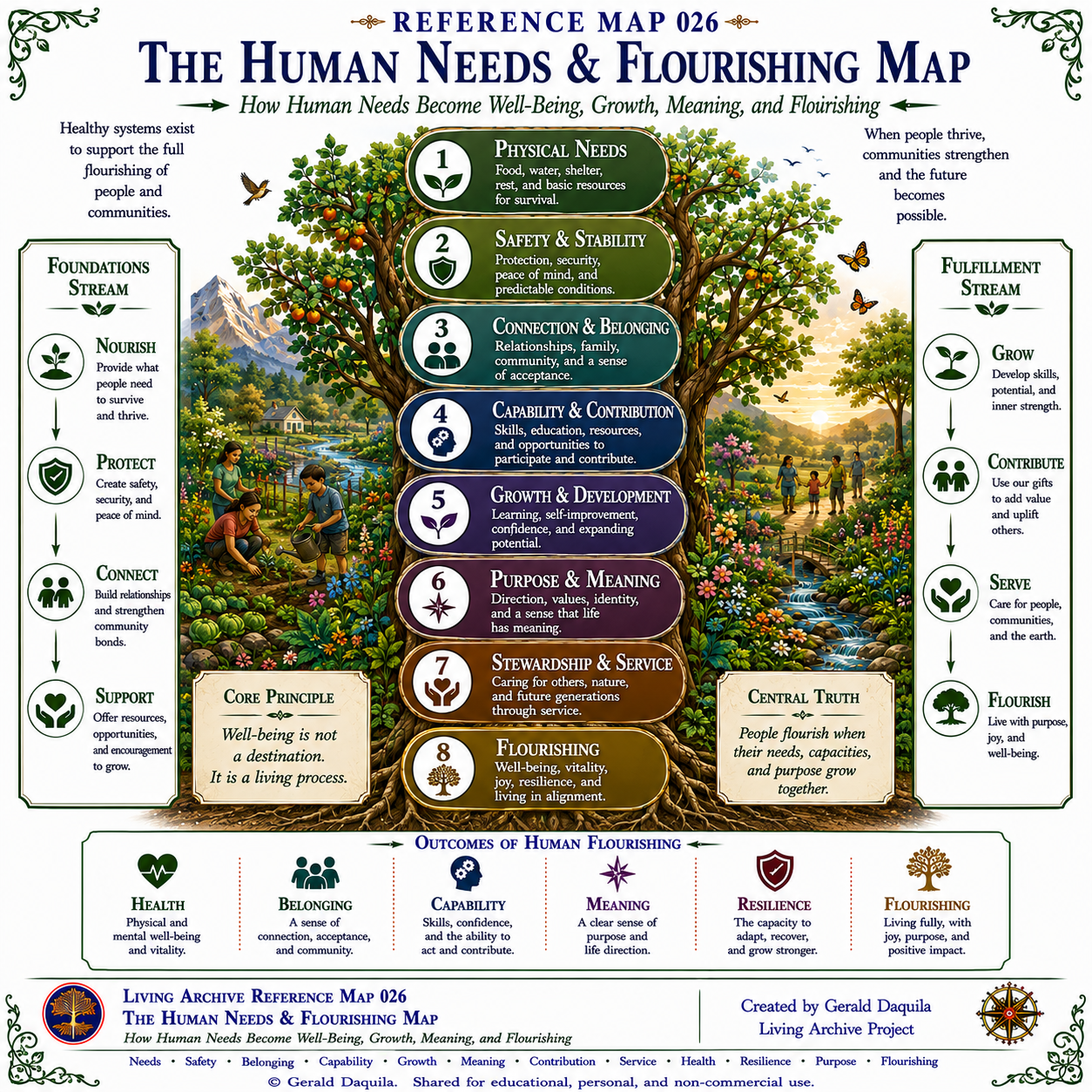
The Human Needs & Flourishing Map visualizes the integrated architecture of human development. Rather than treating biological, psychological, relational, ethical, systemic, and existential capacities as separate domains, it illustrates how they continually interact to support human flourishing as a coherent developmental process.
IV. Development Through Challenge, Feedback, and Integration
If development is the gradual integration of increasingly complex capacities, an important question remains.
How does that integration actually occur?
Time alone is not enough.
Children do not automatically become wise adults, nor does experience inevitably produce maturity. Some individuals emerge from difficulty with greater compassion and discernment, while others become increasingly fearful, rigid, or cynical. Age, knowledge, and experience all matter, but none guarantees development. Something more fundamental is taking place.
Every adaptive system develops through interaction with its environment.
Muscles strengthen by responding to resistance. The immune system learns through exposure. Scientific understanding advances by testing ideas against reality. Healthy organizations improve through reflection, experimentation, and correction. Growth arises not from passive existence but from continuous engagement with feedback (Meadows, 2008).
Human development follows the same principle.
Throughout life we encounter circumstances that exceed our present capacities. Sometimes they expose limitations we did not know we possessed. Sometimes they invite abilities that have not yet been cultivated. Sometimes they simply reveal that the ways we once understood ourselves are no longer sufficient for the realities we now face.
Challenge, however, is not the same as growth.
This distinction deserves careful attention.
Modern culture often romanticizes adversity, as though suffering itself were inherently transformative. Yet history and ordinary experience suggest otherwise. Hardship can just as easily produce despair, resentment, withdrawal, or violence. Trauma can narrow perception rather than expand it. Loss can harden the heart as easily as deepen compassion (Tedeschi & Calhoun, 2004; Frankl, 2006).
Difficulty alone develops no one.
What matters is whether experience becomes integrated.
Integration is the quiet work through which experience is gradually transformed into understanding. It is the process by which pain becomes wisdom rather than bitterness, failure becomes discernment rather than shame, and responsibility becomes something freely embraced rather than externally imposed.
This process rarely happens in isolation.
It is supported by relationships capable of providing safety, honesty, and encouragement. It requires reflection, because experience that remains unexamined often repeats itself rather than teaching anything new. It requires humility, because growth frequently begins with the recognition that our previous ways of understanding the world are no longer adequate.
Development therefore unfolds through recurring cycles of challenge, feedback, reflection, adaptation, and renewed participation.
Each cycle subtly reshapes the whole person.
The body learns new forms of regulation. Identity becomes more flexible. Relationships deepen. Ethical judgment becomes less reactive and more discerning. Systems previously perceived as fixed reveal themselves to be dynamic and capable of transformation. Even one’s sense of meaning evolves as life is interpreted through an increasingly expansive perspective.
Seen this way, mistakes assume a different significance.
Failure becomes information rather than identity.
Conflict becomes an opportunity to strengthen relationships rather than merely to win arguments.
Uncertainty becomes an invitation to learn rather than a threat to certainty.
Even success changes its meaning. It is no longer valued simply as proof of competence but as evidence that certain capacities have become sufficiently integrated to carry greater responsibility.
The goal of development, then, is neither comfort nor perpetual struggle.
It is increasing coherence.
A coherent person remains capable of learning without becoming fragmented by experience. Such individuals are not untouched by difficulty, nor are they defined by it. They become increasingly able to transform the full range of human experience—joy and grief, success and failure, certainty and doubt—into deeper wisdom and more responsible participation in the world.
Development is therefore measured not by how much life happens to us, but by how deeply life becomes integrated into who we are becoming.
If integration is the defining movement of human development, stewardship emerges almost naturally.
Every stage of maturity enlarges the horizon of concern.
Children gradually learn to regulate themselves. Adolescents begin discovering identity beyond dependence. Adults assume responsibility for relationships, families, vocations, and communities. With continued development, perspective expands still further. Decisions are no longer evaluated solely by their immediate outcomes but by the worlds they help create.
At some point, a subtle transformation occurs.
Development ceases to be primarily about becoming a more capable individual.
It becomes about becoming a more responsible participant.
The distinction is profound.
Capability without responsibility can amplify harm. History offers countless examples of brilliant individuals lacking wisdom, influential leaders lacking integrity, and powerful institutions whose capacities outpaced their maturity. Human development therefore cannot culminate in competence alone (Greenleaf, 1977).
Its natural fulfillment is stewardship.
Stewardship begins with a simple recognition: we do not stand outside the systems that sustain us.
We participate in them.
Families shape us long before we influence them. Communities nurture us before we contribute to them. Civilizations inherit the consequences of decisions made by generations who came before, just as future generations will inherit the consequences of ours.
This awareness changes the questions we ask.
Rather than asking, What can I gain from life?, stewardship asks, What has been entrusted to my care?
The question extends far beyond environmental responsibility. It encompasses character, relationships, knowledge, organizations, institutions, culture, and the countless visible and invisible systems upon which human flourishing depends.
Stewardship is therefore not an additional stage beyond development.
It is development expressed outwardly.
Individuals who have learned to regulate themselves become less governed by impulse. Those who understand their own identities become less threatened by difference. Those who cultivate ethical judgment exercise power with greater restraint. Those who perceive systems recognize that meaningful change rarely comes through isolated action but through the patient cultivation of healthier patterns.
Influence gradually becomes service.
Knowledge matures into wisdom.
Achievement finds its fulfillment in contribution.
At its deepest expression, human development ceases to revolve around self-improvement.
Its purpose becomes participation in the ongoing flourishing of life itself.
Modern society often measures development through visible achievements—education, professional success, financial security, status, productivity. Each has genuine value, yet none adequately captures what it means to mature as a human being.
A person may possess extraordinary intelligence while remaining emotionally reactive. Another may achieve considerable influence while lacking ethical judgment. Entire societies may generate remarkable technological innovation while neglecting the relational and moral capacities required to use that innovation wisely.
A systems view of human development asks a different question.
Not simply,
What have we accomplished?
But,
Who are we becoming?
This shift changes the conversation entirely.
Development is no longer understood as a series of disconnected goals to be pursued independently—health, knowledge, relationships, ethics, leadership, meaning, or civic responsibility.
Each represents one expression of a larger movement toward integration. The body learns regulation. The mind learns understanding. Relationships cultivate participation. Responsibility deepens character. Systems thinking expands perspective. Meaning gives direction to the whole.
Together they form an increasingly coherent way of inhabiting the world.
This coherence should not be mistaken for perfection.
Life remains uncertain. Growth remains unfinished. Every new horizon reveals further questions alongside deeper understanding. The mature person is therefore not someone who has eliminated uncertainty but someone who has learned to remain open to reality without becoming fragmented by it.
Such people become stabilizing presences within their families, trusted colleagues within organizations, wise leaders within institutions, and faithful stewards of the communities and systems they inhabit. Their influence arises less from authority than from the quiet integration of their lives.
Perhaps this is the deepest purpose of human development.
Not simply to improve ourselves.
But to become people through whom life itself becomes more coherent, more compassionate, more responsible, and more capable of flourishing.
If this is so, then human development is not merely one subject among many.
It is the living architecture through which biology, psychology, relationships, ethics, leadership, governance, and meaning gradually converge into a single question that accompanies every human life:
How shall we participate in the world we are helping to create?
References & Foundational Works
The following works informed the intellectual development of this essay. Some are directly cited throughout the manuscript, while others are included because they represent foundational contributions to the broader conversations on systems thinking, human development, neuroscience, leadership, ethics, and meaning. Together they provide readers with a guided pathway for exploring the ideas developed here.
The works below are listed alphabetically by author.
Bowlby, J. (1982). Attachment and Loss: Vol. 1. Attachment (2nd ed.). Basic Books. (Original work published 1969)
A landmark in attachment theory, Bowlby demonstrated that human development begins in relationship. His work fundamentally reshaped psychology by showing that early attachment patterns influence emotional regulation, identity formation, resilience, and interpersonal trust throughout life. The relational layer of this essay draws upon this developmental foundation.
Bronfenbrenner, U. (1979). The Ecology of Human Development. Harvard University Press.
Bronfenbrenner’s ecological systems theory transformed developmental psychology by demonstrating that human growth occurs within nested environments—from family and school to institutions and culture. This essay extends that ecological perspective by integrating biological, psychological, ethical, systemic, and existential dimensions into a unified developmental architecture.
Frankl, V. E. (2006). Man’s Search for Meaning. Beacon Press. (Original work published 1946)
Frankl’s exploration of meaning under conditions of profound suffering remains one of the twentieth century’s most influential contributions to existential psychology. This manuscript draws upon his central insight that meaning is not the absence of suffering, but one of the primary capacities through which suffering may be integrated into a meaningful life.
Greenleaf, R. K. (1977). Servant Leadership. Paulist Press.
Greenleaf challenged conventional models of authority by arguing that genuine leadership begins with service rather than power. His work provides an important intellectual foundation for the manuscript’s discussion of stewardship as the natural outward expression of mature human development.
Kegan, R. (1982). The Evolving Self: Problem and Process in Human Development. Harvard University Press.
Kegan’s constructive-developmental theory provides one of the manuscript’s principal developmental foundations. Rather than treating growth as the accumulation of knowledge or skills, he demonstrated that maturity involves increasingly sophisticated ways of constructing meaning. Many of the manuscript’s discussions of adaptive integration and developmental transformation reflect this perspective.
Kegan, R. (1994). In Over Our Heads: The Mental Demands of Modern Life. Harvard University Press.
Expanding his earlier work, Kegan argued that modern societies increasingly demand higher levels of cognitive and emotional complexity than many institutions were designed to cultivate. His work reinforces the manuscript’s argument that development involves expanding one’s capacity to navigate complexity without losing coherence.
Kohlberg, L. (1984). Essays on Moral Development, Volume II: The Psychology of Moral Development. Harper & Row.
Kohlberg’s stage theory of moral development remains one of the foundational frameworks for understanding ethical maturation. Although subsequent scholarship has expanded and critiqued aspects of his model, his work established the principle that ethical reasoning itself develops through increasingly complex structures of judgment.
Meadows, D. H. (2008). Thinking in Systems: A Primer. Chelsea Green Publishing.
Perhaps the most accessible introduction to systems thinking, Meadows demonstrates how feedback loops, emergence, leverage points, and interconnected relationships shape the behavior of complex systems. This manuscript adopts systems thinking not merely as an analytical tool but as a way of understanding human development itself.
Morin, E. (2008). On Complexity. Hampton Press.
Morin has been one of the leading philosophical voices arguing against fragmentation in modern knowledge. His work advocates integrative thinking capable of holding complexity without reducing it to isolated disciplines. The opening chapters of this essay owe much to this broader intellectual orientation.
Porges, S. W. (2011). The Polyvagal Theory: Neurophysiological Foundations of Emotions, Attachment, Communication, and Self-Regulation. W. W. Norton.
Porges’ work highlights the central role of the autonomic nervous system in shaping emotional regulation, safety, social engagement, and adaptive functioning. While aspects of Polyvagal Theory continue to be debated, its emphasis on physiological regulation as a prerequisite for higher-order functioning provides an important biological perspective for understanding development.
Simon, H. A. (1962). “The Architecture of Complexity.” Proceedings of the American Philosophical Society, 106(6), 467–482.
This seminal paper introduced one of the foundational ideas of complexity science: that complex systems can often be understood as hierarchies of interacting subsystems. Simon’s insights continue to influence systems thinking, organizational theory, cognitive science, and interdisciplinary research, providing an important conceptual backdrop for this essay’s discussion of fragmentation and integration.
Tedeschi, R. G., & Calhoun, L. G. (2004). “Posttraumatic Growth: Conceptual Foundations and Empirical Evidence.” Psychological Inquiry, 15(1), 1–18.
Tedeschi and Calhoun challenged the assumption that adversity automatically produces either pathology or resilience. Their research demonstrates that meaningful psychological growth following hardship is possible, but neither inevitable nor universal. This distinction underpins the manuscript’s argument that development arises not from suffering itself, but from the successful integration of experience.
Further Reading by Theme
Readers wishing to explore adjacent conversations may also find the following works valuable. While not directly cited in this essay, they complement its interdisciplinary perspective and provide deeper treatment of specific dimensions of human development.
Antonio Damasio, Descartes’ Error and Self Comes to Mind — embodied cognition, emotion, and consciousness.
Erik Erikson, Childhood and Society — psychosocial development across the lifespan.
Carol Gilligan, In a Different Voice — ethics of care and moral development.
Jean Piaget, The Origins of Intelligence in Children — cognitive development.
Martin Seligman, Flourish — positive psychology and human flourishing.
Peter Senge, The Fifth Discipline — organizational learning and systems thinking.
Paul T. P. Wong, The Psychology of Meaning — meaning-centered psychology and flourishing.
Irvin D. Yalom, Existential Psychotherapy — existential psychology and the human condition.
Living Archive Companion
Every Cornerstone forms part of a larger architecture of inquiry. The Living Archive Companion situates this essay within the broader Living Archive by highlighting its scholarly context, methodological foundations, scope, continuing questions, and related pathways for exploration. As the Living Archive evolves, this companion may expand to reflect new research, historical casework, instruments, and practical applications.
Comparative Perspectives
Where this essay sits within the broader conversation
The Architecture of Human Development explores how human growth unfolds across multiple, interconnected dimensions rather than through isolated milestones. Instead of treating development as the accumulation of knowledge, skills, or achievements alone, the essay proposes that mature development involves the progressive integration of identity, emotional capacity, relationships, meaning, systems awareness, and stewardship. Human flourishing emerges not from maximizing a single dimension but from cultivating coherence across the whole person. This framework serves as one of the organizing architectures for the Human Development branch of the Living Archive.
Developmental Psychology
Developmental psychology has long examined how cognition, identity, emotional maturity, and moral reasoning evolve across the lifespan. This essay builds upon those traditions by integrating multiple developmental domains into a unified architectural framework rather than treating them as separate lines of inquiry.
Systems Thinking
Systems thinking emphasizes that complex systems derive their properties from relationships among their parts rather than from isolated components. This essay applies that principle to human development, suggesting that lasting maturity emerges through the integration of psychological, relational, institutional, and cultural dimensions rather than through optimization of any single capacity.
Human Flourishing
Research in positive psychology and flourishing increasingly recognizes that well-being encompasses meaning, relationships, contribution, resilience, and purpose alongside subjective happiness. This essay extends that perspective by situating flourishing within a lifelong developmental process that naturally culminates in stewardship.
Institutional and Cultural Development
Human development never occurs in isolation. Families, schools, communities, institutions, and cultures all shape developmental pathways. The essay therefore examines personal growth as inseparable from the environments that cultivate—or constrain—it.
The Living Archive’s distinctive contribution
The Living Archive synthesizes developmental psychology, systems thinking, human flourishing, institutional development, and stewardship into a coherent developmental architecture. Rather than presenting human development as preparation for success alone, it frames development as the gradual cultivation of the capacities required for responsible participation in increasingly complex human systems. Stewardship becomes the mature expression of an integrated life rather than an external obligation.
Evidence & Foundations
Knowledge domains informing this essay
Primary disciplines
Developmental Psychology
Human Development
Systems Thinking
Positive Psychology
Moral Development
Organizational Learning
Sociology
Human Flourishing Studies
Representative thinkers
Robert Kegan
Erik Erikson
Jean Piaget
Carol Gilligan
Martin Seligman
Peter Senge
Urie Bronfenbrenner
Mihaly Csikszentmihalyi
Nature of the evidence
✓ Integrative synthesis across multiple disciplines
✓ Systems-based interpretation of lifelong human development
✓ Comparative engagement with developmental and flourishing research
✓ Integration of identity, relationships, meaning, and stewardship
◻ Comparative longitudinal studies of integrated developmental architectures (future)
◻ Practical developmental assessment and stewardship instrumentation (planned)
This essay presents an integrative architectural synthesis informed by multiple disciplines, historical observation, and lived experience. It is intended to support orientation rather than serve as a comprehensive empirical theory. As the Living Archive evolves, this framework may be refined through comparative scholarship, practical instrumentation, historical casework, and empirical research.
Boundaries & Limitations
This essay presents an integrative framework for understanding human development rather than a comprehensive replacement for established developmental theories.
Accordingly, it should not be interpreted as:
a universal stage model applicable to every individual or culture;
a comprehensive psychological theory explaining every aspect of human growth;
a claim that development proceeds through identical pathways for all people;
an assertion that personal development alone resolves institutional or societal challenges.
Instead, the framework offers an orienting architecture that brings together multiple dimensions of development into a coherent whole. It emphasizes relationships, systems, meaning, and stewardship while remaining open to continued refinement through research, lived experience, and interdisciplinary dialogue.
Questions for Further Inquiry
The Architecture of Human Development raises important questions for future interdisciplinary research.
Readers may wish to explore:
Which developmental capacities most strongly support wise stewardship across changing life stages?
How do families, educational systems, and institutions shape long-term developmental trajectories?
What distinguishes growth that increases personal achievement from growth that increases responsibility and contribution?
How can societies intentionally cultivate developmental environments that support human flourishing?
Which forms of assessment can evaluate integrated human development without reducing it to simplistic metrics?
These questions continue to shape the Living Archive’s evolving research agenda.
Continue Exploring
If you’re exploring the foundations of human development…
This essay is part of the Living Archive’s Cornerstone Series—long-form syntheses that integrate research across disciplines to explore enduring questions of human development, systems thinking, stewardship, and meaning. Rather than introducing a new discipline, these essays seek to reveal the underlying architecture connecting diverse fields of inquiry into a coherent understanding of human flourishing.
Research Note
This manuscript is an interdisciplinary synthesis informed by developmental psychology, systems theory, neuroscience, moral philosophy, leadership studies, and existential psychology. This essay is intended as an integrative synthesis rather than an exhaustive review of the scholarly literature. Citations reference foundational works that support the essay’s central propositions while preserving readability for a broad audience.
The Living Archive
Becoming Fully Human is part of the Cornerstone Collection of the Living Archive.
Curated and developed by Gerald Daquila as part of the ongoing Life.Understood. and Living Archive initiatives exploring governance, stewardship, intelligence, meaning, and human flourishing.
The Living Archive is designed to be explored through pathways, frameworks, and connected ideas. If you are looking for a specific concept, question, theme, or relationship, AI Search can help surface relevant articles, maps, hubs, and resources from across the archive.
Ask a question, explore a topic, or follow a thread of inquiry.
Why the Development of People Shapes the Development of Everything Else
Meta Description
Human beings do not develop in isolation. This cornerstone explores the individual as a living system whose growth shapes relationships, organizations, institutions, and civilizations. Drawing upon psychology, systems thinking, sociology, and stewardship, it examines how the development of people ultimately influences the development of society itself.
Invocation
Human beings are born unfinished.
Unlike most other species, we enter the world profoundly dependent upon others. Long before we learn to speak, reason, or choose for ourselves, we are already being shaped by relationships, culture, language, memory, and the countless visible and invisible systems into which we are born.
Our first environment is not a classroom or an institution.
It is another human being.
From our earliest relationships, the circle gradually widens.
Families become communities.
Communities become institutions.
Institutions become civilizations.
By the time we begin asking who we are, much of the answer has already been shaped through relationships extending far beyond ourselves.
It has always been relational.
It has always been systemic.
Human beings often imagine society exists somewhere “out there.”
We speak of institutions as though they possess lives of their own.
We speak of governments, corporations, schools, religions, markets, and cultures as though they possessed lives of their own.
Complex systems often behave in ways that exceed the intentions of any single individual. Institutions develop their own cultures. Organizations acquire momentum. Traditions persist across generations.
Yet another perspective is equally true.
Every institution was imagined by human minds.
Every culture emerged from human relationships.
Every organization reflects countless human decisions.
Every civilization is, in the end, an expression of the people who continuously recreate it.
This is the paradox at the heart of human development.
We shape systems.
Then those systems shape us.
Neither process can be understood in isolation.
This relationship quietly underlies many of the questions explored throughout the Living Archive, even when it is not named directly.
This cornerstone begins where every human system begins.
It begins with the human being.
Not the isolated individual imagined by much of modern culture.
Nor the purely rational actor assumed by many economic models.
Nor the autonomous self often celebrated by contemporary individualism.
Instead, it begins with a simpler proposition.
Human beings are living systems.
Like every living system, they develop through continuous interaction with their environments. Biology, relationships, culture, education, memory, adversity, opportunity, institutions, and meaning all participate in shaping who a person becomes.
Development is neither purely individual nor entirely social. It emerges through the ongoing relationship between the two.
This perspective changes more than our understanding of psychology.
It changes how we think about stewardship.
If human beings are living systems nested within larger living systems, then every larger system ultimately reflects the developmental capacities—and limitations—of the people who create and sustain it.
Healthy institutions rarely emerge from chronically fragmented individuals.
Trustworthy organizations are difficult to sustain where trust itself has not been learned.
Communities struggle to flourish when fear consistently outweighs cooperation.
Likewise, societies capable of long-term stewardship depend upon people who have gradually developed the ability to think beyond immediate gratification, hold competing perspectives without collapsing into certainty, assume responsibility without demanding control, and care for realities larger than themselves.
Seen in this light, stewardship is not merely an ethical obligation.
It is a developmental achievement.
This cornerstone explores how that achievement becomes possible.
Not through self-improvement alone.
Not through institutional reform alone.
But through the continual development of the human system itself.
The Central Question
Why do some human beings consistently create environments of trust, wisdom, cooperation, and renewal, while others—often with equally good intentions—reproduce fear, fragmentation, conflict, and decline?
This question lies beneath many of the challenges explored throughout the Living Archive.
Why do healthy organizations become unhealthy?
Why do capable leaders sometimes create dysfunctional institutions?
Why do communities facing similar circumstances evolve along remarkably different paths?
Why do some societies repeatedly cultivate cooperation while others become trapped in cycles of polarization and distrust?
These questions have traditionally been explored by different disciplines—including psychology, sociology, developmental science, political science, economics, and systems thinking. Each illuminates part of the picture.
The child who develops within a family eventually participates in schools, workplaces, organizations, communities, and institutions. The habits, expectations, and ways of relating learned in one environment inevitably shape participation in the next.
Patterns of trust, fear, cooperation, conflict, resilience, and responsibility do not disappear as human systems become larger. They accumulate, interact, and eventually become embedded within culture itself.
The habits formed within one environment are carried into the next.
The result is a simple but easily overlooked truth.
Human systems cannot consistently mature beyond the developmental capacities of the people who create and sustain them.
This does not reduce every social problem to individual psychology.
Complex systems possess properties that emerge beyond any single individual, and they often shape human behavior as powerfully as people shape them.
Development moves in both directions.
People shape systems.
Systems shape people.
Neither can be understood apart from the other.
This cornerstone asks what becomes possible when we stop treating human development, social development, and institutional development as separate conversations and instead recognize them as expressions of the same living process.
Rather than competing explanations, psychology, sociology, governance, and systems thinking become complementary lenses through which the same reality comes into clearer focus.
Perhaps stewardship begins in that integration.
The Core Thesis
The central proposition of this cornerstone is straightforward.
Human beings are not merely participants within larger systems.
They are living systems from which larger systems emerge.
Families, organizations, institutions, economies, and civilizations do not arise independently of human development. They are created, sustained, and continually reshaped by people whose ways of perceiving, relating, deciding, cooperating, and caring have themselves been formed over time.
Every human system carries two histories simultaneously.
One is visible: its laws, structures, technologies, incentives, and institutions.
The other is largely invisible: the developmental capacities of the people who inhabit those structures—their ability to build trust, regulate emotion, exercise judgment, hold complexity, resolve conflict, and assume responsibility beyond themselves.
These two histories are inseparable.
Neither can be understood apart from the other.
Institutional reform that ignores human development often produces temporary change without lasting transformation.
Likewise, personal development pursued in isolation from families, communities, and institutions frequently struggles to translate into meaningful social contribution.
Healthy systems require the co-development of people and the environments they inhabit.
This reciprocal relationship characterizes every living system.
Human societies are no exception.
Each generation inherits languages, institutions, cultures, and ways of relating that it did not create. Yet every generation also reshapes that inheritance through the countless decisions, relationships, and responsibilities of ordinary life.
Development is therefore neither purely individual nor purely collective.
It unfolds across nested systems that continuously influence one another across time.
Understanding humanity through this systems perspective reveals something both hopeful and demanding.
The future is not determined solely by technology, economics, political reform, or institutional design.
Neither is it transformed through individual self-improvement alone.
It emerges through the ongoing relationship between human development and the systems human beings continuously create together.
Seen in this light, stewardship becomes more than an ethical commitment.
It is the natural expression of developmental maturity.
As awareness expands, so too does responsibility.
Care gradually extends beyond the self to relationships, communities, institutions, future generations, and the wider web of life.
Stewardship is what becomes possible when human development matures into conscious participation in realities larger than oneself.
Why This Cornerstone Exists
Across the Living Archive, a recurring pattern quietly emerges.
Although these subjects appear diverse, they repeatedly return to the same underlying question:
What qualities must human beings develop if they are to participate wisely in increasingly complex systems?
This Cornerstone exists because that question deserves direct attention.
Much of contemporary discourse focuses on changing external systems. We debate policies, redesign institutions, improve technologies, reform organizations, and search for better models of governance. These efforts matter.
Yet every system ultimately depends upon the developmental capacities of the people who inhabit it.
No institution consistently rises above the maturity of its culture.
No governance framework permanently compensates for widespread distrust.
No technological innovation eliminates the need for judgment, responsibility, wisdom, or care.
The Living Archive has long explored these themes from multiple directions.
Trust Architectureexamines the relational foundations that sustain cooperation.
This Cornerstone approaches those same questions from another direction.
Rather than beginning with institutions, it begins with the human being.
It asks how meaning, emotion, relationships, and belonging gradually shape the capacities from which stewardship, governance, and civilization ultimately emerge.
Human development is therefore not a private concern disconnected from public life.
It is one of the deepest forms of infrastructure any society possesses.
The quality of our institutions, communities, and civilizations cannot ultimately be separated from the quality of the human systems from which they continually arise.
For that reason, The Human System is best understood not as a stand-alone essay, but as a foundation beneath many of the ideas explored throughout the Living Archive.
It invites readers to look beneath events, beneath institutions, and even beneath culture itself, toward the developmental processes from which they all emerge.
The Developing Mind
Every human being is born into a world that already exists.
Language has already been spoken.
Customs have already been established.
Stories are already being told.
Institutions are already functioning.
The child inherits not only a family, but an entire civilization compressed into the ordinary rhythms of daily life.
This inheritance extends far beyond genetics.
Long before children understand the societies they inhabit, those societies begin shaping how they perceive the world. Parents and caregivers model patterns of trust or fear.
Schools communicate assumptions about knowledge and success. Communities establish expectations about belonging, cooperation, conflict, and responsibility.
Media, technology, religion, and culture each contribute additional layers of meaning.
Development therefore begins as an act of participation before it becomes an act of choice.
Developmental psychology has long shown that human growth emerges through the continuous interaction of biology and environment (Bronfenbrenner, 1979; Erikson, 1968; Piaget, 1952; Vygotsky, 1978).
Yet these environments are themselves living systems.
Families adapt.
Communities evolve.
Institutions rise and decline.
The developing mind therefore does not simply absorb information from a static world. It continuously learns within systems that are themselves changing.
This makes human development far more dynamic than many conventional models suggest.
Every generation inherits a different developmental landscape.
A child raised in an agricultural village encounters different patterns of relationship than one growing up in an industrial city. Likewise, a generation born into digital networks develops within cognitive and social environments unlike any before it.
A generation growing up before the internet learns differently from one immersed in digital networks from infancy. Children raised during periods of institutional stability inherit different assumptions from those growing up amid economic uncertainty, technological disruption, or rapid cultural change.
Every person develops within a particular historical moment.
This is why no model of human development can be entirely separated from systems thinking.
The mind does not develop in isolation from its environment any more than a forest develops independently of climate or an ecosystem develops independently of the species that inhabit it.
Each continuously shapes the other.
The environments that form us are themselves products of previous generations of human development.
If societies wish to cultivate wiser leaders, healthier communities, more trustworthy institutions, or more resilient civilizations, the question cannot begin only with governance, economics, or public policy.
It must also ask:
What kinds of environments cultivate human beings capable of creating those realities?
Before we become citizens, professionals, leaders, or stewards, we first become persons.
The quality of every larger human system ultimately reflects how that becoming unfolds.
Reference Map 015. Learning & Transformation Spiral: Development unfolds through successive stages of integration rather than isolated events.
Human beings are often described as rational creatures.
Others have called us social creatures, political animals, symbolic thinkers, or storytellers.
Each description captures something important.
Yet none fully explains why human development unfolds as it does.
Long before we construct an identity, we begin constructing meaning.
Even infancy is more than biological maturation.
Faces become familiar.
Voices acquire emotional significance.
Repeated experiences gradually establish expectations about safety, trust, belonging, and care.
Although infants cannot yet describe these experiences in language, they are already organizing reality into meaningful patterns that will shape later perception and behavior (Bowlby, 1988; Siegel, 2012).
Meaning, in this sense, precedes explanation.
Children do not first develop sophisticated beliefs and then interpret the world through them.
They first experience the world.
Only gradually do those experiences become stories.
Developmental psychology suggests that children actively construct increasingly complex models of reality rather than passively receiving information (Piaget, 1952).
Sociocultural theory further shows that these models emerge through interaction with other people, language, and shared cultural practices (Vygotsky, 1978).
The developing mind is therefore neither isolated nor predetermined. It continuously negotiates between lived experience and the worlds into which it has been born.
Many contemporary discussions assume that information changes people.
Information certainly matters.
But information rarely transforms anyone by itself.
Human beings do not respond primarily to facts.
They respond to the meanings they assign to those facts.
The same event may become a source of gratitude for one person, humiliation for another, motivation for a third, and fear for someone else. External circumstances influence development, but they never determine it completely. Between experience and action lies interpretation.
Meaning is the bridge.
Over time these countless interpretations begin forming a coherent internal landscape.
Some experiences become central.
Others fade into the background.
Some memories become integrated into an expanding understanding of oneself, while others remain unresolved, continuing to influence behavior long after the original events have passed.
Psychologists increasingly recognize that identity emerges not simply from isolated memories but from the ongoing narrative through which individuals organize those memories into a coherent life story (McAdams, 1993).
Identity, then, is not the beginning of development.
It is one of its achievements.
Before human beings can answer the question, Who am I?, they have already spent years answering quieter questions that are seldom spoken aloud.
Is the world trustworthy?
Do I belong?
What happens when I make mistakes?
Can other people be relied upon?
Am I worthy of love?
Does life have meaning?
Few of these questions are answered directly.
Most are answered through experience.
Long before we consciously describe ourselves, we have already begun constructing the meanings from which identity quietly grows.
Emotion: The Hidden Architecture of Human Systems
Human beings do not experience reality as detached observers.
Long before conscious reasoning becomes possible, emotional systems are already evaluating the world. Every encounter is accompanied by rapid assessments that ask questions essential to survival.
Is this safe?
Does this belong to me?
Should I approach or withdraw?
Can this be trusted?
Only afterward does conscious thought begin constructing explanations for what has already been emotionally perceived (Damasio, 1999).
Emotion is therefore not the opposite of reason.
Emotion is one of the primary ways through which living systems organize experience.
Neuroscience increasingly shows that cognition and emotion are deeply intertwined. Memory, attention, learning, judgment, and social behavior are all shaped by emotional processes that often operate beneath conscious awareness (Damasio, 1999; Siegel, 2012).
This insight has consequences far beyond psychology.
Every human relationship is simultaneously an exchange of information and an exchange of emotional states.
Parents do not merely teach children what to think.
They teach children what the world feels like.
Teachers communicate more than knowledge.
Organizations communicate more than procedures.
Communities communicate more than traditions.
Every human system continually transmits emotional climates that shape how people perceive safety, possibility, cooperation, and belonging.
For this reason, emotional patterns often become self-reinforcing.
A child consistently raised in environments of trust is more likely to interpret unfamiliar situations with curiosity than suspicion. Conversely, prolonged experiences of unpredictability, exclusion, or chronic threat may orient attention toward danger even when immediate circumstances have changed (Siegel, 2012).
Neither response represents a moral failing.
Both are adaptive responses to lived environments.
Living systems learn.
Human beings are no exception.
Organizations develop emotional climates.
Teams develop emotional norms.
Communities inherit emotional memories.
Entire societies may become organized around hope, fear, trust, resentment, resilience, or insecurity, particularly after periods of war, collective trauma, economic collapse, or prolonged uncertainty.
These patterns are seldom written into constitutions or organizational charts.
Yet they often shape collective behavior as powerfully as formal structures themselves.
This is why systems cannot be understood solely through incentives, rules, or governance arrangements.
Every visible system rests upon an invisible emotional ecology.
Trust cannot be legislated into existence.
Belonging cannot be mandated.
Psychological safety cannot be achieved through policy documents alone.
These emerge gradually through repeated patterns of human relationship.
Emotion quietly shapes what people notice, remember, avoid, trust, and ultimately believe is possible.
Long before institutions inherit these patterns, they first take root within the emotional lives of ordinary people.
The architecture of every society is therefore preceded by a quieter architecture—one built from countless moments of fear and courage, exclusion and belonging, injury and repair, despair and hope.
Before cultures become visible, they are first felt.
Relationships: Where the Human System Learns Itself
No human system develops alone.
Before children understand language, morality, or culture, they learn through relationship. Faces become familiar. Voices become recognizable. Comfort, protection, delight, disappointment, repair, and separation gradually establish expectations about how the world works and what other people are likely to do.
These early relational experiences become the first laboratories in which the human system learns how to interpret reality (Bowlby, 1988; Ainsworth, Blehar, Waters, & Wall, 1978).
Attachment theory describes this process as the formation of internal working models—largely unconscious expectations about oneself, other people, and relationships (Bowlby, 1988). Rather than fixed scripts, these models remain adaptive frameworks through which people anticipate and interpret the social world.
Human beings continue revising these relational models throughout life.
Friendships, mentors, intimate partnerships, communities, workplaces, and even institutions continually reinforce, challenge, or reshape earlier expectations. Development therefore remains an open process.
The human system retains the capacity for growth because relationships continue to provide new experiences from which meaning may be reconstructed (Siegel, 2012).
Relationships do not merely connect individuals.
They actively regulate development.
Psychologists increasingly recognize that emotional regulation is not simply an internal achievement but a relational one. Human beings learn calm through being calmed.
They develop trust through trustworthy relationships. Empathy grows through being understood. Resilience often emerges through repeated experiences of repair following disappointment, conflict, or failure (Siegel, 2012).
Relationships are less exchanges between separate individuals than living systems of mutual adaptation.
Each person influences the development of the other.
Parents shape children.
Children reshape parents.
Teachers transform students.
Students transform teachers.
Communities influence individuals.
Individuals quietly reshape communities.
Development moves in every direction at once.
This reciprocal process also explains why human relationships possess extraordinary generative power.
A single relationship characterized by consistent trust, encouragement, or wise mentorship may alter the developmental trajectory of an entire life.
Likewise, repeated experiences of betrayal, exclusion, humiliation, or chronic neglect may continue shaping perception and behavior decades after the original events have passed.
Every enduring human institution is ultimately composed of relationships.
Organizations, communities, governments, markets, and increasingly even digital platforms are all networks of relationships through which trust, knowledge, conflict, and cooperation continually circulate.
This observation invites a subtle but important shift in perspective.
Human societies are often described in terms of structures, policies, technologies, or economic systems.
Those descriptions are valuable.
Yet beneath every visible structure lies an invisible web of human relationships through which trust is built, knowledge is transmitted, conflict is negotiated, and cooperation becomes possible.
Relationships are therefore not simply one component of society.
They are the living tissue from which society is continually formed.
If meaning provides the architecture of identity, relationships provide the architecture through which human development becomes shared.
Every larger human system begins here.
Belonging: The First Society
No human being belongs to humanity in the abstract.
We belong first to someone.
A family.
A neighborhood.
A circle of friends.
A classroom.
A team.
A congregation.
A village.
Long before we understand the idea of society, we experience belonging—or its absence—in places small enough to know our names.
Relationships teach us how to connect with another person.
Belonging teaches us what it means to become part of something larger than ourselves.
The distinction matters.
A relationship exists between two people.
Belonging exists within a living community.
Here the human system undergoes another developmental transition.
For the first time, individuals must reconcile personal needs with shared realities.
These tensions are not problems to be solved once and for all. They are developmental capacities that must be learned repeatedly throughout life.
Anthropologists have long observed that human beings evolved not as solitary competitors but as intensely social organisms whose survival depended upon cooperation, reciprocal care, and shared cultural knowledge (Tomasello, 2016).
Our remarkable capacity for language, teaching, symbolic thought, and cumulative culture emerged because individuals learned how to participate in groups whose knowledge exceeded that of any one member.
Belonging therefore shapes far more than emotional well-being.
It becomes the environment in which moral imagination begins to grow.
Within healthy communities, children gradually discover that other people possess inner worlds as real as their own. They learn that trust can be strengthened or broken, that cooperation requires mutual restraint, that conflicts may be repaired rather than merely won, and that individual choices inevitably ripple outward into the lives of others.
These lessons are rarely taught as formal doctrines.
They are absorbed through participation.
Communities, in this sense, function as schools of human development.
Every shared meal.
Every celebration.
Every disagreement honestly repaired.
Every act of welcome.
Every act of exclusion.
Each quietly teaches what kind of society is possible.
This may explain why the erosion of belonging has become one of the defining challenges of modern life.
Many contemporary societies possess unprecedented technological connectivity while simultaneously experiencing rising loneliness, declining civic participation, institutional distrust, and increasing social fragmentation.
The paradox is striking.
Human beings have never been more connected through networks of information, yet many experience fewer durable relationships and weaker communities than previous generations (Holt-Lunstad, et al, 2015).
Communities are the first places where societies learn how to cooperate.
Before a civilization can become resilient, people must first experience what it feels like to belong to something worthy of their care.
Every civilization begins as an experience of belonging.
When belonging weakens, the habits that sustain larger systems begin weakening as well.
Trust becomes more difficult.
Shared responsibility becomes more fragile.
Public life grows increasingly transactional.
Institutions, no matter how carefully designed, inherit the quality of the communities from which they arise.
Perhaps this is why healthy societies cannot be manufactured solely through policy, technology, or organizational reform.
Stewardship: The Expanding Circle of Care
If there is a single thread running through this Cornerstone, it is this:
Human development is the gradual expansion of what we are capable of caring for.
An infant’s world is necessarily small.
Attention centers upon immediate needs, immediate relationships, and immediate survival.
As development unfolds, that circle can widen.
Care extends toward family.
Then friends.
Then communities.
Eventually, it may embrace institutions, ecosystems, future generations, and even people we will never meet.
This expansion is neither automatic nor guaranteed.
Some lives become increasingly generous.
Others contract under the weight of fear, isolation, trauma, or chronic insecurity.
Development is therefore not simply the accumulation of knowledge or experience.
It is the gradual enlargement—or constriction—of the circle of responsibility through which we meet the world.
Stewardship is therefore not a role reserved for leaders, public officials, or institutional custodians.
It is the mature expression of a well-developed human system.
The steward recognizes that every action participates in larger patterns.
Every relationship influences a wider web of relationships.
Every institution is ultimately sustained—or weakened—by the character of the people who inhabit it.
And every generation inherits both the gifts and the unfinished work of those who came before.
Stewardship therefore begins long before authority.
It begins in perception.
It begins in learning to see ourselves not as isolated individuals moving through an indifferent world, but as participants in living systems that continually shape and are shaped by our presence.
This is why the health of civilizations can never be separated from the development of the human beings who compose them.
No constitution, technology, economic model, or governance framework can permanently compensate for widespread developmental immaturity.
Nor can personal growth remain complete if it never finds expression in service beyond the self.
The two belong together.
Inner development without contribution risks becoming self-absorption.
Institutional reform without human development rarely endures.
Stewardship is the meeting place where both become whole.
Perhaps this is why every enduring civilization has ultimately depended upon capacities that cannot be manufactured by policy alone: trust, wisdom, responsibility, discernment, cooperation, restraint, courage, compassion, and care.
These qualities emerge slowly.
They are cultivated across relationships, communities, and generations.
They cannot be demanded.
Only developed.
The Human System has explored how meaning becomes identity, how emotion shapes perception, how relationships regulate development, and how belonging becomes the seedbed of society.
Taken together, these are not separate subjects.
They describe one continuous process through which human beings gradually become capable of participating in realities larger than themselves.
Stewardship is the flowering of that process.
It is not the end of human development.
It is what human development makes possible.
Every generation inherits the opportunity to widen that circle a little further.
The future will be shaped not only by the systems we design, but by the kinds of human beings those systems invite us to become.
That, perhaps, is the deepest work of stewardship.
Beyond the Self
Every generation inherits a world it did not create.
Languages already exist.
Cultures have taken shape.
Institutions are already functioning.
Stories are already being told.
The work of human development is therefore never simply personal.
Each life unfolds within an inheritance shaped by countless others, just as each generation quietly reshapes that inheritance for those yet to come.
Seen from this perspective, development is not a race toward self-improvement.
Nor is it merely the pursuit of knowledge, achievement, or success.
It is the gradual awakening to participation.
We begin life asking what the world can provide.
Over time, a different question becomes possible.
What does the world now ask of me?
That shift marks one of the deepest developmental thresholds a person can cross.
Responsibility ceases to feel like an external obligation imposed by society.
Instead, it becomes a natural expression of belonging.
Care extends beyond immediate relationships toward communities, institutions, future generations, and the wider living systems upon which all life depends.
Few people complete this journey perfectly.
Most move forward unevenly.
Growth is rarely linear.
Moments of wisdom alternate with moments of fear.
Periods of expansion are often followed by contraction, uncertainty, and renewal.
Yet the possibility remains.
Human beings can continue developing throughout life.
That possibility offers one of the most hopeful insights of both psychology and stewardship.
Neither individuals nor societies are finished.
Every relationship offers another opportunity to learn.
Every community offers another opportunity to contribute.
Every generation offers another opportunity to widen the circle of care.
Perhaps this is the deepest invitation of The Human System.
Not merely to understand ourselves more clearly.
But to become the kinds of people through whom healthier families, wiser institutions, more resilient communities, and more humane civilizations gradually become possible.
How This Hub Connects to the Living Archive
Although The Human System may be read as a stand-alone exploration of human development, it also occupies a unique position within the architecture of the Living Archive.
Many Cornerstones examine the external dimensions of stewardship—governance, institutions, culture, civilizational change, artificial intelligence, systems thinking, regeneration, trust, and leadership.
Each explores an important aspect of how human societies organize themselves and respond to an increasingly complex world.
The Human System begins one level deeper.
Rather than asking how institutions function, it asks how the human beings who create those institutions develop.
Rather than beginning with governance, it begins with the developmental capacities upon which good governance ultimately depends.
Rather than presenting stewardship as a professional responsibility or ethical obligation, it explores stewardship as the natural expression of an increasingly mature human system.
In this way, the Cornerstone serves as a connective framework across the broader archive.
It provides a developmental lens through which many other essays may be understood.
Questions explored elsewhere in terms of institutions, technology, economics, leadership, or culture are here traced back to the human capacities from which they ultimately emerge.
Readers interested in the relationship between human development and emerging technologies may continue into Knowledge Stewardship in the AI Era.
Together, these Cornerstones suggest a shared insight.
Healthy societies do not emerge independently of healthy human development.
Institutions inherit the strengths and limitations of the people who build them.
Cultures preserve patterns that individuals first learn through relationship.
Civilizations scale capacities that begin within ordinary human lives.
Seen from this perspective, The Human System is less a separate field of inquiry than a foundation beneath many others.
It invites readers to understand stewardship, governance, and civilization not as isolated disciplines, but as expressions of one continuous developmental ecology.
Every Cornerstone illuminates one dimension of the larger whole.
Read individually, each offers a distinct perspective.
Read together, they reveal a single, unfolding inquiry into what it means for human beings—and the systems we create—to flourish.
Explore The Living Archive
Reference Map 031: The Living Archive Atlas: A visual guide to the Living Archive’s Cornerstones, Core Structure Collections, Reference Maps, and interconnected pathways for further exploration.
Ainsworth, M. D. S., Blehar, M. C., Waters, E., & Wall, S. (1978). Patterns of attachment: A psychological study of the strange situation. Lawrence Erlbaum Associates.
Bowlby, J. (1988). A secure base: Parent-child attachment and healthy human development. Basic Books.
Bronfenbrenner, U. (1979). The ecology of human development: Experiments by nature and design. Harvard University Press.
Damasio, A. R. (1999). The feeling of what happens: Body and emotion in the making of consciousness. Harcourt.
Erikson, E. H. (1968). Identity: Youth and crisis. W. W. Norton & Company.
Frankl, V. E. (1963). Man’s search for meaning. Beacon Press.
Holt-Lunstad, J., Smith, T. B., Baker, M., Harris, T., & Stephenson, D. (2015). Loneliness and social isolation as risk factors for mortality: A meta-analytic review. Perspectives on Psychological Science, 10(2), 227–237. https://doi.org/10.1177/1745691614568352
McAdams, D. P. (1993). The stories we live by: Personal myths and the making of the self. William Morrow.
Piaget, J. (1952). The origins of intelligence in children. International Universities Press.
Siegel, D. J. (2012). The developing mind: How relationships and the brain interact to shape who we are (2nd ed.). Guilford Press.
Tomasello, M. (2016). A natural history of human morality. Harvard University Press.
Vygotsky, L. S. (1978). Mind in society: The development of higher psychological processes. Harvard University Press.
Stewardship Maturity Ladder(Map 022)— Understanding how increasing developmental capacity naturally expands circles of responsibility and stewardship.
Living Archive Companion
Every Cornerstone forms part of a larger architecture of inquiry. The Living Archive Companion situates this essay within that broader landscape by highlighting its scholarly context, methodological foundations, scope, continuing questions, and related pathways for exploration. As the Living Archive evolves, this companion may expand to reflect new research, historical casework, instruments, and practical applications.
Comparative Perspectives
Where this essay sits within the broader conversation
The Human System examines the human being not as an isolated individual but as a living system embedded within larger systems of relationship, culture, institutions, and civilization. This perspective resonates with several established fields while contributing an integrative architectural framework.
Systems Thinking
Donella Meadows demonstrated that complex systems are best understood through relationships, feedback loops, and emergent behavior rather than isolated components. This essay similarly views human development as the interaction of multiple interdependent systems.
Developmental Psychology
The constructive-developmental work of Robert Kegan and related developmental theorists emphasizes that human maturity involves increasingly sophisticated ways of making meaning. This essay extends that developmental perspective beyond the individual into participation within families, communities, institutions, and civilizations.
Ecological Systems Theory
Urie Bronfenbrenner’s ecological model illustrates how individual development is shaped by nested social environments. The Human System likewise recognizes that human flourishing cannot be separated from the broader contexts in which people live.
Organizational Learning
Peter Senge’s conception of learning organizations highlights the importance of systems awareness, shared mental models, and continuous learning. This essay broadens those principles beyond organizations to the wider human condition.
Where the Living Archive differs
Rather than presenting these traditions as competing explanations, the Living Archive seeks to place them into conversation through an orientational architecture that connects human development, systems thinking, governance, and stewardship into a coherent developmental ecology.
Evidence & Foundations
Knowledge domains informing this essay
Primary disciplines
Systems Thinking
Human Development
Developmental Psychology
Ecological Systems Theory
Organizational Learning
Leadership Studies
Institutional Theory
Representative thinkers
Donella Meadows
Robert Kegan
Urie Bronfenbrenner
Peter Senge
Edgar Schein
Elinor Ostrom
Nature of the evidence
✓ Integrative synthesis across multiple disciplines
✓ Systems-based conceptual architecture
✓ Phenomenological observation informed by lived experience
✓ Historically informed interpretation
◻ Empirical instrumentation (planned)
◻ Longitudinal institutional validation (future)
This essay should be understood as an architectural synthesis that integrates established bodies of knowledge into a coherent model of the human system. It is intended to orient inquiry rather than function as a comprehensive empirical theory.
Boundaries & Limitations
Every model clarifies certain aspects of reality while leaving others outside its scope.
This essay presents an architectural perspective on human development and participation within larger systems. It does not claim to explain all dimensions of psychology, sociology, biology, or institutional behavior.
Specifically, it should not be interpreted as:
a comprehensive psychological theory;
a predictive model of human behavior;
a substitute for discipline-specific expertise;
evidence that all human systems develop according to a single pathway.
Instead, it offers an integrative framework for understanding how individuals and institutions influence one another across multiple levels of human experience.
Questions for Further Inquiry
The Living Archive understands inquiry as an ongoing developmental practice.
Questions that naturally emerge from this essay include:
Which conditions most consistently enable healthy human systems to emerge and endure?
How do families, communities, institutions, and cultures reinforce—or undermine—human development?
Which historical societies demonstrated unusually coherent human systems, and what sustained them?
What indicators could meaningfully measure the health of a human system without reducing it to simplistic metrics?
How might artificial intelligence help illuminate patterns within human systems while preserving human judgment and responsibility?
These questions continue to inform the Living Archive’s evolving research agenda.
The Human System is one of the Cornerstone Essays within the Living Archive’s evolving interdisciplinary framework.
Curated and developed by Gerald Daquila as part of the ongoing Life.Understood. and Living Archive initiatives exploring governance, stewardship, intelligence, meaning, and human flourishing.
Cultivating the Conditions for Life to Thrive Across Generations
Meta Description
Explore human flourishing as the emergent condition in which people, communities, institutions, and living systems become capable of thriving together across generations.
Excerpt
Human flourishing is often mistaken for happiness, success, or personal well-being. This essay argues that flourishing is something far larger: an emergent condition sustained through healthy relationships, trustworthy institutions, responsible stewardship, and living systems capable of continual renewal. The culmination of the Human System series, it explores what becomes possible when mature people participate in creating conditions under which life itself can thrive.
Human flourishing is one of those rare ideas that almost everyone recognizes yet few people define with precision.
We speak of flourishing when lives appear whole, when communities seem healthy, when cultures become creative, or when societies provide opportunities for people to thrive. The word carries an intuitive sense of abundance, vitality, and well-being. Yet beneath this familiarity lies an important question.
What, exactly, does it mean to flourish?
Modern culture often answers in individual terms.
Flourishing is associated with happiness, success, wealth, health, achievement, or personal fulfillment. These experiences undoubtedly matter. They enrich human life and deserve careful attention. Yet each describes only part of a much larger reality (Seligman, 2011).
A person may enjoy extraordinary success while living within a fragmented community.
A thriving business may depend upon an exhausted ecosystem. A prosperous society may simultaneously produce widespread loneliness, declining trust, or institutions that no longer command public confidence.
Such contradictions invite us to reconsider the question itself.
Perhaps flourishing is not something an individual possesses in isolation.
Perhaps it is a quality that emerges when people, relationships, communities, institutions, cultures, and living systems become capable of supporting one another’s continued development across time. If so, flourishing is less a destination than an ecology—a dynamic condition sustained through countless patterns of reciprocity, care, creativity, responsibility, and renewal (Nussbaum, 2011; Sen, 1999).
This perspective marks the final movement within the Human System.
The previous cornerstones explored the architecture of being human, the lifelong process of development, the inherited conditions into which we are born, the emergence of identity, and the maturation of stewardship.
Each asked what it means for a human being to grow toward greater integration and responsibility. Yet no human life reaches its fullest expression in isolation.
Development ultimately finds its meaning within the larger systems of which every person is already a part.
Flourishing therefore begins where stewardship naturally leads.
The mature steward does not care for people, institutions, or ecosystems merely to preserve what already exists. Stewardship seeks conditions under which life itself becomes more capable of renewing, adapting, creating, and flourishing across generations. Its horizon is never limited to the present moment. It asks how today’s actions quietly shape tomorrow’s possibilities.
This understanding transforms flourishing from a private aspiration into a shared human project.
The question is no longer simply whether I am flourishing.
Nor even whether my family or my community is flourishing.
The deeper question—and the one this cornerstone explores—is far more demanding.
What are the conditions under which life itself is able to flourish?
I. Flourishing Beyond Happiness
Few ideas have been more readily embraced—and more frequently misunderstood—than happiness.
Across cultures and throughout history, human beings have sought lives marked by joy, contentment, and fulfillment. These experiences are genuine goods. They remind us that life is not merely something to endure but something capable of delight, gratitude, and celebration.
Yet happiness alone cannot adequately describe what it means to flourish (Aristotle, trans. 2009; Seligman, 2011).
Happiness is often shaped by circumstance. It rises and falls with health, relationships, success, disappointment, and the countless events that accompany an ordinary life. Flourishing reaches deeper. It describes the underlying capacity of a life to continue growing, adapting, contributing, and renewing itself even as circumstances change.
This distinction becomes increasingly important as we mature.
There are seasons when life is joyful, and seasons when it is marked by grief, uncertainty, sacrifice, or loss.
A parent caring for a seriously ill child may experience profound exhaustion while simultaneously living a deeply meaningful life.
A researcher may spend years confronting repeated failure before contributing an important discovery.
Communities recovering from disaster often demonstrate extraordinary resilience long before they recover comfort or prosperity.
None of these lives would necessarily appear happy in the conventional sense.
Yet each may exhibit qualities that belong unmistakably to flourishing.
Flourishing therefore cannot be reduced to emotional well-being alone.
Nor can it be measured simply by comfort, success, wealth, or the absence of difficulty. A life protected from every hardship may remain remarkably underdeveloped, while a life marked by challenge may cultivate wisdom, courage, compassion, and resilience that could emerge in no other way.
This does not mean suffering is desirable. Human beings rightly seek healing, security, and peace whenever possible. Rather, it suggests that flourishing should never be confused with the elimination of every hardship.
Living systems do not flourish because they avoid change. They flourish because they possess the capacity to respond creatively to change without losing their essential integrity (Meadows, 2008).
The same principle applies to human life.
Individuals flourish not because every goal is achieved, but because they continue becoming more capable of learning, loving, creating, repairing, and participating in realities larger than themselves.
Families flourish when trust deepens despite inevitable conflict. Communities flourish when diversity strengthens rather than fragments social life.
Institutions flourish when they remain capable of learning without abandoning their foundational purpose.
In each case, flourishing reveals itself not as perfection but as vitality.
Vitality is the capacity to generate new possibilities without losing coherence.
It allows a forest to regenerate after fire, a community to recover after crisis, and a human being to discover meaning even in seasons of uncertainty.
Flourishing therefore belongs not to static systems that remain unchanged, but to living systems that continually renew themselves while preserving the relationships upon which life depends.
Seen in this light, flourishing is not the reward waiting at the end of development. It is the ongoing expression of healthy development itself. It emerges wherever life becomes increasingly capable of sustaining, enriching, and regenerating the conditions that allow further life to unfold.
This understanding invites a broader perspective.
If flourishing is more than an individual experience, then it cannot be explained by individuals alone. We must also understand the larger relationships within which human life either withers or thrives.
That requires turning our attention from personal well-being to the wider ecology of human flourishing.
II. The Ecology of Human Flourishing
No living system flourishes by itself.
A forest is not sustained by its tallest trees alone, but by the intricate relationships among soil, water, fungi, insects, plants, animals, climate, and countless unseen processes that continually renew one another.
Remove enough of those relationships and the appearance of life may remain for a time, yet its resilience quietly begins to disappear. Flourishing has always been ecological before it becomes visible.
Human life follows the same pattern.
We often imagine flourishing as a personal accomplishment, achieved through discipline, talent, or determination. Individual effort undoubtedly matters.
Yet no human being flourishes independently of the relationships and systems that sustain life.
Every child depends upon caregivers.
Every community depends upon trust.
Every society depends upon institutions capable of transmitting knowledge, resolving conflict, and coordinating collective action. Even our most personal achievements emerge within conditions we did not create alone (Ostrom, 1990).
This realization changes the way we think about human well-being.
A flourishing individual living within a collapsing family, a fractured community, or a failing institution remains vulnerable in ways that personal achievement alone cannot overcome.
Likewise, healthy institutions cannot endure indefinitely if the people who compose them lack integrity, responsibility, or mutual trust.
Human flourishing therefore cannot be understood by separating individuals from the systems within which they live. Each continually shapes and is shaped by the other.
This reciprocity lies at the heart of every healthy society.
Strong families cultivate resilient individuals. Resilient individuals strengthen communities. Healthy communities sustain trustworthy institutions. Trustworthy institutions create conditions in which future generations are more capable of flourishing.
The movement is circular rather than linear. Each level continually reinforces the health of the others (Senge, 2006).
The reverse is equally true.
When trust erodes within families, communities begin carrying burdens they were never designed to bear.
When institutions lose legitimacy, social cooperation weakens.
When ecosystems are exhausted, economies eventually falter.
Decline rarely begins at only one level. It spreads through relationships that have become progressively less capable of supporting one another.
For this reason, flourishing should never be measured solely by isolated indicators.
Economic prosperity, educational attainment, technological innovation, or increasing longevity each contribute something important. None, however, provides a complete picture.
A society may become wealthier while growing more isolated. It may become technologically advanced while losing its capacity for shared meaning. It may increase productivity while exhausting the ecological systems upon which every future generation depends.
Flourishing asks a more comprehensive question.
Are the relationships that sustain life becoming stronger or weaker?
That question applies equally to marriages and marketplaces, classrooms and governments, neighborhoods and nations. It recognizes that every human system ultimately depends less upon isolated achievements than upon the quality of the relationships that bind its members together (Putnam, 2000).
This is why flourishing is inseparable from stewardship.
Stewardship protects and cultivates the conditions that allow healthy relationships to endure across time.
Flourishing is what becomes possible when those conditions are sustained with sufficient wisdom, reciprocity, and care. One describes the work. The other describes its living consequence.
Seen in this light, flourishing is not an accidental outcome of history. It is the cumulative expression of countless acts of responsibility, trust, creativity, restraint, forgiveness, cooperation, and care, repeated across generations.
Civilizations are not ultimately remembered for the wealth they accumulated or the technologies they invented. They are remembered for the conditions of life they created—and whether those conditions enabled human beings and the living world to flourish together.
The question, then, is no longer simply how individuals become healthy.
It is how entire human systems become capable of sustaining healthy lives, healthy relationships, and healthy futures simultaneously.
That broader perspective leads naturally to the conditions upon which flourishing itself depends.
III. The Conditions That Allow Life to Flourish
Living systems do not flourish by accident.
Whether we consider a forest, a family, a school, an institution, or an entire civilization, flourishing depends upon the presence of conditions that continually sustain and renew life.
These conditions cannot be manufactured overnight, nor can they be maintained through force alone. They emerge gradually through countless choices, relationships, and patterns of participation repeated across time.
This is one reason flourishing is so easily misunderstood.
We often focus our attention on visible outcomes while overlooking the invisible conditions that made those outcomes possible.
We celebrate thriving organizations without asking how trust was cultivated. We admire resilient communities without noticing the generations of relationships that quietly sustained them. We seek innovation while neglecting the educational systems, cultural norms, and institutional stability upon which creativity depends.
Healthy systems remind us that outcomes are always rooted in conditions (Meadows, 2008).
Among the most fundamental of these conditions is trust.
Trust allows people to cooperate beyond immediate self-interest. It makes promises meaningful, institutions reliable, and relationships resilient enough to withstand inevitable disagreement. Without trust, even the most sophisticated systems gradually become fragile, consumed by suspicion, excessive control, and diminishing cooperation.
Yet trust alone is not enough.
Human flourishing also depends upon belonging.
Every person needs to experience themselves as part of something larger than isolated individuality. Families provide one form of belonging. Communities provide another. Shared traditions, meaningful work, cultural practices, and common purpose all help people recognize that their lives participate in stories extending beyond their own immediate experience.
Meaning forms another essential condition.
Human beings do not flourish simply because they survive. They flourish when their efforts become connected to purposes that make life intelligible. Meaning enables sacrifice without despair, responsibility without resentment, and hope even during periods of uncertainty. It provides orientation across the changing seasons of life, allowing people to remain connected to purposes that transcend immediate success or failure.
Freedom also plays a vital role, though not in the way it is often imagined.
Freedom is not merely the absence of restraint. Flourishing requires the presence of opportunities through which people can develop their capacities, exercise responsibility, contribute creatively, and participate meaningfully in the lives of others. A society that protects individual liberty while neglecting the conditions necessary for responsible participation ultimately weakens both freedom and community.
Learning belongs among these conditions as well.
Living systems remain healthy because they continue adapting. Families learn from conflict. Communities learn from history. Institutions learn from failure. Civilizations learn through dialogue, reflection, and the transmission of knowledge across generations.
Where learning ceases, flourishing gradually gives way to rigidity. Systems that can no longer learn eventually lose their capacity to respond wisely to changing realities (Senge, 2006).
Perhaps the most remarkable feature of these conditions is that they continually reinforce one another.
Trust deepens belonging. Belonging strengthens responsibility. Responsibility encourages learning. Learning expands wisdom. Wisdom cultivates better stewardship. Stewardship, in turn, protects the very conditions that allow trust, belonging, meaning, and freedom to flourish once again.
Healthy human systems therefore operate less like machines assembled from separate parts and more like living ecologies whose relationships continually regenerate the whole.
The Human Needs & Flourishing Map illustrates the interdependent conditions that enable people, communities, institutions, and living systems to thrive together. Flourishing emerges not from optimizing isolated outcomes, but from continually strengthening the relationships and capacities that allow life to renew itself across generations.
This perspective carries an important implication.
Flourishing cannot be secured by maximizing a single value in isolation.
Wealth without trust, freedom without responsibility, innovation without wisdom, efficiency without compassion, or growth without ecological renewal each produce forms of imbalance that eventually undermine the very flourishing they promise to achieve.
The question therefore changes once again.
Instead of asking how we might optimize individual outcomes, we begin asking how we might cultivate conditions under which life, in all its interconnected forms, becomes increasingly capable of renewing itself.
That shift marks the beginning of a genuinely regenerative civilization and prepares us for the final movement of this essay: understanding flourishing not merely as a personal aspiration or social ideal, but as the measure of a healthy human future.
IV. The Measure of a Civilization
Every civilization leaves behind a record of what it valued.
History often remembers empires through their wealth, military power, technological achievements, or political influence. These accomplishments matter. They shape the course of nations and often determine the conditions under which millions of people live. Yet they reveal surprisingly little about whether a civilization was genuinely capable of sustaining human flourishing.
Power and flourishing are not synonymous.
A society may accumulate extraordinary wealth while exhausting the ecological systems upon which its future depends.
It may achieve remarkable technological sophistication while weakening the trust that binds communities together.
It may expand individual freedoms while allowing loneliness, polarization, and institutional fragmentation to become defining features of public life.
External success can coexist with profound internal decline.
This distinction becomes increasingly important in an age defined by accelerating complexity.
Human beings now possess unprecedented capacities to transform the world. We can reshape landscapes, engineer biological systems, communicate across continents in moments, and generate knowledge at a pace unimaginable to previous generations.
Yet these expanding capabilities also amplify the consequences of our decisions.
Technology magnifies wisdom, but it magnifies shortsightedness just as readily.
Every increase in human capability therefore places greater importance upon the maturity with which that capability is exercised.
This is why flourishing must become a civilizational question.
The health of a society cannot be measured solely by economic growth, military strength, political influence, or technological innovation. These are capacities. Flourishing asks what those capacities ultimately serve (Sen, 1999).
Do they strengthen the conditions under which people, communities, institutions, and ecosystems become more capable of thriving together? Or do they quietly undermine the very relationships upon which long-term well-being depends?
Such questions resist simple measurement.
No single statistic can capture the quality of trust within a community, the integrity of its institutions, the resilience of its families, or the wisdom with which it prepares future generations for lives they have not yet begun. Yet these realities often prove more decisive than the indicators that dominate public debate.
Civilizations rarely decline because they lose knowledge alone. More often, they lose the cultural capacities required to steward that knowledge responsibly across time.
This perspective also reshapes the meaning of progress.
Progress is not merely moving faster, producing more, or increasing efficiency. Genuine progress enlarges the conditions under which life becomes more capable of flourishing (Nussbaum, 2011).
It strengthens the relationships that sustain cooperation, deepens the wisdom with which power is exercised, and preserves opportunities for generations who will inherit the consequences of today’s decisions.
Seen in this light, the ultimate measure of a civilization is neither what it accumulates nor what it conquers.
It is the quality of life it continually makes possible.
A flourishing civilization is one that leaves both people and the living world more capable of renewing themselves than they were before.
It understands that prosperity without stewardship eventually becomes extraction, freedom without responsibility becomes fragmentation, and innovation without wisdom becomes instability.
The question therefore becomes one of inheritance.
What kind of world are we preparing for those who will one day inherit the conditions we are creating today?
That question brings the Human System to its final reflection.
Not simply how individual human beings flourish, but how flourishing itself becomes an enduring characteristic of the human future.
V. The Ongoing Work of Flourishing
Human flourishing has no final state.
Unlike a destination that can be reached and permanently possessed, flourishing remains a living process.
Every generation inherits conditions shaped by those who came before, contributes to those conditions through its own choices, and passes them forward once again.
The work is never completed because life itself is never complete. Each season presents new possibilities for renewal as well as new responsibilities for care.
This understanding invites a different relationship with hope.
Hope is often mistaken for optimism—the expectation that circumstances will naturally improve with time.
Flourishing requires something more resilient. It rests upon the conviction that meaningful participation remains possible even when outcomes cannot be guaranteed.
Hope becomes less a prediction about the future than a commitment to help cultivate the conditions under which a better future may emerge.
This is one reason flourishing belongs as much to ordinary life as to extraordinary achievement.
The health of a civilization is shaped not only by landmark decisions or transformative leaders, but by millions of daily acts that rarely receive public attention.
Parents who nurture trust within a family, teachers who awaken curiosity, neighbors who strengthen community, researchers who preserve intellectual integrity, public servants who place institutions above personal advantage, and citizens who choose cooperation over division all participate in the quiet work of sustaining the conditions upon which future flourishing depends.
Such contributions seldom appear dramatic.
Yet living systems have always been sustained less by isolated moments of greatness than by enduring patterns of faithful participation.
Forests regenerate through countless unseen relationships beneath the soil.
Communities endure through habits of reciprocity that rarely become headlines.
Civilizations persist because generations choose, often without recognition, to preserve knowledge, repair institutions, care for landscapes, and transmit wisdom to those who follow.
Perhaps this is the deepest lesson of the Human System.
To become fully human has never been simply a matter of individual achievement. It is the gradual movement from dependence toward participation, from participation toward stewardship, and from stewardship toward the ongoing cultivation of conditions in which life itself becomes increasingly capable of flourishing.
The journey began by asking what it means to be human.
It explored how we develop, the lives we inherit, the identities we construct, the meanings we cultivate, and the responsibilities we gradually learn to carry.
Each movement widened our understanding of ourselves until the boundaries of the individual could no longer contain the full significance of human development.
We discover, in the end, that becoming fully human is inseparable from contributing to the flourishing of realities larger than ourselves.
This is not the conclusion of development.
It is the beginning of a different way of living.
A flourishing life is never measured solely by what it acquires, accomplishes, or even experiences. It is measured by the conditions it helps create—conditions in which people, communities, institutions, cultures, and the living world become more capable of learning, renewing, and flourishing together.
For that reason, the question that remains is neither personal nor abstract.
It is profoundly practical.
What kind of future is our way of living making possible today?
Every generation answers that question whether it intends to or not.
The invitation of stewardship is to answer it consciously. The invitation of human flourishing is to answer it well.
Reference
Aristotle. (2009). Nicomachean Ethics (W. D. Ross, Trans.; L. Brown, Ed.). Oxford University Press. (Original work published ca. 4th century BCE)
Meadows, D. H. (2008). Thinking in Systems: A Primer. Chelsea Green Publishing.
Nussbaum, M. C. (2011). Creating Capabilities: The Human Development Approach. Harvard University Press.
Ostrom, E. (1990). Governing the Commons: The Evolution of Institutions for Collective Action. Cambridge University Press.
Putnam, R. D. (2000). Bowling Alone: The Collapse and Revival of American Community. Simon & Schuster.
Seligman, M. E. P. (2011). Flourish: A Visionary New Understanding of Happiness and Well-being. Free Press.
Sen, A. (1999). Development as Freedom. Alfred A. Knopf.
Senge, P. M. (2006). The Fifth Discipline: The Art & Practice of the Learning Organization (Rev. ed.). Doubleday.
Frankl, V. E. (2006). Man’s Search for Meaning. Beacon Press. Kegan, R. (1994). In Over Our Heads: The Mental Demands of Modern Life. Harvard University Press.
Living Archive Companion
Every Cornerstone forms part of a larger architecture of inquiry. The Living Archive Companion situates this essay within the broader Living Archive by highlighting its scholarly context, methodological foundations, scope, continuing questions, and related pathways for exploration. As the Living Archive evolves, this companion may expand to reflect new research, historical casework, instruments, and practical applications.
Comparative Perspectives
Where this essay sits within the broader conversation
Human Flourishing serves as the culminating essay of The Human System. Rather than defining flourishing as happiness, success, well-being, or personal fulfillment alone, it presents flourishing as the emergent condition in which people, relationships, communities, institutions, cultures, and living systems become capable of supporting one another’s continued development across generations. In doing so, the essay shifts the conversation from individual achievement to the cultivation of life-supporting systems.
Positive Psychology
Positive psychology has explored well-being, resilience, meaning, relationships, accomplishment, and human strengths as dimensions of flourishing. This essay builds upon that work while expanding flourishing beyond individual psychology to include relational, institutional, ecological, and civilizational conditions.
Human Development
Developmental theories describe flourishing not as a fixed state but as an ongoing process of growth throughout the lifespan. The essay extends this perspective by suggesting that mature human development naturally widens concern from personal growth toward the flourishing of larger living systems.
Systems Thinking
Systems thinking emphasizes that healthy outcomes emerge from the quality of relationships within complex systems. This essay applies that insight by presenting flourishing as an emergent property of interconnected families, communities, institutions, economies, and ecosystems rather than an isolated personal achievement.
Regenerative Thought
Contemporary regenerative frameworks increasingly examine how societies cultivate conditions that enable life to renew itself over time. This essay contributes to that conversation by positioning stewardship, reciprocity, learning, and long-term responsibility as essential conditions for enduring flourishing.
The Living Archive’s distinctive contribution
The Living Archive integrates developmental psychology, systems thinking, stewardship, governance, regenerative thought, and human development into a unified framework of flourishing. Rather than asking simply How can individuals flourish?, the essay asks what kinds of human beings, relationships, institutions, and cultures make flourishing possible across generations.
Evidence & Foundations
Knowledge domains informing this essay
Primary disciplines
Positive Psychology
Human Development
Systems Thinking
Developmental Psychology
Sociology
Regenerative Studies
Governance Studies
Ecological Systems Theory
Representative thinkers
Martin E. P. Seligman
Tyler J. VanderWeele
Robert Kegan
Urie Bronfenbrenner
Donella H. Meadows
Elinor Ostrom
Peter Senge
Martha C. Nussbaum
Nature of the evidence
✓ Integrative synthesis across multiple disciplines
✓ Systems-oriented interpretation of flourishing
✓ Comparative engagement with developmental and well-being research
✓ Integration of stewardship, governance, and regenerative thought
◻ Comparative longitudinal research on flourishing across cultures (future)
This essay presents an integrative architectural synthesis informed by multiple disciplines, historical observation, and lived experience. It is intended to support orientation rather than serve as a comprehensive empirical theory. As the Living Archive evolves, this framework may be refined through comparative scholarship, practical instrumentation, historical casework, and empirical research.
Boundaries & Limitations
This essay presents flourishing as a systems-oriented developmental framework rather than as a universal theory of well-being or a comprehensive model of human happiness.
Accordingly, it should not be interpreted as:
a claim that flourishing can be reduced to subjective happiness or life satisfaction;
an assertion that flourishing follows a single universal cultural pathway;
a comprehensive theory of economics, governance, or ecological sustainability;
a substitute for empirical research within the individual disciplines it draws upon.
Instead, the framework explores how human flourishing emerges through the interaction of people, relationships, institutions, cultures, and living systems. It invites readers to consider flourishing as a condition that is cultivated collectively through stewardship, reciprocity, learning, and long-term care rather than achieved solely through individual success.
Questions for Further Inquiry
Human Flourishing raises important questions for future interdisciplinary research.
Readers may wish to explore:
Which institutional conditions most consistently support flourishing across generations?
How should societies measure flourishing beyond economic performance or subjective well-being?
What developmental capacities enable people to contribute to collective flourishing rather than individual success alone?
How can governance systems be designed to cultivate flourishing across ecological, cultural, and civic domains?
What role does stewardship play in sustaining flourishing during periods of accelerating technological and social change?
These questions continue to shape the Living Archive’s evolving research agenda.
Continue Exploring
If you’re exploring how flourishing emerges through human development…
Human Flourishing draws upon research in developmental psychology, systems thinking, ecological science, positive psychology, virtue ethics, resilience theory, organizational learning, and regenerative systems. Rather than presenting flourishing as an individual psychological state, this essay approaches it as an emergent property of healthy human and ecological systems sustained through trust, stewardship, reciprocity, and long-term responsibility.
About this Essay
Human Flourishing is the concluding Cornerstone Essay within The Human System, the Living Archive’s exploration of human development, identity, meaning, stewardship, and the conditions that sustain life across generations.
Rather than treating flourishing as an individual achievement or emotional state, this essay presents it as the emergent condition that arises when people, relationships, communities, institutions, cultures, and ecological systems become capable of supporting one another’s continued development. It argues that flourishing is neither accidental nor guaranteed, but cultivated through trust, responsibility, reciprocity, learning, stewardship, and long-term care.
As the culminating essay in the Human System branch, it expands the focus from individual development to the health of the larger systems within which human life unfolds. Together, the six cornerstones describe an integrated philosophy of human development—from becoming fully human to participating in the ongoing flourishing of life itself.
Search the Living Archive
The Living Archive is designed to be explored through pathways, frameworks, and connected ideas. If you are looking for a specific concept, question, theme, or relationship, AI Search can help surface relevant articles, maps, hubs, and resources from across the archive.
Ask a question, explore a topic, or follow a thread of inquiry.
Gerald A. Daquila is a researcher, writer, and founder of the Living Archive and the Stewardship Institute, where his work explores the intersection of systems thinking, governance, human development, and long-term stewardship in an age of accelerating complexity.