

Meta Description
A practical field manual outlining how a 50-person community maintains continuous access to food, water, and essential resources through a structured resource loop.
Introduction
Most conversations about resilience remain abstract.
They speak in terms of “systems change,” “community strength,” or “self-sufficiency,” but rarely define the smallest unit at which these ideas can be tested.
Without a defined unit, there is no way to observe whether a system works.
The 50-Person Resource Loop establishes that unit.
It does not begin with ideology.
It begins with constraint.
What happens when fifty people must ensure that food, water, and basic needs continue to flow—regardless of external disruption?
What structures would need to exist?
What rhythms would need to be maintained?
What failures would immediately become visible?
This manual is not a theory of resilience.
It is a framework for operational continuity at a human scale.

Why Fifty People?
The number is not symbolic. It is functional.
Below fifty:
- insufficient role distribution
- over-reliance on individuals
Above fifty:
- coordination begins to fragment
- visibility declines
- decision-making slows
At fifty, a system can still:
- remain relational rather than bureaucratic
- assign clear responsibility
- maintain shared awareness
It is the largest size at which coherence can still be directly managed.
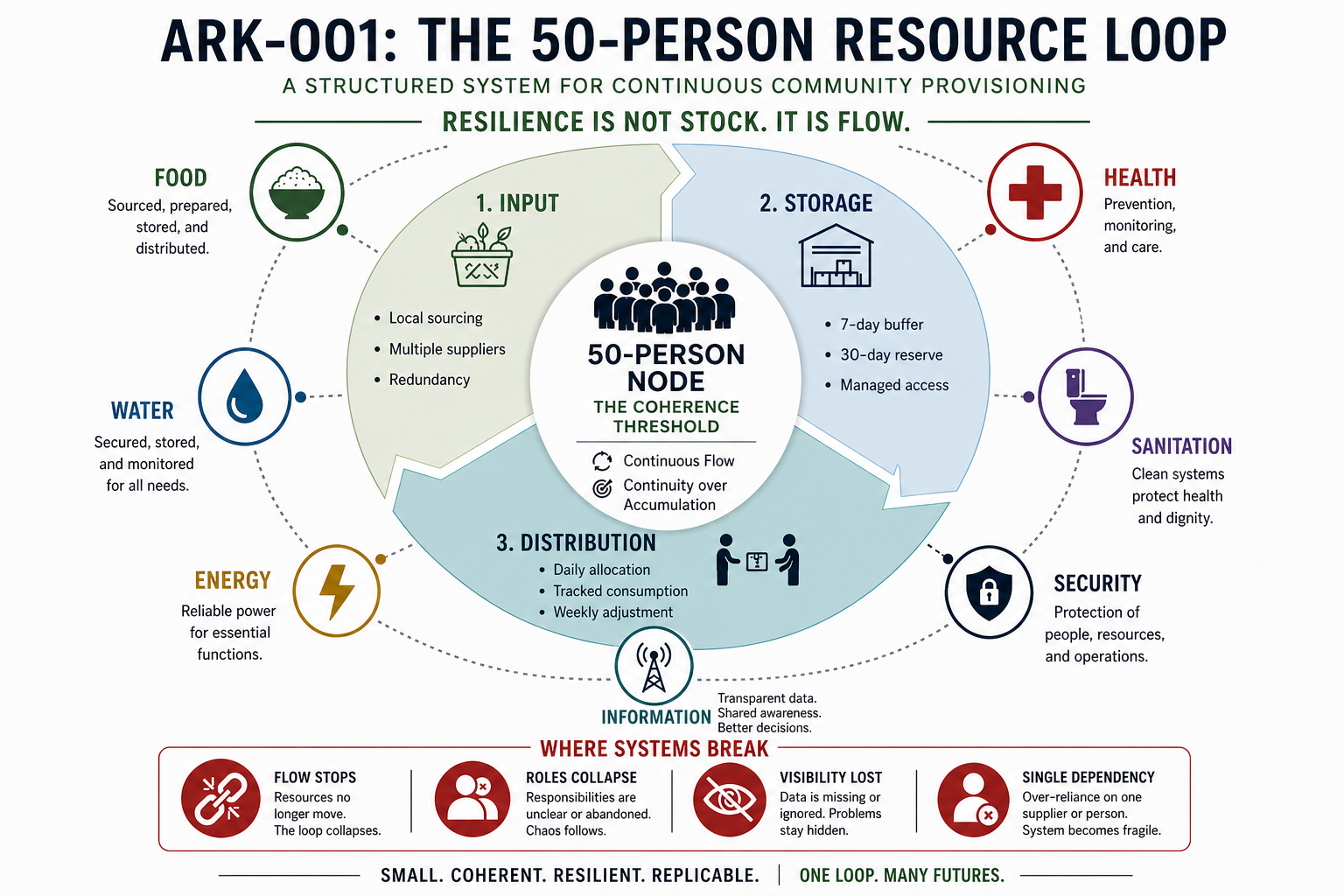
The Core Principle: Flow Over Stock
Most people assume resilience is about having enough.
It is not.
It is not.
A system fails when:
- resources stop moving
- information becomes unclear
- responsibilities dissolve
The loop exists to ensure one condition:
Nothing stops moving.
Food is not just stored—it is cycled.
Water is not assumed—it is measured.
Roles are not implied—they are assigned.
The Three Layers of the Loop
1. Input
Resources enter the system through:
- local procurement
- distributed sourcing
- redundancy (multiple suppliers)
2. Storage
- short-term buffer (active use)
- longer-term reserve (protected)
3. Distribution
- daily allocation
- predictable release cycles
- monitored consumption
These layers are not separate—they are interdependent.
A failure in one propagates through all.
Role Structure
Every participant is part of the system.
Not symbolically—operationally.
Core roles typically include:
- coordination of resources
- food sourcing and preparation
- water management
- health oversight
- infrastructure and energy
- logistics and movement
The critical point is not the titles.
It is that:
No function is left without ownership.
The Importance of Visibility
Most systems degrade quietly.
The loop prevents this through constant visibility:
- how much food remains
- how much water is available
- where pressure is building
When everything is visible:
- small problems are corrected early
- large failures are avoided
What This System IS — and IS NOT
It is not:
- a survivalist model
- an isolationist structure
- a replacement for broader systems
It is:
- a stabilizing layer
- a coordination mechanism
- a way to reduce fragility at the local level
It does not reject larger systems.
It simply does not depend on them for continuity.
Failure Points
Most loops fail in predictable ways:
- roles become unclear
- tracking becomes inconsistent
- participation declines
- reliance on a few individuals increases
When this happens, the loop stops functioning as a system
and becomes a burden.
Why This Matters Now
Urban environments depend on systems that are:
- efficient
- tightly coupled
- fragile under disruption
The resource loop introduces:
- slack
- redundancy
- and local awareness
Not at scale.
But at a level where it can actually function.
Toward Replication
The objective is not to grow one loop indefinitely.
It is to:
- stabilize one
- understand its behavior
- replicate it
Multiple loops can later connect.
But coherence must exist first at the unit level.
Closing
The question is not whether large systems will hold.
The question is whether smaller, coherent systems exist beneath them.
The 50-person loop is one such unit.
Not as a solution to everything—
but as a place where continuity can still be maintained.
Crosslinks
- Internal Reset Hub — psychological grounding for system stability
- Pre-colonial Philippine systems — historical precedent for localized resilience
- What Is NESARA and GESARA? Origins, Claims, and Why the Theory Keeps Resurfacing — macro-system narratives vs local implementation
- The Sovereign Professional — individual readiness for system participation
👉 Download ARK-001 (Printable SOP Version)
👉 Download ARK-001-A (Poster Version)
👉 Download ARK-001-B (Dashboard / Templates)
The concepts outlined here are designed for real-world execution. For a complete set of ready-to-use documents—including governance templates, resource tracking sheets, and operational SOPs—explore the 55 Editable Applied Stewardship Toolkit (Complete Set).
For a broader systems context that situates localized resilience within national and multi-scalar transformation frameworks, explore The Philippine Ark: A Sovereign Blueprint for Systemic Transformation.
Continue Through the ARK Series
This framework is designed as a complete system. You can explore it sequentially or move directly to the layer most relevant to your work:
Foundations
Design + Build
Systems Layer
- ARK-009 — Special Structures and Institutional Design
- ARK-011 — Capitalization and Financial Flows
- ARK-012 — Legal Structures (Philippine Context)
- ARK-013 — Membership, Onboarding, and Exit Systems
Scaling
Suggested Pathways
New to the framework?
Start with ARK-001 → ARK-008 → ARK-011
Designing a physical site?
Begin with ARK-007 → ARK-008 → ARK-009
Preparing for real-world deployment?
Focus on ARK-011 → ARK-012 → ARK-013
Thinking long-term scale?
Move to ARK-010
[DOCUMENT CONTROL & STEWARDSHIP]
Standard Work ID: [ARK-001]
Baseline Version: v1.5.2026
Classification: Open-Access Archive / Systemic Protocol
The Sovereign Audit: Following this protocol is an act of internal quality control. Verification of this standard does not happen here; it happens at your Gemba—the actual place where your life and leadership occur. No external validation is required or offered.
Next in Sequence: [ARK-002: The Babaylan Arc – Institutional Curriculum]
Return to Archive: [Standard Work Knowledge Hub: The Terrain Map]
© 2026 Gerald Daquila • Life.Understood • Systemic Stewardship • Non-Autocratic Architecture • Process over Persona
Leave a Reply