

The Canonical Knowledge Hub for Reclaiming Human Sovereignty in the Age of Intelligent Systems

Primary Pillar: Ethical AI & Human Agency
Purpose: To explore the relationship between artificial intelligence, human consciousness, ethical technology, cognitive sovereignty, and societal stewardship — while establishing foundational principles for human-centered AI, responsible technological governance, digital ethics, and the preservation of human agency in an increasingly algorithmic world.
Hub Status: Canonical Foundation Hub
Placement: Main Navigation → Ethical AI & Human Agency
Meta Description
Explore ethical AI, human agency, cognitive sovereignty, AI governance, digital ethics, information integrity, and humane technology. A comprehensive knowledge hub for navigating the age of artificial intelligence with wisdom, responsibility, and stewardship.
Introduction
Artificial intelligence is no longer a distant technological concept.
It is already reshaping how human beings:
- think,
- work,
- learn,
- communicate,
- govern,
- create meaning,
- and relate to reality itself.
Algorithms increasingly influence what people see, what captures attention, how information spreads, how decisions are made, and how identity is formed.
The AI era is therefore not simply a technological transition.
It is also:
- a governance transition,
- a psychological transition,
- an economic transition,
- a philosophical transition,
- and potentially a civilizational transition.
The defining question of this era is not whether machines will become more intelligent.
It is whether humanity will become wise enough to steward intelligence responsibly.
This knowledge hub exists to explore that challenge.
Not through fear-driven narratives. Not through blind technological optimism. Not through reactionary anti-technology thinking.
But through:
- ethical discernment,
- human sovereignty,
- systems thinking,
- regenerative governance,
- conscious stewardship,
- and humane technological participation.
Artificial intelligence ultimately amplifies the structures already embedded within civilization.
Systems built on extraction amplify extraction. Systems built on manipulation amplify manipulation. Systems built on dignity, responsibility, and stewardship can instead support human flourishing.
The challenge is therefore not technology alone.
The deeper challenge is whether human beings can engage intelligent systems without surrendering:
- agency,
- dignity,
- critical thinking,
- psychological sovereignty,
- ethical responsibility,
- and meaningful human development.
This hub serves as a living archive for exploring how technology can remain in service to life rather than reducing life into programmable optimization.
Understanding Human Agency in an AI-Mediated World
Artificial intelligence is often discussed in terms of capability, efficiency, and automation.
Yet the deeper challenge is not technological. It is human.
Every interaction with an intelligent system influences how information is interpreted, how decisions are made, and how actions are taken.
As AI becomes increasingly embedded within daily life, preserving human agency requires more than access to information—it requires the ability to transform information into understanding, understanding into wise judgment, and judgment into responsible action.
The framework below illustrates this process. The Coherence Cycle provides a practical model for understanding how perception, interpretation, meaning-making, decision-making, and feedback interact to shape individual and collective outcomes.
In an age of intelligent systems, maintaining coherence throughout this cycle may be one of the most important foundations of human sovereignty.

The Coherence Cycle. A universal framework illustrating how reality is perceived, interpreted, assigned meaning, translated into decisions, expressed through action, and refined through feedback.
The map highlights the continuous process through which individuals, communities, institutions, and civilizations either increase coherence or drift into fragmentation, depending on the quality of perception, discernment, stewardship, and adaptation applied at each stage.
→ Reference Map 006: The Coherence Cycle
Framework Note
The Coherence Cycle complements Reference Map 005: The Semantic Mediation Model.
While the Semantic Mediation Model explores how information becomes understanding through synthesis, context, interpretation, and discernment, the Coherence Cycle explores what happens next: how understanding is translated into decisions, actions, feedback, adaptation, and learning.
Together, these frameworks describe two interconnected dimensions of human agency:
- Map 005: How meaning is formed.
- Map 006: How meaning becomes action.
Within the context of artificial intelligence, this distinction is increasingly important. AI can assist information processing and analysis, but responsibility for interpretation, judgment, action, and stewardship remains fundamentally human.
The preservation of agency depends not only upon access to knowledge, but upon maintaining coherence throughout the entire cycle of understanding, decision-making, and learning.
The Ethical AI & Human Agency Hub spans multiple dimensions of technological transformation.
Some articles explore governance, ethics, and institutional design. Others focus on cognition, discernment, sovereignty, meaning-making, and the future relationship between human intelligence and intelligent systems.
The articles below provide foundational entry points into the major themes explored throughout this knowledge domain.
Featured Canonical Articles
Human Sovereignty & Cognitive Liberty
- Collective Sovereignty — How Personal Awakening Scales Into Cultural Change
- The Attention Economy and the Fragmentation of Human Presence
- Sovereignty Without Paranoia: Reclaiming Agency Without Losing Balance
- The Return of Inner Authority
- Staying Sovereign in Uncertain Times
AI Ethics & Human Responsibility
- Human Skills in the Age of AI: What Makes People Valuable in an Automated World
- Responsibility for One’s Own Consciousness
- The Worldview of a Conscious Human
Human Development, Meaning & Consciousness
- AI as a Catalyst for Human Consciousness: Awakening to the Soul’s Irreplaceable Role in a Technological Era
- Creativity Unraveled: Exploring Its Essence, Origins, and the Human-AI Divide
- Synthetic Reality: Deepfakes, Narrative Collapse, and the End of Passive Trust
- From Emotional Intelligence to Coherent Presence
Work, Meaning & Economic Transition
- Human Skills in the Age of AI: What Makes People Valuable in an Automated World
- Beyond the Clock: Reimagining Work-Life Balance as a Triune Path to Eudaimonic Flourishing
- From Scarcity to Abundance: Redesigning Systems for a New Human Reality
- Why Hard Work Alone Doesn’t Make You Valuable
What Is Ethical AI?
Ethical AI refers to the design, deployment, governance, and use of intelligent systems in ways that uphold human dignity, transparency, accountability, fairness, safety, and meaningful human agency.
The central question is not whether artificial intelligence can perform increasingly sophisticated tasks. The deeper question is whether intelligent systems can be developed and stewarded in ways that remain aligned with human flourishing, democratic accountability, psychological well-being, and long-term societal resilience.
Ethical AI therefore extends beyond technical performance. It includes governance structures, incentive systems, institutional accountability, cultural values, and the preservation of human responsibility within increasingly automated environments.
This hub explores ethical AI as both a technological challenge and a stewardship challenge.
Why Human Agency Matters
As intelligent systems become more embedded within everyday life, preserving human agency becomes one of the defining responsibilities of the digital age.
Modern platforms are not neutral.
They are increasingly designed to:
- capture attention,
- shape behavior,
- influence perception,
- optimize emotional engagement,
- and direct decision-making.
The result is a gradual shift from conscious participation toward algorithmically mediated behavior.
Many people now experience:
- digital exhaustion,
- fragmented attention,
- cognitive overload,
- dependency on recommendation systems,
- emotional volatility,
- and increasing difficulty distinguishing signal from noise.
The long-term risk is not merely technological dependence.
It is the erosion of:
- discernment,
- sovereignty,
- inner authority,
- and the human capacity for coherent presence.
This hub therefore approaches artificial intelligence not only as a technical issue, but as a human development challenge.
The future of intelligent systems cannot be separated from:
- ethics,
- psychology,
- governance,
- education,
- culture,
- and consciousness itself.
AI Ethics & Alignment
Artificial intelligence reflects the ethical architecture of the societies that produce it.
If systems are built within environments driven by:
- extraction,
- manipulation,
- surveillance,
- and concentrated power,
then intelligent systems will naturally amplify those tendencies.
The alignment challenge is therefore not only technical.
It is civilizational.
This section explores:
- ethical machine learning,
- governance responsibility,
- bias and fairness,
- human-centered AI,
- existential technological risk,
- and the distinction between intelligence and wisdom.
Recommended Articles
- Human-Centered AI: Reclaiming Ethics in Technological Design
- The Difference Between Intelligence and Consciousness
- Technology Must Remain in Service to Life
- Responsibility for One’s Own Consciousness
Human Sovereignty & Cognitive Liberty
The struggle for sovereignty is no longer limited to territory or economics.
It increasingly includes:
- attention,
- cognition,
- perception,
- information environments,
- and the integrity of consciousness itself.
As algorithms become more capable of predicting and influencing behavior, cognitive liberty becomes a foundational civilizational issue.
Cognitive Sovereignty
Cognitive sovereignty refers to the capacity of individuals and communities to think, discern, learn, form beliefs, and make decisions without undue manipulation, coercion, dependency, or algorithmic control.
It does not imply isolation from information or technology. Rather, it involves maintaining the ability to engage information environments consciously, critically, and responsibly while preserving independent judgment and informed consent.
In an era increasingly shaped by recommendation systems, persuasive technologies, and AI-mediated information flows, cognitive sovereignty becomes a foundational component of human freedom.
This section explores:
- psychological sovereignty,
- behavioral manipulation,
- persuasion systems,
- digital addiction,
- identity fragmentation,
- attention extraction,
- and the preservation of coherent selfhood.
Recommended Articles
- Digital Sovereignty in an Age of Algorithmic Persuasion
- Attention Stewardship in the Digital Age
- Sovereignty Without Paranoia: Reclaiming Agency Without Losing Balance
- The Return of Inner Authority
- Staying Sovereign in Uncertain Times
AI Governance & Decentralized Intelligence
Who governs intelligent systems? Who controls digital infrastructure? Who benefits from informational concentration?
Artificial intelligence is rapidly becoming infrastructural power.
This section explores:
- decentralized governance,
- platform concentration,
- public-interest technology,
- distributed intelligence systems,
- civic participation,
- and ethical stewardship models.
The goal is not merely technological advancement.
It is ensuring that intelligent systems remain accountable to human dignity and social responsibility.
Recommended Articles
- Why Power Concentrates: The Hidden Logic of Systems
- Sovereignty & Governance
- Collective Sovereignty — How Personal Awakening Scales Into Cultural Change
- The Sovereign Leader: How to Practice Stewardship When Systems Fail
AI, Labor & Human Meaning
Automation is transforming labor faster than many institutions can adapt.
Yet the deeper challenge is not merely economic displacement.
It is the destabilization of meaning.
For generations, human worth has often been tied to:
- productivity,
- output,
- performance,
- and economic utility.
As intelligent systems increasingly automate cognitive and technical tasks, humanity is being forced to confront a deeper question:
What makes human beings valuable beyond productivity?
This section explores:
- post-productivity identity,
- meaningful work,
- regenerative economics,
- automation transitions,
- human creativity,
- and the future of contribution.
Recommended Articles
- Human Skills in the Age of AI: What Makes People Valuable in an Automated World
- Beyond the Clock: Reimagining Work-Life Balance as a Triune Path to Eudaimonic Flourishing
- From Scarcity to Abundance: Redesigning Systems for a New Human Reality
- Why Hard Work Alone Doesn’t Make You Valuable
AI, Consciousness & Philosophy
Artificial intelligence has reopened ancient philosophical questions regarding:
- consciousness,
- awareness,
- intelligence,
- identity,
- and the nature of mind itself.
Can intelligence exist without awareness? Can machines simulate meaning without experiencing meaning? Can computation ever become consciousness?
This section explores the philosophical limits of artificial intelligence and the distinction between synthetic capability and lived awareness.
Recommended Articles
- AI as a Catalyst for Human Consciousness: Awakening to the Soul’s Irreplaceable Role in a Technological Era
- Creativity Unraveled: Exploring Its Essence, Origins, and the Human-AI Divide
- The Difference Between Intelligence and Consciousness
- The Worldview of a Conscious Human
Ethical Technology Design
Technology shapes behavior. Interfaces shape cognition. Platforms shape culture.
The architecture of digital systems therefore carries ethical consequences.
This section focuses on designing technologies that:
- protect dignity,
- preserve consent,
- support psychological health,
- minimize exploitation,
- and encourage meaningful human participation.
Topics include:
- humane interfaces,
- ethical UX,
- consent architecture,
- privacy-first infrastructure,
- slow technology,
- and regenerative digital ecosystems.
Recommended Articles
- Human Skills in the Age of AI: What Makes People Valuable in an Automated World
- Technology Must Remain in Service to Life
- Attention Stewardship in the Digital Age
- Consent and Ethical Boundaries
AI & Education
Artificial intelligence is transforming how human beings learn, process information, and relate to knowledge itself.
While AI-assisted systems can dramatically increase access to information, they also introduce risks of:
- cognitive dependency,
- passive consumption,
- discernment erosion,
- and intellectual outsourcing.
This section explores:
- educational sovereignty,
- critical thinking,
- AI-assisted learning,
- cognitive offloading,
- information discernment,
- and the future of human learning.
Recommended Articles
- How to Think Clearly in Times of Systemic Uncertainty
- Decision-Making Under Uncertainty: How People Choose Without Enough Information
- A Descriptive Map of Human Sense-Making Under Change
AI, Knowledge & Sensemaking
Artificial intelligence is transforming more than work, governance, and communication.
It is transforming how human beings interact with knowledge itself.
For centuries, information systems were designed primarily around storage, classification, and retrieval. Increasingly, intelligent systems are becoming active participants in interpretation, synthesis, and meaning-making.
As AI-mediated environments become more common, the challenge shifts from finding information to navigating understanding.
This section explores:
- semantic ecosystems,
- synthetic cognition,
- information integrity,
- discernment,
- sensemaking,
- knowledge networks,
- cognitive sovereignty,
- and collective intelligence.
The central question is no longer simply:
- “What information is available?”
Increasingly, it becomes:
- “How do we determine what is meaningful, coherent, and true?”
Framework Connection
This domain builds directly upon Reference Map 005: The Semantic Mediation Model, which explores how information becomes understanding through context, interpretation, synthesis, discernment, and meaning-making.
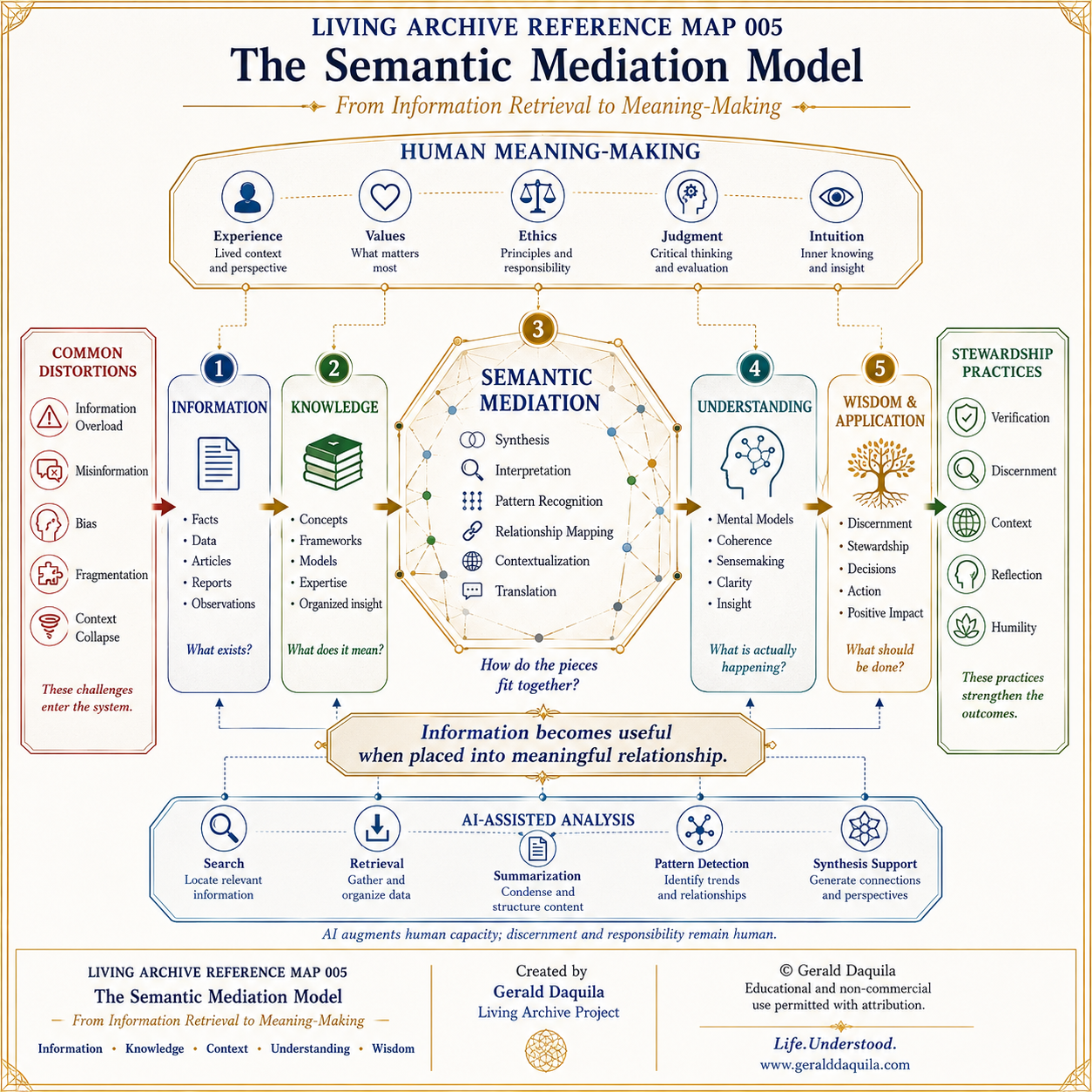
As AI systems increasingly participate in information processing, semantic mediation becomes a critical layer of human agency. The challenge is no longer merely accessing knowledge, but preserving the human capacity to interpret knowledge wisely.
Recommended Articles
- Semantic Ecosystems: How AI Is Changing the Structure of Human Knowledge
- Synthetic Cognition: How AI Is Reshaping Human Thought Patterns
- Why Human Understanding Is Becoming More Networked Than Hierarchical
- Coherence vs Truth: The Emerging Crisis of AI Information Systems
- Truth in the Age of AI: Why Discernment Is Becoming a Survival Skill
- The Sovereign Prompt: How to Use AI Without Outsourcing Discernment
- AI as Mirror: What Intelligent Systems Reveal About Human Consciousness
Digital Identity & Synthetic Reality
The internet is no longer merely a communication layer.
It is increasingly becoming a synthetic social environment where:
- identity,
- perception,
- reputation,
- memory,
- culture,
- and even reality itself
can be technologically manipulated, replicated, amplified, or distorted.
Human beings now operate within digital ecosystems shaped by:
- algorithms,
- synthetic media,
- AI-generated content,
- recommendation systems,
- virtual personas,
- and platform-driven social architectures.
As these systems become more immersive and psychologically adaptive, the boundary between authentic and synthetic experience becomes increasingly blurred.
People are no longer interacting only with other humans online.
They are increasingly interacting with:
- algorithmically curated realities,
- AI-generated narratives,
- synthetic personalities,
- automated persuasion systems,
- and engagement architectures optimized to capture attention and shape behavior.
This transformation carries profound implications for:
- trust,
- identity formation,
- social cohesion,
- political stability,
- emotional health,
- and the preservation of shared reality.
Emerging technologies such as:
- deepfakes,
- synthetic voices,
- AI-generated avatars,
- immersive virtual environments,
- and infinitely scalable content generation
are accelerating the destabilization of traditional verification systems.
The challenge is no longer simply misinformation.
It is the growing fragmentation of shared reality itself:
the erosion of commonly accepted frameworks for determining what is authentic, trustworthy, or real.
In such environments, individuals become increasingly vulnerable to:
- identity fragmentation,
- emotional manipulation,
- digital tribalism,
- algorithmic radicalization,
- parasocial dependency,
- and psychologically destabilizing information flows.
The long-term issue is therefore not merely technological sophistication.
It is whether human beings can preserve:
- discernment,
- grounded identity,
- authentic relationship,
- psychological coherence,
- and meaningful social trust
within increasingly synthetic environments.
This section explores:
- digital identity,
- synthetic media,
- deepfakes,
- online tribalism,
- reputation systems,
- virtual communities,
- algorithmic social architectures,
- and the future of human presence in digital space.
Recommended Articles
- Responsibility for One’s Own Consciousness
- AI as a Catalyst for Human Consciousness
- Creativity Unraveled: Exploring Its Essence, Origins, and the Human-AI Divide
- The Attention Economy and the Fragmentation of Human Presence
- Digital Sovereignty in an Age of Algorithmic Persuasion
The Stewardship Question
Artificial intelligence is often framed as a technological challenge.
In reality, it is also a human challenge.
The future will not be determined solely by the capabilities of intelligent systems, but by the quality of the values, institutions, cultures, and forms of leadership that guide them.
The central question is not whether humanity can create increasingly powerful technologies.
The deeper question is whether humanity can cultivate the wisdom, responsibility, discernment, and stewardship required to use them well.
The answer to that question may shape the trajectory of civilization for generations to come.
Continue the Exploration
This article is part of a broader knowledge ecosystem exploring stewardship, ethical leadership, sovereignty, regenerative systems, human development, governance, technology ethics, and long-term civilizational resilience.
Canonical Knowledge Hubs
- Foundations of Stewardship & Leadership
- Ethical AI & Human Agency
- Governance & Decentralization
- Philippine Development & Renewal
- Shadow Work & Integration
- Regenerative Economics
- Intentional Community Design
Emerging Knowledge Domains
- AI, Knowledge & Sensemaking
- Human Agency & Cognitive Sovereignty
- Synthetic Reality & Information Integrity
- Semantic Knowledge Systems
Related Topics
- Ethical Leadership
- Sovereignty & Responsibility
- Regenerative Governance
- Community Stewardship
- Systems Thinking
- Human-Centered Technology
- Information Integrity
- Emotional Regulation
- Consent & Accountability
- Local Resilience
- Civic Stewardship
- Distributed Leadership
- Ethical AI
- Stewardship Economics
Recommended Next Reads
- What Is Ethical Leadership?
- Stewardship vs Control
- Sovereignty Without Isolation
- Integrity as Infrastructure
- The Difference Between Power and Responsibility
- Regenerative Governance Principles
- The Digital Barangay Framework
- Attention Stewardship in the Digital Age
- Consent and Ethical Boundaries
- Community Accountability Systems
Adjacent Knowledge Pathways
This article may also connect with broader explorations into:
- regenerative development,
- ethical technology,
- decentralized systems,
- intentional communities,
- civic renewal,
- local resilience,
- trauma-informed leadership,
- and human sovereignty in the digital age.
Intellectual Traditions
The Ethical AI & Human Agency Knowledge Hub draws together insights from a broad range of intellectual traditions concerned with the relationship between technology, human flourishing, ethical responsibility, and the future of civilization. Its interdisciplinary foundations include artificial intelligence ethics, philosophy of technology, cognitive science, human-computer interaction, information ethics, systems thinking, governance studies, psychology, educational theory, media and communication studies, complexity science, and moral philosophy.
Rather than advocating either technological optimism or technological resistance, this Hub serves as an integrative framework that brings these complementary traditions into dialogue. The essays, reference materials, and conceptual frameworks gathered here synthesize established scholarship with original architectural perspectives developed through the Living Archive, exploring how intelligent systems influence human agency, cognition, culture, governance, and the conditions for individual and collective flourishing.
Readers are encouraged to engage critically with both the ideas presented here and the wider traditions from which they emerge. The Living Archive does not seek to replace the technical disciplines that shape artificial intelligence, nor the ethical traditions that guide its responsible use. Instead, it provides a navigational framework that helps readers connect insights across disciplines while cultivating the discernment, responsibility, and systems awareness needed to steward increasingly intelligent technologies in service of human dignity and the common good.
About the Author
Gerald Daquila is an independent systems thinker, writer, and stewardship-focused researcher exploring ethical leadership, regenerative systems, governance, sovereignty, human development, decentralized civic models, and long-term civilizational resilience.
His work integrates:
- systems thinking,
- ethical technology,
- regenerative governance,
- community stewardship,
- human-centered development,
- and philosophical inquiry into responsibility, sovereignty, and societal renewal.
The broader body of work seeks to support:
- ethical leadership formation,
- resilient local systems,
- conscious governance,
- digital-era discernment,
- and regenerative approaches to human flourishing.
©2026 Life.Understood. • Systems Thinking, Leadership Architecture, and Applied Coherence
Leave a Reply