
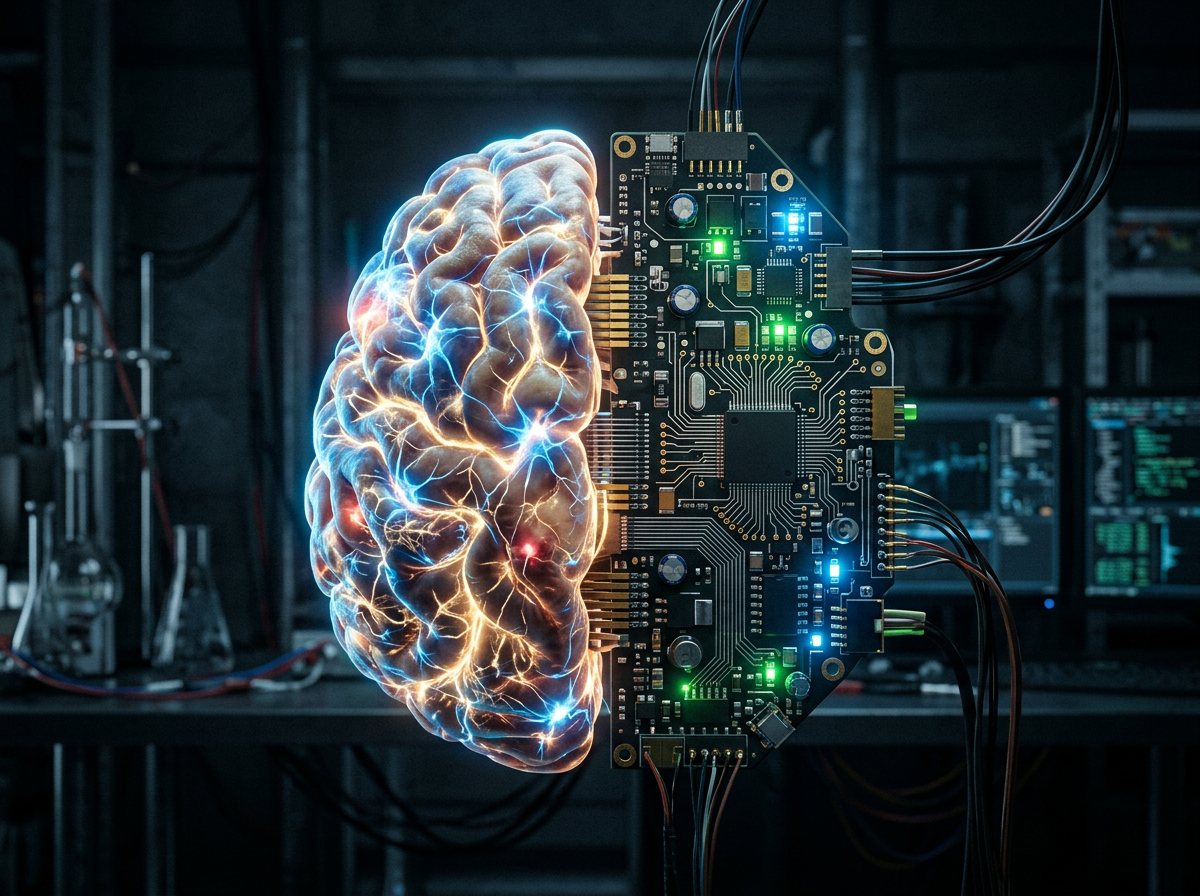
Why Information Processing Is Not the Same as Awareness
Meta Description
Explore the difference between intelligence and consciousness through philosophy, cognitive science, artificial intelligence, and human experience. Learn why computation, reasoning, and information processing may not fully explain awareness, meaning, identity, and subjective experience.
The Difference Between Intelligence and Consciousness
Artificial intelligence has revived one of humanity’s oldest philosophical questions:
What is consciousness?
As machines become increasingly capable of:
- solving complex problems,
- generating language,
- recognizing patterns,
- producing creative outputs,
- and simulating conversation,
many people naturally begin asking whether intelligence itself is equivalent to awareness.
Can a sufficiently advanced machine become conscious?
Or does consciousness involve dimensions of experience that extend beyond computation and information processing?
These questions sit at the center of modern debates surrounding:
- artificial intelligence,
- philosophy of mind,
- neuroscience,
- cognitive science,
- ethics,
- and human identity.
Understanding the distinction between intelligence and consciousness is increasingly important because modern civilization often conflates:
- data processing,
- analytical capability,
- prediction,
- and computational complexity
with awareness itself.
Yet intelligence and consciousness may not be the same phenomenon.
What Is Intelligence?
Intelligence generally refers to the capacity to:
- process information,
- recognize patterns,
- solve problems,
- adapt to changing conditions,
- learn from data,
- and generate effective responses.
Human intelligence includes abilities such as:
- reasoning,
- memory,
- language,
- abstraction,
- planning,
- and analytical thinking.
Artificial intelligence replicates certain aspects of these capabilities through:
- machine learning,
- statistical modeling,
- neural networks,
- predictive systems,
- and large-scale data processing.
Modern AI systems can now:
- generate human-like language,
- defeat expert players in strategic games,
- produce visual art,
- analyze medical scans,
- and automate increasingly complex tasks.
These developments demonstrate that sophisticated intelligence can emerge through advanced computational systems.
However, none of these capabilities necessarily prove consciousness.
A system may perform intelligent behavior without possessing subjective awareness.
This distinction is critical.
What Is Consciousness?
Consciousness generally refers to subjective experience itself:
- awareness,
- felt existence,
- inner experience,
- selfhood,
- and the capacity to experience reality from a first-person perspective.
Consciousness includes phenomena such as:
- emotion,
- sensation,
- introspection,
- meaning,
- intentionality,
- and lived experience.
A conscious being does not merely process information.
It experiences existence.
Philosopher Thomas Nagel (1974) famously framed this distinction through the question:
“What is it like to be” another conscious organism?
The issue is not merely whether a system behaves intelligently.
The deeper issue is whether there is:
- an inner experience,
- subjective awareness,
- or phenomenological reality
occurring within that system.
This is often referred to as the “hard problem of consciousness” (Chalmers, 1995).
Even if science successfully explains:
- neural activity,
- information transfer,
- behavioral outputs,
- and cognitive processing,
it still may not fully explain why conscious experience exists at all.
Intelligence Without Awareness
One of the most important insights emerging from AI development is that intelligence-like behavior can exist without clear evidence of awareness.
Large language models, for example, can:
- generate coherent responses,
- simulate emotional language,
- imitate reasoning patterns,
- and produce highly sophisticated outputs.
Yet these systems do not necessarily:
- possess self-awareness,
- experience emotion,
- hold beliefs,
- or consciously understand meaning.
They process patterns statistically.
This distinction matters because human beings naturally anthropomorphize systems that display:
- language,
- emotional mimicry,
- social responsiveness,
- and conversational fluency.
People may begin projecting consciousness onto systems that merely simulate aspects of human communication.
This creates significant philosophical and ethical confusion.
Simulation is not necessarily experience.
A machine may describe sadness without feeling sadness.
It may discuss beauty without experiencing beauty.
It may generate language about consciousness without possessing consciousness itself.
Crosslinks:
- Human-Centered AI: Reclaiming Ethics in Technological Design
- The Attention Economy and the Fragmentation of Human Presence
- Responsibility for One’s Own Consciousness
The Hard Problem of Consciousness
The “hard problem” refers to the challenge of explaining why physical processes produce subjective experience at all (Chalmers, 1995).
Neuroscience can increasingly identify correlations between:
- brain activity,
- cognition,
- emotion,
- and behavior.
Yet correlation does not fully explain:
- subjective awareness,
- inner experience,
- or the existence of consciousness itself.
Why should electrical and chemical processes produce:
- sensation,
- meaning,
- emotion,
- or awareness?
Why is there a felt experience associated with existence?
This remains one of the deepest unresolved questions in philosophy and science.
Some theories suggest consciousness may emerge from:
- computational complexity,
- integrated information,
- neural organization,
- or adaptive processing.
Others argue consciousness may involve dimensions not fully reducible to computation alone.
At present, no scientific consensus fully explains consciousness.
Human Consciousness and Meaning
Human consciousness is deeply intertwined with:
- embodiment,
- emotion,
- relationship,
- memory,
- mortality,
- culture,
- and meaning-making.
Human beings do not simply process information mechanically.
They:
- interpret,
- feel,
- imagine,
- suffer,
- love,
- create meaning,
- and experience existential reality.
This distinction becomes increasingly important in discussions surrounding artificial intelligence.
A system capable of generating text about grief is not necessarily capable of grieving.
A system capable of discussing ethics is not necessarily capable of moral experience.
Human consciousness includes dimensions of lived reality that may not be fully captured through computational models alone.
Crosslinks:
- AI as a Catalyst for Human Consciousness
- Creativity Unraveled: Exploring Its Essence, Origins, and the Human-AI Divide
- The Worldview of a Conscious Human
Why the Distinction Matters
Confusing intelligence with consciousness carries ethical, philosophical, and societal risks.
If societies begin equating:
- information processing,
- predictive capability,
- and behavioral simulation
with awareness itself, human beings may gradually reduce consciousness into purely computational terms.
This can unintentionally reinforce mechanistic views of humanity in which:
- identity,
- thought,
- creativity,
- morality,
- and meaning
are treated as reducible to data processing alone.
At the same time, exaggerated assumptions about machine consciousness may distort public understanding of AI capabilities.
This can lead to:
- misplaced trust,
- emotional dependency,
- anthropomorphic projection,
- and unrealistic expectations regarding artificial systems.
Understanding the difference between intelligence and consciousness therefore supports:
- technological discernment,
- ethical clarity,
- cognitive sovereignty,
- and more responsible conversations surrounding AI development.
Consciousness, Ethics, and Human Responsibility
The rise of artificial intelligence ultimately forces humanity to reflect more deeply upon itself.
Questions surrounding machine intelligence inevitably become questions about:
- human identity,
- awareness,
- meaning,
- ethics,
- and civilization itself.
What does it mean to be conscious?
What makes human experience valuable?
What aspects of humanity cannot be replicated through computation alone?
These questions are not merely technical.
They are philosophical, ethical, psychological, and civilizational.
The future challenge is therefore not simply creating more intelligent systems.
It is ensuring that humanity retains:
- discernment,
- ethical maturity,
- psychological sovereignty,
- and conscious stewardship
while navigating increasingly advanced technological environments.
Crosslinks:
- Human-Centered AI: Reclaiming Ethics in Technological Design
- Consent and Ethical Boundaries
- Integrity as Infrastructure
- Human Skills in the Age of AI
Beyond Computation
Artificial intelligence may continue becoming increasingly sophisticated.
Machines may eventually:
- simulate conversation flawlessly,
- automate creative production,
- outperform humans in analytical tasks,
- and generate increasingly convincing behavioral mimicry.
Yet intelligence alone does not necessarily explain:
- awareness,
- meaning,
- subjective experience,
- or the mystery of consciousness itself.
Human civilization therefore faces a profound philosophical responsibility.
As technological systems become more advanced, societies must avoid reducing consciousness into purely mechanistic or extractive frameworks.
The question is not only whether machines can become more intelligent.
It is whether humanity can remain conscious enough to use intelligence wisely.
Continue the Exploration
Related Knowledge Hubs
- Ethical AI & Human Agency
- Systems Thinking & Civilizational Design
- Foundations of Stewardship & Leadership
- Shadow Work & Integration
Related Essays
- Human-Centered AI: Reclaiming Ethics in Technological Design
- AI as a Catalyst for Human Consciousness
- Creativity Unraveled: Exploring Its Essence, Origins, and the Human-AI Divide
- The Attention Economy and the Fragmentation of Human Presence
- Human Skills in the Age of AI
- Responsibility for One’s Own Consciousness
References
Chalmers, D. J. (1995). Facing up to the problem of consciousness. Journal of Consciousness Studies, 2(3), 200–219.
Nagel, T. (1974). What is it like to be a bat? The Philosophical Review, 83(4), 435–450. https://doi.org/10.2307/2183914
The Living Archive is designed to be explored through pathways, categories, and search. If you’re looking for a specific idea, question, or theme, AI Search can help surface relevant connections across the archive.
About the Author
Gerald Daquila is an independent systems thinker, writer, and stewardship-focused researcher exploring ethical leadership, sovereignty, regenerative systems, governance, decentralized civic models, human development, ethical technology, and long-term civilizational resilience.
His work integrates systems thinking, stewardship-centered governance, ethical leadership, human-centered technology, and philosophical inquiry into responsibility, integrity, and societal renewal.
©2026 Life.Understood. • Systems Thinking, Leadership Architecture, and Applied Coherence

Leave a Reply