
Meta Description
The Living Archive contains several kinds of documents, each serving a distinct role within the institution. This guide explains the purpose, scope, and methodological identity of every document type, helping readers understand not only what they are reading, but how it is intended to be read.
Document Type: Constitutional Method
Purpose: Defines the principles and process by which the Living Archive is revised, ensuring that growth, correction, and refinement strengthen rather than diminish its coherence.
Scope: Applies across all public corpora as the constitutional framework for maintaining continuity, transparency, and intellectual integrity as the Archive evolves.
No method remains trustworthy if it cannot be revised.
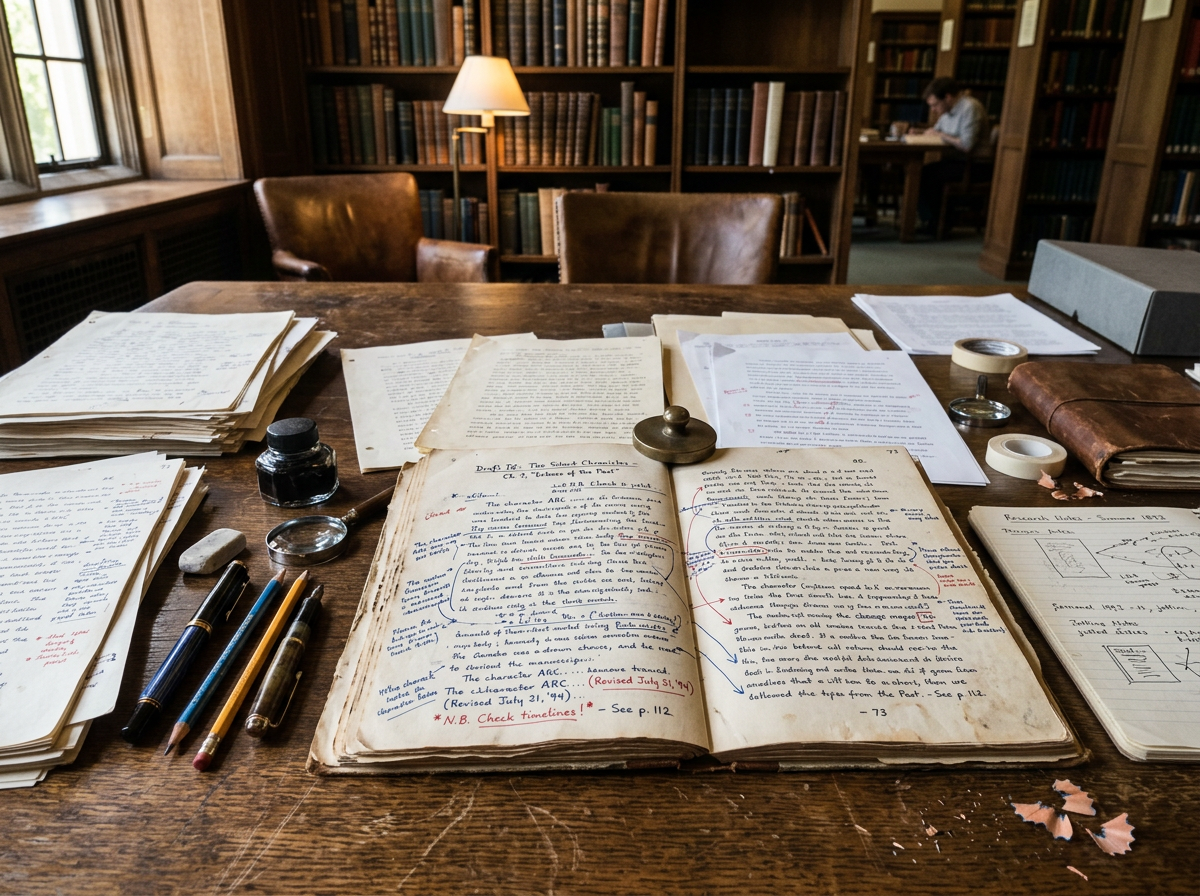
Understanding grows through observation, criticism, reflection, and experience. As new evidence emerges, stronger explanations are developed, and previously unseen relationships become visible, responsible inquiry requires the willingness to reconsider earlier conclusions.
The Living Archive therefore treats revision not as an admission of failure, but as an essential discipline of intellectual integrity.
Revision serves the continuity of understanding rather than the preservation of conclusions.
Revision follows understanding.
The Living Archive does not revise its work in response to novelty alone.
Revision occurs when better evidence, stronger reasoning, greater coherence, or broader understanding provides a more adequate account of reality.
Change is justified by improvement rather than by preference.
Revision preserves continuity.
Responsible revision builds upon prior understanding wherever possible.
Earlier work is not discarded simply because it is incomplete.
Instead, the Living Archive seeks to retain what remains valuable while refining, expanding, correcting, or reorganizing what no longer provides the clearest understanding.
Development is cumulative whenever possible.
Revision remains transparent.
Where significant changes occur, the Living Archive seeks to make the nature of those revisions understandable.
Readers should be able to recognize when an explanation has been clarified, expanded, substantially revised, or replaced.
Transparency strengthens trust by making intellectual development visible.
Revision welcomes criticism.
Thoughtful criticism is an important source of learning.
The Living Archive distinguishes criticism that improves understanding from disagreement that merely reflects differing preferences or assumptions.
Criticism is evaluated according to the quality of its reasoning, evidence, explanatory power, and capacity to illuminate reality more clearly.
Revision remains accountable to the Method.
No revision should contradict the Method merely to preserve convenience, popularity, or institutional consistency.
Every proposed revision remains subject to the same Rules of Reasoning, Levels of Claim, Evidence Standards, Boundary Conditions, First Principles, and Public Vocabulary that govern the Living Archive as a whole.
The Method therefore evaluates its own development.
Revision never becomes final.
Every conclusion remains provisional in principle, even where confidence is high.
Some understandings may remain stable for generations.
Others may change rapidly as inquiry advances.
The Living Archive makes no claim that its present formulations represent the final state of understanding.
For this reason, the Living Archive describes itself as a living archive.
Its identity is not preserved by resisting change.
It is preserved by maintaining continuity of purpose while remaining open to greater understanding.
A method capable of responsible revision becomes more reliable over time because it learns without surrendering its principles.
Its continuity lies not in repeating the same conclusions, but in faithfully practicing the same discipline of inquiry across changing circumstances.
Constitutional Position
This document forms part of The Living Archive Method, the constitutional architecture that makes the Living Archive’s way of reasoning explicit, teachable, and open to examination.
The documents within this series describe how the Living Archive approaches inquiry. They are intended to make its reasoning transparent rather than prescribe what readers must conclude.
Continue Exploring
Previous: Public Vocabulary
Discover the shared language that gives the Living Archive’s concepts consistent meaning across its essays, maps, and constitutional documents.
Next: Analytical Procedure
Learn how the Living Archive applies its Method in practice, moving from observation to coherent understanding through a disciplined process of inquiry.
Institutional Stewardship
Maintained by Gerald Daquila
Founder and Steward, Living Archive
Life.Understood.
© Gerald Daquila. All Rights Reserved.