
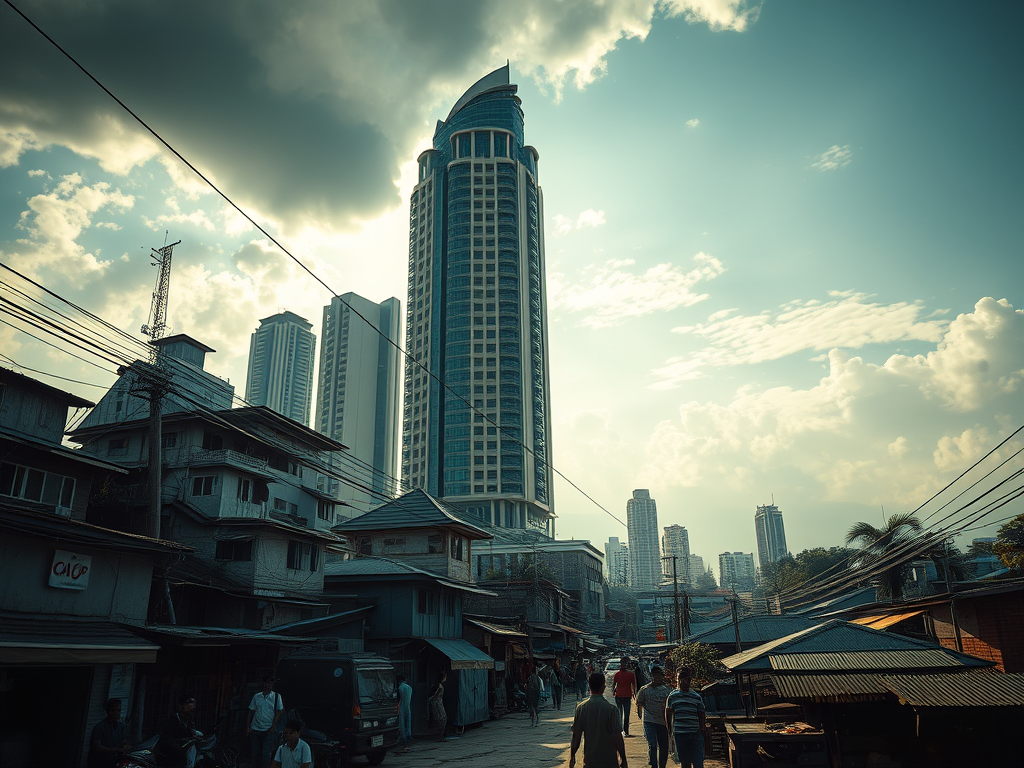
Why Structural Patterns Persist Across Generations
Meta Description
Why do cycles of scarcity and power persist across generations in the Philippines? This essay explores how access, patronage, incentives, and structural inequality reinforce long-term patterns in governance, opportunity, and social mobility.
Across decades, the Philippines has experienced periods of growth, reform, and transition.
New leadership emerges. Policies shift. Economic indicators improve. Public expectations rise.
And yet, many of the same challenges persist:
- uneven access to opportunity
- concentration of political and economic power
- cycles of reform followed by stagnation
- a persistent gap between national potential and lived reality
This creates a recurring question:
Why does this keep happening—even when change appears to be happening?
The answer is not found in any single leader, policy, or event.
It lies in how systems, incentives, and behavior interact across generations.
What’s Actually Happening
The Philippines is not lacking in capability.
Filipinos consistently demonstrate resilience, adaptability, creativity, and perseverance—qualities visible across industries and geographies.
The contrast is striking:
- within the country, many struggle to access opportunity
- outside the country, the same individuals often succeed
This pattern points to a structural explanation:
Outcomes are shaped less by individual capability—and more by the system in which that capability operates.
At the cognitive level, decision-making under pressure narrows focus toward immediate survival and stability.
At the systems level, structures tend to reinforce existing advantages, as described in systems thinking by Donella Meadows.
At the behavioral level, individuals respond to incentives, consistent with economic insights from Adam Smith.
Together, these forces create a system where:
- access shapes opportunity
- opportunity shapes outcomes
- outcomes reinforce access
This is not random.
It is a self-reinforcing structure.
The Core Cycle: Scarcity, Access, and Power
At the center of this pattern is a cycle that links scarcity to power.
1. Early Inequality of Access
From an early stage—family, education, community—access to opportunity is uneven.
Economic constraints, geographic differences, and social positioning shape starting conditions.
2. Patronage as a Survival Mechanism
In environments where access is limited, informal systems emerge.
The padrino (patronage) system becomes a way to navigate scarcity:
- access is mediated through relationships
- opportunities depend on connections
- trust is personalized rather than institutional
This system is not purely cultural—it is adaptive.
It develops as a response to structural imbalance.
3. Power Concentration
Over time, those with access to networks, resources, and influence accumulate more control.
This concentration appears across levels:
- local governance
- institutions
- economic structures
Power becomes clustered within networks that can reinforce their own position.
4. Incentive Alignment Toward Preservation
Systems begin to reward behaviors that maintain stability within these structures.
Individuals adapt by:
- prioritizing relationships over merit
- avoiding risk that challenges the system
- optimizing within existing constraints
Behavior aligns with what is rewarded—not necessarily with what is optimal.
5. Decision-Making Under Constraint
Leaders and individuals operate under pressure and uncertainty.
This narrows decision-making:
- short-term outcomes are prioritized
- structural reform becomes difficult
- visible action replaces systemic change
6. Limited Mobility and Redistribution
Opportunities remain unevenly distributed.
Even when growth occurs, access does not expand proportionally.
Those outside key networks face persistent barriers.
7. Reinforcement Across Generations
The system reproduces itself:
- access remains uneven
- patronage persists
- power remains concentrated
- scarcity continues for many
This cycle explains a critical paradox:
The system is not failing randomly—it is working as structured, even if outcomes fall below potential.
The OFW Contrast: A Structural Test Case
One of the clearest indicators that this is systemic—not individual—is the experience of Overseas Filipino Workers (OFWs).
When Filipinos operate within different systems:
- access is more standardized
- incentives are more transparent
- institutions are more predictable
The same individuals who struggled within local constraints often:
- perform competitively
- advance professionally
- demonstrate high reliability and adaptability
This contrast reveals a key insight:
Capability is not the limiting factor—system structure is.
The difference is not in talent, but in:
- how opportunities are accessed
- how behavior is rewarded
- how systems enforce fairness and predictability
Why Reform Struggles to Scale
Reform efforts often target specific issues:
- governance improvement
- economic development
- social programs
These can produce real gains.
But scaling them across the system is difficult.
Because reform operates within the same structure that produces the pattern.
Several constraints limit impact:
- incentive misalignment
Long-term reforms compete with short-term political and institutional pressures - embedded patronage networks
Informal systems continue to shape access and decision-making - fragmented implementation
Coordination across institutions is limited - risk asymmetry
Challenging existing structures carries higher risk than maintaining them
As a result, reform can succeed locally or temporarily—but struggle to transform the broader system.
Second-Order Effects: What the System Produces Over Time
Over time, the interaction of these dynamics produces deeper effects:
- Normalization of constrained access
Limited opportunity becomes expected rather than questioned - Externalization of potential
Talent and capability are expressed outside the system rather than within it - Short-term behavioral orientation
Individuals prioritize immediate stability over long-term positioning - Trust fragmentation
Trust becomes localized (family, networks) rather than institutional - Reduced system efficiency
Opportunities are not allocated based on capability, limiting overall performance
These effects reinforce the cycle.
The system stabilizes—not because it is optimal, but because it is self-reinforcing.
What Changes the Pattern
Breaking this cycle requires shifts across multiple layers—not a single intervention.
Key conditions include:
1. Expanding Access Pathways
Reducing dependence on informal networks by increasing transparent access to opportunity.
2. Incentive Realignment
Aligning rewards with long-term outcomes rather than short-term stability or visibility.
3. Institutional Predictability
Strengthening consistency in rules and enforcement to reduce reliance on personalized trust.
4. Distributed Opportunity Structures
Creating multiple entry points for participation across regions and sectors.
5. Feedback Visibility
Making outcomes—both successes and failures—more transparent to enable adjustment.
6. Trust at the System Level
Shifting trust from personal networks to institutional reliability.
These changes are interdependent.
Without alignment across these areas, improvements in one part of the system may be absorbed without shifting the overall pattern.
Closing: Seeing the System Clearly
The persistence of these patterns is not a reflection of a lack of capability.
It is a reflection of how systems are structured.
Filipinos demonstrate their capacity every day—both within the country and abroad.
The difference lies in the environment in which that capacity operates.
Understanding this shifts the question.
Instead of asking:
- Why does this keep happening?
It becomes possible to ask:
What structures are producing these outcomes—and how can they be adjusted?
Because when the structure changes, the pattern changes.
And when the pattern changes, the full potential of the system—and the people within it—can begin to emerge.
Steward Pathways & Reflective Inquiry
Some materials below are available primarily through Steward-access pathways.
These writings often engage more symbolic, contemplative, speculative, or metaphysical frameworks that benefit from slower, more intentional reading and stronger contextual grounding.
Steward-access materials are not presented as institutional doctrine or required belief, but as optional exploratory layers for readers choosing to engage these dimensions more deeply.
They are written for readers who want to go beyond surface analysis into structural and forward-looking perspectives.
→ Continue reading (Members Access)
Suggested Crosslinks
- Echoes of Empire: Unresolved Colonial Trauma and Its Role in Shaping Philippine Political Dynamics and Social Fragmentation — for how historical trauma continues to shape identity, behavior, and political structures.
- The Soul of a Nation: Unlocking the Philippines’ Manifest Destiny Through Systemic Transformation — for a systems-level perspective on national identity, purpose, and long-term transformation.
- Dynasties or Democracy: Envisioning the Philippines in 2035 Through Youth-Driven Reform — for future scenarios involving governance reform and generational change.
- The Philippines Awakens: Collective Healing for Humanity’s Future — for the role of collective consciousness and healing in shaping national and global trajectories.
- Reweaving Globalization: How Regenerative Communities and the Philippines’ New Earth Blueprint Are Redefining the Future — for how local systems intersect with global transformation trends.
References (Selected)
- Meadows, D. (2008). Thinking in Systems
- Smith, A. (1776). The Wealth of Nations
- Kahneman, D. (2011). Thinking, Fast and Slow
- Ostrom, E. (1990). Governing the Commons
Explore More Philippine Analysis
- Culture and identity → Understanding the Filipino Psyche
- Precolonial systems → Living in the Barangay
- Governance and power → Political Dynasties in the Philippines
→ View the full Philippines Hub
Understanding these dynamics also requires clarity in how individuals respond under pressure—see Life Under Pressure.
About This Work
This article is part of a broader exploration of Philippine society, culture, and systems—integrating historical context, behavioral patterns, and structural analysis.
It is intended to support understanding, reflection, and informed discussion.
For a wider macro perspective, Global Reset: Systems Change, Economic Transition, and Future Models.
Explore the Rest of the Site
This work sits within a larger system of essays on human development, systems thinking, and societal transformation.
→ Living Archive
→ Stewardship Architecture
→ Main Blog
Attribution
The Living Archive
Integrative Frameworks for Regenerative Civilization
© 2026 Gerald Daquila. All rights reserved.
Part of the Life.Understood. knowledge ecosystem and Stewardship Institute initiative.
This article is intended for educational, reflective, and civic inquiry purposes.
Readers are encouraged to engage critically, think independently, and explore related pathways throughout the archive.
Leave a Reply