
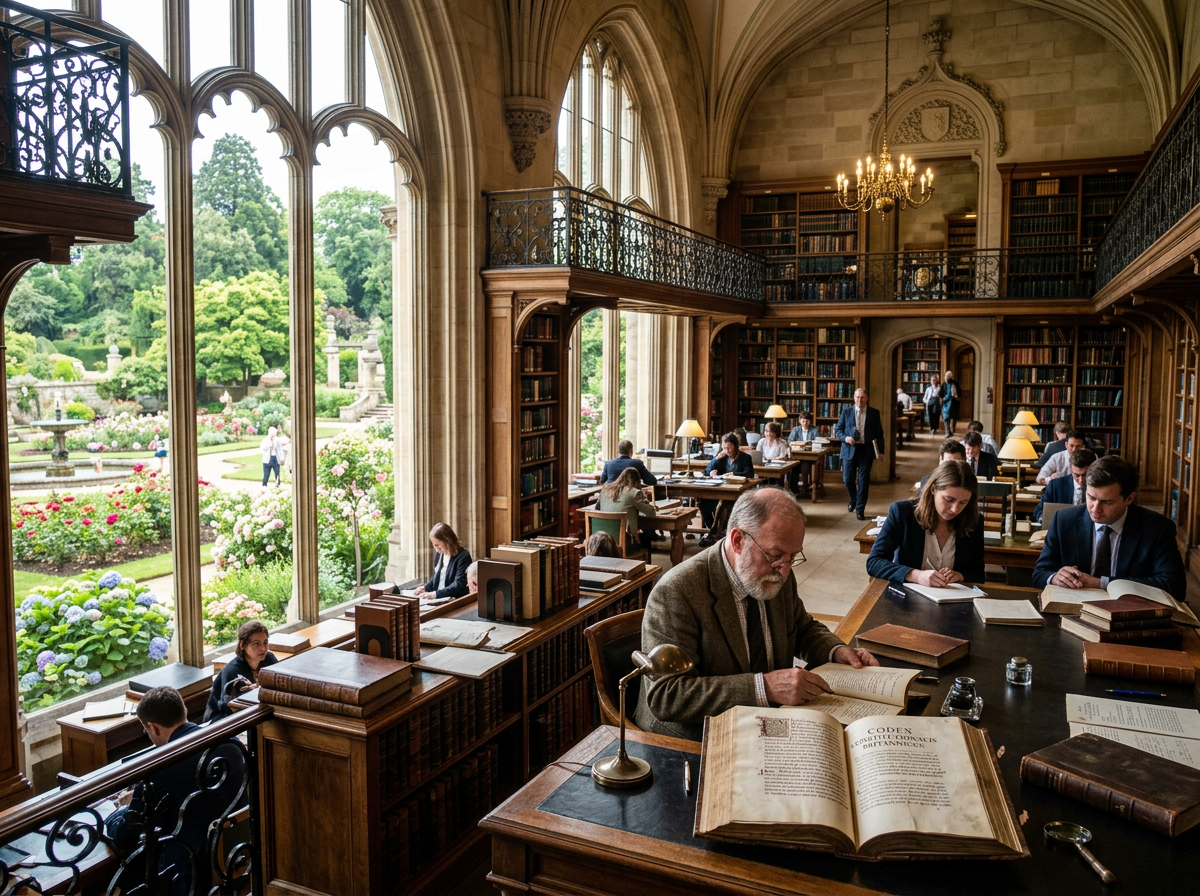
A Constitutional Library for Stewardship, Human Flourishing, and Regenerative Civilization
Meta Description
Explore the Stewardship Archive, a curated library of T4 Codices organized into constitutional collections that guide readers through stewardship, human development, governance, wealth, symbolic systems, and regenerative civilization.
Document Type: Constitutional Library
Purpose: To introduce the Stewardship Archive as the constitutional library of the Stewardship Institute and orient readers to its collections and method.
Scope: This page explains the Archive’s purpose, organization, methodological approach, and constitutional collections. It complements the Stewardship Institute by presenting its integrated body of codices for sustained study.
Every enduring civilization leaves behind more than information.
The Stewardship Archive exists to preserve those enduring patterns of understanding so they may remain available to future generations.
It leaves behind ways of understanding what it means to live well, to care wisely, and to build institutions capable of serving generations yet to come.
The Stewardship Archive brings together the Living Archive’s T4 Codices into a coherent body of knowledge organized around the enduring questions of human life.
Rather than presenting hundreds of individual works as isolated publications, it arranges them into constitutional collections that illuminate the larger patterns connecting stewardship, human development, governance, economics, symbolic understanding, and institutional wisdom.
Each collection serves as an entry point into a distinct field of inquiry. Together, they form an integrated library designed to help readers navigate complexity with greater clarity, coherence, and responsibility.
Whether you begin with questions of personal growth, institutional leadership, wealth, governance, or meaning, the Stewardship Archive invites you to explore these domains as interconnected dimensions of a larger human journey.
A Living Body of Work
The Stewardship Archive was not designed around a predetermined taxonomy. It emerged from the corpus itself.
As the T4 Codices accumulated over time, they revealed a consistent constitutional thread: every enduring question of human life—whether concerning personal growth, governance, wealth, knowledge, symbolic meaning, or civilization—ultimately becomes a question of stewardship.
The collections presented here are not separate subjects but complementary fields through which stewardship may be understood, cultivated, embodied, and sustained.
Together, they illuminate the expanding responsibilities of human life—from personal formation and daily practice to institutions, civilizations, and humanity’s enduring search for meaning.
They illuminate the distinct domains through which stewardship is understood, cultivated, and practiced.
Taken together, they form an integrated orientation to the responsibilities of being human and the work of cultivating a regenerative civilization.
The Living Archive Method
A Constitutional Note
The Living Archive is not organized around a single academic discipline, ideology, or explanatory framework. Instead, it employs a constitutional method of inquiry that brings multiple ways of knowing into disciplined conversation while making their differences explicit.
Rather than beginning with conclusions, the Living Archive begins with careful observation before moving toward architectural interpretation.
Individual experiences, historical events, organizational case studies, philosophical traditions, scientific research, and contemplative writings are examined for recurring patterns before broader architectural interpretations are proposed. Wherever possible, distinctions are preserved rather than collapsed, allowing different forms of evidence to illuminate different aspects of the same human reality.
To preserve intellectual clarity, the Living Archive distinguishes between different levels of claim.
- Empirical claims are grounded in observable evidence, established scholarship, or documented historical events.
- Architectural inferences identify recurring structural patterns that appear across disciplines, cultures, institutions, or historical periods. These are interpretive models intended to improve orientation rather than immutable truths.
- Contemplative and symbolic writings explore questions of meaning, identity, purpose, and human development through reflective and spiritual traditions. These writings are presented as interpretive frameworks rather than universally binding claims.
Each document identifies its own corpus, mode of knowing, and methodological standard so readers can understand both what is being explored and how the inquiry has been conducted.
This commitment to methodological transparency allows readers to engage critically with the work, examine the reasoning behind its conclusions, and distinguish clearly between evidence, interpretation, and reflection.
The Living Archive therefore invites neither unquestioning acceptance nor reflexive skepticism. It invites disciplined inquiry.
Understanding begins where certainty ends.
Readers are encouraged to evaluate each work according to the methodological standard it identifies.
Some writings primarily investigate observable realities; others develop architectural interpretations from recurring patterns; still others explore contemplative and symbolic traditions concerned with meaning, identity, and purpose.
The integrity of the Living Archive depends not upon collapsing these modes into one another, but upon allowing each to contribute appropriately to a more coherent understanding of human flourishing.
How to Use the Stewardship Archive
The archive is organized into constitutional collections, each representing a coherent field of stewardship inquiry.
Each collection introduces a coherent field of inquiry through a curated selection of foundational T4 Codices before expanding into the complete body of related works.
Readers may begin anywhere, following the questions most relevant to their own lives, or progress through the collections as a gradual journey from personal formation toward institutional and civilizational stewardship.
No collection is intended to stand alone. Each illuminates one dimension of stewardship while remaining in conversation with the others, gradually revealing a more integrated architecture of responsibility, leadership, and human flourishing.
A Developmental Journey
Although each constitutional collection may be explored independently, together they trace a coherent arc of stewardship.
Readers often begin by asking different questions, yet these questions naturally build upon one another:
| Question | Begin Here |
|---|---|
| What is stewardship? | Foundations of Stewardship |
| Who must I become? | Human Development & Inner Formation |
| How do I live it? | Practices, Pathways & Embodied Stewardship |
| How do I remain faithful through change? | Thresholds & Continuation |
| How do we steward responsibility together? | Governance & Institution Building |
| How do we steward wealth and resources? | Wealth, Economics & Sacred Exchange |
| How do we preserve wisdom? | Knowledge, Memory & Living Codices |
| How do we recognize enduring patterns? | Archetypes, Glyphs & Sacred Design |
| What kinds of places help stewardship flourish? | Living Light, Planetary Anchoring & Sacred Infrastructure |
| How have human beings sought meaning beyond themselves? | Spirituality, Metaphysics & Higher-Order Intelligence |
This progression is descriptive rather than prescriptive. Readers are invited to begin wherever their present questions arise, returning to other collections as their understanding deepens.
Constitutional Collections
Foundations of Stewardship
The First Principles of Responsibility, Custodianship, and Human Flourishing
The constitutional starting point of the archive, introducing the enduring principles that underlie every other collection.
Human Development & Inner Formation
Becoming the Kind of Person Stewardship Requires
Explores the lifelong process of human maturation through character, discernment, coherence, and personal transformation.
Practices, Pathways & Embodied Stewardship
Translating Wisdom into Faithful Daily Practice
Explores the disciplines, habits, pathways, and formative practices through which stewardship becomes embodied in everyday life. These works examine how understanding matures into lived character, helping readers cultivate coherence through faithful action, continual learning, and lifelong formation.
Thresholds & Continuation
Stewarding Change Across the Thresholds of Life
Explores discernment, guardianship, and faithful navigation through periods of profound personal and collective transition.
Governance & Institution Building
Building Institutions Worthy of Human Trust
Examines how trustworthy organizations, councils, and institutions are designed to carry responsibility across generations.
Wealth, Economics & Sacred Exchange
Cultivating Regenerative Ways of Creating, Exchanging, and Stewarding Wealth
Explores regenerative economics, ethical exchange, treasury, and the stewardship of resources.
Knowledge, Memory & Living Codices
Preserving Wisdom That Endures Beyond a Single Generation
Explores archives, codices, memory, and the faithful transmission of living knowledge.
Archetypes, Glyphs & Sacred Design
The Symbolic Language of Living Stewardship
Examines the symbolic systems, archetypes, glyphs, and sacred designs that preserve and communicate enduring wisdom.
Living Light, Planetary Anchoring & Sacred Infrastructure
Participating in the Living Patterns That Sustain a Regenerative World
Explores living hubs, planetary anchoring, sacred infrastructure, and the environments that support resilient civilization.
Spirituality, Metaphysics & Higher-Order Intelligence
Consciousness, Meaning, and the Inner Architecture of Human Stewardship
Explores consciousness, contemplative inquiry, Akashic intelligence, symbolic systems, higher-order awareness, and the spiritual dimensions of stewardship. These codices examine how questions of meaning, identity, and human development intersect with leadership, civilization, and responsible participation in realities larger than ourselves.
Reading Pathways
Readers may approach the archive in different ways.
These pathways are offered as orientations rather than prescribed curricula. They simply provide natural points of entry based on the questions or responsibilities that currently occupy the reader’s attention.
Over time, many readers find themselves moving fluidly between collections as their understanding deepens.
→ Those seeking personal growth may begin with Human Development & Inner Formation.
→ Leaders and institution builders may begin with Governance & Institution Building.
→ Readers interested in economics and stewardship of resources may begin with Wealth, Economics & Sacred Exchange.
→ Readers drawn to symbolism, contemplative inquiry, or questions of meaning may begin with Archetypes, Glyphs & Sacred Design, Practices, Pathways & Embodied Stewardship, Spirituality, Metaphysics & Higher-Order Intelligence or Thresholds & Continuation before exploring the wider archive.
There is no single required sequence. Every collection ultimately connects with the others, forming an integrated understanding of human flourishing and stewardship.
Relationship to the Living Archive
The Stewardship Archive forms the constitutional library of the Living Archive, bringing together its T4 Codices into an integrated body of work for sustained study, reflection, and application.
Published by Stewardship Institute Press, it serves readers, communities, organizations, and institutions seeking to cultivate greater wisdom, responsibility, and long-term stewardship.
Stewardship Archive
A constitutional library of the Stewardship Institute.
Preserving enduring patterns of stewardship, human flourishing, and regenerative civilization through living codices.
© 2025–2026 Gerald Alba Daquila.
Published by Stewardship Institute Press.