
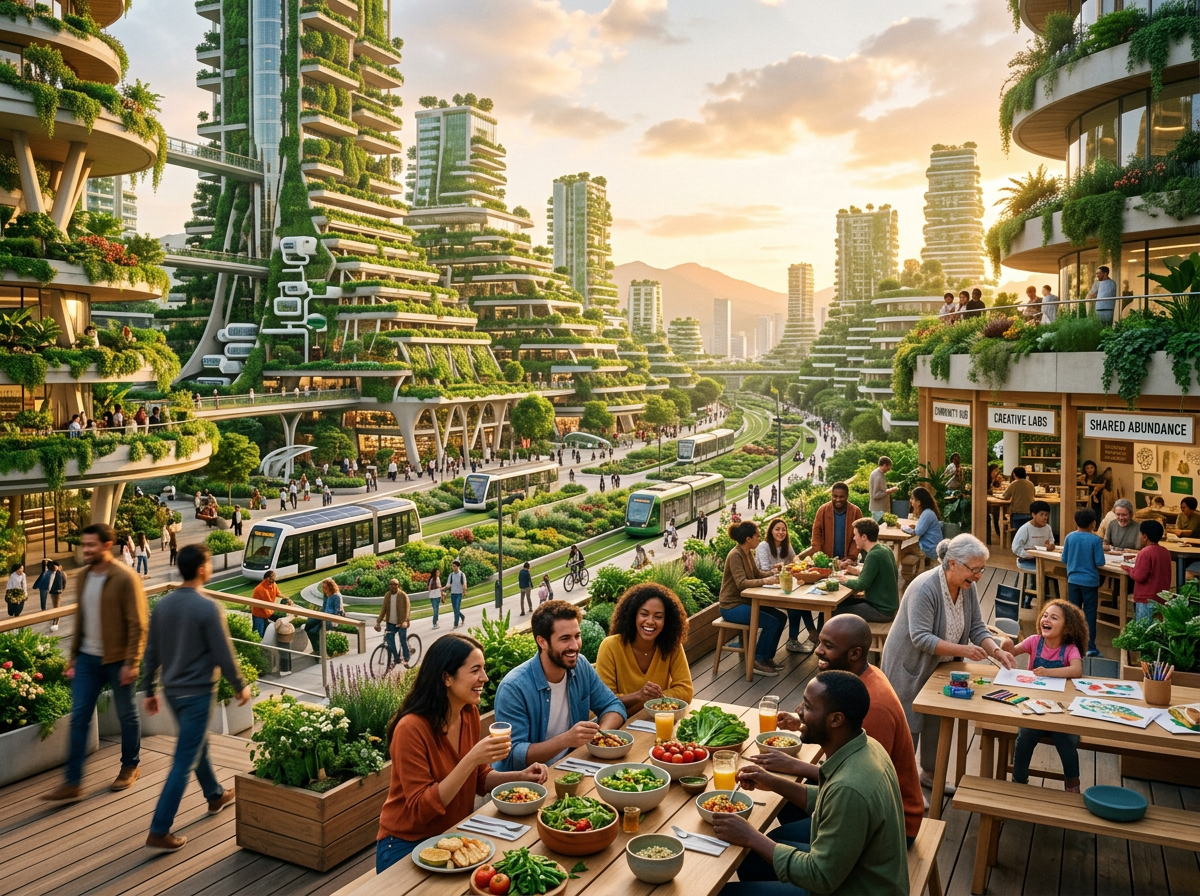
Exploring How Future Communities May Prioritize Well-Being, Meaning, and Stewardship Beyond Basic Survival Needs
Meta Description
What would cities look like if they were designed for human flourishing rather than scarcity management? Explore governance, economics, urban planning, and the future of post-scarcity communities.
For most of human history, communities have been organized around a central challenge: survival.
- Food had to be produced.
- Water had to be secured.
- Shelter had to be built.
- Threats had to be managed.
- Scarcity shaped nearly every social institution.
Governments emerged to coordinate resources. Economies developed to allocate limited goods. Cities evolved around trade, production, transportation, and defense.
While these functions remain important, technological progress has steadily altered humanity’s relationship with scarcity.
Advances in agriculture, energy production, automation, information technology, and logistics have dramatically expanded productive capacity across much of the world.
Yet despite unprecedented abundance, many communities continue to struggle with loneliness, burnout, inequality, distrust, ecological degradation, and declining well-being.
This paradox raises an important question:
What happens when the primary challenge is no longer producing enough resources, but organizing society in ways that help people thrive?
The answer points toward an emerging concept: the post-scarcity city.
What Is a Post-Scarcity City?
A post-scarcity city is not a place where resources are literally infinite.
True scarcity will always exist in some form.
- Land remains finite.
- Time remains finite.
- Attention remains finite.
- Ecological limits remain real.
Instead, a post-scarcity city describes a community where basic human needs can be reliably met for most residents, allowing greater focus on flourishing rather than survival.
The central question shifts from:
“How do we survive?”
to:
“How do we thrive?”
This transition changes the purpose of governance, economics, urban planning, and social institutions.
Understanding this shift requires a broader view of how flourishing communities function.
A post-scarcity city is not defined by any single institution, technology, or policy. Rather, it emerges from the interaction of multiple systems that support human well-being, social trust, ecological resilience, meaningful participation, and long-term stewardship.
The framework below illustrates these interconnected dimensions and provides a lens for understanding how communities can evolve from survival-centered organization toward flourishing-oriented design.

→ Download Reference Map 007: Stewardship Field Map
Figure 1. Stewardship as Community Architecture. A flourishing-oriented city depends upon more than economic productivity.
Human flourishing emerges through the interaction of governance, stewardship, social connection, ecological health, participation, meaning, and long-term resilience.
The Stewardship Field Map provides a systems-level view of how these dimensions reinforce one another within thriving communities.
From Production to Flourishing
Industrial-era cities were largely designed around economic production.
- Factories determined urban layouts.
- Transportation systems moved workers.
- Housing often developed around employment centers.
- Success was frequently measured through growth, output, and efficiency.
- These metrics generated remarkable material prosperity.
However, they often neglected dimensions of human well-being that are difficult to quantify.
Research in positive psychology suggests that flourishing involves multiple dimensions, including:
- Physical health
- Social connection
- Meaning and purpose
- Personal growth
- Autonomy
- Contribution
- Psychological resilience (Seligman, 2011)
A flourishing-oriented city recognizes that economic prosperity is a means rather than an end.
The ultimate goal becomes human development.
Designing for Human Connection
One of the greatest challenges facing many modern cities is social isolation.
Despite living among millions of people, many residents experience profound loneliness.
Studies consistently link social connection to improved health, longevity, resilience, and life satisfaction (Holt-Lunstad et al., 2010).
Yet many urban environments unintentionally discourage relationship building.
- Long commutes reduce community participation.
- Car-dependent development limits spontaneous interaction.
- Housing patterns may isolate generations from one another.
A flourishing city intentionally creates opportunities for connection through:
- Walkable neighborhoods
- Community gathering spaces
- Mixed-use development
- Intergenerational environments
- Public commons
- Cultural participation
Social infrastructure becomes as important as physical infrastructure.
Rethinking Work in an Age of Automation
Automation continues to transform labor markets.
Historically, technological advances often created new forms of employment even as older jobs disappeared.
However, increasing automation raises questions about the future relationship between work and identity.
For many people, employment provides:
- Income
- Purpose
- Community
- Status
- Structure
A post-scarcity city must therefore address not only economic security but also meaning.
The challenge becomes helping individuals contribute in ways that remain deeply human:
- Creativity
- Caregiving
- Education
- Stewardship
- Mentorship
- Community building
- Cultural production
The future of work may increasingly involve cultivating human capacities that machines cannot easily replicate.
The Commons as Civic Infrastructure
Traditional economic systems often divide resources into public and private categories.
Yet flourishing communities depend heavily upon shared assets.
These commons include:
- Parks
- Libraries
- Cultural institutions
- Community centers
- Public spaces
- Knowledge systems
- Ecological resources
Political scientist and Nobel laureate Elinor Ostrom demonstrated that communities can successfully steward shared resources when appropriate governance structures exist (Ostrom, 1990).
The post-scarcity city expands this insight.
Rather than viewing commons as secondary amenities, they become core infrastructure supporting collective well-being.
Measuring What Matters
Many governments still rely heavily upon economic indicators such as GDP, investment, and productivity.
While useful, these metrics provide incomplete pictures of societal health.
A flourishing-oriented community may also track:
- Mental health
- Social trust
- Civic participation
- Educational outcomes
- Environmental quality
- Life satisfaction
- Community resilience
Increasingly, policymakers recognize that economic growth alone does not guarantee improved quality of life.
What gets measured influences what gets prioritized.
The future city may therefore require broader definitions of success.
Regenerative Urban Design
Industrial development often treated natural systems as external factors.
- Cities expanded by extracting resources and exporting waste.
- Regenerative design seeks a different relationship.
- Rather than merely minimizing harm, regenerative systems aim to strengthen ecological health while supporting human prosperity.
Examples include:
- Urban agriculture
- Circular resource systems
- Renewable energy networks
- Green infrastructure
- Watershed restoration
- Biodiversity corridors
In this model, environmental stewardship becomes a foundation of community resilience rather than a competing objective.
Governance Beyond Service Delivery
Traditional governance often focuses on delivering services efficiently.
While essential, future governance may require broader responsibilities.
A flourishing-oriented government asks:
- Are citizens healthy?
- Do people feel connected?
- Is trust increasing?
- Are opportunities expanding?
- Are future generations being considered?
Governance becomes less about managing systems and more about cultivating conditions that enable human potential.
This represents a significant philosophical shift.
The purpose of institutions becomes not merely administration, but stewardship.
The Meaning Economy
As material abundance increases, meaning itself may become a more important social resource.
People increasingly seek:
- Purpose
- Contribution
- Belonging
- Identity
- Growth
These needs cannot be satisfied through consumption alone.
The most successful future communities may therefore become ecosystems that help residents develop meaningful lives rather than simply acquire material goods.
This idea aligns with emerging discussions around well-being economics, regenerative development, and human-centered governance.
Challenges and Critiques
The vision of a post-scarcity city is not without challenges.
Several concerns deserve serious consideration.
- First, abundance remains unevenly distributed.
Many communities still face significant material deprivation.
- Second, technological abundance does not automatically produce social justice.
- Third, concentrating power through technology could create new forms of inequality.
- Finally, flourishing itself is difficult to define universally.
Different cultures may hold different visions of what constitutes a good life.
For these reasons, post-scarcity thinking should not be viewed as a blueprint but as an ongoing inquiry into how societies can evolve beyond survival-centered systems.
From Survival to Stewardship
Perhaps the most important transition involves mindset.
- Scarcity-oriented systems often prioritize competition, accumulation, and protection.
- Flourishing-oriented systems emphasize stewardship, contribution, resilience, and long-term well-being.
This does not eliminate competition or individual ambition.
Rather, it places them within a broader framework that values collective prosperity alongside personal success.
The communities that thrive in the coming decades may not necessarily be those with the greatest wealth.
They may be those that most effectively transform wealth into human flourishing.
Conclusion
The post-scarcity city is not defined by infinite resources or technological perfection. It is defined by a shift in priorities.
As societies become increasingly capable of meeting basic needs, new questions emerge about meaning, belonging, well-being, and stewardship.
The challenge is no longer simply producing abundance. It is learning how to organize abundance in ways that support thriving individuals, resilient communities, and healthy ecosystems.
The future of urban development may therefore depend less on how efficiently cities manage scarcity and more on how effectively they cultivate flourishing.
The ultimate measure of a city may not be what it produces, but what kind of human beings it helps develop.
Related Reading
- Regenerative Governance Principles
- From Nation-State to Meaning-State: The Future of Collective Identity
- Stewardship vs Control
- The Commons Dilemma: Why Shared Resources Are So Difficult to Govern
- From Hierarchies to Stewardship: The Rise of Distributed Human Systems
- Institutional Stability vs Individual Competence: Why Capability Alone Doesn’t Win
- [VSM-002] Value Stream Mapping the Prototype Community: Circulating Wealth Without Central Debt
- How the Prototype Community Functions Day-to-Day
- The Future of Power: From Domination to Stewardship
- From Collective Trauma to System Design: A Living Archive Framework for the Philippines
References
Holt-Lunstad, J., Smith, T. B., & Layton, J. B. (2010). Social relationships and mortality risk: A meta-analytic review. PLoS Medicine, 7(7), e1000316. https://doi.org/10.1371/journal.pmed.1000316
Ostrom, E. (1990). Governing the commons: The evolution of institutions for collective action. Cambridge University Press.
Raworth, K. (2017). Doughnut economics: Seven ways to think like a 21st-century economist. Chelsea Green Publishing.
Seligman, M. E. P. (2011). Flourish: A visionary new understanding of happiness and well-being. Free Press.
West, G. (2017). Scale: The universal laws of life, growth, and death in organisms, cities, and companies. Penguin Books.
The Living Archive is designed to be explored through pathways, categories, and search. If you’re looking for a specific idea, question, or theme, AI Search can help surface relevant connections across the archive.
Attribution
The Living Archive
Integrative Frameworks for Regenerative Civilization
© 2026 Gerald Daquila. All rights reserved.
Part of the Life.Understood. knowledge ecosystem and Stewardship Institute initiative.
This article is intended for educational, research, and civic inquiry purposes.
Readers are encouraged to engage critically, verify sources independently, and explore related knowledge hubs for broader systems context.
Leave a Reply