
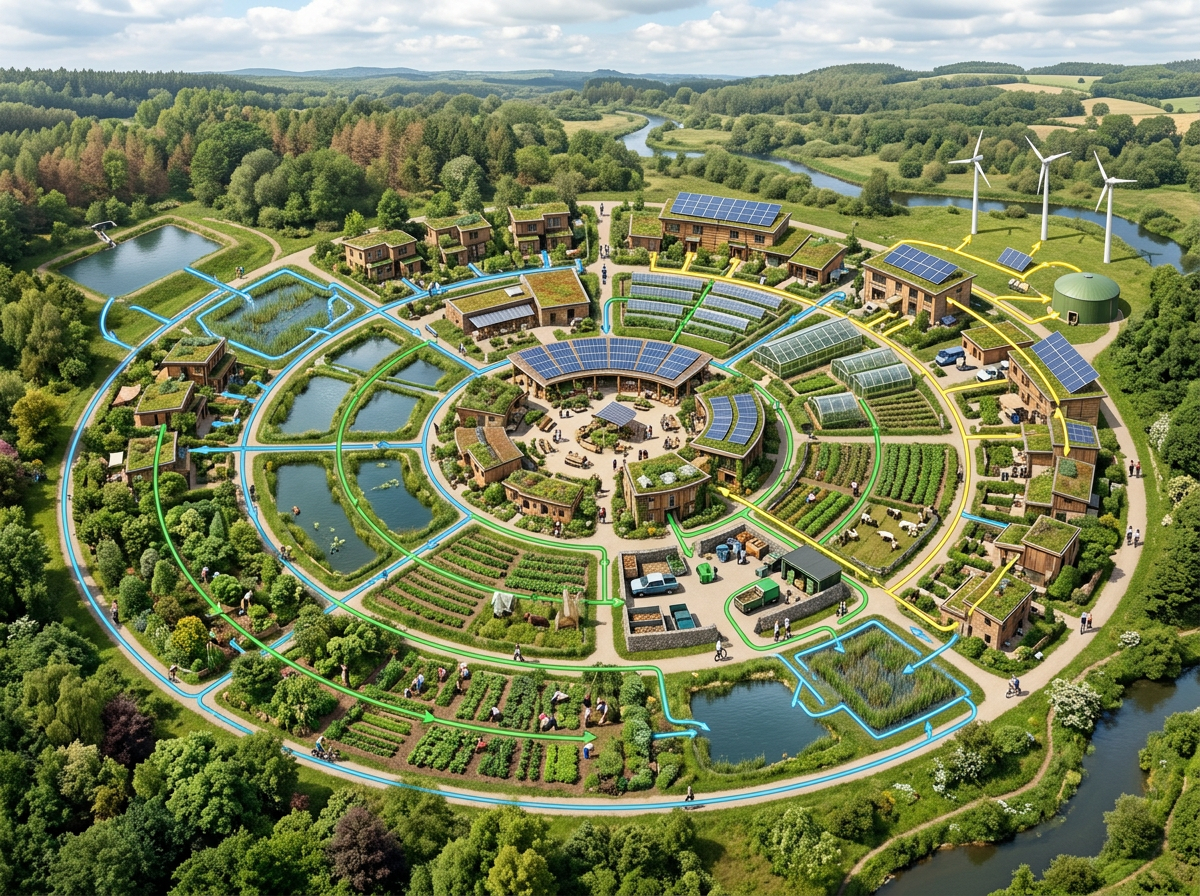
Reimagining the Flow of Value
Protocol Status: Version 1.0 (Initial Release)
Process Owner: Individual Steward / Head of Household
Revision Date: May 2026
Modern economies are structured around extraction.
Wealth produced by local labor, land, and relationships is routinely siphoned outward through debt servicing, speculative finance, centralized supply chains, and dependency on distant institutions.
In contrast, resilient communities historically survived by increasing the velocity of local exchange—keeping food, labor, knowledge, and stewardship circulating within the village itself.
This principle can still be observed in many Philippine barangays where informal reciprocity, mutual aid, cooperative purchasing, and relationship-based trust continue to function beneath the surface of the formal economy.
The prototype intentional community proposed within the SHEYALOTH stewardship architecture is not merely a housing experiment. It is an economic systems prototype.
Its core purpose is to demonstrate that a localized node can generate, circulate, retain, and regenerate wealth without depending entirely on centralized debt structures.
This is where Value Stream Mapping (VSM) becomes essential.
Value Stream Mapping is a Lean systems methodology used to visualize how materials, information, labor, and value move through a process in order to identify waste, inefficiencies, and leakage points (Lean Enterprise Institute, n.d.).
Rather than viewing the community as a collection of isolated activities, VSM allows us to see the community as an interconnected living organism.
Within a stewardship-based prototype community, the question is not simply “How do we earn money?”
The deeper question is:
How does value circulate—and where does it leak?
When mapped correctly, a regenerative community begins to resemble a closed-loop ecosystem rather than a consumer settlement.
From Linear Extraction to Circular Stewardship
The dominant economic model is fundamentally linear:
Labor → Income → Debt → Consumption → External Leakage
In this arrangement, most value exits the local ecosystem almost immediately. Mortgage payments go to banks. Food purchases go to multinational supply chains. Energy payments leave the region. Educational costs reinforce dependency on centralized credentialing systems. Even charitable giving often exits the local area.
A regenerative prototype community must invert this structure.
Instead, the community operates through circular value retention:
Stewardship → Local Production → Internal Exchange → Community Regeneration → Expanded Capacity
This approach closely mirrors principles found within Community Wealth Building frameworks such as the Preston Model, which emphasizes local procurement, cooperative ownership, anchor institutions, and democratic circulation of wealth (Preston City Council, n.d.).
Community Wealth Building seeks to increase the local retention and circulation of economic value instead of allowing capital to continuously drain outward (CLES, n.d.).
The proposed prototype community applies these same principles within a barangay-scale stewardship node.
Mapping the Community Value Streams
Every intentional community contains multiple overlapping value streams. Most fail because these streams remain invisible, fragmented, or dependent on external debt.

Download your copy of the Value Stream Map here
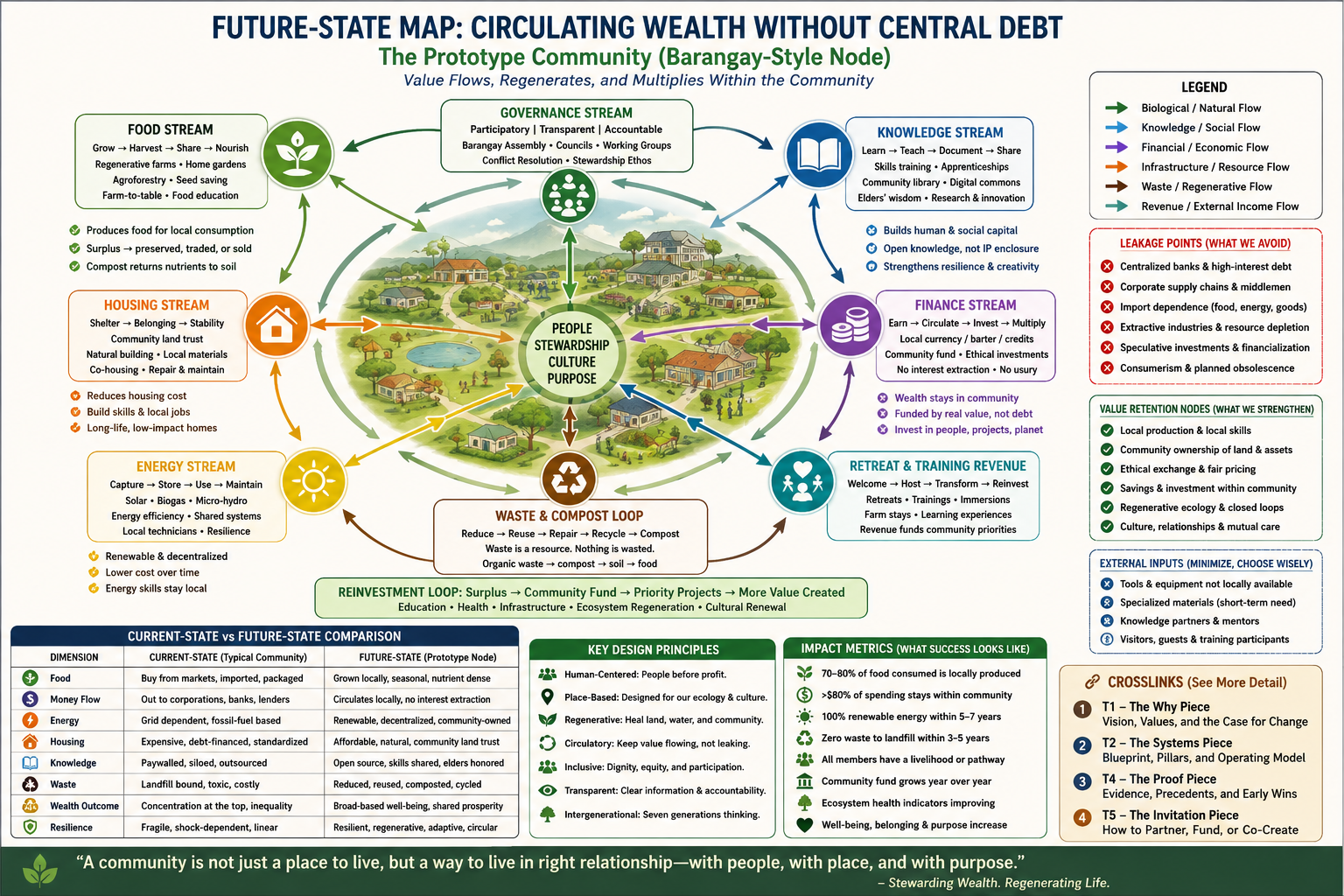
The prototype community instead maps and integrates five primary streams:
1. Food and Agricultural Stream
Food is typically the largest leakage point in urbanized communities. Even rural settlements increasingly depend on externally produced food shipped through centralized logistics systems.
The prototype model reverses this dependency by prioritizing:
- Regenerative agriculture
- Shared food production
- Local seed stewardship
- Cooperative kitchens
- Preservation and storage systems
- Community-supported agriculture (CSA)
In Value Stream terms, the goal is to shorten the distance between production and consumption.
Waste outputs from one subsystem become inputs for another:
- Food scraps become compost.
- Compost feeds gardens.
- Gardens feed kitchens.
- Kitchens feed residents and retreat participants.
- Retreat revenue reinvests into food resilience.
This transforms food from a constant expense into a regenerative asset stream.
Importantly, local food production also stabilizes communities during periods of inflation, supply disruption, or currency volatility.
2. Housing and Infrastructure Stream
Conventional housing systems are debt engines. Mortgages frequently lock individuals into decades of extraction where large portions of lifetime income are redirected toward financial institutions.
The prototype community instead explores phased infrastructure models:
- Incremental construction
- Shared utility systems
- Cooperative ownership structures
- Local material sourcing where possible
- Hybrid live-work spaces
- Modular expansion rather than speculative overbuilding
The goal is not luxury accumulation. The goal is resilient sufficiency.
In Value Stream Mapping language, unnecessary overproduction is considered waste (ASQ, n.d.). Large debt-financed infrastructure projects often create financial fragility before the community has stabilized its internal productive capacity.
The prototype therefore prioritizes:
- Productive infrastructure first
- Aesthetic expansion second
- Debt minimization throughout
This dramatically changes the risk profile of the community.
3. Skills, Education, and Knowledge Stream
Most educational systems train individuals to exit communities in search of employment elsewhere.
A stewardship-oriented node instead treats education as local capacity building.
Residents are encouraged to develop skills that strengthen the resilience of the whole ecosystem:
- Agriculture
- Conflict mediation
- Renewable systems maintenance
- Holistic health support
- Cooperative administration
- Media and communications
- Construction and fabrication
- Teaching and facilitation
Knowledge becomes a circulating asset rather than a privatized credential.
This aligns with the broader Lean understanding that information flow is as important as material flow within any value stream (Lean Enterprise Institute, n.d.). Communities collapse when critical knowledge becomes centralized in a few individuals.
Therefore, cross-training and distributed competency are essential.
The healthiest communities are anti-fragile because knowledge redundancy exists throughout the network.
4. Financial and Exchange Stream
This is the most sensitive and misunderstood layer.
The prototype community is not anti-money. It is anti-extractive dependency.
Money remains necessary. However, the objective is to reduce involuntary external leakage while increasing internal circulation velocity.
Several mechanisms support this:
- Cooperative purchasing
- Shared tools and equipment
- Internal service exchanges
- Member contribution systems
- Ethical microenterprise incubation
- Local reinvestment pools
- Community emergency reserves
A peso that circulates ten times locally creates significantly more resilience than a peso immediately extracted into debt servicing or multinational supply chains.
Community Wealth Building models have repeatedly demonstrated that local procurement and local ownership strengthen regional resilience and increase local multiplier effects (CLES, n.d.).
The prototype community therefore functions as a local economic circulation engine.
External capital is ideally used for:
- Infrastructure seeding
- Productive asset acquisition
- Training systems
- Renewable systems
- Water resilience
- Soil regeneration
It is not primarily used to inflate lifestyles.
This distinction is critical.
5. Cultural and Relational Stream
Most modern economic systems ignore relational health because it cannot easily be quantified.
Yet relational fragmentation creates enormous hidden costs:
- Burnout
- Mental health deterioration
- Social distrust
- Legal conflict
- Isolation
- Governance breakdown
The prototype community therefore treats culture itself as infrastructure.
This includes:
- Shared rituals
- Stewardship circles
- Community meals
- Transparent governance
- Conflict resolution processes
- Intergenerational mentorship
- Shared narratives and mission coherence
In Lean systems language, friction within information and coordination flows creates waste (Lucidchart, n.d.). The same principle applies socially.
Communities with high trust require fewer enforcement systems, lower transaction costs, and less bureaucratic overhead.
Trust itself becomes economic infrastructure.
The Barangay as a Regenerative Node
The barangay model contains ancient intelligence often overlooked by centralized development frameworks.
Historically, barangays functioned through:
- Shared labor
- Kinship accountability
- Localized governance
- Distributed stewardship
- Cooperative resilience
- Embedded reciprocity
While imperfect, these systems possessed adaptive strengths modern urban systems frequently lack.
The prototype community does not romanticize the past. Instead, it extracts viable principles from historically resilient local systems and integrates them with modern regenerative design.
The resulting node becomes:
- Economically localized
- Technologically adaptive
- Ecologically regenerative
- Socially participatory
- Financially resilient
- Spiritually coherent
This is not isolationism.
The node still interacts with broader markets, donors, digital infrastructure, and external trade. However, it does so from a position of increasing sovereignty rather than permanent dependency.
Why This Matters to Donors and Partners
Most charitable models unintentionally reinforce dependency.
Funds enter communities temporarily but leak outward almost immediately through imported goods, debt obligations, centralized vendors, and unsustainable operational costs.
The prototype community instead functions as a regenerative multiplier.
A properly designed stewardship node can:
- Reduce long-term dependency
- Increase local resilience
- Create replicable frameworks
- Demonstrate ethical economic circulation
- Lower operating fragility
- Train future stewardship leaders
- Serve as a scalable proof-of-concept
In systems language, donors are not merely funding a project.
They are helping seed a self-reinforcing value ecosystem.
This is fundamentally different from charity.
It is regenerative systems investment.
References
American Society for Quality. (n.d.). Value stream mapping tutorial – What is VSM? ASQ. https://asq.org/quality-resources/value-stream-mapping
Centre for Local Economic Strategies. (n.d.). Community wealth building. CLES. https://cles.org.uk/expertise/community-wealth-building/
Lean Enterprise Institute. (n.d.). Value-stream mapping. https://www.lean.org/lexicon-terms/value-stream-mapping/
Lucid Software Inc. (n.d.). What is value stream mapping? Lucidchart. https://www.lucidchart.com/pages/value-stream-mapping
Ostrom, E. (1990). Governing the commons: The evolution of institutions for collective action. Cambridge University Press.
Preston City Council. (n.d.). What is community wealth building? https://www.preston.gov.uk/article/1335/What-is-Community-Wealth-Building
Purdue Lean Six Sigma Online. (2024, November 7). Value stream mapping. Purdue University. https://www.purdue.edu/leansixsigmaonline/blog/value-stream-mapping/
United Nations Development Programme. (2022). Local governance and resilient communities. https://www.undp.org/
[DOCUMENT CONTROL & STEWARDSHIP]
Standard Work ID: VSM-002
Baseline Version: v1.5.2026
Classification: Open-Access Archive / Systemic Protocol
The Sovereign Audit: Following this protocol is an act of internal quality control. Verification of this standard does not happen here; it happens at your Gemba—the actual place where your life and leadership occur. No external validation is required or offered.
Next in Sequence: [View VSM-001: Mapping the Sovereign Household Value Stream]
Return to Archive: [Standard Work Knowledge Hub: The Terrain Map]
© 2026 Gerald Daquila • Life.Understood • Systemic Stewardship • Non-Autocratic Architecture • Process over Persona
Leave a Reply