
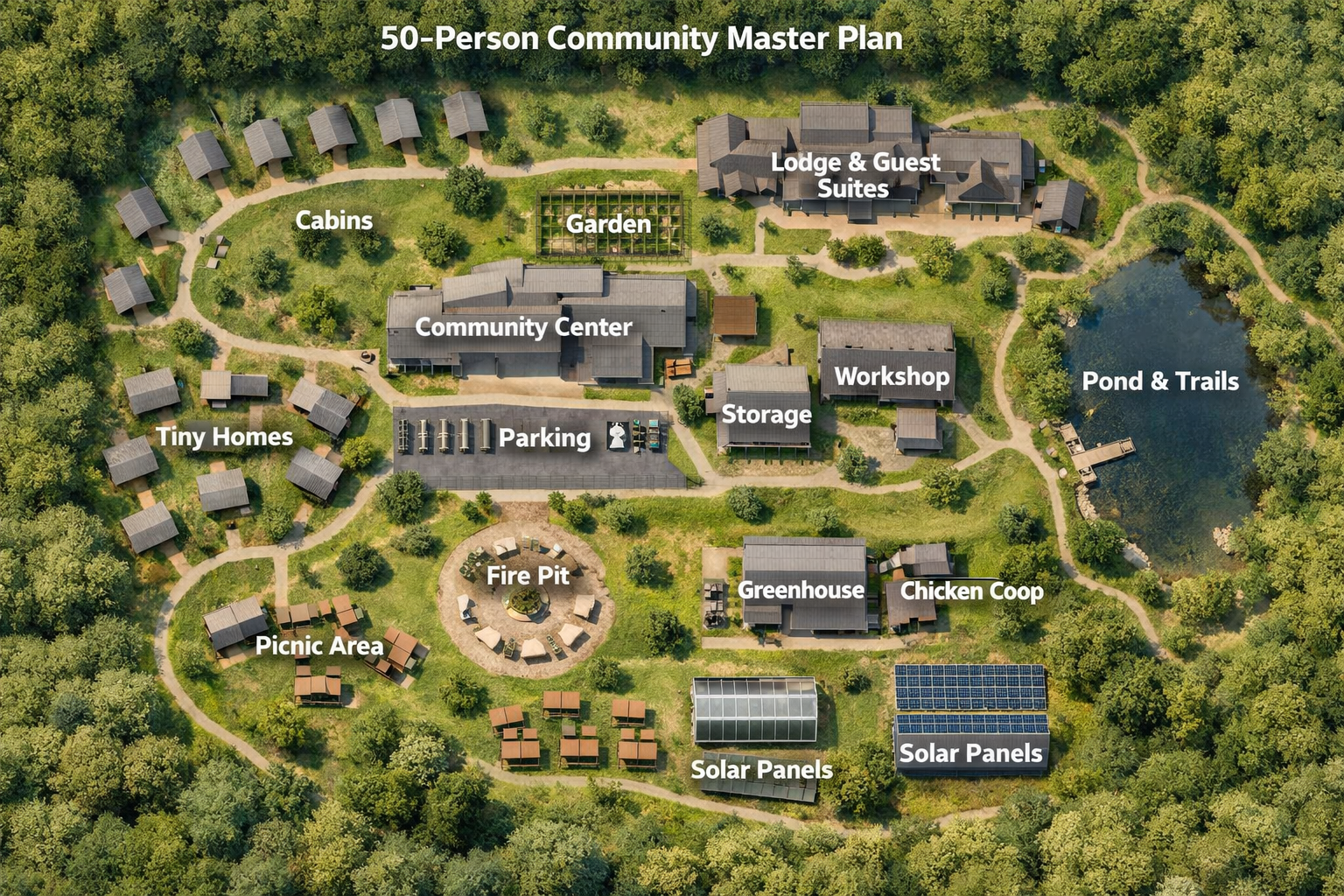
A Phased Implementation Framework for Regenerative, Small-Scale Settlements
Meta Description
A step-by-step operational rollout plan for building a 50-person micro-community prototype, covering land acquisition, infrastructure, governance, and scalable replication.
Opening
Most community projects fail not because of vision—but because they attempt to scale before stabilizing.
The idea of building intentional communities, eco-villages, or sovereign settlements often collapses under the weight of poor sequencing: too many people, insufficient infrastructure, unclear governance, and no operational discipline.
This framework offers a different approach:
Start small. Stabilize early. Scale deliberately.
At the center of this model is a single constraint:
Can this system support 50 people—reliably, sustainably, and legally?
If yes, it can be replicated. If not, it should not expand.
This is the operational backbone of the ARK series—beginning with ARK-001: The 50-Person Resource Loop and extending into governance, land design, and distributed scaling.
Why 50 People? The Stability Threshold
Fifty is not arbitrary. It sits at a functional midpoint:
- Large enough for skill diversity
- Small enough for relational accountability
- Manageable for resource systems
- Legally simpler than large developments
Anthropologically, it aligns with early human group sizes associated with high trust and cohesion (Dunbar, 1992).
Operationally, it allows:
- Clear governance structures
- Efficient communication
- Measurable resource loops
The 50-person model becomes a repeatable unit of civilization, not just a community experiment.
Phase 0: Legal Grounding and Land Acquisition
Before any physical development begins, the project must be legally and structurally sound.
Core Requirements
- Land ownership or long-term lease agreement
- Zoning compliance (agricultural, residential, mixed-use)
- Entity structure (cooperative, corporation, association)
- Basic regulatory alignment
In contexts like the Philippines, this often means navigating:
- Local Government Unit (LGU) approvals
- Barangay-level integration
- Environmental compliance standards
Without this phase, all later work is fragile.
Phase 1: Core Team Formation (5–10 People)
Every stable system begins with a small, highly aligned nucleus.
Core Roles
- Operations lead
- Land/infrastructure steward
- Food systems lead
- Finance/legal coordinator
- Community/growth facilitator
At this stage:
- No large population intake
- No expansion pressure
- Focus is on decision velocity and trust-building
The failure pattern to avoid: recruiting dozens of people before systems exist.
Phase 2: Foundational Infrastructure Build
Before scaling population, the land must support life.
Minimum Viable Systems
- Water
- Potable water source (well, filtration, or delivery)
- Storage + distribution
- Food Production
- Fast-growing crops (leafy greens, root crops)
- Initial soil conditioning
- Small livestock (optional)
- Shelter
- Temporary housing (modular, bamboo, prefab)
- Communal kitchen
- Energy
- Hybrid systems (grid + solar)
- Backup capacity
- Sanitation
- Composting toilets or septic systems
- Waste management protocols
The goal is not perfection—it is functional sufficiency.
Phase 3: Controlled Population Expansion (10 → 50)
Only after systems are stable should population increase.
Expansion Principles
- Gradual onboarding (5–10 people at a time)
- Skills-based selection (not just interest)
- Integration period for each cohort
Population Composition
A functional 50-person system typically includes:
- Growers / food stewards
- Builders / technicians
- Educators / facilitators
- Health and wellness practitioners
- Operations and finance roles
This aligns with the structural layer outlined in
ARK-002: The Babaylan Arc
and governance protocols in
ARK-003: Jurisdictional Sovereignty
Phase 4: Governance Stabilization
Once population approaches 50, governance must mature.
Core Governance Structures
- Decision-making framework (consensus, sociocracy, hybrid)
- Conflict resolution system
- Role clarity and accountability mapping
- Financial transparency protocols
At this stage, informal leadership is no longer enough.
The system must transition from:
- Personality-based coordination
→ Process-based governance
Phase 5: Economic and Resource Loop Stabilization
A viable community must sustain itself—not just socially, but materially.
Core Economic Functions
- Food self-production (partial or majority)
- Income streams (remote work, agriculture, services)
- Internal exchange systems
- External trade relationships
This phase completes the loop introduced in
ARK-001: The 50-Person Resource Loop
Phase 6: Replication Readiness
Only after stability is achieved should replication be considered.
Readiness Indicators
- Stable food and water systems
- Functional governance
- Financial transparency
- Documented processes
- Conflict resolution maturity
Replication Pathways
- Training new core teams
- Supporting new land acquisitions
- Sharing operational playbooks
This becomes the foundation for distributed scaling, later expanded in ARK-010.
Common Failure Patterns
To make this actionable, here are the most frequent collapse points:
- Scaling population before infrastructure
- Undefined governance structures
- Over-reliance on a charismatic founder
- Lack of financial clarity
- Ignoring legal frameworks
Each of these is preventable through disciplined sequencing.
Conclusion: From Vision to Viable System
The difference between an idea and a working community is not intention—it is execution.
A 50-person prototype is small enough to build, but large enough to matter.
It offers a bridge between:
- Individual survival strategies
- And large-scale societal redesign
Done correctly, it becomes:
- A unit of replication
- A training ground for governance
- A living proof of concept
The future of distributed communities will not emerge from massive top-down planning.
It will emerge from small systems that work—and can be repeated.
References
Dunbar, R. I. M. (1992). Neocortex size as a constraint on group size in primates. Journal of Human Evolution, 22(6), 469–493.
Ostrom, E. (1990). Governing the Commons: The Evolution of Institutions for Collective Action. Cambridge University Press.
Holmgren, D. (2002). Permaculture: Principles and Pathways Beyond Sustainability. Holmgren Design Services.
The concepts outlined here are designed for real-world execution. For a complete set of ready-to-use documents—including governance templates, resource tracking sheets, and operational SOPs—explore the 55 Editable Applied Stewardship Toolkit (Complete Set).
For a broader systems context that situates localized resilience within national and multi-scalar transformation frameworks, explore The Philippine Ark: A Sovereign Blueprint for Systemic Transformation.
Continue Through the ARK Series
This framework is designed as a complete system. You can explore it sequentially or move directly to the layer most relevant to your work:
Foundations
Design + Build
Systems Layer
- ARK-009 — Special Structures and Institutional Design
- ARK-011 — Capitalization and Financial Flows
- ARK-012 — Legal Structures (Philippine Context)
- ARK-013 — Membership, Onboarding, and Exit Systems
Scaling
Suggested Pathways
New to the framework?
Start with ARK-001 → ARK-008 → ARK-011
Designing a physical site?
Begin with ARK-007 → ARK-008 → ARK-009
Preparing for real-world deployment?
Focus on ARK-011 → ARK-012 → ARK-013
Thinking long-term scale?
Move to ARK-010
[DOCUMENT CONTROL & STEWARDSHIP]
Standard Work ID: [ARK-008]
Baseline Version: v1.5.2026
Classification: Open-Access Archive / Systemic Protocol
The Sovereign Audit: Following this protocol is an act of internal quality control. Verification of this standard does not happen here; it happens at your Gemba—the actual place where your life and leadership occur. No external validation is required or offered.
Next in Sequence: [ARK-009: Special Structures in Small-Scale Sovereign Communities]
Return to Archive: [Standard Work Knowledge Hub: The Terrain Map]
© 2026 Gerald Daquila • Life.Understood • Systemic Stewardship • Non-Autocratic Architecture • Process over Persona
Leave a Reply