Logo - Life.Understood.

Category: Financial Nodes

  • The Digital Barangay: A Structural Framework for Decentralized Diaspora Stewardship

    The Digital Barangay: A Structural Framework for Decentralized Diaspora Stewardship


    Reimagining the Filipino Barangay as a Sovereign Global Support Network


    Meta Description

    Explore how the ancient Filipino Barangay model can evolve into a decentralized digital stewardship system for the global diaspora—creating sovereign nodes that support homeland resilience, economic regeneration, and cultural continuity.


    For centuries, the Filipino barangay functioned not merely as a geographic settlement, but as a living governance architecture rooted in kinship, mutual aid, collective survival, and shared stewardship.

    Before colonial centralization fragmented indigenous systems, the barangay served as a resilient social organism: adaptive, relational, and deeply localized (Jocano, 1998).

    Today, as millions of Filipinos live and work abroad, a new question emerges:

    What if the barangay never disappeared—only evolved?

    In the age of digital infrastructure, decentralized finance, AI coordination systems, and transnational communities, the ancient barangay model may hold the blueprint for a new form of diaspora organization.

    Rather than seeing overseas Filipinos merely as remittance senders or economic migrants, a more coherent framework views them as distributed stewardship nodes capable of supporting homeland resilience in coordinated, ethical, and regenerative ways.

    This emerging model may be called the Digital Barangay: a decentralized network of sovereign Filipino communities abroad functioning as “life-support systems” for cultural continuity, local resilience, and long-term regenerative development in the Philippines.

    Rather than replicating extractive globalization, the Digital Barangay proposes a return to relational infrastructure—updated for the digital age.


    From Tribal Settlement to Distributed Network

    Historically, the barangay was composed of interconnected families governed through reciprocal obligation and participatory leadership.

    Leadership was relational rather than purely bureaucratic, and survival depended upon collective cohesion (Scott, 1994).

    Modern globalization disrupted many of these systems. Colonialism centralized governance, urbanization weakened localized interdependence, and labor export policies dispersed millions of Filipinos across the world (Rodriguez, 2010).

    Yet paradoxically, this dispersion created one of the most globally connected diasporas in human history.

    Today, Overseas Filipino Workers (OFWs), immigrant professionals, entrepreneurs, caregivers, nurses, engineers, and creatives collectively form a vast transnational network capable of moving not only capital—but knowledge, technology, governance practices, and social coordination.

    The challenge is structural:

    Most diaspora engagement remains fragmented, transactional, or reactive.

    The Digital Barangay proposes a shift from:

    • remittance dependency → regenerative coordination,
    • isolated migration → distributed stewardship,
    • individual success → collective resilience.

    This is not merely cultural nostalgia. It is systems architecture.


    What Is a “Sovereign Node”?

    Within the Digital Barangay framework, a Sovereign Node refers to a self-organizing diaspora cluster capable of supporting both its local members abroad and aligned initiatives in the homeland.

    A node may consist of:

    • Filipino professionals in Toronto,
    • caregivers in California,
    • entrepreneurs in Vancouver,
    • educators in New York,
    • regenerative agriculture advocates in Australia,
    • or hybrid digital communities connected through shared mission.

    Unlike traditional organizations that depend heavily on centralized hierarchy, sovereign nodes operate through distributed trust networks, transparent communication, and mission alignment.

    Their purpose is not ideological control or political dominance.

    Rather, they function as:

    • mutual aid ecosystems,
    • cultural continuity circles,
    • educational and mentorship hubs,
    • ethical investment cooperatives,
    • emergency response networks,
    • and regenerative development support systems.

    In systems theory, resilient systems are often decentralized rather than overly centralized because distributed nodes reduce single points of failure (Meadows, 2008).

    The barangay model naturally reflects this principle.

    A healthy sovereign node therefore acts less like a corporation and more like a living organism.

    A sovereign node does not operate in isolation.

    Its effectiveness depends upon the quality of the governance structures, communication pathways, accountability systems, and stewardship practices connecting it to the broader network.

    The Governance System Map illustrates how healthy distributed systems coordinate information, responsibility, participation, and feedback while preserving both local autonomy and collective coherence across larger communities.

    Figure 1. Governance System Map: Governance as Coordination Architecture

    Download Reference Map 010: Governance System Map

    A systems framework illustrating how distributed communities coordinate through stewardship, accountability, information flows, participation, decision-making, and adaptive feedback.

    Within the Digital Barangay model, sovereign nodes remain locally autonomous while contributing to a larger network of trust, resilience, and shared responsibility.


    The Barangay Logic Applied to the Diaspora

    The Digital Barangay adapts several ancient barangay principles into modern infrastructure:


    1. Relational Stewardship Over Bureaucratic Control

    Traditional barangays operated through relational accountability. Reputation, reciprocity, and communal trust were essential survival mechanisms.

    Modern digital systems often suffer from anonymity, fragmentation, and low social cohesion. Diaspora nodes can restore coherence through:

    • local stewardship councils,
    • transparent decision-making,
    • skill-sharing circles,
    • and community-led governance.

    This mirrors emerging global interest in decentralized autonomous organizations (DAOs), cooperative governance models, and participatory civic systems (Allen & Berg, 2022).

    However, the Digital Barangay differs from purely technological decentralization because it centers human relationships rather than automation alone.

    Technology supports stewardship; it does not replace it.


    2. Distributed Economic Resilience

    The Philippines receives billions annually through remittances from overseas workers. While remittances sustain millions of families, they can also create dependency loops without structural transformation (Opiniano, 2012).

    The Digital Barangay framework asks a deeper question:

    What happens if diaspora capital becomes coordinated toward regenerative infrastructure rather than isolated consumption?

    Examples include:

    • supporting local food systems,
    • funding community land trusts,
    • investing in renewable energy microgrids,
    • sponsoring localized education hubs,
    • and developing cooperative enterprises.

    Instead of temporary relief, sovereign nodes can participate in long-term resilience building.

    This transforms the diaspora from “external labor force” into distributed nation-builders.


    3. Knowledge Transfer as National Infrastructure

    One of the most underutilized resources within the Filipino diaspora is intellectual capital.

    Filipino professionals abroad often gain exposure to:

    • advanced healthcare systems,
    • sustainable architecture,
    • governance innovation,
    • AI systems,
    • renewable energy models,
    • cooperative economics,
    • and trauma-informed education practices.

    Yet these insights rarely flow back into localized Philippine development in structured ways.

    The Digital Barangay proposes ongoing “knowledge return pathways” through:

    • mentorship programs,
    • digital apprenticeship networks,
    • open-source educational systems,
    • and local innovation exchanges.

    In this model, the homeland is not viewed as “behind,” but as a regenerative testing ground for new community systems.


    Why Decentralization Matters

    Many institutional systems fail because they become too centralized, too bureaucratic, and too disconnected from local realities.

    Decentralized systems are often more adaptive during periods of instability because they:

    • distribute responsibility,
    • increase redundancy,
    • enable faster response times,
    • and preserve local autonomy (Taleb, 2012).

    The barangay historically embodied these qualities.

    A Digital Barangay network could therefore strengthen resilience against:

    • economic shocks,
    • climate instability,
    • food insecurity,
    • political volatility,
    • and social fragmentation.

    Importantly, decentralization does not mean disorder.

    Healthy decentralized systems require:

    • shared principles,
    • transparent communication,
    • interoperable structures,
    • and ethical stewardship frameworks.

    Without these, decentralization can devolve into fragmentation.

    Thus, the Digital Barangay is not anti-structure. It is anti-extractive centralization.


    The Role of Technology

    Modern infrastructure now makes transnational barangays possible in ways that were unimaginable even twenty years ago.

    Key enabling technologies include:

    • encrypted communication platforms,
    • cooperative digital banking systems,
    • decentralized finance tools,
    • AI-assisted coordination systems,
    • remote education platforms,
    • and distributed cloud governance.

    However, technological sophistication alone does not create coherence.

    Many digitally connected communities remain emotionally fragmented.

    Thus, the Digital Barangay must integrate:

    • cultural continuity,
    • ethical discernment,
    • intergenerational mentorship,
    • and localized human relationships.

    Technology becomes meaningful only when rooted in shared stewardship values.


    Potential Applications of the Digital Barangay

    Diaspora Emergency Response Systems

    Sovereign nodes could rapidly mobilize localized support during typhoons, earthquakes, or humanitarian crises.

    Rather than relying solely on centralized aid systems, barangay-aligned networks could deploy:

    • direct mutual aid,
    • rapid crowdfunding,
    • local supply coordination,
    • and community logistics.

    Regenerative Provincial Development

    Diaspora-supported nodes could help revitalize rural provinces through:

    • regenerative agriculture,
    • local entrepreneurship,
    • eco-tourism cooperatives,
    • renewable energy infrastructure,
    • and digital livelihood systems.

    This may reduce overconcentration in Metro Manila while strengthening regional resilience.


    Cultural Preservation Networks

    As younger generations abroad become increasingly disconnected from Filipino language and traditions, sovereign nodes can create:

    • cultural learning circles,
    • oral history archives,
    • language preservation projects,
    • and intergenerational mentorship programs.

    The Digital Barangay therefore becomes not only economic infrastructure, but civilizational memory infrastructure.


    Challenges and Ethical Considerations

    The Digital Barangay is not immune to risk.

    Potential challenges include:

    • ideological fragmentation,
    • personality-driven leadership,
    • digital misinformation,
    • financial opacity,
    • and neo-feudal dynamics disguised as “community.”

    Therefore, healthy nodes require:

    • transparency,
    • consent-based participation,
    • distributed accountability,
    • and clear ethical safeguards.

    True stewardship empowers communities rather than creating dependency.

    This distinction is essential.


    Toward a Regenerative Diaspora Civilization

    The Filipino diaspora is often described through sacrifice, separation, and survival.

    But another possibility exists.

    What if the diaspora evolved into a distributed regenerative civilization architecture?

    What if overseas Filipinos became not merely workers abroad, but interconnected stewards participating in the rebuilding of resilient local systems?

    The Digital Barangay offers one possible framework.

    Not as utopian fantasy, but as a practical reapplication of ancient relational intelligence to modern decentralized infrastructure.

    The future may not belong solely to massive centralized institutions.

    It may belong to adaptive networks capable of combining:

    • local autonomy,
    • global coordination,
    • ethical stewardship,
    • and cultural continuity.

    In many ways, the barangay was already doing this long before the modern world rediscovered decentralization.

    The question now is whether the diaspora is prepared to remember.


    Suggested Internal Crosslinks


    References

    Allen, D. W., & Berg, C. (2022). Blockchain governance: Programming our future. Lexington Books.

    Jocano, F. L. (1998). Filipino social organization: Traditional kinship and family organization. Punlad Research House.

    Meadows, D. H. (2008). Thinking in systems: A primer. Chelsea Green Publishing.

    Opiniano, J. M. (2012). Migration and development in the Philippines. Institute of Migration and Development Issues.

    Rodriguez, R. M. (2010). Migrants for export: How the Philippine state brokers labor to the world. University of Minnesota Press.

    Scott, W. H. (1994). Barangay: Sixteenth-century Philippine culture and society. Ateneo de Manila University Press.

    Taleb, N. N. (2012). Antifragile: Things that gain from disorder. Random House.


    The Sovereign Professional: A structural map of power, systems thinking, and personal autonomy—dedicated to helping the independent professional navigate complexity and own their value stream.Ask


    ©2026 Gerald Daquila • Life.Understood. • Systems Thinking, Leadership Architecture, and Applied Coherence

  • The Exile’s Advantage: Why the Diaspora is the R&D Lab for the New Philippine Ark

    The Exile’s Advantage: Why the Diaspora is the R&D Lab for the New Philippine Ark


    Distance Was Never the Failure


    For generations, the Philippine diaspora has often been framed through the language of loss.

    Brain drain.
    Overseas labor.
    Migration necessity.
    Families separated by economics.
    Talent exported to sustain a fragile domestic system.

    The narrative is familiar: the nation loses its best people, while millions of Filipinos scatter across the world in search of opportunity, survival, or stability.

    As of the mid-2020s, overseas Filipinos contribute billions annually through remittances, forming one of the largest diaspora economies on Earth (Bangko Sentral ng Pilipinas [BSP], 2025).

    Yet beneath this familiar framing lies another possibility.

    What if distance from the homeland was not only tragedy?
    What if it was also preparation?


    What if the diaspora unintentionally became the Philippines’ largest distributed research-and-development laboratory?

    The emerging global transition suggests that this question is no longer theoretical.

    As economic systems strain under debt saturation, geopolitical fragmentation, climate pressure, technological disruption, and institutional distrust, many nations are searching for adaptive social models capable of surviving instability (World Economic Forum [WEF], 2025).

    In this environment, diasporic populations possess unusual strategic advantages:

    • cross-cultural fluency,
    • global systems exposure,
    • diversified economic access,
    • adaptive identity structures,
    • and distributed survival intelligence.

    The Filipino diaspora, in particular, may hold a unique position.

    Not because it escaped the homeland.
    But because it learned how multiple systems function from the inside.


    The Diaspora as a Distributed Intelligence Network

    Filipinos abroad are often described economically, but rarely systemically.

    Yet over decades, millions of overseas Filipinos have effectively embedded themselves inside nearly every major global infrastructure:

    • healthcare,
    • shipping,
    • caregiving,
    • hospitality,
    • engineering,
    • finance,
    • education,
    • domestic work,
    • logistics,
    • technology,
    • and energy sectors.

    This matters more than many realize.

    Diasporas do not merely send money home. They transmit operational intelligence.

    A nurse working in Canada observes healthcare administration models.
    An engineer in Singapore witnesses infrastructure efficiency.
    A maritime worker learns global logistics systems.
    An entrepreneur in Dubai studies trade networks.
    A caregiver in Italy experiences aging-population realities firsthand.
    A software developer in the United States adapts to digital innovation ecosystems.

    Over time, this creates something larger than remittance flows.

    It creates a distributed learning field.

    Sociologists studying diaspora systems increasingly recognize that transnational communities can function as “knowledge bridges” between societies, transferring not only capital but practices, governance norms, technical competencies, and adaptive cultural models (Faist, 2010).

    The Philippine diaspora has therefore become something unusual:
    a globally dispersed systems-observation network.

    The irony is that many Filipinos abroad internalized migration as personal sacrifice while failing to recognize that they were simultaneously gathering strategic civilizational intelligence.


    Exile Produces Pattern Recognition

    There is another reason diasporic populations often become powerful transitional actors:

    distance creates comparative vision.

    People immersed entirely within one system frequently normalize its dysfunctions. But those who move between systems develop pattern recognition.

    They begin noticing:

    • what works,
    • what scales,
    • what collapses,
    • what produces dignity,
    • and what quietly erodes social cohesion.

    Exile sharpens contrast.

    A Filipino who has lived abroad may notice inefficiencies in Philippine infrastructure that local residents have long accepted as inevitable. At the same time, they may also recognize forms of social warmth, adaptability, and relational resilience that wealthier societies have lost.

    This dual vision matters.

    Because the future likely does not belong purely to imitation.

    The goal is not simply copying foreign systems into Philippine conditions. Many imported development models fail precisely because they ignore cultural context and local realities (Acemoglu & Robinson, 2012).

    Rather, the emerging opportunity is synthesis:

    • combining global operational intelligence
      with
    • local cultural coherence.

    The diaspora is uniquely positioned to facilitate this synthesis because it has lived inside both worlds.


    Why the “Ark” Requires External Builders

    Historically, transformative national renewal efforts often emerged partly from outside the homeland itself.

    Exiled intellectuals, emigrant communities, and overseas networks have repeatedly contributed to reconstruction movements:

    • Jewish diaspora networks during Israel’s state-building period,
    • overseas Chinese investment during China’s modernization,
    • Irish-American financial and political influence during Irish independence movements,
    • Indian diaspora technology and capital contributions during India’s growth phase.

    Diasporas often possess advantages unavailable domestically:

    • access to diversified capital,
    • lower immediate political pressure,
    • exposure to functioning institutions,
    • international networks,
    • and operational distance from entrenched local systems.

    This does not make the diaspora “superior” to residents within the homeland. Rather, it creates complementary positioning.

    The homeland retains:

    • cultural grounding,
    • local knowledge,
    • relational continuity,
    • and direct lived stakes.

    The diaspora retains:

    • comparative perspective,
    • capital access,
    • global exposure,
    • and adaptive experimentation.

    The “New Philippine Ark” therefore cannot emerge from either side alone.

    It requires bridge architecture.


    The Real Resource is Not Money

    Much discussion surrounding overseas Filipinos centers on remittances. Indeed, the Philippines remains heavily supported by diaspora financial flows, which contribute substantially to household stability and national foreign exchange reserves (BSP, 2025).

    But money alone is insufficient for civilizational transition.

    Without coherent frameworks, capital disperses into:

    • consumption,
    • fragmented investments,
    • speculative behavior,
    • or dependency reinforcement.

    The deeper challenge is blueprint deficiency.

    Many Filipinos abroad possess:

    • resources,
    • competencies,
    • experience,
    • and goodwill,
      but lack a coherent framework through which to channel them toward regenerative nation-building.

    This is where the idea of a “Sovereign Blueprint” becomes important.

    Not sovereignty in the narrow political sense.
    But sovereignty as systemic resilience:

    • food security,
    • local production,
    • ethical enterprise,
    • distributed infrastructure,
    • regenerative communities,
    • educational reform,
    • technological adaptation,
    • cooperative economics,
    • and resilient cultural identity.

    The diaspora does not merely need patriotism.
    It needs operational coherence.

    Without a blueprint, energy dissipates.

    With one, scattered intelligence can converge.


    The Philippines as a Prototype Zone

    The Philippines occupies an unusual position in the emerging global transition.

    It remains economically vulnerable in many respects:

    • infrastructure gaps,
    • governance challenges,
    • disaster exposure,
    • and dependency on external systems.

    Yet these vulnerabilities may paradoxically create adaptability advantages.

    Highly optimized systems often struggle to change because their complexity creates inertia. Meanwhile, societies accustomed to improvisation frequently develop stronger adaptive capacities during volatility.

    Filipino culture has historically demonstrated:

    • relational resilience,
    • community improvisation,
    • multilingual adaptability,
    • emotional intelligence,
    • and distributed family support systems.

    These traits are often undervalued inside industrial-era metrics but may become increasingly valuable in transition-era conditions.

    The Philippines could therefore evolve into a prototype zone for:

    • decentralized community systems,
    • regenerative enterprise models,
    • diaspora-linked development,
    • hybrid local-global economies,
    • and relationally anchored governance experiments.

    But this requires intentionality.

    Not nostalgia.
    Not performative nationalism.
    Not escapist fantasy.

    Design.


    From Remittance Economy to Regenerative Network

    One of the great strategic opportunities ahead is transforming the diaspora relationship from extraction-based economics into regenerative systems architecture.

    Historically, many overseas workers effectively subsidized domestic instability through remittances while receiving little structural participation in national redesign.

    The next phase may require something different:

    • cooperative investment structures,
    • local production ecosystems,
    • ethical land stewardship,
    • distributed education platforms,
    • resilient agriculture,
    • small-scale manufacturing,
    • and values-aligned enterprise incubation.

    In this model, diaspora capital becomes developmental rather than merely consumptive.

    More importantly, diaspora intelligence becomes actionable.

    The question shifts from:

    “How do we send money home?”

    to:

    “How do we help build systems that reduce long-term fragility?”

    This is a fundamentally different orientation.


    Why Distance May Have Been Preparation

    Many Filipinos abroad carry guilt.

    Guilt for leaving.
    Guilt for building lives elsewhere.
    Guilt for becoming culturally hybrid.
    Guilt for watching the homeland from afar.

    But history suggests that exile often produces bridge-builders.

    Distance can generate:

    • broader perspective,
    • adaptive thinking,
    • systems literacy,
    • and comparative wisdom.

    The challenge is ensuring that this distance does not harden into detachment.

    The task ahead is reconnection without romanticization.

    The New Philippine Ark — whatever form it ultimately takes — will likely not emerge from centralized institutions alone. It may instead emerge from distributed nodes:
    families, professionals, builders, educators, technologists, farmers, healers, entrepreneurs, and communities learning to coordinate across borders.

    In that sense, the diaspora may already be functioning as an early prototype field for the future:

    a globally distributed Filipino intelligence network waiting for coherent architecture.

    The resources already exist.

    The deeper need is alignment.


    References

    Acemoglu, D., & Robinson, J. A. (2012). Why nations fail: The origins of power, prosperity, and poverty. Crown Publishers.

    Bangko Sentral ng Pilipinas. (2025). Overseas Filipinos’ remittances report. BSP.

    Faist, T. (2010). Diaspora and transnationalism: Concepts, theories and methods. Amsterdam University Press.

    World Economic Forum. (2025). Global risks report 2025. WEF.


    Related Pathways


    The Sovereign Professional: A structural map of power, systems thinking, and personal autonomy—dedicated to helping the independent professional navigate complexity and own their value stream.Ask


    ©2026 Gerald Daquila • Life.Understood. • Systems Thinking, Leadership Architecture, and Applied Coherence

  • Standard Inventory — The “Sovereign Kit”

    Standard Inventory — The “Sovereign Kit”


    The Minimum Resources Required to Maintain a Node


    If takt time defines when a steward returns to alignment, and work sequence defines how transitions are executed with integrity, then standard inventory defines what must always be present for the system to remain functional.

    In lean systems, standard inventory refers to the minimum quantity of materials required to sustain flow without interruption—no excess, no shortage (Liker, 2004).

    Too little inventory results in stoppages. Too much creates waste, obscures inefficiencies, and locks up capital.

    Transposed into the context of barangay resilience and diaspora architecture, standard inventory becomes:

    The Sovereign Kit — the essential set of physical, digital, and internal resources required to maintain continuity, coherence, and responsiveness at the node level.

    A “node” here refers to any functional unit of stewardship: a barangay team, a diaspora-led initiative, or even an individual operating as a coordination point.

    Without a clearly defined Sovereign Kit, nodes become fragile—overdependent on external inputs, vulnerable to disruption, and inconsistent in performance.

    This piece establishes a structured framework for designing, auditing, and standardizing the Sovereign Kit as a core component of resilient systems.


    1. Why Minimum Viability Matters More Than Maximum Capacity

    A common mistake in development and leadership systems is overaccumulation—more tools, more resources, more complexity.

    While this may appear as preparedness, it often produces the opposite:

    • Decision fatigue
    • Maintenance burden
    • Reduced adaptability

    Lean thinking emphasizes just-enough inventory—the precise amount needed to sustain operations under expected conditions (Ohno, 1988).

    This principle is especially critical in decentralized environments like barangays, where resources are constrained and variability is high.

    Research on disaster resilience further supports this: communities with well-managed, accessible core resources outperform those with larger but poorly coordinated inventories (Cutter et al., 2008).

    Thus, the first principle of the Sovereign Kit:

    Resilience is not built on abundance—it is built on sufficiency, accessibility, and clarity.


    2. Defining the Sovereign Kit

    The Sovereign Kit (SK) is a standardized inventory composed of three interdependent layers:

    a. Physical Layer — Tangible Continuity

    These are the material resources required for basic operations and crisis response.

    Examples:

    • Communication tools (mobile devices, radios)
    • Power continuity (chargers, backup batteries)
    • Essential documents (printed protocols, contact lists)
    • Emergency supplies (first aid kits, basic provisions)

    In barangay contexts, physical readiness is often the first line of resilience, particularly during disasters where digital systems may fail.


    b. Digital Layer — Information and Coordination Infrastructure

    These resources enable coordination, transparency, and scalability.

    Examples:

    • Cloud-based document repositories
    • Financial tracking systems
    • Communication platforms (messaging groups, dashboards)
    • Data backups and access protocols

    Digital governance has been shown to improve service delivery and reduce corruption when properly implemented (World Bank, 2016).

    However, digital systems must be:

    • Accessible (low bandwidth requirements where possible)
    • Redundant (offline backups available)
    • Secure (clear access controls)

    c. Internal Layer — Human System Readiness

    This is the most overlooked yet most critical component.

    Examples:

    • Cognitive clarity (understanding of roles and protocols)
    • Emotional regulation capacity
    • Decision-making frameworks
    • Shared values and trust within the team

    Research in resilience consistently highlights that human factors—trust, cohesion, adaptability—are the strongest predictors of system performance under stress (Aldrich & Meyer, 2015).

    Thus, the internal layer is not intangible—it is operational infrastructure.


    3. The Minimum Threshold: What “Standard” Really Means

    “Standard” does not mean uniform across all contexts. It means:

    A clearly defined baseline below which system integrity is compromised.

    For example:

    • A barangay node without a reliable communication channel falls below standard
    • A financial initiative without transparent tracking falls below standard
    • A steward operating without internal regulation falls below standard

    Establishing this baseline allows for:

    • Rapid diagnostics
    • Consistent training
    • Scalable replication

    4. Designing the Sovereign Kit

    A functional Sovereign Kit must satisfy three criteria:

    a. Completeness

    All critical functions are supported (communication, coordination, decision-making).


    b. Accessibility

    Resources can be used when needed—not locked behind complexity or hierarchy.


    c. Redundancy

    Backup options exist for critical components.

    This aligns with systems engineering principles, where redundancy is a key factor in reliability (Hollnagel et al., 2006).


    5. Inventory as Flow Enabler, Not Stockpile

    In lean systems, inventory exists to support flow, not to accumulate.

    Applied to the Sovereign Kit:

    • Physical tools must be ready for immediate use
    • Digital systems must enable real-time coordination
    • Internal readiness must allow rapid response

    If any component becomes stagnant—unused, outdated, or inaccessible—it shifts from asset to liability.


    6. Auditing the Sovereign Kit

    Regular audits ensure that the kit remains functional and relevant.

    Key audit questions:

    Physical Layer

    • Are all tools operational?
    • Are supplies sufficient but not excessive?

    Digital Layer

    • Are systems up to date and accessible?
    • Are backups functioning?

    Internal Layer

    • Do team members understand their roles?
    • Is there evidence of emotional and cognitive regulation under stress?

    Auditing transforms the kit from a static list into a living system.


    7. Integration with BVSM, Takt Time, and Work Sequence

    The Sovereign Kit does not operate in isolation. It is the resource foundation that enables:

    • BVSM → identifies where resources are needed
    • Takt Time → ensures the steward can maintain alignment while using the kit
    • Work Sequence → defines how the resources are deployed

    Without standard inventory:

    • Value streams break
    • Sequences fail
    • Alignment becomes irrelevant

    8. The Role of the Diaspora Architect

    Diaspora architects are uniquely positioned to enhance Sovereign Kits by:

    • Introducing efficient, low-cost tools
    • Designing interoperable digital systems
    • Sharing best practices from other contexts

    However, the critical discipline is restraint:

    Do not expand the kit beyond what the node can sustain.

    Overengineering is a common failure mode—introducing tools that require maintenance, skills, or resources that are not locally available.

    The goal is not sophistication—it is sustainability.


    9. Failure Modes and Safeguards

    Common failures include:

    • Overaccumulation → too many tools, low usability
    • Under-specification → missing critical components
    • Dependency → reliance on external inputs

    Safeguards:

    • Clear inventory lists with ownership
    • Regular audits and updates
    • Training for all users

    10. Measuring Sovereignty

    A node’s sovereignty can be assessed through its kit:

    • Can it operate independently for a defined period?
    • Can it respond to disruptions without external assistance?
    • Can it maintain coordination and decision-making under stress?

    If the answer is consistently yes, the node is not just functional—it is resilient.


    11. Conclusion: Inventory as Autonomy

    Standard inventory, reframed as the Sovereign Kit, is not about accumulation—it is about autonomy.

    It ensures that:

    • Systems do not stall
    • Decisions do not delay
    • Responses do not depend on external rescue

    For barangays and diaspora-led initiatives alike, this is the foundation of true resilience.

    Because a system that cannot sustain itself—even briefly—cannot truly be called sovereign.

    And a steward without a Sovereign Kit is not leading a node—they are managing a dependency.


    Crosslinks

    Work Sequence — The Protocol – Anchor: “How resources are deployed in real operations.” Inventory exists to serve sequence.


    Barangay Value Stream Map (BVSM) – Anchor: “Where each resource fits within the larger system.” Connects micro assets → macro flows.


    Poka-Yoke — Soul-Error Proofing – Anchor: “Safeguarding resources from misuse, loss, or dependency.” Protects the kit itself.


    References

    Aldrich, D. P., & Meyer, M. A. (2015). Social capital and community resilience. American Behavioral Scientist, 59(2), 254–269.

    Cutter, S. L., Burton, C. G., & Emrich, C. T. (2008). Disaster resilience indicators for benchmarking baseline conditions. Journal of Homeland Security and Emergency Management, 5(1).

    Hollnagel, E., Woods, D. D., & Leveson, N. (2006). Resilience Engineering: Concepts and Precepts. Ashgate.

    Liker, J. K. (2004). The Toyota Way. McGraw-Hill.

    Ohno, T. (1988). Toyota Production System: Beyond Large-Scale Production. Productivity Press.

    World Bank. (2016). Digital Dividends. World Bank Publications.


    The Sovereign Professional: A structural map of power, systems thinking, and personal autonomy—dedicated to helping the independent professional navigate complexity and own their value stream.Ask


    ©2026 Gerald Daquila • Life.Understood. • Systems Thinking, Leadership Architecture, and Applied Coherence

  • ARK-012: Legal Structures for Community Prototypes (Philippine Context)

    ARK-012: Legal Structures for Community Prototypes (Philippine Context)


    Navigating Land Ownership, Governance Entities, and Regulatory Compliance


    Meta Description

    A practical legal framework for establishing a 50-person community prototype in the Philippines, covering land ownership, entity structures, compliance, and risk management.


    Opening

    A community can be perfectly designed—and still fail the moment it encounters the legal system.

    Land titles, zoning rules, ownership restrictions, and regulatory compliance are not abstract constraints. They determine whether a project can:

    • Exist long-term
    • Scale without interruption
    • Protect its members
    • Avoid costly disputes or shutdowns

    Many intentional community projects avoid legal complexity until it becomes unavoidable. By then, it is often too late.

    Legal structure is not a final step—it is the foundation.

    This piece grounds the ARK framework in the Philippine context, building on:


    Why Legal Design Determines Continuity

    Legal systems define:

    • Who owns the land
    • Who has decision-making authority
    • Who bears liability
    • How disputes are resolved

    Without clear legal grounding:

    • Ownership becomes contested
    • Members are exposed to risk
    • Expansion becomes impossible

    Research on institutional systems emphasizes that clear rules and enforceable structures are essential for collective stability (Ostrom, 1990).


    Layer 1: Land Ownership Constraints in the Philippines

    The first—and most critical—legal reality:

    Land ownership in the Philippines is restricted.

    Key Rule

    • Only Filipino citizens and Filipino-owned entities (≥60% Filipino ownership) can legally own land.

    This immediately shapes:

    • Who can invest
    • How ownership is structured
    • How foreign participants are included

    Land Ownership Options

    1. Individual Filipino Ownership

    • Land is titled under one or more Filipino individuals

    Pros:

    • Simple
    • Fast acquisition

    Cons:

    • High trust dependency
    • Risk of personal ownership disputes

    2. Corporation Structure

    • Land owned by a Philippine corporation
    • Must be ≥60% Filipino-owned

    Pros:

    • Clear legal identity
    • Easier scaling and contracts

    Cons:

    • Regulatory complexity
    • Requires corporate governance discipline

    3. Cooperative Structure

    • Registered under the Cooperative Development Authority

    Pros:

    • Aligns with shared ownership principles
    • Democratic governance built-in

    Cons:

    • Slower decision-making
    • Requires compliance with cooperative laws

    Recommended Approach

    For most ARK prototypes:

    Hybrid model: Corporation or cooperative + internal governance agreements

    This balances:

    • Legal clarity
    • Operational flexibility

    Layer 2: Entity Structure for the Community

    Beyond land ownership, the community must exist as a legal entity.

    Primary Options


    1. Corporation

    Registered through the Securities and Exchange Commission (Philippines)

    • Can enter contracts
    • Can own assets
    • Provides liability separation

    2. Cooperative

    Registered with the Cooperative Development Authority

    • Member-owned and governed
    • Profit distribution based on participation

    3. Association (Non-Profit)

    • Suitable for early-stage or advocacy-focused groups
    • Limited in economic activity

    Key Decision Factors

    • Level of economic activity
    • Governance style
    • Member expectations

    Layer 3: Zoning and Land Use Compliance

    Even with ownership secured, land must be used legally.


    Zoning Categories

    • Agricultural
    • Residential
    • Mixed-use

    Key Considerations

    • Agricultural land may restrict residential structures
    • Conversion may be required for certain uses
    • Local Government Units (LGUs) enforce zoning rules

    Regulatory Bodies Involved

    • Municipal or City LGU
    • Barangay authorities
    • Environmental agencies

    Core Permits and Clearances

    • Barangay clearance
    • Building permits
    • Environmental compliance (if applicable)

    Failure to comply can result in:

    • Fines
    • Project shutdown
    • Legal disputes

    Layer 4: Internal Legal Agreements

    Even with external compliance, the internal legal framework is equally critical.

    Essential Documents


    1. Membership Agreement

    Defines:

    • Rights and responsibilities
    • Contribution expectations
    • Use of shared resources

    2. Governance Charter

    Defines:

    • Decision-making processes
    • Leadership roles
    • Conflict resolution systems

    3. Asset and Equity Agreements

    Defines:

    • Ownership of land and infrastructure
    • Financial contributions
    • Exit terms

    Key Principle

    Verbal agreements are not sufficient.

    All expectations must be:

    • Written
    • Signed
    • Accessible

    Layer 5: Liability and Risk Protection

    Communities must anticipate legal risk.


    Common Risk Areas

    • Accidents or injuries
    • Financial disputes
    • Land ownership conflicts
    • Regulatory violations

    Protection Mechanisms

    • Legal entity shielding (corporation/cooperative)
    • Insurance (where available)
    • Clear contracts and waivers

    Layer 6: Foreign Participation

    Given global interest, many communities include non-Filipino members.


    Legal Reality

    • Foreigners cannot own land directly
    • Can participate through:
      • Leasing agreements
      • Membership in entities
      • Service or investment roles

    Risk Consideration

    Improper structuring can lead to:

    • Legal invalidation of ownership
    • Government intervention

    Layer 7: Alignment with Financial Systems

    Legal structure must support the financial model in
    ARK-011: Capitalization and Financial Flows for a 50-Person Prototype

    Key Alignments

    • Treasury management
    • Contribution tracking
    • Profit or surplus distribution

    Without alignment:

    • Financial disputes escalate into legal issues

    Layer 8: Scaling Across Multiple Nodes

    As outlined in
    ARK-010: From Prototype to Network — Scaling Distributed Communities

    Each node must:

    • Have its own legal entity
    • Comply with local regulations

    Network-Level Considerations

    • Inter-entity agreements
    • Shared standards
    • Optional umbrella organizations

    Common Legal Failure Patterns

    Observed across projects:

    • Informal land ownership arrangements
    • Lack of written agreements
    • Ignoring zoning laws
    • Mixing personal and community finances
    • Misunderstanding foreign ownership rules

    Each creates long-term instability.


    Local Governance Dynamics (Philippine Reality)

    Beyond formal law, success often depends on:

    • Relationship with Barangay leaders
    • Alignment with LGU priorities
    • Community integration

    Practical Insight

    Legal compliance + local trust = operational stability

    Ignoring local dynamics can stall or block progress—even if formal requirements are met.


    Conclusion: Law as Infrastructure

    Legal systems are often treated as constraints.

    In reality, they are infrastructure—just like water, land, or energy.

    A well-structured legal foundation:

    • Protects members
    • Enables growth
    • Reduces conflict
    • Supports replication

    At 50 people, complexity is manageable—but only if:

    • Ownership is clear
    • Rules are defined
    • Compliance is maintained

    With this layer in place, the ARK system becomes not just viable—but defensible and scalable within the real world.


    References

    Ostrom, E. (1990). Governing the commons: The evolution of institutions for collective action. Cambridge University Press.

    Republic of the Philippines. (1987). The Constitution of the Republic of the Philippines.

    Cooperative Development Authority. (n.d.). Guidelines and regulations for cooperatives.

    Securities and Exchange Commission (Philippines). (n.d.). Corporate registration and governance rules.

    The concepts outlined here are designed for real-world execution. For a complete set of ready-to-use documents—including governance templates, resource tracking sheets, and operational SOPs—explore the 55 Editable Applied Stewardship Toolkit (Complete Set).

    For a broader systems context that situates localized resilience within national and multi-scalar transformation frameworks, explore The Philippine Ark: A Sovereign Blueprint for Systemic Transformation.


    Continue Through the ARK Series

    This framework is designed as a complete system. You can explore it sequentially or move directly to the layer most relevant to your work:

    Foundations

    Design + Build

    Systems Layer

    Scaling


    Suggested Pathways

    New to the framework?

    Start with ARK-001 ARK-008ARK-011


    Designing a physical site?

    Begin with ARK-007ARK-008ARK-009


    Preparing for real-world deployment?

    Focus on ARK-011ARK-012ARK-013


    Thinking long-term scale?

    Move to ARK-010


    [DOCUMENT CONTROL & STEWARDSHIP]

    Standard Work ID: [ARK-012]

    Baseline Version: v1.5.2026

    Classification: Open-Access Archive / Systemic Protocol

    The Sovereign Audit: Following this protocol is an act of internal quality control. Verification of this standard does not happen here; it happens at your Gemba—the actual place where your life and leadership occur. No external validation is required or offered.

    Next in Sequence: [ARK-013: Membership, Onboarding, and Exit Systems]

    Return to Archive: [Standard Work Knowledge Hub: The Terrain Map]


    © 2026 Gerald Daquila • Life.Understood Systemic Stewardship • Non-Autocratic Architecture • Process over Persona

  • [VSM-002] Value Stream Mapping the Prototype Community: Circulating Wealth Without Central Debt

    [VSM-002] Value Stream Mapping the Prototype Community: Circulating Wealth Without Central Debt


    Reimagining the Flow of Value


    Protocol Status: Version 1.0 (Initial Release)

    Process Owner: Individual Steward / Head of Household

    Revision Date: May 2026


    Modern economies are structured around extraction.

    Wealth produced by local labor, land, and relationships is routinely siphoned outward through debt servicing, speculative finance, centralized supply chains, and dependency on distant institutions.

    In contrast, resilient communities historically survived by increasing the velocity of local exchange—keeping food, labor, knowledge, and stewardship circulating within the village itself.

    This principle can still be observed in many Philippine barangays where informal reciprocity, mutual aid, cooperative purchasing, and relationship-based trust continue to function beneath the surface of the formal economy.

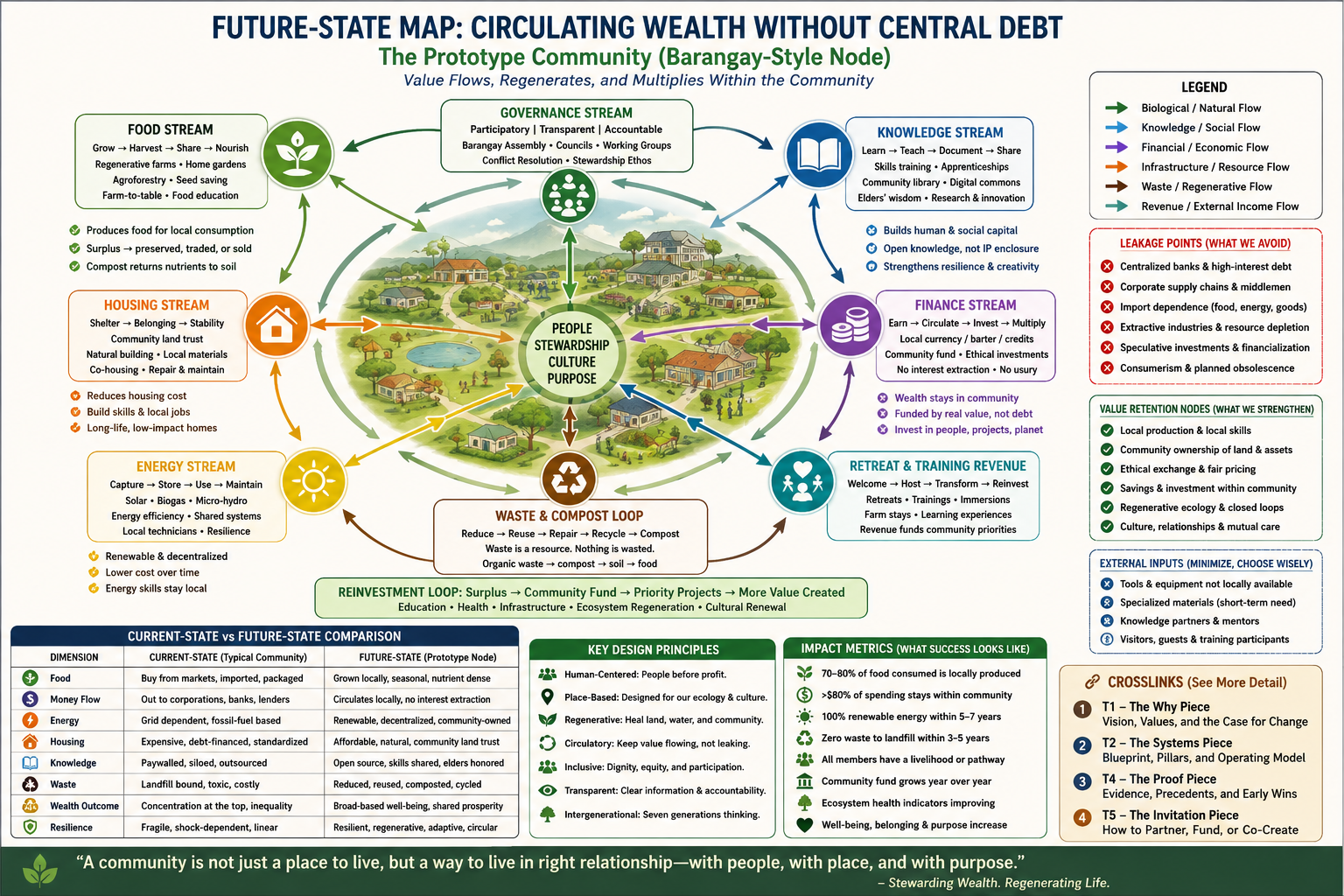
    The prototype intentional community proposed within the SHEYALOTH stewardship architecture is not merely a housing experiment. It is an economic systems prototype.

    Its core purpose is to demonstrate that a localized node can generate, circulate, retain, and regenerate wealth without depending entirely on centralized debt structures.

    This is where Value Stream Mapping (VSM) becomes essential.

    Value Stream Mapping is a Lean systems methodology used to visualize how materials, information, labor, and value move through a process in order to identify waste, inefficiencies, and leakage points (Lean Enterprise Institute, n.d.).

    Rather than viewing the community as a collection of isolated activities, VSM allows us to see the community as an interconnected living organism.

    Within a stewardship-based prototype community, the question is not simply “How do we earn money?”

    The deeper question is:

    How does value circulate—and where does it leak?

    When mapped correctly, a regenerative community begins to resemble a closed-loop ecosystem rather than a consumer settlement.


    From Linear Extraction to Circular Stewardship

    The dominant economic model is fundamentally linear:

    Labor → Income → Debt → Consumption → External Leakage

    In this arrangement, most value exits the local ecosystem almost immediately. Mortgage payments go to banks. Food purchases go to multinational supply chains. Energy payments leave the region. Educational costs reinforce dependency on centralized credentialing systems. Even charitable giving often exits the local area.

    A regenerative prototype community must invert this structure.

    Instead, the community operates through circular value retention:

    Stewardship → Local Production → Internal Exchange → Community Regeneration → Expanded Capacity

    This approach closely mirrors principles found within Community Wealth Building frameworks such as the Preston Model, which emphasizes local procurement, cooperative ownership, anchor institutions, and democratic circulation of wealth (Preston City Council, n.d.).

    Community Wealth Building seeks to increase the local retention and circulation of economic value instead of allowing capital to continuously drain outward (CLES, n.d.).

    The proposed prototype community applies these same principles within a barangay-scale stewardship node.


    Mapping the Community Value Streams

    Every intentional community contains multiple overlapping value streams. Most fail because these streams remain invisible, fragmented, or dependent on external debt.

    Download your copy of the Value Stream Map here

    The prototype community instead maps and integrates five primary streams:

    1. Food and Agricultural Stream

    Food is typically the largest leakage point in urbanized communities. Even rural settlements increasingly depend on externally produced food shipped through centralized logistics systems.

    The prototype model reverses this dependency by prioritizing:

    • Regenerative agriculture
    • Shared food production
    • Local seed stewardship
    • Cooperative kitchens
    • Preservation and storage systems
    • Community-supported agriculture (CSA)

    In Value Stream terms, the goal is to shorten the distance between production and consumption.

    Waste outputs from one subsystem become inputs for another:

    • Food scraps become compost.
    • Compost feeds gardens.
    • Gardens feed kitchens.
    • Kitchens feed residents and retreat participants.
    • Retreat revenue reinvests into food resilience.

    This transforms food from a constant expense into a regenerative asset stream.

    Importantly, local food production also stabilizes communities during periods of inflation, supply disruption, or currency volatility.


    2. Housing and Infrastructure Stream

    Conventional housing systems are debt engines. Mortgages frequently lock individuals into decades of extraction where large portions of lifetime income are redirected toward financial institutions.

    The prototype community instead explores phased infrastructure models:

    • Incremental construction
    • Shared utility systems
    • Cooperative ownership structures
    • Local material sourcing where possible
    • Hybrid live-work spaces
    • Modular expansion rather than speculative overbuilding

    The goal is not luxury accumulation. The goal is resilient sufficiency.

    In Value Stream Mapping language, unnecessary overproduction is considered waste (ASQ, n.d.). Large debt-financed infrastructure projects often create financial fragility before the community has stabilized its internal productive capacity.

    The prototype therefore prioritizes:

    1. Productive infrastructure first
    2. Aesthetic expansion second
    3. Debt minimization throughout

    This dramatically changes the risk profile of the community.


    3. Skills, Education, and Knowledge Stream

    Most educational systems train individuals to exit communities in search of employment elsewhere.

    A stewardship-oriented node instead treats education as local capacity building.

    Residents are encouraged to develop skills that strengthen the resilience of the whole ecosystem:

    • Agriculture
    • Conflict mediation
    • Renewable systems maintenance
    • Holistic health support
    • Cooperative administration
    • Media and communications
    • Construction and fabrication
    • Teaching and facilitation

    Knowledge becomes a circulating asset rather than a privatized credential.

    This aligns with the broader Lean understanding that information flow is as important as material flow within any value stream (Lean Enterprise Institute, n.d.). Communities collapse when critical knowledge becomes centralized in a few individuals.

    Therefore, cross-training and distributed competency are essential.

    The healthiest communities are anti-fragile because knowledge redundancy exists throughout the network.


    4. Financial and Exchange Stream

    This is the most sensitive and misunderstood layer.

    The prototype community is not anti-money. It is anti-extractive dependency.

    Money remains necessary. However, the objective is to reduce involuntary external leakage while increasing internal circulation velocity.

    Several mechanisms support this:

    • Cooperative purchasing
    • Shared tools and equipment
    • Internal service exchanges
    • Member contribution systems
    • Ethical microenterprise incubation
    • Local reinvestment pools
    • Community emergency reserves

    A peso that circulates ten times locally creates significantly more resilience than a peso immediately extracted into debt servicing or multinational supply chains.

    Community Wealth Building models have repeatedly demonstrated that local procurement and local ownership strengthen regional resilience and increase local multiplier effects (CLES, n.d.).

    The prototype community therefore functions as a local economic circulation engine.

    External capital is ideally used for:

    • Infrastructure seeding
    • Productive asset acquisition
    • Training systems
    • Renewable systems
    • Water resilience
    • Soil regeneration

    It is not primarily used to inflate lifestyles.

    This distinction is critical.


    5. Cultural and Relational Stream

    Most modern economic systems ignore relational health because it cannot easily be quantified.

    Yet relational fragmentation creates enormous hidden costs:

    • Burnout
    • Mental health deterioration
    • Social distrust
    • Legal conflict
    • Isolation
    • Governance breakdown

    The prototype community therefore treats culture itself as infrastructure.

    This includes:

    • Shared rituals
    • Stewardship circles
    • Community meals
    • Transparent governance
    • Conflict resolution processes
    • Intergenerational mentorship
    • Shared narratives and mission coherence

    In Lean systems language, friction within information and coordination flows creates waste (Lucidchart, n.d.). The same principle applies socially.

    Communities with high trust require fewer enforcement systems, lower transaction costs, and less bureaucratic overhead.

    Trust itself becomes economic infrastructure.


    The Barangay as a Regenerative Node

    The barangay model contains ancient intelligence often overlooked by centralized development frameworks.

    Historically, barangays functioned through:

    • Shared labor
    • Kinship accountability
    • Localized governance
    • Distributed stewardship
    • Cooperative resilience
    • Embedded reciprocity

    While imperfect, these systems possessed adaptive strengths modern urban systems frequently lack.

    The prototype community does not romanticize the past. Instead, it extracts viable principles from historically resilient local systems and integrates them with modern regenerative design.

    The resulting node becomes:

    • Economically localized
    • Technologically adaptive
    • Ecologically regenerative
    • Socially participatory
    • Financially resilient
    • Spiritually coherent

    This is not isolationism.

    The node still interacts with broader markets, donors, digital infrastructure, and external trade. However, it does so from a position of increasing sovereignty rather than permanent dependency.


    Why This Matters to Donors and Partners

    Most charitable models unintentionally reinforce dependency.

    Funds enter communities temporarily but leak outward almost immediately through imported goods, debt obligations, centralized vendors, and unsustainable operational costs.

    The prototype community instead functions as a regenerative multiplier.

    A properly designed stewardship node can:

    • Reduce long-term dependency
    • Increase local resilience
    • Create replicable frameworks
    • Demonstrate ethical economic circulation
    • Lower operating fragility
    • Train future stewardship leaders
    • Serve as a scalable proof-of-concept

    In systems language, donors are not merely funding a project.

    They are helping seed a self-reinforcing value ecosystem.

    This is fundamentally different from charity.

    It is regenerative systems investment.


    References

    American Society for Quality. (n.d.). Value stream mapping tutorial – What is VSM? ASQ. https://asq.org/quality-resources/value-stream-mapping

    Centre for Local Economic Strategies. (n.d.). Community wealth building. CLES. https://cles.org.uk/expertise/community-wealth-building/

    Lean Enterprise Institute. (n.d.). Value-stream mapping. https://www.lean.org/lexicon-terms/value-stream-mapping/

    Lucid Software Inc. (n.d.). What is value stream mapping? Lucidchart. https://www.lucidchart.com/pages/value-stream-mapping

    Ostrom, E. (1990). Governing the commons: The evolution of institutions for collective action. Cambridge University Press.

    Preston City Council. (n.d.). What is community wealth building? https://www.preston.gov.uk/article/1335/What-is-Community-Wealth-Building

    Purdue Lean Six Sigma Online. (2024, November 7). Value stream mapping. Purdue University. https://www.purdue.edu/leansixsigmaonline/blog/value-stream-mapping/

    United Nations Development Programme. (2022). Local governance and resilient communities. https://www.undp.org/


    [DOCUMENT CONTROL & STEWARDSHIP]

    Standard Work ID: VSM-002

    Baseline Version: v1.5.2026

    Classification: Open-Access Archive / Systemic Protocol

    The Sovereign Audit: Following this protocol is an act of internal quality control. Verification of this standard does not happen here; it happens at your Gemba—the actual place where your life and leadership occur. No external validation is required or offered.

    Next in Sequence: [View VSM-001: Mapping the Sovereign Household Value Stream]

    Return to Archive: [Standard Work Knowledge Hub: The Terrain Map]


    © 2026 Gerald Daquila • Life.Understood Systemic Stewardship • Non-Autocratic Architecture • Process over Persona

  • ARK-011: Capitalization and Financial Flows for a 50-Person Prototype

    ARK-011: Capitalization and Financial Flows for a 50-Person Prototype


    Designing the Economic Engine of a Micro-Community System


    Meta Description

    A practical financial framework for launching and sustaining a 50-person micro-community, covering startup costs, contribution models, cash flow strategy, and risk management.


    Opening

    Most community projects don’t fail because of land, people, or vision.

    They fail because of money—specifically, unclear financial structure.

    • Costs are underestimated
    • Contributions are uneven
    • Cash flow is unstable
    • Transparency is lacking

    The result is predictable: tension, burnout, and collapse.

    If ARK-007 defined where things go, ARK-008 defined how to build, and ARK-009 defined what structures are needed, then this piece answers the question:

    How does the system fund itself—without undermining its own stability?

    This is the economic layer that makes the entire ARK architecture real-world viable, building on
    ARK-001: The 50-Person Resource Loop
    and enabling the replication model in
    ARK-010: From Prototype to Network — Scaling Distributed Communities


    Why Financial Design Determines Survival

    Money is not just a resource—it is a coordination mechanism.

    In small communities, poor financial design leads to:

    • Hidden inequality
    • Unclear expectations
    • Dependency on a few individuals
    • Conflict over contribution vs benefit

    Research on collective systems shows that transparent and agreed-upon economic rules are essential for long-term cooperation (Ostrom, 1990).

    Without this, even strong social bonds degrade under pressure.


    The Three Layers of Community Finance

    A functional financial system must operate across three layers:

    1. Capital Expenditure (CapEx)

    One-time or upfront costs:

    • Land acquisition
    • Infrastructure build
    • Tools and equipment

    2. Operational Expenditure (OpEx)

    Ongoing costs:

    • Food supplementation
    • Utilities
    • Maintenance
    • Healthcare and contingencies

    3. Income and Value Generation

    Revenue streams:

    • External income (remote work, services)
    • Agricultural surplus
    • Products and training

    A viable system balances all three.


    Startup Cost Ranges (Philippine Context)

    Costs vary widely based on location and design, but realistic baseline estimates for a 50-person prototype:

    Land

    • ₱1.5M – ₱10M+
      (depending on province, accessibility, and land type)

    Basic Infrastructure

    • Water systems: ₱200K – ₱800K
    • Solar + electrical: ₱300K – ₱1M
    • Housing (modular/basic): ₱2M – ₱6M
    • Sanitation: ₱150K – ₱500K

    Tools + Setup

    • Construction tools, storage, initial inputs: ₱200K – ₱600K

    Total Estimated Range

    ₱4M – ₱18M+ (USD ~$70K – $320K)

    This range reflects minimum viable build, not luxury development.


    Contribution Models: How People Buy In

    One of the most sensitive design areas is how participants contribute financially.

    There is no single correct model—but there are proven structures.


    1. Equal Buy-In Model

    Each member contributes a fixed amount.

    Pros:

    • Simple
    • Clear expectations

    Cons:

    • Excludes lower-income participants
    • Creates economic homogeneity

    2. Tiered Contribution Model

    Members contribute based on capacity.

    Pros:

    • More inclusive
    • Reflects real-world inequality

    Cons:

    • Requires strong transparency
    • Can create perceived imbalance

    3. Hybrid Model (Recommended)

    Combination of:

    • Financial contribution
    • Labor contribution
    • Skill-based contribution

    Example:

    • Lower cash → higher labor commitment
    • Higher cash → reduced operational load

    This aligns with equity-based systems observed in cooperative models (ICA, 2015).


    Community Treasury System

    All contributions must flow into a central treasury.

    Functions of the Treasury

    • Pay for shared infrastructure
    • Cover operational costs
    • Maintain emergency reserves
    • Track inflows and outflows

    Non-Negotiable Rule

    Full financial transparency

    This includes:

    • Open ledgers
    • Regular reporting
    • Clear budget allocation

    Transparency reduces mistrust and aligns expectations.


    Cash Flow Strategy (First 12–24 Months)

    The most fragile period is the first two years.

    Phase 1–2 (Setup)

    • High expenses
    • Low or no income
    • Reliance on initial capital

    Phase 3 (Early Stabilization)

    • Partial food production reduces costs
    • Initial income streams begin

    Phase 4–5 (Stabilization)

    • Multiple income streams active
    • Reduced dependency on external inputs

    Income Stream Design

    A resilient system does not rely on a single source.

    Primary Categories


    1. Remote / Digital Work

    • Freelancing
    • Consulting
    • Online services

    2. Agriculture and Food

    • Surplus produce
    • Value-added goods (processed foods)

    3. Skills and Training

    • Workshops
    • Hosting programs
    • Knowledge exchange

    4. Small-Scale Production

    • Crafts
    • Construction services
    • Repair and fabrication

    Diversification reduces risk.


    Internal Economy vs External Economy

    A key distinction:

    Internal Economy

    • Resource sharing
    • Labor exchange
    • Communal provisioning

    External Economy

    • Cash income
    • Trade with outside markets

    A healthy system balances both.

    Too much internal focus → lack of cash flow
    Too much external focus → loss of cohesion


    Financial Governance

    Financial systems must align with governance structures in
    ARK-003: Jurisdictional Sovereignty

    Core Elements

    • Budget approval process
    • Spending thresholds
    • Accountability roles
    • Audit mechanisms

    Role Example

    • Treasury steward
    • Oversight council
    • Community review process

    Risk Management and Buffers

    No system is stable without reserves.

    Recommended Buffers

    • 6–12 months of basic operating costs
    • Emergency health fund
    • Infrastructure repair fund

    Common Risks

    • Crop failure
    • Member exit
    • Unexpected legal or medical costs

    Reserves convert crises into manageable disruptions.


    Exit and Equity Considerations

    Financial clarity must extend to leaving the system.

    Questions That Must Be Answered

    • Can members withdraw capital?
    • How is shared ownership handled?
    • What happens to contributed labor value?

    Without clear exit rules:

    • Conflict becomes inevitable
    • Trust erodes

    This connects directly to the human systems layer that will be formalized in ARK-013.


    Scaling Financial Systems Across Nodes

    As described in
    ARK-010: From Prototype to Network — Scaling Distributed Communities

    Each node must:

    • Maintain independent finances
    • Avoid centralized dependency

    Network-Level Finance

    • Optional shared funds
    • Cooperative investment pools
    • Inter-node trade agreements

    But:

    No node should rely on another for survival funding


    Common Financial Failure Patterns

    Observed across community projects:

    • Underestimating startup costs
    • Lack of transparent accounting
    • Over-reliance on a single donor
    • No income generation strategy
    • Undefined ownership structures

    Each leads to instability—even when other systems are strong.


    Conclusion: Money as Structure, Not Just Resource

    Financial systems are often treated as secondary.

    In reality, they are foundational.

    A well-designed financial model:

    • Aligns expectations
    • Reduces conflict
    • Enables sustainability
    • Supports scaling

    At 50 people, the system is small enough to manage—but only if:

    • Contributions are clear
    • Flows are transparent
    • Risks are anticipated

    With this layer in place, the ARK framework moves from:

    • Concept → Buildable system

    References

    International Co-operative Alliance (ICA). (2015). Guidance notes to the co-operative principles.

    Ostrom, E. (1990). Governing the commons: The evolution of institutions for collective action. Cambridge University Press.

    The concepts outlined here are designed for real-world execution. For a complete set of ready-to-use documents—including governance templates, resource tracking sheets, and operational SOPs—explore the 55 Editable Applied Stewardship Toolkit (Complete Set).

    For a broader systems context that situates localized resilience within national and multi-scalar transformation frameworks, explore The Philippine Ark: A Sovereign Blueprint for Systemic Transformation.


    Continue Through the ARK Series

    This framework is designed as a complete system. You can explore it sequentially or move directly to the layer most relevant to your work:

    Foundations

    Design + Build

    Systems Layer

    Scaling


    Suggested Pathways

    New to the framework?

    Start with ARK-001 ARK-008ARK-011


    Designing a physical site?

    Begin with ARK-007ARK-008ARK-009


    Preparing for real-world deployment?

    Focus on ARK-011ARK-012ARK-013


    Thinking long-term scale?

    Move to ARK-010


    [DOCUMENT CONTROL & STEWARDSHIP]

    Standard Work ID: [ARK-011]

    Baseline Version: v1.5.2026

    Classification: Open-Access Archive / Systemic Protocol

    The Sovereign Audit: Following this protocol is an act of internal quality control. Verification of this standard does not happen here; it happens at your Gemba—the actual place where your life and leadership occur. No external validation is required or offered.

    Next in Sequence: [ARK-012: Legal Structures for Community Prototypes (Philippine Context)]

    Return to Archive: [Standard Work Knowledge Hub: The Terrain Map]


    © 2026 Gerald Daquila • Life.Understood Systemic Stewardship • Non-Autocratic Architecture • Process over Persona