
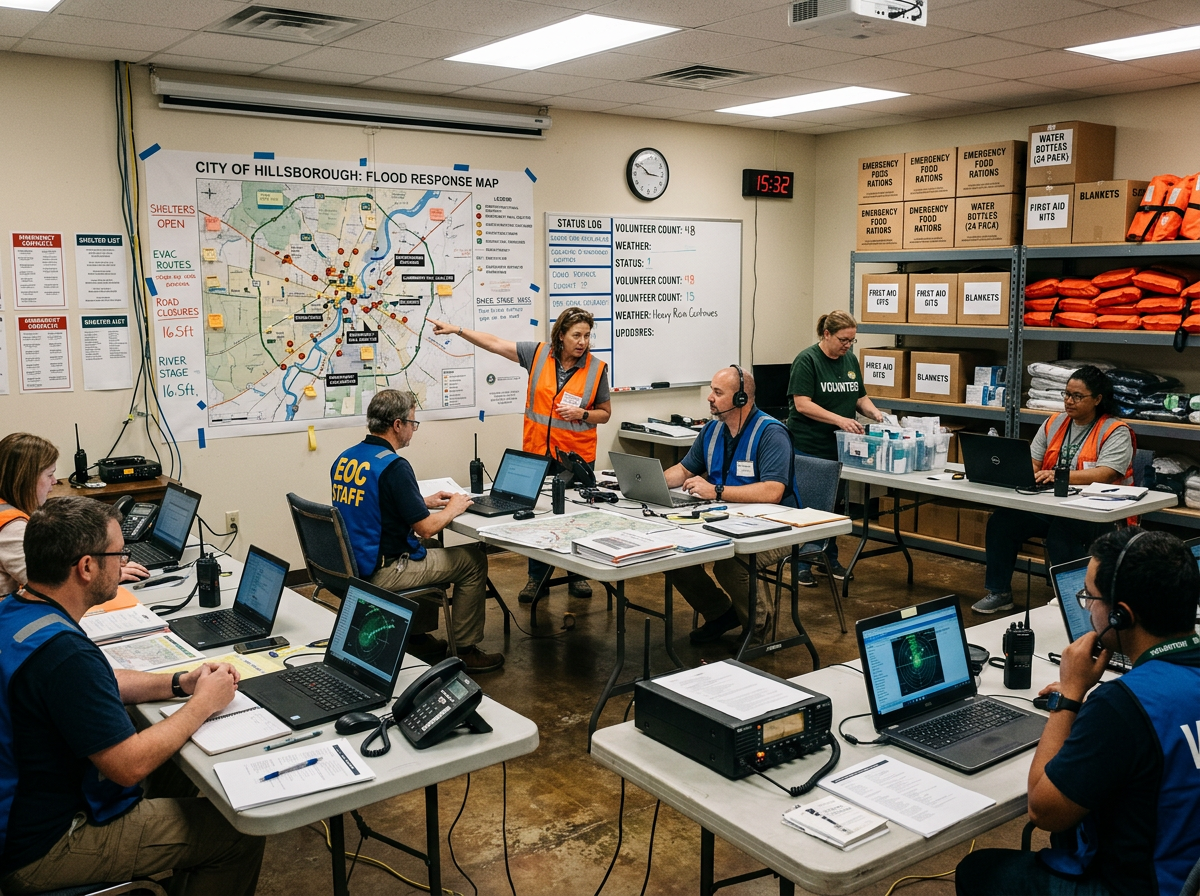
The Minimum Resources Required to Maintain a Node
If takt time defines when a steward returns to alignment, and work sequence defines how transitions are executed with integrity, then standard inventory defines what must always be present for the system to remain functional.
In lean systems, standard inventory refers to the minimum quantity of materials required to sustain flow without interruption—no excess, no shortage (Liker, 2004).
Too little inventory results in stoppages. Too much creates waste, obscures inefficiencies, and locks up capital.
Transposed into the context of barangay resilience and diaspora architecture, standard inventory becomes:
The Sovereign Kit — the essential set of physical, digital, and internal resources required to maintain continuity, coherence, and responsiveness at the node level.
A “node” here refers to any functional unit of stewardship: a barangay team, a diaspora-led initiative, or even an individual operating as a coordination point.
Without a clearly defined Sovereign Kit, nodes become fragile—overdependent on external inputs, vulnerable to disruption, and inconsistent in performance.
This piece establishes a structured framework for designing, auditing, and standardizing the Sovereign Kit as a core component of resilient systems.
1. Why Minimum Viability Matters More Than Maximum Capacity
A common mistake in development and leadership systems is overaccumulation—more tools, more resources, more complexity.
While this may appear as preparedness, it often produces the opposite:
- Decision fatigue
- Maintenance burden
- Reduced adaptability
Lean thinking emphasizes just-enough inventory—the precise amount needed to sustain operations under expected conditions (Ohno, 1988).
This principle is especially critical in decentralized environments like barangays, where resources are constrained and variability is high.
Research on disaster resilience further supports this: communities with well-managed, accessible core resources outperform those with larger but poorly coordinated inventories (Cutter et al., 2008).
Thus, the first principle of the Sovereign Kit:
Resilience is not built on abundance—it is built on sufficiency, accessibility, and clarity.
2. Defining the Sovereign Kit
The Sovereign Kit (SK) is a standardized inventory composed of three interdependent layers:
a. Physical Layer — Tangible Continuity
These are the material resources required for basic operations and crisis response.
Examples:
- Communication tools (mobile devices, radios)
- Power continuity (chargers, backup batteries)
- Essential documents (printed protocols, contact lists)
- Emergency supplies (first aid kits, basic provisions)
In barangay contexts, physical readiness is often the first line of resilience, particularly during disasters where digital systems may fail.
b. Digital Layer — Information and Coordination Infrastructure
These resources enable coordination, transparency, and scalability.
Examples:
- Cloud-based document repositories
- Financial tracking systems
- Communication platforms (messaging groups, dashboards)
- Data backups and access protocols
Digital governance has been shown to improve service delivery and reduce corruption when properly implemented (World Bank, 2016).
However, digital systems must be:
- Accessible (low bandwidth requirements where possible)
- Redundant (offline backups available)
- Secure (clear access controls)
c. Internal Layer — Human System Readiness
This is the most overlooked yet most critical component.
Examples:
- Cognitive clarity (understanding of roles and protocols)
- Emotional regulation capacity
- Decision-making frameworks
- Shared values and trust within the team
Research in resilience consistently highlights that human factors—trust, cohesion, adaptability—are the strongest predictors of system performance under stress (Aldrich & Meyer, 2015).
Thus, the internal layer is not intangible—it is operational infrastructure.
3. The Minimum Threshold: What “Standard” Really Means
“Standard” does not mean uniform across all contexts. It means:
A clearly defined baseline below which system integrity is compromised.
For example:
- A barangay node without a reliable communication channel falls below standard
- A financial initiative without transparent tracking falls below standard
- A steward operating without internal regulation falls below standard
Establishing this baseline allows for:
- Rapid diagnostics
- Consistent training
- Scalable replication
4. Designing the Sovereign Kit
A functional Sovereign Kit must satisfy three criteria:
a. Completeness
All critical functions are supported (communication, coordination, decision-making).
b. Accessibility
Resources can be used when needed—not locked behind complexity or hierarchy.
c. Redundancy
Backup options exist for critical components.
This aligns with systems engineering principles, where redundancy is a key factor in reliability (Hollnagel et al., 2006).
5. Inventory as Flow Enabler, Not Stockpile
In lean systems, inventory exists to support flow, not to accumulate.
Applied to the Sovereign Kit:
- Physical tools must be ready for immediate use
- Digital systems must enable real-time coordination
- Internal readiness must allow rapid response
If any component becomes stagnant—unused, outdated, or inaccessible—it shifts from asset to liability.
6. Auditing the Sovereign Kit
Regular audits ensure that the kit remains functional and relevant.
Key audit questions:
Physical Layer
- Are all tools operational?
- Are supplies sufficient but not excessive?
Digital Layer
- Are systems up to date and accessible?
- Are backups functioning?
Internal Layer
- Do team members understand their roles?
- Is there evidence of emotional and cognitive regulation under stress?
Auditing transforms the kit from a static list into a living system.
7. Integration with BVSM, Takt Time, and Work Sequence
The Sovereign Kit does not operate in isolation. It is the resource foundation that enables:
- BVSM → identifies where resources are needed
- Takt Time → ensures the steward can maintain alignment while using the kit
- Work Sequence → defines how the resources are deployed
Without standard inventory:
- Value streams break
- Sequences fail
- Alignment becomes irrelevant
8. The Role of the Diaspora Architect
Diaspora architects are uniquely positioned to enhance Sovereign Kits by:
- Introducing efficient, low-cost tools
- Designing interoperable digital systems
- Sharing best practices from other contexts
However, the critical discipline is restraint:
Do not expand the kit beyond what the node can sustain.
Overengineering is a common failure mode—introducing tools that require maintenance, skills, or resources that are not locally available.
The goal is not sophistication—it is sustainability.
9. Failure Modes and Safeguards
Common failures include:
- Overaccumulation → too many tools, low usability
- Under-specification → missing critical components
- Dependency → reliance on external inputs
Safeguards:
- Clear inventory lists with ownership
- Regular audits and updates
- Training for all users
10. Measuring Sovereignty
A node’s sovereignty can be assessed through its kit:
- Can it operate independently for a defined period?
- Can it respond to disruptions without external assistance?
- Can it maintain coordination and decision-making under stress?
If the answer is consistently yes, the node is not just functional—it is resilient.
11. Conclusion: Inventory as Autonomy
Standard inventory, reframed as the Sovereign Kit, is not about accumulation—it is about autonomy.
It ensures that:
- Systems do not stall
- Decisions do not delay
- Responses do not depend on external rescue
For barangays and diaspora-led initiatives alike, this is the foundation of true resilience.
Because a system that cannot sustain itself—even briefly—cannot truly be called sovereign.
And a steward without a Sovereign Kit is not leading a node—they are managing a dependency.
Crosslinks
→ Work Sequence — The Protocol – Anchor: “How resources are deployed in real operations.” Inventory exists to serve sequence.
→ Barangay Value Stream Map (BVSM) – Anchor: “Where each resource fits within the larger system.” Connects micro assets → macro flows.
→ Poka-Yoke — Soul-Error Proofing – Anchor: “Safeguarding resources from misuse, loss, or dependency.” Protects the kit itself.
References
Aldrich, D. P., & Meyer, M. A. (2015). Social capital and community resilience. American Behavioral Scientist, 59(2), 254–269.
Cutter, S. L., Burton, C. G., & Emrich, C. T. (2008). Disaster resilience indicators for benchmarking baseline conditions. Journal of Homeland Security and Emergency Management, 5(1).
Hollnagel, E., Woods, D. D., & Leveson, N. (2006). Resilience Engineering: Concepts and Precepts. Ashgate.
Liker, J. K. (2004). The Toyota Way. McGraw-Hill.
Ohno, T. (1988). Toyota Production System: Beyond Large-Scale Production. Productivity Press.
World Bank. (2016). Digital Dividends. World Bank Publications.
The Sovereign Professional: A structural map of power, systems thinking, and personal autonomy—dedicated to helping the independent professional navigate complexity and own their value stream.Ask
©2026 Gerald Daquila • Life.Understood. • Systems Thinking, Leadership Architecture, and Applied Coherence
Leave a Reply