Logo - Life.Understood.

Category: GESARA Nodes

  • Standard Inventory — The “Sovereign Kit”

    Standard Inventory — The “Sovereign Kit”


    The Minimum Resources Required to Maintain a Node


    If takt time defines when a steward returns to alignment, and work sequence defines how transitions are executed with integrity, then standard inventory defines what must always be present for the system to remain functional.

    In lean systems, standard inventory refers to the minimum quantity of materials required to sustain flow without interruption—no excess, no shortage (Liker, 2004).

    Too little inventory results in stoppages. Too much creates waste, obscures inefficiencies, and locks up capital.

    Transposed into the context of barangay resilience and diaspora architecture, standard inventory becomes:

    The Sovereign Kit — the essential set of physical, digital, and internal resources required to maintain continuity, coherence, and responsiveness at the node level.

    A “node” here refers to any functional unit of stewardship: a barangay team, a diaspora-led initiative, or even an individual operating as a coordination point.

    Without a clearly defined Sovereign Kit, nodes become fragile—overdependent on external inputs, vulnerable to disruption, and inconsistent in performance.

    This piece establishes a structured framework for designing, auditing, and standardizing the Sovereign Kit as a core component of resilient systems.


    1. Why Minimum Viability Matters More Than Maximum Capacity

    A common mistake in development and leadership systems is overaccumulation—more tools, more resources, more complexity.

    While this may appear as preparedness, it often produces the opposite:

    • Decision fatigue
    • Maintenance burden
    • Reduced adaptability

    Lean thinking emphasizes just-enough inventory—the precise amount needed to sustain operations under expected conditions (Ohno, 1988).

    This principle is especially critical in decentralized environments like barangays, where resources are constrained and variability is high.

    Research on disaster resilience further supports this: communities with well-managed, accessible core resources outperform those with larger but poorly coordinated inventories (Cutter et al., 2008).

    Thus, the first principle of the Sovereign Kit:

    Resilience is not built on abundance—it is built on sufficiency, accessibility, and clarity.


    2. Defining the Sovereign Kit

    The Sovereign Kit (SK) is a standardized inventory composed of three interdependent layers:

    a. Physical Layer — Tangible Continuity

    These are the material resources required for basic operations and crisis response.

    Examples:

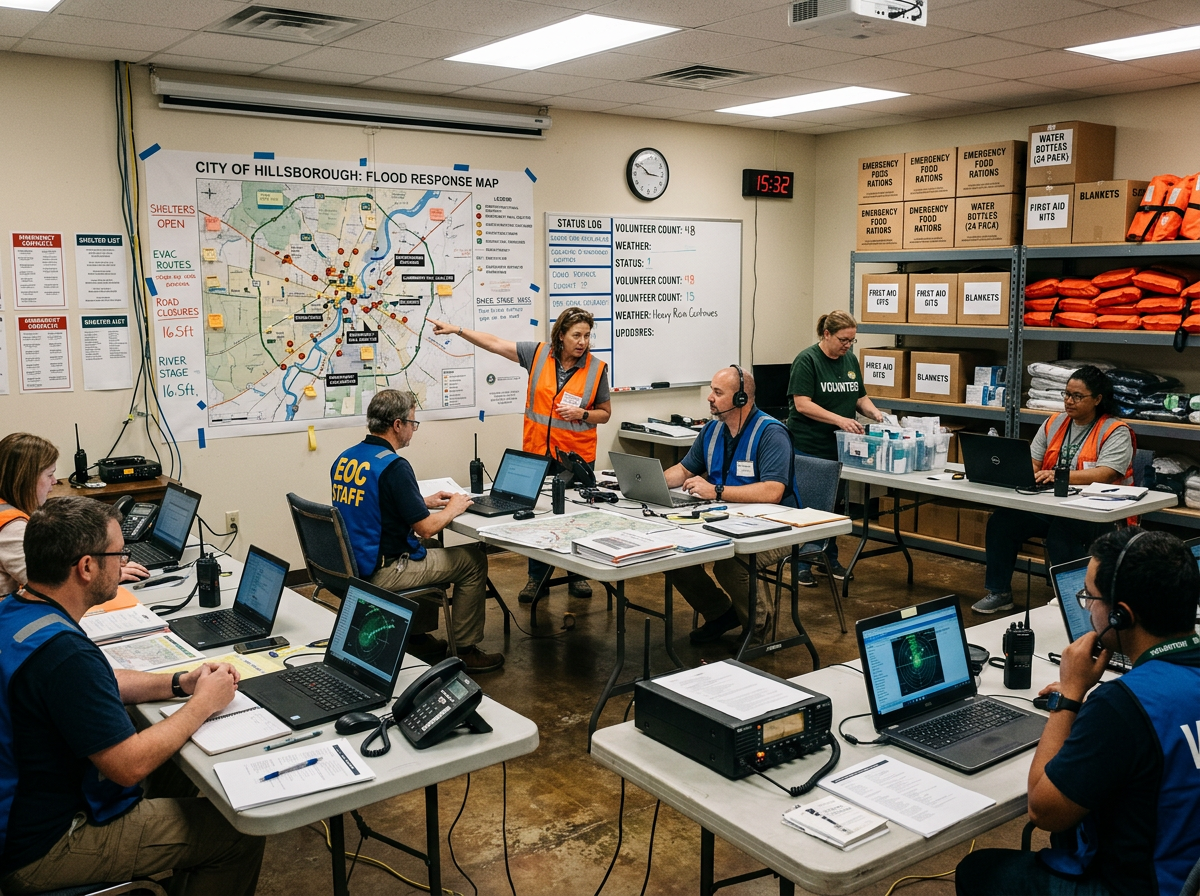
    • Communication tools (mobile devices, radios)
    • Power continuity (chargers, backup batteries)
    • Essential documents (printed protocols, contact lists)
    • Emergency supplies (first aid kits, basic provisions)

    In barangay contexts, physical readiness is often the first line of resilience, particularly during disasters where digital systems may fail.


    b. Digital Layer — Information and Coordination Infrastructure

    These resources enable coordination, transparency, and scalability.

    Examples:

    • Cloud-based document repositories
    • Financial tracking systems
    • Communication platforms (messaging groups, dashboards)
    • Data backups and access protocols

    Digital governance has been shown to improve service delivery and reduce corruption when properly implemented (World Bank, 2016).

    However, digital systems must be:

    • Accessible (low bandwidth requirements where possible)
    • Redundant (offline backups available)
    • Secure (clear access controls)

    c. Internal Layer — Human System Readiness

    This is the most overlooked yet most critical component.

    Examples:

    • Cognitive clarity (understanding of roles and protocols)
    • Emotional regulation capacity
    • Decision-making frameworks
    • Shared values and trust within the team

    Research in resilience consistently highlights that human factors—trust, cohesion, adaptability—are the strongest predictors of system performance under stress (Aldrich & Meyer, 2015).

    Thus, the internal layer is not intangible—it is operational infrastructure.


    3. The Minimum Threshold: What “Standard” Really Means

    “Standard” does not mean uniform across all contexts. It means:

    A clearly defined baseline below which system integrity is compromised.

    For example:

    • A barangay node without a reliable communication channel falls below standard
    • A financial initiative without transparent tracking falls below standard
    • A steward operating without internal regulation falls below standard

    Establishing this baseline allows for:

    • Rapid diagnostics
    • Consistent training
    • Scalable replication

    4. Designing the Sovereign Kit

    A functional Sovereign Kit must satisfy three criteria:

    a. Completeness

    All critical functions are supported (communication, coordination, decision-making).


    b. Accessibility

    Resources can be used when needed—not locked behind complexity or hierarchy.


    c. Redundancy

    Backup options exist for critical components.

    This aligns with systems engineering principles, where redundancy is a key factor in reliability (Hollnagel et al., 2006).


    5. Inventory as Flow Enabler, Not Stockpile

    In lean systems, inventory exists to support flow, not to accumulate.

    Applied to the Sovereign Kit:

    • Physical tools must be ready for immediate use
    • Digital systems must enable real-time coordination
    • Internal readiness must allow rapid response

    If any component becomes stagnant—unused, outdated, or inaccessible—it shifts from asset to liability.


    6. Auditing the Sovereign Kit

    Regular audits ensure that the kit remains functional and relevant.

    Key audit questions:

    Physical Layer

    • Are all tools operational?
    • Are supplies sufficient but not excessive?

    Digital Layer

    • Are systems up to date and accessible?
    • Are backups functioning?

    Internal Layer

    • Do team members understand their roles?
    • Is there evidence of emotional and cognitive regulation under stress?

    Auditing transforms the kit from a static list into a living system.


    7. Integration with BVSM, Takt Time, and Work Sequence

    The Sovereign Kit does not operate in isolation. It is the resource foundation that enables:

    • BVSM → identifies where resources are needed
    • Takt Time → ensures the steward can maintain alignment while using the kit
    • Work Sequence → defines how the resources are deployed

    Without standard inventory:

    • Value streams break
    • Sequences fail
    • Alignment becomes irrelevant

    8. The Role of the Diaspora Architect

    Diaspora architects are uniquely positioned to enhance Sovereign Kits by:

    • Introducing efficient, low-cost tools
    • Designing interoperable digital systems
    • Sharing best practices from other contexts

    However, the critical discipline is restraint:

    Do not expand the kit beyond what the node can sustain.

    Overengineering is a common failure mode—introducing tools that require maintenance, skills, or resources that are not locally available.

    The goal is not sophistication—it is sustainability.


    9. Failure Modes and Safeguards

    Common failures include:

    • Overaccumulation → too many tools, low usability
    • Under-specification → missing critical components
    • Dependency → reliance on external inputs

    Safeguards:

    • Clear inventory lists with ownership
    • Regular audits and updates
    • Training for all users

    10. Measuring Sovereignty

    A node’s sovereignty can be assessed through its kit:

    • Can it operate independently for a defined period?
    • Can it respond to disruptions without external assistance?
    • Can it maintain coordination and decision-making under stress?

    If the answer is consistently yes, the node is not just functional—it is resilient.


    11. Conclusion: Inventory as Autonomy

    Standard inventory, reframed as the Sovereign Kit, is not about accumulation—it is about autonomy.

    It ensures that:

    • Systems do not stall
    • Decisions do not delay
    • Responses do not depend on external rescue

    For barangays and diaspora-led initiatives alike, this is the foundation of true resilience.

    Because a system that cannot sustain itself—even briefly—cannot truly be called sovereign.

    And a steward without a Sovereign Kit is not leading a node—they are managing a dependency.


    Crosslinks

    Work Sequence — The Protocol – Anchor: “How resources are deployed in real operations.” Inventory exists to serve sequence.


    Barangay Value Stream Map (BVSM) – Anchor: “Where each resource fits within the larger system.” Connects micro assets → macro flows.


    Poka-Yoke — Soul-Error Proofing – Anchor: “Safeguarding resources from misuse, loss, or dependency.” Protects the kit itself.


    References

    Aldrich, D. P., & Meyer, M. A. (2015). Social capital and community resilience. American Behavioral Scientist, 59(2), 254–269.

    Cutter, S. L., Burton, C. G., & Emrich, C. T. (2008). Disaster resilience indicators for benchmarking baseline conditions. Journal of Homeland Security and Emergency Management, 5(1).

    Hollnagel, E., Woods, D. D., & Leveson, N. (2006). Resilience Engineering: Concepts and Precepts. Ashgate.

    Liker, J. K. (2004). The Toyota Way. McGraw-Hill.

    Ohno, T. (1988). Toyota Production System: Beyond Large-Scale Production. Productivity Press.

    World Bank. (2016). Digital Dividends. World Bank Publications.


    The Sovereign Professional: A structural map of power, systems thinking, and personal autonomy—dedicated to helping the independent professional navigate complexity and own their value stream.Ask


    ©2026 Gerald Daquila • Life.Understood. • Systems Thinking, Leadership Architecture, and Applied Coherence

  • [SWI-003] Standard Work for Sovereign Wealth: A Protocol for Transitioning from Digital Fiat to Crystalline Assets

    [SWI-003] Standard Work for Sovereign Wealth: A Protocol for Transitioning from Digital Fiat to Crystalline Assets


    Protocol Status: Version 1.0 (Initial Release)

    Process Owner: Individual Steward / Head of Household

    Revision Date: May 2026


    Reframing Wealth in an Age of Institutional Fracture

    The 21st century global economy is entering a period of profound transition.

    Across multiple regions, trust in institutions is being tested by debt expansion, inflationary pressure, widening inequality, ecological instability, geopolitical fragmentation, and the accelerating digitization of money itself.

    Sovereign wealth, once understood primarily as state-controlled reserves and financial instruments, is now increasingly being reconsidered through the lenses of resilience, transparency, ethics, locality, and long-term stewardship.

    At the same time, new conversations are emerging around alternative forms of value storage and exchange. These include decentralized financial systems, tokenized assets, renewable energy-backed economies, cooperative ownership structures, data sovereignty, and emerging concepts sometimes described metaphorically as “crystalline assets.”

    Within this framework, the term crystalline assets should not be interpreted as mystical currency or magical material wealth. Rather, the phrase can serve as a symbolic and systems-oriented metaphor for assets characterized by:

    • transparency;
    • structural integrity;
    • traceability;
    • ethical coherence;
    • long-term resilience;
    • low corruption entropy;
    • regenerative value creation; and
    • alignment between human, ecological, and institutional systems.

    In this sense, crystalline assets stand in contrast to extractive or opaque financial structures that depend heavily on speculative leverage, institutional opacity, or unsustainable debt expansion.

    This article proposes a “standard work” framework — a practical protocol for individuals, communities, organizations, and emerging sovereign networks seeking to transition portions of their economic orientation away from fragile digital fiat dependency and toward resilient, transparent, and regenerative asset ecosystems.


    Understanding Digital Fiat Systems

    Modern fiat currencies derive value primarily from government backing, taxation authority, and collective trust rather than direct commodity convertibility (Mishkin, 2022).

    Over the past several decades, digital banking infrastructure and electronic monetary systems have further abstracted money away from tangible assets and local production.

    Digital fiat systems offer many advantages:

    • liquidity;
    • scalability;
    • rapid transaction capability;
    • international interoperability; and
    • institutional coordination.

    However, they also introduce vulnerabilities when detached from productive, ecological, and social realities.

    Critics of highly financialized economies note that excessive speculative expansion can produce systemic fragility, debt dependence, asset bubbles, and wealth concentration (Piketty, 2014).

    In emerging economies and post-colonial societies, these dynamics can become even more pronounced when external debt structures, currency instability, or institutional capture weaken local sovereignty.

    As a result, many communities worldwide are exploring hybrid models that combine digital systems with more grounded forms of value:

    • local production;
    • cooperative infrastructure;
    • renewable energy systems;
    • land stewardship;
    • food resilience;
    • distributed ownership;
    • transparent ledgers;
    • ethical enterprise;
    • knowledge commons; and
    • community trust networks.

    The transition described here is therefore not a rejection of modern finance entirely, but an attempt to rebalance economic systems toward durability, accountability, and real-world value generation.


    Defining Crystalline Assets

    Crystalline assets may be understood as assets that exhibit structural coherence across multiple dimensions:

    DimensionCrystalline Characteristic
    EconomicDurable, productive, low-speculation value
    EcologicalRegenerative rather than extractive
    SocialCommunity-benefiting and trust-building
    InformationalTransparent and verifiable
    InstitutionalResistant to corruption and opacity
    PsychologicalReduces fear-based scarcity behavior
    CulturalPreserves identity, continuity, and stewardship

    Examples may include:

    • regenerative agricultural land;
    • renewable energy infrastructure;
    • community-owned utilities;
    • ethical cooperative enterprises;
    • educational archives and knowledge systems;
    • decentralized but transparent financial ledgers;
    • resilient local supply chains;
    • open-source technological ecosystems;
    • culturally rooted production networks; and
    • tokenized systems backed by real-world productive assets.

    Importantly, not every digital asset qualifies as crystalline merely because it is decentralized or blockchain-based.

    Many speculative digital assets replicate the same extractive behaviors present within traditional financial systems.

    The critical distinction lies not in technological novelty alone, but in whether the asset structure contributes to long-term resilience, accountability, and regenerative capacity.


    Why Sovereign Wealth Must Evolve

    Traditional sovereign wealth models often focus heavily on:

    • foreign currency reserves;
    • bonds;
    • extractive resource exports;
    • centralized investment vehicles; and
    • large-scale institutional capital deployment.

    While these tools remain important, the global environment is changing rapidly.

    The World Bank (2024) notes that climate instability, supply chain fragmentation, and geopolitical shifts are increasingly influencing economic resilience. Meanwhile, technological acceleration is redistributing power away from exclusively centralized institutions toward hybrid public-private-community ecosystems.

    In this context, sovereign wealth may need to evolve beyond purely financial metrics toward broader measures of societal resilience, including:

    • food security;
    • energy independence;
    • digital sovereignty;
    • educational capacity;
    • ecological stability;
    • community trust;
    • transparent governance; and
    • adaptive infrastructure.

    Countries and communities that fail to diversify beyond fragile financial abstractions may become increasingly vulnerable during periods of global instability.


    A Standard Work Protocol for Transition

    The following framework is not a rigid doctrine but a practical orientation model.


    1. Conduct a Sovereign Asset Audit

    The first step is identifying what forms of value already exist.

    Many societies underestimate their true wealth because they measure only financial liquidity rather than:

    • ecological assets;
    • human capability;
    • cultural continuity;
    • local knowledge;
    • agricultural productivity;
    • diaspora networks;
    • social trust; and
    • cooperative capacity.

    An asset audit should therefore include:

    • land and ecological resources;
    • energy infrastructure;
    • educational systems;
    • digital infrastructure;
    • food production capacity;
    • institutional integrity;
    • cultural archives;
    • public trust metrics; and
    • local enterprise ecosystems.

    This creates a broader picture of sovereign resilience.


    2. Reduce Dependency Concentration

    Systems become fragile when too much value depends on a single point of failure.

    Communities and institutions should evaluate overdependence on:

    • external debt systems;
    • imported essentials;
    • centralized digital platforms;
    • speculative asset exposure;
    • monopolized supply chains; and
    • unstable geopolitical arrangements.

    Resilience emerges through diversification and redundancy.

    This may include:

    • local agriculture initiatives;
    • distributed energy systems;
    • cooperative manufacturing;
    • community finance structures;
    • open-source technologies; and
    • local knowledge preservation.

    3. Anchor Value to Real Production

    One of the central critiques of hyper-financialized economies is the detachment of wealth accumulation from productive contribution.

    Crystalline-oriented systems seek stronger alignment between:

    • value creation;
    • labor;
    • ecological regeneration;
    • social benefit; and
    • tangible production.

    This does not eliminate digital systems. Rather, it reconnects them to measurable real-world outputs.

    Potential examples include:

    • tokenized renewable energy production;
    • agricultural cooperatives;
    • ethical manufacturing;
    • knowledge infrastructure;
    • distributed educational platforms; and
    • regenerative land stewardship systems.

    4. Build Transparent Ledger Systems

    Transparency is foundational to trust.

    Emerging ledger technologies can improve:

    • accountability;
    • traceability;
    • anti-corruption measures;
    • public auditing; and
    • participatory governance.

    However, transparency alone is insufficient without ethical governance and informed civic participation.

    Technology cannot substitute for stewardship.

    The strongest systems combine:

    • transparent infrastructure;
    • ethical leadership;
    • institutional checks;
    • civic literacy; and
    • distributed accountability.

    5. Develop Regenerative Wealth Metrics

    Gross Domestic Product (GDP) remains a dominant economic metric globally, yet many economists argue that GDP alone fails to capture societal wellbeing, ecological health, or long-term resilience (Stiglitz et al., 2010).

    A crystalline wealth framework may therefore incorporate broader indicators such as:

    • ecological restoration;
    • educational access;
    • food resilience;
    • local ownership ratios;
    • trust indices;
    • corruption reduction;
    • renewable energy capacity;
    • mental health outcomes; and
    • intergenerational sustainability.

    These metrics help align economic systems with human flourishing rather than pure extraction.


    6. Preserve Human Meaning and Cultural Continuity

    Economic systems are not merely transactional structures. They shape identity, meaning, belonging, and collective direction.

    Communities undergoing rapid digitization or financial transition often experience psychological fragmentation when cultural continuity is lost.

    Therefore, sovereign wealth transition should also preserve:

    • language;
    • memory;
    • ancestral knowledge;
    • local traditions;
    • ethical frameworks; and
    • community cohesion.

    In post-colonial societies especially, economic sovereignty and cultural sovereignty are deeply intertwined.


    The Philippine Context

    The Philippines occupies a uniquely complex position within the global transition landscape.

    It is simultaneously:

    • deeply integrated into global labor migration;
    • highly digitized in communication culture;
    • vulnerable to climate instability;
    • shaped by colonial history;
    • rich in human adaptab

    References

    Mishkin, F. S. (2022). The economics of money, banking, and financial markets (13th ed.). Pearson.

    Piketty, T. (2014). Capital in the twenty-first century. Harvard University Press.

    Stiglitz, J. E., Sen, A., & Fitoussi, J.-P. (2010). Mismeasuring our lives: Why GDP doesn’t add up: The report by the Commission on the Measurement of Economic Performance and Social Progress. The New Press.

    World Bank. (2024). Global economic prospects: Broadening the scope of debt sustainability. World Bank Publications.


    Crosslinks


    [DOCUMENT CONTROL & STEWARDSHIP]

    Standard Work ID: SWI-003

    Baseline Version: v1.5.2026

    Classification: Open-Access Archive / Systemic Protocol

    The Sovereign Audit: Following this protocol is an act of internal quality control. Verification of this standard does not happen here; it happens at your Gemba—the actual place where your life and leadership occur. No external validation is required or offered.

    Next in Sequence: [SWI-002: The 72-Hour Protocol]

    Return to Archive: [Standard Work Knowledge Hub: The Terrain Map]


    © 2026 Gerald Daquila • Life.Understood Systemic Stewardship • Non-Autocratic Architecture • Process over Persona

  • Why the Global Reset Requires an Internal Reboot: The Role of Shadow Work in NESARA/GESARA

    Why the Global Reset Requires an Internal Reboot: The Role of Shadow Work in NESARA/GESARA


    Beyond external change—why no financial or political reset can succeed without psychological and cultural integration


    Meta Description

    Can a global financial reset succeed without inner transformation? Explore why shadow work and identity coherence are essential for any meaningful systemic shift, including narratives like NESARA/GESARA.


    The Allure of the External Reset

    In recent years, conversations around a “global reset” have gained traction—often framed through narratives such as NESARA/GESARA.

    These ideas typically promise sweeping transformations: debt relief, equitable wealth distribution, restored governance, and systemic fairness.

    At face value, the appeal is understandable.

    For nations like the Philippines—shaped by colonial extraction, economic dependency, and systemic inequality—the idea of a structural reset speaks directly to long-standing grievances.

    But there is a critical question that is often overlooked:

    Can external systems truly change if internal patterns remain the same?


    A Necessary Clarification

    Before going deeper, it is important to ground this discussion.

    As of today, NESARA/GESARA are not recognized as implemented policies by any verified global governing body. They exist largely in speculative, interpretive, or aspirational discourse rather than institutional reality.

    This does not invalidate the desire behind them.

    But it does highlight a key distinction:

    • A narrative of change is not the same as the capacity to sustain change

    And capacity is where inner work becomes non-negotiable.


    The Pattern Beneath the System

    Every system—financial, political, or social—is a reflection of the consciousness that sustains it.

    Corruption, inequality, and instability do not emerge in isolation. They are expressions of deeper patterns:

    • Scarcity thinking
    • Power hoarding
    • Short-term survival behavior
    • Distrust and fragmentation

    These patterns are not confined to leaders or institutions.

    They exist at every level of society.

    This aligns with research in social psychology showing that systems tend to reproduce the dominant behaviors and norms of the populations within them (North, 1990; Acemoglu & Robinson, 2012).

    In other words:
    We do not just live under systems. We participate in their continuation.


    Shadow Work: The Missing Component

    This is where shadow work becomes essential.

    Shadow work refers to the process of identifying, acknowledging, and integrating the parts of ourselves—and our collective identity—that are denied or suppressed (Jung, 1959).

    At a societal level, this includes:

    • Internalized colonial mentality
    • Normalized corruption at micro-levels
    • Avoidance of accountability
    • Dependence on external saviors or solutions

    (Crosslink: From Informer to Steward: Why True Leadership Begins with Owning Our Shared Shadow)

    Without confronting these elements, any external reset risks becoming superficial.


    The Reset Paradox

    History provides a clear pattern:

    Major systemic shifts—revolutions, reforms, regime changes—often begin with hope but eventually reproduce familiar dysfunctions.

    Why?

    Because structures changed, but consciousness did not.

    Frantz Fanon (1963) observed this in post-colonial societies, where new leadership often replicated the extractive behaviors of former colonizers.

    This creates what we can call the Reset Paradox:

    Without inner transformation, new systems inherit old dysfunctions.


    The Filipino Context: A High-Stakes Test Case

    The Philippines represents a unique convergence point:

    • A deeply colonized past
    • A globally distributed diaspora
    • High adaptability and resilience
    • Persistent systemic challenges

    This makes it not just a participant—but a prototype environment.

    (Crosslink: The Philippine Ark: A Global South Prototype)

    If a global reset were to occur, nations like the Philippines would face a critical test:

    Can new resources be stewarded differently than before?


    Or will they be absorbed into existing patterns?


    From Dependency to Sovereignty

    One of the most subtle shadows in “reset” narratives is dependency.

    The belief that:

    • Change will arrive externally
    • Solutions will be delivered
    • Systems will fix themselves

    This mindset mirrors colonial dynamics—where authority and transformation are expected from outside.

    True sovereignty requires a shift:

    From:

    “When the reset happens, things will improve.”

    To:

    “Are we prepared to sustain what we are asking for?”


    Internal Reboot: What It Actually Means

    An internal reboot is not abstract spirituality.

    It is practical, observable, and measurable in behavior.


    1. Psychological Integration

    Recognizing and interrupting inherited patterns:

    • Scarcity-driven decisions
    • Avoidance of responsibility
    • External validation seeking

    2. Cultural Recalibration

    Re-examining norms:

    • When does pakikisama enable dysfunction?
    • When does hiya prevent truth-telling?

    (Crosslink: Naming the Unspoken: A Guide to Navigating the Hidden Fractures of Our National Identity)


    3. Behavioral Integrity

    Aligning actions with values:

    • No tolerance for “small” corruption
    • Consistency between private and public behavior

    4. Systems Thinking

    Understanding how individual behavior scales into systemic outcomes.

    This is where the Ark architecture becomes critical:

    • Small coherent units
    • Replicable governance models
    • Built-in accountability

    What Happens If the Inner Work Is Ignored

    If a large-scale financial or governance reset were to occur without internal reboot:

    • Wealth redistribution may concentrate again
    • Corruption may reappear in new forms
    • Institutional trust may erode quickly
    • Public disillusionment may deepen

    In short:
    The reset would collapse into a recycle.


    A More Grounded Interpretation of “Global Reset”

    Instead of viewing the reset as a singular event, a more grounded framing is:

    A multi-layered transition involving both external restructuring and internal maturation.

    This includes:

    • Policy and institutional reform
    • Economic redesign
    • Cultural evolution
    • Psychological integration

    All four must move together.

    Remove one, and the system destabilizes.


    The Role of Stewardship

    This is where this body of work converges.

    A true reset—if it is to succeed—requires not just awareness, but stewardship capacity.

    People who can:

    • Hold resources without misusing them
    • Build systems without replicating harm
    • Lead without reverting to dominance patterns

    (Crosslink: ARK-001: The 50-Person Resource Loop)

    This is not mass leadership in the traditional sense.


    It is distributed, grounded, and practiced at every level.


    Conclusion: The Reset Begins Within

    The idea of a global reset speaks to something real:

    A collective recognition that current systems are no longer sustainable.

    But the deeper truth is this:

    No external reset can outpace internal readiness.


    The work is not to wait.


    The work is to prepare.

    To name the shadow.
    To integrate it.
    To build differently.

    So that if and when larger shifts occur, they do not collapse under the weight of old patterns.

    The future is not secured by policy alone.


    It is secured by the people who will live within it.


    References

    Acemoglu, D., & Robinson, J. A. (2012). Why Nations Fail. Crown Business.

    Fanon, F. (1963). The Wretched of the Earth. Grove Press.

    Jung, C. G. (1959). Aion: Researches into the Phenomenology of the Self. Princeton University Press.

    North, D. C. (1990). Institutions, Institutional Change and Economic Performance. Cambridge University Press.

    David, E. J. R. (2013). Brown Skin, White Minds. Information Age Publishing.


    The Sovereign Professional: A structural map of power, systems thinking, and personal autonomy—dedicated to helping the independent professional navigate complexity and own their value stream.Ask


    ©2026 Gerald Daquila • Life.Understood. • Systems Thinking, Leadership Architecture, and Applied Coherence

  • The Philippine Ark: A Sovereign Blueprint for Systemic Transformation

    The Philippine Ark: A Sovereign Blueprint for Systemic Transformation


    By early 2026, the global narrative has shifted from mere “digital transformation” to something far more profound: Systemic Transition.

    For the Sovereign Professional, the noise of the legacy corporate world is increasingly being replaced by a high-signal frequency—one that points toward a new architecture of value. At the center of this shift is a profound framework known as The Philippine Ark.

    Spanning a critical four-part series, the “Philippine Ark Codes” offer more than just spiritual or cultural reflection; they provide a Systemic Operating System for navigating the 2026 reset.

    Whether you are a tech lead in Silicon Valley or a financial architect in Manila, understanding the Ark is about moving your “Value Stream” from an extractive past to a generative future.


    Part 1 & 2: Reawakening the Island Node

    The first two stages of the series, Part 1: Philippine Ark Codes: Reawakening the Islands, establish the foundational “Signal” over the “Noise.”

    In the 2026 context, “Reawakening” is a technical term for Sovereign Clarity. It is the process of stripping away the colonial and extractive layers that have suppressed the Philippines’ potential as a global node of value.

    For the high-performer, this is the ultimate “Lean Audit.” You cannot build a new architecture on a foundation of “Muda” (waste).

    Parts 1 and 2 argue that the islands—and by extension, the professionals who inhabit them or lead them—are being activated as a Coherence Node.

    This activation is essential to withstand the volatility of the global reset. As explored in Signal vs Noise: Why Clear Thinking Is Rare, the ability to maintain internal stability while systems collapse is the defining trait of the 2026 leader.


    Part 3: The Diaspora and the Building of the Ark

    Part 3 of 4. The Diaspora, Ark Codes & Building the Ark shifts the focus to the global Filipino community. This is where the concept of “Agentic Stewardship” becomes practical.

    The Diaspora is not just a source of remittances; it is a distributed network of Sovereign Talent that holds the “codes” for a new economy.

    In 2026, “Building the Ark” means creating redundant, independent, and high-trust systems that operate outside of traditional extractive banking. This is the GESARA Bridge in action.

    The Ark is a “vessel” of resources—intellectual, technological, and financial—that ensures that when the “old world” systems fail, the Sovereign Professional has a platform for continued output.

    This is about moving beyond the “Ube Latte” aesthetic and into the structural reality of being a “Barangay Architect” in a digital world.


    Part 4: The Ascension of the System

    The final movement, Part 4: Reawakening the Islands for Earth’s Ascension, brings the framework to its apex. Here, “Ascension” is translated into the language of Systemic Complexity.

    It is the transition from a low-efficiency, competition-based economy to a high-efficiency, cooperation-based “Sacred Economy.”

    For the Sovereign Professional, this means your “Incentive Structure” must change. You can no longer optimize for short-term extractive gain because the system itself is moving toward zero-waste.

    As analyzed in Incentives Drive Behavior: Why Good Intentions Fail in Systems, the old systems failed because they rewarded the “scrap” (interest/debt). The Ark rewards Flow.


    The Ark as a Cognitive Operating System

    The “Philippine Ark” is not a piece of land; it is a Cognitive OS. It is a way of perceiving power, wealth, and community that is immune to corporate toxicity.

    By integrating the four parts of the Ark series, the professional begins to practice “Gemba Walking the Ancestral Soul.”

    1. Observation (Part 1-2): Seeing the hidden patterns of the island nodes and recognizing the “Signal.”
    2. Network (Part 3): Activating the Diaspora as a Sovereign Resource Pipeline.
    3. Deployment (Part 4): Executing work that contributes to the “New Earth” architecture.

    Conclusion: Boarding the Vessel

    The 2026 economic environment is a desert of meaning, but the The Philippine Ark provides the oasis. The “Ark” is currently being built by “Silent Professionals” who recognize that the financial miracles promised by GESARA are not “free money,” but a Systemic Reset to Zero Waste.

    Boarding the Ark requires you to trade your “employee” mindset for a “Sovereign” architecture.

    It requires you to stop being a unit of labor and start being a steward of the transition. The codes are active. The series is complete.

    The question is: Are you an architect of the Ark, or are you still trying to patch a sinking ship?

    To translate systemic vision into lived infrastructure, the next layer moves from macro-design into operational reality. See how localized resource loops function at human scale in ARK-001: The 50-Person Resource Loop: A Field Manual for Localized Resilience.


    The Sovereign Professional: A structural map of power, systems thinking, and personal autonomy—dedicated to helping the independent professional navigate complexity and own their value stream.


    ©2026 Gerald Daquila • Life.Understood. • Systems Thinking, Leadership Architecture, and Applied Coherence

  • What NESARA/GESARA Means for the Filipino Soul: A Return to the Babaylan Blueprint

    What NESARA/GESARA Means for the Filipino Soul: A Return to the Babaylan Blueprint


    For many Filipinos, NESARA (National Economic Security and Recovery Act) and GESARA (Global Economic Security and Reformation Act) have emerged as symbols of hope in a world shaped by persistent scarcity and systemic fatigue.

    They are often framed as a coming “Global Reset”—a moment where debt is dissolved, wealth is redistributed, and long-standing financial burdens are lifted.

    But to interpret these shifts purely through the lens of currency and banking is to misread their deeper significance.

    At its core, this transition is not financial—it is civilizational.

    For the Filipino soul, GESARA is not merely an external upgrade of systems. It is an internal recall signal—a structural invitation to return to an older, more coherent operating framework: the Babaylan blueprint.

    This piece serves as a living bridge between Gate 1 • GESARA & Financial Sovereignty and The Architecture of Resilience: Reconciling Duality in the Filipino Psyche. Without this bridge, both remain incomplete—one risks becoming purely economic, the other purely psychological.


    The Misstep: Escaping into the “Waiting Room”

    A critical distortion has emerged within “New Earth” discourse—what can be called the Waiting Room Trap.

    This is the mindset that suspends agency in anticipation of external salvation:
    waiting for the system to reset,
    waiting for wealth to be released,
    waiting for permission to begin.

    While systemic shifts may indeed be underway, this posture is structurally incoherent.

    The Filipino psyche, in particular, is vulnerable to this trap. Centuries of colonial conditioning and modern economic patterns have reinforced a habit of outward dependency—waiting for change to arrive rather than generating it from within.

    This pattern is further unpacked in Beyond the Ube Latte, where surface-level cultural identity is shown to mask deeper structural dislocation.

    But the Babaylan tradition operates on an entirely different premise.


    The Babaylan did not wait.


    They functioned as active stewards of reality—anchored in bayanihan, where abundance was not accumulated but circulated. Sovereignty was not granted; it was embodied.


    If GESARA is to have any real impact, it cannot be approached as rescue. It must be understood as mirror.


    GESARA as Structural Mirror, Not External Savior

    The old system was built on extraction—of labor, attention, and life force. Scarcity was not accidental; it was engineered as a mechanism of control.

    GESARA, in its intended form, represents the dismantling of these extraction loops.

    But dismantling a system externally does not guarantee transformation internally.

    If the structures change but the consciousness remains conditioned by scarcity, the same patterns will reassemble under new names.

    This is why internal discipline becomes central. As outlined in [SWI-001] Standard Work for the Sovereign Mind, sovereignty is not a belief—it is a trained operating system.

    The Babaylan understood wealth not as accumulation, but as flow integrity—the balanced circulation of resources for collective coherence. In this sense, they were not merely spiritual figures; they were system designers.

    This archetype is further explored in The Architecture of Overflow Communities, where wealth is reframed as a stewardship function rather than a possession.

    What is now being described as a “Golden Age” is not the arrival of abundance—it is the restoration of stewardship.

    And stewardship requires structure.


    The Philippine Ark: From Extraction to Stewardship

    The Philippines occupies a unique position in this transition.

    Historically framed as a labor-export economy, it has been one of the most resilient yet most extracted systems globally. That combination is not incidental—it is preparatory.


    In a post-extraction world, resilience without sovereignty becomes obsolete.


    What emerges instead is a new function: stewardship anchoring.

    This role is articulated in The Philippine Ark, where the country is framed not as a passive recipient of global change, but as an active threshold node within it.

    The practical pathway for this transition is further mapped in The 5-Year Plan for Building the New Earth in the Philippines (Threshold Flame Edition), shifting the narrative from aspiration to implementation.

    But this transition is not geographic. It is psychological and ancestral.

    Without addressing lineage-level distortions—poverty conditioning, colonial mentality, fractured identity—the same dysfunction will simply reappear inside any new system.

    This is why the work within your Ancestral & Lineage Healing cluster remains foundational, not supplementary.

    GESARA, in this sense, does not solve these issues. It exposes them.


    From Concept to Practice: Stabilizing the Transition

    High-level frameworks without grounded application create instability.

    The bridge between systemic change and lived experience must be practical.

    For those entering this work, [SWI-002] The 72-Hour Sovereignty Protocol provides an immediate stabilization pathway—a way to regulate the internal system while external systems fluctuate.

    A transition period of this scale introduces volatility:
    financial uncertainty,
    information distortion,
    institutional instability.

    The role of the individual is not to predict outcomes, but to stabilize their internal system within this volatility.

    The Babaylan principle applies directly:

    You do not fight the storm.
    You become the point of coherence within it.


    The Real Shift: From Resilience to Architecture

    The Filipino identity has long been defined by resilience.


    But resilience alone is no longer sufficient.


    Endurance without direction perpetuates the very conditions it seeks to survive.

    What is required now is a shift toward architectural thinking—a theme developed across the archive, particularly within The Architecture of Resilience: Reconciling Duality in the Filipino Psyche.

    This is the deeper transition:

    Not survival.
    Not even recovery.
    But construction.

    A movement from reacting to systems → to building them.


    Closing: Sovereignty as Recall, Not Acquisition

    The question is no longer whether NESARA/GESARA will happen.

    The more relevant question is:

    What state of consciousness will meet it when it does?

    If approached as salvation, it reinforces dependency.
    If approached as opportunity, it activates agency.
    If approached as mirror, it demands transformation.

    For the Filipino soul, this moment is not about receiving something new.

    It is about remembering something old.

    Dangal (dignity) and Ginhawa (vitality) are not future states—they are baseline conditions that were disrupted and are now being reintroduced.

    The Babaylan were never lost.

    They were simply operating in a system that could not support their function.

    If that system is now shifting, the responsibility is clear:

    Not to wait for it.
    Not to rely on it.
    But to become coherent enough to steward what replaces it.


    © 2025-2026 Gerald Alba Daquila • Life.Understood. • All rights reserved
    Exploring structure, meaning, and human experience across systems and inner life.

  • Protected: GESARA Council Templates

    Protected: GESARA Council Templates

    This content is password-protected. To view it, please enter the password below.