
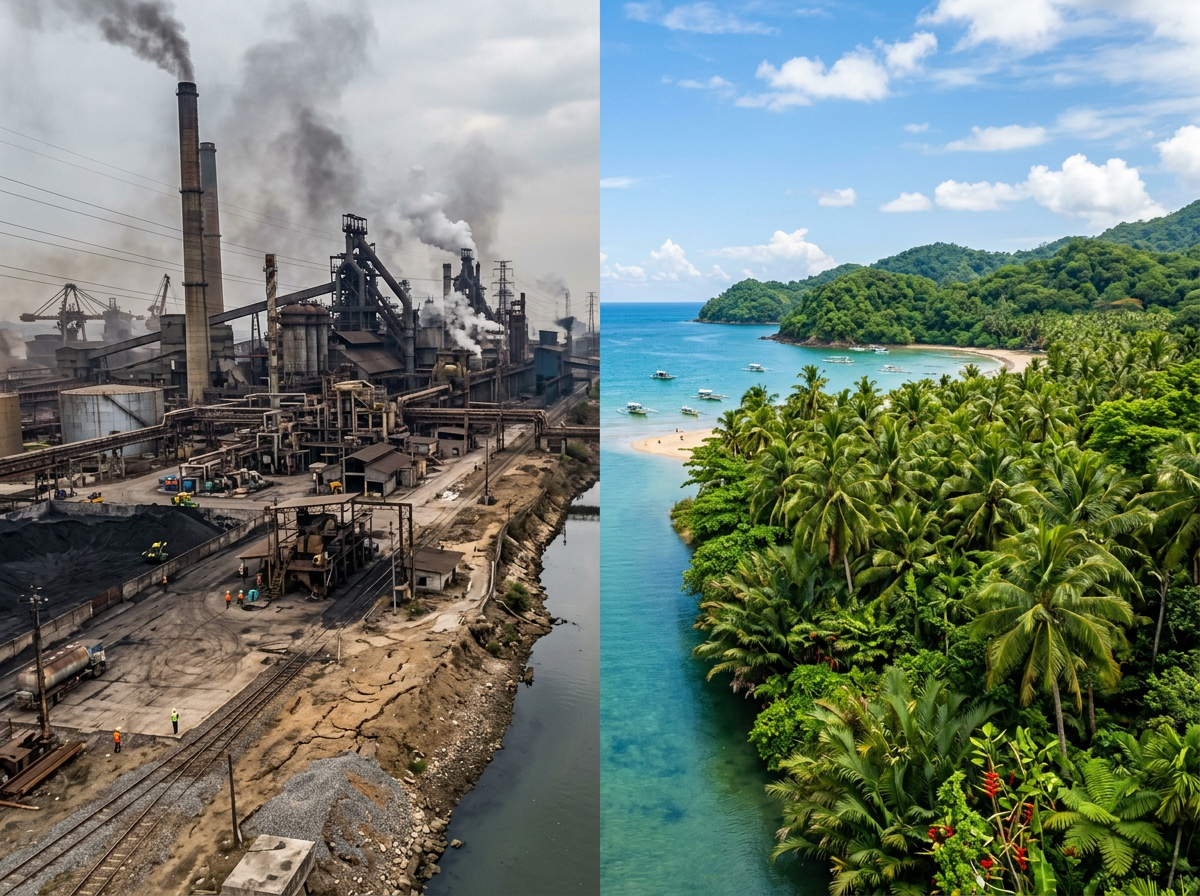
For many Filipinos, NESARA (National Economic Security and Recovery Act) and GESARA (Global Economic Security and Reformation Act) have emerged as symbols of hope in a world shaped by persistent scarcity and systemic fatigue.
They are often framed as a coming “Global Reset”—a moment where debt is dissolved, wealth is redistributed, and long-standing financial burdens are lifted.
But to interpret these shifts purely through the lens of currency and banking is to misread their deeper significance.
At its core, this transition is not financial—it is civilizational.
For the Filipino soul, GESARA is not merely an external upgrade of systems. It is an internal recall signal—a structural invitation to return to an older, more coherent operating framework: the Babaylan blueprint.
This piece serves as a living bridge between Gate 1 • GESARA & Financial Sovereignty and The Architecture of Resilience: Reconciling Duality in the Filipino Psyche. Without this bridge, both remain incomplete—one risks becoming purely economic, the other purely psychological.
The Misstep: Escaping into the “Waiting Room”
A critical distortion has emerged within “New Earth” discourse—what can be called the Waiting Room Trap.
This is the mindset that suspends agency in anticipation of external salvation:
waiting for the system to reset,
waiting for wealth to be released,
waiting for permission to begin.
While systemic shifts may indeed be underway, this posture is structurally incoherent.
The Filipino psyche, in particular, is vulnerable to this trap. Centuries of colonial conditioning and modern economic patterns have reinforced a habit of outward dependency—waiting for change to arrive rather than generating it from within.
This pattern is further unpacked in Beyond the Ube Latte, where surface-level cultural identity is shown to mask deeper structural dislocation.
But the Babaylan tradition operates on an entirely different premise.
The Babaylan did not wait.
They functioned as active stewards of reality—anchored in bayanihan, where abundance was not accumulated but circulated. Sovereignty was not granted; it was embodied.
If GESARA is to have any real impact, it cannot be approached as rescue. It must be understood as mirror.
GESARA as Structural Mirror, Not External Savior
The old system was built on extraction—of labor, attention, and life force. Scarcity was not accidental; it was engineered as a mechanism of control.
GESARA, in its intended form, represents the dismantling of these extraction loops.
But dismantling a system externally does not guarantee transformation internally.
If the structures change but the consciousness remains conditioned by scarcity, the same patterns will reassemble under new names.
This is why internal discipline becomes central. As outlined in [SWI-001] Standard Work for the Sovereign Mind, sovereignty is not a belief—it is a trained operating system.
The Babaylan understood wealth not as accumulation, but as flow integrity—the balanced circulation of resources for collective coherence. In this sense, they were not merely spiritual figures; they were system designers.
This archetype is further explored in The Architecture of Overflow Communities, where wealth is reframed as a stewardship function rather than a possession.
What is now being described as a “Golden Age” is not the arrival of abundance—it is the restoration of stewardship.
And stewardship requires structure.
The Philippine Ark: From Extraction to Stewardship
The Philippines occupies a unique position in this transition.
Historically framed as a labor-export economy, it has been one of the most resilient yet most extracted systems globally. That combination is not incidental—it is preparatory.
In a post-extraction world, resilience without sovereignty becomes obsolete.
What emerges instead is a new function: stewardship anchoring.
This role is articulated in The Philippine Ark, where the country is framed not as a passive recipient of global change, but as an active threshold node within it.
The practical pathway for this transition is further mapped in The 5-Year Plan for Building the New Earth in the Philippines (Threshold Flame Edition), shifting the narrative from aspiration to implementation.
But this transition is not geographic. It is psychological and ancestral.
Without addressing lineage-level distortions—poverty conditioning, colonial mentality, fractured identity—the same dysfunction will simply reappear inside any new system.
This is why the work within your Ancestral & Lineage Healing cluster remains foundational, not supplementary.
GESARA, in this sense, does not solve these issues. It exposes them.
From Concept to Practice: Stabilizing the Transition
High-level frameworks without grounded application create instability.
The bridge between systemic change and lived experience must be practical.
For those entering this work, [SWI-002] The 72-Hour Sovereignty Protocol provides an immediate stabilization pathway—a way to regulate the internal system while external systems fluctuate.
A transition period of this scale introduces volatility:
financial uncertainty,
information distortion,
institutional instability.
The role of the individual is not to predict outcomes, but to stabilize their internal system within this volatility.
The Babaylan principle applies directly:
You do not fight the storm.
You become the point of coherence within it.
The Real Shift: From Resilience to Architecture
The Filipino identity has long been defined by resilience.
But resilience alone is no longer sufficient.
Endurance without direction perpetuates the very conditions it seeks to survive.
What is required now is a shift toward architectural thinking—a theme developed across the archive, particularly within The Architecture of Resilience: Reconciling Duality in the Filipino Psyche.
This is the deeper transition:
Not survival.
Not even recovery.
But construction.
A movement from reacting to systems → to building them.
Closing: Sovereignty as Recall, Not Acquisition
The question is no longer whether NESARA/GESARA will happen.
The more relevant question is:
What state of consciousness will meet it when it does?
If approached as salvation, it reinforces dependency.
If approached as opportunity, it activates agency.
If approached as mirror, it demands transformation.
For the Filipino soul, this moment is not about receiving something new.
It is about remembering something old.
Dangal (dignity) and Ginhawa (vitality) are not future states—they are baseline conditions that were disrupted and are now being reintroduced.
The Babaylan were never lost.
They were simply operating in a system that could not support their function.
If that system is now shifting, the responsibility is clear:
Not to wait for it.
Not to rely on it.
But to become coherent enough to steward what replaces it.
© 2025-2026 Gerald Alba Daquila • Life.Understood. • All rights reserved
Exploring structure, meaning, and human experience across systems and inner life.
Leave a Reply