
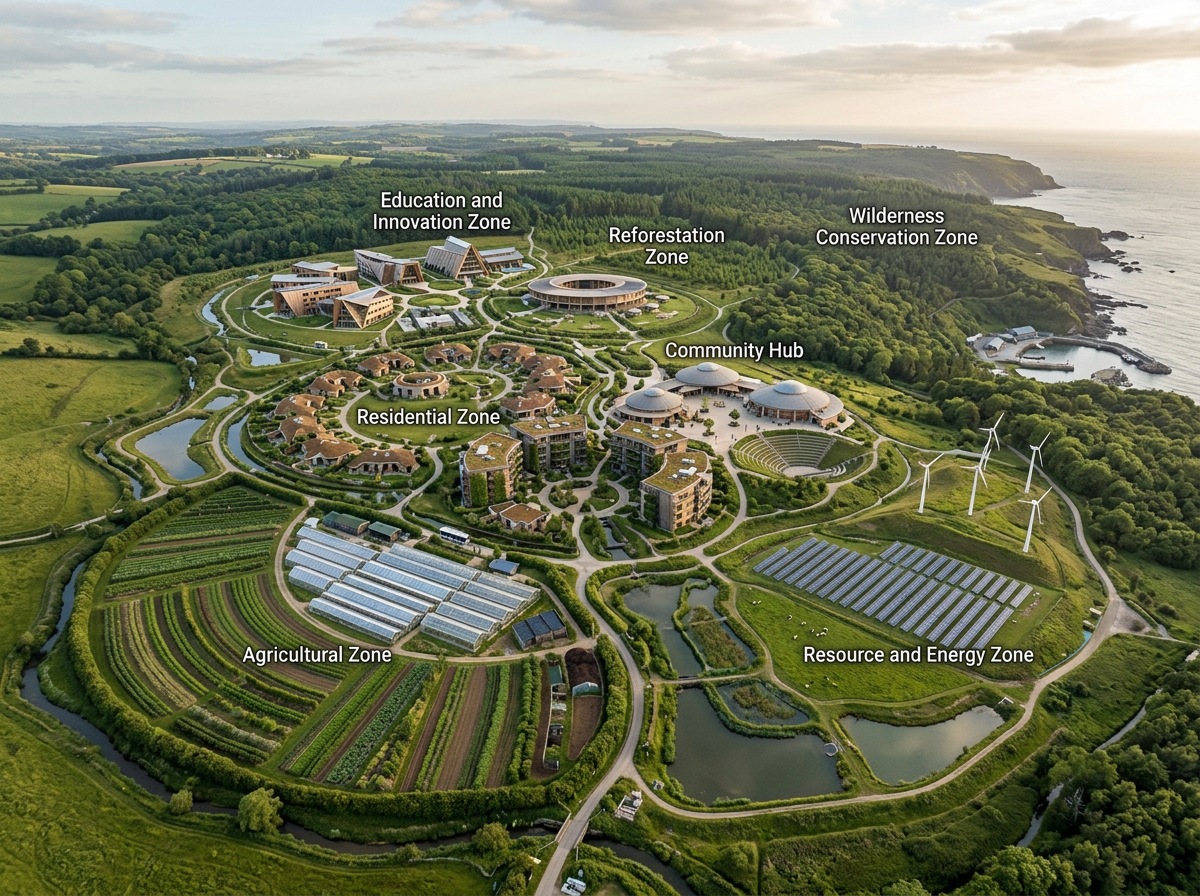
A Barangay-Scale Stewardship Framework for Regenerative Living, Economic Circulation, and Distributed Leadership
Meta Description
Explore the operational blueprint behind a regenerative barangay-scale prototype community in the Philippines, including governance, stewardship systems, local economics, conflict resolution, and resilient day-to-day living without centralized debt dependency.
Introduction
Many intentional communities fail not because their vision lacks inspiration, but because their operational systems remain vague.
Noble ideals alone cannot sustain land stewardship, shared infrastructure, financial resilience, or human relationships over time.
The Prototype Community proposed within the SHEYALOTH stewardship architecture is therefore designed not merely as a philosophical experiment, but as an operationally grounded living system.
This document outlines how the prototype community functions on a day-to-day basis.
Its purpose is to answer the practical questions donors, collaborators, future residents, and governance advisors will inevitably ask:
- How is the community structured?
- Who makes decisions?
- How does money circulate?
- How are conflicts handled?
- How are members selected?
- What prevents leadership abuse?
- How does the community remain financially viable?
- How does the model scale without collapsing?
This is not a utopian blueprint.
It is a systems-informed prototype designed for gradual implementation, adaptation, and resilience.
1. Core Design Philosophy
The prototype community is built around five foundational principles:
1. Stewardship Over Ownership
Land, infrastructure, knowledge, and resources are treated primarily as stewarded assets rather than speculative commodities.
The objective is long-term regenerative use rather than extraction.
2. Distributed Responsibility
The community avoids over-centralization of authority.
Leadership functions are distributed through councils, working groups, rotating stewardship roles, and transparent governance structures.
This reduces fragility and dependency on charismatic leadership.
3. Regenerative Economics
The node is designed to retain and circulate value locally whenever practical.
Priority is placed on:
- local production,
- skill development,
- cooperative purchasing,
- resilient infrastructure,
- and ethical enterprise creation.
4. Human-Scale Governance
The community is intentionally kept within a manageable relational scale.
Research in social cohesion repeatedly suggests that trust and accountability degrade when communities become too large or overly bureaucratic (Ostrom, 1990).
The prototype therefore prioritizes:
- relational governance,
- participatory decision-making,
- and face-to-face accountability.
5. Adaptive Evolution
The operating model is not static.
The prototype is designed to learn through implementation.
Systems are expected to evolve based on:
- ecological realities,
- member feedback,
- financial conditions,
- and operational experience.
2. Community Structure
Initial Prototype Size
The recommended initial scale is:
- 12–20 founding adults
- small family clusters
- rotating retreat participants
- local collaborators and trainees
This allows sufficient diversity of skills while maintaining manageable governance complexity.
Expansion beyond 50–70 residents should occur only after:
- governance stabilization,
- infrastructure maturity,
- financial resilience,
- and conflict systems have proven functional.
Physical Layout
The community is organized into interconnected functional zones:
A. Residential Zone
- private sleeping quarters
- small family dwellings
- shared housing clusters
- co-living options
B. Productive Agriculture Zone
- food forests
- gardens
- regenerative farming plots
- seed stewardship
- compost systems
- water capture systems
C. Commons Zone
Shared community infrastructure:
- kitchen
- dining space
- workshop
- learning spaces
- meditation/reflection areas
- meeting spaces
D. Enterprise Zone
Micro-enterprise and livelihood activities:
- fabrication
- media production
- retreats
- training programs
- crafts
- processing facilities
- digital workspaces
3. Membership Model
The prototype uses a layered participation structure.
Not all participants carry identical responsibilities or privileges.
Tier 1 – Visitors
Short-term participants:
- retreat guests
- volunteers
- educational participants
- researchers
No governance authority.
Tier 2 – Apprentices
Longer-term immersion participants learning stewardship systems.
Responsibilities include:
- contribution hours
- training participation
- collaborative work
- community integration
Limited governance participation.
Tier 3 – Resident Stewards
Core long-term members.
Responsibilities include:
- operational stewardship
- governance participation
- financial contribution
- skill-sharing
- mentorship
- infrastructure care
These members hold voting participation in major community decisions.
Tier 4 – Custodian Council
A rotating stewardship council responsible for:
- legal oversight
- financial transparency
- conflict facilitation
- systems coordination
- external partnerships
- continuity planning
The council does not function as permanent rulers.
Term limits and rotation structures reduce power concentration.
4. Governance Architecture
Governance is one of the most critical systems within the prototype.
Most intentional communities fail from unresolved governance weaknesses rather than resource scarcity.
Decision-Making Structure
The community uses a hybrid governance model combining:
- consensus-seeking,
- delegated authority,
- and operational autonomy.
Not every decision requires full-community deliberation.
Examples:
| Decision Type | Governance Layer |
|---|---|
| Daily operations | Working groups |
| Budget allocations | Stewardship council + community review |
| Land use changes | Full steward vote |
| Conflict mediation | Designated mediation circle |
| Legal compliance | Custodian council |
Transparency Systems
Transparency is mandatory.
Members have access to:
- budget summaries
- project spending
- governance notes
- operational reports
- stewardship agreements
Opaque governance breeds distrust.
Conflict Resolution Process
Conflict is treated as inevitable rather than abnormal.
The prototype therefore institutionalizes conflict support mechanisms.
The escalation structure includes:
- Direct dialogue
- Facilitated mediation
- Stewardship review circle
- Temporary cooling-off agreements
- Membership reassessment if necessary
The objective is restoration whenever possible.
However, persistent abuse, manipulation, violence, or severe boundary violations may result in removal.
Community safety takes priority over ideological purity.
5. Financial Operating Model
The prototype community is not designed as an anti-market commune.
It operates as a hybrid regenerative economy.
External revenue remains important.
However, the objective is to progressively increase internal resilience while minimizing extractive leakage.
Primary Revenue Streams
A. Retreats and Trainings
- stewardship intensives
- regenerative living workshops
- leadership immersions
- wellness retreats
- systems-thinking seminars
B. Agricultural Production
- fresh produce
- seedlings
- preserved foods
- herbal products
- value-added goods
C. Digital and Educational Media
- online courses
- publications
- consulting
- media production
- educational content
D. Ethical Enterprise Incubation
Members may operate aligned micro-enterprises that:
- contribute to the node,
- employ local participants,
- and strengthen community resilience.
Community Contribution System
Resident stewards contribute through combinations of:
- financial contribution,
- labor contribution,
- skill contribution,
- or operational stewardship.
Contribution expectations are calibrated realistically.
The objective is participation—not coercion.
Reserve Funds
The prototype maintains reserve allocations for:
- emergency resilience,
- medical support,
- infrastructure maintenance,
- climate disruptions,
- and operational continuity.
Communities collapse quickly without reserves.
6. Work Rhythm and Daily Life
The prototype avoids both extremes:
- hyper-capitalist overwork,
- and unsustainable idealistic leisure culture.
Instead, it seeks balanced contribution rhythms.
Daily Structure Example
Morning
- food systems work
- maintenance
- infrastructure tasks
- operational coordination
Afternoon
- enterprise work
- training
- educational programs
- remote/digital work
Evening
- shared meals
- reflection circles
- cultural activities
- governance meetings when necessary
Weekly Rhythm
The weekly cycle includes:
- stewardship days
- enterprise days
- learning days
- rest periods
- governance review periods
Intentional rest is considered infrastructure.
Burnout destroys communities.
7. External Partnerships
The prototype does not isolate itself.
It actively collaborates with:
- local barangays
- farmers
- NGOs
- educators
- regenerative design experts
- universities
- ethical businesses
- public agencies where aligned
This reduces ideological isolation and improves practical resilience.
8. Risk Factors and Safeguards
The prototype acknowledges several major risks.
Risk 1 – Leadership Centralization
Safeguards:
- rotating councils
- transparent finances
- distributed authority
- written governance protocols
Risk 2 – Financial Fragility
Safeguards:
- diversified revenue streams
- reserve funds
- phased growth
- low-debt strategy
Risk 3 – Social Fragmentation
Safeguards:
- conflict mediation
- onboarding processes
- mentorship systems
- cultural rituals
- shared meals
Risk 4 – Ideological Rigidity
Safeguards:
- adaptive review cycles
- evidence-based assessment
- external advisors
- community feedback structures
Risk 5 – Burnout
Safeguards:
- workload balancing
- rotating responsibilities
- rest periods
- emotional support systems
9. Long-Term Vision
The prototype is not intended to become a giant centralized settlement.
Instead, the long-term model resembles:
- interconnected stewardship nodes,
- distributed regenerative communities,
- local training hubs,
- and collaborative barangay-scale ecosystems.
Replication occurs horizontally rather than through top-heavy expansion.
This creates resilience through decentralization.
Conclusion
The Prototype Community is ultimately an experiment in practical regeneration.
Its purpose is not to escape society.
Its purpose is to test whether human communities can once again organize around:
- stewardship instead of extraction,
- participation instead of passivity,
- resilience instead of dependency,
- and relational wealth instead of perpetual debt.
The operating model therefore serves as both:
- a practical governance framework,
- and a living systems laboratory.
If successful, the prototype may provide evidence that localized regenerative communities are not merely idealistic visions, but viable social infrastructure for an increasingly unstable world.
Crosslinks
Value Stream Mapping the Prototype Community: Circulating Wealth Without Central Debt – Maps how food, labor, finance, governance, infrastructure, and knowledge circulate within the prototype community while minimizing extractive leakage into centralized debt systems.
Agentic Systems and the End of Passive Labor – Analyzes how AI, automation, and decentralized production systems are reshaping the future of work, stewardship, and local economic resilience.
The Sovereign Prompt: How to Use AI Without Outsourcing Discernment – Discusses the ethical integration of AI within regenerative systems while preserving human discernment, accountability, and stewardship responsibility.
Why the Global Reset Requires an Internal Reboot: The Role of Shadow Work in NESARA/GESARA – Explores the psychological and cultural dimensions of systemic transformation, emphasizing that sustainable external reform requires internal ethical and relational maturity first.
References
American Society for Quality. (n.d.). Value stream mapping tutorial – What is VSM? ASQ. ASQ Value Stream Mapping Tutorial
Centre for Local Economic Strategies. (n.d.). Community wealth building. CLES. CLES Community Wealth Building
Lean Enterprise Institute. (n.d.). Value-stream mapping. Lean Enterprise Institute Value Stream Mapping
Lucid Software Inc. (n.d.). What is value stream mapping? Lucidchart. Lucidchart Value Stream Mapping Guide
Elinor Ostrom. (1990). Governing the commons: The evolution of institutions for collective action. Cambridge University Press.
Preston City Council. (n.d.). What is community wealth building? Preston Community Wealth Building Overview
Purdue University. (2024, November 7). Value stream mapping. Purdue Lean Six Sigma Online. Purdue Lean Six Sigma Value Stream Mapping
United Nations Development Programme. (2022). Local governance and resilient communities. UNDP Official Website
Transition Network. (n.d.). What is transition? Transition Network Official Website
Permaculture Research Institute. (n.d.). Principles of permaculture. Permaculture Research Institute
The Sovereign Professional: A structural map of power, systems thinking, and personal autonomy—dedicated to helping the independent professional navigate complexity and own their value stream.
©2026 Gerald Daquila • Life.Understood. • Systems Thinking, Leadership Architecture, and Applied Coherence
Leave a Reply