
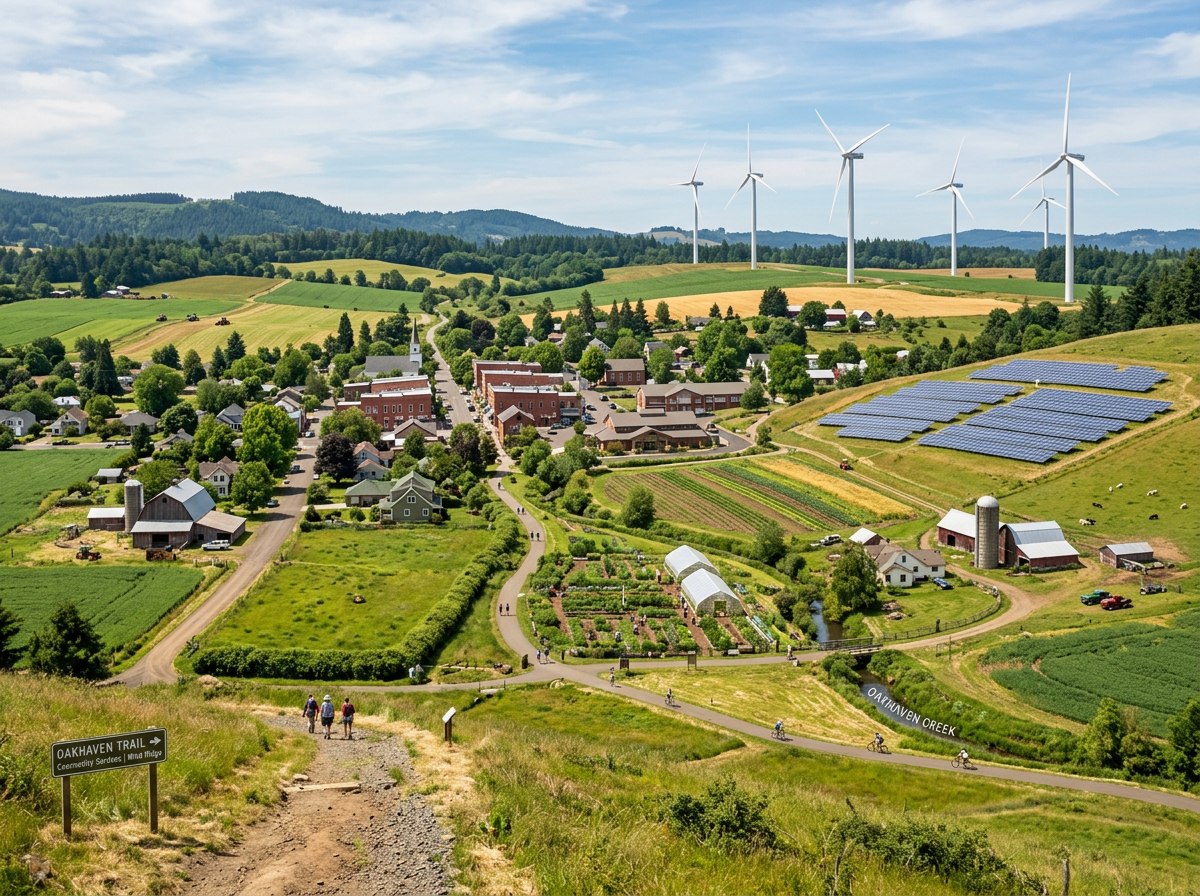
Reclaiming Local Resilience in an Age of Systemic Uncertainty
Meta Description
Explore how communities can cultivate economic sovereignty through local resilience, regenerative systems, cooperative governance, decentralized infrastructure, and long-term stewardship.
Introduction
Modern societies are increasingly interconnected through global finance, digital infrastructure, international trade, and transnational supply chains.
While this interconnectedness has enabled unprecedented economic expansion, it has also exposed communities to systemic vulnerabilities far beyond local control.
Economic shocks, inflationary pressures, supply chain disruptions, housing instability, labor precarity, ecological stress, and financial concentration have revealed a critical reality: many communities possess limited sovereignty over the systems that shape their daily survival.
As instability grows across institutional, ecological, and economic domains, the question of economic sovereignty is becoming increasingly relevant.
Economic sovereignty for communities does not imply isolationism or rejection of global cooperation. Rather, it refers to the capacity of communities to cultivate sufficient resilience, adaptive infrastructure, and local stewardship so that essential human needs can remain stable even amid larger systemic volatility.
At its core, economic sovereignty concerns agency.
Can communities meaningfully influence the economic conditions that determine their well-being?
Can local systems retain enough coherence to withstand external shocks?
Can human economies be reorganized around long-term flourishing rather than perpetual extraction and instability?
These questions are no longer theoretical.
They are increasingly central to the future of social resilience.
What Is Economic Sovereignty?
Economic sovereignty refers to the ability of individuals, communities, or nations to maintain meaningful influence over the economic systems that shape their lives.
At the community level, this includes:
- Local resilience capacity
- Access to essential resources
- Distributed economic participation
- Community-owned infrastructure
- Cooperative governance structures
- Food and energy resilience
- Local enterprise development
- Reduced dependency on fragile centralized systems
- Adaptive capacity during crisis conditions
Economic sovereignty is not absolute self-sufficiency.
Modern societies remain interconnected and interdependent. Rather, sovereignty exists on a spectrum.
The question is not whether communities participate in larger systems, but whether they retain sufficient autonomy, resilience, and adaptive capacity within those systems.
Communities with little economic sovereignty are often highly vulnerable to:
- External financial shocks
- Corporate consolidation
- Resource scarcity
- Supply chain instability
- Labor exploitation
- Inflationary cycles
- Debt dependency
- Housing insecurity
- Political instability
Conversely, communities with stronger local resilience tend to possess diversified economic structures, stronger social trust, cooperative networks, and greater capacity for coordinated adaptation.
Economic sovereignty is best understood not as a fixed condition but as a developmental process. Communities rarely move from dependency to resilience overnight.
Instead, they gradually build the capacities, relationships, institutions, and stewardship practices that increase their ability to influence the conditions shaping their future.
The Sovereignty Ladder provides a conceptual framework for understanding this progression, illustrating how communities can move from vulnerability and dependence toward greater participation, stewardship, resilience, and self-determination.

Download Reference Map 002: The Sovereignty Ladder
A developmental framework illustrating how individuals, organizations, and communities can progressively build capacity, stewardship, and resilience, increasing their ability to influence the systems that shape their future.
The Fragility of Hyper-Centralized Economies
Over recent decades, many economic systems have become increasingly centralized.
Production chains stretch across continents. Essential goods depend upon complex logistical coordination. Financial systems concentrate power within large institutional networks. Digital platforms mediate communication, commerce, and labor participation at unprecedented scale.
While centralization can increase efficiency, it may also increase fragility.
Highly centralized systems often:
- Reduce local redundancy
- Concentrate decision-making power
- Increase systemic exposure to disruption
- Weaken regional self-reliance
- Externalize ecological and social costs
- Prioritize short-term optimization over resilience
The COVID-19 pandemic revealed how quickly tightly coupled economic systems can experience cascading failures when supply chains, labor systems, transportation infrastructure, healthcare systems, and consumer markets simultaneously come under stress (Tooze, 2021).
Communities dependent upon distant systems for food, medicine, energy, or essential goods often experienced heightened vulnerability.
This has renewed interest in localized resilience strategies.
Community Resilience as Economic Infrastructure
Economic resilience is not merely financial.
It is social, ecological, relational, and infrastructural.
Communities capable of maintaining stability during periods of disruption often possess strong networks of trust, reciprocal support systems, diversified local economies, and participatory governance structures.
Community resilience may include:
- Local food systems
- Cooperative enterprises
- Regional energy initiatives
- Community land stewardship
- Mutual aid networks
- Skills-sharing ecosystems
- Decentralized manufacturing capacity
- Local entrepreneurship
- Civic participation structures
- Distributed knowledge systems
Elinor Ostrom’s research on commons governance demonstrated that communities are often capable of sustainably managing shared resources when participatory stewardship and local accountability mechanisms are present (Ostrom, 1990).
This challenges assumptions that large centralized structures are always the most effective forms of coordination.
In many cases, distributed resilience networks outperform centralized systems during periods of instability because they maintain adaptive flexibility and localized responsiveness.
Cooperative Economics and Shared Stewardship
Economic sovereignty does not necessarily require purely individual ownership models.
Many resilient communities historically relied upon cooperative frameworks that balanced personal initiative with collective stewardship.
Cooperative economics can include:
- Worker cooperatives
- Credit unions
- Community-owned enterprises
- Shared infrastructure systems
- Local investment networks
- Participatory budgeting
- Cooperative housing models
- Community agriculture initiatives
These structures often aim to distribute both responsibility and benefit more equitably across communities.
Research on cooperative enterprises suggests they may increase long-term stability, worker participation, and local reinvestment under certain conditions (Schneiberg, 2013).
Importantly, economic sovereignty is not solely about resisting centralized systems.
It is about cultivating diversified economic ecosystems capable of supporting human dignity, resilience, and long-term stability.
Local Economies in a Globalized World
Globalization has generated both opportunity and vulnerability.
International trade and technological integration have expanded access to goods, information, and markets. However, globalization has also intensified dependency upon distant systems over which local communities possess little control.
As a result, many communities face a paradox:
The systems that provide abundance can also generate instability.
Economic sovereignty therefore requires balance.
Healthy economic ecosystems may combine:
- Global cooperation
- Regional resilience
- Local production capacity
- Distributed infrastructure
- Strategic interdependence
- Community adaptability
The goal is not isolation from global systems.
Rather, it is preventing total dependency upon systems that may become increasingly volatile, centralized, or fragile.
This principle is especially relevant in areas such as:
- Food security
- Energy resilience
- Digital infrastructure
- Housing systems
- Water stewardship
- Healthcare access
- Community finance
When communities retain partial local control over essential systems, they often possess greater flexibility during periods of wider disruption.
Financialization and the Erosion of Local Stability
One major challenge to economic sovereignty is financialization.
Financialization refers to the increasing dominance of financial markets, speculative capital, and debt-based systems within economic life.
In highly financialized systems:
- Housing becomes investment speculation
- Local economies become vulnerable to capital extraction
- Wealth concentrates within large institutional structures
- Long-term stewardship declines
- Productive economies may weaken relative to speculative activity
This dynamic can erode local resilience.
Communities often struggle when economic value generated locally is continuously extracted outward through debt servicing, rent concentration, speculative ownership, or monopolistic structures.
Economic sovereignty therefore increasingly involves questions of:
- Community ownership
- Local reinvestment
- Ethical finance
- Resource circulation
- Distributed economic participation
- Long-term stewardship over short-term extraction
Communities that retain stronger internal circulation of value frequently demonstrate higher resilience and stronger social cohesion.
If economic sovereignty concerns a community’s ability to retain agency over its future, then stewardship concerns how that agency is exercised.
Resilient communities do not merely accumulate resources; they cultivate systems that circulate, renew, and reinvest value across generations.
Economic vitality becomes sustainable when wealth is understood not solely as financial accumulation, but as a diverse collection of resources—including social trust, knowledge, culture, and ecological capital—that require ongoing stewardship.
The Wealth Stewardship Cycle offers a framework for understanding how healthy economies transform resources into enduring resilience and shared prosperity.

Download Reference Map 009: The Wealth Stewardship Cycle
A regenerative framework illustrating how wealth moves through cycles of creation, exchange, allocation, stewardship, regeneration, and legacy.
The model emphasizes that long-term prosperity depends not merely on accumulation, but on responsible circulation and renewal of financial, social, cultural, ecological, and knowledge resources.
Ecological Stewardship and Regenerative Economics
Economic sovereignty cannot be separated from ecological sustainability.
Human economies remain dependent upon energy systems, biodiversity, water systems, agricultural stability, and ecological resilience.
Economic models based entirely upon perpetual extraction often generate long-term instability by degrading the very systems that support civilization.
Regenerative economic frameworks seek to align economic activity with ecological renewal rather than depletion.
This may include:
- Regenerative agriculture
- Circular economic systems
- Local ecological restoration
- Renewable energy systems
- Watershed stewardship
- Soil regeneration
- Community-based conservation
- Bioregional planning
Ecological resilience and economic resilience are increasingly intertwined.
Communities capable of restoring ecological stability may also strengthen long-term economic sovereignty.
Technology and Decentralized Coordination
Emerging technologies may both strengthen and weaken community sovereignty depending upon how they are implemented.
Digital infrastructure can:
- Enable decentralized collaboration
- Improve local coordination
- Expand educational access
- Support distributed entrepreneurship
- Strengthen local information networks
However, technological systems can also:
- Increase surveillance capacity
- Centralize platform power
- Intensify dependency on external infrastructure
- Accelerate labor precarity
- Concentrate informational control
The question is not whether technology is inherently beneficial or harmful.
The question is whether technological systems increase human agency and resilience or diminish them.
Communities that cultivate technological literacy while maintaining local adaptability may be better positioned to navigate future complexity.
Social Trust as Economic Infrastructure
Economic systems ultimately depend upon relationships.
Trust functions as invisible infrastructure within communities.
Societies with higher levels of social trust often demonstrate:
- Greater civic participation
- Stronger cooperative capacity
- Lower coordination costs
- Higher institutional stability
- More resilient local economies
Francis Fukuyama (1995) argued that trust acts as a form of social capital enabling societies to coordinate beyond immediate family structures.
Without trust, even technically sophisticated economic systems become fragile.
Economic sovereignty therefore depends not only upon infrastructure and policy, but also upon culture:
- Shared responsibility
- Reciprocity
- Civic engagement
- Ethical stewardship
- Participatory governance
- Long-term thinking
Communities capable of sustaining trust are often more adaptable during periods of uncertainty.
Economic Sovereignty Is Not Economic Isolation
It is important to distinguish sovereignty from isolationism.
Economic sovereignty does not require communities to sever themselves from larger systems.
Rather, it involves cultivating enough local resilience that communities are not entirely destabilized by external volatility.
Healthy sovereignty balances:
- Local resilience with global cooperation
- Independence with interdependence
- Innovation with stability
- Efficiency with redundancy
- Growth with sustainability
The goal is not rigid self-containment.
It is adaptive resilience.
Communities that retain diversified capabilities, cooperative structures, and ecological alignment may be better prepared for a future characterized by accelerating complexity.
Toward Regenerative Community Economies
The future of economic sovereignty may depend less upon maximizing centralized scale and more upon strengthening distributed resilience.
This transition may involve:
- Rebuilding local production capacity
- Strengthening regional food systems
- Expanding cooperative ownership models
- Investing in regenerative infrastructure
- Supporting ethical entrepreneurship
- Cultivating financial literacy
- Encouraging participatory governance
- Restoring ecological systems
- Reinforcing civic trust
Economic systems ultimately shape not only material survival, but also social cohesion, psychological stability, and collective possibility.
Communities capable of balancing resilience, stewardship, innovation, and cooperation may become increasingly important within an era defined by systemic uncertainty.
Economic sovereignty is therefore not merely an economic question.
It is a civilizational question concerning how human beings choose to organize resources, responsibility, and collective life in a rapidly changing world.
Crosslinks
- Systems, Governance, and Organizational Design: Structure, Incentives, and Stability
- Intentional Community Design
- Building a Thriving Intentional Community
- Beyond the Peso: Why Pre-colonial Philippine Economics is the Blueprint for Modern Resilience
- Codex of Regenerative Economies
References
Fukuyama, F. (1995). Trust: The social virtues and the creation of prosperity. Free Press.
Ostrom, E. (1990). Governing the commons: The evolution of institutions for collective action. Cambridge University Press.
Schneiberg, M. (2013). Movements as political conditions for policy. In D. A. Snow et al. (Eds.), The Wiley-Blackwell encyclopedia of social and political movements. Wiley-Blackwell.
Tooze, A. (2021). Shutdown: How COVID shook the world’s economy. Viking.
The Living Archive is designed to be explored through pathways, categories, and search. If you’re looking for a specific idea, question, or theme, AI Search can help surface relevant connections across the archive.
Attribution
The Living Archive
Integrative Frameworks for Regenerative Civilization
© 2026 Gerald Daquila. All rights reserved.
Part of the Life.Understood. knowledge ecosystem and Stewardship Institute initiative.
This article is intended for educational, research, and civic inquiry purposes.
Readers are encouraged to engage critically, verify sources independently, and explore related knowledge hubs for broader systems context.
Leave a Reply