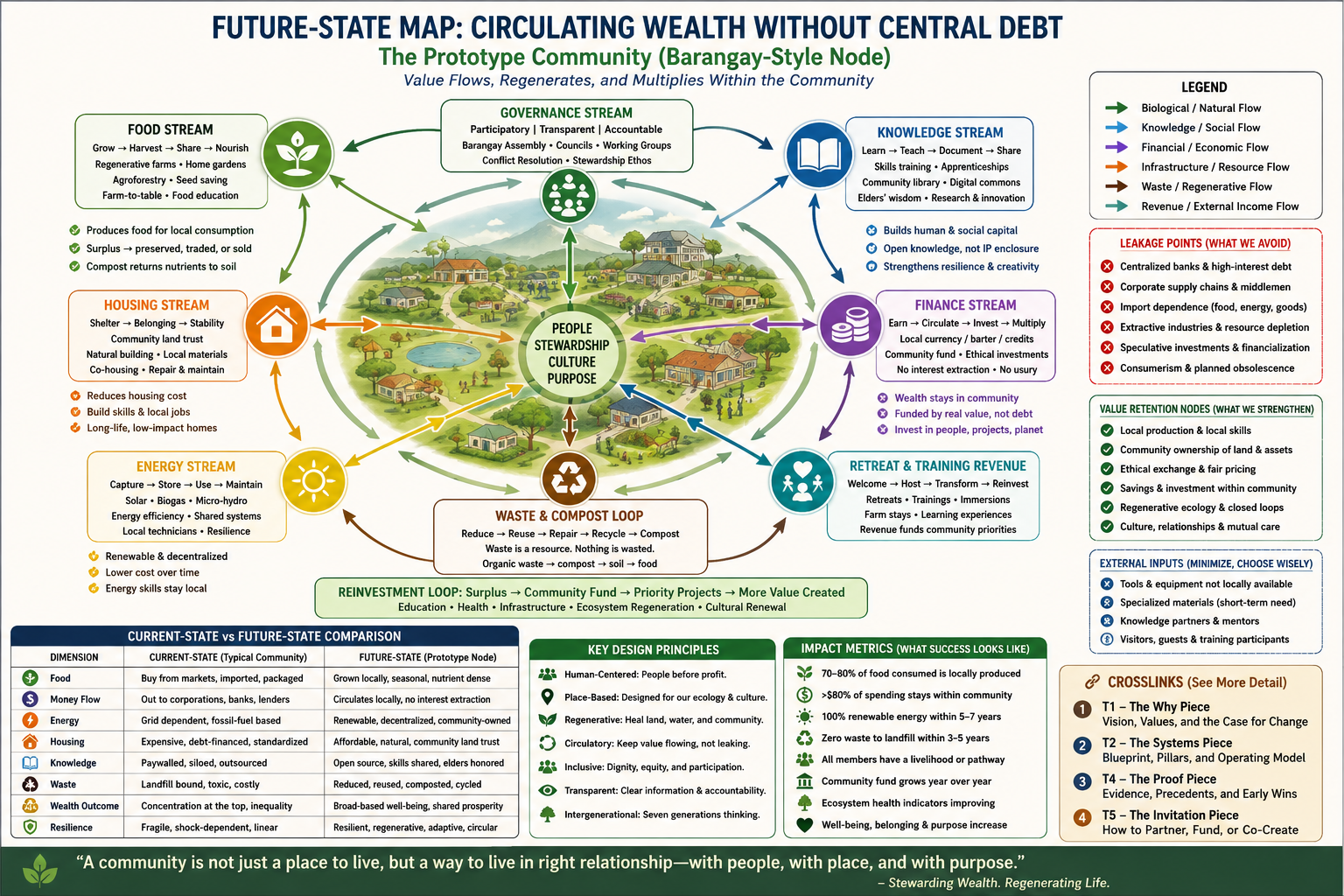
Category: Barangay-Communities

  • The Barangay Value Stream Map (BVSM)

    The Barangay Value Stream Map (BVSM)


    Standardizing Community Resilience for Diaspora Architects


    In the language of systems thinking, resilience is not a feeling—it is an outcome of design.

    For diaspora architects seeking to contribute meaningfully to homeland development, the challenge is not simply what to build, but how to ensure that what is built can endure volatility, absorb shocks, and regenerate capacity at the local level.

    Nowhere is this more critical than in the barangay, the smallest administrative unit in the Philippines, yet paradoxically the most immediate interface between governance and lived reality.

    This piece introduces the Barangay Value Stream Map (BVSM) as a replicable framework for diagnosing, optimizing, and standardizing community resilience.

    Drawing from lean systems, public administration theory, and community-driven development models, the BVSM provides diaspora architects with a structured pathway to transform fragmented interventions into coherent, scalable systems.


    1. Why the Barangay is the True Unit of Resilience

    The barangay is often treated as an implementation layer—where national policies are executed and local concerns are managed. But this framing is incomplete.

    In practice, the barangay is a micro-system where social capital, informal economies, and governance dynamics converge.

    Research in decentralized governance shows that local units with higher autonomy and participation tend to produce better development outcomes, particularly in crisis response and service delivery (Brillantes & Moscare, 2002).

    Meanwhile, community-driven development programs in the Philippines—such as KALAHI-CIDSS—demonstrate that when communities are directly involved in planning and resource allocation, project sustainability increases significantly (Labonne & Chase, 2011).

    For diaspora architects, this presents a critical insight: resilience cannot be imported—it must be co-designed at the barangay level.


    2. From Projects to Systems: The Case for Value Stream Mapping

    Traditional development approaches often focus on discrete projects: a water system here, a livelihood program there.

    While valuable, these interventions frequently fail to integrate into a larger system, resulting in inefficiencies, redundancies, or eventual decay.

    Value Stream Mapping (VSM), a tool derived from lean management, shifts the focus from isolated outputs to end-to-end flows of value.

    Originally developed in manufacturing, VSM has been adapted for healthcare, government services, and social systems to identify bottlenecks, eliminate waste, and improve flow efficiency (Rother & Shook, 2003).

    Applied to the barangay context, VSM allows stakeholders to map:

    • The flow of essential services (health, water, education)
    • The movement of resources (funds, goods, information)
    • The interaction between actors (officials, households, NGOs)

    The result is not just a map—but a diagnostic instrument revealing where resilience is strengthened or compromised.


    3. Defining the Barangay Value Stream Map (BVSM)

    The Barangay Value Stream Map (BVSM) is a localized adaptation of VSM tailored to the socio-political realities of Philippine communities.

    It integrates three layers:

    a. Service Flow Layer

    Tracks how essential services move from source to beneficiary. For example:

    • Health services: Barangay Health Worker → Rural Health Unit → Household
    • Disaster response: Early warning system → Barangay council → Community evacuation

    b. Resource Flow Layer

    Maps financial and material inputs:

    • Internal Revenue Allotment (IRA) distribution
    • External funding (NGOs, diaspora contributions)
    • Local revenue streams

    c. Governance & Decision Layer

    Captures how decisions are made:

    • Barangay council processes
    • Community assemblies (pulong-pulong)
    • Informal influence networks

    By overlaying these layers, the BVSM reveals not only what exists, but how effectively it functions.


    4. Identifying Waste in Community Systems

    Lean thinking defines “waste” as any activity that does not add value to the end user.

    In a barangay context, waste manifests in more subtle but equally damaging ways:

    • Delay: Slow disbursement of funds for urgent needs
    • Duplication: Multiple programs addressing the same issue without coordination
    • Leakage: Misallocation or inefficiency in resource use
    • Underutilization: Skills and capacities within the community left untapped

    Studies in public sector efficiency highlight that process inefficiencies can reduce service effectiveness by up to 30% in decentralized systems (World Bank, 2018).

    The BVSM allows diaspora architects to pinpoint these inefficiencies with precision.

    Instead of broad assumptions, interventions can be targeted at specific failure points—maximizing impact while minimizing cost.


    5. Standardizing Without Erasing Local Identity

    A common concern in systematization is the risk of imposing rigid structures that ignore local context.

    The BVSM addresses this by distinguishing between:

    • Core Standards: Universal elements that ensure functionality (e.g., transparent fund tracking, clear service pathways)
    • Adaptive Layers: Context-specific practices shaped by culture, geography, and community dynamics

    This dual approach aligns with adaptive governance theory, which emphasizes flexibility within structured systems to handle complexity and uncertainty (Folke et al., 2005).

    For diaspora architects, the implication is clear: standardization should enable consistency, not conformity.


    6. The Role of the Diaspora Architect

    Diaspora communities possess a unique advantage: exposure to global systems combined with a personal connection to local realities.

    However, this dual perspective can either be a strength or a liability.

    When interventions are designed without local integration, they risk becoming misaligned or unsustainable. Conversely, when diaspora architects act as system integrators, they can bridge gaps between global best practices and local needs.

    The BVSM provides a structured role for diaspora involvement:

    • Observer: Mapping existing flows without imposing assumptions
    • Analyst: Identifying inefficiencies and resilience gaps
    • Facilitator: Supporting local stakeholders in co-designing solutions
    • Connector: Linking barangays to external resources and networks

    This shifts the diaspora role from donor to co-architect of resilience.


    7. From Mapping to Transformation: Implementation Pathway

    Creating a BVSM is only the first step. The true value lies in translating insights into action. A practical pathway includes:

    Step 1: Stakeholder Alignment

    Engage barangay officials, community members, and local organizations. Ensure shared understanding of goals.


    Step 2: Data Gathering

    Collect qualitative and quantitative data on service delivery, resource flows, and governance processes.


    Step 3: Mapping Workshop

    Co-create the BVSM with stakeholders. Visual tools enhance clarity and ownership.


    Step 4: Gap Analysis

    Identify bottlenecks, redundancies, and vulnerabilities.


    Step 5: Intervention Design

    Develop targeted solutions—process improvements, policy adjustments, or capacity-building initiatives.


    Step 6: Iteration and Feedback

    Continuously refine the system based on real-world outcomes.

    This iterative approach reflects principles of continuous improvement, which have been shown to significantly enhance system resilience over time (Deming, 1986).


    8. Measuring Resilience: Beyond Outputs

    One of the limitations of traditional development metrics is their focus on outputs—number of projects completed, funds disbursed, etc.

    While important, these metrics do not capture system health.

    The BVSM enables a shift toward resilience metrics, such as:

    • Response time to emergencies
    • Continuity of essential services during disruptions
    • Community participation rates
    • Redundancy and backup systems

    Research on resilience measurement emphasizes the importance of system-level indicators that reflect adaptability and recovery (Cutter et al., 2008).

    For diaspora architects, this means success is not defined by what is built, but by how well the system continues to function under stress.


    9. Scaling the BVSM Across Barangays

    The ultimate potential of the BVSM lies in its scalability.

    When standardized frameworks are applied across multiple barangays, patterns emerge:

    • Common bottlenecks that can be addressed at higher policy levels
    • Best practices that can be replicated
    • Opportunities for inter-barangay collaboration

    This creates the foundation for a networked resilience system, where barangays are not isolated units but interconnected nodes.

    Such networked approaches have been shown to enhance collective resilience, particularly in disaster-prone regions (Aldrich & Meyer, 2015).


    10. Conclusion: Designing for Continuity

    The Barangay Value Stream Map is not merely a technical tool—it is a shift in perspective.

    It invites diaspora architects to move beyond episodic interventions and toward systemic design.

    In a world of increasing uncertainty—climate change, economic volatility, social fragmentation—resilience is no longer optional. It must be designed, measured, and continuously improved.

    The barangay, often overlooked, is where this design becomes tangible. It is where policies meet people, where systems meet stories, and where resilience is either built or broken.

    For those called to contribute from afar, the question is no longer “How can I help?” but rather:

    “How can I help build a system that helps itself?”

    The BVSM offers one answer—grounded in structure, guided by participation, and oriented toward continuity.


    Crosslinks

    Takt Time — The Rhythm of Presence – Anchor: “Why system design fails without internal alignment.” Moves reader from external system mapping → internal regulation.


    Work Sequence — The Protocol – Anchor: “How mapped systems translate into repeatable execution.” BVSM shows what exists; Work Sequence shows how it runs.


    Standard Inventory — The Sovereign Kit – Anchor: “What resources are required to sustain each node in the map.” Bridges mapping → resourcing.


    References

    Aldrich, D. P., & Meyer, M. A. (2015). Social capital and community resilience. American Behavioral Scientist, 59(2), 254–269.

    Brillantes, A. B., & Moscare, D. (2002). Decentralization and federalism in the Philippines. Public Administration and Development, 22(1), 23–35.

    Cutter, S. L., Burton, C. G., & Emrich, C. T. (2008). Disaster resilience indicators for benchmarking baseline conditions. Journal of Homeland Security and Emergency Management, 5(1).

    Deming, W. E. (1986). Out of the Crisis. MIT Press.

    Folke, C., Hahn, T., Olsson, P., & Norberg, J. (2005). Adaptive governance of social-ecological systems. Annual Review of Environment and Resources, 30, 441–473.

    Labonne, J., & Chase, R. S. (2011). Do community-driven development projects enhance social capital? World Bank Policy Research Working Paper.

    Rother, M., & Shook, J. (2003). Learning to See: Value Stream Mapping to Add Value and Eliminate MUDA. Lean Enterprise Institute.

    World Bank. (2018). Improving Public Sector Performance Through Process Optimization.


    The Sovereign Professional: A structural map of power, systems thinking, and personal autonomy—dedicated to helping the independent professional navigate complexity and own their value stream.Ask


    ©2026 Gerald Daquila • Life.Understood. • Systems Thinking, Leadership Architecture, and Applied Coherence

  • [SWI-003] Standard Work for Sovereign Wealth: A Protocol for Transitioning from Digital Fiat to Crystalline Assets

    [SWI-003] Standard Work for Sovereign Wealth: A Protocol for Transitioning from Digital Fiat to Crystalline Assets


    Protocol Status: Version 1.0 (Initial Release)

    Process Owner: Individual Steward / Head of Household

    Revision Date: May 2026


    Reframing Wealth in an Age of Institutional Fracture

    The 21st century global economy is entering a period of profound transition.

    Across multiple regions, trust in institutions is being tested by debt expansion, inflationary pressure, widening inequality, ecological instability, geopolitical fragmentation, and the accelerating digitization of money itself.

    Sovereign wealth, once understood primarily as state-controlled reserves and financial instruments, is now increasingly being reconsidered through the lenses of resilience, transparency, ethics, locality, and long-term stewardship.

    At the same time, new conversations are emerging around alternative forms of value storage and exchange. These include decentralized financial systems, tokenized assets, renewable energy-backed economies, cooperative ownership structures, data sovereignty, and emerging concepts sometimes described metaphorically as “crystalline assets.”

    Within this framework, the term crystalline assets should not be interpreted as mystical currency or magical material wealth. Rather, the phrase can serve as a symbolic and systems-oriented metaphor for assets characterized by:

    • transparency;
    • structural integrity;
    • traceability;
    • ethical coherence;
    • long-term resilience;
    • low corruption entropy;
    • regenerative value creation; and
    • alignment between human, ecological, and institutional systems.

    In this sense, crystalline assets stand in contrast to extractive or opaque financial structures that depend heavily on speculative leverage, institutional opacity, or unsustainable debt expansion.

    This article proposes a “standard work” framework — a practical protocol for individuals, communities, organizations, and emerging sovereign networks seeking to transition portions of their economic orientation away from fragile digital fiat dependency and toward resilient, transparent, and regenerative asset ecosystems.


    Understanding Digital Fiat Systems

    Modern fiat currencies derive value primarily from government backing, taxation authority, and collective trust rather than direct commodity convertibility (Mishkin, 2022).

    Over the past several decades, digital banking infrastructure and electronic monetary systems have further abstracted money away from tangible assets and local production.

    Digital fiat systems offer many advantages:

    • liquidity;
    • scalability;
    • rapid transaction capability;
    • international interoperability; and
    • institutional coordination.

    However, they also introduce vulnerabilities when detached from productive, ecological, and social realities.

    Critics of highly financialized economies note that excessive speculative expansion can produce systemic fragility, debt dependence, asset bubbles, and wealth concentration (Piketty, 2014).

    In emerging economies and post-colonial societies, these dynamics can become even more pronounced when external debt structures, currency instability, or institutional capture weaken local sovereignty.

    As a result, many communities worldwide are exploring hybrid models that combine digital systems with more grounded forms of value:

    • local production;
    • cooperative infrastructure;
    • renewable energy systems;
    • land stewardship;
    • food resilience;
    • distributed ownership;
    • transparent ledgers;
    • ethical enterprise;
    • knowledge commons; and
    • community trust networks.

    The transition described here is therefore not a rejection of modern finance entirely, but an attempt to rebalance economic systems toward durability, accountability, and real-world value generation.


    Defining Crystalline Assets

    Crystalline assets may be understood as assets that exhibit structural coherence across multiple dimensions:

    DimensionCrystalline Characteristic
    EconomicDurable, productive, low-speculation value
    EcologicalRegenerative rather than extractive
    SocialCommunity-benefiting and trust-building
    InformationalTransparent and verifiable
    InstitutionalResistant to corruption and opacity
    PsychologicalReduces fear-based scarcity behavior
    CulturalPreserves identity, continuity, and stewardship

    Examples may include:

    • regenerative agricultural land;
    • renewable energy infrastructure;
    • community-owned utilities;
    • ethical cooperative enterprises;
    • educational archives and knowledge systems;
    • decentralized but transparent financial ledgers;
    • resilient local supply chains;
    • open-source technological ecosystems;
    • culturally rooted production networks; and
    • tokenized systems backed by real-world productive assets.

    Importantly, not every digital asset qualifies as crystalline merely because it is decentralized or blockchain-based.

    Many speculative digital assets replicate the same extractive behaviors present within traditional financial systems.

    The critical distinction lies not in technological novelty alone, but in whether the asset structure contributes to long-term resilience, accountability, and regenerative capacity.


    Why Sovereign Wealth Must Evolve

    Traditional sovereign wealth models often focus heavily on:

    • foreign currency reserves;
    • bonds;
    • extractive resource exports;
    • centralized investment vehicles; and
    • large-scale institutional capital deployment.

    While these tools remain important, the global environment is changing rapidly.

    The World Bank (2024) notes that climate instability, supply chain fragmentation, and geopolitical shifts are increasingly influencing economic resilience. Meanwhile, technological acceleration is redistributing power away from exclusively centralized institutions toward hybrid public-private-community ecosystems.

    In this context, sovereign wealth may need to evolve beyond purely financial metrics toward broader measures of societal resilience, including:

    • food security;
    • energy independence;
    • digital sovereignty;
    • educational capacity;
    • ecological stability;
    • community trust;
    • transparent governance; and
    • adaptive infrastructure.

    Countries and communities that fail to diversify beyond fragile financial abstractions may become increasingly vulnerable during periods of global instability.


    A Standard Work Protocol for Transition

    The following framework is not a rigid doctrine but a practical orientation model.


    1. Conduct a Sovereign Asset Audit

    The first step is identifying what forms of value already exist.

    Many societies underestimate their true wealth because they measure only financial liquidity rather than:

    • ecological assets;
    • human capability;
    • cultural continuity;
    • local knowledge;
    • agricultural productivity;
    • diaspora networks;
    • social trust; and
    • cooperative capacity.

    An asset audit should therefore include:

    • land and ecological resources;
    • energy infrastructure;
    • educational systems;
    • digital infrastructure;
    • food production capacity;
    • institutional integrity;
    • cultural archives;
    • public trust metrics; and
    • local enterprise ecosystems.

    This creates a broader picture of sovereign resilience.


    2. Reduce Dependency Concentration

    Systems become fragile when too much value depends on a single point of failure.

    Communities and institutions should evaluate overdependence on:

    • external debt systems;
    • imported essentials;
    • centralized digital platforms;
    • speculative asset exposure;
    • monopolized supply chains; and
    • unstable geopolitical arrangements.

    Resilience emerges through diversification and redundancy.

    This may include:

    • local agriculture initiatives;
    • distributed energy systems;
    • cooperative manufacturing;
    • community finance structures;
    • open-source technologies; and
    • local knowledge preservation.

    3. Anchor Value to Real Production

    One of the central critiques of hyper-financialized economies is the detachment of wealth accumulation from productive contribution.

    Crystalline-oriented systems seek stronger alignment between:

    • value creation;
    • labor;
    • ecological regeneration;
    • social benefit; and
    • tangible production.

    This does not eliminate digital systems. Rather, it reconnects them to measurable real-world outputs.

    Potential examples include:

    • tokenized renewable energy production;
    • agricultural cooperatives;
    • ethical manufacturing;
    • knowledge infrastructure;
    • distributed educational platforms; and
    • regenerative land stewardship systems.

    4. Build Transparent Ledger Systems

    Transparency is foundational to trust.

    Emerging ledger technologies can improve:

    • accountability;
    • traceability;
    • anti-corruption measures;
    • public auditing; and
    • participatory governance.

    However, transparency alone is insufficient without ethical governance and informed civic participation.

    Technology cannot substitute for stewardship.

    The strongest systems combine:

    • transparent infrastructure;
    • ethical leadership;
    • institutional checks;
    • civic literacy; and
    • distributed accountability.

    5. Develop Regenerative Wealth Metrics

    Gross Domestic Product (GDP) remains a dominant economic metric globally, yet many economists argue that GDP alone fails to capture societal wellbeing, ecological health, or long-term resilience (Stiglitz et al., 2010).

    A crystalline wealth framework may therefore incorporate broader indicators such as:

    • ecological restoration;
    • educational access;
    • food resilience;
    • local ownership ratios;
    • trust indices;
    • corruption reduction;
    • renewable energy capacity;
    • mental health outcomes; and
    • intergenerational sustainability.

    These metrics help align economic systems with human flourishing rather than pure extraction.


    6. Preserve Human Meaning and Cultural Continuity

    Economic systems are not merely transactional structures. They shape identity, meaning, belonging, and collective direction.

    Communities undergoing rapid digitization or financial transition often experience psychological fragmentation when cultural continuity is lost.

    Therefore, sovereign wealth transition should also preserve:

    • language;
    • memory;
    • ancestral knowledge;
    • local traditions;
    • ethical frameworks; and
    • community cohesion.

    In post-colonial societies especially, economic sovereignty and cultural sovereignty are deeply intertwined.


    The Philippine Context

    The Philippines occupies a uniquely complex position within the global transition landscape.

    It is simultaneously:

    • deeply integrated into global labor migration;
    • highly digitized in communication culture;
    • vulnerable to climate instability;
    • shaped by colonial history;
    • rich in human adaptab

    References

    Mishkin, F. S. (2022). The economics of money, banking, and financial markets (13th ed.). Pearson.

    Piketty, T. (2014). Capital in the twenty-first century. Harvard University Press.

    Stiglitz, J. E., Sen, A., & Fitoussi, J.-P. (2010). Mismeasuring our lives: Why GDP doesn’t add up: The report by the Commission on the Measurement of Economic Performance and Social Progress. The New Press.

    World Bank. (2024). Global economic prospects: Broadening the scope of debt sustainability. World Bank Publications.


    Crosslinks


    [DOCUMENT CONTROL & STEWARDSHIP]

    Standard Work ID: SWI-003

    Baseline Version: v1.5.2026

    Classification: Open-Access Archive / Systemic Protocol

    The Sovereign Audit: Following this protocol is an act of internal quality control. Verification of this standard does not happen here; it happens at your Gemba—the actual place where your life and leadership occur. No external validation is required or offered.

    Next in Sequence: [SWI-002: The 72-Hour Protocol]

    Return to Archive: [Standard Work Knowledge Hub: The Terrain Map]


    © 2026 Gerald Daquila • Life.Understood Systemic Stewardship • Non-Autocratic Architecture • Process over Persona

  • AI and the Filipino Context: Babaylan vs Algorithm in the Age of Cultural Intelligence

    AI and the Filipino Context: Babaylan vs Algorithm in the Age of Cultural Intelligence


    Why the future of AI in the Philippines depends not on adoption alone—but on sovereignty, memory, and the integration of indigenous intelligence systems

    Meta Description

    How AI intersects with Filipino identity: Babaylan wisdom vs algorithms, and why cultural intelligence—not just technology—determines sovereignty.

    Artificial intelligence is often framed as progress—but in the Filipino context, it raises a deeper question:

    What happens when a people shaped by erased knowledge systems adopt a technology built on abstraction?

    The tension is not just between old and new. It is between two forms of intelligence—one rooted in relationship, the other in computation. And how this tension is resolved will determine whether AI becomes a tool for sovereignty… or another layer of invisible colonization.


    Introduction: Two Ways of Knowing

    The rise of artificial intelligence is often framed as an inevitable global shift—an upgrade to human cognition driven by data, scale, and computational efficiency. Yet in the Philippines, this transition is not merely technical. It is cultural, historical, and deeply psychological.

    The question is not simply how Filipinos will adopt AI, but what kind of intelligence will be centered in the process.

    At the heart of this inquiry lies a tension between two epistemologies: the ancestral intelligence of the Babaylan—embodied, relational, and land-based—and the modern algorithm—abstracted, optimized, and data-driven.

    This is not a binary opposition, but a diagnostic lens. It reveals how colonial legacies, technological systems, and cultural memory intersect in shaping the Filipino relationship to knowledge, authority, and truth.


    The Babaylan: Intelligence as Embodiment

    Before colonization, the Babaylan functioned as healer, mediator, and keeper of communal memory. Their intelligence was not extracted from datasets but cultivated through direct attunement to land, body, and spirit.

    Knowledge was relational—validated through harmony, not prediction.

    This form of intelligence aligns with what contemporary scholarship might describe as situated cognition—knowledge that emerges from lived experience and environmental context (Haraway, 1988).

    Unlike algorithmic systems that seek generalizable patterns, the Babaylan operated within specificity: each ritual, each healing act, each decision was calibrated to the unique conditions of the moment.

    Colonial disruption—first under Spanish colonization of the Philippines, then American colonial period in the Philippines—systematically dismantled this epistemology.

    Indigenous knowledge systems were reframed as superstition, while Western rationalism was institutionalized through education and governance (Rafael, 2005).

    The result was not just cultural loss, but epistemic displacement: a shift in what counts as valid knowledge.


    The Algorithm: Intelligence as Abstraction

    Modern AI systems—rooted in fields like Machine Learning—operate through abstraction. They ingest vast amounts of data, identify statistical patterns, and generate outputs optimized for specific objectives. This model of intelligence is powerful, but it is also context-agnostic.

    Algorithms do not “understand” in the human sense; they approximate. As Cathy O’Neil (2016) argues, many algorithmic systems function as “weapons of math destruction,” reinforcing existing biases under the guise of objectivity.

    In the Filipino context, this raises critical concerns: whose data is being used? Whose realities are being encoded? And whose voices are being excluded?

    The Philippines, with its history of colonial administration and outsourced labor, risks becoming a data periphery—a source of training data and labor for global AI systems without corresponding sovereignty over their design or deployment.

    This mirrors earlier patterns of extraction, now transposed into the digital domain.


    Babaylan vs. Algorithm: A False Dichotomy?

    Framing the Babaylan and the algorithm as opposites can be misleading.

    The more productive question is: what happens when one displaces the other without integration?

    When algorithmic systems are adopted without cultural grounding, they can exacerbate what Frantz Fanon (1967) described as colonial alienation—a disconnection from one’s own cultural framework of meaning.

    In practical terms, this might manifest as:

    • Overreliance on AI-generated knowledge without critical evaluation
    • Devaluation of local expertise in favor of “global” (often Western) standards
    • Loss of community-based decision-making in favor of automated systems

    Conversely, rejecting AI entirely is neither feasible nor desirable.

    The challenge is not to choose between Babaylan and algorithm, but to reconfigure their relationship.


    Toward Cultural Intelligence: Integration, Not Replacement

    What would it mean to develop AI systems that are culturally attuned to the Filipino context?

    First, it requires recognizing that intelligence is not monolithic. The Babaylan represents a form of cultural intelligence—the ability to navigate complex social and ecological systems through relational awareness.

    This is not something AI can replicate, but it is something AI can be designed to respect and support.

    Second, it demands data sovereignty. Filipino communities must have agency over how their data is collected, used, and interpreted. This aligns with broader movements for digital self-determination, particularly in postcolonial contexts (Couldry & Mejias, 2019).

    Third, it calls for hybrid epistemologies. Instead of treating indigenous knowledge and machine intelligence as incompatible, we can explore how they might inform each other.

    For example:

    • AI systems trained on local languages and cultural contexts
    • Decision-support tools that incorporate community input, not just statistical models
    • Educational frameworks that teach both computational literacy and cultural memory

    This is not about romanticizing the past or resisting the future. It is about anchoring technological development in cultural coherence.


    Governance and Sovereignty in the AI Era

    This tension directly intersects with questions of governance—particularly those explored in ARK-003: Jurisdictional Sovereignty: Legal Standard Work.

    If AI systems are shaping decision-making processes, then who governs those systems becomes a matter of sovereignty.

    In the Philippine context, this means:

    • Establishing regulatory frameworks for AI that reflect local values
    • Ensuring transparency and accountability in algorithmic decision-making
    • Building institutional capacity to develop and audit AI systems domestically

    Without these measures, the Philippines risks becoming a passive consumer of AI technologies designed elsewhere—technologies that may not align with local needs or values.


    Infrastructure and the Human Loop

    There is also a direct connection to ARK-001: The 50-Person Resource Loop. At the community level, AI can either augment or erode local resilience.

    A purely algorithmic approach might optimize resource distribution based on efficiency metrics. But without human oversight, it could overlook critical social dynamics—trust, reciprocity, cultural norms—that sustain communities.

    A Babaylan-informed approach, by contrast, would treat AI as a tool within a human loop, not a replacement for it.

    Decisions would still be grounded in community relationships, with AI providing supplementary insights rather than authoritative directives.


    Education: Reclaiming the Babaylan Arc

    Finally, this integration must be cultivated through education—particularly within frameworks like ARK-002: The Babaylan Arc: Institutional Curriculum.

    If future generations are to navigate an AI-driven world without losing cultural coherence, they must be trained in both domains:

    • Technical literacy: understanding how AI systems work, their limitations, and their biases
    • Cultural literacy: understanding indigenous knowledge systems, historical context, and community dynamics

    This dual literacy is what enables discernment—the ability to engage with AI critically rather than passively.


    Conclusion: From Extraction to Stewardship

    The emergence of AI in the Philippines is not a neutral development. It is a continuation of historical patterns—now refracted through digital systems. The risk is not just technological dependence, but cultural erasure.

    Yet there is also an opportunity. By re-centering the Babaylan—not as a relic of the past, but as a living archetype of cultural intelligence—the Philippines can chart a different path. One where AI is not an instrument of extraction, but a tool for stewardship.

    This requires more than technical innovation. It requires a shift in orientation—from efficiency to coherence, from abstraction to relationship, from consumption to sovereignty.

    The question is no longer whether AI will shape the Filipino future. It already is. The question is whether that future will be algorithmically imposed or culturally authored.


    References

    Couldry, N., & Mejias, U. A. (2019). The costs of connection: How data is colonizing human life and appropriating it for capitalism. Stanford University Press.

    Fanon, F. (1967). Black skin, white masks. Grove Press.

    Haraway, D. (1988). Situated knowledges: The science question in feminism and the privilege of partial perspective. Feminist Studies, 14(3), 575–599.

    O’Neil, C. (2016). Weapons of math destruction: How big data increases inequality and threatens democracy. Crown.

    Rafael, V. L. (2005). White love and other events in Filipino history. Duke University Press.


    Suggested Internal Crosslinks (Optional)

    If this piece resonates, continue through the applied layer:

    This is not about rejecting AI.
    It is about reclaiming authorship in how intelligence is defined, built, and lived.


    Attribution

    ©2026 Gerald Daquila • Life.Understood.
    Steward of applied thinking at the intersection of systems, identity, and real-world constraint.

    This work draws from lived experience across cultures and environments, translated into practical frameworks for clearer thinking and more coherent contribution.

    This piece is part of an ongoing exploration of applied thinking in real-world systems.. Part of the ongoing Codex on leadership, awakening, and applied intelligence.

  • Naming the Unspoken: A Guide to Navigating the Hidden Fractures of Our National Identity

    Naming the Unspoken: A Guide to Navigating the Hidden Fractures of Our National Identity


    Reclaiming coherence in the Filipino psyche through truth, memory, and sovereign integration


    Meta Description

    Explore the hidden fractures shaping Filipino identity—from colonial trauma to diaspora dislocation—and learn how naming the unspoken becomes a pathway to national coherence and sovereign return.


    The Silence Beneath the Smile

    The Filipino is known globally for warmth, adaptability, and resilience. Yet beneath this outward ease lies a quieter terrain—one marked by contradiction, fragmentation, and unspoken tension.

    These are not failures of character. They are the inherited echoes of a history that was never fully metabolized.

    To “name the unspoken” is not an act of criticism. It is an act of coherence.

    Across generations, the Philippines has moved through layers of colonization, displacement, and systemic extraction. From Spanish rule to American occupation to modern economic dependency, each era has left imprints not only on institutions—but on identity itself (Constantino, 1975; David, 2013).

    These imprints form what we might call identity fractures—subtle but persistent dissonances in how a people see themselves versus how they live.

    Without naming them, these fractures become invisible governors of behavior.


    What Are the Hidden Fractures?

    Hidden fractures are not always obvious. They do not appear as open conflict. Instead, they manifest as normalized patterns—cultural defaults that feel “just the way things are.”

    Among the most pervasive:

    1. Colonial Mentality

    A learned preference for foreign validation over indigenous worth. This is seen in everything from beauty standards to language hierarchies to institutional mimicry of Western systems (David & Okazaki, 2006).


    2. Fragmented Identity Across Class Lines

    The Philippines is not a monolith. The lived reality of an urban elite differs dramatically from that of a rural farmer or an overseas worker. These gaps create parallel identities with limited shared narrative.


    3. Diaspora Dislocation

    With over 10 million Filipinos living or working abroad, identity becomes stretched across geographies. Many experience belonging everywhere—and nowhere at once.

    (Crosslink: The Diaspora Wound: Reclaiming Identity Across Distance)


    4. Survival-Driven Relational Patterns

    Utang na loob, pakikisama, and hiya are often framed as cultural virtues. Yet in survival contexts, they can also reinforce silence, avoidance, and the suppression of truth.


    5. Institutional Mistrust

    Centuries of extractive governance have seeded a deep skepticism toward systems—making collective action difficult to sustain.

    These fractures are not independent. They interlock, reinforcing one another in subtle loops.


    Why Naming Matters

    In systems thinking, what remains unnamed remains unchangeable.

    The act of naming performs three critical functions:

    1. It Makes the Invisible Visible

    When a pattern is named, it can be observed. When it is observed, it can be questioned.


    2. It Restores Agency

    Instead of unconsciously reenacting inherited patterns, individuals and communities gain the ability to choose differently.


    3. It Enables Collective Coherence

    Shared language creates shared understanding. Shared understanding creates the possibility of aligned action.

    Psychologically, this aligns with research showing that narrative integration—the ability to make sense of one’s history—correlates with higher well-being and identity stability (McAdams & McLean, 2013).

    At a national level, this becomes even more critical.


    The Cost of Avoidance

    Avoidance is often mistaken for harmony.

    But what is not processed does not disappear—it embeds.

    Unaddressed identity fractures manifest in:

    • Cycles of political polarization
    • Brain drain and perpetual outward migration
    • Weak institutional continuity
    • Internalized inferiority masked as humor or self-deprecation
    • Difficulty sustaining long-term collective initiatives

    These are not isolated issues. They are systemic outcomes of unintegrated history.

    As Frantz Fanon (1963) observed in post-colonial societies, the failure to confront internalized narratives often leads to the replication of the very structures that once oppressed them.


    The Filipino Threshold: From Fragmentation to Coherence

    Within the Ark framework, the Philippines is not merely a case study—it is a prototype.

    (Crosslink: The Philippine Ark: A Global South Prototype)

    A nation positioned at the intersection of East and West, tradition and modernity, diaspora and homeland, carries a unique function: to model how fractured identities can be reintegrated into a coherent whole.

    This is not theoretical. It is already underway in micro-forms:

    • Community-led governance experiments
    • Cultural reclamation movements
    • Decentralized economic initiatives
    • Renewed interest in pre-colonial knowledge systems

    These are early signals of a shift from extracted survival to sovereign design.


    A Practical Guide: Navigating the Unspoken

    Naming alone is not enough. It must be paired with navigation.

    Here is a grounded framework:

    1. Witness Without Judgment

    Observe patterns—within yourself, your family, your community—without immediately labeling them as good or bad. The goal is clarity, not blame.

    Prompt: Where do I seek external validation over internal knowing?


    2. Trace the Origin

    Every pattern has a lineage. Ask:

    • When did this begin?
    • What conditions made it necessary?

    This shifts perception from “defect” to “adaptation.”


    3. Differentiate Then Choose

    Not all inherited patterns need to be discarded. Some need refinement; others need release.

    Key question: Does this pattern serve coherence—or fragmentation?


    4. Reclaim Indigenous Anchors

    Identity cannot be rebuilt on critique alone. It requires grounding.

    This includes:

    • Language revitalization
    • Local histories
    • Ancestral practices adapted to modern context

    These anchors provide stability amid transition.


    5. Build in Small, Coherent Systems

    Large-scale change begins with small, functional units.

    (Crosslink: ARK-001: The 50-Person Resource Loop)

    When coherence is achieved at the micro-level, it becomes replicable.


    Beyond Identity: Toward Sovereignty

    This work is not about nostalgia or idealization of the past.

    It is about functional sovereignty—the ability of a people to:

    • Define their own values
    • Design their own systems
    • Sustain their own future

    Identity coherence is the prerequisite.

    Without it, even well-designed systems collapse under internal contradiction.


    The Courage to Name

    To name the unspoken is to step out of inherited silence.

    It requires:

    • Intellectual honesty
    • Emotional maturity
    • Cultural humility

    But it also opens something long dormant: the possibility of alignment between who we are, what we say, and how we build.

    The Filipino story is still being written.


    The question is no longer whether fractures exist.


    The question is whether we are willing to see them clearly enough to integrate them.


    Conclusion: The Return to Coherence

    Every nation carries a wound. Not every nation chooses to face it.

    The Philippines stands at a threshold—not just economically or politically, but psychologically and civilizationally.


    Naming the unspoken is the first movement of return.


    Not to a romanticized past—but to a coherent future.


    References

    Constantino, R. (1975). The Philippines: A Past Revisited. Tala Publishing Services.

    David, E. J. R. (2013). Brown Skin, White Minds: Filipino-/American Postcolonial Psychology. Information Age Publishing.

    David, E. J. R., & Okazaki, S. (2006). Colonial mentality: A review and recommendation for Filipino American psychology. Cultural Diversity and Ethnic Minority Psychology, 12(1), 1–16.

    Fanon, F. (1963). The Wretched of the Earth. Grove Press.

    McAdams, D. P., & McLean, K. C. (2013). Narrative identity. Current Directions in Psychological Science, 22(3), 233–238.


    The Sovereign Professional: A structural map of power, systems thinking, and personal autonomy—dedicated to helping the independent professional navigate complexity and own their value stream.Ask


    ©2026 Gerald Daquila • Life.Understood. • Systems Thinking, Leadership Architecture, and Applied Coherence

  • ARK-005: The Babaylan Arc — Pilot Implementation Model

    ARK-005: The Babaylan Arc — Pilot Implementation Model


    From Curriculum Design to Field-Tested Leadership Formation


    Meta Description

    A field-tested pilot model for implementing the Babaylan Arc curriculum in Philippine communities, integrating cultural memory, systems thinking, and leadership training into measurable real-world outcomes.


    Introduction: Where Most Ideas Fail

    ARK-002 established the Babaylan Arc as a curricular intervention—a response to the fragmentation of modern education and the historical disruption of integrative leadership traditions.

    But most frameworks fail at a predictable point:

    They remain conceptually compelling but operationally vague.

    This piece closes that gap.

    ARK-005 defines how the Babaylan Arc is actually run—under constraint, with real participants, in a real community.

    This follows the same logic introduced in
    ARK-001: The 50-Person Resource Loop
    where systems are validated only when they function under pressure, not when they read well on paper.

    A system is only real when it produces behavior under constraint.


    Why This Cannot Stay Theoretical

    The Philippines’ education crisis is often framed in terms of funding, access, or curriculum gaps. These matter—but they are not the root.

    The deeper issue is contextual incoherence.

    Filipino students are trained in abstract frameworks that do not map onto their lived realities.

    This is reflected in persistently low performance in assessments such as the Programme for International Student Assessment (PISA), where Filipino learners struggle not just with knowledge recall, but with application and reasoning in unfamiliar contexts (OECD, 2019).

    This supports an earlier critique by Renato Constantino, who argued that Philippine education historically produced individuals who are literate but detached from their own socio-cultural grounding (Constantino, 1970).

    The Babaylan Arc is not trying to add more content.

    It is attempting to restore alignment between knowledge, identity, and action.


    Pilot Design: The Smallest Unit That Matters

    https://images.openai.com/static-rsc-4/zJzu0-yep6CNVIhep7dwNLKHZiifxh4JEVrAPC6wJz-5dSskdOZN1Fq6zJL62us0dVHREKaTKfcD62-X8GKd337irEErSAxJ3C2LeAWqbY68q88QgkwJSG-vtfZH2vOrq123IXLfpZZPdMdYdBb0pUhGsA3nwaqf_hIetixtwAtAICLkjhOduW_2CZy9raNL?purpose=fullsize

    The pilot must operate at a scale where:

    • Human dynamics are visible
    • Systems can be tested
    • Failure is survivable

    Design Parameters:

    • Cohort Size: 24 participants
    • Duration: 16 weeks
    • Setting: Barangay-level or LGU-supported community
    • Cadence: 2 sessions per week (3–4 hours each)
    • Expected Output: At least one functioning micro-system

    This is not arbitrary.

    It mirrors anthropological observations of community-scale cohesion in pre-colonial Philippine societies, where leadership roles—including those associated with figures like the babaylan—operated within tight social units rather than large anonymous populations (Scott, 1994).


    Phase Structure — With Week-Level Reality


    Phase 1 (Weeks 1–4): Cultural Grounding

    This phase is not “orientation.”
    It is deconditioning.


    Participants confront:

    • Their assumptions about history
    • Their relationship to authority
    • Their level of disconnection from local systems

    Activities include:

    • Mapping local resource flows (food, water, labor)
    • Reconstructing pre-colonial systems using guided materials
    • Identifying gaps between inherited narratives and lived reality

    This phase draws directly from
    Pre-colonial Philippine Economics


    Observed Reality (Week 2–3):

    • Participants often default to “textbook answers”
    • Discomfort emerges when asked to describe their own barangay systems
    • Early signs of disengagement from abstract learners

    Output:
    A Context Map—not theoretical, but specific to their barangay


    Phase 2 (Weeks 5–8): Relational Stress Testing

    https://images.openai.com/static-rsc-4/m3J9mJdFftUjFXRJ-Te-3euJ_ELhghs6V79bCDbsiIUpujO5viD_wAUt4mQ6X66c86DiVAg-FA17fe9N3hFT3uL3y2vcu7mmdd9f9ptbOpWJkVE4VGNdUdsIjpWnwQa2f13yX5LFFHifVTydvjac06B1yINZS_L8WtSZb2b6QeZuy4MX0xW3nU2kdp0soM-k?purpose=fullsize

    This is where most programs fail.

    Because this is where friction becomes visible.


    Participants are placed in:

    • Conflicting decision scenarios
    • Resource allocation dilemmas
    • Leadership rotation exercises

    What emerges is predictable:

    • Dominant personalities attempt control
    • Passive participants withdraw
    • Conflict avoidance patterns surface (common in high “hiya” cultures)

    These dynamics align with broader cultural patterns explored in
    The Architecture of Silence

    Research in critical pedagogy shows that learning accelerates when participants are forced to confront real relational tension, not avoid it (Freire, 1970).


    Observed Reality (Week 6–7):

    • First major conflicts emerge
    • Some participants consider dropping out
    • Cohort cohesion either stabilizes—or fractures

    Output:
    Demonstrated ability to navigate structured conflict without facilitator intervention


    Phase 3 (Weeks 9–12): Systems Under Constraint

    This is the pivot point.

    https://images.openai.com/static-rsc-4/2NPpF7Qf5koTcSaw72DmqolXIKBcYB6yxBbI1tLixQGz-aC4e1oYaPUSWxhRaZvMJ5KN5NCb5SBproQ4zv6FkQgyLIgqMd1699j78o9aGNaBTt7NvLefkpUPTe-TtfMs0aEj0t63JYqQq9MLMReZtvZvum-4_W9bW9AdthnLPWT7gym_JPF2_GTifYiDHE8j?purpose=fullsize

    Participants must now:

    • Work with incomplete data
    • Engage real stakeholders
    • Design systems that function despite limitations

    They are tasked to build systems aligned with:
    ARK-001: The 50-Person Resource Loop


    Examples:

    • Small-scale food redistribution network
    • Community study group for struggling students
    • Waste-to-resource initiative

    Observed Reality (Week 10–11):

    • Plans initially overcomplicate
    • Participants underestimate logistical constraints
    • First contact with community resistance

    Output:

    A working prototype plan with clear inputs, outputs, and failure points


    Phase 4 (Weeks 13–16): Deployment and Feedback

    This phase separates:

    • Those who can explain systems
    • From those who can run them

    Participants:

    • Launch their system (even at micro scale)
    • Track outputs (participation, flow, breakdowns)
    • Present results to barangay stakeholders

    Observed Reality (Week 14–16):

    • Systems partially fail (this is expected)
    • Participants experience real accountability
    • Confidence shifts from abstract to grounded

    Output:

    An operational system, however imperfect


    Facilitator Structure: Preventing Collapse

    The pilot fails without proper facilitation.

    https://images.openai.com/static-rsc-4/DrRD5cdFBr2aTkAVHD85HlfIf2Pmrsu21rEoYHtYPfEtO4ZXNeTS00P_OjsIkjTJXHdbI03anM9vjb_-FAXsZ8RiiRo5W6eVv4Lfn1f2MU9qmoMTa-SfIu7nDEaVXgsWEgcOPw5DH3I4F9W6CQW3zB2sWJohpIJ49FM6A7sV_xFUyDw4IM7y6QMeYDZ1VeoL?purpose=fullsize

    Required Roles:

    • Lead Facilitator: Maintains structural integrity
    • Cultural Anchor: Prevents abstraction drift
    • Technical Advisor: Engaged during system design phase
    • Cohort Leads: Rotating participant leadership

    This reflects the integrative leadership model documented by William Henry Scott, where authority was functional, not hierarchical (Scott, 1994).


    Assessment: What Actually Gets Measured

    Traditional education asks:

    “What do you know?”

    This model asks:

    “What can you sustain?”


    Metrics

    1. Coherence Index
      • Can participants link identity → decision → outcome?
    2. Relational Stability
      • Does the group function under stress?
    3. System Viability
      • Does the micro-system operate for at least 2 weeks?
    4. Community Validation
      • Do external stakeholders perceive value?

    This aligns with experiential learning frameworks where real-world performance is the primary indicator of competence (Freire, 1970).


    Philippine Feasibility: Why This Can Actually Work

    The model is intentionally low-resource:

    • Uses barangay infrastructure
    • Requires minimal technology
    • Leverages local knowledge holders

    This makes it viable for LGUs, where community programs exist but often lack systemic coherence.

    The key advantage:

    It does not require systemic overhaul to begin.

    Only a single functioning pilot.


    Failure Modes (Realistic, Not Theoretical)

    • Participant dropout (Week 5–8)
    • Conflict breakdown (Phase 2)
    • Overdesigned systems that fail in execution
    • Community disengagement

    These are not bugs.

    They are the actual training environment.


    Conclusion: From Curriculum to Capability

    The Babaylan Arc cannot prove itself through narrative.

    It must prove itself through:

    • Participants who can stabilize groups
    • Systems that function under constraint
    • Communities that experience tangible benefit

    This pilot does not guarantee success.

    It guarantees something more valuable:

    Feedback grounded in reality.


    References

    Constantino, R. (1970). The Miseducation of the Filipino.

    Freire, P. (1970). Pedagogy of the Oppressed.

    OECD. (2019). PISA 2018 Results.

    Scott, W. H. (1994). Barangay: Sixteenth-Century Philippine Culture and Society.

    The concepts outlined here are designed for real-world execution. For a complete set of ready-to-use documents—including governance templates, resource tracking sheets, and operational SOPs—explore the 55 Editable Applied Stewardship Toolkit (Complete Set).

    For a broader systems context that situates localized resilience within national and multi-scalar transformation frameworks, explore The Philippine Ark: A Sovereign Blueprint for Systemic Transformation.


    Continue Through the ARK Series

    This framework is designed as a complete system. You can explore it sequentially or move directly to the layer most relevant to your work:

    Foundations

    Design + Build

    Systems Layer

    Scaling


    Suggested Pathways

    New to the framework?

    Start with ARK-001 ARK-008ARK-011


    Designing a physical site?

    Begin with ARK-007ARK-008ARK-009


    Preparing for real-world deployment?

    Focus on ARK-011ARK-012ARK-013


    Thinking long-term scale?

    Move to ARK-010


    [DOCUMENT CONTROL & STEWARDSHIP]

    Standard Work ID: [ARK-005]

    Baseline Version: v1.5.2026

    Classification: Open-Access Archive / Systemic Protocol

    The Sovereign Audit: Following this protocol is an act of internal quality control. Verification of this standard does not happen here; it happens at your Gemba—the actual place where your life and leadership occur. No external validation is required or offered.

    Next in Sequence: [ARK-006: Governance Protocols for Distributed Communities]

    Return to Archive: [Standard Work Knowledge Hub: The Terrain Map]


    © 2026 Gerald Daquila • Life.Understood • Systemic Stewardship • Non-Autocratic Architecture • Process over Persona

  • Standard Work: The “Digital Barangay” Startup Kit

    Standard Work: The “Digital Barangay” Startup Kit


    In the hyper-accelerated corporate landscape of 2026, the North American Filipino diaspora faces a unique systemic challenge.

    We are often high-performing “cogs” in Western financial and tech machines, yet we feel a persistent, quiet ache for the “Root.”

    The problem is that heritage retrieval is usually presented as a hobby or a social event—something that requires more “Motion Muda” (waste) than our already over-taxed schedules can handle.

    If we are to bridge the gap between the modern “Grind” and the ancestral “Source,” we need Standard Work.

    In Lean systems, Standard Work is the most efficient, safest method to perform a process.

    The Digital Barangay Startup Kit is that process. It is a protocol for forming a “Sovereign Node” of 3–5 people that acts as a decentralized support structure, allowing you to reclaim your autonomy without crashing your career.


    The Internal Gemba: Facing the Identity Defect

    The primary obstacle to forming a Sovereign Node isn’t lack of time; it is the friction of the Internal Gemba.

    Most of us are still running a “Corporate OS” that prioritizes external validation and hierarchical approval.

    As we begin to step away from this, we encounter The Loneliness of Waking Up—the realization that our old social circles may not understand our new trajectory.

    Before you can build a “Digital Barangay,” you must recognize that your current professional mask is a legacy system. Heritage retrieval is not just about learning history; it is about the internal refinement explored in The Ego’s Journey: From Identity to Unity Through Shadow Work.

    You have to face the parts of your ego that are addicted to the safety of the corporate waste-stream before you can effectively lead or participate in a sovereign community.


    Job Instructions (JI): The Roles of the Node

    A Digital Barangay is not a “club” where people talk about their feelings; it is a Sovereign Unit where people execute specific functions.

    To keep the system “Lean,” every member must have a clear Job Instruction (JI). This prevents the “Waste of Over-processing” and ensures that the node remains generative.


    1. The Scribe (The Pattern Sensor)

    The Scribe is the node’s “Quality Control” for information. They filter the global noise and archive the high-signal insights that the group discovers.

    They are the guardians of the collective memory, ensuring that the group’s evolution is documented. They watch for Projection: The Mirror of Our Inner Shadows, helping the group distinguish between actual external threats and internal unhealed patterns that are being projected onto the project.


    2. The Steward (The Resource Architect)

    The Steward manages the “Sacred Exchange” within the node. They ensure that the group’s resources—time, attention, and capital—are distributed fairly.

    They are the Poka-yoke for burnout. If a member is over-extending themselves, the Steward flags the defect.

    They understand that Why Inner Change Feels Invisible (And What to Do When No One Sees It) is a natural part of the process, and they encourage the node to stay the course even when external “success” metrics aren’t yet visible.


    3. The Guardian (The Systemic Sentry)

    The Guardian is the “Andon Cord” of the node. Their job is to monitor the external environment for systemic risks—financial instability, corporate toxicity, or AI disruption.

    They protect the perimeter of the node’s sovereignty. They measure the group’s progress using a Codex of Resonance Metrics, focusing on clarity and coherence rather than legacy corporate KPIs.


    The Protocol: Initializing Your Node

    To launch your Digital Barangay, follow this “Standard Work” checklist. Do not over-complicate the launch; simplicity is the antidote to waste.

    1. Selection (Small Batch): Find 2–4 other “Silent Professionals” who are ready to “vote with their feet.” Do not look for people who want to complain; look for people who want to build.
    2. The “Catchball” Alignment: Share your individual “True North.” If your missions align at the level of systemic sovereignty, the node is viable.
    3. Instruction Assignment: Assign the roles of Scribe, Steward, and Guardian. Even in a group of three, these functions must be distinct.
    4. Takt Time (The Rhythm): Establish a cadence for your “Synchronicity.” One focused, 90-minute digital “Gemba Walk” per month is more valuable than four hours of aimless chatting.

    Why “Standard Work” is the Key to the Ark

    In 2026, we are transitioning from a world of “Institutions” to a world of “Nodes.” The Digital Barangay is your lifeboat in the Philippine Ark.

    By using Job Instructions and Standard Work, you move heritage retrieval from a “sentimental luxury” to a Strategic Requirement.

    This structure allows you to navigate the corporate world without being consumed by it. You are “in the system, but not of it.”

    You have a small, high-trust circle that understands your internal shifts and supports your Inner Change. You are no longer an isolated professional; you are a component of a sovereign, transnational mesh network.


    Conclusion: Refined Sovereignty

    The Digital Barangay Startup Kit is the bridge between the “Identity” you were taught and the “Sovereignty” you are reclaiming.

    It uses the best of Western systems thinking to protect the best of Philippine ancestral logic.

    Don’t wait for a mass movement. Sovereignty is a “Small Batch” process. Form your node. Assign your instructions. Start the work.


    The Sovereign Professional: A structural map of power, systems thinking, and personal autonomy—dedicated to helping the independent professional navigate complexity and own their value stream.


    Note from the Architect: I use these Lean principles because they are the only way I found to keep my energy from leaking while building in the physical world. It’s not about productivity; it’s about protection.

    ©2026 Gerald Daquila • Life.Understood. • Systems Thinking, Leadership Architecture, and Applied Coherence