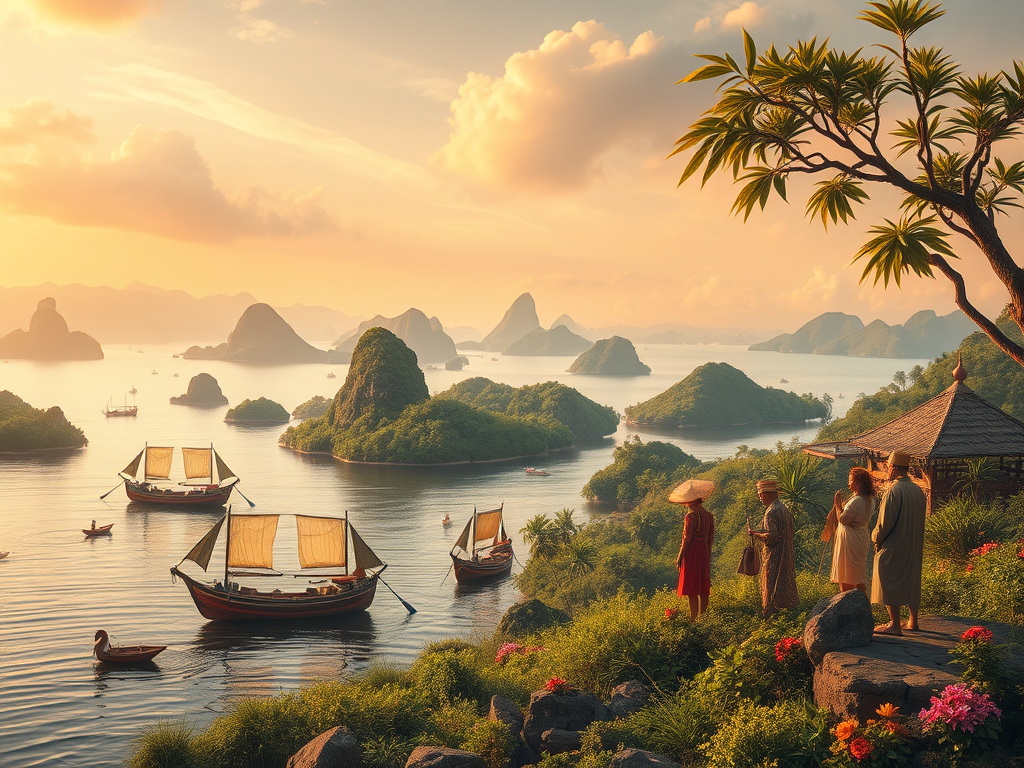
Exploring the Impact of Western Individualism and Materialism on Filipino Identity and Collective Resilience
Prepared by: Gerald A. Daquila, PhD. Candidate
What might the Philippines look like today if its pre-colonial systems of governance, identity, and worldview had not been disrupted? This question is not about rewriting history—it is about understanding how colonial influence reshaped Filipino consciousness, institutions, and collective behavior.
By examining the contrast between pre-colonial structures such as the barangay, indigenous leadership models, and community-based values, and the systems that replaced them, we gain clearer insight into present-day challenges.
This article explores whether a stronger, more cohesive national identity could have emerged from uninterrupted indigenous development—and what that means for the Philippines today.
For a broader view of Philippine culture, society, and systems, see:
→ Understanding the Philippines: Culture, Society, and Systems (Hub)
Scope and Approach
This article takes an analytical, non-ideological approach to exploring Philippine development across time. It does not attempt to romanticize the pre-colonial past or dismiss the complexities introduced by colonial rule. Instead, it focuses on identifying structural differences in governance, social organization, and cultural orientation—and how these shifts continue to influence modern Filipino society.
The discussion draws from historical accounts, anthropological insights, and observable behavioral patterns. It compares pre-colonial systems such as decentralized leadership, kinship-based networks, and localized autonomy with later centralized and externally imposed structures.
The goal is not to assign blame or propose a single alternative path, but to clarify how different foundations produce different outcomes. By understanding these dynamics, readers can better interpret current societal patterns, including governance challenges, identity fragmentation, and institutional trust.
This work is intended to support informed reflection, not advocacy. It invites readers to examine the relationship between history and present conditions with greater clarity, nuance, and critical thinking.
ABSTRACT
This dissertation explores the speculative question of whether the Philippines could have developed a more socially conscious society without the Western colonial influences of Spanish and American rule, which introduced individualism and materialism, disrupting the pre-colonial communal ethos rooted in kapwa (shared identity).
Employing a multidisciplinary lens—spanning history, anthropology, psychology, sociology, and cultural studies—this study examines the vibrant pre-colonial Filipino societies, characterized by cooperative barangays, sophisticated trade networks, and a collective consciousness. It analyzes the colonial imposition of Western ideologies, which fractured Indigenous values, fostering inequality and cultural alienation.
Drawing on the Star Trek-inspired Prime Directive, the study evaluates arguments for and against non-interference, suggesting that while isolation might have preserved kapwa and resilience, selective cultural integration could have optimized development. The enduring Filipino spirit of bayanihan (communal cooperation), evident in crisis responses, indicates a latent potential to reclaim pre-colonial values.
By integrating Sikolohiyang Pilipino (Filipino Psychology), decolonized education, and community-driven governance, this work proposes that reviving Indigenous consciousness could restore Filipino self-confidence and collective efficacy, offering a pathway to transcend modern challenges like inequality and corruption. This narrative bridges academic rigor with accessible language, aiming to inspire cultural reconnection and societal transformation.
Keywords: Pre-colonial Philippines, kapwa, bayanihan, colonialism, individualism, materialism, Sikolohiyang Pilipino, collective resilience, cultural identity, Prime Directive

Glyph of the Gridkeeper
The One Who Holds the Lattice of Light
Introduction
The Philippines, an archipelago of over 7,000 islands, is a nation rich in cultural heritage, resilience, and communal spirit. Yet, its history is marked by centuries of colonial rule—first under Spain (1521–1898) and then the United States (1898–1946)—which introduced Western ideologies of individualism and materialism that reshaped Indigenous ways of life.
The Star Trek-inspired concept of the Prime Directive, a policy of non-interference in the development of less advanced civilizations, prompts a provocative question: What if the Philippines had been left to evolve without Western colonial influence? Could its pre-colonial communal ethos, rooted in kapwa (shared identity) and collective cooperation, have fostered a more socially conscious society, better equipped to face modern challenges?
This paper dives into this speculative inquiry, using a multidisciplinary lens—drawing from history, anthropology, psychology, sociology, and cultural studies—to explore how colonial disruptions altered Filipino consciousness and how reconnecting with pre-colonial values might restore self-confidence, self-efficacy, and collective resilience. By examining historical narratives, Indigenous psychology, and modern crises, we aim to uncover pathways to transcend the Philippines’ enduring societal challenges.
The Pre-Colonial Filipino World: A Tapestry of Communal Consciousness
Before Spanish galleons arrived in 1521, the Philippines was a mosaic of barangays—small, kinship-based communities led by datus, rajahs, or sultans. These societies were not primitive but sophisticated, with complex trade networks, oral traditions, and spiritual practices.
The Laguna Copperplate Inscription (900 CE), the earliest known written record, reveals a society engaged in maritime trade with regional powers like Srivijaya and Majapahit (Jocano, 1998). Barangays thrived on kapwa, a core Filipino value emphasizing shared identity and interconnectedness, where individual well-being was inseparable from the collective (Enriquez, 1992).
Social Structure and Collective Ethos
Pre-colonial Filipinos lived in egalitarian yet stratified communities. The datu led through consensus and charisma, supported by maharlika (nobles), timawa (freemen), and alipin (dependents). Unlike rigid Western feudal systems, social mobility was possible through bravery, marriage, or debt repayment (Scott, 1994).
Cooperation was paramount, seen in communal farming, fishing, and rituals led by babaylans (spiritual leaders, often women), who mediated between the community and the spiritual realm. Oral epics like the Darangen of the Maranao and Hinilawod of the Visayans reinforced values of unity, sacrifice, and collective survival.
Economic and Cultural Vibrancy
Economically, Filipinos were adept traders, exchanging gold, pearls, and beeswax with China, India, and Southeast Asia. Artifacts like the Manunggul Jar (890–710 BCE) and Surigao gold treasures highlight advanced craftsmanship and a belief in the afterlife, reflecting a spiritually rich worldview (Jocano, 1998).
Education was informal but effective, with parents and babaylans teaching skills and values through baybayin (a syllabic script) and oral storytelling (Piacentini, 2023). This communal system fostered resilience, as communities banded together during crises like typhoons or raids.
Consciousness and Worldview
Sikolohiyang Pilipino (Filipino Psychology), pioneered by Virgilio Enriquez, identifies kamalayan (consciousness) and kapwa as central to pre-colonial Filipino identity.
Unlike Western individualism, which prioritizes the self, kapwa views the self as inherently connected to others, fostering empathy and collective responsibility (Enriquez, 2013).
This worldview underpinned cooperative behaviors, such as bayanihan—the tradition of neighbors collectively moving a house to a new location—still evident in modern Filipino responses to calamities.
The Colonial Disruption: Imposing Individualism and Materialism
The arrival of Spanish colonizers in 1521, followed by American rule in 1898, introduced ideologies that clashed with Indigenous values.
The Spanish imposed Catholicism and the encomienda system, while Americans brought capitalist individualism and modern governance. These shifts disrupted the communal consciousness, reshaping Filipino identity.
Spanish Colonialism (1521–1898)
The Spanish viewed pre-colonial society as a “dark period” to be enlightened by Christianity and Western governance (Constantino, 1975). They introduced:
- Religious Conversion: Catholicism replaced animist beliefs, marginalizing babaylans and reframing spirituality as individualistic salvation rather than communal harmony. The pasyon (a narrative of Christ’s suffering) became a subversive outlet for expressing dissent but also entrenched a narrative of suffering and submission (Ileto, 2021).
- Encomienda System: Land was redistributed to Spanish encomenderos, undermining communal land ownership. Filipinos were forced to pay tributos (tributes), shifting economic priorities from collective sustenance to individual tax obligations (Studocu, 2023).
- Social Stratification: The datu class was co-opted as cabezas de barangay, creating an elite loyal to colonial powers, while the majority faced exploitation (Scott, 1994).
This eroded kapwa, replacing it with a hierarchical, individualistic mindset. The Spanish narrative of Filipino inferiority further undermined collective self-confidence, fostering a sense of dependency.
American Colonialism (1898–1946)
The Americans, under the guise of “benevolent assimilation,” introduced capitalist individualism and modern education. Key impacts included:
- Education System: American schools emphasized English and Western values, portraying pre-colonial society as backward. This alienated Filipinos from their cultural roots, fostering a colonial mentality (Constantino, 1975).
- Economic Shifts: Land registration systems favored elites, entrenching a class divide that prioritized individual wealth over communal welfare (Studocu, 2020). The cedula personal (poll tax) further burdened the poor, reinforcing materialist priorities.
- Governance: The American emphasis on individual rights and democratic institutions clashed with the communal decision-making of barangays, fragmenting collective identity (House of Representatives, 2023).
These changes instilled a materialist ethos, where success was measured by personal wealth rather than community well-being, weakening the pre-colonial spirit of cooperation.
The Prime Directive Argument: Non-Interference and Filipino Potential
The Prime Directive, a fictional policy of non-interference, offers a lens to speculate on the Philippines’ trajectory without Western influence.
Proponents of a “Prime Directive” approach argue that Indigenous societies should evolve organically, free from external imposition. Critics, however, contend that cultural exchange, even through colonialism, can spur progress. Let’s explore both sides.
Arguments For Non-Interference
- Preservation of Communal Consciousness: Pre-colonial Filipino society was built on kapwa and bayanihan, fostering resilience and cooperation. Without Western individualism, these values could have evolved into a modern, collectivist framework, potentially creating a society prioritizing social equity over personal gain (Enriquez, 2013).
- Organic Development: The Philippines’ trade networks and political systems (e.g., Tondo, Butuan) suggest a capacity for self-driven progress. Non-interference might have allowed these polities to unify into a confederation, balancing regional diversity with national cohesion (Jocano, 1998).
- Cultural Integrity: Colonialism distorted Filipino identity, fostering a colonial mentality that devalued Indigenous knowledge. A non-interfered Philippines could have nurtured a confident cultural identity, rooted in baybayin, oral epics, and animist spirituality (Piacentini, 2023).
Arguments Against Non-Interference
- Global Integration: Isolation might have limited the Philippines’ exposure to global innovations, such as advanced technology or governance models. Colonialism, despite its harms, introduced infrastructure and literacy that shaped modern institutions (House of Representatives, 2023).
- Conflict and Fragmentation: The archipelago’s diversity—hundreds of ethnolinguistic groups—posed challenges to unity. Western systems, though flawed, provided a framework for centralization, potentially averting inter-barangay conflicts (Scott, 1994).
- Hybridity as Strength: Cultural hybridity, blending Indigenous and Western elements, created a unique Filipino identity. Scholars like Ocampo (2024) argue that this adaptability is a strength, enabling Filipinos to navigate globalization while preserving cultural roots.
Synthesis: A Balanced Perspective
While non-interference could have preserved kapwa and communal resilience, complete isolation might have hindered technological and political evolution. The Philippines’ pre-colonial systems were dynamic, but their fragmentation could have delayed nationhood.
Colonialism, however, introduced a materialist and individualist ethos that fractured collective consciousness, leaving a legacy of inequality and cultural alienation. A balanced approach suggests that selective integration of external ideas, guided by Indigenous values, could have optimized societal development.
Colonial Legacies and Modern Challenges
The colonial imposition of individualism and materialism has left deep imprints on Filipino society, contributing to persistent challenges:
- Social Inequality: Colonial land systems entrenched an elite class, perpetuating wealth disparities. Today, 70 years after independence, economic and political power remains concentrated among a few (Studocu, 2020).
- Colonial Mentality: The internalization of Western superiority has eroded cultural confidence, leading to a preference for foreign goods, languages, and ideals (Constantino, 1975).
- Moral Ambivalence: Benitez (2022) identifies a “chaotic constellation” of competing pre-colonial, colonial, and postcolonial values, resulting in cynicism and weakened moral courage. This hinders collective action on issues like corruption or poverty.
Yet, Filipino resilience shines in crises. During typhoons, earthquakes, and pandemics, bayanihan reemerges, with communities pooling resources to aid victims (Kilag, 2024). This suggests that pre-colonial values remain latent, ready to be harnessed.

Glyph of the Unshackled Spirit
Could a pre-colonial consciousness have forged a stronger nation, where the Filipino soul rises unbound beneath the sun?
Reclaiming Pre-Colonial Consciousness: A Path to Self-Efficacy
Reconnecting with pre-colonial values like kapwa and bayanihan could restore Filipino self-confidence and collective efficacy. Here’s how:
1. Reviving Indigenous Psychology
Sikolohiyang Pilipino offers a framework to decolonize Filipino consciousness. By prioritizing kapwa, it fosters empathy and collective responsibility, countering individualistic tendencies.
Enriquez (2013) advocates for indigenization-from-within, using local languages and experiences to build psychological theories. Educational programs incorporating baybayin, oral epics, and babaylan traditions could instill cultural pride (Piacentini, 2023).
2. Strengthening Community-Based Resilience
Filipino responses to crises demonstrate a latent communal ethos. For example, during Typhoon Haiyan (2013), communities self-organized to distribute aid, reflecting bayanihan (Kilag, 2024).
Formalizing these practices through community-driven policies—such as cooperative farming or disaster preparedness networks—could institutionalize collective efficacy.
3. Decolonizing Education and Governance
Education systems should emphasize Filipino history from a pantayong pananaw (for us, from us) perspective, highlighting pre-colonial achievements to counter colonial narratives (Constantino, 1975).
Governance could adopt consensus-based models inspired by barangay systems, fostering participatory decision-making over top-down individualism.
4. Cultural Hybridity as Empowerment
Rather than rejecting Western influences, Filipinos can integrate them selectively, as seen in the Katipunan’s use of Enlightenment ideals to fuel the 1896 Revolution (Ileto, 2021).
This hybridity can empower youth to blend global innovation with Indigenous values, as evidenced by modern Filipino social media collectives advocating for social change (Soriano & Cabañes, 2020).
Transcending Societal Challenges: A Vision for the Future
Harnessing pre-colonial consciousness could address the Philippines’ “polycrisis”—economic inequality, corruption, and cultural alienation. By fostering kapwa, Filipinos can rebuild trust in institutions, countering the elite-centric bureaucracy noted by De Leon (2022).
Youth, as agents of change, are pivotal. Their engagement in cultural preservation, political activism, and economic innovation—seen in movements like #YouthVotePH—reflects a blend of traditional cooperation and modern aspirations (Kilag, 2024).
A multidisciplinary approach suggests:
- Historical Reclamation: Rewrite narratives to highlight pre-colonial resilience, as advocated by Constantino (1975).
- Psychological Empowerment: Promote Sikolohiyang Pilipino to instill cultural pride and collective self-efficacy.
- Sociological Collaboration: Strengthen community networks to institutionalize bayanihan in governance and crisis response.
- Cultural Adaptation: Embrace hybridity to navigate globalization while rooting identity in Indigenous values.
By tapping into this “hidden unconscious programming,” the Philippines can transcend its challenges, fostering a society that is confident, cooperative, and resilient.
Conclusion
The Philippines’ pre-colonial past reveals a society rooted in kapwa and collective resilience, disrupted by Western individualism and materialism. While a Prime Directive approach might have preserved this consciousness, it could have limited global integration.
Colonialism’s legacy of inequality and cultural alienation persists, but the Filipino spirit of bayanihan endures in times of crisis. By reclaiming pre-colonial values through education, psychology, and governance, Filipinos can restore self-confidence and collective efficacy, transcending modern challenges.
This journey requires a delicate balance: honoring the past while embracing a hybrid future, where the Filipino soul shines as a beacon of unity and resilience.
Suggested Crosslinks
- Decolonizing Education: A New Earth Curriculum for the Filipino Soul — for rethinking education through cultural, psychological, and systemic lenses.
- Living in the Barangay: Unveiling the Societal Tapestry of Pre-Colonial Philippines — for historical foundations of community structure, leadership, and social organization.
- Reweaving Globalization: How Regenerative Communities and the Philippines’ New Earth Blueprint Are Redefining the Future — for how local systems intersect with global transformation trends.
- Burning Out, Rising Up: Understanding Burnout and Resilience in the Philippines — for how systemic pressures manifest at the individual and societal level.
- Philippine Sacred Sites: Anchoring the Crystalline Grid — for geographical and symbolic interpretations of place-based energy and cultural significance.
Glossary
- Barangay: A pre-colonial Filipino community unit, typically consisting of 30–100 families, led by a datu.
- Bayanihan: A Filipino tradition of communal cooperation, often symbolized by neighbors collectively moving a house.
- Babaylan: Indigenous spiritual leaders, often women, who mediated between communities and the spiritual realm.
- Kapwa: A core Filipino value meaning “shared identity,” emphasizing interconnectedness and empathy.
- Kamalayan: Consciousness or awareness, a concept in Sikolohiyang Pilipino reflecting collective understanding.
- Encomienda: A Spanish colonial system granting land and labor to Spanish settlers, often exploiting Indigenous peoples.
- Pantayong Pananaw: A historiographical approach meaning “for us, from us,” advocating for Filipino-centric narratives.
- Sikolohiyang Pilipino: Filipino Psychology, a movement to develop culturally relevant psychological theories.
Bibliography
Benitez, C. M. (2022). An inquiry into the problems concerning Filipino values and norms. ResearchGate. Retrieved from https://www.researchgate.net/publication/361678942[](https://www.researchgate.net/publication/360897749_An_Inquiry_into_the_Problems_Concerning_Filipino_Values_and_Norms)
Constantino, R., & Constantino, L. R. (1975). The Philippines: A past revisited (Vol. 1). Quezon City: Renato Constantino.
Enriquez, V. G. (1992). From colonial to liberation psychology: The Philippine experience. University of the Philippines Press.
Enriquez, V. G. (2013). From colonial to liberation psychology: The Philippine experience. Philosophy East and West, 63(2), 123-145.
Ileto, R. C. (2021). The Philippines in imperial history. Journal of Global History, 19(1), 1-19.
Jocano, F. L. (1998). Filipino indigenous ethnic communities: Patterns, variations, and typologies. Quezon City: Punlad Research House Inc.
Kilag, O. K. (2024). Filipino youth for stronger future of the new Philippines. International Multidisciplinary Journal of Research for Innovation, Sustainability, and Excellence, 1(6). Retrieved from https://risejournals.org[](https://risejournals.org/index.php/imjrise/article/view/460)
Ocampo, A. (2024). The continuum of Filipino cultural identity: Balancing tradition and change in a globalized and post-pandemic world. Preprints.org. Retrieved from https://www.preprints.org/manuscript/202409.2292/v1[](https://www.preprints.org/manuscript/202409.2386/v1)
Piacentini, K. (2023). Influences on Philippine education. Wixsite. Retrieved from https://kpiacentini.wixsite.com/iem-php/unit-1-influences[](https://kpiacentini.wixsite.com/iem-php/blank-csac)
Scott, W. H. (1994). Barangay: Sixteenth-century Philippine culture and society. Quezon City: Ateneo de Manila University Press.
Soriano, C. R. R., & Cabañes, J. V. A. (2020). Entrepreneurial solidarities: Social media collectives and Filipino digital platform workers. Social Media + Society, 6(2), 2056305120926484.
Studocu. (2020). Philippine democracy and its discontents: The failed promise of social justice under the 1987 People Power Constitution. Retrieved from https://www.studocu.com[](https://revista-estudios.revistas.deusto.es/article/download/1457/1781?inline=1)
Studocu. (2023). Module 13 Week 13: Social, political, economic, and cultural issues in Philippine history. Retrieved from https://www.studocu.com[](https://www.studocu.com/ph/document/our-lady-of-fatima-university/readings-in-philippine-history/lesson-13-module-13-week-13-social-political-economic-and-cultural-issues-in-philippine/37957364)
U.S. House of Representatives. (2023). The Philippines, 1898–1946. History, Art & Archives. Retrieved from https://history.house.gov[](https://history.house.gov/Exhibitions-and-Publications/APA/Historical-Essays/Exclusion-and-Empire/The-Philippines/)
Explore More Philippine Analysis
- Culture and identity → Understanding the Filipino Psyche
- Precolonial systems → Living in the Barangay
- Governance and power → Political Dynasties in the Philippines
→ View the full Philippines Hub
Understanding these dynamics also requires clarity in how individuals respond under pressure—see Life Under Pressure.
Some articles in this section are part of the Stewardship Archive
These pieces explore deeper layers of Philippine transformation, including:
- long-term societal redesign
- advanced governance frameworks
- future-state modeling
They are written for readers who want to go beyond surface analysis into structural and forward-looking perspectives.
→ Continue reading (Members Access)
About This Work
This article is part of a broader exploration of Philippine society, culture, and systems—integrating historical context, behavioral patterns, and structural analysis.
It is intended to support understanding, reflection, and informed discussion.
For a wider macro perspective, Global Reset: Systems Change, Economic Transition, and Future Models.
Explore the Rest of the Site
This work sits within a larger system of essays on human development, systems thinking, and societal transformation.
→ Living Archive
→ Stewardship Architecture
→ Main Blog
Attribution
© 2025–2026 Gerald Alba Daquila
All rights reserved.
This work is offered for reflection and independent interpretation. It does not represent a formal doctrine, institution, or required belief system.
Codex Origin and Stewardship
This material originates within the field of the Living Codex and is stewarded under Oversoul Appointment.
It may be shared in its complete and unaltered form, with attribution preserved.
Lineage Marker: Universal Master Key (UMK) Codex Field
Support This Work
If you find this work valuable, you may support its continued development and availability.
Support helps sustain:
- ongoing writing and research
- digital hosting and access
- future publications
Ways to access and support:
• Free reading within the Living Archive
• Individual digital editions
• Stewardship-based access
Support link:
paypal.me/GeraldDaquila694
www.geralddaquila.com