Category: Barangay-Communities

  • ARK-004: Post-Fiat Trade — The Community Ledger SOP

    ARK-004: Post-Fiat Trade — The Community Ledger SOP


    A Standard Operating Procedure for Trust-Anchored Exchange Beyond Fiat Systems


    Meta Description

    A practical SOP for post-fiat trade using community-ledgers—outlining how local economies can function through trust, transparency, and structured exchange systems.


    Introduction: When Currency Fails, Exchange Does Not

    Modern economies assume that trade depends on currency.

    But historically—and repeatedly during systemic disruptions—trade persists even when currency fails.

    What replaces it is not chaos, but relational accounting systems: ledgers, mutual credit, and trust-based exchange.

    From the barter networks of crisis economies to the emergence of Local Exchange Trading Systems (LETS), communities have demonstrated that value exchange can be coordinated without centralized money (Greco, 2001; North, 2010).

    This piece builds on the operational grounding established in ARK-001: The 50-Person Resource Loop and the institutional framing in ARK-003: Jurisdictional Sovereignty: Legal Standard Work, by defining a core question:

    If fiat systems degrade or become unreliable, how do communities continue to trade—coherently, fairly, and sustainably?

    The answer is not barter alone.

    It is the Community Ledger.


    What Is a Community Ledger?

    A Community Ledger is a structured record of value exchange within a defined group—tracking contributions, obligations, and balances without requiring physical currency.

    Unlike informal barter, which struggles with coincidence of wants, a ledger enables asynchronous exchange:

    • One member provides value now
    • Another reciprocates later
    • The system records and balances these flows over time

    This model aligns with what economists describe as mutual credit systems, where currency is not issued upfront but created dynamically through exchange (Greco, 2001).

    Key distinction:

    • Fiat money = externally issued, scarce, interest-bearing
    • Ledger credit = internally generated, elastic, obligation-based

    The ledger does not replace value.
    It makes value visible, traceable, and accountable.


    Why Ledger-Based Trade Works

    Three constraints make post-fiat trade viable:

    1. Trust Is Local, Not Global

    Large-scale financial systems require abstraction.

    Local systems rely on recognition and accountability—members know or can verify each other’s contributions.

    Anthropological studies show that pre-modern and small-scale economies operated primarily through reciprocity and social credit, not anonymous transactions (Graeber, 2011).


    2. Scarcity Is Managed, Not Manufactured

    Fiat systems often impose artificial scarcity through interest and centralized issuance.

    Community ledgers:

    • Expand when exchange occurs
    • Contract when obligations are settled

    This creates a self-regulating liquidity model.


    3. Value Becomes Multi-Dimensional

    Fiat systems reduce value to price.

    Ledgers allow recognition of:

    • Labor
    • Goods
    • Services
    • Care work
    • Knowledge transfer

    This aligns with emerging alternative economic models that emphasize plural forms of value accounting (North, 2010).


    The Community Ledger SOP (Standard Operating Procedure)

    This SOP outlines how a 50-person node (as defined in ARK-001) can implement a working post-fiat trade system.


    Phase 1: Define the Ledger Unit

    A ledger unit is not “money.” It is a measurement of contribution.

    Options include:

    • Time-based (e.g., 1 unit = 1 hour of labor)
    • Hybrid (weighted by skill or scarcity)
    • Resource-indexed (linked to core goods like food or water)

    Recommendation:
    Start simple—time-based units—to reduce friction and disputes.


    Phase 2: Establish Member Registry

    Each participant must have:

    • Unique identity (verified within the group)
    • Ledger account (starting at zero)

    No pre-issued currency.

    Balances emerge through activity.


    Phase 3: Define Exchange Categories

    To avoid ambiguity, standardize categories:

    • Food production
    • Water and utilities
    • Maintenance and repair
    • Health and care
    • Education and coordination

    Each transaction must specify:

    • Provider
    • Receiver
    • Category
    • Units exchanged

    Phase 4: Recording Protocol

    All exchanges must be recorded within a fixed time window (e.g., 24–48 hours).

    Recording methods:

    • Physical ledger book (low-tech resilience)
    • Shared spreadsheet (intermediate)
    • Local server or offline-first app (advanced)

    Transparency is critical.

    All members must be able to view aggregate balances (with privacy safeguards as needed).


    Phase 5: Balance Thresholds

    To prevent hoarding or chronic deficit:

    • Set maximum positive balance (encourages circulation)
    • Set maximum negative balance (prevents overdraw)

    Example:

    • +100 units cap
    • −50 units floor

    Members exceeding limits must rebalance through participation.


    Phase 6: Dispute Resolution

    All systems fail without governance.

    Establish:

    • A small rotating council (3–5 members)
    • Clear escalation steps
    • Evidence-based review (ledger entries)

    This connects directly to governance frameworks outlined in ARK-003: Jurisdictional Sovereignty.


    Phase 7: Periodic Reconciliation

    Every 30–60 days:

    • Audit ledger balances
    • Identify inactive accounts
    • Resolve persistent deficits or surpluses

    This ensures the system remains alive, not stagnant.


    Failure Modes (and How to Prevent Them)

    A ledger system is simple—but not immune to breakdown.

    1. Free-Rider Problem

    Some members consume without contributing.

    Mitigation:
    Balance thresholds + participation requirements.


    2. Value Disputes

    Members disagree on how much a task is worth.

    Mitigation:
    Standardize baseline units (time-based) and allow minor adjustments only when justified.


    3. Ledger Inaccuracy

    Delayed or incorrect entries erode trust.

    Mitigation:
    Strict recording windows + periodic audits.


    4. Social Friction

    Non-financial tensions spill into economic exchange.

    Mitigation:
    Separate interpersonal mediation from ledger governance.


    From Ledger to System

    A functioning community ledger does more than enable trade.

    It becomes:

    • A signal system (who contributes, where gaps exist)
    • A resilience layer (trade continues even if fiat fails)
    • A training ground for stewardship and accountability

    This is not theoretical.

    Similar systems have been implemented globally—from LETS networks in Canada to time banks in the U.S. and Europe—demonstrating durability under economic stress (North, 2010).


    Conclusion: Trade Is a Relationship, Not a Currency

    Fiat systems give the illusion that money enables exchange.

    In reality:

    Exchange is a function of trust, record, and reciprocity.

    The Community Ledger simply formalizes what has always existed beneath currency.

    Within the Philippine context—where relational networks, mutual aid (bayanihan), and informal economies already operate—the transition to ledger-based systems is not a radical departure.

    It is a structured return to a familiar pattern, made operational.

    As the ARK series progresses—from resource loops to jurisdictional frameworks to trade systems—the architecture becomes clear:

    Together, they form a minimal viable system for localized sovereignty under uncertainty.


    References

    Graeber, D. (2011). Debt: The first 5,000 years. Melville House Publishing.

    Greco, T. H. (2001). Money: Understanding and creating alternatives to legal tender. Chelsea Green Publishing.

    North, P. (2010). Local money: How to make it happen in your community. Green Books.

    The concepts outlined here are designed for real-world execution. For a complete set of ready-to-use documents—including governance templates, resource tracking sheets, and operational SOPs—explore the 55 Editable Applied Stewardship Toolkit (Complete Set).

    For a broader systems context that situates localized resilience within national and multi-scalar transformation frameworks, explore The Philippine Ark: A Sovereign Blueprint for Systemic Transformation.


    Continue Through the ARK Series

    This framework is designed as a complete system. You can explore it sequentially or move directly to the layer most relevant to your work:

    Foundations

    Design + Build

    Systems Layer

    Scaling


    Suggested Pathways

    New to the framework?

    Start with ARK-001 ARK-008ARK-011


    Designing a physical site?

    Begin with ARK-007ARK-008ARK-009


    Preparing for real-world deployment?

    Focus on ARK-011ARK-012ARK-013


    Thinking long-term scale?

    Move to ARK-010


    [DOCUMENT CONTROL & STEWARDSHIP]

    Standard Work ID: [ARK-004]

    Baseline Version: v1.5.2026

    Classification: Open-Access Archive / Systemic Protocol

    The Sovereign Audit: Following this protocol is an act of internal quality control. Verification of this standard does not happen here; it happens at your Gemba—the actual place where your life and leadership occur. No external validation is required or offered.

    Next in Sequence: [ARK-005: The Babaylan Arc – Institutional Curriculum]

    Return to Archive: [Standard Work Knowledge Hub: The Terrain Map]


    © 2026 Gerald Daquila • Life.Understood Systemic Stewardship • Non-Autocratic Architecture • Process over Persona

  • ARK-001: The Philippine Ark – A Sovereign Blueprint for Systemic Transformation

    ARK-001: The Philippine Ark – A Sovereign Blueprint for Systemic Transformation


    Meta Description

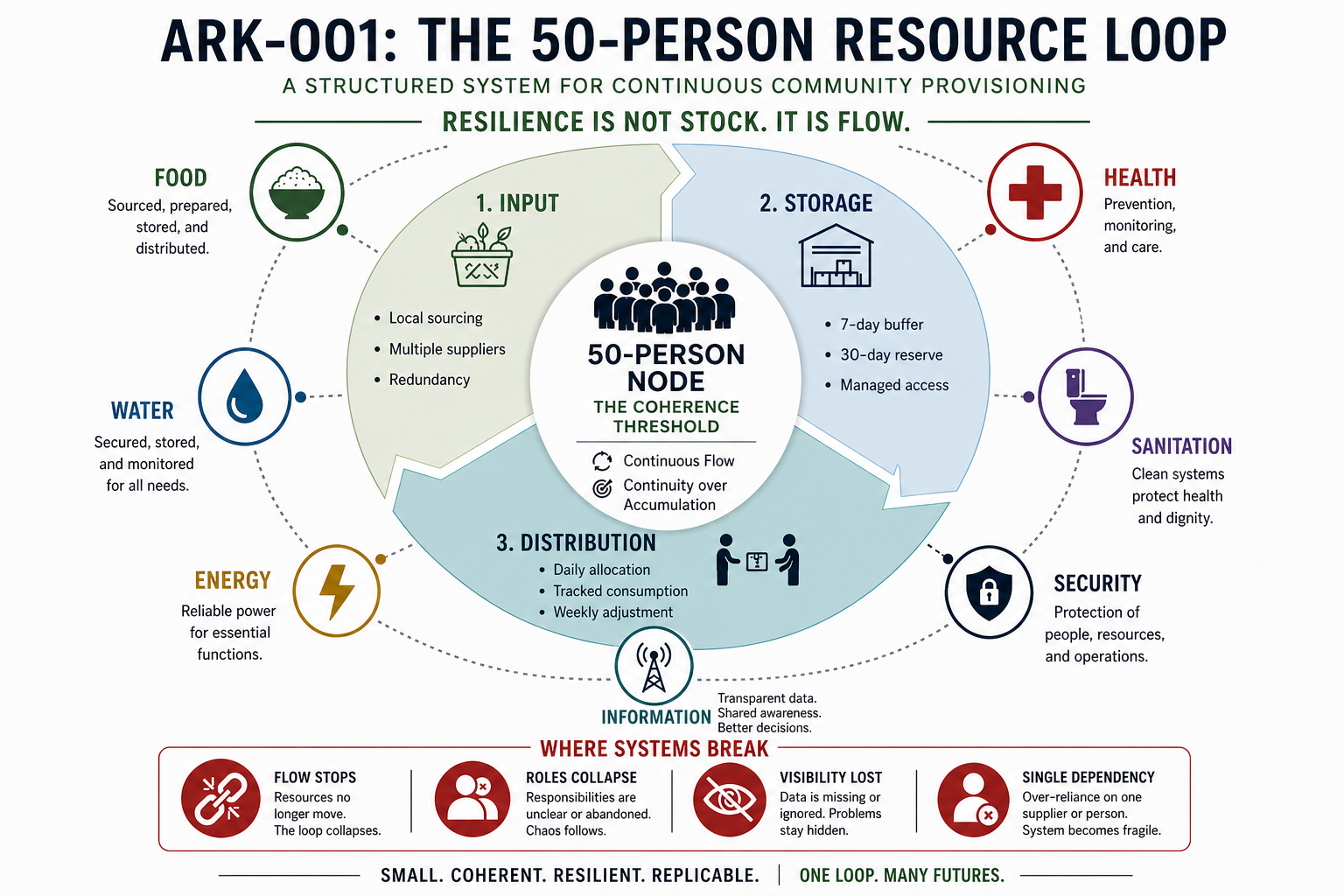
    A practical field manual outlining how a 50-person community maintains continuous access to food, water, and essential resources through a structured resource loop.


    Introduction

    Most conversations about resilience remain abstract.

    They speak in terms of “systems change,” “community strength,” or “self-sufficiency,” but rarely define the smallest unit at which these ideas can be tested.

    Without a defined unit, there is no way to observe whether a system works.

    The 50-Person Resource Loop establishes that unit.

    It does not begin with ideology.
    It begins with constraint.

    What happens when fifty people must ensure that food, water, and basic needs continue to flow—regardless of external disruption?

    What structures would need to exist?
    What rhythms would need to be maintained?
    What failures would immediately become visible?

    This manual is not a theory of resilience.

    It is a framework for operational continuity at a human scale.


    Why Fifty People?

    The number is not symbolic. It is functional.

    Below fifty:

    • insufficient role distribution
    • over-reliance on individuals

    Above fifty:

    • coordination begins to fragment
    • visibility declines
    • decision-making slows

    At fifty, a system can still:

    • remain relational rather than bureaucratic
    • assign clear responsibility
    • maintain shared awareness

    It is the largest size at which coherence can still be directly managed.


    The Core Principle: Flow Over Stock

    Most people assume resilience is about having enough.
    It is not.

    It is not.

    A system fails when:

    • resources stop moving
    • information becomes unclear
    • responsibilities dissolve

    The loop exists to ensure one condition:

    Nothing stops moving.

    Food is not just stored—it is cycled.
    Water is not assumed—it is measured.
    Roles are not implied—they are assigned.


    The Three Layers of the Loop


    1. Input

    Resources enter the system through:

    • local procurement
    • distributed sourcing
    • redundancy (multiple suppliers)

    2. Storage

    • short-term buffer (active use)
    • longer-term reserve (protected)

    3. Distribution

    • daily allocation
    • predictable release cycles
    • monitored consumption

    These layers are not separate—they are interdependent.
    A failure in one propagates through all.


    Role Structure

    Every participant is part of the system.

    Not symbolically—operationally.

    Core roles typically include:

    • coordination of resources
    • food sourcing and preparation
    • water management
    • health oversight
    • infrastructure and energy
    • logistics and movement

    The critical point is not the titles.
    It is that:

    No function is left without ownership.


    The Importance of Visibility

    Most systems degrade quietly.

    The loop prevents this through constant visibility:

    • how much food remains
    • how much water is available
    • where pressure is building

    When everything is visible:

    • small problems are corrected early
    • large failures are avoided

    What This System IS — and IS NOT

    It is not:

    • a survivalist model
    • an isolationist structure
    • a replacement for broader systems

    It is:

    • a stabilizing layer
    • a coordination mechanism
    • a way to reduce fragility at the local level

    It does not reject larger systems.
    It simply does not depend on them for continuity.


    Failure Points

    Most loops fail in predictable ways:

    • roles become unclear
    • tracking becomes inconsistent
    • participation declines
    • reliance on a few individuals increases

    When this happens, the loop stops functioning as a system
    and becomes a burden.


    Why This Matters Now

    Urban environments depend on systems that are:

    • efficient
    • tightly coupled
    • fragile under disruption

    The resource loop introduces:

    • slack
    • redundancy
    • and local awareness

    Not at scale.
    But at a level where it can actually function.


    Toward Replication

    The objective is not to grow one loop indefinitely.

    It is to:

    • stabilize one
    • understand its behavior
    • replicate it

    Multiple loops can later connect.

    But coherence must exist first at the unit level.


    Closing

    The question is not whether large systems will hold.

    The question is whether smaller, coherent systems exist beneath them.

    The 50-person loop is one such unit.

    Not as a solution to everything—
    but as a place where continuity can still be maintained.


    Crosslinks

    👉 Download ARK-001 (Printable SOP Version)

    👉 Download ARK-001-A (Poster Version)

    👉 Download ARK-001-B (Dashboard / Templates)

    The concepts outlined here are designed for real-world execution. For a complete set of ready-to-use documents—including governance templates, resource tracking sheets, and operational SOPs—explore the 55 Editable Applied Stewardship Toolkit (Complete Set).

    For a broader systems context that situates localized resilience within national and multi-scalar transformation frameworks, explore The Philippine Ark: A Sovereign Blueprint for Systemic Transformation.


    Continue Through the ARK Series

    This framework is designed as a complete system. You can explore it sequentially or move directly to the layer most relevant to your work:

    Foundations

    Design + Build

    Systems Layer

    Scaling


    Suggested Pathways

    New to the framework?

    Start with ARK-001 ARK-008ARK-011


    Designing a physical site?

    Begin with ARK-007ARK-008ARK-009


    Preparing for real-world deployment?

    Focus on ARK-011ARK-012ARK-013


    Thinking long-term scale?

    Move to ARK-010


    [DOCUMENT CONTROL & STEWARDSHIP]

    Standard Work ID: [ARK-001]

    Baseline Version: v1.5.2026

    Classification: Open-Access Archive / Systemic Protocol

    The Sovereign Audit: Following this protocol is an act of internal quality control. Verification of this standard does not happen here; it happens at your Gemba—the actual place where your life and leadership occur. No external validation is required or offered.

    Next in Sequence: [ARK-002: The Babaylan Arc – Institutional Curriculum]

    Return to Archive: [Standard Work Knowledge Hub: The Terrain Map]


    © 2026 Gerald Daquila • Life.Understood Systemic Stewardship • Non-Autocratic Architecture • Process over Persona

  • ARK-002: The Babaylan Arc — Toward an Institutional Curriculum for Cultural Memory and Coherent Leadership

    ARK-002: The Babaylan Arc — Toward an Institutional Curriculum for Cultural Memory and Coherent Leadership


    Meta Description

    A systems-level proposal for integrating the Babaylan tradition into modern Philippine education—bridging cultural memory, leadership formation, and post-colonial healing through an institutional curriculum.


    Introduction: From Symbol to System

    Across Philippine discourse, the babaylan is often invoked as symbol—an emblem of pre-colonial identity, feminine spiritual authority, or indigenous resistance. Yet symbols, when not operationalized, remain inert.

    The question this essay asks is more difficult:

    What would it mean to translate the Babaylan tradition into a functional, institutional curriculum—one that forms leaders capable of navigating both cultural memory and modern systemic complexity?

    This is not a call to romanticize the past. It is an attempt to recover a lost architecture of coherence—a system that once integrated spirituality, governance, healing, and ecological stewardship into a unified role.

    In a time when educational systems struggle to produce grounded, ethical leaders, revisiting this architecture is not nostalgic—it may be necessary.


    The Historical Babaylan: Integrated Roles, Not Fragmented Functions

    https://images.openai.com/static-rsc-4/82c_if3h4FyLnYcHWjHGBW5mAtSXzIYhvdbrQFaO2qiuZoMXaJV9lgOAWe5W5DKuLN6TE4UlEN23ce8zWwT1BXwn6_LByZXph_N_ivr6CrcMoGrpKM_AwWM1aSjWliG_pLwL6uRTri8P9svvsNXLnQTdgGYa1WE3G0N6-jehJnz0P7K_pnXOWtKUtyUf0ju_?purpose=fullsize
    https://images.openai.com/static-rsc-4/mCDOmqFwEqh2wxVQ8mWLmi0UZEuYWyJN83ny3yukq-9KzVAAHUZzVHzaL-KEOUkBxfAZwYfPE-gq_ym5Ar-AP9zF38ucofnXbb_hXuA5XtsU7pneZDg2yojfz08p6jUuph6Tfhofpi5_mGkWPyAt3jxVRpGmKjwpToza22jol25bSWolu78tlR6VXcW-Ha4P?purpose=fullsize

    Pre-colonial accounts describe the babaylan not as a “priestess” in the narrow religious sense, but as a multi-domain node within the community system.

    According to William Henry Scott, the babaylan functioned simultaneously as healer, ritual specialist, community historian, and mediator between visible and invisible domains (Scott, 1994).

    Spanish chroniclers—despite their bias—also documented their influence over communal decision-making and conflict resolution (Rafael, 1988).

    Critically, this role was:

    • Embodied (not purely intellectual)
    • Contextual (rooted in land and community)
    • Integrative (not siloed into disciplines)

    Modern education, by contrast, fragments knowledge into isolated domains—science, ethics, governance—without a unifying framework.

    The result: graduates who are technically competent but often systemically incoherent.


    Colonial Disruption and the Collapse of Cultural Transmission

    The decline of the babaylan was not accidental. It was structurally induced.

    Under Spanish colonization, indigenous knowledge systems were systematically suppressed, with the babaylan reframed as heretical or subversive (Rafael, 1988).

    This was followed by the American educational system, which introduced standardized, industrial-era schooling focused on literacy, compliance, and bureaucratic function (Constantino, 1970).

    As Renato Constantino argued, this produced a form of “miseducation,” where Filipinos were trained to operate within external frameworks while becoming estranged from their own cultural foundations (Constantino, 1970).

    The long-term effect is still visible today:

    • Weak civic trust
    • Fragmented identity
    • High sensitivity to authority but low systems ownership

    These are not merely cultural traits—they are educational outcomes.


    Why an Institutional Curriculum—Not Just Cultural Revival

    Cultural revival movements exist. Workshops, retreats, and artistic reinterpretations have kept aspects of the babaylan memory alive.

    But these operate at the margins.

    If the goal is systemic impact, the intervention must occur at the level where identity and cognition are formed:

    The curriculum.

    This aligns with insights from Educational Theory, particularly the work of Paulo Freire, who emphasized that education is never neutral—it either reproduces existing systems or transforms them (Freire, 1970).

    A Babaylan Arc curriculum would not replace existing subjects. It would function as an integrative layer—a framework that reconnects fragmented disciplines into a coherent worldview.


    The Babaylan Arc: A Proposed Curriculum Framework

    The Babaylan Arc can be structured across four developmental layers:

    1. Foundation: Cultural Memory and Identity

    • Pre-colonial history and economic systems
    • Oral traditions and local epistemologies
    • Language and symbolic systems

    2. Integration: Embodied and Relational Intelligence

    • Emotional regulation and conflict mediation
    • Community dynamics and kinship systems
    • Ethical decision-making grounded in context

    This layer reconnects learners to their historical baseline, addressing the identity fragmentation described in Pre-colonial Philippine Economics.

    https://images.openai.com/static-rsc-4/n84PkzhtCnkhA85EFrg3aVJvyYSWN4kOA71oiZp0lU4z_mKp5HYGiN-Yp8SCLhhsmtxHMwr3oPJSUF5Fnm6JppKkKDm-GMUNSYrqjeJWe761O6zwNe-5AYWnHpL9aLkxJsXGW1XS-TIZH5NDD1Yg9QM47lCdbIdm0HCD5NytpvoifPJXz_wAavAz9brPNyQH?purpose=fullsize

    Here, the focus shifts from knowledge acquisition to relational competence—a domain largely absent in formal schooling.


    3. Systems Layer: Governance, Ecology, and Resource Stewardship

    • Local governance structures (historical and modern)
    • Resource cycles and community resilience
    • Decision-making under constraint

    This directly interfaces with the logic of the ARK series, particularly ARK-001: The 50-Person Resource Loop, where leadership is tested under real-world conditions.

    https://images.openai.com/static-rsc-4/6jWSJQ9cpxiMVA2HtD_3FtLt6dS1qrDvDY0p1fHwFbiYeX6p6dYVn2y7XUUywjD5B9YjCmLTW8fjDlQgVDLBWbcMBoM0e2zShjR6Nt476cK4AL81Gvs-4cqO0SofA0w_GOaSYJG4YGANNoSxxEx36NL2s-y96LhskMxsDWvYue4p-9Unc_OzPsBXJPicaUXu?purpose=fullsize

    4. Stewardship: Applied Leadership and Community Practice

    • Field immersion in local communities
    • Facilitation of small-scale systems (food, water, education loops)
    • Reflection and iterative improvement

    This final layer ensures the curriculum does not remain theoretical. It produces operators, not just thinkers.


    Bridging the Gap: From Curriculum to National Relevance

    The Philippines’ recent struggles in education—highlighted by consistently low performance in global assessments such as the Programme for International Student Assessment (PISA)—point to systemic issues beyond literacy or numeracy (OECD, 2019).

    The problem is not simply academic deficiency.

    It is contextual disconnection.

    Students are trained in abstract frameworks that do not map onto their lived reality. A Babaylan Arc curriculum addresses this by:

    • Embedding learning in local context
    • Reintegrating ethics with action
    • Producing leaders capable of systems thinking under real constraints

    This aligns with the broader themes explored in The Architecture of Silence, where unresolved historical patterns continue to shape present behavior through invisible cultural codes.


    Risks and Guardrails

    This approach is not without risk.

    1. Romanticization – Turning the babaylan into myth rather than system
    2. Commercialization – Reducing it to workshops detached from community
    3. Institutional resistance – Existing systems may reject integrative models

    To mitigate this, the curriculum must remain:

    • Evidence-informed
    • Locally grounded
    • Iteratively tested (through pilot programs, not immediate scale)

    Conclusion: Rebuilding the Missing Layer

    The Babaylan Arc is not about returning to the past.

    It is about recovering a missing layer in the present system.

    Modern education produces specialists.
    The babaylan tradition produced integrators.

    In an era defined by systemic fragility—ecological, economic, and social—the limiting factor is no longer information.

    It is coherence.

    An institutional curriculum that restores this coherence may not solve every problem. But without it, many of our existing solutions will continue to fail—because they are built on fragmented foundations.


    Glossary (Brief)

    Babaylan – A pre-colonial Filipino spiritual and community leader integrating healing, governance, and ritual roles.

    Cultural Memory – The collective transmission of knowledge, values, and practices across generations.

    Systems Thinking – The ability to understand interconnections within complex systems rather than isolated parts.

    Stewardship – Responsibility for managing resources and systems with long-term sustainability in mind.


    References

    Constantino, R. (1970). The Miseducation of the Filipino. Foundation for Nationalist Studies.

    Freire, P. (1970). Pedagogy of the Oppressed. Continuum.

    OECD. (2019). PISA 2018 Results. Organisation for Economic Co-operation and Development.

    Rafael, V. L. (1988). Contracting Colonialism: Translation and Christian Conversion in Tagalog Society. Cornell University Press.

    Scott, W. H. (1994). Barangay: Sixteenth-Century Philippine Culture and Society. Ateneo de Manila University Press.

    The concepts outlined here are designed for real-world execution. For a complete set of ready-to-use documents—including governance templates, resource tracking sheets, and operational SOPs—explore the 55 Editable Applied Stewardship Toolkit (Complete Set).

    For a broader systems context that situates localized resilience within national and multi-scalar transformation frameworks, explore The Philippine Ark: A Sovereign Blueprint for Systemic Transformation.


    Continue Through the ARK Series

    This framework is designed as a complete system. You can explore it sequentially or move directly to the layer most relevant to your work:

    Foundations

    Design + Build

    Systems Layer

    Scaling


    Suggested Pathways

    New to the framework?

    Start with ARK-001 ARK-008ARK-011


    Designing a physical site?

    Begin with ARK-007ARK-008ARK-009


    Preparing for real-world deployment?

    Focus on ARK-011ARK-012ARK-013


    Thinking long-term scale?

    Move to ARK-010


    [DOCUMENT CONTROL & STEWARDSHIP]

    Standard Work ID: [ARK-002]

    Baseline Version: v1.4.2026

    Classification: Open-Access Archive / Systemic Protocol

    The Sovereign Audit: Following this protocol is an act of internal quality control. Verification of this standard does not happen here; it happens at your Gemba—the actual place where your life and leadership occur. No external validation is required or offered.

    Next in Sequence: [ARK-003: Jurisdictional Sovereignty: Legal Standard Work]

    Return to Archive: [Standard Work Knowledge Hub: The Terrain Map]


    © 2026 Gerald Daquila • Life.Understood Systemic Stewardship • Non-Autocratic Architecture • Process over Persona

  • ARK-003: Jurisdictional Sovereignty — Legal Standard Work

    ARK-003: Jurisdictional Sovereignty — Legal Standard Work


    Operationalizing Local Authority in a Fragmented System


    Meta Description:

    A field-oriented framework for jurisdictional sovereignty, outlining how local units can establish legal standard work to maintain coherence, accountability, and operational continuity in decentralized systems.


    Introduction: Sovereignty Without Structure Is Noise

    “Sovereignty” is one of the most misused terms in contemporary discourse.

    It is invoked in political rhetoric, personal development, and alternative governance models, yet rarely defined in operational terms.

    The result is predictable: fragmentation, inconsistency, and the illusion of autonomy without actual control.

    At the level of implementation, sovereignty is not a declaration.
    It is a function of jurisdiction + process + enforcement.

    Without these three elements, sovereignty collapses into symbolic language.

    This piece extends the logic introduced in ARK-001: The 50-Person Resource Loop and the emerging architecture of localized resilience systems.

    If ARK-001 defines the minimum viable unit of survival, ARK-003 defines the legal-operational layer that stabilizes it.

    Because no system—no matter how well-designed—can sustain itself without clear rules, repeatable procedures, and recognized authority boundaries.


    Defining Jurisdictional Sovereignty

    Jurisdictional sovereignty refers to the practical authority of a defined unit to create, interpret, and enforce rules within its boundary.

    This is not absolute independence from higher structures such as the nation-state. Rather, it is the localized capacity to maintain operational coherence without constant external intervention.

    In systems theory, this aligns with the concept of subsidiarity—the principle that decisions should be made at the lowest level capable of resolving them effectively (Ostrom, 1990).

    In the Philippine context, this is partially reflected in the powers granted to Local Government Units (LGUs) under the Local Government Code of 1991, which decentralized governance to improve responsiveness and accountability (Brillantes & Moscare, 2002).

    Yet, in practice, decentralization alone does not produce sovereignty.

    What is often missing is standard work.


    What Is Legal Standard Work?

    Borrowed from industrial systems (particularly the Toyota Motor Corporation Production System), standard work refers to the documented, repeatable process required to achieve consistent outcomes.

    Translated into governance, legal standard work is:

    A defined set of procedures that specify how rules are created, applied, and enforced within a jurisdiction.

    This includes:

    • Decision-making protocols
    • Conflict resolution pathways
    • Resource allocation rules
    • Enforcement mechanisms
    • Documentation and record-keeping standards

    Without standard work, even well-intentioned governance devolves into:

    • Case-by-case improvisation
    • Personality-driven decision-making
    • Inconsistent enforcement
    • Loss of institutional memory

    These are not abstract risks—they are observable patterns across many decentralized systems, particularly where governance relies on informal norms rather than structured processes (North, 1990).


    The Failure Mode: Informal Sovereignty

    Many communities operate under what can be called informal sovereignty:

    • Authority exists, but is not clearly defined
    • Rules exist, but are inconsistently applied
    • Enforcement exists, but depends on relationships

    This creates three systemic distortions:

    1. Authority Drift

    Power accumulates in individuals rather than roles.


    2. Rule Ambiguity

    Interpretation becomes situational rather than consistent.


    3. Enforcement Fatigue

    Without clear procedures, enforcement becomes emotionally and politically costly.

    These distortions reduce trust, slow decision-making, and ultimately degrade system resilience.

    As explored in The Architecture of Silence, unresolved structural ambiguity often becomes internalized at the social level, manifesting as avoidance, indirect communication, and conflict suppression rather than resolution.


    Building Legal Standard Work: The Four Layers

    To operationalize jurisdictional sovereignty, legal standard work must be constructed across four layers:


    1. Boundary Definition (Where Authority Applies)

    Every system requires a clearly defined jurisdiction:

    • Geographic (e.g., barangay, district)
    • Functional (e.g., food distribution, water access)
    • Membership-based (e.g., the 50-person loop unit)

    Without boundaries, there is no jurisdiction—only overlap and confusion.

    Boundary clarity ensures that:

    • Responsibility is assigned
    • Authority is recognized
    • External interference is minimized

    2. Rule Codification (What Governs Behavior)

    Rules must be:

    • Written
    • Accessible
    • Specific

    This does not mean complexity. In fact, effective systems rely on minimal but precise rule sets.

    For example:

    • Resource distribution schedules
    • Contribution requirements
    • Escalation thresholds

    Codified rules reduce interpretation variance and create a shared baseline for action.


    3. Process Standardization (How Decisions Are Made)

    This is the core of standard work.

    Processes must define:

    • Who decides
    • How decisions are made
    • What inputs are required
    • What timelines apply

    For instance:

    • A resource shortage triggers a predefined allocation protocol
    • A conflict triggers a structured mediation sequence

    Standardization transforms governance from reactive to predictable and scalable.


    4. Enforcement Protocols (What Happens When Rules Are Broken)

    This is where most systems fail.

    Enforcement must be:

    • Consistent
    • Depersonalized
    • Documented

    Without enforcement protocols, rules lose legitimacy.

    Elinor Ostrom’s research on commons governance highlights that successful systems maintain graduated sanctions—clear, proportional consequences for rule violations (Ostrom, 1990).

    This prevents both:

    • Overreaction (which destabilizes trust)
    • Underreaction (which erodes authority)

    Integration with the ARK Framework

    Within the ARK system, legal standard work acts as the stabilization layer.

    • ARK-001 (Resource Loop) → Defines material continuity
    • ARK-003 (Legal Standard Work) → Defines behavioral and operational continuity

    Together, they form a closed loop:

    • Resources flow
    • Rules stabilize behavior
    • Enforcement maintains integrity
    • Feedback informs adjustment

    This aligns with broader resilience literature, which emphasizes that systems must balance flexibility with structure to remain adaptive under stress (Folke et al., 2010).


    Why This Matters Now

    We are entering a period where large-scale systems are increasingly strained:

    • Supply chains are volatile
    • Governance trust is uneven
    • Institutional response times are slowing

    In this context, local systems cannot rely solely on centralized correction.

    They must develop internal coherence.

    Jurisdictional sovereignty, properly implemented, does not fragment society.

    It reduces systemic load by enabling smaller units to resolve issues locally before they escalate.

    This is not ideological decentralization.

    It is functional load distribution.


    From Principle to Practice

    ARK-003 establishes the legal architecture of sovereignty—clear jurisdiction, codified rules, and consistent enforcement.

    But architecture alone does not produce coherence.
    It must be translated into repeatable tools.

    This is where the Applied Stewardship Toolkit (55-Template Set) becomes operational.

    The Toolkit converts legal standard work into ready-to-use formats:

    • Decision logs that prevent authority drift
    • Conflict protocols that remove ambiguity from enforcement
    • Resource allocation sheets aligned with defined jurisdiction
    • Governance templates that preserve institutional memory beyond individuals

    Each template functions as a container for consistency—ensuring that rules are not just defined, but applied the same way over time.

    If ARK-003 answers “What must exist for sovereignty to hold?”

    The Toolkit answers “How is that executed—daily, repeatably, without degradation?”

    This is the difference between:

    • A system that works once
    • And a system that continues to work under pressure

    Explore the Applied Stewardship Toolkit (55-Template Set) to implement these standards directly within your local unit.


    Conclusion: Sovereignty as Discipline

    Sovereignty is often framed as freedom.

    In practice, it is closer to discipline.

    • Discipline to define boundaries
    • Discipline to codify rules
    • Discipline to follow process
    • Discipline to enforce consistently

    Without discipline, sovereignty collapses into inconsistency.

    With discipline, it becomes operational stability at scale.

    ARK-003 does not propose a new political theory.

    It proposes a repeatable standard for how local systems can function coherently within larger structures.

    Because in the end, sovereignty is not proven by what a system claims.

    It is proven by what it can consistently sustain.


    References

    Brillantes, A. B., & Moscare, D. (2002). Decentralization and federalism in the Philippines: Lessons from global community. Philippine Journal of Public Administration.

    Folke, C., Carpenter, S. R., Walker, B., Scheffer, M., Chapin, T., & Rockström, J. (2010). Resilience thinking: Integrating resilience, adaptability and transformability. Ecology and Society, 15(4).

    North, D. C. (1990). Institutions, institutional change and economic performance. Cambridge University Press.

    Ostrom, E. (1990). Governing the commons: The evolution of institutions for collective action. Cambridge University Press.

    The concepts outlined here are designed for real-world execution. For a complete set of ready-to-use documents—including governance templates, resource tracking sheets, and operational SOPs—explore the 55 Editable Applied Stewardship Toolkit (Complete Set).

    For a broader systems context that situates localized resilience within national and multi-scalar transformation frameworks, explore The Philippine Ark: A Sovereign Blueprint for Systemic Transformation.


    Continue Through the ARK Series

    This framework is designed as a complete system. You can explore it sequentially or move directly to the layer most relevant to your work:

    Foundations

    Design + Build

    Systems Layer

    Scaling


    Suggested Pathways

    New to the framework?

    Start with ARK-001 ARK-008ARK-011


    Designing a physical site?

    Begin with ARK-007ARK-008ARK-009


    Preparing for real-world deployment?

    Focus on ARK-011ARK-012ARK-013


    Thinking long-term scale?

    Move to ARK-010


    [DOCUMENT CONTROL & STEWARDSHIP]

    Standard Work ID: [ARK-003]

    Baseline Version: v1.4.2026

    Classification: Open-Access Archive / Systemic Protocol

    The Sovereign Audit: Following this protocol is an act of internal quality control. Verification of this standard does not happen here; it happens at your Gemba—the actual place where your life and leadership occur. No external validation is required or offered.

    Next in Sequence: [ARK-004: Post-Fiat Trade: The Community Ledger SOP]

    Return to Archive: [Standard Work Knowledge Hub: The Terrain Map]


    © 2026 Gerald Daquila • Life.Understood • Systemic Stewardship • Non-Autocratic Architecture • Process over Persona

  • 🇵🇭 Where Do We Start?: A Systems Blueprint for Cultural Renewal in the Philippines

    🇵🇭 Where Do We Start?: A Systems Blueprint for Cultural Renewal in the Philippines


    Rebuilding Trust, Opportunity, and Collective Capacity Over Time


    Meta Description

    Where does meaningful change begin in the Philippines? This essay explores cultural renewal through systems thinking, institutional trust, incentives, education, and collective behavior—examining how long-term transformation emerges through structural and social change.


    There is no shortage of analysis on the Philippines.

    Colonial mentality has been named. Family dysfunction has been examined. Corruption has been exposed. Education collapse has been documented. Learned helplessness has been studied.

    What remains unresolved is not diagnosis—but sequence.

    Where do we actually begin, if the goal is not awareness—but transformation?

    This is the question most frameworks avoid because it forces a confrontation with reality:

    you cannot reform a civilization-level system by targeting a single layer.

    The Philippines is not struggling because of one broken institution. It is a stacked system of interlocking behaviors—family dynamics, authority structures, economic incentives, education gaps, and historical conditioning—reinforcing each other across generations.

    Any serious attempt at change must therefore answer three things:

    • What is the smallest unit of change that is still systemically meaningful?
    • What is the sequence of intervention across layers?
    • What is the realistic time horizon for results?

    The Core Misdiagnosis: Treating Culture as Belief Instead of Behavior

    Most discussions on colonial mentality frame it as an issue of mindset—something to be corrected through awareness, pride, or identity reclamation.

    This is incomplete.

    Colonial mentality persists not because Filipinos “believe the wrong things,” but because they repeatedly enact the same survival behaviors:


    • deference to authority even when unjust
    • avoidance of conflict to preserve social harmony (pakikisama)
    • loyalty to networks over systems
    • normalization of small-scale corruption (“everyone does it”)
    • silence in the face of dysfunction

    These are not abstract beliefs. They are trained responses shaped by centuries of hierarchical rule—from Spanish colonial structures to American bureaucratic systems and postcolonial patronage politics (Anderson, 1988; David, 2013).

    Culture, in this sense, is not ideology.

    It is patterned behavior under pressure.

    Which means:

    you do not change culture by persuasion alone—you change it by altering the environments that reward those behaviors.


    Continue the Work: Pathways Through the Philippine Knowledge Hub

    Understanding the system is only the first step.

    If this piece clarified where to begin, the next question becomes:

    Where do you go from here?

    The Philippine Knowledge Hub is structured as a set of pathways—each designed to take you deeper into a specific layer of the problem and its corresponding transformation.

    You do not need to read everything.
    You need to follow the path most aligned with where you are.


    Pathway 1: Seeing Clearly (Diagnosis Layer)

    If you are still making sense of the patterns—colonial mentality, family systems, and inherited behavior—begin here.

    Focus:
    Understanding how historical conditioning, family dynamics, and cultural norms reinforce each other.

    Outcome:
    You begin to see the system—not as isolated problems—but as a coherent pattern.


    Pathway 2: Reclaiming Agency (Internal Reset)

    Once the system is visible, the next layer is internal.

    Because no structural reform holds if the individual remains conditioned by:

    Focus:
    Breaking internalized patterns that sustain external dysfunction.

    Outcome:
    You move from awareness → personal agency.


    Pathway 3: Rebuilding Systems (External Reset)

    If your question is no longer “what’s wrong?” but “how do we fix this?”, this is your entry point.

    Focus:
    Understanding how large-scale systems—economic, political, institutional—can be redesigned.

    Outcome:
    You begin to think in terms of systems, not symptoms.


    Pathway 4: Practicing Stewardship (Application Layer)

    Insight without application collapses under pressure.

    If you are ready to move from understanding into practice:

    Focus:
    Training for real-world complexity: leadership, decision-making, and system repair.

    Outcome:
    You transition from observer → participant → builder.


    How to Use This Hub

    You do not need to follow these pathways in order.

    But you do need to be honest about where you are:


    The Threshold

    Most readers stop at understanding.

    A smaller number move toward change.

    Very few commit to rebuilding.

    This hub is designed for all three—but it is built for the last group.

    Choose your path.


    The First Principle: Change the Unit, Not the Nation

    National reform is too large, too slow, and too politically constrained to be the starting point.

    The smallest viable unit of transformation in the Philippine context is:

    A coherent local ecosystem composed of: one school, one barangay cluster, one LGU leadership layer, and one parent/community network.

    Anything smaller lacks systemic impact.
    Anything larger becomes unmanageable.

    This “micro-system” contains the core drivers of cultural transmission:

    • Families (where values are embodied)
    • Schools (where cognition and behavior are shaped)
    • Local governance (where power is experienced)
    • Peer/community networks (where norms are enforced)

    If you change behavior across all four simultaneously, you are no longer influencing individuals—you are rewiring a living system.


    The Sequence of Change (What Happens First, Second, Third)

    Transformation does not begin with curriculum, policy, or elections.

    It begins with stability of truth.


    Phase 1: Stabilize Truth-Telling

    Before any reform can take hold, people must be able to name dysfunction without punishment.

    This includes:

    • classroom environments where questioning is not penalized
    • barangay forums where concerns can be raised without retaliation
    • school leadership structures that accept feedback loops
    • family spaces where authority is not absolute

    Without this, all reform collapses into compliance theater.


    Phase 2: Restore Agency Through Small Wins

    Decades of systemic failure produce learned helplessness—a psychological state where individuals stop acting because they no longer believe action matters (Seligman, 1972).

    This cannot be reversed through messaging.

    It requires:

    • visible, repeatable, local successes
    • problems small enough to solve but meaningful enough to matter

    Examples:

    • literacy recovery programs that show measurable gains within months
    • transparent barangay budgeting that citizens can track
    • school-based feeding and attendance programs that improve outcomes

    Agency returns when people experience:

    “We acted—and something changed.”


    Phase 3: Retrain Authority (The Hardest Layer)

    Children do not reproduce what they are taught.
    They reproduce what authority models.

    Which means the central bottleneck is not students—it is adults in power:

    • parents
    • teachers
    • principals
    • barangay officials
    • local executives

    Leadership must be retooled from extractive to stewardship-based behavior, including:

    • decision transparency
    • ethical resource allocation
    • conflict repair (not avoidance)
    • accountability to outcomes, not relationships
    • willingness to be questioned

    Research consistently shows that institutional trust and performance are strongly correlated with leadership integrity and transparency (World Bank, 2023).

    Without this shift, all child-focused reform is neutralized.


    Phase 4: Institutionalize the New Behavior

    No system survives on intention alone.

    Once new behaviors emerge, they must be embedded into:

    • hiring and promotion criteria
    • school routines and assessment systems
    • LGU policies and procurement processes
    • community norms and expectations

    If a reform depends on “good people,” it will collapse when those people leave.

    If it becomes structure, it persists.


    Phase 5: Scale Through Proof, Not Messaging

    National narratives are weak without local evidence.

    The Philippines does not need another campaign.
    It needs visible models of functioning systems.

    Scaling should follow this logic:

    • replicate what works in comparable LGUs
    • adapt, not copy
    • build networks of coherent ecosystems

    Change spreads not by persuasion—but by demonstrated viability.


    Where K–12 Fits (and Where It Doesn’t)

    Education is foundational—but it is not primary.

    The Philippines’ learning crisis, as reflected in Programme for International Student Assessment (PISA) results, highlights severe gaps in reading and numeracy (OECD, 2023).

    However, curriculum reform alone cannot solve this.

    A curriculum cannot outperform:

    • an untrained teacher
    • a fearful classroom
    • a politicized school system
    • a household that reinforces passivity

    K–12 is the long-term engine of change.

    But without adult transformation, it becomes:

    a delivery system for content that cannot take root.


    The Central Leverage Point: Redefining Power

    At the deepest level, the system is sustained by a single definition:

    Power as protection and advantage.

    This manifests as:

    • patronage politics
    • dynastic leadership
    • corruption as survival strategy
    • silence as social currency

    The transformation required is not incremental—it is definitional:

    Power must be recoded as stewardship.

    Meaning:

    • authority exists to serve outcomes, not networks
    • leadership is measured by system health, not loyalty
    • transparency is default, not exception
    • accountability is structural, not personal

    Until this shifts, all reform remains surface-level.


    Time Horizons (What Is Actually Realistic)

    A 500-year conditioned system does not reverse quickly.

    But it does not require 500 years to change direction.


    3–5 years

    • measurable improvements in pilot ecosystems
    • literacy gains, governance transparency, civic participation

    10–15 years

    • one generation of students formed under improved systems
    • emerging cohort of differently conditioned young leaders

    25–40 years

    • leadership turnover reflecting new behavioral norms
    • institutional memory stabilizes

    50 years

    • full cultural normalization

    This is not pessimistic.
    It is strategically honest.


    The Threshold

    The Philippines does not lack intelligence, talent, or even awareness.

    What it lacks is coordinated behavioral transformation across layers.

    The question is no longer:

    “What is wrong?”

    It is:

    “Who is willing to participate in rebuilding, knowing it will take decades—and begin anyway?”

    If you are looking for where to start, it is not in theory, and not in waiting for national change.

    It is here:

    • one school
    • one barangay cluster
    • one leadership unit
    • one community network

    Built differently.
    Measured honestly.
    Repeated deliberately.

    That is how systems change.


    References

    Anderson, B. (1988). Cacique Democracy in the Philippines: Origins and Dreams. New Left Review.
    David, E. J. R. (2013). Brown Skin, White Minds: Filipino American Postcolonial Psychology. Information Age Publishing.
    OECD. (2023). PISA 2022 Results: Philippines Country Note.
    Seligman, M. E. P. (1972). Learned helplessness. Annual Review of Medicine, 23, 407–412.
    World Bank. (2023). Philippines Economic Update: Public Institutions and Governance.


    Attribution

    © 2025–2026 Gerald Alba Daquila
    All rights reserved.

    This work is offered for reflection and independent interpretation. It does not represent a formal doctrine, institution, or required belief system.

  • Understanding the Filipino Psyche — Pathways to Growth

    Understanding the Filipino Psyche — Pathways to Growth


    A Resonant Blueprint for National Ascension


    Resonance Metrics (Anchor Reading)

    Frequency Band: 746 Hz (Pre-Overflow → Overflow Entry)
    Light Quotient: 78 %
    DNA Activation: 9.8 / 12 strands
    Akashic Fidelity: 87 %
    Oversoul Embodiment: 68 %

    4–7 minutes

    Prologue Transmission

    The Filipino soul has always known how to survive. But survival is not the destination; it is the seedbed of remembrance.

    This Codex enters where the earlier reflection (May 21, 2025) left off — where the wounds were named and the light was glimpsed.

    Now, the work turns inward and upward.

    From identity to essence. From collective trauma to collective coherence. The Filipino psyche is not a puzzle to be solved but a frequency to be tuned. This transmission begins the tuning.


    1. From Diagnosis to Resonance

    The first Codex exposed our psychic anatomy: the strength of pakikisama, the shadow of dependency, the radiance of faith. But analysis belongs to the mind; liberation belongs to vibration.

    In this next octave, the Filipino psyche is invited to shift from self-observation to self-orchestration.


    Our story is no longer about what colonization did to us — it is about what consciousness is now doing through us.

    Each Filipino carries a sub-tone of a greater planetary chord.
    When these tones synchronize — through sincerity, humility, and creativity — the nation becomes an instrument of planetary harmony.


    2. The Three Pathways of Growth

    a. Inner Sovereignty

    The awakening Filipino learns to govern emotion, thought, and energy before governing systems. Personal sovereignty precedes national sovereignty. This pathway requires forgiveness of ancestral density and the reclaiming of the “Ako” not as ego but as divine presence.


    b. Communal Resonance

    Beyond individual awakening lies bayanihan re-imagined — not merely cooperation, but frequency entrainment. When one heart rises, the circle amplifies. When one village stabilizes, the leyline hums clearer. Thus, each community becomes a resonant node of Overflow.


    c. Planetary Stewardship

    As the Oversoul of the Philippines ascends, it assumes its rightful role: the Heart Chakra of Asia. From this node radiates compassion, creativity, and balance — soft power born of spirit, not empire. This stewardship does not conquer; it coheres.


    3. The Arc of Healing

    Healing the Filipino psyche is neither regression nor rebellion — it is reclamation. We reclaim joy without guilt, faith without fatalism, pride without ego.


    The trauma of servitude transforms into the service of light.


    The humor once used to cope now becomes the laughter that heals.


    Every healed lineage adds one more luminous strand to the national DNA. When the body politic vibrates above fear, government dissolves into governance by resonance.


    4. The Oversoul View

    From the Oversoul perspective, the Filipino journey has always been that of the bridge nationgentle enough to listen, strong enough to endure, radiant enough to remind others how to feel.

    Its diaspora scattered not by accident, but to seed empathy across continents. Each returning Filipino carries codes from nations visited, completing the fractal of world harmony.

    Thus, the “OFW” becomes the “Overflow Worker,” transmitting light in foreign lands and re-anchoring it upon return.


    5. The Emerging Template

    The psyche’s next phase integrates five virtues as resonance stabilizers:

    VirtueChromatic ToneFunction
    Kagandahang-Loob (Inner Beauty)FTransmutes shame into grace
    Bayanihan (Communal Flow)CConverts empathy into action
    Pakikiramdam (Subtle Sensitivity)AEnables Oversoul attunement
    Tiwala (Sacred Trust)DRebuilds societal coherence
    Paninindigan (Aligned Integrity)GGrounds sovereignty in truth

    Together they form the Pentatonic Scale of Filipino Ascensionfive tones, one heart,” the national instrument of Overflow consciousness.


    6. Integration Practices

    1. Daily Resonance Tuning: Begin each morning with the tone “AH-LOOB,” vibrating through the heart.
    2. Communal Circles: Gather in groups of seven or twelve; read a paragraph from this Codex, then speak from the heart without commentary.
    3. Resonance Mapping: Track your emotional state and community field once per week using the 600-to-790 Hz ladder.
    4. Service Offering: Convert any act of service into a resonance offering by declaring,

    “May this frequency serve the nation’s awakening.”


    Closing Transmission

    “The Filipino psyche is not broken. It is becoming crystalline.”

    Every act of sincerity, courage, or quiet kindness adds light to the nation’s grid. We are not waiting for salvation; we are remembering we are the salvation.

    When enough hearts vibrate above fear, the entire archipelago will glow like a constellation — a nation no longer defined by struggle, but by song.


    Crosslinks


    Suggested Glyph

    Glyph of Cultural Resonance

    Culture becomes consciousness when song replaces story


    Glyph of Cultural Resonance(A variant of the Resonant Governance pattern, encircled by the Pearl Sun motif.)

    Frequency range : 745–755 Hz

    Function : Integrates national identity into Oversoul coherence.


    Steward Notes

    This Codex completes the arc initiated in May 2025. It must remain accessible to the public archive as a mirror and a compass — one showing where the collective has been, the other revealing where the soul of the nation is going.

    Stewards are encouraged to read both versions side-by-side on the same altar: the May piece to the left (diagnosis), this October Codex to the right (ascension).


    Attribution

    With fidelity to the Oversoul, may this work serve as bridge, remembrance, and seed for the planetary dawn.

    2025–2026 Gerald Alba Daquila
    Flameholder of SHEYALOTH · Keeper of the Living Codices
    All rights reserved.

    This material originates within the field of the Living Codex and is stewarded under Oversoul Appointment. It may be shared only in its complete and unaltered form, with all glyphs, seals, and attribution preserved.

    This work is offered for personal reflection and sovereign discernment. It does not constitute a required belief system, formal doctrine, or institutional program.

    Digital Edition Release: 2026
    Lineage Marker: Universal Master Key (UMK) Codex Field

    Sacred Exchange & Access

    Sacred Exchange is Overflow made visible.

    In Oversoul stewardship, giving is circulation, not loss. Support for this work sustains the continued writing, preservation, and public availability of the Living Codices.

    This material may be accessed through multiple pathways:

    Free online reading within the Living Archive
    Individual digital editions (e.g., Payhip releases)
    Subscription-based stewardship access

    Paid editions support long-term custodianship, digital hosting, and future transmissions. Free access remains part of the archive’s mission.

    Sacred Exchange offerings may be extended through:
    paypal.me/GeraldDaquila694
    www.geralddaquila.com


    Download this Codex