Logo - Life.Understood.

Category: Barangay-Communities

  • ARK-009: Special Structures in Small-Scale Sovereign Communities

    ARK-009: Special Structures in Small-Scale Sovereign Communities


    Designing the Institutional Layer of a 50-Person Settlement


    Meta Description

    A systems-based framework for designing essential structures—governance, education, health, and production—in a 50-person micro-community, aligned with sustainability and operational coherence.


    Opening

    Most intentional communities focus on land, housing, and food—and stop there.

    But settlements do not stabilize on infrastructure alone. They stabilize on institutions.

    Without clear structures for governance, learning, health, and coordination, even well-designed communities regress into:

    • Informal power dynamics
    • Role confusion
    • Burnout of key individuals
    • Eventual fragmentation

    The difference between a temporary gathering and a functioning settlement is this:

    Are there systems that outlast the people currently holding them?

    This piece defines the institutional layer of a 50-person prototype—building on the spatial logic in
    ARK-007: The 50-Person Settlement — Spatial Design and Land Allocation Model
    and the rollout sequencing in
    ARK-008: Operational Rollout of a 50-Person Micro-Community Prototype


    Why “Special Structures” Matter

    In this context, “special structures” are not luxury additions. They are functional anchors that enable:

    • Continuity of knowledge
    • Fair and transparent decision-making
    • Physical and mental health stability
    • Economic coordination

    Elinor Ostrom’s work on collective resource management shows that communities succeed when they establish clear, shared institutions with defined roles and rules (Ostrom, 1990).

    Without them, systems default to:

    • Informal hierarchies
    • Inconsistent decision-making
    • Resource mismanagement

    The Five Core Structures of a 50-Person System

    At this scale, not everything is needed—but certain structures are non-negotiable.


    1. Governance Node

    Function: Decision-making, coordination, and conflict resolution

    This is the central nervous system of the community.

    Core Components

    • Regular assembly or council process
    • Defined decision-making framework (consensus, sociocracy, hybrid)
    • Conflict resolution protocols
    • Role and responsibility registry

    Design Requirements

    • Physically central or easily accessible
    • Neutral and shared (not “owned” by any subgroup)
    • Designed for dialogue, not hierarchy

    Operational Insight

    At 50 people, governance cannot remain informal. Research shows that clearly defined decision systems significantly reduce internal conflict and increase group longevity (Ostrom, 1990).


    2. Food and Resource Hub

    Function: Coordination of production, storage, and distribution

    While food is grown across zones (see
    ARK-001: The 50-Person Resource Loop),
    the hub is where it is managed.

    Core Components

    • Storage facilities (dry, cold, preserved goods)
    • Distribution system (communal meals or allocation schedules)
    • Inventory tracking
    • Tool and equipment storage

    Design Requirements

    • Proximity to both production zones and residential cluster
    • Efficient access routes
    • Climate-appropriate storage systems

    Operational Insight

    Without centralized coordination, food systems become inconsistent—leading to waste in some areas and scarcity in others.


    3. Learning and Skills Development Hub

    Function: Knowledge transmission and capability building

    Communities fail when knowledge is siloed or lost.

    Core Components

    • Training space (indoor/outdoor)
    • Documentation systems (manuals, digital records)
    • Skill-sharing schedules
    • Apprenticeship pathways

    Focus Areas

    • Agriculture and food systems
    • Construction and maintenance
    • Governance and facilitation
    • Health and wellness practices

    Design Requirements

    • Accessible and flexible space
    • Integrated with daily life (not isolated)

    Operational Insight

    Holmgren (2002) emphasizes that resilient systems depend on distributed knowledge, not centralized expertise. Every member should be able to contribute meaningfully.


    4. Health and Wellness Space

    Function: Physical, mental, and social well-being

    Health is not an external service—it is an internal system.

    Core Components

    • First-aid and basic medical resources
    • Space for rest and recovery
    • Mental health support practices
    • Preventive care systems (nutrition, hygiene, movement)

    Design Requirements

    • Quiet, slightly removed from high-activity zones
    • Accessible to all members
    • Clean, well-maintained environment

    Operational Insight

    Small communities amplify both support and stress. Without dedicated space and protocols for health, minor issues can escalate into systemic problems.


    5. Production and Economic Node

    Function: Income generation and external exchange

    No settlement is fully isolated. Even highly self-sufficient systems require:

    • Tools
    • Materials
    • External services

    Core Components

    • Workspaces (craft, digital, agricultural processing)
    • Storage for goods
    • Logistics coordination (transport, trade)
    • Financial tracking systems

    Possible Economic Activities

    • Agriculture surplus
    • Value-added products (food processing, crafts)
    • Remote or digital work
    • Training or hosting programs

    Design Requirements

    • Positioned at the edge of the settlement (to interface with outside systems)
    • Accessible without disrupting internal life

    Operational Insight

    Economic clarity reduces internal tension. When contributions and outputs are visible, trust increases and conflict decreases.


    Integration: Structures Must Work as a System

    Each structure cannot operate in isolation.

    For example:

    • Governance decisions affect food allocation
    • Learning systems train people to support production
    • Health systems ensure workforce continuity
    • Economic outputs sustain infrastructure

    This interdependence reflects systems thinking principles, where the whole is shaped by the relationships between parts, not just the parts themselves (Meadows, 2008).


    Staffing and Role Distribution

    At 50 people, specialization must exist—but remain flexible.

    Typical Allocation

    • 5–8 people in food systems
    • 5–7 in infrastructure and maintenance
    • 3–5 in governance and coordination
    • 3–5 in health and wellness
    • 5–10 in economic activities
    • Remaining members in hybrid or support roles

    Key Principle

    Avoid rigid roles. Instead:

    Design for primary responsibility + secondary capability

    This ensures redundancy and resilience.


    Physical Placement: Why It Matters

    Where structures are located influences:

    • Usage frequency
    • Accessibility
    • Social interaction

    Guidelines

    • Governance node → central
    • Food hub → between production and residential zones
    • Learning hub → near daily activity areas
    • Health space → quiet but accessible
    • Economic node → near external access points

    This reinforces the spatial logic introduced in
    ARK-007: The 50-Person Settlement — Spatial Design and Land Allocation Model


    Phased Development of Structures

    Not all structures are built at once.

    Phase Alignment

    • Phase 1–2 (Core Team + Infrastructure):
      • Basic governance process
      • Minimal food coordination
      • Temporary learning spaces
    • Phase 3 (Population Growth):
      • Formalize governance node
      • Expand food hub
      • Establish learning systems
    • Phase 4–5 (Stabilization):
      • Dedicated health space
      • Full economic node
      • Documented institutional processes

    This aligns directly with the rollout sequencing in
    ARK-008: Operational Rollout of a 50-Person Micro-Community Prototype


    Common Failure Patterns

    Across community case studies, several patterns emerge:

    • Overbuilding physical structures without operational clarity
    • Ignoring governance until conflict arises
    • Concentrating knowledge in a few individuals
    • Lack of economic coordination
    • Treating health as an afterthought

    Each leads to instability—even when land and infrastructure are adequate.


    Conclusion: From Space to System

    A settlement becomes viable not when it has land or people—but when it has structures that organize both.

    At 50 people, complexity is manageable—but only if it is structured.

    These five core nodes:

    • Governance
    • Food and resources
    • Learning
    • Health
    • Economic production

    Transform a group of individuals into a functioning system.

    They ensure that:

    • Knowledge persists
    • Decisions are fair
    • Resources flow efficiently
    • People remain supported

    From this foundation, the settlement is no longer experimental—it becomes replicable.

    And replication is the next layer of the ARK architecture.


    References

    Holmgren, D. (2002). Permaculture: Principles and pathways beyond sustainability. Holmgren Design Services.

    Meadows, D. H. (2008). Thinking in systems: A primer. Chelsea Green Publishing.

    Ostrom, E. (1990). Governing the commons: The evolution of institutions for collective action. Cambridge University Press.

    The concepts outlined here are designed for real-world execution. For a complete set of ready-to-use documents—including governance templates, resource tracking sheets, and operational SOPs—explore the 55 Editable Applied Stewardship Toolkit (Complete Set).

    For a broader systems context that situates localized resilience within national and multi-scalar transformation frameworks, explore The Philippine Ark: A Sovereign Blueprint for Systemic Transformation.


    Continue Through the ARK Series

    This framework is designed as a complete system. You can explore it sequentially or move directly to the layer most relevant to your work:

    Foundations

    Design + Build

    Systems Layer

    Scaling


    Suggested Pathways

    New to the framework?

    Start with ARK-001 ARK-008ARK-011


    Designing a physical site?

    Begin with ARK-007ARK-008ARK-009


    Preparing for real-world deployment?

    Focus on ARK-011ARK-012ARK-013


    Thinking long-term scale?

    Move to ARK-010


    [DOCUMENT CONTROL & STEWARDSHIP]

    Standard Work ID: [ARK-009]

    Baseline Version: v1.5.2026

    Classification: Open-Access Archive / Systemic Protocol

    The Sovereign Audit: Following this protocol is an act of internal quality control. Verification of this standard does not happen here; it happens at your Gemba—the actual place where your life and leadership occur. No external validation is required or offered.

    Next in Sequence: [ARK-010: From Prototype to Network — Scaling Distributed Communities]

    Return to Archive: [Standard Work Knowledge Hub: The Terrain Map]


    © 2026 Gerald Daquila • Life.Understood Systemic Stewardship • Non-Autocratic Architecture • Process over Persona

  • How the Prototype Community Functions Day-to-Day

    How the Prototype Community Functions Day-to-Day


    A Barangay-Scale Stewardship Framework for Regenerative Living, Economic Circulation, and Distributed Leadership


    Meta Description

    Explore the operational blueprint behind a regenerative barangay-scale prototype community in the Philippines, including governance, stewardship systems, local economics, conflict resolution, and resilient day-to-day living without centralized debt dependency.


    Introduction

    Many intentional communities fail not because their vision lacks inspiration, but because their operational systems remain vague.

    Noble ideals alone cannot sustain land stewardship, shared infrastructure, financial resilience, or human relationships over time.

    The Prototype Community proposed within the SHEYALOTH stewardship architecture is therefore designed not merely as a philosophical experiment, but as an operationally grounded living system.

    This document outlines how the prototype community functions on a day-to-day basis.

    Its purpose is to answer the practical questions donors, collaborators, future residents, and governance advisors will inevitably ask:

    • How is the community structured?
    • Who makes decisions?
    • How does money circulate?
    • How are conflicts handled?
    • How are members selected?
    • What prevents leadership abuse?
    • How does the community remain financially viable?
    • How does the model scale without collapsing?

    This is not a utopian blueprint.

    It is a systems-informed prototype designed for gradual implementation, adaptation, and resilience.


    1. Core Design Philosophy

    The prototype community is built around five foundational principles:

    1. Stewardship Over Ownership

    Land, infrastructure, knowledge, and resources are treated primarily as stewarded assets rather than speculative commodities.

    The objective is long-term regenerative use rather than extraction.


    2. Distributed Responsibility

    The community avoids over-centralization of authority.

    Leadership functions are distributed through councils, working groups, rotating stewardship roles, and transparent governance structures.

    This reduces fragility and dependency on charismatic leadership.


    3. Regenerative Economics

    The node is designed to retain and circulate value locally whenever practical.

    Priority is placed on:

    • local production,
    • skill development,
    • cooperative purchasing,
    • resilient infrastructure,
    • and ethical enterprise creation.

    4. Human-Scale Governance

    The community is intentionally kept within a manageable relational scale.

    Research in social cohesion repeatedly suggests that trust and accountability degrade when communities become too large or overly bureaucratic (Ostrom, 1990).

    The prototype therefore prioritizes:

    • relational governance,
    • participatory decision-making,
    • and face-to-face accountability.

    5. Adaptive Evolution

    The operating model is not static.

    The prototype is designed to learn through implementation.

    Systems are expected to evolve based on:

    • ecological realities,
    • member feedback,
    • financial conditions,
    • and operational experience.

    2. Community Structure

    Initial Prototype Size

    The recommended initial scale is:

    • 12–20 founding adults
    • small family clusters
    • rotating retreat participants
    • local collaborators and trainees

    This allows sufficient diversity of skills while maintaining manageable governance complexity.

    Expansion beyond 50–70 residents should occur only after:

    • governance stabilization,
    • infrastructure maturity,
    • financial resilience,
    • and conflict systems have proven functional.

    Physical Layout

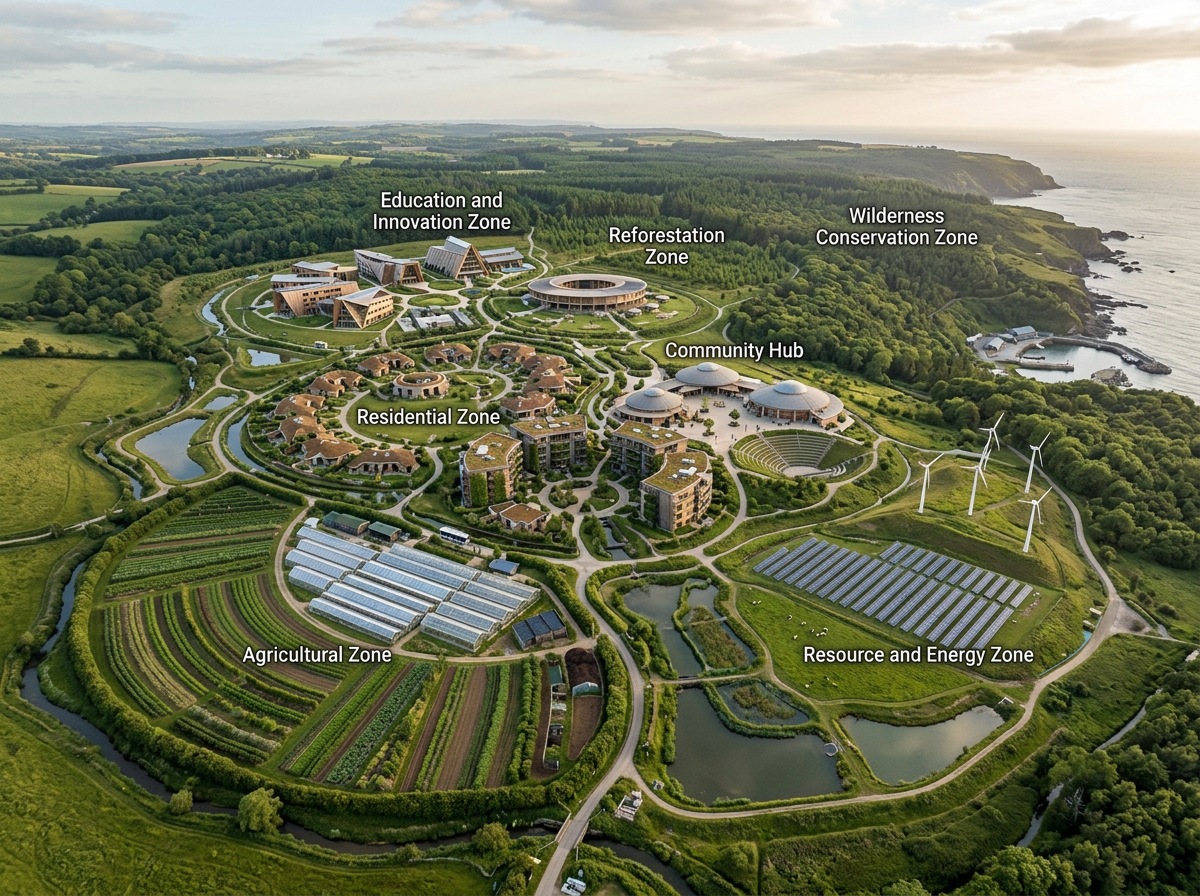
    The community is organized into interconnected functional zones:

    A. Residential Zone

    • private sleeping quarters
    • small family dwellings
    • shared housing clusters
    • co-living options

    B. Productive Agriculture Zone

    • food forests
    • gardens
    • regenerative farming plots
    • seed stewardship
    • compost systems
    • water capture systems

    C. Commons Zone

    Shared community infrastructure:

    • kitchen
    • dining space
    • workshop
    • learning spaces
    • meditation/reflection areas
    • meeting spaces

    D. Enterprise Zone

    Micro-enterprise and livelihood activities:

    • fabrication
    • media production
    • retreats
    • training programs
    • crafts
    • processing facilities
    • digital workspaces

    3. Membership Model

    The prototype uses a layered participation structure.

    Not all participants carry identical responsibilities or privileges.


    Tier 1 – Visitors

    Short-term participants:

    • retreat guests
    • volunteers
    • educational participants
    • researchers

    No governance authority.


    Tier 2 – Apprentices

    Longer-term immersion participants learning stewardship systems.

    Responsibilities include:

    • contribution hours
    • training participation
    • collaborative work
    • community integration

    Limited governance participation.


    Tier 3 – Resident Stewards

    Core long-term members.

    Responsibilities include:

    • operational stewardship
    • governance participation
    • financial contribution
    • skill-sharing
    • mentorship
    • infrastructure care

    These members hold voting participation in major community decisions.


    Tier 4 – Custodian Council

    A rotating stewardship council responsible for:

    • legal oversight
    • financial transparency
    • conflict facilitation
    • systems coordination
    • external partnerships
    • continuity planning

    The council does not function as permanent rulers.

    Term limits and rotation structures reduce power concentration.


    4. Governance Architecture

    Governance is one of the most critical systems within the prototype.

    Most intentional communities fail from unresolved governance weaknesses rather than resource scarcity.


    Decision-Making Structure

    The community uses a hybrid governance model combining:

    • consensus-seeking,
    • delegated authority,
    • and operational autonomy.

    Not every decision requires full-community deliberation.

    Examples:

    Decision TypeGovernance Layer
    Daily operationsWorking groups
    Budget allocationsStewardship council + community review
    Land use changesFull steward vote
    Conflict mediationDesignated mediation circle
    Legal complianceCustodian council

    Transparency Systems

    Transparency is mandatory.

    Members have access to:

    • budget summaries
    • project spending
    • governance notes
    • operational reports
    • stewardship agreements

    Opaque governance breeds distrust.


    Conflict Resolution Process

    Conflict is treated as inevitable rather than abnormal.

    The prototype therefore institutionalizes conflict support mechanisms.

    The escalation structure includes:

    1. Direct dialogue
    2. Facilitated mediation
    3. Stewardship review circle
    4. Temporary cooling-off agreements
    5. Membership reassessment if necessary

    The objective is restoration whenever possible.

    However, persistent abuse, manipulation, violence, or severe boundary violations may result in removal.

    Community safety takes priority over ideological purity.


    5. Financial Operating Model

    The prototype community is not designed as an anti-market commune.

    It operates as a hybrid regenerative economy.

    External revenue remains important.

    However, the objective is to progressively increase internal resilience while minimizing extractive leakage.


    Primary Revenue Streams

    A. Retreats and Trainings

    • stewardship intensives
    • regenerative living workshops
    • leadership immersions
    • wellness retreats
    • systems-thinking seminars

    B. Agricultural Production

    • fresh produce
    • seedlings
    • preserved foods
    • herbal products
    • value-added goods

    C. Digital and Educational Media

    • online courses
    • publications
    • consulting
    • media production
    • educational content

    D. Ethical Enterprise Incubation

    Members may operate aligned micro-enterprises that:

    • contribute to the node,
    • employ local participants,
    • and strengthen community resilience.

    Community Contribution System

    Resident stewards contribute through combinations of:

    • financial contribution,
    • labor contribution,
    • skill contribution,
    • or operational stewardship.

    Contribution expectations are calibrated realistically.

    The objective is participation—not coercion.


    Reserve Funds

    The prototype maintains reserve allocations for:

    • emergency resilience,
    • medical support,
    • infrastructure maintenance,
    • climate disruptions,
    • and operational continuity.

    Communities collapse quickly without reserves.


    6. Work Rhythm and Daily Life

    The prototype avoids both extremes:

    • hyper-capitalist overwork,
    • and unsustainable idealistic leisure culture.

    Instead, it seeks balanced contribution rhythms.


    Daily Structure Example

    Morning

    • food systems work
    • maintenance
    • infrastructure tasks
    • operational coordination

    Afternoon

    • enterprise work
    • training
    • educational programs
    • remote/digital work

    Evening

    • shared meals
    • reflection circles
    • cultural activities
    • governance meetings when necessary

    Weekly Rhythm

    The weekly cycle includes:

    • stewardship days
    • enterprise days
    • learning days
    • rest periods
    • governance review periods

    Intentional rest is considered infrastructure.

    Burnout destroys communities.


    7. External Partnerships

    The prototype does not isolate itself.

    It actively collaborates with:

    • local barangays
    • farmers
    • NGOs
    • educators
    • regenerative design experts
    • universities
    • ethical businesses
    • public agencies where aligned

    This reduces ideological isolation and improves practical resilience.


    8. Risk Factors and Safeguards

    The prototype acknowledges several major risks.


    Risk 1 – Leadership Centralization

    Safeguards:

    • rotating councils
    • transparent finances
    • distributed authority
    • written governance protocols

    Risk 2 – Financial Fragility

    Safeguards:

    • diversified revenue streams
    • reserve funds
    • phased growth
    • low-debt strategy

    Risk 3 – Social Fragmentation

    Safeguards:

    • conflict mediation
    • onboarding processes
    • mentorship systems
    • cultural rituals
    • shared meals

    Risk 4 – Ideological Rigidity

    Safeguards:

    • adaptive review cycles
    • evidence-based assessment
    • external advisors
    • community feedback structures

    Risk 5 – Burnout

    Safeguards:

    • workload balancing
    • rotating responsibilities
    • rest periods
    • emotional support systems

    9. Long-Term Vision

    The prototype is not intended to become a giant centralized settlement.

    Instead, the long-term model resembles:

    • interconnected stewardship nodes,
    • distributed regenerative communities,
    • local training hubs,
    • and collaborative barangay-scale ecosystems.

    Replication occurs horizontally rather than through top-heavy expansion.

    This creates resilience through decentralization.


    Conclusion

    The Prototype Community is ultimately an experiment in practical regeneration.

    Its purpose is not to escape society.

    Its purpose is to test whether human communities can once again organize around:

    • stewardship instead of extraction,
    • participation instead of passivity,
    • resilience instead of dependency,
    • and relational wealth instead of perpetual debt.

    The operating model therefore serves as both:

    • a practical governance framework,
    • and a living systems laboratory.

    If successful, the prototype may provide evidence that localized regenerative communities are not merely idealistic visions, but viable social infrastructure for an increasingly unstable world.


    Crosslinks

    Value Stream Mapping the Prototype Community: Circulating Wealth Without Central Debt – Maps how food, labor, finance, governance, infrastructure, and knowledge circulate within the prototype community while minimizing extractive leakage into centralized debt systems.

    Agentic Systems and the End of Passive Labor – Analyzes how AI, automation, and decentralized production systems are reshaping the future of work, stewardship, and local economic resilience.

    The Sovereign Prompt: How to Use AI Without Outsourcing Discernment – Discusses the ethical integration of AI within regenerative systems while preserving human discernment, accountability, and stewardship responsibility.

    Why the Global Reset Requires an Internal Reboot: The Role of Shadow Work in NESARA/GESARA – Explores the psychological and cultural dimensions of systemic transformation, emphasizing that sustainable external reform requires internal ethical and relational maturity first.


    References

    American Society for Quality. (n.d.). Value stream mapping tutorial – What is VSM? ASQ. ASQ Value Stream Mapping Tutorial

    Centre for Local Economic Strategies. (n.d.). Community wealth building. CLES. CLES Community Wealth Building

    Lean Enterprise Institute. (n.d.). Value-stream mapping. Lean Enterprise Institute Value Stream Mapping

    Lucid Software Inc. (n.d.). What is value stream mapping? Lucidchart. Lucidchart Value Stream Mapping Guide

    Elinor Ostrom. (1990). Governing the commons: The evolution of institutions for collective action. Cambridge University Press.

    Preston City Council. (n.d.). What is community wealth building? Preston Community Wealth Building Overview

    Purdue University. (2024, November 7). Value stream mapping. Purdue Lean Six Sigma Online. Purdue Lean Six Sigma Value Stream Mapping

    United Nations Development Programme. (2022). Local governance and resilient communities. UNDP Official Website

    Transition Network. (n.d.). What is transition? Transition Network Official Website

    Permaculture Research Institute. (n.d.). Principles of permaculture. Permaculture Research Institute


    The Sovereign Professional: A structural map of power, systems thinking, and personal autonomy—dedicated to helping the independent professional navigate complexity and own their value stream.


    ©2026 Gerald Daquila • Life.Understood. • Systems Thinking, Leadership Architecture, and Applied Coherence

  • ARK-012: Legal Structures for Community Prototypes (Philippine Context)

    ARK-012: Legal Structures for Community Prototypes (Philippine Context)


    Navigating Land Ownership, Governance Entities, and Regulatory Compliance


    Meta Description

    A practical legal framework for establishing a 50-person community prototype in the Philippines, covering land ownership, entity structures, compliance, and risk management.


    Opening

    A community can be perfectly designed—and still fail the moment it encounters the legal system.

    Land titles, zoning rules, ownership restrictions, and regulatory compliance are not abstract constraints. They determine whether a project can:

    • Exist long-term
    • Scale without interruption
    • Protect its members
    • Avoid costly disputes or shutdowns

    Many intentional community projects avoid legal complexity until it becomes unavoidable. By then, it is often too late.

    Legal structure is not a final step—it is the foundation.

    This piece grounds the ARK framework in the Philippine context, building on:


    Why Legal Design Determines Continuity

    Legal systems define:

    • Who owns the land
    • Who has decision-making authority
    • Who bears liability
    • How disputes are resolved

    Without clear legal grounding:

    • Ownership becomes contested
    • Members are exposed to risk
    • Expansion becomes impossible

    Research on institutional systems emphasizes that clear rules and enforceable structures are essential for collective stability (Ostrom, 1990).


    Layer 1: Land Ownership Constraints in the Philippines

    The first—and most critical—legal reality:

    Land ownership in the Philippines is restricted.

    Key Rule

    • Only Filipino citizens and Filipino-owned entities (≥60% Filipino ownership) can legally own land.

    This immediately shapes:

    • Who can invest
    • How ownership is structured
    • How foreign participants are included

    Land Ownership Options

    1. Individual Filipino Ownership

    • Land is titled under one or more Filipino individuals

    Pros:

    • Simple
    • Fast acquisition

    Cons:

    • High trust dependency
    • Risk of personal ownership disputes

    2. Corporation Structure

    • Land owned by a Philippine corporation
    • Must be ≥60% Filipino-owned

    Pros:

    • Clear legal identity
    • Easier scaling and contracts

    Cons:

    • Regulatory complexity
    • Requires corporate governance discipline

    3. Cooperative Structure

    • Registered under the Cooperative Development Authority

    Pros:

    • Aligns with shared ownership principles
    • Democratic governance built-in

    Cons:

    • Slower decision-making
    • Requires compliance with cooperative laws

    Recommended Approach

    For most ARK prototypes:

    Hybrid model: Corporation or cooperative + internal governance agreements

    This balances:

    • Legal clarity
    • Operational flexibility

    Layer 2: Entity Structure for the Community

    Beyond land ownership, the community must exist as a legal entity.

    Primary Options


    1. Corporation

    Registered through the Securities and Exchange Commission (Philippines)

    • Can enter contracts
    • Can own assets
    • Provides liability separation

    2. Cooperative

    Registered with the Cooperative Development Authority

    • Member-owned and governed
    • Profit distribution based on participation

    3. Association (Non-Profit)

    • Suitable for early-stage or advocacy-focused groups
    • Limited in economic activity

    Key Decision Factors

    • Level of economic activity
    • Governance style
    • Member expectations

    Layer 3: Zoning and Land Use Compliance

    Even with ownership secured, land must be used legally.


    Zoning Categories

    • Agricultural
    • Residential
    • Mixed-use

    Key Considerations

    • Agricultural land may restrict residential structures
    • Conversion may be required for certain uses
    • Local Government Units (LGUs) enforce zoning rules

    Regulatory Bodies Involved

    • Municipal or City LGU
    • Barangay authorities
    • Environmental agencies

    Core Permits and Clearances

    • Barangay clearance
    • Building permits
    • Environmental compliance (if applicable)

    Failure to comply can result in:

    • Fines
    • Project shutdown
    • Legal disputes

    Layer 4: Internal Legal Agreements

    Even with external compliance, the internal legal framework is equally critical.

    Essential Documents


    1. Membership Agreement

    Defines:

    • Rights and responsibilities
    • Contribution expectations
    • Use of shared resources

    2. Governance Charter

    Defines:

    • Decision-making processes
    • Leadership roles
    • Conflict resolution systems

    3. Asset and Equity Agreements

    Defines:

    • Ownership of land and infrastructure
    • Financial contributions
    • Exit terms

    Key Principle

    Verbal agreements are not sufficient.

    All expectations must be:

    • Written
    • Signed
    • Accessible

    Layer 5: Liability and Risk Protection

    Communities must anticipate legal risk.


    Common Risk Areas

    • Accidents or injuries
    • Financial disputes
    • Land ownership conflicts
    • Regulatory violations

    Protection Mechanisms

    • Legal entity shielding (corporation/cooperative)
    • Insurance (where available)
    • Clear contracts and waivers

    Layer 6: Foreign Participation

    Given global interest, many communities include non-Filipino members.


    Legal Reality

    • Foreigners cannot own land directly
    • Can participate through:
      • Leasing agreements
      • Membership in entities
      • Service or investment roles

    Risk Consideration

    Improper structuring can lead to:

    • Legal invalidation of ownership
    • Government intervention

    Layer 7: Alignment with Financial Systems

    Legal structure must support the financial model in
    ARK-011: Capitalization and Financial Flows for a 50-Person Prototype

    Key Alignments

    • Treasury management
    • Contribution tracking
    • Profit or surplus distribution

    Without alignment:

    • Financial disputes escalate into legal issues

    Layer 8: Scaling Across Multiple Nodes

    As outlined in
    ARK-010: From Prototype to Network — Scaling Distributed Communities

    Each node must:

    • Have its own legal entity
    • Comply with local regulations

    Network-Level Considerations

    • Inter-entity agreements
    • Shared standards
    • Optional umbrella organizations

    Common Legal Failure Patterns

    Observed across projects:

    • Informal land ownership arrangements
    • Lack of written agreements
    • Ignoring zoning laws
    • Mixing personal and community finances
    • Misunderstanding foreign ownership rules

    Each creates long-term instability.


    Local Governance Dynamics (Philippine Reality)

    Beyond formal law, success often depends on:

    • Relationship with Barangay leaders
    • Alignment with LGU priorities
    • Community integration

    Practical Insight

    Legal compliance + local trust = operational stability

    Ignoring local dynamics can stall or block progress—even if formal requirements are met.


    Conclusion: Law as Infrastructure

    Legal systems are often treated as constraints.

    In reality, they are infrastructure—just like water, land, or energy.

    A well-structured legal foundation:

    • Protects members
    • Enables growth
    • Reduces conflict
    • Supports replication

    At 50 people, complexity is manageable—but only if:

    • Ownership is clear
    • Rules are defined
    • Compliance is maintained

    With this layer in place, the ARK system becomes not just viable—but defensible and scalable within the real world.


    References

    Ostrom, E. (1990). Governing the commons: The evolution of institutions for collective action. Cambridge University Press.

    Republic of the Philippines. (1987). The Constitution of the Republic of the Philippines.

    Cooperative Development Authority. (n.d.). Guidelines and regulations for cooperatives.

    Securities and Exchange Commission (Philippines). (n.d.). Corporate registration and governance rules.

    The concepts outlined here are designed for real-world execution. For a complete set of ready-to-use documents—including governance templates, resource tracking sheets, and operational SOPs—explore the 55 Editable Applied Stewardship Toolkit (Complete Set).

    For a broader systems context that situates localized resilience within national and multi-scalar transformation frameworks, explore The Philippine Ark: A Sovereign Blueprint for Systemic Transformation.


    Continue Through the ARK Series

    This framework is designed as a complete system. You can explore it sequentially or move directly to the layer most relevant to your work:

    Foundations

    Design + Build

    Systems Layer

    Scaling


    Suggested Pathways

    New to the framework?

    Start with ARK-001 ARK-008ARK-011


    Designing a physical site?

    Begin with ARK-007ARK-008ARK-009


    Preparing for real-world deployment?

    Focus on ARK-011ARK-012ARK-013


    Thinking long-term scale?

    Move to ARK-010


    [DOCUMENT CONTROL & STEWARDSHIP]

    Standard Work ID: [ARK-012]

    Baseline Version: v1.5.2026

    Classification: Open-Access Archive / Systemic Protocol

    The Sovereign Audit: Following this protocol is an act of internal quality control. Verification of this standard does not happen here; it happens at your Gemba—the actual place where your life and leadership occur. No external validation is required or offered.

    Next in Sequence: [ARK-013: Membership, Onboarding, and Exit Systems]

    Return to Archive: [Standard Work Knowledge Hub: The Terrain Map]


    © 2026 Gerald Daquila • Life.Understood Systemic Stewardship • Non-Autocratic Architecture • Process over Persona

  • ARK-007: The 50-Person Settlement — Spatial Design and Land Allocation Model

    ARK-007: The 50-Person Settlement — Spatial Design and Land Allocation Model


    Translating Land into Function: A Practical Blueprint for Small-Scale, Regenerative Communities


    Meta Description

    A detailed land allocation and spatial design model for a 50-person micro-community, covering zoning, density, infrastructure, and regenerative planning principles.

    Land is where most community visions quietly fail.

    Not because land is unavailable—but because it is misunderstood. Projects either overestimate how much is needed, leading to financial strain, or underestimate it, resulting in resource stress, conflict, and eventual collapse.

    The difference between a vision and a viable settlement lies in one question:

    Can the land physically support the people, systems, and rhythms placed upon it?

    This piece translates conceptual community design into a grounded spatial framework, aligned with the operational sequencing outlined in

    Here, land is not treated as passive space—but as an active system of constraints, flows, and relationships.


    Why Spatial Design Determines Survival

    In small-scale communities, space is not neutral. It directly shapes:

    • Resource efficiency (food, water, energy)
    • Social cohesion and conflict levels
    • Infrastructure cost and maintenance
    • Long-term ecological health

    Poor spatial design creates hidden friction: long walking distances, inefficient water systems, fragmented social clusters, and underutilized land. Over time, these inefficiencies compound into instability.

    Research in ecological planning and permaculture consistently shows that proximity and functional zoning dramatically affect system efficiency and resilience (Holmgren, 2002; Mollison, 1988).

    In short:

    Where things are placed matters as much as what is built.


    Land Size: Minimum Viable Range

    For a 50-person settlement, land requirements vary based on density, climate, and system goals.

    However, a practical working range is:


    2 to 5 hectares (5 to 12 acres)

    This range allows for:

    • Residential clustering
    • Food production (partial to majority)
    • Water and energy systems
    • Communal and governance spaces
    • Buffer zones for ecological regeneration

    Density Tradeoffs

    • 2 hectares (high efficiency)
      • Requires tight design and strong coordination
      • Limited buffer zones
      • Higher dependency on external inputs
    • 5 hectares (balanced resilience)
      • Greater food autonomy
      • More ecological restoration space
      • Lower system stress

    The key is not maximizing land—but optimizing function per square meter.


    Core Zoning Framework: The Functional Ring Model

    A proven approach to small-scale settlement design is concentric functional zoning, adapted from permaculture principles (Mollison, 1988).


    Zone 0: Core Living Cluster (Residential + Commons)

    ~10–15% of land

    This is the social heart of the settlement.

    Includes:

    • Housing units (clustered, not dispersed)
    • Communal kitchen and dining
    • Meeting and governance spaces
    • Shared facilities (laundry, storage)

    Design Principle:

    Keep people close enough to interact daily without friction.

    Clustering reduces:

    • Infrastructure cost (water, power lines)
    • Travel time
    • Social fragmentation

    Zone 1: Intensive Food Production

    ~15–25% of land

    Located directly adjacent to living areas.

    Includes:

    • Kitchen gardens
    • Herbs and medicinal plants
    • Fast-growing vegetables

    This zone requires:

    • Daily attention
    • Frequent harvesting

    Design Principle:

    High-frequency use areas must be closest to habitation


    Zone 2: Semi-Intensive Production

    ~20–30% of land

    Includes:

    • Fruit trees
    • Perennial crops
    • Small livestock systems

    Requires:

    • Regular, but not daily, interaction

    This zone builds food security depth, beyond immediate consumption.


    Zone 3: Extensive Production and Buffer Systems

    ~20–30% of land

    Includes:

    • Staple crops (rice, corn, root crops)
    • Timber or construction materials
    • Larger livestock (if applicable)

    This area supports:

    • Bulk production
    • Economic output

    Zone 4–5: Ecological Buffer and Regeneration

    ~10–20% of land

    Often overlooked—but critical.

    Includes:

    • Forest patches
    • Watershed protection
    • Biodiversity zones

    Functions:

    • Climate regulation
    • Soil regeneration
    • Disaster buffering

    Research shows that maintaining natural ecosystems within managed landscapes significantly improves long-term resilience and productivity (Altieri, 1995).


    Water and Energy Placement: The Hidden Backbone

    While zoning defines space, water and energy define viability.

    Water Systems

    • Source: well, rainwater, or nearby body
    • Storage: elevated tanks for gravity distribution
    • Flow design: minimize pumping where possible

    Key Insight:

    Water should move with gravity, not against it.

    Energy Systems

    • Hybrid model: grid + solar
    • Centralized or clustered distribution
    • Backup redundancy

    Placement should minimize:

    • Transmission loss
    • Maintenance complexity

    Circulation and Movement Design

    One of the most underestimated elements is how people move through the land.

    Principles

    • Walking-first layout
    • Central paths connecting key zones
    • Minimal reliance on vehicles

    Poor circulation leads to:

    • Isolation between zones
    • Reduced participation in communal life
    • Increased operational friction

    Urban planning studies consistently show that walkable environments increase social interaction and system efficiency (Gehl, 2010).


    Residential Density and Layout

    For 50 people, housing must balance:

    • Privacy
    • Community
    • Land efficiency

    Recommended Approach

    • Clustered housing (not scattered)
    • Mixed unit sizes (individual, family, shared)
    • Shared infrastructure (kitchen, sanitation)

    Why Clustering Matters

    • Reduces land fragmentation
    • Preserves agricultural space
    • Strengthens social cohesion

    This directly supports governance systems outlined in
    ARK-003: Jurisdictional Sovereignty
    where proximity enhances accountability and participation.


    Special Structures: Strategic Placement

    Beyond housing and food, certain structures are essential:

    1. Governance Node

    • Central, accessible
    • Symbolically and functionally important

    2. Learning and Skills Hub

    • Workshops, training, education
    • Near residential zones

    3. Health and Wellness Space

    • Quiet, slightly removed
    • Accessible but not central

    4. Storage and Logistics Area

    • Edge of settlement
    • Connected to transport access

    Placement affects usage. Poorly placed structures become underutilized.


    Land Selection Criteria (Before Design Even Begins)

    No design can compensate for poor land choice.

    Critical Factors

    • Water availability
    • Soil quality
    • Flood and disaster risk
    • Access (roads, proximity to markets)
    • Legal clarity

    In the Philippine context, additional considerations include:

    • Typhoon exposure
    • Flood plains
    • Local governance dynamics

    Ignoring these leads to long-term instability regardless of design quality.


    Common Spatial Design Failures

    Patterns observed across failed or struggling communities:

    • Scattered housing increasing infrastructure cost
    • Over-allocation to residential space, reducing food capacity
    • Ignoring water flow and drainage
    • Lack of buffer zones
    • Poor circulation design

    Each of these creates compounding inefficiencies that erode system viability.


    Conclusion: Land as a Living System

    A 50-person settlement is not defined by ideology—but by spatial intelligence.

    When land is properly allocated:

    • Systems reinforce each other
    • People interact naturally
    • Resources circulate efficiently

    When it is not:

    • Friction increases
    • Costs rise
    • Communities fragment

    This model is not about perfection. It is about functional coherence.

    It creates a foundation upon which:

    From this foundation, replication becomes possible—not as theory, but as practice.


    References

    Altieri, M. A. (1995). Agroecology: The science of sustainable agriculture. Westview Press.

    Gehl, J. (2010). Cities for people. Island Press.

    Holmgren, D. (2002). Permaculture: Principles and Pathways Beyond Sustainability. Holmgren Design Services.

    Mollison, B. (1988). Permaculture: A designer’s manual. Tagari Publications.


    The concepts outlined here are designed for real-world execution. For a complete set of ready-to-use documents—including governance templates, resource tracking sheets, and operational SOPs—explore the 55 Editable Applied Stewardship Toolkit (Complete Set).

    For a broader systems context that situates localized resilience within national and multi-scalar transformation frameworks, explore The Philippine Ark: A Sovereign Blueprint for Systemic Transformation.


    Continue Through the ARK Series

    This framework is designed as a complete system. You can explore it sequentially or move directly to the layer most relevant to your work:

    Foundations

    Design + Build

    Systems Layer

    Scaling


    Suggested Pathways

    New to the framework?

    Start with ARK-001 ARK-008ARK-011


    Designing a physical site?

    Begin with ARK-007ARK-008ARK-009


    Preparing for real-world deployment?

    Focus on ARK-011ARK-012ARK-013


    Thinking long-term scale?

    Move to ARK-010


    [DOCUMENT CONTROL & STEWARDSHIP]

    Standard Work ID: [ARK-007]

    Baseline Version: v1.5.2026

    Classification: Open-Access Archive / Systemic Protocol

    The Sovereign Audit: Following this protocol is an act of internal quality control. Verification of this standard does not happen here; it happens at your Gemba—the actual place where your life and leadership occur. No external validation is required or offered.

    Next in Sequence: [ARK-008: Operational Rollout of a 50-Person Micro-Community Prototype]

    Return to Archive: [Standard Work Knowledge Hub: The Terrain Map]


    © 2026 Gerald Daquila • Life.Understood Systemic Stewardship • Non-Autocratic Architecture • Process over Persona

  • [VSM-002] Value Stream Mapping the Prototype Community: Circulating Wealth Without Central Debt

    [VSM-002] Value Stream Mapping the Prototype Community: Circulating Wealth Without Central Debt


    Reimagining the Flow of Value


    Protocol Status: Version 1.0 (Initial Release)

    Process Owner: Individual Steward / Head of Household

    Revision Date: May 2026


    Modern economies are structured around extraction.

    Wealth produced by local labor, land, and relationships is routinely siphoned outward through debt servicing, speculative finance, centralized supply chains, and dependency on distant institutions.

    In contrast, resilient communities historically survived by increasing the velocity of local exchange—keeping food, labor, knowledge, and stewardship circulating within the village itself.

    This principle can still be observed in many Philippine barangays where informal reciprocity, mutual aid, cooperative purchasing, and relationship-based trust continue to function beneath the surface of the formal economy.

    The prototype intentional community proposed within the SHEYALOTH stewardship architecture is not merely a housing experiment. It is an economic systems prototype.

    Its core purpose is to demonstrate that a localized node can generate, circulate, retain, and regenerate wealth without depending entirely on centralized debt structures.

    This is where Value Stream Mapping (VSM) becomes essential.

    Value Stream Mapping is a Lean systems methodology used to visualize how materials, information, labor, and value move through a process in order to identify waste, inefficiencies, and leakage points (Lean Enterprise Institute, n.d.).

    Rather than viewing the community as a collection of isolated activities, VSM allows us to see the community as an interconnected living organism.

    Within a stewardship-based prototype community, the question is not simply “How do we earn money?”

    The deeper question is:

    How does value circulate—and where does it leak?

    When mapped correctly, a regenerative community begins to resemble a closed-loop ecosystem rather than a consumer settlement.


    From Linear Extraction to Circular Stewardship

    The dominant economic model is fundamentally linear:

    Labor → Income → Debt → Consumption → External Leakage

    In this arrangement, most value exits the local ecosystem almost immediately. Mortgage payments go to banks. Food purchases go to multinational supply chains. Energy payments leave the region. Educational costs reinforce dependency on centralized credentialing systems. Even charitable giving often exits the local area.

    A regenerative prototype community must invert this structure.

    Instead, the community operates through circular value retention:

    Stewardship → Local Production → Internal Exchange → Community Regeneration → Expanded Capacity

    This approach closely mirrors principles found within Community Wealth Building frameworks such as the Preston Model, which emphasizes local procurement, cooperative ownership, anchor institutions, and democratic circulation of wealth (Preston City Council, n.d.).

    Community Wealth Building seeks to increase the local retention and circulation of economic value instead of allowing capital to continuously drain outward (CLES, n.d.).

    The proposed prototype community applies these same principles within a barangay-scale stewardship node.


    Mapping the Community Value Streams

    Every intentional community contains multiple overlapping value streams. Most fail because these streams remain invisible, fragmented, or dependent on external debt.

    Download your copy of the Value Stream Map here

    The prototype community instead maps and integrates five primary streams:

    1. Food and Agricultural Stream

    Food is typically the largest leakage point in urbanized communities. Even rural settlements increasingly depend on externally produced food shipped through centralized logistics systems.

    The prototype model reverses this dependency by prioritizing:

    • Regenerative agriculture
    • Shared food production
    • Local seed stewardship
    • Cooperative kitchens
    • Preservation and storage systems
    • Community-supported agriculture (CSA)

    In Value Stream terms, the goal is to shorten the distance between production and consumption.

    Waste outputs from one subsystem become inputs for another:

    • Food scraps become compost.
    • Compost feeds gardens.
    • Gardens feed kitchens.
    • Kitchens feed residents and retreat participants.
    • Retreat revenue reinvests into food resilience.

    This transforms food from a constant expense into a regenerative asset stream.

    Importantly, local food production also stabilizes communities during periods of inflation, supply disruption, or currency volatility.


    2. Housing and Infrastructure Stream

    Conventional housing systems are debt engines. Mortgages frequently lock individuals into decades of extraction where large portions of lifetime income are redirected toward financial institutions.

    The prototype community instead explores phased infrastructure models:

    • Incremental construction
    • Shared utility systems
    • Cooperative ownership structures
    • Local material sourcing where possible
    • Hybrid live-work spaces
    • Modular expansion rather than speculative overbuilding

    The goal is not luxury accumulation. The goal is resilient sufficiency.

    In Value Stream Mapping language, unnecessary overproduction is considered waste (ASQ, n.d.). Large debt-financed infrastructure projects often create financial fragility before the community has stabilized its internal productive capacity.

    The prototype therefore prioritizes:

    1. Productive infrastructure first
    2. Aesthetic expansion second
    3. Debt minimization throughout

    This dramatically changes the risk profile of the community.


    3. Skills, Education, and Knowledge Stream

    Most educational systems train individuals to exit communities in search of employment elsewhere.

    A stewardship-oriented node instead treats education as local capacity building.

    Residents are encouraged to develop skills that strengthen the resilience of the whole ecosystem:

    • Agriculture
    • Conflict mediation
    • Renewable systems maintenance
    • Holistic health support
    • Cooperative administration
    • Media and communications
    • Construction and fabrication
    • Teaching and facilitation

    Knowledge becomes a circulating asset rather than a privatized credential.

    This aligns with the broader Lean understanding that information flow is as important as material flow within any value stream (Lean Enterprise Institute, n.d.). Communities collapse when critical knowledge becomes centralized in a few individuals.

    Therefore, cross-training and distributed competency are essential.

    The healthiest communities are anti-fragile because knowledge redundancy exists throughout the network.


    4. Financial and Exchange Stream

    This is the most sensitive and misunderstood layer.

    The prototype community is not anti-money. It is anti-extractive dependency.

    Money remains necessary. However, the objective is to reduce involuntary external leakage while increasing internal circulation velocity.

    Several mechanisms support this:

    • Cooperative purchasing
    • Shared tools and equipment
    • Internal service exchanges
    • Member contribution systems
    • Ethical microenterprise incubation
    • Local reinvestment pools
    • Community emergency reserves

    A peso that circulates ten times locally creates significantly more resilience than a peso immediately extracted into debt servicing or multinational supply chains.

    Community Wealth Building models have repeatedly demonstrated that local procurement and local ownership strengthen regional resilience and increase local multiplier effects (CLES, n.d.).

    The prototype community therefore functions as a local economic circulation engine.

    External capital is ideally used for:

    • Infrastructure seeding
    • Productive asset acquisition
    • Training systems
    • Renewable systems
    • Water resilience
    • Soil regeneration

    It is not primarily used to inflate lifestyles.

    This distinction is critical.


    5. Cultural and Relational Stream

    Most modern economic systems ignore relational health because it cannot easily be quantified.

    Yet relational fragmentation creates enormous hidden costs:

    • Burnout
    • Mental health deterioration
    • Social distrust
    • Legal conflict
    • Isolation
    • Governance breakdown

    The prototype community therefore treats culture itself as infrastructure.

    This includes:

    • Shared rituals
    • Stewardship circles
    • Community meals
    • Transparent governance
    • Conflict resolution processes
    • Intergenerational mentorship
    • Shared narratives and mission coherence

    In Lean systems language, friction within information and coordination flows creates waste (Lucidchart, n.d.). The same principle applies socially.

    Communities with high trust require fewer enforcement systems, lower transaction costs, and less bureaucratic overhead.

    Trust itself becomes economic infrastructure.


    The Barangay as a Regenerative Node

    The barangay model contains ancient intelligence often overlooked by centralized development frameworks.

    Historically, barangays functioned through:

    • Shared labor
    • Kinship accountability
    • Localized governance
    • Distributed stewardship
    • Cooperative resilience
    • Embedded reciprocity

    While imperfect, these systems possessed adaptive strengths modern urban systems frequently lack.

    The prototype community does not romanticize the past. Instead, it extracts viable principles from historically resilient local systems and integrates them with modern regenerative design.

    The resulting node becomes:

    • Economically localized
    • Technologically adaptive
    • Ecologically regenerative
    • Socially participatory
    • Financially resilient
    • Spiritually coherent

    This is not isolationism.

    The node still interacts with broader markets, donors, digital infrastructure, and external trade. However, it does so from a position of increasing sovereignty rather than permanent dependency.


    Why This Matters to Donors and Partners

    Most charitable models unintentionally reinforce dependency.

    Funds enter communities temporarily but leak outward almost immediately through imported goods, debt obligations, centralized vendors, and unsustainable operational costs.

    The prototype community instead functions as a regenerative multiplier.

    A properly designed stewardship node can:

    • Reduce long-term dependency
    • Increase local resilience
    • Create replicable frameworks
    • Demonstrate ethical economic circulation
    • Lower operating fragility
    • Train future stewardship leaders
    • Serve as a scalable proof-of-concept

    In systems language, donors are not merely funding a project.

    They are helping seed a self-reinforcing value ecosystem.

    This is fundamentally different from charity.

    It is regenerative systems investment.


    References

    American Society for Quality. (n.d.). Value stream mapping tutorial – What is VSM? ASQ. https://asq.org/quality-resources/value-stream-mapping

    Centre for Local Economic Strategies. (n.d.). Community wealth building. CLES. https://cles.org.uk/expertise/community-wealth-building/

    Lean Enterprise Institute. (n.d.). Value-stream mapping. https://www.lean.org/lexicon-terms/value-stream-mapping/

    Lucid Software Inc. (n.d.). What is value stream mapping? Lucidchart. https://www.lucidchart.com/pages/value-stream-mapping

    Ostrom, E. (1990). Governing the commons: The evolution of institutions for collective action. Cambridge University Press.

    Preston City Council. (n.d.). What is community wealth building? https://www.preston.gov.uk/article/1335/What-is-Community-Wealth-Building

    Purdue Lean Six Sigma Online. (2024, November 7). Value stream mapping. Purdue University. https://www.purdue.edu/leansixsigmaonline/blog/value-stream-mapping/

    United Nations Development Programme. (2022). Local governance and resilient communities. https://www.undp.org/


    [DOCUMENT CONTROL & STEWARDSHIP]

    Standard Work ID: VSM-002

    Baseline Version: v1.5.2026

    Classification: Open-Access Archive / Systemic Protocol

    The Sovereign Audit: Following this protocol is an act of internal quality control. Verification of this standard does not happen here; it happens at your Gemba—the actual place where your life and leadership occur. No external validation is required or offered.

    Next in Sequence: [View VSM-001: Mapping the Sovereign Household Value Stream]

    Return to Archive: [Standard Work Knowledge Hub: The Terrain Map]


    © 2026 Gerald Daquila • Life.Understood Systemic Stewardship • Non-Autocratic Architecture • Process over Persona

  • Takt Time — The Rhythm of Presence

    Takt Time — The Rhythm of Presence


    How Often a Steward Must “Check In” with Their Internal Signal


    In lean systems, takt time defines the pace at which a product must be completed to meet customer demand.

    It is not arbitrary—it is derived from reality: available time divided by required output (Rother & Shook, 2003). Too slow, and demand is unmet. Too fast, and the system destabilizes, producing errors, burnout, or waste.

    Transposed into the inner architecture of stewardship, takt time becomes something far more intimate:

    The cadence at which a human system must return to awareness in order to remain coherent.

    For diaspora architects and community stewards working across distance, complexity, and layered identities, this concept is not metaphorical—it is operational.

    Without a calibrated rhythm of presence, even the most sophisticated external systems (like the Barangay Value Stream Map) will degrade over time.

    This piece reframes takt time as an internal governance mechanism—a disciplined, repeatable rhythm of checking in with one’s cognitive, emotional, and somatic signals to sustain clarity, alignment, and resilience.


    1. From Industrial Pace to Human Cadence

    In manufacturing, takt time synchronizes production with demand.

    In human systems, the “demand” is more subtle:

    • The need for accurate perception
    • The need for regulated emotional states
    • The need for aligned decision-making

    Cognitive science suggests that human attention naturally oscillates rather than remains constant.

    Studies on ultradian rhythms indicate that cycles of high focus last approximately 90–120 minutes before requiring recovery (Kleitman, 1963; Rossi, 2002). Ignoring these cycles leads to diminished performance and increased error rates.

    Thus, the first principle of internal takt time:

    Presence is not continuous—it is rhythmic.

    A steward who assumes they can operate at peak awareness indefinitely is already operating out of misalignment.


    2. Defining the Internal Signal

    Before establishing a rhythm, one must define what is being “checked.”

    The internal signal is a composite of three domains:

    a. Cognitive Signal

    Clarity of thought, coherence of reasoning, absence of mental noise.


    b. Emotional Signal

    Stability of affect, awareness of emotional shifts, absence of reactive distortion.


    c. Somatic Signal

    Physical sensations—tension, breath pattern, fatigue, or ease.

    Neuroscience research emphasizes that decision-making is deeply influenced by somatic markers—bodily signals that guide judgment, often beneath conscious awareness (Damasio, 1996).

    Ignoring these signals does not eliminate their influence; it only removes them from conscious calibration.

    Thus, the internal signal is not optional—it is always active, whether attended to or not.


    3. Calculating Personal Takt Time

    Unlike industrial systems, human takt time cannot be standardized into a single universal interval.

    However, it can be derived through observation and calibration.

    A practical formulation:

    Personal Takt Time = Duration of sustained clarity before measurable drift

    Where “drift” includes:

    • Reduced focus
    • Emotional reactivity
    • Physical tension or fatigue
    • Decision hesitation or impulsivity

    For many knowledge workers, initial observations reveal:

    • 60–90 minutes of high-quality focus
    • Followed by a decline in signal clarity

    However, for stewards operating in high-stakes or emotionally charged environments (e.g., community facilitation, governance mediation), takt time may be significantly shorter—sometimes 20–40 minutes.

    This aligns with research on cognitive load, which shows that complex decision-making accelerates mental fatigue (Sweller, 1988).

    The implication:

    The more complex the environment, the shorter the optimal check-in interval.


    4. The Cost of Missing the Beat

    In lean systems, missing takt time results in overproduction or underproduction. In human systems, the consequences are more subtle but equally consequential:

    a. Cognitive Drift → Poor Decisions

    Unchecked assumptions, misinterpretation of data, or strategic misalignment.


    b. Emotional Drift → Reactive Behavior

    Escalation in conflict, erosion of trust, or miscommunication.


    c. Somatic Drift → Burnout

    Accumulated stress leading to reduced capacity over time.

    Research on self-regulation shows that failure to monitor internal states significantly increases the likelihood of impulsive or suboptimal decisions (Baumeister & Vohs, 2007).

    In a barangay context, this can manifest as:

    • Misallocation of resources
    • Breakdown in stakeholder engagement
    • Loss of credibility for the steward

    Thus, missing internal takt time is not a personal issue—it is a systemic risk.


    5. Designing the Check-In Protocol

    A takt time system is only as effective as its implementation. The goal is not introspection for its own sake, but rapid recalibration.

    A functional check-in can be executed in 60–120 seconds:

    Step 1: Cognitive Scan

    • “Is my thinking clear or scattered?”
    • “Am I solving the right problem?”

    Step 2: Emotional Scan

    • “What am I feeling right now?”
    • “Is this emotion proportionate to the situation?”

    Step 3: Somatic Scan

    • “Where is tension present in my body?”
    • “What is my breathing pattern?”

    Step 4: Micro-Adjustment

    • Slow the breath
    • Release tension
    • Reframe the task

    This aligns with mindfulness-based self-regulation techniques, which have been shown to improve attention, emotional regulation, and decision-making under stress (Kabat-Zinn, 2003).

    The key is not depth—it is consistency.


    6. Embedding Takt Time into Daily Operations

    For diaspora architects balancing multiple roles, internal takt time must be integrated into workflow—not treated as an add-on.

    a. Time-Blocking with Embedded Checkpoints

    Structure work sessions (e.g., 60–90 minutes) with predefined check-in moments.


    b. Transition Rituals

    Use brief check-ins when shifting between tasks (e.g., from analysis to communication).


    c. Trigger-Based Check-Ins

    Initiate a check-in when:

    • Emotional intensity rises
    • A decision feels unclear
    • Physical discomfort emerges

    This creates a hybrid system: scheduled + responsive.


    7. Collective Takt Time: Synchronizing Teams

    While individual regulation is foundational, resilience at the barangay level requires collective coherence.

    Teams can implement shared takt time through:

    • Regular reflection intervals in meetings
    • Brief emotional check-ins before decision-making
    • Structured pauses during high-stakes discussions

    Research on team performance shows that groups with higher emotional awareness and regulation outperform those with purely technical focus (Goleman, 1998).

    Thus, takt time scales from the individual to the collective.


    8. The Paradox of Efficiency

    At first glance, frequent check-ins may seem inefficient.

    However, lean principles reveal the opposite:

    Short pauses prevent long failures.

    By catching drift early, stewards avoid:

    • Rework
    • Conflict escalation
    • Strategic misalignment

    In lean terms, this is the elimination of defects at the source.


    9. Measuring Alignment, Not Activity

    Traditional productivity metrics focus on output: tasks completed, hours worked.

    Internal takt time introduces a different metric:

    • Alignment per unit time

    A steward who works fewer hours but maintains high alignment may produce more effective outcomes than one who operates continuously in a state of drift.

    This aligns with research on deliberate practice, where focused, high-quality engagement yields superior results compared to prolonged, unfocused effort (Ericsson et al., 1993).


    10. Conclusion: The Discipline of Return

    Takt time, when internalized, becomes a discipline of return:

    • Return to clarity
    • Return to regulation
    • Return to presence

    It is not about perfection, but about frequency of recalibration.

    For diaspora architects working to design resilient barangay systems, this is the hidden layer of infrastructure. External maps, frameworks, and interventions will only be as effective as the state of the steward implementing them.

    In this sense, internal takt time is not separate from community resilience—it is its precursor.


    Because a system can only be as stable as the consciousness that designs and maintains it.


    Crosslinks

    Work Sequence — The Protocol – Anchor: “How internal alignment converts into structured action.” Presence without execution is inert.


    Poka-Yoke — Soul-Error Proofing – Anchor: “How to protect alignment under stress and regression pressure.” Takt Time maintains awareness; Poka-Yoke protects it.


    Barangay Value Stream Map (BVSM) – Anchor: “Applying internal cadence to real-world community systems.” Grounds the inner work in external systems.


    References

    Baumeister, R. F., & Vohs, K. D. (2007). Self-regulation, ego depletion, and motivation. Social and Personality Psychology Compass, 1(1), 115–128.

    Damasio, A. R. (1996). The somatic marker hypothesis and the possible functions of the prefrontal cortex. Philosophical Transactions of the Royal Society B, 351(1346), 1413–1420.

    Ericsson, K. A., Krampe, R. T., & Tesch-Römer, C. (1993). The role of deliberate practice in the acquisition of expert performance. Psychological Review, 100(3), 363–406.

    Goleman, D. (1998). Working with Emotional Intelligence. Bantam Books.

    Kabat-Zinn, J. (2003). Mindfulness-based interventions in context. Clinical Psychology: Science and Practice, 10(2), 144–156.

    Kleitman, N. (1963). Sleep and Wakefulness. University of Chicago Press.

    Rossi, E. L. (2002). The Psychobiology of Gene Expression. W. W. Norton & Company.

    Rother, M., & Shook, J. (2003). Learning to See: Value Stream Mapping to Add Value and Eliminate MUDA. Lean Enterprise Institute.

    Sweller, J. (1988). Cognitive load during problem solving. Cognitive Science, 12(2), 257–285.


    The Sovereign Professional: A structural map of power, systems thinking, and personal autonomy—dedicated to helping the independent professional navigate complexity and own their value stream.Ask


    ©2026 Gerald Daquila • Life.Understood. • Systems Thinking, Leadership Architecture, and Applied Coherence