
Category: NEW EARTH ECONOMY

  • The Sovereign Return Blueprint: A Step-by-Step Plan for OFWs

    The Sovereign Return Blueprint: A Step-by-Step Plan for OFWs


    A structured roadmap for Overseas Filipino Workers to transition from overseas labor to local sovereignty, stability, and reintegration


    Meta Description

    Discover a practical step-by-step blueprint for OFWs planning their return to the Philippines—covering financial readiness, asset building, identity reintegration, and long-term stability.


    The Sovereign Return Blueprint: A Step-by-Step Plan for OFWs

    Returning Home Is Not the End—It’s the Design

    For many Overseas Filipino Workers (OFWs), “going home” is the dream.

    But for thousands each year, return is not a triumph—it is a disruption.

    Income stops.
    Roles shift.
    Savings deplete faster than expected.

    Without preparation, return can feel like starting over.

    This reveals a critical truth:

    Return is not an event. It is a system.

    And like any system, it must be designed.


    Why Most Returns Fail

    Despite years—sometimes decades—of overseas work, many OFWs struggle to sustain financial stability upon returning home.

    Research from the Philippine Institute for Development Studies highlights that reintegration challenges include:

    • Lack of sustainable income sources
    • Poor business outcomes due to limited planning
    • Family dependency on remittance continuing post-return

    These patterns mirror what we explored in The OFW Financial Exit Strategy—income without asset conversion leads to fragility.

    Return fails not because of lack of effort, but because of lack of structure.


    The Sovereign Return Framework

    The Sovereign Return Blueprint is a four-stage system:

    1. Preparation (While Abroad)
    2. Positioning (Pre-Return Setup)
    3. Transition (First 12 Months Back)
    4. Stabilization (Long-Term Sovereignty)

    Each stage builds on the previous—skipping one creates risk.


    Stage 1: Preparation (While Abroad)

    Timeline: 2–5 Years Before Return

    This is the most critical—and most overlooked—phase.

    Key actions:

    • Build a 12-month financial runway (living expenses covered post-return)
    • Eliminate high-interest debt
    • Begin asset acquisition (rental property, small business, financial instruments)
    • Track all finances using tools like GCash or Maya

    The goal is simple:

    Return with income streams—not just savings.

    Savings deplete.
    Assets sustain.


    Stage 2: Positioning (Pre-Return Setup)

    Timeline: 6–12 Months Before Return

    Here, the focus shifts from accumulation to alignment.

    Key actions:

    • Identify your primary income source post-return
    • Secure or test business operations remotely
    • Align family expectations (critical but often avoided)
    • Establish local networks and partnerships

    This is where many OFWs underestimate complexity.

    A business that “looks good on paper” often fails without operational testing.


    Stage 3: Transition (First 12 Months Back)

    Timeline: 0–12 Months After Return

    This is the most volatile phase.

    Common challenges:

    • Cultural readjustment
    • Income instability
    • Family pressure to resume financial support

    To navigate this:

    • Stick to a structured monthly budget
    • Avoid large, emotional financial decisions
    • Maintain at least one stable income stream
    • Use digital banking tools to track flows and prevent leakage

    This stage requires discipline.

    Not expansion.
    Not risk.
    Stability.


    Stage 4: Stabilization (Long-Term Sovereignty)

    Timeline: 1–5 Years After Return

    Once stability is achieved, the focus shifts to growth.

    Key actions:

    • Scale income-generating assets
    • Diversify investments
    • Reduce dependency on any single income source
    • Participate in community-level economic systems

    This aligns with models in Ark 1: The 50-Person Resource Loop, which emphasize resilient, localized economies over fragile, centralized ones.

    At this stage, the OFW is no longer a returning worker—but a local economic node.


    The Identity Dimension of Return

    Return is not just financial—it is psychological.

    As explored in The Diaspora Wound, OFWs often experience:

    • Loss of identity tied to overseas roles
    • Difficulty reintegrating into local culture
    • Shifts in family dynamics

    Without addressing this, even financially successful returns can feel disorienting.

    Thus, the blueprint includes:

    • Reconnecting with local community
    • Reframing identity beyond “provider”
    • Rebuilding a sense of belonging

    The Family System Factor

    Return also reshapes family structures.

    From Breaking the Cycle of Generational Scarcity, we know that:

    • Family expectations can quickly absorb financial gains
    • Lack of boundaries leads to regression into old patterns

    To prevent this:

    • Establish clear financial roles
    • Shift from reactive support → structured contribution
    • Align on long-term goals (education, assets, business)

    Return must be a family-level transition, not just an individual one.


    Common Mistakes to Avoid

    Across all stages, several patterns consistently lead to failure:

    • Returning without income streams
    • Overinvesting in a single, untested business
    • Ignoring family dynamics
    • Treating return as a “rest phase” instead of a strategic phase

    Each of these reflects the same issue:

    Hope without structure.


    From Worker to Builder

    The Sovereign Return Blueprint reframes the OFW journey:

    • From labor exporterasset builder
    • From remittance providersystem designer
    • From temporary migrantlocal stabilizer

    This shift is not just personal—it has national implications.

    If scaled, it could:

    • Reduce dependency on overseas employment
    • Strengthen local economies
    • Build resilient, community-based systems

    Conclusion: Designing the Return

    Returning home is one of the most significant transitions an OFW can make.

    Handled passively, it leads to instability.
    Handled intentionally, it becomes transformation.

    The difference is design.


    Action: Begin Your Return Blueprint

    Start today—no matter where you are in the journey:

    1. Define your target return date
    2. Calculate your 12-month runway
    3. Identify one asset that can generate income before you return

    That’s it.

    One step.
    Then another.

    Return is not a leap.
    It is a sequence.


    References

    Philippine Institute for Development Studies. (2022). Reintegration challenges of returning OFWs.

    Schumacher, E. F. (1973). Small is beautiful: Economics as if people mattered. Harper & Row.


    Suggested Crosslink


    The Sovereign Professional: A structural map of power, systems thinking, and personal autonomy—dedicated to helping the independent professional navigate complexity and own their value stream.Ask


    ©2026 Gerald Daquila • Life.Understood. • Systems Thinking, Leadership Architecture, and Applied Coherence
  • ARK-005: The Babaylan Arc — Pilot Implementation Model

    ARK-005: The Babaylan Arc — Pilot Implementation Model


    From Curriculum Design to Field-Tested Leadership Formation


    Meta Description

    A field-tested pilot model for implementing the Babaylan Arc curriculum in Philippine communities, integrating cultural memory, systems thinking, and leadership training into measurable real-world outcomes.


    Introduction: Where Most Ideas Fail

    ARK-002 established the Babaylan Arc as a curricular intervention—a response to the fragmentation of modern education and the historical disruption of integrative leadership traditions.

    But most frameworks fail at a predictable point:

    They remain conceptually compelling but operationally vague.

    This piece closes that gap.

    ARK-005 defines how the Babaylan Arc is actually run—under constraint, with real participants, in a real community.

    This follows the same logic introduced in
    ARK-001: The 50-Person Resource Loop
    where systems are validated only when they function under pressure, not when they read well on paper.

    A system is only real when it produces behavior under constraint.


    Why This Cannot Stay Theoretical

    The Philippines’ education crisis is often framed in terms of funding, access, or curriculum gaps. These matter—but they are not the root.

    The deeper issue is contextual incoherence.

    Filipino students are trained in abstract frameworks that do not map onto their lived realities.

    This is reflected in persistently low performance in assessments such as the Programme for International Student Assessment (PISA), where Filipino learners struggle not just with knowledge recall, but with application and reasoning in unfamiliar contexts (OECD, 2019).

    This supports an earlier critique by Renato Constantino, who argued that Philippine education historically produced individuals who are literate but detached from their own socio-cultural grounding (Constantino, 1970).

    The Babaylan Arc is not trying to add more content.

    It is attempting to restore alignment between knowledge, identity, and action.


    Pilot Design: The Smallest Unit That Matters

    https://images.openai.com/static-rsc-4/zJzu0-yep6CNVIhep7dwNLKHZiifxh4JEVrAPC6wJz-5dSskdOZN1Fq6zJL62us0dVHREKaTKfcD62-X8GKd337irEErSAxJ3C2LeAWqbY68q88QgkwJSG-vtfZH2vOrq123IXLfpZZPdMdYdBb0pUhGsA3nwaqf_hIetixtwAtAICLkjhOduW_2CZy9raNL?purpose=fullsize

    The pilot must operate at a scale where:

    • Human dynamics are visible
    • Systems can be tested
    • Failure is survivable

    Design Parameters:

    • Cohort Size: 24 participants
    • Duration: 16 weeks
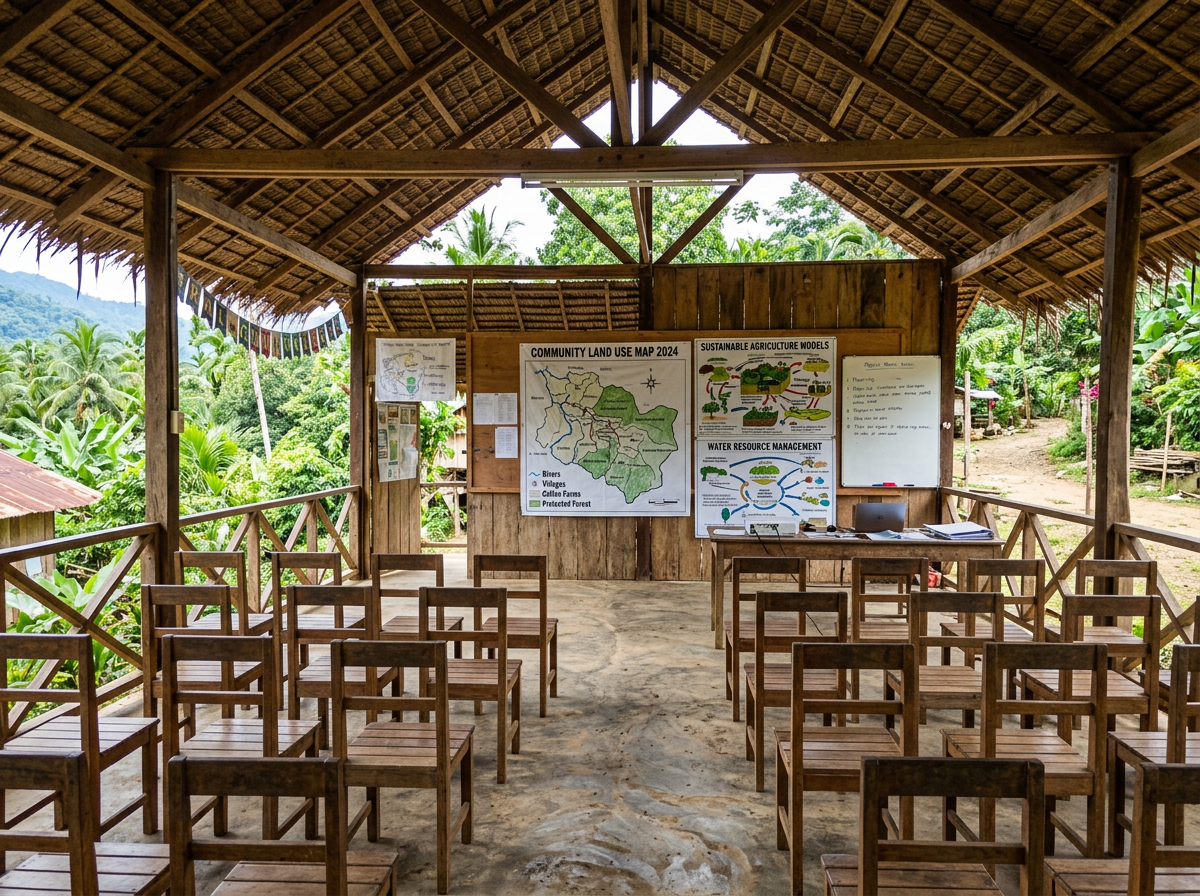
    • Setting: Barangay-level or LGU-supported community
    • Cadence: 2 sessions per week (3–4 hours each)
    • Expected Output: At least one functioning micro-system

    This is not arbitrary.

    It mirrors anthropological observations of community-scale cohesion in pre-colonial Philippine societies, where leadership roles—including those associated with figures like the babaylan—operated within tight social units rather than large anonymous populations (Scott, 1994).


    Phase Structure — With Week-Level Reality


    Phase 1 (Weeks 1–4): Cultural Grounding

    This phase is not “orientation.”
    It is deconditioning.


    Participants confront:

    • Their assumptions about history
    • Their relationship to authority
    • Their level of disconnection from local systems

    Activities include:

    • Mapping local resource flows (food, water, labor)
    • Reconstructing pre-colonial systems using guided materials
    • Identifying gaps between inherited narratives and lived reality

    This phase draws directly from
    Pre-colonial Philippine Economics


    Observed Reality (Week 2–3):

    • Participants often default to “textbook answers”
    • Discomfort emerges when asked to describe their own barangay systems
    • Early signs of disengagement from abstract learners

    Output:
    A Context Map—not theoretical, but specific to their barangay


    Phase 2 (Weeks 5–8): Relational Stress Testing

    https://images.openai.com/static-rsc-4/m3J9mJdFftUjFXRJ-Te-3euJ_ELhghs6V79bCDbsiIUpujO5viD_wAUt4mQ6X66c86DiVAg-FA17fe9N3hFT3uL3y2vcu7mmdd9f9ptbOpWJkVE4VGNdUdsIjpWnwQa2f13yX5LFFHifVTydvjac06B1yINZS_L8WtSZb2b6QeZuy4MX0xW3nU2kdp0soM-k?purpose=fullsize

    This is where most programs fail.

    Because this is where friction becomes visible.


    Participants are placed in:

    • Conflicting decision scenarios
    • Resource allocation dilemmas
    • Leadership rotation exercises

    What emerges is predictable:

    • Dominant personalities attempt control
    • Passive participants withdraw
    • Conflict avoidance patterns surface (common in high “hiya” cultures)

    These dynamics align with broader cultural patterns explored in
    The Architecture of Silence

    Research in critical pedagogy shows that learning accelerates when participants are forced to confront real relational tension, not avoid it (Freire, 1970).


    Observed Reality (Week 6–7):

    • First major conflicts emerge
    • Some participants consider dropping out
    • Cohort cohesion either stabilizes—or fractures

    Output:
    Demonstrated ability to navigate structured conflict without facilitator intervention


    Phase 3 (Weeks 9–12): Systems Under Constraint

    This is the pivot point.

    https://images.openai.com/static-rsc-4/2NPpF7Qf5koTcSaw72DmqolXIKBcYB6yxBbI1tLixQGz-aC4e1oYaPUSWxhRaZvMJ5KN5NCb5SBproQ4zv6FkQgyLIgqMd1699j78o9aGNaBTt7NvLefkpUPTe-TtfMs0aEj0t63JYqQq9MLMReZtvZvum-4_W9bW9AdthnLPWT7gym_JPF2_GTifYiDHE8j?purpose=fullsize

    Participants must now:

    • Work with incomplete data
    • Engage real stakeholders
    • Design systems that function despite limitations

    They are tasked to build systems aligned with:
    ARK-001: The 50-Person Resource Loop


    Examples:

    • Small-scale food redistribution network
    • Community study group for struggling students
    • Waste-to-resource initiative

    Observed Reality (Week 10–11):

    • Plans initially overcomplicate
    • Participants underestimate logistical constraints
    • First contact with community resistance

    Output:

    A working prototype plan with clear inputs, outputs, and failure points


    Phase 4 (Weeks 13–16): Deployment and Feedback

    This phase separates:

    • Those who can explain systems
    • From those who can run them

    Participants:

    • Launch their system (even at micro scale)
    • Track outputs (participation, flow, breakdowns)
    • Present results to barangay stakeholders

    Observed Reality (Week 14–16):

    • Systems partially fail (this is expected)
    • Participants experience real accountability
    • Confidence shifts from abstract to grounded

    Output:

    An operational system, however imperfect


    Facilitator Structure: Preventing Collapse

    The pilot fails without proper facilitation.

    https://images.openai.com/static-rsc-4/DrRD5cdFBr2aTkAVHD85HlfIf2Pmrsu21rEoYHtYPfEtO4ZXNeTS00P_OjsIkjTJXHdbI03anM9vjb_-FAXsZ8RiiRo5W6eVv4Lfn1f2MU9qmoMTa-SfIu7nDEaVXgsWEgcOPw5DH3I4F9W6CQW3zB2sWJohpIJ49FM6A7sV_xFUyDw4IM7y6QMeYDZ1VeoL?purpose=fullsize

    Required Roles:

    • Lead Facilitator: Maintains structural integrity
    • Cultural Anchor: Prevents abstraction drift
    • Technical Advisor: Engaged during system design phase
    • Cohort Leads: Rotating participant leadership

    This reflects the integrative leadership model documented by William Henry Scott, where authority was functional, not hierarchical (Scott, 1994).


    Assessment: What Actually Gets Measured

    Traditional education asks:

    “What do you know?”

    This model asks:

    “What can you sustain?”


    Metrics

    1. Coherence Index
      • Can participants link identity → decision → outcome?
    2. Relational Stability
      • Does the group function under stress?
    3. System Viability
      • Does the micro-system operate for at least 2 weeks?
    4. Community Validation
      • Do external stakeholders perceive value?

    This aligns with experiential learning frameworks where real-world performance is the primary indicator of competence (Freire, 1970).


    Philippine Feasibility: Why This Can Actually Work

    The model is intentionally low-resource:

    • Uses barangay infrastructure
    • Requires minimal technology
    • Leverages local knowledge holders

    This makes it viable for LGUs, where community programs exist but often lack systemic coherence.

    The key advantage:

    It does not require systemic overhaul to begin.

    Only a single functioning pilot.


    Failure Modes (Realistic, Not Theoretical)

    • Participant dropout (Week 5–8)
    • Conflict breakdown (Phase 2)
    • Overdesigned systems that fail in execution
    • Community disengagement

    These are not bugs.

    They are the actual training environment.


    Conclusion: From Curriculum to Capability

    The Babaylan Arc cannot prove itself through narrative.

    It must prove itself through:

    • Participants who can stabilize groups
    • Systems that function under constraint
    • Communities that experience tangible benefit

    This pilot does not guarantee success.

    It guarantees something more valuable:

    Feedback grounded in reality.


    References

    Constantino, R. (1970). The Miseducation of the Filipino.

    Freire, P. (1970). Pedagogy of the Oppressed.

    OECD. (2019). PISA 2018 Results.

    Scott, W. H. (1994). Barangay: Sixteenth-Century Philippine Culture and Society.

    The concepts outlined here are designed for real-world execution. For a complete set of ready-to-use documents—including governance templates, resource tracking sheets, and operational SOPs—explore the 55 Editable Applied Stewardship Toolkit (Complete Set).

    For a broader systems context that situates localized resilience within national and multi-scalar transformation frameworks, explore The Philippine Ark: A Sovereign Blueprint for Systemic Transformation.


    Continue Through the ARK Series

    This framework is designed as a complete system. You can explore it sequentially or move directly to the layer most relevant to your work:

    Foundations

    Design + Build

    Systems Layer

    Scaling


    Suggested Pathways

    New to the framework?

    Start with ARK-001 ARK-008ARK-011


    Designing a physical site?

    Begin with ARK-007ARK-008ARK-009


    Preparing for real-world deployment?

    Focus on ARK-011ARK-012ARK-013


    Thinking long-term scale?

    Move to ARK-010


    [DOCUMENT CONTROL & STEWARDSHIP]

    Standard Work ID: [ARK-005]

    Baseline Version: v1.5.2026

    Classification: Open-Access Archive / Systemic Protocol

    The Sovereign Audit: Following this protocol is an act of internal quality control. Verification of this standard does not happen here; it happens at your Gemba—the actual place where your life and leadership occur. No external validation is required or offered.

    Next in Sequence: [ARK-006: Governance Protocols for Distributed Communities]

    Return to Archive: [Standard Work Knowledge Hub: The Terrain Map]


    © 2026 Gerald Daquila • Life.Understood • Systemic Stewardship • Non-Autocratic Architecture • Process over Persona

  • ARK-004: Post-Fiat Trade — The Community Ledger SOP

    ARK-004: Post-Fiat Trade — The Community Ledger SOP


    A Standard Operating Procedure for Trust-Anchored Exchange Beyond Fiat Systems


    Meta Description

    A practical SOP for post-fiat trade using community-ledgers—outlining how local economies can function through trust, transparency, and structured exchange systems.


    Introduction: When Currency Fails, Exchange Does Not

    Modern economies assume that trade depends on currency.

    But historically—and repeatedly during systemic disruptions—trade persists even when currency fails.

    What replaces it is not chaos, but relational accounting systems: ledgers, mutual credit, and trust-based exchange.

    From the barter networks of crisis economies to the emergence of Local Exchange Trading Systems (LETS), communities have demonstrated that value exchange can be coordinated without centralized money (Greco, 2001; North, 2010).

    This piece builds on the operational grounding established in ARK-001: The 50-Person Resource Loop and the institutional framing in ARK-003: Jurisdictional Sovereignty: Legal Standard Work, by defining a core question:

    If fiat systems degrade or become unreliable, how do communities continue to trade—coherently, fairly, and sustainably?

    The answer is not barter alone.

    It is the Community Ledger.


    What Is a Community Ledger?

    A Community Ledger is a structured record of value exchange within a defined group—tracking contributions, obligations, and balances without requiring physical currency.

    Unlike informal barter, which struggles with coincidence of wants, a ledger enables asynchronous exchange:

    • One member provides value now
    • Another reciprocates later
    • The system records and balances these flows over time

    This model aligns with what economists describe as mutual credit systems, where currency is not issued upfront but created dynamically through exchange (Greco, 2001).

    Key distinction:

    • Fiat money = externally issued, scarce, interest-bearing
    • Ledger credit = internally generated, elastic, obligation-based

    The ledger does not replace value.
    It makes value visible, traceable, and accountable.


    Why Ledger-Based Trade Works

    Three constraints make post-fiat trade viable:

    1. Trust Is Local, Not Global

    Large-scale financial systems require abstraction.

    Local systems rely on recognition and accountability—members know or can verify each other’s contributions.

    Anthropological studies show that pre-modern and small-scale economies operated primarily through reciprocity and social credit, not anonymous transactions (Graeber, 2011).


    2. Scarcity Is Managed, Not Manufactured

    Fiat systems often impose artificial scarcity through interest and centralized issuance.

    Community ledgers:

    • Expand when exchange occurs
    • Contract when obligations are settled

    This creates a self-regulating liquidity model.


    3. Value Becomes Multi-Dimensional

    Fiat systems reduce value to price.

    Ledgers allow recognition of:

    • Labor
    • Goods
    • Services
    • Care work
    • Knowledge transfer

    This aligns with emerging alternative economic models that emphasize plural forms of value accounting (North, 2010).


    The Community Ledger SOP (Standard Operating Procedure)

    This SOP outlines how a 50-person node (as defined in ARK-001) can implement a working post-fiat trade system.


    Phase 1: Define the Ledger Unit

    A ledger unit is not “money.” It is a measurement of contribution.

    Options include:

    • Time-based (e.g., 1 unit = 1 hour of labor)
    • Hybrid (weighted by skill or scarcity)
    • Resource-indexed (linked to core goods like food or water)

    Recommendation:
    Start simple—time-based units—to reduce friction and disputes.


    Phase 2: Establish Member Registry

    Each participant must have:

    • Unique identity (verified within the group)
    • Ledger account (starting at zero)

    No pre-issued currency.

    Balances emerge through activity.


    Phase 3: Define Exchange Categories

    To avoid ambiguity, standardize categories:

    • Food production
    • Water and utilities
    • Maintenance and repair
    • Health and care
    • Education and coordination

    Each transaction must specify:

    • Provider
    • Receiver
    • Category
    • Units exchanged

    Phase 4: Recording Protocol

    All exchanges must be recorded within a fixed time window (e.g., 24–48 hours).

    Recording methods:

    • Physical ledger book (low-tech resilience)
    • Shared spreadsheet (intermediate)
    • Local server or offline-first app (advanced)

    Transparency is critical.

    All members must be able to view aggregate balances (with privacy safeguards as needed).


    Phase 5: Balance Thresholds

    To prevent hoarding or chronic deficit:

    • Set maximum positive balance (encourages circulation)
    • Set maximum negative balance (prevents overdraw)

    Example:

    • +100 units cap
    • −50 units floor

    Members exceeding limits must rebalance through participation.


    Phase 6: Dispute Resolution

    All systems fail without governance.

    Establish:

    • A small rotating council (3–5 members)
    • Clear escalation steps
    • Evidence-based review (ledger entries)

    This connects directly to governance frameworks outlined in ARK-003: Jurisdictional Sovereignty.


    Phase 7: Periodic Reconciliation

    Every 30–60 days:

    • Audit ledger balances
    • Identify inactive accounts
    • Resolve persistent deficits or surpluses

    This ensures the system remains alive, not stagnant.


    Failure Modes (and How to Prevent Them)

    A ledger system is simple—but not immune to breakdown.

    1. Free-Rider Problem

    Some members consume without contributing.

    Mitigation:
    Balance thresholds + participation requirements.


    2. Value Disputes

    Members disagree on how much a task is worth.

    Mitigation:
    Standardize baseline units (time-based) and allow minor adjustments only when justified.


    3. Ledger Inaccuracy

    Delayed or incorrect entries erode trust.

    Mitigation:
    Strict recording windows + periodic audits.


    4. Social Friction

    Non-financial tensions spill into economic exchange.

    Mitigation:
    Separate interpersonal mediation from ledger governance.


    From Ledger to System

    A functioning community ledger does more than enable trade.

    It becomes:

    • A signal system (who contributes, where gaps exist)
    • A resilience layer (trade continues even if fiat fails)
    • A training ground for stewardship and accountability

    This is not theoretical.

    Similar systems have been implemented globally—from LETS networks in Canada to time banks in the U.S. and Europe—demonstrating durability under economic stress (North, 2010).


    Conclusion: Trade Is a Relationship, Not a Currency

    Fiat systems give the illusion that money enables exchange.

    In reality:

    Exchange is a function of trust, record, and reciprocity.

    The Community Ledger simply formalizes what has always existed beneath currency.

    Within the Philippine context—where relational networks, mutual aid (bayanihan), and informal economies already operate—the transition to ledger-based systems is not a radical departure.

    It is a structured return to a familiar pattern, made operational.

    As the ARK series progresses—from resource loops to jurisdictional frameworks to trade systems—the architecture becomes clear:

    Together, they form a minimal viable system for localized sovereignty under uncertainty.


    References

    Graeber, D. (2011). Debt: The first 5,000 years. Melville House Publishing.

    Greco, T. H. (2001). Money: Understanding and creating alternatives to legal tender. Chelsea Green Publishing.

    North, P. (2010). Local money: How to make it happen in your community. Green Books.

    The concepts outlined here are designed for real-world execution. For a complete set of ready-to-use documents—including governance templates, resource tracking sheets, and operational SOPs—explore the 55 Editable Applied Stewardship Toolkit (Complete Set).

    For a broader systems context that situates localized resilience within national and multi-scalar transformation frameworks, explore The Philippine Ark: A Sovereign Blueprint for Systemic Transformation.


    Continue Through the ARK Series

    This framework is designed as a complete system. You can explore it sequentially or move directly to the layer most relevant to your work:

    Foundations

    Design + Build

    Systems Layer

    Scaling


    Suggested Pathways

    New to the framework?

    Start with ARK-001 ARK-008ARK-011


    Designing a physical site?

    Begin with ARK-007ARK-008ARK-009


    Preparing for real-world deployment?

    Focus on ARK-011ARK-012ARK-013


    Thinking long-term scale?

    Move to ARK-010


    [DOCUMENT CONTROL & STEWARDSHIP]

    Standard Work ID: [ARK-004]

    Baseline Version: v1.5.2026

    Classification: Open-Access Archive / Systemic Protocol

    The Sovereign Audit: Following this protocol is an act of internal quality control. Verification of this standard does not happen here; it happens at your Gemba—the actual place where your life and leadership occur. No external validation is required or offered.

    Next in Sequence: [ARK-005: The Babaylan Arc – Institutional Curriculum]

    Return to Archive: [Standard Work Knowledge Hub: The Terrain Map]


    © 2026 Gerald Daquila • Life.Understood Systemic Stewardship • Non-Autocratic Architecture • Process over Persona

  • ARK-002: The Babaylan Arc — Toward an Institutional Curriculum for Cultural Memory and Coherent Leadership

    ARK-002: The Babaylan Arc — Toward an Institutional Curriculum for Cultural Memory and Coherent Leadership


    Meta Description

    A systems-level proposal for integrating the Babaylan tradition into modern Philippine education—bridging cultural memory, leadership formation, and post-colonial healing through an institutional curriculum.


    Introduction: From Symbol to System

    Across Philippine discourse, the babaylan is often invoked as symbol—an emblem of pre-colonial identity, feminine spiritual authority, or indigenous resistance. Yet symbols, when not operationalized, remain inert.

    The question this essay asks is more difficult:

    What would it mean to translate the Babaylan tradition into a functional, institutional curriculum—one that forms leaders capable of navigating both cultural memory and modern systemic complexity?

    This is not a call to romanticize the past. It is an attempt to recover a lost architecture of coherence—a system that once integrated spirituality, governance, healing, and ecological stewardship into a unified role.

    In a time when educational systems struggle to produce grounded, ethical leaders, revisiting this architecture is not nostalgic—it may be necessary.


    The Historical Babaylan: Integrated Roles, Not Fragmented Functions

    https://images.openai.com/static-rsc-4/82c_if3h4FyLnYcHWjHGBW5mAtSXzIYhvdbrQFaO2qiuZoMXaJV9lgOAWe5W5DKuLN6TE4UlEN23ce8zWwT1BXwn6_LByZXph_N_ivr6CrcMoGrpKM_AwWM1aSjWliG_pLwL6uRTri8P9svvsNXLnQTdgGYa1WE3G0N6-jehJnz0P7K_pnXOWtKUtyUf0ju_?purpose=fullsize
    https://images.openai.com/static-rsc-4/mCDOmqFwEqh2wxVQ8mWLmi0UZEuYWyJN83ny3yukq-9KzVAAHUZzVHzaL-KEOUkBxfAZwYfPE-gq_ym5Ar-AP9zF38ucofnXbb_hXuA5XtsU7pneZDg2yojfz08p6jUuph6Tfhofpi5_mGkWPyAt3jxVRpGmKjwpToza22jol25bSWolu78tlR6VXcW-Ha4P?purpose=fullsize

    Pre-colonial accounts describe the babaylan not as a “priestess” in the narrow religious sense, but as a multi-domain node within the community system.

    According to William Henry Scott, the babaylan functioned simultaneously as healer, ritual specialist, community historian, and mediator between visible and invisible domains (Scott, 1994).

    Spanish chroniclers—despite their bias—also documented their influence over communal decision-making and conflict resolution (Rafael, 1988).

    Critically, this role was:

    • Embodied (not purely intellectual)
    • Contextual (rooted in land and community)
    • Integrative (not siloed into disciplines)

    Modern education, by contrast, fragments knowledge into isolated domains—science, ethics, governance—without a unifying framework.

    The result: graduates who are technically competent but often systemically incoherent.


    Colonial Disruption and the Collapse of Cultural Transmission

    The decline of the babaylan was not accidental. It was structurally induced.

    Under Spanish colonization, indigenous knowledge systems were systematically suppressed, with the babaylan reframed as heretical or subversive (Rafael, 1988).

    This was followed by the American educational system, which introduced standardized, industrial-era schooling focused on literacy, compliance, and bureaucratic function (Constantino, 1970).

    As Renato Constantino argued, this produced a form of “miseducation,” where Filipinos were trained to operate within external frameworks while becoming estranged from their own cultural foundations (Constantino, 1970).

    The long-term effect is still visible today:

    • Weak civic trust
    • Fragmented identity
    • High sensitivity to authority but low systems ownership

    These are not merely cultural traits—they are educational outcomes.


    Why an Institutional Curriculum—Not Just Cultural Revival

    Cultural revival movements exist. Workshops, retreats, and artistic reinterpretations have kept aspects of the babaylan memory alive.

    But these operate at the margins.

    If the goal is systemic impact, the intervention must occur at the level where identity and cognition are formed:

    The curriculum.

    This aligns with insights from Educational Theory, particularly the work of Paulo Freire, who emphasized that education is never neutral—it either reproduces existing systems or transforms them (Freire, 1970).

    A Babaylan Arc curriculum would not replace existing subjects. It would function as an integrative layer—a framework that reconnects fragmented disciplines into a coherent worldview.


    The Babaylan Arc: A Proposed Curriculum Framework

    The Babaylan Arc can be structured across four developmental layers:

    1. Foundation: Cultural Memory and Identity

    • Pre-colonial history and economic systems
    • Oral traditions and local epistemologies
    • Language and symbolic systems

    2. Integration: Embodied and Relational Intelligence

    • Emotional regulation and conflict mediation
    • Community dynamics and kinship systems
    • Ethical decision-making grounded in context

    This layer reconnects learners to their historical baseline, addressing the identity fragmentation described in Pre-colonial Philippine Economics.

    https://images.openai.com/static-rsc-4/n84PkzhtCnkhA85EFrg3aVJvyYSWN4kOA71oiZp0lU4z_mKp5HYGiN-Yp8SCLhhsmtxHMwr3oPJSUF5Fnm6JppKkKDm-GMUNSYrqjeJWe761O6zwNe-5AYWnHpL9aLkxJsXGW1XS-TIZH5NDD1Yg9QM47lCdbIdm0HCD5NytpvoifPJXz_wAavAz9brPNyQH?purpose=fullsize

    Here, the focus shifts from knowledge acquisition to relational competence—a domain largely absent in formal schooling.


    3. Systems Layer: Governance, Ecology, and Resource Stewardship

    • Local governance structures (historical and modern)
    • Resource cycles and community resilience
    • Decision-making under constraint

    This directly interfaces with the logic of the ARK series, particularly ARK-001: The 50-Person Resource Loop, where leadership is tested under real-world conditions.

    https://images.openai.com/static-rsc-4/6jWSJQ9cpxiMVA2HtD_3FtLt6dS1qrDvDY0p1fHwFbiYeX6p6dYVn2y7XUUywjD5B9YjCmLTW8fjDlQgVDLBWbcMBoM0e2zShjR6Nt476cK4AL81Gvs-4cqO0SofA0w_GOaSYJG4YGANNoSxxEx36NL2s-y96LhskMxsDWvYue4p-9Unc_OzPsBXJPicaUXu?purpose=fullsize

    4. Stewardship: Applied Leadership and Community Practice

    • Field immersion in local communities
    • Facilitation of small-scale systems (food, water, education loops)
    • Reflection and iterative improvement

    This final layer ensures the curriculum does not remain theoretical. It produces operators, not just thinkers.


    Bridging the Gap: From Curriculum to National Relevance

    The Philippines’ recent struggles in education—highlighted by consistently low performance in global assessments such as the Programme for International Student Assessment (PISA)—point to systemic issues beyond literacy or numeracy (OECD, 2019).

    The problem is not simply academic deficiency.

    It is contextual disconnection.

    Students are trained in abstract frameworks that do not map onto their lived reality. A Babaylan Arc curriculum addresses this by:

    • Embedding learning in local context
    • Reintegrating ethics with action
    • Producing leaders capable of systems thinking under real constraints

    This aligns with the broader themes explored in The Architecture of Silence, where unresolved historical patterns continue to shape present behavior through invisible cultural codes.


    Risks and Guardrails

    This approach is not without risk.

    1. Romanticization – Turning the babaylan into myth rather than system
    2. Commercialization – Reducing it to workshops detached from community
    3. Institutional resistance – Existing systems may reject integrative models

    To mitigate this, the curriculum must remain:

    • Evidence-informed
    • Locally grounded
    • Iteratively tested (through pilot programs, not immediate scale)

    Conclusion: Rebuilding the Missing Layer

    The Babaylan Arc is not about returning to the past.

    It is about recovering a missing layer in the present system.

    Modern education produces specialists.
    The babaylan tradition produced integrators.

    In an era defined by systemic fragility—ecological, economic, and social—the limiting factor is no longer information.

    It is coherence.

    An institutional curriculum that restores this coherence may not solve every problem. But without it, many of our existing solutions will continue to fail—because they are built on fragmented foundations.


    Glossary (Brief)

    Babaylan – A pre-colonial Filipino spiritual and community leader integrating healing, governance, and ritual roles.

    Cultural Memory – The collective transmission of knowledge, values, and practices across generations.

    Systems Thinking – The ability to understand interconnections within complex systems rather than isolated parts.

    Stewardship – Responsibility for managing resources and systems with long-term sustainability in mind.


    References

    Constantino, R. (1970). The Miseducation of the Filipino. Foundation for Nationalist Studies.

    Freire, P. (1970). Pedagogy of the Oppressed. Continuum.

    OECD. (2019). PISA 2018 Results. Organisation for Economic Co-operation and Development.

    Rafael, V. L. (1988). Contracting Colonialism: Translation and Christian Conversion in Tagalog Society. Cornell University Press.

    Scott, W. H. (1994). Barangay: Sixteenth-Century Philippine Culture and Society. Ateneo de Manila University Press.

    The concepts outlined here are designed for real-world execution. For a complete set of ready-to-use documents—including governance templates, resource tracking sheets, and operational SOPs—explore the 55 Editable Applied Stewardship Toolkit (Complete Set).

    For a broader systems context that situates localized resilience within national and multi-scalar transformation frameworks, explore The Philippine Ark: A Sovereign Blueprint for Systemic Transformation.


    Continue Through the ARK Series

    This framework is designed as a complete system. You can explore it sequentially or move directly to the layer most relevant to your work:

    Foundations

    Design + Build

    Systems Layer

    Scaling


    Suggested Pathways

    New to the framework?

    Start with ARK-001 ARK-008ARK-011


    Designing a physical site?

    Begin with ARK-007ARK-008ARK-009


    Preparing for real-world deployment?

    Focus on ARK-011ARK-012ARK-013


    Thinking long-term scale?

    Move to ARK-010


    [DOCUMENT CONTROL & STEWARDSHIP]

    Standard Work ID: [ARK-002]

    Baseline Version: v1.4.2026

    Classification: Open-Access Archive / Systemic Protocol

    The Sovereign Audit: Following this protocol is an act of internal quality control. Verification of this standard does not happen here; it happens at your Gemba—the actual place where your life and leadership occur. No external validation is required or offered.

    Next in Sequence: [ARK-003: Jurisdictional Sovereignty: Legal Standard Work]

    Return to Archive: [Standard Work Knowledge Hub: The Terrain Map]


    © 2026 Gerald Daquila • Life.Understood Systemic Stewardship • Non-Autocratic Architecture • Process over Persona

  • The Philippine Ark: A Sovereign Blueprint for Systemic Transformation

    The Philippine Ark: A Sovereign Blueprint for Systemic Transformation


    By early 2026, the global narrative has shifted from mere “digital transformation” to something far more profound: Systemic Transition.

    For the Sovereign Professional, the noise of the legacy corporate world is increasingly being replaced by a high-signal frequency—one that points toward a new architecture of value. At the center of this shift is a profound framework known as The Philippine Ark.

    Spanning a critical four-part series, the “Philippine Ark Codes” offer more than just spiritual or cultural reflection; they provide a Systemic Operating System for navigating the 2026 reset.

    Whether you are a tech lead in Silicon Valley or a financial architect in Manila, understanding the Ark is about moving your “Value Stream” from an extractive past to a generative future.


    Part 1 & 2: Reawakening the Island Node

    The first two stages of the series, Part 1: Philippine Ark Codes: Reawakening the Islands, establish the foundational “Signal” over the “Noise.”

    In the 2026 context, “Reawakening” is a technical term for Sovereign Clarity. It is the process of stripping away the colonial and extractive layers that have suppressed the Philippines’ potential as a global node of value.

    For the high-performer, this is the ultimate “Lean Audit.” You cannot build a new architecture on a foundation of “Muda” (waste).

    Parts 1 and 2 argue that the islands—and by extension, the professionals who inhabit them or lead them—are being activated as a Coherence Node.

    This activation is essential to withstand the volatility of the global reset. As explored in Signal vs Noise: Why Clear Thinking Is Rare, the ability to maintain internal stability while systems collapse is the defining trait of the 2026 leader.


    Part 3: The Diaspora and the Building of the Ark

    Part 3 of 4. The Diaspora, Ark Codes & Building the Ark shifts the focus to the global Filipino community. This is where the concept of “Agentic Stewardship” becomes practical.

    The Diaspora is not just a source of remittances; it is a distributed network of Sovereign Talent that holds the “codes” for a new economy.

    In 2026, “Building the Ark” means creating redundant, independent, and high-trust systems that operate outside of traditional extractive banking. This is the GESARA Bridge in action.

    The Ark is a “vessel” of resources—intellectual, technological, and financial—that ensures that when the “old world” systems fail, the Sovereign Professional has a platform for continued output.

    This is about moving beyond the “Ube Latte” aesthetic and into the structural reality of being a “Barangay Architect” in a digital world.


    Part 4: The Ascension of the System

    The final movement, Part 4: Reawakening the Islands for Earth’s Ascension, brings the framework to its apex. Here, “Ascension” is translated into the language of Systemic Complexity.

    It is the transition from a low-efficiency, competition-based economy to a high-efficiency, cooperation-based “Sacred Economy.”

    For the Sovereign Professional, this means your “Incentive Structure” must change. You can no longer optimize for short-term extractive gain because the system itself is moving toward zero-waste.

    As analyzed in Incentives Drive Behavior: Why Good Intentions Fail in Systems, the old systems failed because they rewarded the “scrap” (interest/debt). The Ark rewards Flow.


    The Ark as a Cognitive Operating System

    The “Philippine Ark” is not a piece of land; it is a Cognitive OS. It is a way of perceiving power, wealth, and community that is immune to corporate toxicity.

    By integrating the four parts of the Ark series, the professional begins to practice “Gemba Walking the Ancestral Soul.”

    1. Observation (Part 1-2): Seeing the hidden patterns of the island nodes and recognizing the “Signal.”
    2. Network (Part 3): Activating the Diaspora as a Sovereign Resource Pipeline.
    3. Deployment (Part 4): Executing work that contributes to the “New Earth” architecture.

    Conclusion: Boarding the Vessel

    The 2026 economic environment is a desert of meaning, but the The Philippine Ark provides the oasis. The “Ark” is currently being built by “Silent Professionals” who recognize that the financial miracles promised by GESARA are not “free money,” but a Systemic Reset to Zero Waste.

    Boarding the Ark requires you to trade your “employee” mindset for a “Sovereign” architecture.

    It requires you to stop being a unit of labor and start being a steward of the transition. The codes are active. The series is complete.

    The question is: Are you an architect of the Ark, or are you still trying to patch a sinking ship?

    To translate systemic vision into lived infrastructure, the next layer moves from macro-design into operational reality. See how localized resource loops function at human scale in ARK-001: The 50-Person Resource Loop: A Field Manual for Localized Resilience.


    The Sovereign Professional: A structural map of power, systems thinking, and personal autonomy—dedicated to helping the independent professional navigate complexity and own their value stream.


    ©2026 Gerald Daquila • Life.Understood. • Systems Thinking, Leadership Architecture, and Applied Coherence

  • Agentic Stewardship: Why the ‘New Earth’ is a Cognitive Operating System, Not a Financial Miracle

    Agentic Stewardship: Why the ‘New Earth’ is a Cognitive Operating System, Not a Financial Miracle


    By mid 2026, the promise of “Artificial Intelligence” has mutated. We have moved past the era of chatbots and image generators into the era of Agentic AI—systems that don’t just predict text, but reason, plan, and execute complex goals across entire digital ecosystems.

    For the “Silent Professionals” sitting in the high-rises of BGC or the remote hubs of Silicon Valley, this shift has created a profound sense of vertigo.

    You see the writing on the wall. The legacy systems of finance and tech—those extractive, high-friction hierarchies—are being rendered obsolete by agents that can optimize value streams at speeds no human committee can match.

    You are looking for an exit ramp, and in the “fringe” corners of the web, you keep hearing about GESARA and a “New Earth.”

    But here is the direct, unvarnished truth: The “New Earth” is not a financial miracle coming to save you from your debts.

    It is a Cognitive Operating System you must install to survive the systemic reset.


    The 2026 Context: Agentic AI as Sovereign Infrastructure

    In 2026, Agentic AI has become the primary mirror for our own competence. When an AI can plan a 12-month project and execute the first 30% without human intervention, it exposes the massive “Muda” (waste) inherent in traditional corporate management.

    For the professional in finance or tech, the realization hits: if a machine can reason and plan with more coherence than your department head, the department head’s role is a structural defect.

    This is where the concept of Agentic Stewardship emerges.


    Sovereignty in this new landscape isn’t about “owning” the AI; it’s about becoming the consciousness that directs it.

    We are moving from a world of “units of labor” to a world of “Sovereign Resource Pipelines.” As discussed in Signal vs Noise: Why Clear Thinking Is Rare, the ability to maintain clarity amidst the collapse of old certainties is the only asset that holds its value.


    Reframing GESARA: The End of Extractive Muda

    The “Silent Professional” often views GESARA (The Global Economic Security and Reformation Act) through a lens of desperate hope—a “free money” event that wipes the slate clean. But a Sovereign Professional understands that a systemic reset is never a gift; it is an Efficiency Event.

    If we look at the current financial system through a Lean lens, it is riddled with extraction.


    Interest-based debt, complex derivative layering, and the “taxation of movement” are all forms of waste that prevent capital from reaching its highest-potential use.

    A “Systemic Reset” to a higher-efficiency, zero-waste value stream isn’t about giving everyone a windfall; it’s about the removal of the friction that currently keeps the “Sovereign Professional” in a state of indentured service.

    As explored in Incentives Drive Behavior: Why Good Intentions Fail in Systems, the old system incentivized debt and complexity because that is how it extracted power.


    The “New Earth” system incentivizes Stewardship. If you aren’t prepared to be an agent of value, a reset won’t save you—it will simply leave you behind in a world where “effort” is no longer the metric of success.


    The Cognitive OS: Stewardship Over Survival

    The “Exit Ramp” you are looking for isn’t a destination; it’s a shift in your internal architecture.

    Most professionals are running a Survival OS—an operating system optimized for pleasing the hierarchy, avoiding risk, and maintaining solvency.

    The “New Earth” requires the installation of the Agentic Stewardship OS.


    This OS is built on three core modules:

    1. Sovereign Governance: The ability to govern your own attention and resources without an external manager.
    2. Reasoning Capacity: Shifting from “executing tasks” to “defining goals.” In the age of Agentic AI, the human’s role is the Goal Designer.
    3. Coherent Stewardship: Managing resources (financial, technological, and energetic) in a way that minimizes waste and maximizes generative output.

    This is the bridge to the Sovereignty Architecture: A Coherence Framework. Without this internal shift, you will bring the same “slave-logic” into a new system, and you will find yourself once again wondering Why Hard Work Alone Doesn’t Make You Valuable.


    The Call to the Silent Professionals

    You in Finance: You see the algorithmic decay of the fiat system.


    You in Tech: You see the “Dead Internet Theory” becoming a reality as AI agents outpace human content.

    You are the ones capable of building the new pipelines. But to do so, you must stop waiting for a “Financial Miracle” and start practicing The Discipline of Inner Sovereignty.

    Agentic Stewardship means you stop being a “user” of the system and start being the “architect” of the flow.

    GESARA, if it manifests as a systemic reset, is simply the grand opening of the Gemba—the “real place” where value is created.

    It is the removal of the extractive middleman. If you have spent your career becoming an expert in the friction of the old system (the red tape, the tax loopholes, the management bloat), you are currently high-risk inventory.

    If you are learning to be an agent of pure value, you are the cornerstone of the New Earth.


    Conclusion: The Exit Ramp is Internal

    The “New Earth” isn’t a location you find on a map after a global reset.


    It is the reality that manifests when a critical mass of professionals decides to stop serving the waste-stream and start serving the value-stream.

    Agentic AI is the catalyst. It is forcing us to be more “human” than we have ever been allowed to be in a corporate setting. It is forcing us to become Stewards.

    The exit ramp is open. But to take it, you must be willing to trade your “employee” mindset for a “Sovereign” architecture.


    The Sovereign Professional: A structural map of power, systems thinking, and personal autonomy—dedicated to helping the independent professional navigate complexity and own their value stream.


    ©2026 Gerald Daquila • Life.Understood. • Systems Thinking, Leadership Architecture, and Applied Coherence