
Logo - Life.Understood.

Category: Relationships

  • The Steward’s Mirror: Why Facing Our Shadow Is the First Step to Reclaiming the Babaylan Legacy

    The Steward’s Mirror: Why Facing Our Shadow Is the First Step to Reclaiming the Babaylan Legacy


    From inherited fragmentation to embodied guidance—how inner work restores the integrity of Filipino leadership


    Meta Description

    Reclaiming the Babaylan legacy begins within. Discover how shadow work, identity integration, and cultural grounding shape the next generation of Filipino stewards.


    The Return of a Forgotten Archetype

    Across the Philippines, there is a quiet resurgence of interest in the Babaylan—the precolonial figure often described as healer, mediator, ritual specialist, and community guide.

    Before colonization, the Babaylan was not marginal.

    They were central.

    https://images.openai.com/static-rsc-4/yQ1a7GXCoQ_lbYALVKw6pFnqeND28K9D2AxeUVHLCCtMaZP7eZeyXjhcmMZCoBWDFOMXu1lYFXfhkVwZOWZeKR_LUBUbYyZ1YmVuukAn9zYF5QTFBJpB3iMXwTXL9vkeFakQU87TL0i_GtevSUCBLH2m4cpQ20BtaIj-kkTBwnOnUeSSxH3-50X382BV88Vt?purpose=fullsize

    They held roles that integrated:

    • Spiritual leadership
    • Emotional and communal care
    • Ecological awareness
    • Decision-making influence
    https://images.openai.com/static-rsc-4/1RnuAWILwAHsShghkSyc5jMUmBp6Ogp2Nzvr8U8BWyWf-YkwIPpEZcWw4YbdCQUJ2GFkWlQro5VGef3A2hLOhRDBLU4f6P3XfrLxQWf7ictXyTgJPqO7DfCrE1mEB5BZb9I_wC2yLQWl4aXPwWgw6jziYeM5I91I5XuA9OIPaJGfjSVJnWzWEygOXxoQZWLH?purpose=fullsize

    But with the arrival of colonial systems, this archetype was systematically displaced—replaced by external religious hierarchies and institutional authority (Jocano, 1969).

    Today, as Filipinos seek to reclaim identity and sovereignty, the Babaylan re-emerges not as a relic—but as a reference point.

    https://images.openai.com/static-rsc-4/0UlJo-MT3w5SYKXzHSgtVVAgoLuPphJGjruuXkemoPoIoIkcnpG9cWt4q2LtNlvkFf1PQSiHCX_RxD3aGhIo-arczPzmY6MbknrN973A2iLHaatAuScoDQfZqjF8wmcgSnVGY-yfmggykLZtyUzMx-B5ZpYp0XhdFZTO-dqmYEH7MQgAZBS_smeJF8Qi23t_?purpose=fullsize

    Yet there is a crucial misunderstanding that must be addressed:

    The Babaylan is not reclaimed through imitation.
    It is reclaimed through integration.


    The Mirror Before the Mantle

    There is a growing desire to “step into” the Babaylan role—often expressed through spiritual language, rituals, or symbolic identification.

    But the original function of the Babaylan required something deeper:

    Clarity of self.

    A guide who has not faced their own shadow cannot safely hold space for others.

    This is where many modern attempts falter.

    They seek the mantle without the mirror.


    What Is the Steward’s Mirror?

    The steward’s mirror is the process of turning inward to examine:

    • Personal motivations
    • Emotional triggers
    • Inherited patterns
    • Unresolved wounds

    It asks difficult questions:

    • Why do I want to lead or guide?
    • Where am I still reactive or defensive?
    • What parts of myself do I avoid seeing?

    This aligns with psychological frameworks of shadow work, where integrating disowned aspects of the self leads to greater coherence and stability (Jung, 1959).

    Without this process, leadership becomes projection.


    The Filipino Shadow: A Collective Layer

    Shadow work in the Filipino context is not only individual.

    It is collective.

    (Crosslink: Naming the Unspoken: A Guide to Navigating the Hidden Fractures of Our National Identity)

    The shared shadow includes:

    • Colonial mentality
    • Generational shame around poverty
    • Avoidance of conflict
    • Dependency on external validation

    These patterns shape how leadership is expressed:

    • Over-accommodation instead of clarity
    • Avoidance of difficult truths
    • Desire to be accepted rather than effective

    (Crosslink: Money, Guilt, and the Colonized Soul: Why We Sabotage Our Own Sovereignty)

    If unaddressed, these dynamics are carried into any leadership role—including spiritual ones.


    Why Shadow Work Comes First

    Reclaiming the Babaylan legacy requires more than cultural memory.

    It requires energetic and psychological integrity.

    Shadow work provides this by:

    1. Reducing Projection

    Unintegrated emotions are often projected onto others.

    A steward must be able to distinguish:

    • What belongs to them
    • What belongs to the community

    2. Increasing Emotional Capacity

    Holding space for others requires the ability to remain grounded in the presence of:

    • Pain
    • Conflict
    • Uncertainty

    3. Aligning Intention and Action

    Without integration, there is often a gap between:

    • What one says
    • What one does

    This erodes trust.


    4. Preventing Replication of Harm

    Unexamined leaders can unintentionally recreate:

    • Hierarchies
    • Dependency
    • Manipulation

    Even within “healing” spaces.


    The Difference Between Role and Function

    One of the key distinctions in this framework is this:

    The Babaylan is not a title. It is a function.

    It is defined by:

    • What is held
    • What is facilitated
    • What is transformed

    This shifts the focus from identity performance to responsibility.

    (Crosslink: From Informer to Steward: Why True Leadership Begins with Owning Our Shared Shadow)


    The Path of Integration

    Reclaiming the Babaylan legacy involves integrating three layers:


    1. Personal Shadow

    This includes:

    • Emotional wounds
    • Behavioral patterns
    • Internal contradictions

    Work here creates self-coherence.


    2. Cultural Shadow

    (Crosslink: The Ancestral Debt: Healing the Generational Shame of Poverty in the Filipino Psyche)

    This involves:

    • Understanding inherited narratives
    • Releasing limiting beliefs
    • Reframing identity

    3. Systemic Awareness

    A modern steward must also understand:

    • How systems function
    • Where power operates
    • How change is implemented

    (Crosslink: ARK-003: Jurisdictional Sovereignty: Legal Standard Work)

    Without this, leadership remains symbolic.


    The Nervous System Dimension

    Shadow work is not purely cognitive.

    It is embodied.

    When individuals confront difficult truths, the nervous system responds:

    • Activation (fight/flight)
    • Withdrawal (freeze)

    Learning to regulate these responses is essential.

    (Crosslink: Financial Sovereignty Is a Nervous System State: Grounding the QFS in the Filipino Reality)

    A regulated steward can:

    • Stay present in discomfort
    • Respond rather than react
    • Maintain clarity under pressure

    The Risk of Skipping the Mirror

    If the mirror is bypassed, several risks emerge:

    • Spiritual bypassing – using practices to avoid real issues
    • Authority without accountability – claiming roles without responsibility
    • Community harm – reinforcing dependency or confusion
    • Personal burnout – inability to sustain the role

    These outcomes undermine the very legacy being reclaimed.


    The Ark Perspective: Stewardship as Continuity

    Within the Ark framework, the Babaylan archetype is not isolated.

    It is part of a broader movement toward sovereign stewardship.

    (Crosslink: From Fragmented Souls to Sovereign Stewards: Reclaiming Identity After 500 Years of Institutional Trauma)

    This means:

    • Leadership is distributed
    • Responsibility is shared
    • Systems are designed, not just experienced

    The Babaylan becomes one expression of this larger coherence.


    Practical Pathways: Engaging the Steward’s Mirror

    1. Daily Self-Observation

    Notice reactions without immediate judgment.


    2. Pattern Identification

    Track recurring behaviors:

    • Where do I avoid?
    • Where do I overcompensate?

    3. Emotional Processing

    Allow emotions to be:

    • Felt
    • Named
    • Understood

    4. Feedback Integration

    Invite trusted perspectives.

    Blind spots are often relational.


    5. Continuous Alignment

    Regularly ask:

    Are my actions aligned with my stated values?


    Beyond Reclamation: Toward Evolution

    The goal is not to recreate the past exactly as it was.

    The original Babaylan operated within a different context.

    Today’s world requires:

    • Integration of modern knowledge
    • Engagement with complex systems
    • Adaptation to global realities

    This is not dilution.

    It is evolution.


    Conclusion: The Mirror as Initiation

    The desire to reclaim the Babaylan legacy reflects something real:

    A longing for grounded, integrated, culturally rooted leadership.

    But this path does not begin with outward expression.

    It begins with inward clarity.

    The mirror is not an obstacle.

    It is the initiation.

    To face the shadow is to:

    • Reduce harm
    • Increase capacity
    • Build trust

    And from that foundation, something authentic can emerge:

    Not a performance of leadership.

    But its embodiment.


    References

    Jocano, F. L. (1969). Philippine Mythology. University of the Philippines Press.

    Jung, C. G. (1959). Aion: Researches into the Phenomenology of the Self. Princeton University Press.

    David, E. J. R. (2013). Brown Skin, White Minds. Information Age Publishing.

    Constantino, R. (1975). The Philippines: A Past Revisited. Tala Publishing Services.


    The Sovereign Professional: A structural map of power, systems thinking, and personal autonomy—dedicated to helping the independent professional navigate complexity and own their value stream.Ask


    ©2026 Gerald Daquila • Life.Understood. • Systems Thinking, Leadership Architecture, and Applied Coherence

  • Takt Time — The Rhythm of Presence

    Takt Time — The Rhythm of Presence


    How Often a Steward Must “Check In” with Their Internal Signal


    In lean systems, takt time defines the pace at which a product must be completed to meet customer demand.

    It is not arbitrary—it is derived from reality: available time divided by required output (Rother & Shook, 2003). Too slow, and demand is unmet. Too fast, and the system destabilizes, producing errors, burnout, or waste.

    Transposed into the inner architecture of stewardship, takt time becomes something far more intimate:

    The cadence at which a human system must return to awareness in order to remain coherent.

    For diaspora architects and community stewards working across distance, complexity, and layered identities, this concept is not metaphorical—it is operational.

    Without a calibrated rhythm of presence, even the most sophisticated external systems (like the Barangay Value Stream Map) will degrade over time.

    This piece reframes takt time as an internal governance mechanism—a disciplined, repeatable rhythm of checking in with one’s cognitive, emotional, and somatic signals to sustain clarity, alignment, and resilience.


    1. From Industrial Pace to Human Cadence

    In manufacturing, takt time synchronizes production with demand.

    In human systems, the “demand” is more subtle:

    • The need for accurate perception
    • The need for regulated emotional states
    • The need for aligned decision-making

    Cognitive science suggests that human attention naturally oscillates rather than remains constant.

    Studies on ultradian rhythms indicate that cycles of high focus last approximately 90–120 minutes before requiring recovery (Kleitman, 1963; Rossi, 2002). Ignoring these cycles leads to diminished performance and increased error rates.

    Thus, the first principle of internal takt time:

    Presence is not continuous—it is rhythmic.

    A steward who assumes they can operate at peak awareness indefinitely is already operating out of misalignment.


    2. Defining the Internal Signal

    Before establishing a rhythm, one must define what is being “checked.”

    The internal signal is a composite of three domains:

    a. Cognitive Signal

    Clarity of thought, coherence of reasoning, absence of mental noise.


    b. Emotional Signal

    Stability of affect, awareness of emotional shifts, absence of reactive distortion.


    c. Somatic Signal

    Physical sensations—tension, breath pattern, fatigue, or ease.

    Neuroscience research emphasizes that decision-making is deeply influenced by somatic markers—bodily signals that guide judgment, often beneath conscious awareness (Damasio, 1996).

    Ignoring these signals does not eliminate their influence; it only removes them from conscious calibration.

    Thus, the internal signal is not optional—it is always active, whether attended to or not.


    3. Calculating Personal Takt Time

    Unlike industrial systems, human takt time cannot be standardized into a single universal interval.

    However, it can be derived through observation and calibration.

    A practical formulation:

    Personal Takt Time = Duration of sustained clarity before measurable drift

    Where “drift” includes:

    • Reduced focus
    • Emotional reactivity
    • Physical tension or fatigue
    • Decision hesitation or impulsivity

    For many knowledge workers, initial observations reveal:

    • 60–90 minutes of high-quality focus
    • Followed by a decline in signal clarity

    However, for stewards operating in high-stakes or emotionally charged environments (e.g., community facilitation, governance mediation), takt time may be significantly shorter—sometimes 20–40 minutes.

    This aligns with research on cognitive load, which shows that complex decision-making accelerates mental fatigue (Sweller, 1988).

    The implication:

    The more complex the environment, the shorter the optimal check-in interval.


    4. The Cost of Missing the Beat

    In lean systems, missing takt time results in overproduction or underproduction. In human systems, the consequences are more subtle but equally consequential:

    a. Cognitive Drift → Poor Decisions

    Unchecked assumptions, misinterpretation of data, or strategic misalignment.


    b. Emotional Drift → Reactive Behavior

    Escalation in conflict, erosion of trust, or miscommunication.


    c. Somatic Drift → Burnout

    Accumulated stress leading to reduced capacity over time.

    Research on self-regulation shows that failure to monitor internal states significantly increases the likelihood of impulsive or suboptimal decisions (Baumeister & Vohs, 2007).

    In a barangay context, this can manifest as:

    • Misallocation of resources
    • Breakdown in stakeholder engagement
    • Loss of credibility for the steward

    Thus, missing internal takt time is not a personal issue—it is a systemic risk.


    5. Designing the Check-In Protocol

    A takt time system is only as effective as its implementation. The goal is not introspection for its own sake, but rapid recalibration.

    A functional check-in can be executed in 60–120 seconds:

    Step 1: Cognitive Scan

    • “Is my thinking clear or scattered?”
    • “Am I solving the right problem?”

    Step 2: Emotional Scan

    • “What am I feeling right now?”
    • “Is this emotion proportionate to the situation?”

    Step 3: Somatic Scan

    • “Where is tension present in my body?”
    • “What is my breathing pattern?”

    Step 4: Micro-Adjustment

    • Slow the breath
    • Release tension
    • Reframe the task

    This aligns with mindfulness-based self-regulation techniques, which have been shown to improve attention, emotional regulation, and decision-making under stress (Kabat-Zinn, 2003).

    The key is not depth—it is consistency.


    6. Embedding Takt Time into Daily Operations

    For diaspora architects balancing multiple roles, internal takt time must be integrated into workflow—not treated as an add-on.

    a. Time-Blocking with Embedded Checkpoints

    Structure work sessions (e.g., 60–90 minutes) with predefined check-in moments.


    b. Transition Rituals

    Use brief check-ins when shifting between tasks (e.g., from analysis to communication).


    c. Trigger-Based Check-Ins

    Initiate a check-in when:

    • Emotional intensity rises
    • A decision feels unclear
    • Physical discomfort emerges

    This creates a hybrid system: scheduled + responsive.


    7. Collective Takt Time: Synchronizing Teams

    While individual regulation is foundational, resilience at the barangay level requires collective coherence.

    Teams can implement shared takt time through:

    • Regular reflection intervals in meetings
    • Brief emotional check-ins before decision-making
    • Structured pauses during high-stakes discussions

    Research on team performance shows that groups with higher emotional awareness and regulation outperform those with purely technical focus (Goleman, 1998).

    Thus, takt time scales from the individual to the collective.


    8. The Paradox of Efficiency

    At first glance, frequent check-ins may seem inefficient.

    However, lean principles reveal the opposite:

    Short pauses prevent long failures.

    By catching drift early, stewards avoid:

    • Rework
    • Conflict escalation
    • Strategic misalignment

    In lean terms, this is the elimination of defects at the source.


    9. Measuring Alignment, Not Activity

    Traditional productivity metrics focus on output: tasks completed, hours worked.

    Internal takt time introduces a different metric:

    • Alignment per unit time

    A steward who works fewer hours but maintains high alignment may produce more effective outcomes than one who operates continuously in a state of drift.

    This aligns with research on deliberate practice, where focused, high-quality engagement yields superior results compared to prolonged, unfocused effort (Ericsson et al., 1993).


    10. Conclusion: The Discipline of Return

    Takt time, when internalized, becomes a discipline of return:

    • Return to clarity
    • Return to regulation
    • Return to presence

    It is not about perfection, but about frequency of recalibration.

    For diaspora architects working to design resilient barangay systems, this is the hidden layer of infrastructure. External maps, frameworks, and interventions will only be as effective as the state of the steward implementing them.

    In this sense, internal takt time is not separate from community resilience—it is its precursor.


    Because a system can only be as stable as the consciousness that designs and maintains it.


    Crosslinks

    Work Sequence — The Protocol – Anchor: “How internal alignment converts into structured action.” Presence without execution is inert.


    Poka-Yoke — Soul-Error Proofing – Anchor: “How to protect alignment under stress and regression pressure.” Takt Time maintains awareness; Poka-Yoke protects it.


    Barangay Value Stream Map (BVSM) – Anchor: “Applying internal cadence to real-world community systems.” Grounds the inner work in external systems.


    References

    Baumeister, R. F., & Vohs, K. D. (2007). Self-regulation, ego depletion, and motivation. Social and Personality Psychology Compass, 1(1), 115–128.

    Damasio, A. R. (1996). The somatic marker hypothesis and the possible functions of the prefrontal cortex. Philosophical Transactions of the Royal Society B, 351(1346), 1413–1420.

    Ericsson, K. A., Krampe, R. T., & Tesch-Römer, C. (1993). The role of deliberate practice in the acquisition of expert performance. Psychological Review, 100(3), 363–406.

    Goleman, D. (1998). Working with Emotional Intelligence. Bantam Books.

    Kabat-Zinn, J. (2003). Mindfulness-based interventions in context. Clinical Psychology: Science and Practice, 10(2), 144–156.

    Kleitman, N. (1963). Sleep and Wakefulness. University of Chicago Press.

    Rossi, E. L. (2002). The Psychobiology of Gene Expression. W. W. Norton & Company.

    Rother, M., & Shook, J. (2003). Learning to See: Value Stream Mapping to Add Value and Eliminate MUDA. Lean Enterprise Institute.

    Sweller, J. (1988). Cognitive load during problem solving. Cognitive Science, 12(2), 257–285.


    The Sovereign Professional: A structural map of power, systems thinking, and personal autonomy—dedicated to helping the independent professional navigate complexity and own their value stream.Ask


    ©2026 Gerald Daquila • Life.Understood. • Systems Thinking, Leadership Architecture, and Applied Coherence

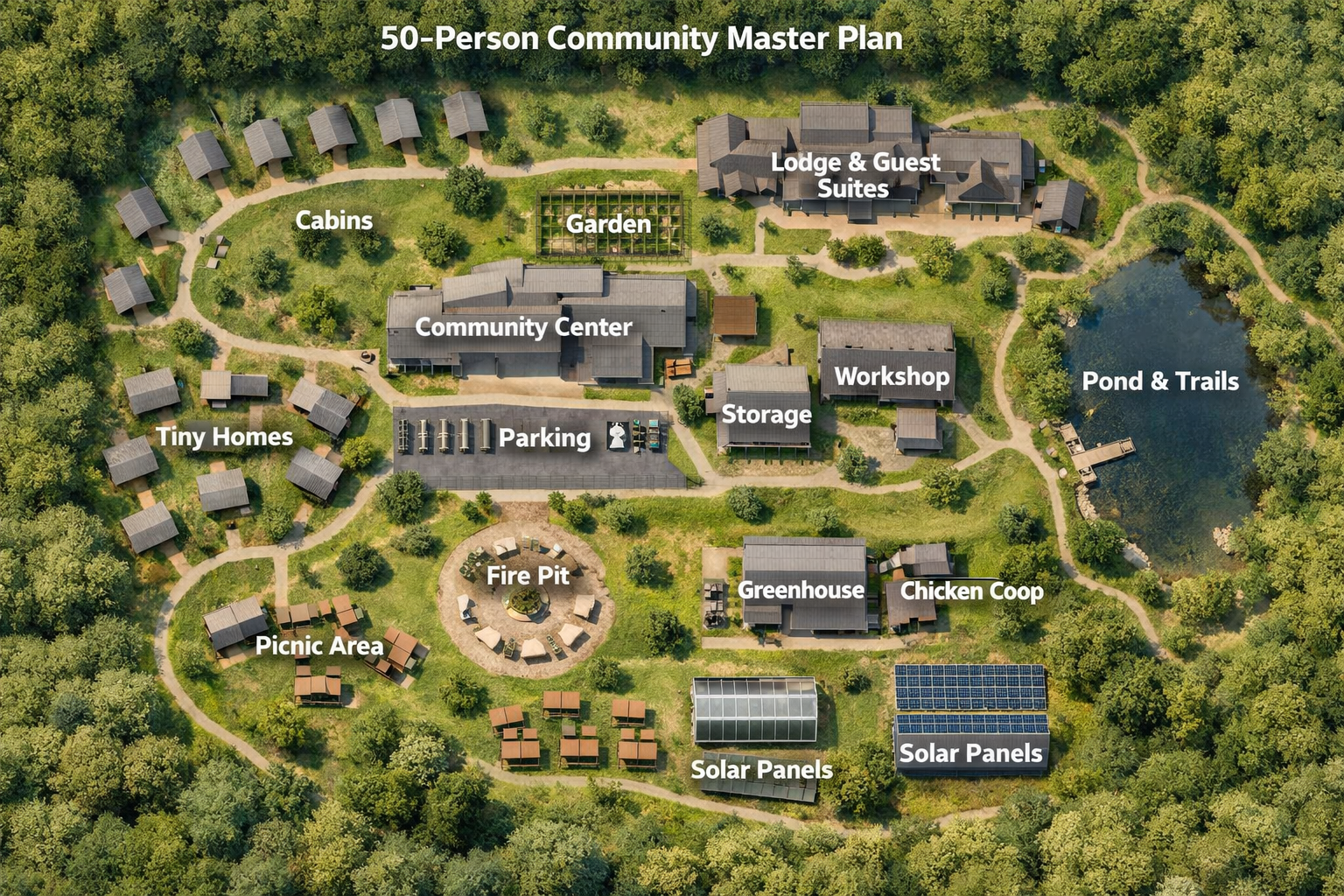
  • ARK-008: Operational Rollout of a 50-Person Micro-Community Prototype

    ARK-008: Operational Rollout of a 50-Person Micro-Community Prototype


    A Phased Implementation Framework for Regenerative, Small-Scale Settlements


    Meta Description

    A step-by-step operational rollout plan for building a 50-person micro-community prototype, covering land acquisition, infrastructure, governance, and scalable replication.


    Opening

    Most community projects fail not because of vision—but because they attempt to scale before stabilizing.

    The idea of building intentional communities, eco-villages, or sovereign settlements often collapses under the weight of poor sequencing: too many people, insufficient infrastructure, unclear governance, and no operational discipline.

    This framework offers a different approach:

    Start small. Stabilize early. Scale deliberately.

    At the center of this model is a single constraint:

    Can this system support 50 people—reliably, sustainably, and legally?

    If yes, it can be replicated. If not, it should not expand.

    This is the operational backbone of the ARK series—beginning with ARK-001: The 50-Person Resource Loop and extending into governance, land design, and distributed scaling.


    Why 50 People? The Stability Threshold

    Fifty is not arbitrary. It sits at a functional midpoint:

    • Large enough for skill diversity
    • Small enough for relational accountability
    • Manageable for resource systems
    • Legally simpler than large developments

    Anthropologically, it aligns with early human group sizes associated with high trust and cohesion (Dunbar, 1992).

    Operationally, it allows:

    • Clear governance structures
    • Efficient communication
    • Measurable resource loops

    The 50-person model becomes a repeatable unit of civilization, not just a community experiment.


    Phase 0: Legal Grounding and Land Acquisition

    Before any physical development begins, the project must be legally and structurally sound.

    Core Requirements

    • Land ownership or long-term lease agreement
    • Zoning compliance (agricultural, residential, mixed-use)
    • Entity structure (cooperative, corporation, association)
    • Basic regulatory alignment

    In contexts like the Philippines, this often means navigating:

    • Local Government Unit (LGU) approvals
    • Barangay-level integration
    • Environmental compliance standards

    Without this phase, all later work is fragile.


    Phase 1: Core Team Formation (5–10 People)

    Every stable system begins with a small, highly aligned nucleus.

    Core Roles

    • Operations lead
    • Land/infrastructure steward
    • Food systems lead
    • Finance/legal coordinator
    • Community/growth facilitator

    At this stage:

    • No large population intake
    • No expansion pressure
    • Focus is on decision velocity and trust-building

    The failure pattern to avoid: recruiting dozens of people before systems exist.


    Phase 2: Foundational Infrastructure Build

    Before scaling population, the land must support life.

    Minimum Viable Systems

    1. Water
      • Potable water source (well, filtration, or delivery)
      • Storage + distribution
    2. Food Production
      • Fast-growing crops (leafy greens, root crops)
      • Initial soil conditioning
      • Small livestock (optional)
    3. Shelter
      • Temporary housing (modular, bamboo, prefab)
      • Communal kitchen
    4. Energy
      • Hybrid systems (grid + solar)
      • Backup capacity
    5. Sanitation
      • Composting toilets or septic systems
      • Waste management protocols

    The goal is not perfection—it is functional sufficiency.


    Phase 3: Controlled Population Expansion (10 → 50)

    Only after systems are stable should population increase.

    Expansion Principles

    • Gradual onboarding (5–10 people at a time)
    • Skills-based selection (not just interest)
    • Integration period for each cohort

    Population Composition

    A functional 50-person system typically includes:

    • Growers / food stewards
    • Builders / technicians
    • Educators / facilitators
    • Health and wellness practitioners
    • Operations and finance roles

    This aligns with the structural layer outlined in
    ARK-002: The Babaylan Arc
    and governance protocols in
    ARK-003: Jurisdictional Sovereignty


    Phase 4: Governance Stabilization

    Once population approaches 50, governance must mature.

    Core Governance Structures

    • Decision-making framework (consensus, sociocracy, hybrid)
    • Conflict resolution system
    • Role clarity and accountability mapping
    • Financial transparency protocols

    At this stage, informal leadership is no longer enough.

    The system must transition from:

    • Personality-based coordination
      Process-based governance

    Phase 5: Economic and Resource Loop Stabilization

    A viable community must sustain itself—not just socially, but materially.

    Core Economic Functions

    • Food self-production (partial or majority)
    • Income streams (remote work, agriculture, services)
    • Internal exchange systems
    • External trade relationships

    This phase completes the loop introduced in
    ARK-001: The 50-Person Resource Loop


    Phase 6: Replication Readiness

    Only after stability is achieved should replication be considered.

    Readiness Indicators

    • Stable food and water systems
    • Functional governance
    • Financial transparency
    • Documented processes
    • Conflict resolution maturity

    Replication Pathways

    • Training new core teams
    • Supporting new land acquisitions
    • Sharing operational playbooks

    This becomes the foundation for distributed scaling, later expanded in ARK-010.


    Common Failure Patterns

    To make this actionable, here are the most frequent collapse points:

    • Scaling population before infrastructure
    • Undefined governance structures
    • Over-reliance on a charismatic founder
    • Lack of financial clarity
    • Ignoring legal frameworks

    Each of these is preventable through disciplined sequencing.


    Conclusion: From Vision to Viable System

    The difference between an idea and a working community is not intention—it is execution.

    A 50-person prototype is small enough to build, but large enough to matter.

    It offers a bridge between:

    • Individual survival strategies
    • And large-scale societal redesign

    Done correctly, it becomes:

    • A unit of replication
    • A training ground for governance
    • A living proof of concept

    The future of distributed communities will not emerge from massive top-down planning.

    It will emerge from small systems that work—and can be repeated.


    References

    Dunbar, R. I. M. (1992). Neocortex size as a constraint on group size in primates. Journal of Human Evolution, 22(6), 469–493.

    Ostrom, E. (1990). Governing the Commons: The Evolution of Institutions for Collective Action. Cambridge University Press.

    Holmgren, D. (2002). Permaculture: Principles and Pathways Beyond Sustainability. Holmgren Design Services.

    The concepts outlined here are designed for real-world execution. For a complete set of ready-to-use documents—including governance templates, resource tracking sheets, and operational SOPs—explore the 55 Editable Applied Stewardship Toolkit (Complete Set).

    For a broader systems context that situates localized resilience within national and multi-scalar transformation frameworks, explore The Philippine Ark: A Sovereign Blueprint for Systemic Transformation.


    Continue Through the ARK Series

    This framework is designed as a complete system. You can explore it sequentially or move directly to the layer most relevant to your work:

    Foundations

    Design + Build

    Systems Layer

    Scaling


    Suggested Pathways

    New to the framework?

    Start with ARK-001 ARK-008ARK-011


    Designing a physical site?

    Begin with ARK-007ARK-008ARK-009


    Preparing for real-world deployment?

    Focus on ARK-011ARK-012ARK-013


    Thinking long-term scale?

    Move to ARK-010


    [DOCUMENT CONTROL & STEWARDSHIP]

    Standard Work ID: [ARK-008]

    Baseline Version: v1.5.2026

    Classification: Open-Access Archive / Systemic Protocol

    The Sovereign Audit: Following this protocol is an act of internal quality control. Verification of this standard does not happen here; it happens at your Gemba—the actual place where your life and leadership occur. No external validation is required or offered.

    Next in Sequence: [ARK-009: Special Structures in Small-Scale Sovereign Communities]

    Return to Archive: [Standard Work Knowledge Hub: The Terrain Map]


    © 2026 Gerald Daquila • Life.Understood Systemic Stewardship • Non-Autocratic Architecture • Process over Persona

  • Why Resiliency Is a Trap: Moving from Colonial Survival to New Earth Stewardship

    Why Resiliency Is a Trap: Moving from Colonial Survival to New Earth Stewardship


    How the celebrated strength of the Filipino spirit can quietly reinforce the very systems it seeks to endure


    Meta Description

    Is Filipino resilience empowering—or limiting? Discover how resilience can become a trap, and why moving toward stewardship is the key to true sovereignty and long-term transformation.


    The Most Celebrated Trait

    “Filipinos are resilient.”

    https://images.openai.com/static-rsc-4/8uoZccnLBOsVBEpiVtl-A4H4f8zEuTPtT1BpKUZHVNW6XZ_NsDlQooLYPCr3xKXgv4T3-pDEVe_X5N-yGRDBZeS0Ydg5UsQlb6kQ9cQid42b6wHGWIblYoMwmuTLJRihRtv9TjAbtb_9S7KjBWgu3fIpzJIFoyUea3abRN0jL2hww4Kd-tbCD2BdyJtEQU7s?purpose=fullsize

    It is a phrase repeated in media, policy discussions, and everyday conversation—especially in the aftermath of crisis. Typhoons, economic shocks, political instability—each time, the same narrative emerges:

    Despite everything, Filipinos endure.

    https://images.openai.com/static-rsc-4/fe88O7ddP7tw1LZKJQwPppeAXbXzaOJJektrABqnWB_30-YMX3uG88hgJGL5GeBlOZ6ebG9s9D1jvarCEwfXalUndJUcjtppWeaw3VcXvTl-Q4Kw-SBguodSPKkHqjicob7GxMbOIN0ELeS-emyDoJgBJ3eTZT7UI4GGWEJRAe8IJBcIKArg801Sd_xM2wIh?purpose=fullsize

    At first glance, this seems like a compliment.

    And in many ways, it is. The ability to adapt, recover, and continue in the face of difficulty is undeniably a strength.

    https://images.openai.com/static-rsc-4/o_q500qPnpqgI-bxsWh8oj3a5DShjE7zniqmccfbAhTG_B7jV5oDs-r1A6Rjqt8gwKHGi6MdHr3ij7nmppv7vd1j1lzOfkGEYYZs_ZNQ-g6N1NrldYPoyk0obprt5PijlrnLngn89xJkmsBjcj3Oz1ON-KmsNZp7sh6VoZV5CVajAbPZiEAIYgEstmF5egq3?purpose=fullsize

    But there is a deeper question that is rarely asked:

    What if resilience, when over-relied upon, becomes a mechanism that keeps people in cycles they should no longer have to endure?


    Resilience vs. Transformation

    Resilience is the capacity to withstand and recover.


    Transformation is the capacity to change the conditions that require recovery in the first place.

    These are not the same.

    A resilient system can survive dysfunction indefinitely.

    A transformed system eliminates the need for constant survival.


    The danger arises when resilience is mistaken for progress.


    The Colonial Roots of Survival

    To understand why resilience is so deeply embedded in the Filipino identity, we must examine its origins.

    Centuries of colonization—Spanish, American, and Japanese—created conditions where survival was not optional. It was required.

    • Economic extraction limited local wealth-building
    • Political control reduced autonomy
    • Cultural disruption fragmented identity

    In such environments, resilience becomes adaptive.

    It allows individuals and communities to:

    • Endure instability
    • Maintain social cohesion
    • Continue functioning under pressure

    But over generations, this adaptation becomes identity.


    And identity becomes expectation.


    When Strength Becomes a Script

    The problem is not resilience itself.


    The problem is when it becomes the default script, even when conditions change.

    This script says:

    • “Just keep going.”
    • “We’ll get through this.”
    • “That’s life.”

    While these statements can provide comfort, they can also:

    • Normalize systemic dysfunction
    • Discourage structural change
    • Suppress legitimate frustration

    Research in social systems suggests that populations can become adapted to suboptimal conditions, maintaining stability at the cost of progress (North, 1990).

    In other words:

    People adjust to what should be changed.


    The Resilience Trap

    The resilience trap occurs when:

    1. Hardship is expected
    2. Endurance is praised
    3. Change is deprioritized

    This creates a loop:

    Crisis → Adaptation → Recovery → Repeat

    Over time, resilience becomes a form of containment.

    It keeps individuals functioning—but within the same constraints.


    The Filipino Context: Everyday Resilience

    In the Philippines, this trap appears in multiple domains:

    1. Economic Survival

    Multiple jobs, overseas work, and informal economies are normalized responses to systemic gaps.

    (Crosslink: The Ghosts of the Galleon Trade: How Colonial Echoes Still Dictate Your Financial Decisions)


    2. Family Responsibility

    Extended support structures absorb financial strain—often without addressing root causes.


    3. Disaster Response

    Communities rebuild repeatedly, but underlying vulnerabilities remain.


    4. Institutional Tolerance

    Corruption and inefficiency are criticized—but often endured.

    (Crosslink: Naming the Unspoken: A Guide to Navigating the Hidden Fractures of Our National Identity)


    These are not failures.

    They are evidence of resilience operating at scale.


    The Psychological Cost

    While resilience enables survival, it carries hidden costs:

    • Chronic stress
    • Burnout
    • Emotional suppression
    • Reduced expectations for improvement

    Over time, individuals may internalize the belief that:

    “This is as good as it gets.”

    This aligns with research on learned adaptation, where repeated exposure to uncontrollable conditions reduces motivation to change them (Seligman, 1975).


    From Resilience to Stewardship

    If resilience is not the endpoint, what is?

    Stewardship.


    Stewardship shifts the focus from enduring systems to designing better ones.

    (Crosslink: From Informer to Steward: Why True Leadership Begins with Owning Our Shared Shadow)

    A steward does not ask:

    “How do we survive this?”

    They ask:

    “How do we ensure this no longer happens?”


    The New Earth Framing (Grounded Interpretation)

    “New Earth” is often used in spiritual discourse to describe a higher state of collective existence.

    Grounded practically, it can be understood as:

    • Systems designed for sustainability
    • Economies built on value creation and retention
    • Governance rooted in accountability
    • Cultures that support dignity and growth

    This is not an escape from reality.

    It is an evolution of it.


    The Shift: Survival → Design

    Moving beyond the resilience trap requires a shift in orientation.

    From:

    • Reactive adaptation
    • Short-term coping
    • Individual endurance

    To:

    • Proactive design
    • Long-term planning
    • Collective responsibility

    (Crosslink: ARK-001: The 50-Person Resource Loop)

    Small, well-designed systems reduce the need for constant resilience.


    Practical Pathways Out of the Trap

    1. Question the Narrative

    When resilience is praised, ask:

    What condition required this resilience?


    2. Validate Frustration

    Discomfort is not weakness.

    It is often a signal that change is needed.


    3. Build Stability, Not Just Recovery

    Focus on:

    • Preventive systems
    • Risk reduction
    • Long-term security

    4. Shift from Coping to Creating

    Instead of:

    “How do I manage this?”

    Ask:

    “What can I build that changes this?”


    5. Develop Stewardship Capacity

    (Crosslink: From Fragmented Souls to Sovereign Stewards: Reclaiming Identity After 500 Years of Institutional Trauma)

    This includes:

    • Systems thinking
    • Emotional regulation
    • Collaborative leadership

    The Role of the Nervous System

    Resilience often operates in a stress-adapted state.

    To move into stewardship, individuals must access regulated states:

    • Calm
    • Clarity
    • Strategic thinking

    (Crosslink: Financial Sovereignty Is a Nervous System State: Grounding the QFS in the Filipino Reality)

    Without this shift, efforts remain reactive.


    The Risk of Overcorrecting

    It is important not to reject resilience entirely.

    Resilience is still necessary.

    But it must be:

    • Contextual, not constant
    • Transitional, not permanent
    • Supported by systems, not relied on alone

    The goal is not to stop being resilient.

    It is to stop needing resilience as often.


    The Ark Perspective: From Endurance to Emergence

    Within the Ark framework, the Philippines is positioned not just to endure—but to demonstrate transition.

    (Crosslink: The Philippine Ark: A Global South Prototype)

    A society that has mastered survival has the raw capacity for stewardship.

    The question is whether that capacity is redirected.


    Conclusion: The Courage to Want More

    Resilience has carried the Filipino people through centuries of disruption.


    It deserves recognition.


    But it is not the destination.

    The next phase requires something different:

    The courage to say:

    “Surviving is not enough.”

    The willingness to ask:

    “What would it look like to design a life—and a system—where survival is no longer the baseline?”

    This is the shift from:

    • Enduring the world
      to
    • Shaping it

    From:

    • Resilient individuals
      to
    • Sovereign stewards

    References

    North, D. C. (1990). Institutions, Institutional Change and Economic Performance. Cambridge University Press.

    Seligman, M. E. P. (1975). Helplessness: On Depression, Development, and Death. Freeman.

    David, E. J. R. (2013). Brown Skin, White Minds. Information Age Publishing.

    Constantino, R. (1975). The Philippines: A Past Revisited. Tala Publishing Services.


    The Sovereign Professional: A structural map of power, systems thinking, and personal autonomy—dedicated to helping the independent professional navigate complexity and own their value stream.Ask


    ©2026 Gerald Daquila • Life.Understood. • Systems Thinking, Leadership Architecture, and Applied Coherence

  • [SWI-004] Standard Work for the Transition: 5 Financial Protocols for the 2026 Volatility

    [SWI-004] Standard Work for the Transition: 5 Financial Protocols for the 2026 Volatility


    Relearning Stability in an Age of Fragility

    The financial volatility emerging across the mid-2020s is not merely a market event. It is a systems event.

    Around the world, institutions once assumed to be permanent are showing signs of strain: sovereign debt expansion, currency instability, declining trust in governance, rising geopolitical fragmentation, supply chain disruptions, and widening inequality between asset holders and wage earners (International Monetary Fund [IMF], 2025; World Economic Forum [WEF], 2025).

    For professionals, entrepreneurs, skilled workers, and ordinary households, the question is no longer whether volatility exists.

    The question is how to operate coherently inside it.

    In Lean systems thinking, the Japanese term Gemba refers to “the real place” — the actual environment where work occurs and where reality can be directly observed (Liker, 2004).

    In the context of transition-era finance, the Gemba is not the trading floor or the policy conference. It is everyday life: the household, the small business, the local network, the savings account, the food supply, the trust relationship, and the decisions made quietly each week.

    “Sovereignty” at the Gemba level does not require ideological extremism or total disengagement from existing systems. Rather, it means reducing fragility and increasing adaptive capacity. It is the disciplined practice of ensuring that one’s life can continue functioning even when larger systems become unstable.

    This piece outlines five practical financial protocols for navigating the 2026 volatility environment. They are not predictions, nor are they framed as investment advice. They are operational principles for resilience.


    Protocol 1: Maintain Strategic Liquidity

    One of the defining characteristics of volatile transitions is that liquidity evaporates faster than most people expect. During periods of uncertainty, access to capital becomes more important than the theoretical value of assets.

    Many households appear financially stable on paper while remaining operationally fragile in practice. A professional may possess retirement funds, home equity, or digital portfolio gains, yet still be vulnerable to sudden unemployment, delayed banking access, medical emergencies, or regional disruptions.

    The first protocol of transition-era stability is therefore simple:

    Maintain accessible liquidity outside long-duration dependency structures.

    This does not imply abandoning long-term investing. Rather, it means balancing long-term positioning with immediate operational flexibility.

    Practical applications include:

    • Maintaining several months of living expenses in highly accessible form
    • Avoiding overleveraged debt structures
    • Diversifying banking relationships where appropriate
    • Keeping emergency reserves in instruments that can be rapidly accessed
    • Reducing dependence on a single employer, client, or platform

    Historically, households that survived periods of instability most effectively were not always the wealthiest. Often, they were the most liquid, adaptable, and socially connected (Dalio, 2021).

    In Lean operational systems, resilience emerges from flow, not rigidity. Financial systems operate similarly. Capital trapped inside illiquid structures during a shock event becomes difficult to mobilize precisely when it is most needed.

    Liquidity is therefore not fear-based hoarding. It is operational continuity.


    Protocol 2: Favor Real Utility Over Speculative Abstraction

    Modern economies increasingly reward abstraction: derivatives layered atop derivatives, digital valuations disconnected from production, and speculative instruments detached from material usefulness.

    Yet transition periods tend to reprice reality.

    During systemic contractions, assets tied to real utility frequently outperform purely narrative-driven speculation.

    This does not mean speculative assets disappear entirely, but rather that societies re-anchor around what directly supports life and function.

    A sovereignty-oriented professional therefore asks:

    “What retains value because it remains useful?”

    Examples may include:

    • Productive skills
    • Local service capacity
    • Food systems
    • Energy resilience
    • Repair capability
    • Durable infrastructure
    • Practical education
    • Community-supported enterprises
    • Ethical small businesses
    • Asset-backed productive systems

    This principle echoes broader shifts now discussed in international economic circles regarding “real economy resilience” and “productive capacity restoration” (OECD, 2025).

    At the individual level, this can manifest as:

    • Investing in practical competencies rather than status signaling
    • Building side-income systems tied to real demand
    • Supporting locally productive ecosystems
    • Prioritizing durable tools and infrastructure over disposable consumption
    • Developing adaptable multi-domain skills

    The transition economy increasingly rewards usefulness over appearance.

    In volatile eras, prestige can collapse quickly. Utility endures longer.


    Protocol 3: Build Redundant Trust Networks

    One of the least discussed realities of financial systems is that economies ultimately operate on trust.

    Currencies function because populations collectively believe they will retain exchange value. Institutions function because people believe agreements will be honored. Supply chains function because participants trust continuity.

    When trust erodes, friction increases everywhere.

    For this reason, one of the strongest forms of sovereignty is relational rather than purely financial.

    Households and professionals entering uncertain periods benefit from cultivating:

    • Local alliances
    • Professional reciprocity
    • Skill-sharing communities
    • Ethical trade networks
    • Cooperative relationships
    • Trusted referral ecosystems
    • Mutual aid structures

    Research following major disruptions consistently demonstrates that social cohesion strongly predicts recovery resilience (Putnam, 2000).

    This principle also reflects Lean manufacturing wisdom. Toyota’s operational durability historically depended not merely on internal optimization but on deeply integrated supplier trust networks capable of coordinating during disruption (Liker, 2004).

    At the human level, the same principle applies.

    In practical terms:

    • Know who can be trusted in your local environment
    • Build reciprocal rather than extractive relationships
    • Reduce isolation
    • Develop peer-to-peer competency networks
    • Exchange knowledge openly where appropriate
    • Cultivate reputation capital through consistency and integrity

    Many people focus exclusively on financial assets while neglecting relational assets.

    Yet during periods of transition, trust itself becomes a form of infrastructure.


    Protocol 4: Reduce Fragility Through Simplicity

    Complexity often masquerades as sophistication.

    In stable periods, highly optimized lifestyles may appear efficient: multiple debt layers, maximal leverage, subscription dependency, fragile logistics, and hyper-specialized income streams.

    But highly optimized systems frequently become brittle systems.

    The fourth protocol therefore emphasizes simplification:

    • Reduce unnecessary fixed expenses
    • Minimize dependency chains
    • Eliminate operational clutter
    • Lower exposure to volatility-sensitive obligations
    • Build margin into schedules and finances
    • Favor durable systems over high-maintenance ones

    This mirrors the Lean principle of reducing Muda — unnecessary waste and inefficiency (Ohno, 1988).

    Importantly, simplicity is not regression. It is strategic clarity.

    A household with lower prestige but higher adaptability may prove more resilient than a high-status lifestyle dependent on continuous economic expansion.

    The same applies professionally.

    Workers and entrepreneurs increasingly benefit from:

    • Multiple adaptable competencies
    • Portable skillsets
    • Digital independence
    • Lower burn rates
    • Operational flexibility
    • Direct client relationships
    • Reduced institutional dependency

    The goal is not withdrawal from society. The goal is decreasing systemic fragility.

    A simpler structure can often move faster, recover faster, and endure longer.


    Protocol 5: Anchor Wealth to Ethics and Stewardship

    Periods of volatility often intensify the temptation toward opportunism, fear-based extraction, or predatory accumulation.

    Yet history repeatedly shows that systems built solely on exploitation eventually destabilize themselves.

    Long-term resilience depends not merely on acquisition, but stewardship.

    This protocol asks professionals to reconsider wealth not only as personal accumulation, but as:

    • capacity,
    • continuity,
    • contribution,
    • and responsibility.

    Emerging conversations around stakeholder capitalism, regenerative economics, and sustainable enterprise increasingly reflect this recognition (WEF, 2025).

    At the Gemba level, stewardship may include:

    • Ethical business practices
    • Transparent agreements
    • Fair compensation
    • Community contribution
    • Local reinvestment
    • Sustainable production
    • Long-term relationship thinking
    • Responsible debt usage
    • Intergenerational planning

    Trust compounds slowly but powerfully.

    A professional known for integrity during unstable periods often becomes more valuable over time than one who maximizes short-term extraction.

    This is not merely moral philosophy. It is operational resilience.

    Communities instinctively preserve relationships with those who contribute stability, fairness, and reliability during stress cycles.

    Stewardship therefore becomes both ethical and strategic.


    The Quiet Nature of Sovereignty

    The transition now unfolding is not only economic. It is psychological and civilizational.

    Many people still assume stability means returning to the exact structures of the previous era. Yet transitions rarely move backward in perfect form. More often, they reorganize around new realities.

    For professionals navigating 2026 and beyond, sovereignty may ultimately look quieter than expected:

    • prudent liquidity,
    • practical skills,
    • trustworthy relationships,
    • reduced fragility,
    • and ethical stewardship.

    Not spectacle.
    Not panic.
    Not ideological absolutism.

    Simply coherent living at the Gemba.

    In volatile systems, resilience rarely appears dramatic in the beginning. It often appears ordinary — until the shock arrives.

    Those who endure transitions most effectively are usually not the loudest actors. They are the ones who quietly built operational continuity before the turbulence became visible to everyone else.


    References

    Dalio, R. (2021). Principles for dealing with the changing world order. Avid Reader Press.

    International Monetary Fund. (2025). Global financial stability report 2025. IMF Publishing.

    Liker, J. K. (2004). The Toyota way: 14 management principles from the world’s greatest manufacturer. McGraw-Hill.

    OECD. (2025). Economic outlook 2025: Resilience and productive transition. Organisation for Economic Co-operation and Development.

    Ohno, T. (1988). Toyota production system: Beyond large-scale production. Productivity Press.

    Putnam, R. D. (2000). Bowling alone: The collapse and revival of American community. Simon & Schuster.

    World Economic Forum. (2025). Global risks report 2025. WEF.


    Related Pathways


    [DOCUMENT CONTROL & STEWARDSHIP]

    Standard Work ID: SWI-004

    Baseline Version: v1.5.2026

    Classification: Open-Access Archive / Systemic Protocol

    The Sovereign Audit: Following this protocol is an act of internal quality control. Verification of this standard does not happen here; it happens at your Gemba—the actual place where your life and leadership occur. No external validation is required or offered.

    Next in Sequence: [SWI-003: Standard Work for Sovereign Wealth]

    Return to Archive: [Standard Work Knowledge Hub: The Terrain Map]


    © 2026 Gerald Daquila • Life.Understood Systemic Stewardship • Non-Autocratic Architecture • Process over Persona

  • The Barangay Value Stream Map (BVSM)

    The Barangay Value Stream Map (BVSM)


    Standardizing Community Resilience for Diaspora Architects


    In the language of systems thinking, resilience is not a feeling—it is an outcome of design.

    For diaspora architects seeking to contribute meaningfully to homeland development, the challenge is not simply what to build, but how to ensure that what is built can endure volatility, absorb shocks, and regenerate capacity at the local level.

    Nowhere is this more critical than in the barangay, the smallest administrative unit in the Philippines, yet paradoxically the most immediate interface between governance and lived reality.

    This piece introduces the Barangay Value Stream Map (BVSM) as a replicable framework for diagnosing, optimizing, and standardizing community resilience.

    Drawing from lean systems, public administration theory, and community-driven development models, the BVSM provides diaspora architects with a structured pathway to transform fragmented interventions into coherent, scalable systems.


    1. Why the Barangay is the True Unit of Resilience

    The barangay is often treated as an implementation layer—where national policies are executed and local concerns are managed. But this framing is incomplete.

    In practice, the barangay is a micro-system where social capital, informal economies, and governance dynamics converge.

    Research in decentralized governance shows that local units with higher autonomy and participation tend to produce better development outcomes, particularly in crisis response and service delivery (Brillantes & Moscare, 2002).

    Meanwhile, community-driven development programs in the Philippines—such as KALAHI-CIDSS—demonstrate that when communities are directly involved in planning and resource allocation, project sustainability increases significantly (Labonne & Chase, 2011).

    For diaspora architects, this presents a critical insight: resilience cannot be imported—it must be co-designed at the barangay level.


    2. From Projects to Systems: The Case for Value Stream Mapping

    Traditional development approaches often focus on discrete projects: a water system here, a livelihood program there.

    While valuable, these interventions frequently fail to integrate into a larger system, resulting in inefficiencies, redundancies, or eventual decay.

    Value Stream Mapping (VSM), a tool derived from lean management, shifts the focus from isolated outputs to end-to-end flows of value.

    Originally developed in manufacturing, VSM has been adapted for healthcare, government services, and social systems to identify bottlenecks, eliminate waste, and improve flow efficiency (Rother & Shook, 2003).

    Applied to the barangay context, VSM allows stakeholders to map:

    • The flow of essential services (health, water, education)
    • The movement of resources (funds, goods, information)
    • The interaction between actors (officials, households, NGOs)

    The result is not just a map—but a diagnostic instrument revealing where resilience is strengthened or compromised.


    3. Defining the Barangay Value Stream Map (BVSM)

    The Barangay Value Stream Map (BVSM) is a localized adaptation of VSM tailored to the socio-political realities of Philippine communities.

    It integrates three layers:

    a. Service Flow Layer

    Tracks how essential services move from source to beneficiary. For example:

    • Health services: Barangay Health Worker → Rural Health Unit → Household
    • Disaster response: Early warning system → Barangay council → Community evacuation

    b. Resource Flow Layer

    Maps financial and material inputs:

    • Internal Revenue Allotment (IRA) distribution
    • External funding (NGOs, diaspora contributions)
    • Local revenue streams

    c. Governance & Decision Layer

    Captures how decisions are made:

    • Barangay council processes
    • Community assemblies (pulong-pulong)
    • Informal influence networks

    By overlaying these layers, the BVSM reveals not only what exists, but how effectively it functions.


    4. Identifying Waste in Community Systems

    Lean thinking defines “waste” as any activity that does not add value to the end user.

    In a barangay context, waste manifests in more subtle but equally damaging ways:

    • Delay: Slow disbursement of funds for urgent needs
    • Duplication: Multiple programs addressing the same issue without coordination
    • Leakage: Misallocation or inefficiency in resource use
    • Underutilization: Skills and capacities within the community left untapped

    Studies in public sector efficiency highlight that process inefficiencies can reduce service effectiveness by up to 30% in decentralized systems (World Bank, 2018).

    The BVSM allows diaspora architects to pinpoint these inefficiencies with precision.

    Instead of broad assumptions, interventions can be targeted at specific failure points—maximizing impact while minimizing cost.


    5. Standardizing Without Erasing Local Identity

    A common concern in systematization is the risk of imposing rigid structures that ignore local context.

    The BVSM addresses this by distinguishing between:

    • Core Standards: Universal elements that ensure functionality (e.g., transparent fund tracking, clear service pathways)
    • Adaptive Layers: Context-specific practices shaped by culture, geography, and community dynamics

    This dual approach aligns with adaptive governance theory, which emphasizes flexibility within structured systems to handle complexity and uncertainty (Folke et al., 2005).

    For diaspora architects, the implication is clear: standardization should enable consistency, not conformity.


    6. The Role of the Diaspora Architect

    Diaspora communities possess a unique advantage: exposure to global systems combined with a personal connection to local realities.

    However, this dual perspective can either be a strength or a liability.

    When interventions are designed without local integration, they risk becoming misaligned or unsustainable. Conversely, when diaspora architects act as system integrators, they can bridge gaps between global best practices and local needs.

    The BVSM provides a structured role for diaspora involvement:

    • Observer: Mapping existing flows without imposing assumptions
    • Analyst: Identifying inefficiencies and resilience gaps
    • Facilitator: Supporting local stakeholders in co-designing solutions
    • Connector: Linking barangays to external resources and networks

    This shifts the diaspora role from donor to co-architect of resilience.


    7. From Mapping to Transformation: Implementation Pathway

    Creating a BVSM is only the first step. The true value lies in translating insights into action. A practical pathway includes:

    Step 1: Stakeholder Alignment

    Engage barangay officials, community members, and local organizations. Ensure shared understanding of goals.


    Step 2: Data Gathering

    Collect qualitative and quantitative data on service delivery, resource flows, and governance processes.


    Step 3: Mapping Workshop

    Co-create the BVSM with stakeholders. Visual tools enhance clarity and ownership.


    Step 4: Gap Analysis

    Identify bottlenecks, redundancies, and vulnerabilities.


    Step 5: Intervention Design

    Develop targeted solutions—process improvements, policy adjustments, or capacity-building initiatives.


    Step 6: Iteration and Feedback

    Continuously refine the system based on real-world outcomes.

    This iterative approach reflects principles of continuous improvement, which have been shown to significantly enhance system resilience over time (Deming, 1986).


    8. Measuring Resilience: Beyond Outputs

    One of the limitations of traditional development metrics is their focus on outputs—number of projects completed, funds disbursed, etc.

    While important, these metrics do not capture system health.

    The BVSM enables a shift toward resilience metrics, such as:

    • Response time to emergencies
    • Continuity of essential services during disruptions
    • Community participation rates
    • Redundancy and backup systems

    Research on resilience measurement emphasizes the importance of system-level indicators that reflect adaptability and recovery (Cutter et al., 2008).

    For diaspora architects, this means success is not defined by what is built, but by how well the system continues to function under stress.


    9. Scaling the BVSM Across Barangays

    The ultimate potential of the BVSM lies in its scalability.

    When standardized frameworks are applied across multiple barangays, patterns emerge:

    • Common bottlenecks that can be addressed at higher policy levels
    • Best practices that can be replicated
    • Opportunities for inter-barangay collaboration

    This creates the foundation for a networked resilience system, where barangays are not isolated units but interconnected nodes.

    Such networked approaches have been shown to enhance collective resilience, particularly in disaster-prone regions (Aldrich & Meyer, 2015).


    10. Conclusion: Designing for Continuity

    The Barangay Value Stream Map is not merely a technical tool—it is a shift in perspective.

    It invites diaspora architects to move beyond episodic interventions and toward systemic design.

    In a world of increasing uncertainty—climate change, economic volatility, social fragmentation—resilience is no longer optional. It must be designed, measured, and continuously improved.

    The barangay, often overlooked, is where this design becomes tangible. It is where policies meet people, where systems meet stories, and where resilience is either built or broken.

    For those called to contribute from afar, the question is no longer “How can I help?” but rather:

    “How can I help build a system that helps itself?”

    The BVSM offers one answer—grounded in structure, guided by participation, and oriented toward continuity.


    Crosslinks

    Takt Time — The Rhythm of Presence – Anchor: “Why system design fails without internal alignment.” Moves reader from external system mapping → internal regulation.


    Work Sequence — The Protocol – Anchor: “How mapped systems translate into repeatable execution.” BVSM shows what exists; Work Sequence shows how it runs.


    Standard Inventory — The Sovereign Kit – Anchor: “What resources are required to sustain each node in the map.” Bridges mapping → resourcing.


    References

    Aldrich, D. P., & Meyer, M. A. (2015). Social capital and community resilience. American Behavioral Scientist, 59(2), 254–269.

    Brillantes, A. B., & Moscare, D. (2002). Decentralization and federalism in the Philippines. Public Administration and Development, 22(1), 23–35.

    Cutter, S. L., Burton, C. G., & Emrich, C. T. (2008). Disaster resilience indicators for benchmarking baseline conditions. Journal of Homeland Security and Emergency Management, 5(1).

    Deming, W. E. (1986). Out of the Crisis. MIT Press.

    Folke, C., Hahn, T., Olsson, P., & Norberg, J. (2005). Adaptive governance of social-ecological systems. Annual Review of Environment and Resources, 30, 441–473.

    Labonne, J., & Chase, R. S. (2011). Do community-driven development projects enhance social capital? World Bank Policy Research Working Paper.

    Rother, M., & Shook, J. (2003). Learning to See: Value Stream Mapping to Add Value and Eliminate MUDA. Lean Enterprise Institute.

    World Bank. (2018). Improving Public Sector Performance Through Process Optimization.


    The Sovereign Professional: A structural map of power, systems thinking, and personal autonomy—dedicated to helping the independent professional navigate complexity and own their value stream.Ask


    ©2026 Gerald Daquila • Life.Understood. • Systems Thinking, Leadership Architecture, and Applied Coherence