Category: Living Archive

  • ❓The Question Beneath the Questions

    ❓The Question Beneath the Questions


    A note to those who find their way here.


    Most people arrive at the Living Archive through a particular doorway.

    Some come looking for ideas about leadership, systems, governance, or technology. Others arrive through questions of meaning, transition, personal growth, or the search for a more coherent way of understanding the world.

    The doorway varies.

    The underlying question is often the same.

    How do we make sense of life when familiar explanations no longer seem sufficient?

    Looking back, that question sits beneath nearly everything in this archive.

    It was present long before there was an archive, before there were frameworks, maps, essays, or institutions to study. It appeared as a quiet but persistent feeling that many of the explanations I had inherited were useful but incomplete. They could describe certain aspects of reality while leaving others untouched.

    Like many people, I followed the paths that seemed likely to produce a meaningful life.

    Education, achievement, professional development, and the pursuit of competence all mattered, and many brought genuine value. Yet beneath those pursuits remained questions that success alone could not answer.

    • What makes a life meaningful?
    • Why do certain experiences change us so profoundly?
    • Why do individuals and organizations so often produce outcomes that differ from their intentions?
    • How do people remain grounded during periods of uncertainty and change?

    At first, these appeared to be separate questions. Over time, they revealed themselves as different expressions of the same inquiry.

    The more I explored human behavior, the more systems seemed to matter. The more I explored systems, the more questions of leadership emerged. Leadership led toward ethics. Ethics led toward culture.

    Culture led toward institutions. Institutions led toward technology. Technology eventually circled back to questions of identity, meaning, and what it means to remain human in an increasingly complex world.

    What changed was not the question.

    Only the scale.

    The inquiry expanded from the personal to the collective, from individual lives to organizations, from organizations to institutions, and from institutions to the broader systems shaping contemporary civilization.

    The Living Archive emerged from following that expansion.

    Looking back, I eventually came to see that many of the questions explored throughout this archive emerge from a recurring human experience.

    At certain moments, life places us in unfamiliar territory. A relationship ends. A career changes. A belief system no longer fits. A society enters a period of disruption. Something we once relied upon stops making sense.

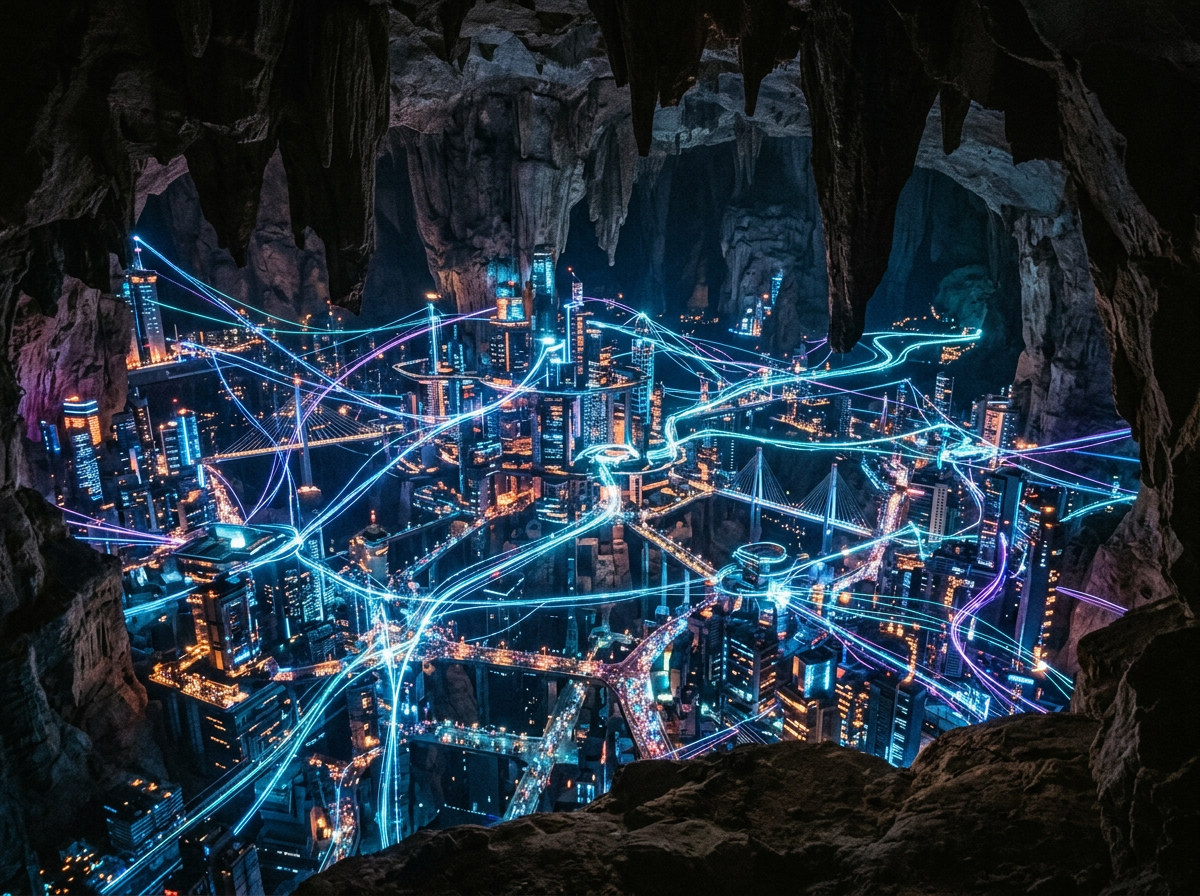
    The experience can feel like finding oneself dropped into an unfamiliar landscape without a map.

    The first task is not mastery.

    • It is orientation.
    • Where am I?
    • What has changed?
    • What assumptions no longer apply?
    • Is this place safe enough to explore?

    As understanding grows, the landscape gradually becomes more familiar. Patterns emerge. Relationships become visible. What once felt chaotic begins to make sense.

    Eventually a new equilibrium forms. Life stabilizes. The questions quiet.

    Until another horizon appears and the process begins again.

    In retrospect, much of the Living Archive can be understood as a record of that process—an ongoing effort to orient, understand, adapt, and participate more consciously within changing environments.

    It was never intended to become a comprehensive theory of anything. It is better understood as a record of observation, reflection, and sensemaking across multiple domains that are often treated separately but experienced together.

    Real life rarely arrives neatly organized into categories.

    • Questions of meaning influence leadership.
    • Leadership influences institutions.
    • Institutions influence culture.
    • Culture influences technology.

    Technology influences how people understand themselves and one another.

    The boundaries between these domains are far more permeable than they initially appear.

    Much of the work collected here is an attempt to understand those relationships.

    Over time, another pattern became increasingly visible.

    Many of the challenges facing individuals and societies are not caused by a lack of information. They arise from difficulty interpreting information within environments that are becoming more complex, interconnected, and fast-moving.

    • We know more than previous generations and yet often feel less certain.
    • We have unprecedented access to knowledge and yet frequently struggle to distinguish signal from noise.
    • We possess powerful technologies and yet continue wrestling with ancient questions of meaning, responsibility, and human flourishing.

    This is not merely a technological challenge.

    It is a sensemaking challenge.

    How do we understand reality well enough to participate in it wisely?

    That question appears throughout the archive in different forms. Sometimes it emerges through essays on governance and institutional design.

    Sometimes through leadership, systems thinking, artificial intelligence, stewardship, culture, or personal development. Occasionally it appears through symbolic or contemplative inquiry.

    The language changes.

    The underlying concern remains remarkably consistent.

    Human beings increasingly need ways of navigating complexity without surrendering their humanity.

    • We need frameworks without becoming trapped by them.
    • We need knowledge without mistaking it for wisdom.
    • We need adaptability without losing coherence.
    • We need the capacity to remain thoughtful while the world around us changes.

    The Living Archive does not offer a final answer to these challenges.

    Nor does it present a doctrine to be adopted.

    It is simply one person’s ongoing attempt to remain in conversation with questions that have proven difficult, consequential, and enduring.

    Some readers may find practical tools here.

    Others may find language for experiences they have struggled to articulate. Still others may discover ideas that challenge assumptions or open new avenues of inquiry.

    The archive is large enough that different people encounter different things.

    • What connects them is not a shared conclusion.
    • It is a shared willingness to ask deeper questions.

    If there is a purpose behind the work, it is perhaps this:

    To create a space where ideas, experiences, systems, and questions can be held together long enough for meaningful patterns to emerge.

    • A place for orientation rather than certainty.
    • A place for inquiry rather than ideology.
    • A place where complexity can be engaged without abandoning reflection, responsibility, or wonder.

    Everything else in the archive grows from that intention.

    • The essays.
    • The maps.
    • The frameworks.
    • The simulations.
    • The Cornerstone Hubs.
    • The Stewardship Institute.

    The recurring explorations of leadership, governance, technology, meaning, and human development.

    • They are not separate projects.
    • They are different pathways into the same landscape.

    And beneath them all remains the question that started the journey:

    How do we make sense of reality well enough to participate in it wisely?

    That question remains unfinished.

    For that reason alone, it remains worth asking.


    Living Archive Companion

    Every Cornerstone forms part of a larger architecture of inquiry. The Living Archive Companion situates this essay within that broader landscape by highlighting its scholarly context, methodological foundations, scope, open questions, and related pathways for continued exploration. As the Living Archive evolves, this companion may expand to reflect new research, instruments, historical casework, and practical applications.


    Comparative Perspectives

    Where this essay sits within the broader conversation

    This essay belongs to a long tradition of inquiry into how human beings orient themselves amid uncertainty. While it does not advance a single disciplinary theory, it draws together insights from several complementary fields.

    Sensemaking & Organizational Learning

    Karl Weick’s work on organizational sensemaking explores how people construct meaning when familiar assumptions no longer explain unfolding events. Like Weick, this essay understands orientation as preceding effective action.

    Systems Thinking

    Donella Meadows demonstrated that understanding relationships often matters more than analyzing isolated parts. This essay similarly treats leadership, meaning, governance, technology, and human development as interconnected expressions of a larger living system.

    Adult Development

    Robert Kegan’s constructive-developmental theory suggests that human maturity involves progressively more complex ways of making meaning. The developmental movement described throughout this essay closely parallels that understanding while extending it toward stewardship and civilizational participation.

    Existential Philosophy

    Thinkers such as Viktor Frankl and Hannah Arendt emphasized humanity’s capacity to respond consciously amid uncertainty rather than merely react to circumstance. This essay shares that concern while framing orientation as an ongoing developmental practice.

    Where the Living Archive differs

    The Living Archive does not seek to replace these traditions, but to place them into conversation with one another. Its distinctive contribution is the construction of an orientational architecture through which insights from multiple disciplines can be understood as mutually reinforcing rather than intellectually isolated.


    Evidence & Foundations

    Knowledge domains informing this essay

    Primary disciplines

    • Systems Thinking
    • Developmental Psychology
    • Organizational Sensemaking
    • Existential Psychology
    • Leadership Studies
    • Institutional Theory
    • Human Development

    Representative thinkers

    • Karl Weick
    • Donella Meadows
    • Robert Kegan
    • Viktor Frankl
    • Edgar Schein
    • Elinor Ostrom

    Nature of the evidence

    ✓ Integrative synthesis of established scholarship

    ✓ Phenomenological reflection grounded in lived observation

    ✓ Conceptual architecture

    ◻ Original empirical research (future)

    ◻ Longitudinal institutional validation (future)

    This essay should be understood as an orientational synthesis rather than a comprehensive empirical theory. It draws together recurring patterns observed across multiple disciplines while remaining open to refinement as further historical, comparative, and empirical work develops.


    Boundaries & Limitations

    Every framework illuminates some aspects of reality while leaving others outside its scope.

    This essay is intended as an orientation rather than a doctrine. It does not claim to explain every dimension of human development, nor does it prescribe a universal pathway through complexity.

    The framework does not claim that:

    • all people experience development in the same sequence;
    • sensemaking alone resolves institutional or societal challenges;
    • complexity can always be reduced to coherent patterns;
    • reflection should replace empirical investigation or domain-specific expertise.

    Instead, it proposes that orientation is a necessary precursor to wise participation, while recognizing that different disciplines contribute complementary forms of knowledge.


    Questions for Further Inquiry

    The Living Archive treats inquiry as an ongoing practice rather than a completed achievement.

    Readers may wish to explore questions such as:

    • What enables some individuals to remain coherent during periods of profound uncertainty while others fragment?
    • Which historical societies developed particularly resilient practices of collective sensemaking?
    • How should orientation differ across cultures, institutions, and stages of development?
    • What evidence would strengthen—or meaningfully revise—the architectural model presented here?
    • How might artificial intelligence assist human orientation without diminishing human judgment?

    These questions continue to shape the Living Archive’s evolving research agenda.


    Continue Exploring

    If you’re beginning your journey

    If you’d like to deepen this inquiry

    If you’re interested in practical application


    About This Piece

    The Question Beneath the Questions serves as a reflective orientation to the Living Archive and the broader body of work it contains.

    Rather than presenting a single framework or argument, it explores the recurring questions that connect the archive’s major domains, including systems thinking, leadership, governance, stewardship, technology, meaning-making, and human development.

    Readers new to the archive may wish to continue with the Living Archive Atlas, the Twelve Cornerstone Hubs, or the Orientation Pathways.


    The Living Archive

    Exploring systems, leadership, stewardship, meaning-making, and human development through reflective inquiry.

    © 2026 Gerald Alba Daquila. All rights reserved.

    Part of the Life.Understood. knowledge ecosystem and Stewardship Institute initiative.

    “Maps rather than destinations. Questions rather than doctrines.”

  • Living Archives: The Future of Knowledge May Be Relational, Not Linear

    Living Archives: The Future of Knowledge May Be Relational, Not Linear


    As information becomes increasingly abundant, the challenge shifts from storing knowledge to connecting it in ways that support meaning, context, and collective intelligence.


    Meta Description

    Traditional knowledge systems organize information linearly. Yet complexity increasingly demands relational approaches to knowledge. Explore why living archives may represent the future of sensemaking, learning, and collective intelligence.


    For centuries, knowledge has largely been organized as a sequence.

    • Books begin at page one and end at the final chapter.
    • Schools progress through curricula in predetermined order.
    • Libraries categorize information into discrete subjects.
    • Research fields divide knowledge into disciplines.
    • Archives preserve records according to chronological or administrative structures.

    This approach made sense.

    Human beings needed systems capable of storing, retrieving, and transmitting information across time.

    Linear organization provided clarity.

    • It improved accessibility.
    • It reduced complexity.

    Yet the world knowledge attempts to describe is rarely linear.

    Ecological systems are interconnected.

    • Human behavior emerges from multiple influences.
    • Economies interact with politics, technology, culture, and geography.
    • Communities evolve through relationships rather than isolated events.

    Increasingly, the challenge facing modern societies is not the absence of information.

    It is the difficulty of understanding connections.

    This shift may require a new approach to knowledge itself.

    One that treats information not merely as a collection of isolated facts, but as a living network of relationships.


    The Success of Linear Knowledge Systems

    Linear knowledge systems achieved extraordinary results.

    • Scientific progress depended upon documentation.
    • Historical understanding depended upon records.
    • Education depended upon structured transmission.

    Modern civilization would be impossible without organized archives, libraries, databases, and formal knowledge institutions.

    These systems solved an important problem.

    • Information preservation.
    • Knowledge could survive beyond individual lifetimes.
    • Ideas could accumulate across generations.
    • Learning could become cumulative.

    The challenge is that preserving information and understanding reality are not always the same thing.

    A library may contain immense knowledge while revealing little about how that knowledge connects.

    Information can remain fragmented even when it is well organized.


    Knowledge in an Age of Abundance

    Historically, scarcity defined information systems.

    • Books were expensive.
    • Experts were rare.
    • Access to knowledge was limited.
    • Today, the situation is reversed.

    Digital technologies have created unprecedented information abundance.

    Articles, videos, databases, reports, research papers, podcasts, and AI-generated content are available almost instantly.

    The problem is no longer access.

    The problem is navigation.

    People increasingly struggle to answer questions such as:

    • How do these ideas connect?
    • What context is missing?
    • Which information matters most?
    • How does one insight relate to another?
    • What larger pattern is emerging?

    These are relational questions rather than informational questions.

    The distinction is important.

    Knowledge abundance often creates sensemaking scarcity.


    Reality Operates Through Relationships

    One reason traditional knowledge structures feel increasingly inadequate is that reality itself operates through relationships.

    • Climate change involves ecology, economics, technology, politics, psychology, and governance.
    • Public health involves biology, culture, communication, institutions, and behavior.
    • Artificial intelligence affects education, labor markets, identity, economics, and information systems simultaneously.

    The world does not organize itself according to academic departments.

    Relationships often matter as much as individual facts.

    Systems theorist Donella Meadows (2008) emphasized that understanding a system requires understanding interactions rather than merely cataloging components.

    The same principle applies to knowledge.

    Facts gain meaning through context.

    Context emerges through relationships.


    The Rise of Networked Knowledge

    Digital technologies have already begun transforming how knowledge is organized.

    • Hyperlinks connect ideas across documents.
    • Knowledge graphs map relationships between concepts.
    • Collaborative platforms allow information to evolve continuously.
    • Researchers increasingly work across disciplinary boundaries.

    These developments represent a subtle but important shift.

    Knowledge is becoming less hierarchical and more networked.

    Rather than moving through fixed sequences, individuals increasingly navigate webs of interconnected information.

    The experience resembles exploration more than consumption.

    Learning becomes less about following predetermined paths and more about discovering meaningful relationships.


    Why Archives Matter More Than Ever

    Paradoxically, the information age has increased the importance of archives.

    As information expands, memory becomes more difficult.

    • People forget.
    • Institutions lose context.
    • Communities repeat previous mistakes.

    Knowledge disappears beneath newer content.

    Archives provide continuity.

    They preserve collective memory.

    They allow ideas to remain accessible across time.

    Yet archives themselves face new challenges.

    Traditional archives were designed primarily for preservation.

    The emerging challenge is integration.

    Future archives may need to do more than store information.

    They may need to reveal relationships.


    What Makes an Archive Living?

    • A traditional archive preserves the past.
    • A living archive connects past, present, and future.

    The difference is not technological.

    It is structural.

    A living archive continuously evolves as new information emerges.

    • It reveals relationships between ideas.
    • It allows knowledge to remain dynamic rather than static.
    • It supports inquiry rather than merely retrieval.
    • Most importantly, a living archive helps people navigate complexity.

    Rather than asking:

    “What information exists?”

    it increasingly asks:

    “How does this information connect?”

    This shift transforms the archive from a repository into a sensemaking system.


    Knowledge as an Ecosystem

    One useful metaphor is ecology.

    • An ecosystem consists of relationships.
    • Individual organisms matter.
    • Their interactions matter even more.

    Knowledge systems operate similarly.

    • Ideas influence one another.
    • Concepts evolve through interaction.
    • Insights emerge from unexpected connections.

    A living archive therefore resembles an ecosystem more than a filing cabinet.

    • Knowledge remains organized.
    • Yet organization serves relationships rather than categories alone.
    • The goal is not merely classification.
    • The goal is understanding.

    The Human Need for Context

    Human beings rarely seek facts in isolation.

    They seek meaning.

    Meaning requires context.

    A statistic gains significance when connected to a trend.

    • A historical event gains significance when connected to broader patterns.
    • A piece of research gains significance when connected to real-world implications.
    • Context transforms information into understanding.

    This explains why people often feel overwhelmed despite having access to unprecedented amounts of information.

    What is missing is not data.

    What is missing is structure capable of revealing relationships.

    Living archives address this challenge by emphasizing connection alongside preservation.


    Artificial Intelligence and Relational Knowledge

    Artificial intelligence introduces new possibilities for knowledge systems.

    AI can summarize information, identify patterns, generate connections, and surface relevant materials across large collections.

    Yet AI also introduces risks.

    As discussed in Coherence vs Truth: The Emerging Crisis of AI Information Systems, generated connections are not necessarily meaningful connections.

    The challenge is ensuring that relational knowledge remains grounded in evidence, context, and verification.

    • Used thoughtfully, AI may help individuals navigate increasingly complex information landscapes.
    • Used carelessly, it may generate the appearance of understanding without genuine comprehension.

    The future likely depends upon combining technological capabilities with human judgment.


    From Information Storage to Sensemaking

    Perhaps the most significant shift involves the purpose of knowledge systems themselves.

    Historically, knowledge systems focused primarily on storage and retrieval.

    The future may emphasize sensemaking.

    Sensemaking involves identifying patterns, understanding relationships, integrating perspectives, and constructing coherent interpretations of complex realities (Weick, 1995).

    As complexity increases, this function becomes increasingly valuable.

    Information alone rarely solves problems.

    Understanding relationships often does.

    The most useful knowledge systems may therefore be those that help people think rather than merely remember.


    Collective Intelligence and Shared Memory

    Societies depend upon collective memory.

    • Without it, learning becomes impossible.
    • Every generation would be forced to begin again.
    • Archives preserve this memory.
    • Living archives expand it.

    They allow communities to connect insights across disciplines, institutions, experiences, and generations.

    In doing so, they support collective intelligence.

    Collective intelligence emerges when groups become capable of learning more effectively together than individuals can learn alone.

    This capability may become increasingly important as societies confront growing complexity.

    • No single person can understand everything.
    • No institution possesses all relevant knowledge.
    • Understanding increasingly emerges through relationships.

    The Future May Be Relational

    The information age began with a promise of access.

    Knowledge would become available to everyone.

    To a remarkable extent, that promise has been fulfilled.

    The next challenge is different.

    How do people make sense of what they can now access?

    • The answer may involve moving beyond purely linear models of knowledge.
    • Not abandoning them.
    • Expanding them.

    The future of knowledge may be less about accumulating information and more about cultivating relationships between ideas.

    Less about storing facts and more about revealing patterns.

    Less about isolated expertise and more about integrated understanding.

    In this sense, living archives represent more than a technological development.

    They represent a different philosophy of knowledge.

    One that recognizes that reality itself is relational.

    And that understanding often emerges not from what we know individually, but from how what we know connects together.


    Crosslinks


    References

    Meadows, D. H. (2008). Thinking in systems: A primer. Chelsea Green Publishing.

    Weick, K. E. (1995). Sensemaking in organizations. Sage Publications.

    Weinberger, D. (2007). Everything is miscellaneous: The power of the new digital disorder. Times Books.

    Zuboff, S. (2019). The age of surveillance capitalism. PublicAffairs.

    The Living Archive is designed to be explored through pathways, categories, and search. If you’re looking for a specific idea, question, or theme, AI Search can help surface relevant connections across the archive.


    Attribution

    The Living Archive
    Integrative Frameworks for Regenerative Civilization

    © 2026 Gerald Daquila. All rights reserved.
    Part of the Life.Understood. knowledge ecosystem and Stewardship Institute initiative.

    This article is intended for educational, research, and civic inquiry purposes.
    Readers are encouraged to engage critically, verify sources independently, and explore related knowledge hubs for broader systems context.

  • ARK-F001 — The Living Archive: Collective Integration Infrastructure

    ARK-F001 — The Living Archive: Collective Integration Infrastructure


    In most systems, memory is treated as storage. Something passive. Something that holds the past while the present moves forward.

    But in resilient human systems—especially those shaped by decentralization, diaspora coordination, and community governance—memory is not storage.

    Memory is infrastructure.

    ARK-F001 — The Living Archive reframes documentation, knowledge, and institutional memory as an active, evolving system that integrates collective experience into decision-making, coordination, and continuity across time.

    This is not a database.

    It is a living nervous system for collective intelligence.


    1. Why Most Systems Fail: The Collapse of Institutional Memory

    Across governance systems, NGOs, and community initiatives, one of the most common failure points is not lack of funding or intent—it is loss of continuity.

    Projects fail because:

    • Knowledge is not transferred between leadership cycles
    • Documentation exists but is not usable
    • Lessons learned are not embedded into future action

    Research on organizational learning shows that systems without structured memory repeatedly recreate the same failures because they cannot retain operational wisdom (Argote, 2013).

    In barangay-level systems, this is even more acute due to:

    • Leadership turnover
    • Informal documentation practices
    • Fragmented communication channels

    Thus, the core problem ARK-F001 addresses:

    Without a living archive, every cycle begins from zero.


    2. Defining the Living Archive

    The Living Archive is a structured infrastructure that captures, organizes, and activates collective knowledge across time.

    It is composed of three functional layers:

    a. Capture Layer — What is recorded

    This includes:

    • Decisions and resolutions
    • Project histories
    • Community feedback
    • Crisis response logs
    • Financial flows and outcomes

    Unlike traditional archives, capture is continuous and embedded, not post-event.


    b. Integration Layer — How meaning is formed

    Raw data is not enough. The Living Archive processes information into:

    • Patterns
    • Lessons learned
    • Systemic insights
    • Reusable protocols

    This aligns with knowledge management theory, which emphasizes that value emerges not from data accumulation but from interpretation and contextualization (Nonaka & Takeuchi, 1995).


    c. Activation Layer — How knowledge is used

    This is what differentiates a Living Archive from static documentation.

    Activation means:

    • Past decisions inform current action
    • Historical patterns guide present design
    • Lessons are embedded into protocols (e.g., Work Sequence, Poka-Yoke systems)

    In short:

    The archive participates in decision-making.


    3. From Static Records to Living Systems

    Traditional archives are:

    • Passive
    • Fragmented
    • Retrospective

    The Living Archive is:

    • Active
    • Connected
    • Prospective

    It does not simply answer: “What happened?”
    It continuously informs: “What should happen next?”

    This reflects principles of learning organizations, where systems evolve through continuous feedback loops between action and reflection (Senge, 1990).


    4. The Role of ARK-F001 in the System Stack

    ARK-F001 is not an isolated module. It is the memory backbone of the entire stewardship architecture:

    ARK-F001 ensures all of these:

    remember themselves over time

    Without it:

    • Improvements are lost
    • Patterns are not retained
    • Each cycle repeats prior mistakes

    With it:

    • Systems evolve cumulatively
    • Learning compounds
    • Institutional intelligence emerges

    5. Core Functions of the Living Archive

    Function 1: Continuity Preservation

    Ensures that transitions in leadership do not reset knowledge.


    Function 2: Pattern Recognition

    Identifies recurring issues across cycles (e.g., funding delays, coordination breakdowns).


    Function 3: Decision Traceability

    Allows communities to understand why decisions were made—not just what was decided.


    Function 4: Protocol Evolution

    Feeds insights directly into updates of Work Sequence, SOPs, and governance rules.

    This transforms governance from static rule-following into adaptive intelligence.


    6. Architecture of Implementation

    A functional ARK-F001 system typically includes:

    a. Structured Documentation System

    • Standardized templates for decisions, projects, and incidents
    • Consistent tagging and categorization

    b. Narrative Layer

    • Contextual storytelling of events
    • Qualitative insights from stakeholders
    • Community memory capture (oral + written)

    c. Data Layer

    • Quantitative tracking (funds, timelines, outputs)
    • Dashboards for visibility and accountability

    d. Retrieval System

    • Searchable indexing
    • Cross-referenced entries
    • Linkage to operational protocols

    The key principle:

    If it cannot be retrieved, it does not exist as infrastructure.


    7. The Diaspora Architect’s Role in the Living Archive

    Diaspora architects often act as external memory stabilizers.

    Their role includes:

    • Designing documentation frameworks that local teams can sustain
    • Translating lived community experience into structured systems
    • Ensuring knowledge is not lost across geographic or leadership distance

    However, the critical discipline is this:

    Do not extract memory—co-own it.

    The Living Archive must remain locally anchored while globally accessible.


    8. Failure Modes of Archival Systems

    Even well-designed archives fail when:

    a. Overdocumentation without usability

    Too much data, no retrieval logic.


    b. Under-integration

    Information exists but is not used in decision-making.


    c. Centralization risk

    Knowledge becomes dependent on a single custodian or platform.


    d. Temporal fragmentation

    New systems overwrite old knowledge instead of layering it.

    These failures convert archives into digital graveyards rather than living systems.


    9. Integration with the Full System Stack

    ARK-F001 becomes fully functional when embedded into:

    • BVSM → archives map actual system flows
    • Work Sequence → stores execution protocols and iterations
    • Poka-Yoke → logs errors and correction patterns
    • Standard Inventory → tracks resource evolution over time
    • Takt Time → records cycles of attention and decision rhythm

    Together, these form a self-referential system of learning.


    10. Measuring a Living Archive

    A Living Archive is not measured by size—but by activation quality:

    Key indicators:

    • How often archived knowledge informs decisions
    • Speed of retrieving relevant past patterns
    • Reduction of repeated systemic errors
    • Continuity across leadership transitions

    A dormant archive stores history.

    A living archive changes behavior.


    11. Conclusion: Memory as Infrastructure

    ARK-F001 reframes the most overlooked layer of systems design:

    Without memory, there is no learning.
    Without learning, there is no evolution.
    Without evolution, there is no resilience.

    For barangay systems and diaspora-led initiatives, the Living Archive is not optional documentation—it is the nervous system of continuity.

    It ensures that every cycle:

    • Builds on the last
    • Learns from its own errors
    • Improves without losing identity

    Because in the end, resilience is not just the ability to act under pressure.

    It is the ability to remember who you are while acting under pressure.


    References

    Argote, L. (2013). Organizational Learning: Creating, Retaining and Transferring Knowledge. Springer.

    Nonaka, I., & Takeuchi, H. (1995). The Knowledge-Creating Company. Oxford University Press.

    Senge, P. M. (1990). The Fifth Discipline. Doubleday.


    For a broader systems context that situates localized resilience within national and multi-scalar transformation frameworks, explore The Philippine Ark: A Sovereign Blueprint for Systemic Transformation.


    Suggested Internal Crosslinks


    [DOCUMENT CONTROL & STEWARDSHIP]

    Standard Work ID: [ARK-F001]

    Baseline Version: v1.5.2026

    Classification: Open-Access Archive / Systemic Protocol

    The Sovereign Audit: Following this protocol is an act of internal quality control. Verification of this standard does not happen here; it happens at your Gemba—the actual place where your life and leadership occur. No external validation is required or offered.

    Next in Sequence: [ARK-004: Post-Fiat Trade: The Community Ledger SOP]

    Return to Archive: [Standard Work Knowledge Hub: The Terrain Map]


    © 2026 Gerald Daquila • Life.Understood • Systemic Stewardship • Non-Autocratic Architecture • Process over Persona

  • Protected: 📘The Living Record of Becoming

    Protected: 📘The Living Record of Becoming

    Stewardship Access

    This material is part of the Stewardship Institute’s protected formation layer.

    Most of the Living Archive is intentionally public. Some materials belong to a deeper, interconnected body of work designed for sustained reflection, practical application, and lifelong steward formation. Stewardship Access is the threshold into that body of work.

    If you already have Stewardship Access, enter your access password below.


    Entering the deeper Archive

    Interested in entering the Stewardship Archive?

    Learn about Stewardship Access

  • Protected: Codex of Soul Stewardship Templates

    Protected: Codex of Soul Stewardship Templates

    Stewardship Access

    This material is part of the Stewardship Institute’s protected formation layer.

    Most of the Living Archive is intentionally public. Some materials belong to a deeper, interconnected body of work designed for sustained reflection, practical application, and lifelong steward formation. Stewardship Access is the threshold into that body of work.

    If you already have Stewardship Access, enter your access password below.


    Entering the deeper Archive

    Interested in entering the Stewardship Archive?

    Learn about Stewardship Access

  • Protected: 🧩Codex of the Resonant Archetypes

    Protected: 🧩Codex of the Resonant Archetypes

    Stewardship Access

    This material is part of the Stewardship Institute’s protected formation layer.

    Most of the Living Archive is intentionally public. Some materials belong to a deeper, interconnected body of work designed for sustained reflection, practical application, and lifelong steward formation. Stewardship Access is the threshold into that body of work.

    If you already have Stewardship Access, enter your access password below.


    Entering the deeper Archive

    Interested in entering the Stewardship Archive?

    Learn about Stewardship Access