
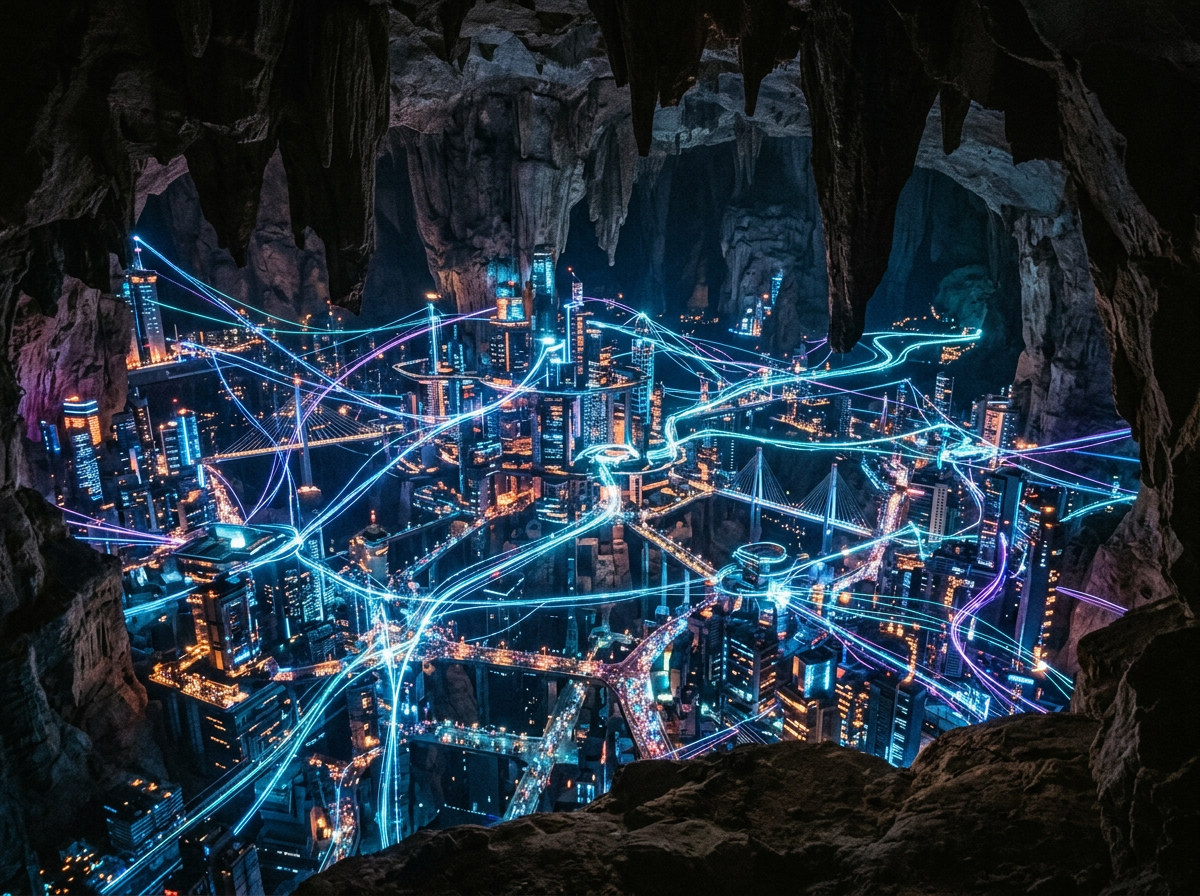
In most systems, memory is treated as storage. Something passive. Something that holds the past while the present moves forward.
But in resilient human systems—especially those shaped by decentralization, diaspora coordination, and community governance—memory is not storage.
Memory is infrastructure.
ARK-F001 — The Living Archive reframes documentation, knowledge, and institutional memory as an active, evolving system that integrates collective experience into decision-making, coordination, and continuity across time.
This is not a database.
It is a living nervous system for collective intelligence.
1. Why Most Systems Fail: The Collapse of Institutional Memory
Across governance systems, NGOs, and community initiatives, one of the most common failure points is not lack of funding or intent—it is loss of continuity.
Projects fail because:
- Knowledge is not transferred between leadership cycles
- Documentation exists but is not usable
- Lessons learned are not embedded into future action
Research on organizational learning shows that systems without structured memory repeatedly recreate the same failures because they cannot retain operational wisdom (Argote, 2013).
In barangay-level systems, this is even more acute due to:
- Leadership turnover
- Informal documentation practices
- Fragmented communication channels
Thus, the core problem ARK-F001 addresses:
Without a living archive, every cycle begins from zero.
2. Defining the Living Archive
The Living Archive is a structured infrastructure that captures, organizes, and activates collective knowledge across time.
It is composed of three functional layers:
a. Capture Layer — What is recorded
This includes:
- Decisions and resolutions
- Project histories
- Community feedback
- Crisis response logs
- Financial flows and outcomes
Unlike traditional archives, capture is continuous and embedded, not post-event.
b. Integration Layer — How meaning is formed
Raw data is not enough. The Living Archive processes information into:
- Patterns
- Lessons learned
- Systemic insights
- Reusable protocols
This aligns with knowledge management theory, which emphasizes that value emerges not from data accumulation but from interpretation and contextualization (Nonaka & Takeuchi, 1995).
c. Activation Layer — How knowledge is used
This is what differentiates a Living Archive from static documentation.
Activation means:
- Past decisions inform current action
- Historical patterns guide present design
- Lessons are embedded into protocols (e.g., Work Sequence, Poka-Yoke systems)
In short:
The archive participates in decision-making.
3. From Static Records to Living Systems
Traditional archives are:
- Passive
- Fragmented
- Retrospective
The Living Archive is:
- Active
- Connected
- Prospective
It does not simply answer: “What happened?”
It continuously informs: “What should happen next?”
This reflects principles of learning organizations, where systems evolve through continuous feedback loops between action and reflection (Senge, 1990).
4. The Role of ARK-F001 in the System Stack
ARK-F001 is not an isolated module. It is the memory backbone of the entire stewardship architecture:
- BVSM (Barangay Value Stream Map) → defines system flows
- Takt Time → regulates internal awareness
- Work Sequence → structures execution
- Standard Inventory → stabilizes resource availability
- Poka-Yoke → prevents regression and error
ARK-F001 ensures all of these:
remember themselves over time
Without it:
- Improvements are lost
- Patterns are not retained
- Each cycle repeats prior mistakes
With it:
- Systems evolve cumulatively
- Learning compounds
- Institutional intelligence emerges
5. Core Functions of the Living Archive
Function 1: Continuity Preservation
Ensures that transitions in leadership do not reset knowledge.
Function 2: Pattern Recognition
Identifies recurring issues across cycles (e.g., funding delays, coordination breakdowns).
Function 3: Decision Traceability
Allows communities to understand why decisions were made—not just what was decided.
Function 4: Protocol Evolution
Feeds insights directly into updates of Work Sequence, SOPs, and governance rules.
This transforms governance from static rule-following into adaptive intelligence.
6. Architecture of Implementation
A functional ARK-F001 system typically includes:
a. Structured Documentation System
- Standardized templates for decisions, projects, and incidents
- Consistent tagging and categorization
b. Narrative Layer
- Contextual storytelling of events
- Qualitative insights from stakeholders
- Community memory capture (oral + written)
c. Data Layer
- Quantitative tracking (funds, timelines, outputs)
- Dashboards for visibility and accountability
d. Retrieval System
- Searchable indexing
- Cross-referenced entries
- Linkage to operational protocols
The key principle:
If it cannot be retrieved, it does not exist as infrastructure.
7. The Diaspora Architect’s Role in the Living Archive
Diaspora architects often act as external memory stabilizers.
Their role includes:
- Designing documentation frameworks that local teams can sustain
- Translating lived community experience into structured systems
- Ensuring knowledge is not lost across geographic or leadership distance
However, the critical discipline is this:
Do not extract memory—co-own it.
The Living Archive must remain locally anchored while globally accessible.
8. Failure Modes of Archival Systems
Even well-designed archives fail when:
a. Overdocumentation without usability
Too much data, no retrieval logic.
b. Under-integration
Information exists but is not used in decision-making.
c. Centralization risk
Knowledge becomes dependent on a single custodian or platform.
d. Temporal fragmentation
New systems overwrite old knowledge instead of layering it.
These failures convert archives into digital graveyards rather than living systems.
9. Integration with the Full System Stack
ARK-F001 becomes fully functional when embedded into:
- BVSM → archives map actual system flows
- Work Sequence → stores execution protocols and iterations
- Poka-Yoke → logs errors and correction patterns
- Standard Inventory → tracks resource evolution over time
- Takt Time → records cycles of attention and decision rhythm
Together, these form a self-referential system of learning.
10. Measuring a Living Archive
A Living Archive is not measured by size—but by activation quality:
Key indicators:
- How often archived knowledge informs decisions
- Speed of retrieving relevant past patterns
- Reduction of repeated systemic errors
- Continuity across leadership transitions
A dormant archive stores history.
A living archive changes behavior.
11. Conclusion: Memory as Infrastructure
ARK-F001 reframes the most overlooked layer of systems design:
Without memory, there is no learning.
Without learning, there is no evolution.
Without evolution, there is no resilience.
For barangay systems and diaspora-led initiatives, the Living Archive is not optional documentation—it is the nervous system of continuity.
It ensures that every cycle:
- Builds on the last
- Learns from its own errors
- Improves without losing identity
Because in the end, resilience is not just the ability to act under pressure.
It is the ability to remember who you are while acting under pressure.
References
Argote, L. (2013). Organizational Learning: Creating, Retaining and Transferring Knowledge. Springer.
Nonaka, I., & Takeuchi, H. (1995). The Knowledge-Creating Company. Oxford University Press.
Senge, P. M. (1990). The Fifth Discipline. Doubleday.
For a broader systems context that situates localized resilience within national and multi-scalar transformation frameworks, explore The Philippine Ark: A Sovereign Blueprint for Systemic Transformation.
Suggested Internal Crosslinks
- ARK-001: The 50-Person Resource Loop → foundational unit
- The Architecture of Silence → social-psychological failure mode
- Pre-colonial Philippine Economics → indigenous precedent for localized governance
[DOCUMENT CONTROL & STEWARDSHIP]
Standard Work ID: [ARK-F001]
Baseline Version: v1.5.2026
Classification: Open-Access Archive / Systemic Protocol
The Sovereign Audit: Following this protocol is an act of internal quality control. Verification of this standard does not happen here; it happens at your Gemba—the actual place where your life and leadership occur. No external validation is required or offered.
Next in Sequence: [ARK-004: Post-Fiat Trade: The Community Ledger SOP]
Return to Archive: [Standard Work Knowledge Hub: The Terrain Map]
© 2026 Gerald Daquila • Life.Understood • Systemic Stewardship • Non-Autocratic Architecture • Process over Persona
Leave a Reply