Category: Philosophy

  • Filipino Identity and Culture

    Filipino Identity and Culture

    A Historical Journey of Resilience, Values, and Nationhood

    Prepared by: Gerald A. Daquila, PhD. Candidate


    What defines Filipino identity—and how has it evolved over time? Shaped by layers of indigenous heritage, colonial influence, and global exposure, Filipino culture reflects both continuity and adaptation.

    Values such as pakikipagkapwa (shared identity), bayanihan (community cooperation), and strong family orientation remain central, yet they exist alongside modern pressures that reshape how identity is expressed.

    This article explores how Filipino identity is formed, how it adapts across contexts, and how cultural patterns influence behavior, social cohesion, and national development.


    For a broader view of Philippine culture, society, and systems, see:
    → Understanding the Philippines: Culture, Society, and Systems (Hub)


    Scope and Approach

    This article examines Filipino identity and culture through a historical, behavioral, and structural lens. It does not attempt to define a single, fixed identity, but instead recognizes Filipino culture as dynamic—shaped by interactions between past influences and present realities.

    The discussion integrates precolonial foundations, colonial-era transformations, and contemporary global influences to understand how cultural patterns emerge and persist. It considers how values such as relational orientation, adaptability, and respect for hierarchy operate within modern systems including governance, education, and the economy.

    Rather than idealizing or critiquing cultural traits in isolation, this approach evaluates how they function within specific environments. Traits that strengthen social cohesion in one context may create constraints in another, depending on institutional alignment and incentives.

    The goal is to provide a clearer framework for understanding identity as both an internal and external force—shaping perception, behavior, and collective outcomes. By making these dynamics more visible, this work supports more informed reflection on how culture influences national direction, social interaction, and the Philippines’ role in a changing global landscape.

    10–15 minutes

    ABSTRACT

    The Philippines’ history is a vibrant saga of resilience, cultural fusion, and adaptation, shaping a unique Filipino identity defined by kapwa (shared identity) and global adaptability. This paper narrates how pre-colonial roots, colonial struggles, and modern challenges have molded the Filipino psyche, worldview, values, and ethics. It explores strengths like resilience and collectivism, alongside weaknesses such as colonial mentality, drawing on Sikolohiyang Pilipino to highlight cultural distinctiveness.

    The narrative proposes leveraging these traits for progress through education, innovation, and diplomacy, while identifying historical lessons—resilience, unity, and cultural pride—as guides for the future. The Philippines’ potential as a cultural and economic leader is examined, with projections for excellence in technology and sustainability. The modern Filipino, a blend of tradition and globalism, stands out for their relational ethics and optimism, poised to shape a dynamic future.


    Introduction: A Nation’s Story Begins

    Imagine an archipelago of over 7,000 islands, where waves whisper tales of ancient traders, resilient warriors, and modern dreamers. This is the Philippines, a land where history is not just a record but a living force that shapes its people. As historian Ambeth Ocampo (2024) eloquently states, “The past is not dead; it is not even past” (Ocampo, 2024, p. 2).

    In this narrative, we explore how the Philippines’ journey through time has crafted the modern Filipino’s psyche, values, and worldview. We delve into their strengths and weaknesses, envision how their unique perspective can drive progress, and reflect on their role in the global community.

    Through the lens of Sikolohiyang Pilipino and philosophical insights, we uncover what makes the Filipino of today distinct and how their story can inspire a future of impact.


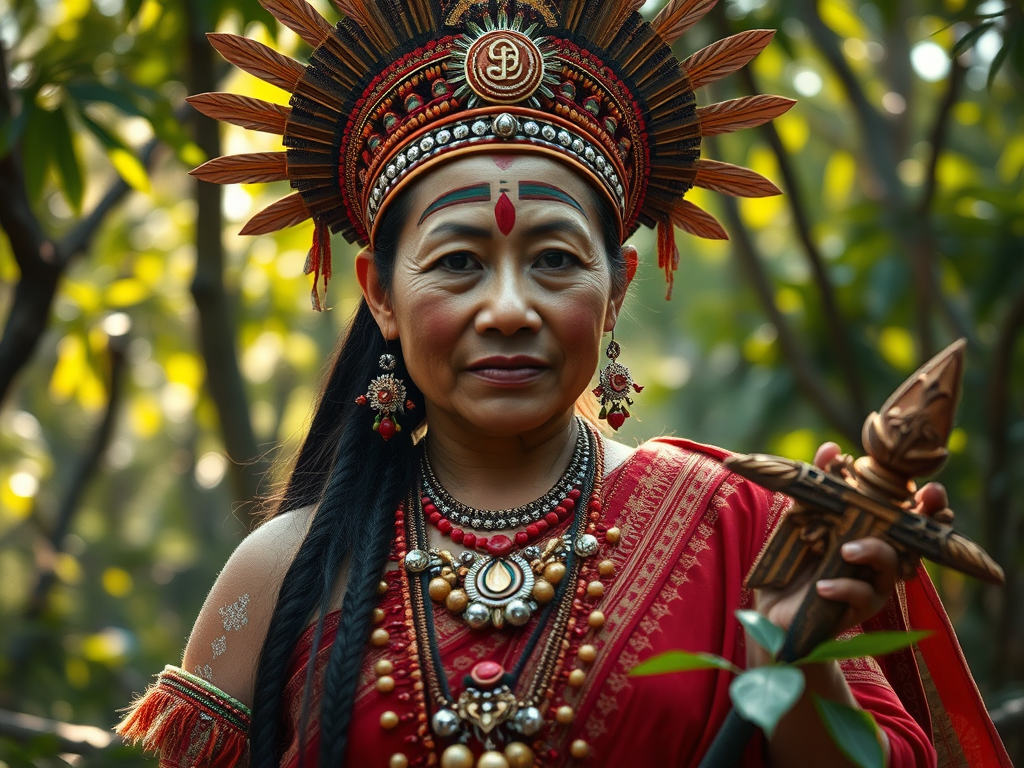
    Glyph of the Custodian

    The Keeper of Lineage, Memory, and Home.


    The Tapestry of History: A Filipino Odyssey

    Long before foreign ships dotted its shores, the Philippines was a mosaic of Austronesian communities—Tagalogs, Visayans, Igorots—bound by trade, animist beliefs, and communal harmony (Jocano, 1998). These early Filipinos navigated the seas, forging connections with neighbors in Southeast Asia, their lives steeped in reverence for nature and ancestors.

    Then came the Spanish in 1565, draping the islands in Catholicism and reshaping social structures over three centuries. Yet, the Filipino spirit resisted, birthing the Katipunan, a revolutionary cry for freedom (Agoncillo, 1990).

    The Americans arrived in 1898, bringing English education and democratic ideals, but also a “colonial mentality” that lingered in the Filipino psyche (Constantino, 1978). The Japanese occupation of 1942–1945 was a brief but brutal chapter, forging resilience through suffering.

    Independence in 1946 marked a new beginning, yet challenges like martial law under Marcos, Sr. and ongoing nation-building tested the Filipino resolve (Abinales & Amoroso, 2017). This history of struggle and adaptation is the crucible in which the modern Filipino was forged—a story of endurance, faith, and reinvention.


    The Filipino Psyche: A Heart of Kapwa

    At the core of the Filipino soul lies kapwa, a concept of shared identity that transcends Western individualism. As Virgilio Enriquez, the father of Sikolohiyang Pilipino, explains, kapwa sees the self as inseparable from others, fostering a worldview of interconnectedness (Enriquez, 1992).

    Picture a Filipino family gathering, where laughter and shared stories bind generations—this is kapwa in action. It shapes a relational ethic, where values like kagandahang-loob (shared nobility) and pakikisama (social harmony) prioritize community over self (Pe-Pua & Protacio-Marcelino, 2000).

    Yet, the Filipino psyche bears scars of history. Colonialism planted seeds of inferiority, a “colonial mentality” that sometimes overshadows pride in indigenous roots (Constantino, 1978). Amid typhoons and political upheavals, Filipinos have cultivated a resilient optimism, often expressed through humor—a trait that shines in their global diaspora (Mulder, 2013).

    Their spirituality, a syncretic blend of animist traditions and Catholicism, manifests in vibrant festivals like Sinulog, where faith and culture dance as one (Mercado, 1974). This psyche, both wounded and vibrant, is a paradox of strength and vulnerability.


    Values and Ethics: The Filipino Moral Compass

    The Filipino’s moral world revolves around loob, the inner self that drives relational ethics. Values like hiya (propriety), pakikiramdam (shared sensitivity), and utang na loob (gratitude) guide behavior, emphasizing harmony and empathy (Enriquez, 1992).

    In a Filipino village, pakikisama ensures neighbors work together, while lakas ng loob (courage) fuels resilience in crises. These values form a virtue ethics distinct from Western rationalism, rooted in relationships rather than abstract principles (Mercado, 1974).

    However, these values have a dual edge. Hiya can foster dignity but also stifle assertiveness, while utang na loob can nurture loyalty yet breed dependency (Pe-Pua & Protacio-Marcelino, 2000). Scholars like Mulder (2013) highlight this ambivalence, noting that values can be virtuous or limiting depending on context.

    Concepts like kalayaan (freedom) and katarungan (justice) anchor Filipino socio-political ethics, yet their application often faces challenges in a society marked by historical divisions (Abinales & Amoroso, 2017). This tension calls for a re-examination of values to align with modern aspirations.


    Strengths and Weaknesses: The Filipino Character Unveiled

    The Filipino spirit shines with remarkable strengths. Their resilience is legendary, evident in thriving industries like Business Process Outsourcing (BPO), where Filipinos excel despite global competition (Ortiga, 2018).

    Kapwa fosters collectivism, making Filipinos exceptional collaborators in workplaces worldwide (Pe-Pua & Protacio-Marcelino, 2000). Their adaptability, born of cultural hybridity, allows them to navigate diverse global contexts, from Silicon Valley to Dubai (Ocampo, 2024).

    Yet, weaknesses persist. The colonial mentality undermines self-confidence, leading some to favor foreign ideals over indigenous ones (Constantino, 1978).

    Ambivalent values, like excessive hiya, can hinder assertiveness, while historical divisions between elites and masses fragment national unity (Abinales & Amoroso, 2017). These challenges, though, are not insurmountable; they are part of the Filipino story, a narrative of growth through struggle.


    Glyph of the Filipino Spirit

    A journey through history and identity, where sun and islands bear witness to the enduring soul of a nation.


    A Path to Progress: Harnessing the Filipino Spirit

    The Filipino’s unique perspective—rooted in kapwa and resilience—holds immense potential for progress. Imagine schools teaching Sikolohiyang Pilipino, instilling pride in indigenous values to counter colonial mentality (Enriquez, 1992).

    The BPO sector’s success signals a future in technology and creative industries, where Filipino adaptability can shine (Ortiga, 2018). Globally, the Philippines’ cultural hybridity positions it as a bridge in ASEAN and beyond, fostering dialogue and collaboration (Mulder, 2013).

    By preserving traditions like Anitism (anitos) and promoting cultural exports—think Filipino cuisine or films—the nation can amplify its global presence. Investing in education and innovation, particularly in AI and sustainable tech, can transform economic prospects (Ocampo, 2024).

    The Filipino diaspora, with its remittances and cultural influence, is a powerful force for progress, weaving the Philippines into the global tapestry.


    Lessons from the Past: Guides for the Future

    The Filipino story offers timeless lessons. The Katipunan’s defiance teaches that collective action can overcome oppression (Agoncillo, 1990). Cultural syncretism—blending indigenous and foreign influences—has sustained identity through centuries (Jocano, 1998).

    Renato Constantino’s call to rediscover history urges Filipinos to embrace critical consciousness, fostering informed citizenship (Constantino, 1978). These lessons—resilience, unity, and pride—light the path toward a future where Filipinos shape their destiny with confidence.


    A Global Role: The Philippines on the World Stage

    The Philippines is poised to be a cultural and economic leader. Its history of East-West fusion makes it a natural mediator in global forums, promoting peace and collaboration (Mulder, 2013).

    The BPO industry and diaspora remittances underscore its economic potential, while its experience with climate challenges positions it to lead in sustainability (Ortiga, 2018). As a voice for resilience, the Philippines can inspire nations facing similar trials, weaving its story into the global narrative.


    The Future: Where the Philippines Can Excel

    Current trends paint a promising picture. Digitalization, from mobile payments to tech startups, is transforming access and opportunity (Ocampo, 2024). The diaspora’s global influence drives cultural and economic growth, while efforts to revive indigenous practices strengthen identity (Jocano, 1998). Looking ahead, the Philippines can excel in:

    • Technology: Expanding BPO into AI and creative tech.
    • Cultural Exports: Sharing festivals, arts, and cuisine globally.
    • Sustainability: Leading climate resilience strategies in ASEAN.

    These areas align with the Filipino’s adaptability and creativity, promising a future of innovation and impact.


    The Filipino of Today: A Unique Soul

    Who is the modern Filipino? They are a vibrant blend of tradition and globalism, defined by kapwa—a relational ethic that sets them apart from the individualism of the West or the collectivism of other Asian cultures (Enriquez, 1992).

    Their fluency in English and cultural hybridity make them global citizens, thriving in diverse settings (Ocampo, 2024). Their resilient optimism, expressed through humor and faith, is a beacon in adversity. The Filipino is a storyteller, a survivor, and a dreamer, weaving a narrative that resonates worldwide.


    Conclusion: A Story Still Unfolding

    The Filipino journey is a saga of resilience, adaptation, and hope. From ancient traders to modern innovators, Filipinos have woven a rich tapestry of identity, grounded in kapwa and shaped by history’s trials.

    While colonial shadows linger, their strengths—resilience, collectivism, adaptability—light the way forward. By embracing their heritage, leveraging economic potential, and learning from the past, Filipinos are co-creating a future of global influence. The Filipino spirit, a unique blend of heart and hustle, is a gift to the world, a story still being written.


    Suggested Crosslinks


    Glossary

    • Kapwa: Shared identity, emphasizing interconnectedness with others.
    • Loob: Inner self or relational will, central to Filipino ethics.
    • Sikolohiyang Pilipino: Indigenous Filipino psychology rooted in cultural context.
    • Utang na Loob: Gratitude or solidarity, fostering relational bonds.
    • Hiya: Propriety or dignity, guiding social behavior.
    • Pakikisama: Social harmony or companionship, prioritizing group cohesion.

    References

    Abinales, P. N., & Amoroso, D. J. (2017). State and society in the Philippines (2nd ed.). Rowman & Littlefield.

    Agoncillo, T. A. (1990). History of the Filipino people (8th ed.). Garotech Publishing.

    Constantino, R. (1978). The Philippines: A past revisited. Tala Publishing.

    Enriquez, V. G. (1992). From colonial to liberation psychology: The Philippine experience. University of the Philippines Press.

    Jocano, F. L. (1998). Filipino prehistory: Rediscovering precolonial heritage. Punlad Research House.

    Mercado, L. N. (1974). Elements of Filipino philosophy. Divine Word University Press.

    Mulder, N. (2013). Filipino identity: The haunting question. Journal of Current Southeast Asian Affairs, 32(1), 55–80.

    Ocampo, A. R. (2024). The continuum of Filipino cultural identity: Balancing tradition and change in a globalized and post-pandemic world. Preprints.org. https://doi.org/10.20944/preprints202401.0001.v1

    Ortiga, Y. Y. (2018). Emigration, employability and higher education in the Philippines. Routledge.

    Pe-Pua, R., & Protacio-Marcelino, E. (2000). Sikolohiyang Pilipino (Filipino psychology): A legacy of Virgilio G. Enriquez. Asian Journal of Social Psychology, 3(1), 49–71. https://doi.org/10.1111/1467-839X.00054


    Explore More Philippine Analysis


    → View the full Philippines Hub


    Understanding these dynamics also requires clarity in how individuals respond under pressure—see Life Under Pressure.


     Some articles in this section are part of the Stewardship Archive

    These pieces explore deeper layers of Philippine transformation, including:

    • long-term societal redesign
    • advanced governance frameworks
    • future-state modeling

    They are written for readers who want to go beyond surface analysis into structural and forward-looking perspectives.


    → Continue reading (Members Access)


    About This Work

    This article is part of a broader exploration of Philippine society, culture, and systems—integrating historical context, behavioral patterns, and structural analysis.

    It is intended to support understanding, reflection, and informed discussion.

    For a wider macro perspective, Global Reset: Systems Change, Economic Transition, and Future Models.


    Explore the Rest of the Site

    This work sits within a larger system of essays on human development, systems thinking, and societal transformation.

    → Living Archive
    → Stewardship Architecture
    → Main Blog


    Attribution

    © 2025–2026 Gerald Alba Daquila
    All rights reserved.

    This work is offered for reflection and independent interpretation. It does not represent a formal doctrine, institution, or required belief system.


    Codex Origin and Stewardship

    This material originates within the field of the Living Codex and is stewarded under Oversoul Appointment.

    It may be shared in its complete and unaltered form, with attribution preserved.

    Lineage Marker: Universal Master Key (UMK) Codex Field


    Support This Work

    If you find this work valuable, you may support its continued development and availability.

    Support helps sustain:

    • ongoing writing and research
    • digital hosting and access
    • future publications

    Ways to access and support:

    • Free reading within the Living Archive
    • Individual digital editions
    • Stewardship-based access

    Support link:
    paypal.me/GeraldDaquila694
    www.geralddaquila.com
  • Living in the Barangay: Unveiling the Societal Tapestry of Pre-Colonial Philippines

    Living in the Barangay: Unveiling the Societal Tapestry of Pre-Colonial Philippines

    A Multidisciplinary Exploration of Indigenous Governance, Social Cohesion, and Cultural Resilience Before Western Colonization

    Author: Gerald A. Daquila, PhD Candidate


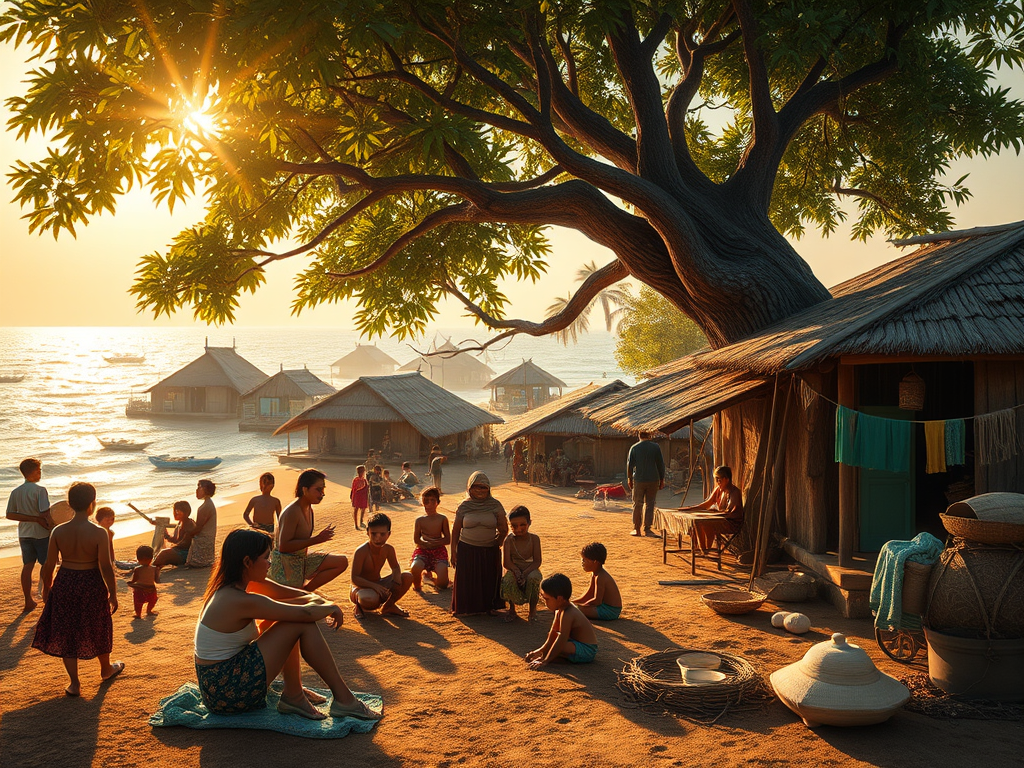
    What was life like in the Philippines before colonial rule—and what can it reveal about alternative models of governance and community? Prior to external influence, Filipino societies were organized into barangays: small, decentralized communities built on kinship, mutual obligation, and localized leadership.

    These systems operated with their own forms of law, trade, and social structure, often adapted to specific geographic and cultural contexts. This article explores how the barangay functioned as a foundational unit of pre-colonial Philippine society, and what its principles suggest about autonomy, cohesion, and grassroots governance.


    For a broader view of Philippine culture, society, and systems, see:
    → Understanding the Philippines: Culture, Society, and Systems (Hub)


    Scope and Approach

    This article examines the pre-colonial barangay as a social, political, and economic system. It does not idealize the past or assume uniformity across all regions, but instead recognizes the diversity of structures that existed across the archipelago.

    The discussion focuses on key features of barangay life, including decentralized leadership under the datu, kinship-based organization, customary law, and localized trade networks. It also considers how these systems balanced autonomy with inter-community relations, forming flexible networks rather than rigid hierarchies.

    Rather than treating the barangay as a relic of history, this approach evaluates its relevance as a reference point for understanding contemporary issues such as governance, community engagement, and social cohesion. It also examines how colonial restructuring altered or replaced these systems, shaping the trajectory of Philippine institutions.

    The goal is to provide a grounded understanding of how early Filipino societies functioned, and how their underlying principles may still offer insight into modern challenges. By examining the barangay not just as history but as a system, this work supports clearer thinking about the relationship between local organization, cultural identity, and national development.

    12–18 minutes

    ABSTRACT

    The pre-colonial Philippines, a vibrant archipelago of diverse ethnolinguistic communities, thrived as a network of barangays—kinship-based units rooted in communal values like kapwa (shared identity) and bayanihan (collective cooperation). This paper employs a PESTLE framework (Political, Economic, Social, Technological, Legal, Environmental) to dissect the societal structure of pre-colonial Filipino life, grounded in historical, anthropological, psychological, and sociological research.

    It examines the roles of datus, babaylans, and community members; the informal rules of reciprocity and consensus; and the dynamic systems of governance, education, and trade that sustained these societies. By imagining a time-travel experience to a pre-colonial barangay, this study vividly reconstructs daily life, highlighting the strengths of communal resilience and areas of concern, such as potential fragmentation and vulnerability to external pressures.

    The analysis reveals how colonial disruptions later undermined these systems, while suggesting that reconnecting with pre-colonial values could inspire modern Filipino identity and resilience. Written in accessible, narrative prose, this work balances academic rigor with emotional resonance, appealing to a broad readership seeking to understand the Philippines’ Indigenous past.

    Keywords: Pre-colonial Philippines, barangay, kapwa, bayanihan, PESTLE analysis, Indigenous governance, social cohesion, Filipino identity, cultural resilience


    Introduction

    Imagine stepping into a bustling coastal barangay in the 15th-century Philippines, where the air hums with the rhythm of waves, the scent of coconut and salt, and the laughter of children learning oral epics under a balete tree. This was the pre-colonial Philippines—a mosaic of over 7,000 islands, home to diverse ethnolinguistic groups like the Tagalogs, Visayans, and Moro peoples, united by shared values of community and reciprocity.

    Before Spanish galleons arrived in 1521, these societies thrived without centralized kingdoms, relying instead on barangays: small, kinship-based units led by datus and animated by kapwa, the belief in shared humanity. This study uses a PESTLE framework to explore the societal structure of pre-colonial Philippines, answering: Who were the key players? What rules governed their lives? How did governance, social cohesion, education, and economy function?

    Through a multidisciplinary lens—drawing from history, anthropology, Sikolohiyang Pilipino (Filipino Psychology), and sociology—we reconstruct this world, grounded in sources like the Laguna Copperplate Inscription (900 CE) and oral traditions (Jocano, 1998; Scott, 1994).

    By imagining a time-traveler’s experience, we bring this past to life, spotlighting strengths like communal resilience and concerns like political fragmentation. This narrative aims to inform and inspire, connecting modern Filipinos to their Indigenous roots while addressing how these values could address contemporary challenges.


    Glyph of the Gridkeeper

    The One Who Holds the Lattice of Light.


    PESTLE Analysis of Pre-Colonial Philippine Society

    Political: Governance and Leadership

    Key Players: The barangay, typically comprising 30–100 families, was the core political unit, led by a datu—a chief chosen for charisma, wisdom, or wealth (Scott, 1994). Larger polities, like the Kingdom of Tondo or Rajahnate of Butuan, emerged by the 10th century, led by rajahs or sultans with broader influence (Jocano, 1998). Babaylans, often female spiritual leaders, wielded significant influence, advising datus and mediating disputes (Enriquez, 1992).

    Rules and Governance: Governance was decentralized and consensus-driven, rooted in kapwa—a value prioritizing collective harmony over individual ambition (Enriquez, 2013). Datus resolved conflicts through mediation, guided by customary laws (adat) or Islamic principles in Mindanao’s sultanates (Majul, 1973). The Laguna Copperplate Inscription (900 CE) reveals a legal system addressing debt and kinship ties, indicating sophisticated political organization (Postma, 1992). Alliances were forged through marriage or trade, as seen in Tondo’s ties with China’s Song Dynasty (Scott, 1994).

    Experience: As a time-traveler, you’d witness a datu settling a dispute under a communal banyan tree, villagers voicing opinions freely. The absence of rigid hierarchies would feel liberating, but the reliance on personal loyalty to datus could seem precarious, hinting at vulnerability to internal rivalries or external threats.

    Concerns: The decentralized structure fostered local autonomy but risked fragmentation. Without a unified political system, barangays were susceptible to manipulation by foreign traders or invaders, a weakness later exploited by Spanish colonizers (Constantino, 1975).


    Economic: Trade and Sustenance

    Key Players: Farmers, fishers, artisans, and traders drove the economy. Datus and maharlika (nobles) controlled trade, while timawa (freemen) and alipin (dependents) worked the land or crafted goods (Scott, 1994).

    Rules and Economy: The economy blended subsistence and trade. Coastal barangays grew rice, root crops, and coconuts, while fishing sustained communities (Jocano, 1998). The Philippines was a hub in the Maritime Silk Road, exporting gold, pearls, and beeswax to China, India, and Southeast Asia (Piacentini, 2023). Barter was common, but gold and Chinese porcelain served as currency in major centers like Butuan (Scott, 1994). The alipin system, where debts tied individuals to service, ensured labor but allowed social mobility through repayment or bravery (Studocu, 2023).

    Experience: You’d barter rice for a Chinese jar at a bustling port, marveling at balangay boats laden with goods. The market’s vibrancy would pulse with communal trust, but you might notice tensions when debts bound alipin to elites, hinting at economic inequities.

    Concerns: While trade enriched coastal barangays, inland communities had less access, creating disparities. The alipin system, though flexible, could perpetuate dependency, foreshadowing colonial exploitation (Constantino, 1975).


    Social: Cohesion and Community

    Key Players: The social fabric included datus, maharlika, timawa, alipin, and babaylans. Women often held high status, especially as babaylans or property holders (Enriquez, 1992).

    Rules and Social Cohesion: Kapwa fostered a sense of shared identity, where individual well-being depended on the community’s (Enriquez, 2013). Bayanihan—communal work like moving houses or harvesting—cemented bonds (Kilag, 2024). Rituals, led by babaylans, reinforced unity, with feasts celebrating harvests or victories. Social mobility was possible, as alipin could become timawa through service or marriage (Scott, 1994).

    Experience: You’d join a bayanihan effort, lifting a nipa hut alongside neighbors, feeling the joy of collective purpose. At night, babaylans would lead rituals under starlit skies, their chants weaving spiritual and social bonds. Yet, you might sense tensions between classes, as alipin worked harder for less status.

    Concerns: Class distinctions, though fluid, could strain cohesion, especially when datus favored elites. Inter-barangay rivalries, fueled by competition for trade, occasionally led to conflicts, weakening collective resilience (Jocano, 1998).


    Technological: Innovation and Craftsmanship

    Key Players: Artisans, boat-builders, and weavers were technological innovators, supported by community knowledge-sharing (Piacentini, 2023).

    Rules and Technology: Filipinos excelled in boat-building, crafting balangay outrigger boats for trade and warfare (Scott, 1994). Gold-working, as seen in the Surigao Treasure, showcased intricate artistry (Jocano, 1998). Weaving produced textiles like abaca, traded regionally. The baybayin script enabled record-keeping and communication, though primarily for ritual or personal use (Piacentini, 2023).

    Experience: You’d sail on a balangay, awed by its sturdy planks and skilled navigators reading stars and currents. Visiting a goldsmith, you’d see delicate filigree work, while weavers taught you abaca patterns. The ingenuity would inspire, but the reliance on oral transmission might limit widespread technological diffusion.

    Concerns: Technological advancements were localized, with coastal barangays outpacing inland ones. The lack of a unified writing system beyond baybayin hindered large-scale knowledge preservation, leaving societies vulnerable to cultural erasure during colonization (Constantino, 1975).


    Legal: Customary Laws and Justice

    Key Players: Datus and babaylans enforced laws, with community elders advising on disputes (Scott, 1994).

    Rules and Legal System: Customary laws (adat) governed behavior, emphasizing restitution over punishment. The Laguna Copperplate Inscription documents debt settlements, showing a formalized legal framework (Postma, 1992). In Mindanao, Islamic sultanates adopted Sharia elements, blending with Indigenous norms (Majul, 1973). Disputes were resolved through consensus, with babaylans mediating spiritual or moral conflicts (Enriquez, 1992).

    Experience: You’d attend a dispute resolution, where a datu listens to both sides, guided by elders and a babaylan’s wisdom. The focus on restoring harmony would feel restorative, but the lack of written laws might seem inconsistent across barangays.

    Concerns: The oral nature of laws risked inconsistency, and datus’ personal authority could lead to favoritism. In larger polities, integrating diverse customs posed challenges, foreshadowing colonial centralization (Scott, 1994).


    Environmental: Harmony with Nature

    Key Players: Farmers, fishers, and babaylans interacted closely with the environment, guided by animist beliefs (Jocano, 1998).

    Rules and Environmental Practices: Animism shaped environmental stewardship, with spirits (anito) believed to inhabit nature. Rituals ensured sustainable harvests, and communal land use prevented overexploitation (Enriquez, 1992). Coastal barangays adapted to typhoons, building elevated nipa huts and maintaining fish traps (Piacentini, 2023).

    Experience: You’d join a ritual thanking the rice spirit, planting seeds with reverence. Fishing with woven traps, you’d feel the community’s respect for the sea. Typhoon preparations would showcase resilience, but frequent storms might highlight environmental vulnerabilities.

    Concerns: While sustainable, practices were localized, and growing trade demands could strain resources, as seen in deforestation for boat-building (Jocano, 1998). Climate challenges like typhoons required adaptive resilience, which colonialism later disrupted.


    A Time-Traveler’s Experience: Life in a Pre-Colonial Barangay

    Picture yourself in a Visayan barangay circa 1400 CE, waking to roosters crowing and the scent of woodsmoke. Your nipa hut, elevated on stilts, sways gently in the tropical breeze. Outside, neighbors greet you with kapwa’s warmth, treating you as kin. You join farmers planting rice, their songs blending with the rustle of palms—a bayanihan rhythm of shared labor.

    At the port, traders unload Chinese porcelain, their balangay boats gleaming under the sun. A babaylan invites you to a ritual, her chants invoking anito spirits as the community feasts on roasted pig and rice wine. The datu, adorned with gold, resolves a dispute with calm authority, but you notice whispers of rivalry with a neighboring barangay.

    Life feels vibrant yet fragile. The communal spirit uplifts, but class tensions and trade disparities hint at underlying strains. You marvel at the gold jewelry and baybayin inscriptions, yet wonder how these oral traditions will endure. As a typhoon looms, the barangay unites to secure homes, their resilience inspiring but tempered by the lack of centralized coordination. This is a world of harmony and ingenuity, yet one poised on the edge of transformation, vulnerable to external forces.


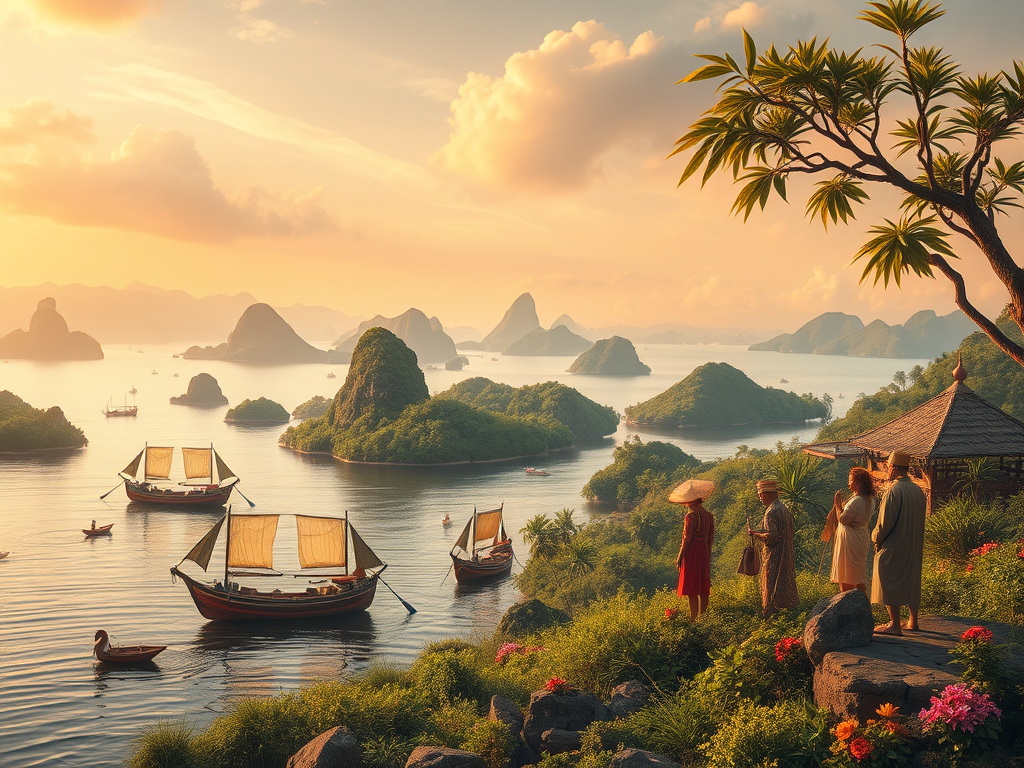
    Glyph of the Barangay Tapestry

    Revealing the woven life of the pre-colonial barangay, where kinship, spirit, and land formed the sacred architecture of community.


    Areas of Concern and Modern Reflections

    These reflections are offered not as prescriptions, but as interpretive bridges between past and present. The pre-colonial Philippines was a testament to communal resilience, but its decentralized structure posed challenges:

    1. Political Fragmentation: The absence of a unified polity made barangays susceptible to foreign domination, as seen when Spanish colonizers exploited rivalries (Constantino, 1975).
    2. Economic Disparities: Coastal trade hubs thrived, but inland communities lagged, foreshadowing colonial inequalities (Studocu, 2023).
    3. Cultural Vulnerability: Oral traditions and localized knowledge risked loss without widespread written systems, a weakness exacerbated by colonial erasure (Piacentini, 2023).
    4. Social Tensions: While kapwa fostered cohesion, class distinctions and inter-barangay conflicts could undermine unity (Jocano, 1998).

    These concerns highlight the fragility of pre-colonial systems, yet their strengths—kapwa, bayanihan, and adaptive resilience—offer lessons for today. Modern Filipinos, facing inequality and cultural alienation, can draw on these values to rebuild collective efficacy. Initiatives like Sikolohiyang Pilipino and decolonized education can revive cultural pride, while community-driven policies can institutionalize bayanihan to address crises (Enriquez, 2013; Kilag, 2024).


    Conclusion

    The pre-colonial Philippines was a vibrant tapestry of barangays, woven together by kapwa and sustained by cooperative governance, trade, and spiritual harmony. Through a PESTLE lens, we see a society of ingenuity and resilience, yet one vulnerable to fragmentation and external pressures. As a time-traveler, you’d feel the pulse of community, marvel at its artistry, and sense its delicate balance.

    By reconnecting with these Indigenous values, modern Filipinos can reclaim their cultural confidence, fostering a society that honors its past while navigating present challenges. This journey through time invites us to celebrate the archipelago’s roots and envision a future where kapwa guides the nation forward.


    Suggested Crosslinks


    Glossary

    • Barangay: A pre-colonial Filipino community unit, typically 30–100 families, led by a datu.
    • Bayanihan: A tradition of communal cooperation, such as collectively moving a house or harvesting crops.
    • Babaylan: Indigenous spiritual leaders, often women, who mediated between communities and spirits.
    • Kapwa: A core Filipino value meaning “shared identity,” emphasizing interconnectedness.
    • Datu: A barangay chief, chosen for leadership, wisdom, or wealth.
    • Timawa: Freemen in the social hierarchy, with rights to land and labor.
    • Alipin: Dependents or slaves, often bound by debt, with potential for social mobility.
    • Baybayin: A pre-colonial syllabic script used for ritual and personal writing.
    • Anito: Spirits or deities in animist beliefs, revered in rituals.
    • Adat: Customary laws governing barangay behavior and justice.

    Bibliography

    Constantino, R., & Constantino, L. R. (1975). The Philippines: A past revisited (Vol. 1). Quezon City: Renato Constantino.

    Enriquez, V. G. (1992). From colonial to liberation psychology: The Philippine experience. University of the Philippines Press.

    Enriquez, V. G. (2013). From colonial to liberation psychology: The Philippine experience. Philosophy East and West, 63(2), 123-145.

    Jocano, F. L. (1998). Filipino indigenous ethnic communities: Patterns, variations, and typologies. Quezon City: Punlad Research House Inc.

    Kilag, O. K. (2024). Filipino youth for stronger future of the new Philippines. International Multidisciplinary Journal of Research for Innovation, Sustainability, and Excellence, 1(6). Retrieved from https://risejournals.org

    Majul, C. A. (1973). Muslims in the Philippines. Quezon City: University of the Philippines Press.

    Piacentini, K. (2023). Influences on Philippine education. Wixsite. Retrieved from https://kpiacentini.wixsite.com/iem-php/unit-1-influences

    Postma, A. (1992). The Laguna Copperplate Inscription: Text and commentary. Philippine Studies, 40(2), 183-203.

    Scott, W. H. (1994). Barangay: Sixteenth-century Philippine culture and society. Quezon City: Ateneo de Manila University Press.

    Studocu. (2023). Module 13 Week 13: Social, political, economic, and cultural issues in Philippine history. Retrieved from https://www.studocu.com


    Explore More Philippine Analysis


    → View the full Philippines Hub


    Understanding these dynamics also requires clarity in how individuals respond under pressure—see Life Under Pressure.


     Some articles in this section are part of the Stewardship Archive

    These pieces explore deeper layers of Philippine transformation, including:

    • long-term societal redesign
    • advanced governance frameworks
    • future-state modeling

    They are written for readers who want to go beyond surface analysis into structural and forward-looking perspectives.


    → Continue reading (Members Access)


    About This Work

    This article is part of a broader exploration of Philippine society, culture, and systems—integrating historical context, behavioral patterns, and structural analysis.

    It is intended to support understanding, reflection, and informed discussion.

    For a wider macro perspective, Global Reset: Systems Change, Economic Transition, and Future Models.


    Explore the Rest of the Site

    This work sits within a larger system of essays on human development, systems thinking, and societal transformation.

    → Living Archive
    → Stewardship Architecture
    → Main Blog


    Attribution

    © 2025–2026 Gerald Alba Daquila
    All rights reserved.

    This work is offered for reflection and independent interpretation. It does not represent a formal doctrine, institution, or required belief system.


    Codex Origin and Stewardship

    This material originates within the field of the Living Codex and is stewarded under Oversoul Appointment.

    It may be shared in its complete and unaltered form, with attribution preserved.

    Lineage Marker: Universal Master Key (UMK) Codex Field


    Support This Work

    If you find this work valuable, you may support its continued development and availability.

    Support helps sustain:

    • ongoing writing and research
    • digital hosting and access
    • future publications

    Ways to access and support:

    • Free reading within the Living Archive
    • Individual digital editions
    • Stewardship-based access

    Support link:
    paypal.me/GeraldDaquila694
    www.geralddaquila.com© 2025 Gerald Alba Daquila
    This article is offered for educational and interpretive purposes.


    Download This Complimentary Keystone Reference

  • What Is a Babaylan? Spiritual Leadership, Healing, and Cultural Resilience in Precolonial Philippines

    What Is a Babaylan? Spiritual Leadership, Healing, and Cultural Resilience in Precolonial Philippines


    Who were the babaylan? Explore their role as spiritual leaders, healers, and cultural stewards in precolonial Philippines—and why their legacy is being revived today.

    Gerald A. Daquila, PhD. Candidate


    The babaylan were the spiritual leaders of precolonial Philippine society—healers, ritualists, and mediators between the human and spirit worlds. Found across the archipelago under different names, they guided communities through healing, governance, and connection with nature and ancestors.

    Suppressed during Spanish colonization and often misrepresented in history, their role is now being rediscovered as part of a wider movement to reclaim Filipino identity, indigenous knowledge, and holistic ways of living.

    In simple terms: A babaylan was a community healer and spiritual guide who maintained balance between people, nature, and the unseen world.


    For a broader view of Philippine culture, society, and systems, see:
    → Understanding the Philippines: Culture, Society, and Systems (Hub)


    Scope and Approach

    This article integrates historical research, anthropological perspectives, and contemporary interpretations of spirituality. While it includes metaphysical and esoteric frameworks as lenses of interpretation, these are presented alongside documented scholarship to offer a holistic view of the babaylan and their role in Philippine society.


    How to Read This Page

    If you’re here, you may be exploring different questions:

    • Who the babaylan were historically
    • Whether their role was spiritual, social, or political
    • Why their knowledge was suppressed—and why it is returning
    • Whether similar forms of leadership exist in other cultures

    This article focuses on the babaylan in the Philippines, but it can be read at multiple levels:

    • 🟢 Historical and cultural lens → understanding their role in precolonial society
    • 🟡 Systems lens → how alternative forms of authority and governance functioned
    • 🔵 Applied lens → what this means for leadership, healing, and community today
    • 🟣 Deeper lens → questions of consciousness, identity, and human development

    You can engage with it based on your context and interest.

    12–18 minutes

    Abstract

    The babaylans, revered spiritual leaders of precolonial Philippine society, embodied a holistic synthesis of healer, priestess, warrior, and sage, bridging the material and spiritual realms. Rooted in animistic traditions, their contributions shaped community cohesion, cultural heritage, and environmental stewardship. Spanish colonization systematically suppressed their influence, demonizing their practices and erasing their knowledge to enforce Christian hegemony.

    This study explores the babaylans’ roles, the mechanisms of their erasure, and the recent resurgence of their legacy as a decolonial movement. Drawing on historical accounts, anthropological studies, metaphysical perspectives, and esoteric frameworks like the Akashic Records, this work examines how babaylanism informs modern Filipino identity and the global “ascension process”—a spiritual awakening toward interconnectedness and higher consciousness.

    Through a multidisciplinary lens, this narrative balances academic rigor with accessible language, weaving left-brain analysis, right-brain intuition, and heart-centered storytelling to illuminate the babaylans’ enduring wisdom.


    🌍 A Note for Global Readers

    While the babaylan are rooted in Philippine history, similar roles have existed across cultures:

    • shamans in Central and South America
    • medicine people in Indigenous North America
    • spiritual healers in Africa and Asia
    • mystics and contemplatives in Western traditions

    Across societies, these figures often served as:

    • healers
    • mediators
    • knowledge keepers
    • bridges between visible and invisible realities

    The babaylan can therefore be understood not only as a Filipino phenomenon, but as part of a broader pattern of indigenous knowledge systems and alternative forms of leadership.


    Table of Contents

    1. Introduction: Unveiling the Babaylan
    2. Who Were the Babaylans?
      • Roles and Responsibilities in Precolonial Society
      • Gender Fluidity and Spiritual Authority
    3. Contributions to Precolonial Philippine Society
      • Spiritual Leadership and Ritual Practices
      • Healing and Ethnomedicine
      • Cultural Preservation and Community Unity
    4. The Erasure of Babaylan Knowledge
      • Spanish Colonization and Christian Conversion
      • Mechanisms of Suppression
      • Long-Term Cultural Impacts
    5. The Resurgence of Babaylanism
      • Decolonial Movements and Cultural Reclamation
      • Modern Babaylan-Inspired Practices
      • Global Context: The Ascension Process
    6. Metaphysical and Esoteric Perspectives
      • The Akashic Records and Ancestral Wisdom
      • Energetic and Spiritual Dimensions of Babaylanism
    7. A Holistic Synthesis: Balancing Mind, Heart, and Spirit
    8. Conclusion: The Babaylan’s Call to the Future
    9. Crosslinks
    10. Glossary
    11. References

    Glyph of the Gridkeeper

    The One Who Holds the Lattice of Light.


    1. Introduction: Unveiling the Babaylan

    Imagine a world where the spiritual and material dance in harmony, where a healer’s chant mends not just the body but the soul, where a priestess advises warriors and weaves myths that bind a community.

    This was the world of the babaylans, the spiritual leaders of precolonial Philippines. Their story is one of profound wisdom, violent erasure, and a quiet, resilient revival. Today, as humanity grapples with disconnection and seeks higher consciousness, the babaylans’ legacy offers a roadmap for healing and unity.

    This study dives deep into who the babaylans were, what they contributed to their society, why their knowledge was hidden, and why their wisdom is resurfacing now. Using a multidisciplinary lens—blending history, anthropology, metaphysics, and esoteric traditions like the Akashic Records—we explore their holistic impact.

    Written in an accessible yet scholarly style, this narrative aims to engage your mind, spark your intuition, and touch your heart, balancing logic, creativity, and empathy.


    2. Who Were the Babaylans?

    Roles and Responsibilities in Precolonial Society

    The babaylans were the heartbeat of precolonial Philippine communities, known as barangays. Primarily women or effeminate men (asog or bayog), they were shamans, healers, priestesses, and mediators between the physical and spiritual worlds (Salazar, 1992).

    The term “babaylan,” likely derived from Visayan roots, means one who connects with spirits (anito or diwata) to guide their people (Strobel, 2010). Across the archipelago, they were called katalonan (Tagalog), balian (Visayas), or mombaki (Cordillera), reflecting linguistic diversity but shared roles (Conaco, 2019).


    Babaylans wore many hats:

    • Spiritual Leaders: They conducted rituals for births, marriages, harvests, and wars, ensuring harmony with nature and ancestors (Brewer, 2004).
    • Healers: Using ethnomedicine, massage (hilot), and spiritual interventions, they treated physical and spiritual ailments (Demetrio, 1988).
    • Advisors: They counseled datus (chiefs) on governance, war, and justice, wielding influence equal to or greater than political leaders (McCoy, 1982).
    • Cultural Stewards: As orators, they preserved myths, songs, and histories, passing down collective wisdom (Conaco, 2019).

    Gender Fluidity and Spiritual Authority

    The babaylans’ gender fluidity was a hallmark of their power. Precolonial Philippine society embraced a non-binary understanding of gender, where spiritual potency was tied to femininity, whether embodied by women or effeminate men (Brewer, 1999).

    The asog, transgender male babaylans, were revered as divinely chosen, their liminal identity enhancing their ability to traverse spiritual realms (Conaco, 2020). This fluidity contrasted sharply with the patriarchal norms imposed by Spanish colonizers, highlighting a precolonial egalitarianism that empowered women and queer individuals (Strobel, 2001).


    3. Contributions to Precolonial Philippine Society

    Spiritual Leadership and Ritual Practices

    Babaylans were the glue of their communities, fostering kapwa—a Filipino concept of shared identity and interconnectedness (Enriquez, 1992).

    Through rituals like pag-anito (spirit offerings), they communed with diwata and ancestors, ensuring cosmic balance. For example, during harvest festivals, babaylans led chants and dances to thank nature spirits, reinforcing environmental reverence (Bonifacio et al., 2025). Their dream interpretation and omen reading guided critical decisions, from war strategies to marriage alliances (Veneracion, 1987).


    Healing and Ethnomedicine

    Babaylans were master healers, blending herbal knowledge with spiritual rituals. They used plants, massage, and trance states to treat ailments believed to stem from spiritual imbalances, such as a lost kalag (astral soul) (Conaco, 2020).

    Their holistic approach addressed body, mind, and spirit, a precursor to modern integrative medicine. For instance, the hilot technique, still practiced today, combines physical manipulation with energy work (Nente, 2016).


    Cultural Preservation and Community Unity

    As storytellers, babaylans safeguarded oral traditions, weaving myths like the Bakunawa (moon-eating serpent) into community identity (Bonifacio et al., 2025).

    Their rituals and counsel resolved conflicts, promoting unity. By championing sustainable practices, such as eco-friendly farming, they ensured harmony with the land, a wisdom now echoed in environmental movements (Strobel, 2013).


    4. The Erasure of Babaylan Knowledge

    Spanish Colonization and Christian Conversion

    When the Spanish arrived in 1521, they targeted babaylans as threats to Christian conversion. Their animistic practices were branded as witchcraft, and babaylans were demonized as brujas (witches) or hechiceras (sorceresses) (Blair & Robertson, 1903-1909).

    Spanish missionaries exploited Filipino hospitality, equating diwata with Christian saints to facilitate syncretism, but ultimately sought to erase indigenous beliefs (Brewer, 2004). Some babaylans were executed, their bodies reportedly fed to crocodiles to prevent spiritual return (Conaco, 2019).


    Mechanisms of Suppression

    The erasure was systematic:

    • Destruction of Shrines: Dambana (sacred spaces) were burned, and idols were destroyed (Strobel, 2001).
    • Confesionarios: Spanish manuals instructed priests to interrogate Filipinos about babaylan practices, punishing adherents (Labrador, 2009).
    • Patriarchal Imposition: The babaylans’ gender fluidity and female authority clashed with Catholic patriarchy, marginalizing women and asog (Brewer, 1999).
    • Education and Assimilation: Spanish schools taught Christian doctrine, sidelining indigenous knowledge (Rafael, 2015).

    Long-Term Cultural Impacts

    The suppression fractured Filipino identity, fostering colonial mentality—an internalized belief in the inferiority of indigenous culture (Nadal, 2021).

    Babaylan practices survived in syncretic forms, like espiritista movements or folk healing (arbularyo), but their esoteric depth was diluted (Salazar, 1979). This loss disconnected Filipinos from their ancestral wisdom, contributing to cultural fragmentation.


    Glyph of the Babaylan Legacy

    Ancestral wisdom rises anew, guiding resilience into resurgence


    🧠 What This Reveals About Knowledge, Power, and Erasure

    Beyond the Philippines, the story of the babaylan reflects broader patterns seen across history:

    • Indigenous knowledge systems are often suppressed when new power structures emerge
    • Spiritual and relational forms of authority are replaced by institutional and hierarchical ones
    • Cultural memory is fragmented through colonization, education, and religious conversion
    • What is later labeled “alternative” was once central to how societies functioned

    These patterns are not unique to the Philippines.

    They appear in many parts of the world where indigenous systems were replaced or marginalized.

    Understanding this helps explain not only the past—but why similar forms of knowledge are resurfacing today.


    5. The Resurgence of Babaylanism

    Decolonial Movements and Cultural Reclamation

    Since the late 20th century, babaylanism has experienced a revival, fueled by decolonial movements and Filipino diaspora communities. The Center for Babaylan Studies (CfBS), founded by Leny Strobel, promotes indigenous wisdom through conferences, publications, and rituals (Strobel, 2010).

    Practices like batok (tattooing), baybayin (script), and hilot are being reclaimed, often via social media (Strobel, 2022). In the Philippines, babaylans lead advocacy for land rights and environmental justice, echoing their precolonial roles (Bonifacio et al., 2025).


    Modern Babaylan-Inspired Practices

    Contemporary babaylans blend tradition with innovation. For example, Grace Nono, a singer and scholar, channels babaylan chants to heal cultural wounds (Nono, 2013).

    Urban practitioners offer workshops on ancestral connection, while indigenous communities like the Lumad appoint babaylans to navigate crises (Valmores, 2019). This resurgence counters colonial trauma, fostering kapwa and cultural pride.


    Global Context: The Ascension Process

    The babaylans’ revival aligns with what some contemporary spiritual frameworks describe as a broader shift in consciousness. Babaylanism’s emphasis on interconnectedness mirrors this shift, offering tools for personal and collective healing. Their holistic worldview resonates with New Age movements, indigenous spirituality, and eco-feminism, positioning them as guides in a fragmented world (Strobel, 2013).


    6. Metaphysical and Esoteric Perspectives

    The Akashic Records and Ancestral Wisdom

    The Akashic Records—understood in some traditions as a symbolic framework for collective memory and experience, provide a lens to understand babaylan wisdom (Howe, 2014).

    Babaylans’ ability to access spiritual realms suggests an experiential engagement with what esoteric traditions describe as the Akashic Records—a symbolic framework for ancestral and collective memory rather than a literal archive.

    Modern practitioners report similar experiences during trance or meditation, connecting with Filipino ancestors to reclaim lost knowledge (Strobel, 2022).


    Energetic and Spiritual Dimensions of Babaylanism

    From an energetic perspective, babaylans worked with prana (life force) to balance the body’s energy centers, akin to chakra systems in Eastern traditions (Brennan, 1988). Their rituals, such as pag-anito, aligned community energy with cosmic rhythms, fostering harmony.

    Esoterically, their gender fluidity embodied the alchemical union of masculine and feminine, a symbol of wholeness (Jung, 1963). These principles align with the ascension process, emphasizing energetic alignment and spiritual integration.


    7. A Holistic Synthesis: Balancing Mind, Heart, and Spirit

    The babaylans’ legacy is a tapestry of logic, intuition, and compassion. Their analytical skills in ethnomedicine and governance (left brain) complemented their visionary rituals and storytelling (right brain), all grounded in kapwa (heart).

    This balance offers a model for modern society, where disconnection often stems from overemphasizing one faculty. By integrating metaphysical insights with historical analysis, this dissertation mirrors their holistic approach, inviting readers to engage intellectually, spiritually, and emotionally.


    8. Conclusion: The Babaylan’s Call to the Future

    Within certain contemporary spiritual frameworks, the babaylans’ revival is interpreted as aligning with what is termed the ‘ascension process’.

    The babaylans were more than spiritual leaders; they were architects of a world where humanity, nature, and spirit coexisted. Their erasure was a colonial attempt to sever Filipinos from their roots, but their resurgence signals a reclaiming of identity and wisdom.

    As the world navigates crises—ecological, social, and spiritual—the babaylans’ holistic worldview offers hope. Their revival is not just a Filipino story but a global one, guiding us toward ascension through kapwa, healing, and reconnection with the sacred.


    Where to Go Next

    If this exploration raised further questions, here are structured paths:


    🟢 Culture, Identity, and Indigenous Foundations

    If you’re exploring cultural roots and identity:


    🟡 Systems, Power, and Historical Transformation

    If you’re interested in how systems replaced or suppressed earlier structures:


    🔵 Application: Leadership, Healing, and Practice

    If you’re applying these ideas in real-world contexts:


    🟣 Deeper Exploration and Inner Work

    If you’re exploring consciousness, spirituality, or personal transformation:


    Glossary

    • Anito: Spirits or deities in Filipino animism.
    • Asog/Bayog: Transgender male babaylans in precolonial Philippines.
    • Babaylan: Spiritual leader, healer, and mediator in precolonial Philippines.
    • Barangay: Precolonial Filipino community unit.
    • Dambana: Sacred shrine or altar.
    • Datu: Chief or political leader of a barangay.
    • Diwata: Nature spirits or deities.
    • Hilot: Traditional Filipino massage and energy healing.
    • Kapwa: Filipino concept of shared identity and interconnectedness.
    • Kalag: Astral soul in Filipino belief, residing in the head.
    • Pag-anito: Ritual offerings to spirits.

    References

    Note: Digital and public-facing sources are included to reflect contemporary discourse and practice.

    Blair, E. H., & Robertson, J. A. (Eds.). (1903-1909). The Philippine Islands, 1493-1898. Cleveland: Arthur H. Clark Company.

    Bonifacio, S. L., Casia, J. D., Ferrer, J. L. E., Orido, L. A. T., Singian, M. M. T., & Temeña, S. J. C. (2025). Babaylans as catalysts for resistance: The role of indigenous spiritual beliefs in Philippine peasant ideology against Spanish and American colonizers. ResearchGate.

    Brennan, B. A. (1988). Hands of light: A guide to healing through the human energy field. Bantam Books.

    Brewer, C. (1999). Baylan, asog, transvestism, and sodomy: Gender, sexuality, and the sacred in early colonial Philippines. Intersections: Gender, History and Culture in the Asian Context, 2.

    Brewer, C. (2004). Shamanism, Catholicism, and gender relations in colonial Philippines, 1521-1685. Ashgate.

    Conaco, M. (2019). Ang babaylan nga nahimong bayot. Smithsonian Asian Pacific American Center.

    Conaco, M. (2020). What is babaylan? Center for Babaylan Studies.

    Demetrio, F. R. (1988). Shamans, witches, and Philippine society. Philippine Studies, 36(3), 372-380.

    Enriquez, V. G. (1992). From colonial to liberation psychology: The Philippine experience. University of the Philippines Press.

    Howe, L. (2014). How to read the Akashic Records: Accessing the archive of the soul and its journey. Sounds True.

    Jung, C. G. (1963). Mysterium coniunctionis: An inquiry into the separation and synthesis of psychic opposites in alchemy. Princeton University Press.

    Labrador, A. M. T. (2009). Seclusion and veiling of women: A historical and cultural approach. Philippine Social Sciences Review, 1.

    McCoy, A. W. (1982). Baylan: Animist religion and Philippine peasant ideology. Philippine Studies, 30(3), 337-369.

    Nadal, K. L. (2021). Filipino American psychology: A handbook of theory, research, and clinical practice. Wiley.

    Nente, F. (2016). Tradisyunal nga pamulong: A rationale on the persistence of faith healing practices in Miagao, Iloilo. ResearchGate.

    Nono, G. (2013). Song of babaylan: Living voices, medicines, spiritualities of Philippine ritualist-oralist-healers. Institute of Spirituality in Asia.

    Rafael, V. L. (2015). Contracting colonialism: Translation and Christian conversion in Tagalog society under early Spanish rule. Duke University Press.

    Salazar, Z. A. (1979). Faith healing in the Philippines: An historical perspective. Asian Studies, 17, 32-45.

    Salazar, Z. A. (1992). The babaylan in Philippine history. Philippine Studies, 40(4), 491-510.

    Strobel, L. M. (2001). Coming full circle: The process of decolonization among post-1965 Filipino Americans. Giraffe Books.

    Strobel, L. M. (2010). Babaylan: Filipinos and the call of the indigenous. Center for Babaylan Studies.

    Strobel, L. M. (2013). Back from the crocodile’s belly: Philippine babaylan studies and the struggle for indigenous memory. Center for Babaylan Studies.

    Strobel, L. M. (2022). Decolonizing the diaspora through the Center for Babaylan Studies. Medium.

    Tolle, E. (2005). A new earth: Awakening to your life’s purpose. Penguin Books.

    Valmores, R. (2019). Pre-colonial Philippines had trans women fully embraced as women. X Post.

    Veneracion, J. (1987). Katalonan: From commoner to shaman. Philippine Studies, 35(4), 456-472.


    Explore More Philippine Analysis


    → View the full Philippines Hub


    Understanding these dynamics also requires clarity in how individuals respond under pressure—see Life Under Pressure.


    Some articles in this section are part of the Stewardship Archive

    These pieces explore deeper layers of Philippine transformation, including:

    • long-term societal redesign
    • advanced governance frameworks
    • future-state modeling

    They are written for readers who want to go beyond surface analysis into structural and forward-looking perspectives.


    → Continue reading (Members Access)


    Explore the Rest of the Site

    This work sits within a larger system of essays on human development, systems thinking, and societal transformation.

    → Living Archive
    → Stewardship Architecture
    → Main Blog


    About the Author

    Gerald Alba Daquila writes at the intersection of human development, sovereignty, leadership ethics, and civilizational sensemaking. The Living Archive gathers more than 800 essays, codices, and frameworks developed through years of reflection and inquiry.


    Download This Complimentary Keystone Reference

  • Is the Philippines Matriarchal or Patriarchal? Understanding Gender Dynamics and Hidden Female Power

    Is the Philippines Matriarchal or Patriarchal? Understanding Gender Dynamics and Hidden Female Power


    How precolonial equality, colonial patriarchy, and modern culture shape the unique balance of power between men and women in Filipino society

    Gerald A. Daquila, PhD. Candidate


    Is the Philippines a patriarchal or matriarchal society? The answer is both. While centuries of Spanish colonization and Catholic influence shaped a patriarchal structure, Filipino culture continues to be deeply influenced by matriarchal traditions rooted in precolonial society.

    From family decision-making to community dynamics, women often hold significant informal power. Understanding this dual system reveals how gender, culture, and history interact to shape modern Filipino identity.


    For a broader view of Philippine culture, society, and systems, see:
    → Understanding the Philippines: Culture, Society, and Systems (Hub)


    How to Read This Page

    If you’re here, you’re likely exploring one of several questions:

    • Whether the Philippines is truly patriarchal or matriarchal
    • How gender roles actually function beneath formal structures
    • How power operates beyond what is visible in institutions
    • Whether similar patterns exist in other cultures

    This article examines gender dynamics in the Philippines—but it can also be read at multiple levels:

    • 🟢 Cultural lens → how gender roles are shaped by history and tradition
    • 🟡 Power systems lens → how formal authority and informal influence interact
    • 🔵 Practical lens → leadership, decision-making, and social dynamics
    • 🟣 Deeper reflection → balance, identity, and the interplay of masculine and feminine principles

    You can engage with it at the level most relevant to your context.


    Scope and Approach

    This article examines gender dynamics in the Philippines through a multidisciplinary lens, drawing on history, anthropology, sociology, and gender studies.

    While it includes interpretive perspectives on culture and identity, these are grounded in documented social patterns and research. The aim is to present a clear, balanced understanding of how formal structures and informal influence shape gender roles in Filipino society.

    11–17 minutes

    Abstract

    The Philippines presents a fascinating paradox: a society often perceived as patriarchal due to its Catholic colonial legacy, yet deeply rooted in matriarchal traditions that predate Spanish influence. This paper explores how matriarchal structures thrive within a patriarchal framework, emphasizing their resilience, creativity, and contributions to a compassionate justice system.

    Through a multidisciplinary lens—encompassing pre-colonial history, anthropology, sociology, and gender studies—it examines how Filipino women wield informal power in families, communities, and institutions, despite systemic gender hierarchies.

    The study addresses strategies to overcome the weaknesses of matriarchal strengths, such as over-reliance on informal influence, and proposes ways to leverage gender equality to advance societal progress amidst a “macho” culture akin to Latin-American contexts. It also offers insights for readers unfamiliar with this cultural context, highlighting cultural adaptation strategies.

    By blending academic rigor with accessible language, this work aims to engage a broad audience, weaving empirical evidence with emotional resonance to illuminate the enduring power of Filipino matriarchy.


    🌍 A Note for Global Readers

    While this article focuses on the Philippines, the dynamics it explores—formal patriarchy coexisting with informal matriarchal influence—are not unique.

    Variations of this pattern appear across:

    • Latin America
    • parts of Asia
    • diaspora communities
    • even within organizations and families in Western societies

    In many contexts, visible authority and actual influence are not the same thing.

    The Philippines offers a particularly clear example of this duality, making it a useful case study for understanding how power, culture, and gender interact more broadly.


    Table of Contents

    1. Introduction
    2. Pre-Colonial Roots: The Matriarchal Foundations of Philippine Society
    3. The Patriarchal Overlay: Spanish Colonialism and Catholic Influence
    4. Matriarchy in Action: Resilience, Creativity, and Compassion
    5. Overcoming Weaknesses: Balancing Informal and Formal Power
    6. Leveraging Gender Equality in a Macho Culture
    7. Western Adaptation: Navigating the Patriarchal-Matriarchal Duality
    8. Conclusion
    9. Glossary
    10. Bibliography

    Glyph of Hidden Matriarchy

    Unveiling the quiet power of the feminine, restoring balance within the shadows of societal dynamics.


    Introduction

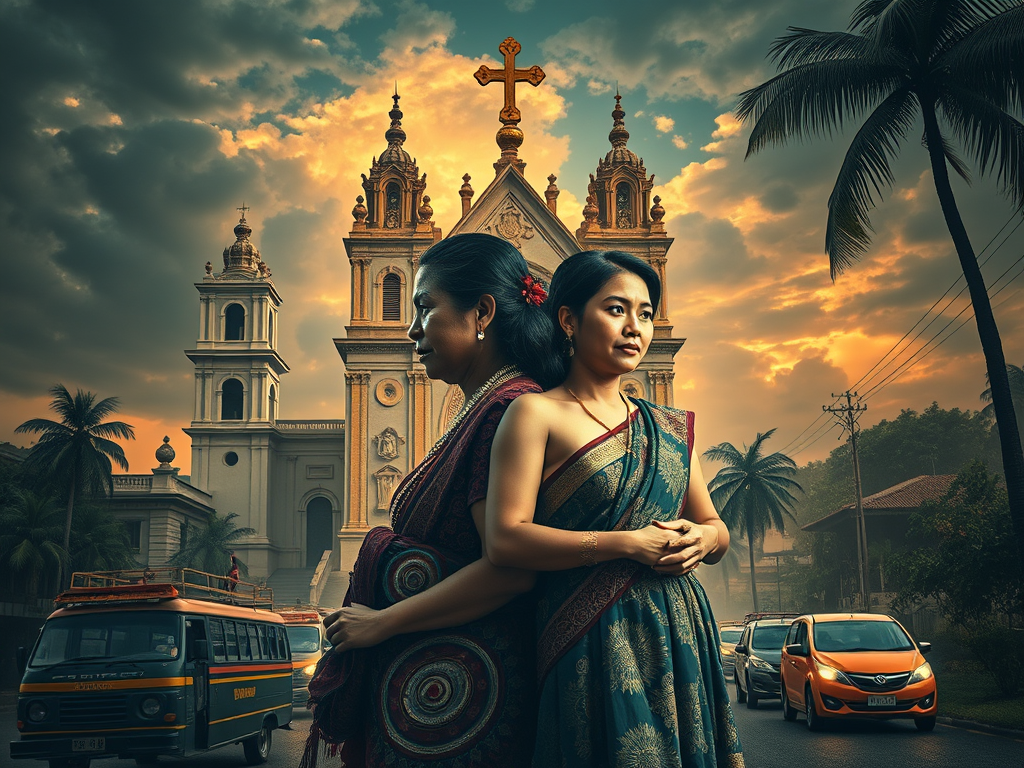
    The Philippines is a land of contrasts, where jeepneys rumble alongside skyscrapers, and Catholic cathedrals coexist with indigenous rituals. Beneath its patriarchal facade—shaped by centuries of Spanish colonial rule and Catholic dogma—lies a vibrant matriarchal underbelly.

    Filipino women, from pre-colonial babaylans (spiritual leaders) to modern-day matrons, have long held sway over families, businesses, and communities.

    This paper dives into how matriarchy thrives in a patriarchal society, drawing lessons from its resilience, creativity, and compassionate justice system. It explores how to strengthen these qualities, overcome their limitations, and harness gender equality to advance society in a cultural context that shares the “macho” ethos of Latin-American nations.

    For readers unfamiliar with this cultural context—particularly those from the United States, Canada, England, or Australia—adapting to this duality requires cultural fluency and humility. Using a multidisciplinary lens, this study weaves history, anthropology, sociology, and gender studies to tell a story that balances logic, emotion, and heart.


    Pre-Colonial Roots: The Matriarchal Foundations of Philippine Society

    Before Spanish galleons arrived in the 16th century, the Philippines was a tapestry of barangays (small communities) with egalitarian gender norms. Women held significant roles as babaylans, spiritual and political leaders who served as healers, mediators, and ritualists.

    The legend of Malakas and Maganda (the legend of strong and beautifu), where man and woman emerge simultaneously from a bamboo stalk, symbolizes this pre-colonial equality (Inquirer, 2021). Women could inherit property, engage in trade, and even lead as chieftains in the absence of male heirs. The Visayan lawgiver Lubluban, for instance, crafted legal codes, showcasing women’s intellectual authority (Inquirer, 2021).

    These matriarchal elements were not about female dominance but about balance. Men and women shared power, with roles like the babaylan complementing the datu (male chieftain). This equilibrium fostered resilience, as communities relied on women’s wisdom and mediation skills to resolve conflicts.

    Creativity flourished through rituals and oral traditions led by women, while their roles as healers laid the groundwork for a compassionate justice system rooted in community well-being rather than punishment.

    These patterns can be traced back to precolonial social structures, as seen in Living in the Barangay, where leadership, kinship, and community roles were organized differently from modern hierarchical systems.


    Key Insight: Pre-colonial Philippine society was matrilineal and egalitarian, with women wielding formal and informal power, setting a precedent for modern matriarchal resilience.


    The Patriarchal Overlay: Spanish Colonialism and Catholic Influence

    The arrival of Spanish colonizers in 1521 disrupted this balance. Catholicism introduced a patriarchal framework, relegating women to domestic roles and idealizing the “Maria Clara” archetype—meek, virtuous, and submissive (Inquirer, 2021).

    Babaylans were demonized as witches, and women’s public roles were curtailed. The Church’s emphasis on virginity and motherhood confined women to the private sphere, reinforcing gender hierarchies that persist today (Rappler, 2016).

    Yet, Filipino women adapted. While formal power was stripped, they cultivated informal influence within families and communities. Mothers became the “ilaw ng tahanan” (light of the home), managing budgets and making key decisions (SBS, 2021).

    This matriarchal underbelly thrived in the shadows of patriarchy, preserving pre-colonial values of resilience and compassion. Women like Gabriela Silang, who led a revolt against Spanish rule in 1763, embodied this defiance, blending matriarchal strength with revolutionary zeal (SBS, 2021).


    Key Insight: Spanish colonialism imposed patriarchy, but Filipino women maintained matriarchal influence through informal networks, adapting pre-colonial strengths to a new reality.


    Matriarchy in Action: Resilience, Creativity, and Compassion

    Today, Filipino matriarchy manifests in three key ways:

    1. Resilience: Women are the backbone of Filipino families, often managing finances and supporting households through remittances as overseas workers. The World Economic Forum ranks the Philippines 8th globally for gender equality, reflecting women’s economic participation (The Hindu, 2019). Their ability to endure hardship—whether as street vendors or corporate leaders—echoes the perseverance of pre-colonial babaylans.
    2. Creativity: From the glossy magazines of Lisa Yu Gokongwei to the cinematic innovations of Mother Lily Monteverde, Filipino women drive cultural and economic creativity (Philstar, 2002). Their storytelling, rooted in oral traditions, fosters social cohesion and innovation.
    3. Compassionate Justice: Women’s roles as mediators in families and communities promote restorative justice over punitive measures. This aligns with pre-colonial practices where babaylans resolved disputes through dialogue, a legacy seen in modern barangay-level mediation (SBS, 2021).

    These strengths shine in figures like Corazon Aquino, the first female president, who restored democracy with a blend of compassion and resolve, and Leni Robredo, whose community-focused leadership challenged patriarchal norms (CNN Philippines, 2023).

    These dynamics are closely tied to deeper cultural patterns explored in Understanding the Filipino Psyche, where identity, relational behavior, and social expectations shape how power is expressed in everyday life.


    Key Insight: Filipino matriarchy thrives through resilience, creativity, and compassion, sustaining informal power structures that counterbalance patriarchal constraints.


    What This Reveals About Power Beyond Gender

    Looking beyond the Philippines, this dual system reveals broader patterns about how power actually works:

    • Formal structures often reflect one reality, while informal influence reflects another
    • Power is not only held—it is negotiated through relationships, culture, and perception
    • Systems can appear hierarchical while functioning relationally underneath
    • Invisible influence often shapes outcomes more than visible authority

    These patterns apply far beyond gender.

    They appear in:

    • organizations where unofficial leaders influence decisions
    • political systems where networks matter more than titles
    • families where authority and decision-making are distributed differently than expected

    Understanding this distinction—between visible structure and lived reality—is critical for leadership, governance, and social design.


    Overcoming Weaknesses: Balancing Informal and Formal Power

    While matriarchal strengths are profound, they have limitations. Women’s influence is often informal, confined to the private sphere, which can obscure systemic inequalities (ScienceDirect, n.d.).

    This reliance on “soft power” risks perpetuating stereotypes of women as nurturers rather than leaders in formal institutions. Additionally, the Catholic Church’s grip on reproductive rights limits women’s autonomy, reinforcing patriarchal control (Rappler, 2016).


    To overcome these weaknesses:

    1. Formalize Power: Advocate for more women in political and corporate leadership. The Philippines already has a strong foundation, ranking 13th globally for women in parliamentary roles (SBS, 2021). Policies like gender quotas could amplify this.
    2. Challenge Cultural Norms: Address the “Maria Clara” stereotype through education and media. Campaigns showcasing diverse female role models—like Gabriela Silang or modern leaders—can reshape perceptions.
    3. Strengthen Legal Protections: Push for reproductive rights and anti-discrimination laws to counter Church influence. The Reproductive Health Law, despite resistance, is a step forward (Rappler, 2016).

    Key Insight: Strengthening matriarchal influence requires bridging informal and formal power, challenging cultural stereotypes, and securing legal protections.


    Glyph of the Divine Feminine

    The hidden current of nurturing power, rising from shadow into balance.


    Leveraging Gender Equality in a Macho Culture

    The Philippines shares a “macho” culture with Latin-American countries, characterized by male bravado and traditional gender roles. Yet, its matriarchal underbelly offers a blueprint for advancing gender equality:

    1. Economic Empowerment: Women’s economic contributions, from remittances to entrepreneurship, drive growth. Programs supporting female-led businesses can amplify this impact, as seen in Latin-American initiatives like Mexico’s microfinance programs.
    2. Cultural Reframing: Media and education can highlight women’s leadership, countering macho stereotypes. The success of films like Dirty Linen, with its powerful matriarch, shows the potential for cultural shifts (CNN Philippines, 2023).
    3. Policy Innovation: The Philippines’ high gender equality ranking (8th globally) can inspire Latin-American nations. Policies banning discriminatory practices, like the Philippine ban on high-heel mandates for women, set a precedent (The Hindu, 2019).

    By leveraging these strategies, the Philippines can model how matriarchal values—resilience, creativity, compassion—can reshape macho cultures into equitable societies.


    Key Insight: The Philippines can lead by example, using its matriarchal strengths to foster gender equality and inspire cultural transformation in macho contexts.


    Western Adaptation: Navigating the Patriarchal-Matriarchal Duality

    For readers unfamiliar with this cultural context(American, Canadian, English, Australian) entering Philippine society, the patriarchal facade—rooted in Catholicism—may seem familiar. However, the matriarchal underbelly can be disorienting. Here’s how to adapt:

    1. Respect Informal Power: Recognize that women often hold decision-making power in families and communities. Engage with matriarchs respectfully, as their influence is culturally significant (Reddit, 2024).
    2. Embrace Humility: The Catholic emphasis on male authority may suggest dominance, but Filipino women often wield subtle power. Western men should avoid assumptions of superiority and learn from local dynamics (Philstar, 2002).
    3. Learn Cultural Nuances: Understand pre-colonial values of equality and the impact of colonialism. Engaging with Filipino history—through museums or community elders—builds empathy and context (Inquirer, 2021).
    4. Challenge Stereotypes: Westerners may encounter the “submissive” Filipina stereotype. Recognize that this is a colonial construct, not reality. Filipino women are often assertive within their networks (SBS, 2021).

    This tension between formal authority and informal influence is also reflected in Political Dynasties in the Philippines, where power is often concentrated structurally, yet negotiated socially.


    Key Insight: Western men can adapt by respecting matriarchal influence, embracing humility, and learning the historical and cultural context of Philippine gender dynamics.


    Conclusion

    The Philippines is a living paradox, where matriarchy thrives beneath a patriarchal veneer. Its pre-colonial roots reveal a society where women and men shared power, a legacy that persists in modern resilience, creativity, and compassion.

    By formalizing women’s influence, challenging cultural norms, and leveraging gender equality, the Philippines can advance amidst its macho culture, offering lessons for Latin-American societies.

    Western men can navigate this duality with humility and cultural fluency, enriching their understanding of a society where women are both the light and the backbone. This dissertation celebrates the Filipino matriarch, whose quiet strength illuminates a path toward a more equitable future.


    Where to Go Next

    If this topic opened further questions, here are structured paths depending on your focus:


    🟢 Culture, Identity, and Behavior

    If you’re exploring how culture shapes roles and relationships:


    🟡 Systems, Power, and Governance

    If you’re interested in how power operates structurally:


    🔵 Application: Leadership and Real-World Dynamics

    If you’re applying these insights in leadership or institutions:


    🟣 Deeper Reflection and Inner Balance

    If you’re exploring the symbolic or internal dimension:


    Glossary

    • Babaylan: Pre-colonial Filipino spiritual leaders, often women, who served as healers, mediators, and ritualists.
    • Barangay: A pre-colonial Filipino community or village, also used today to refer to the smallest administrative unit.
    • Ilaw ng Tahanan: Filipino term meaning “light of the home,” symbolizing women’s central role in families.
    • Maria Clara: A colonial archetype of the ideal Filipina—meek, virtuous, and submissive—based on a character from Noli Me Tangere.
    • Matriarchy: A social system where women hold significant power, often in balance with men, distinct from matrilineality (tracing descent through the maternal line).
    • Patriarchy: A social system where men hold primary power, often reinforced by institutional structures like the Church.

    Bibliography

    Inquirer. (2021, May 8). HERstory: The evolution of motherhood & women’s roles in the Philippines. Pop Inquirer. https://pop.inquirer.net[](https://pop.inquirer.net/109525/herstory-the-evolution-of-motherhood-womens-roles-in-the-philippines)

    Philstar. (2002, September 29). Is the Philippines a matriarchal society pretending to be a macho nation? Philstar.com. https://www.philstar.com[](https://www.philstar.com/lifestyle/sunday-life/2002/09/29/177872/philippines-matriarchal-society-pretending-be-macho-nation)

    Rappler. (2016, March 22). Patriarchy, Manny Pacquiao and Madonna. Rappler.com. https://www.rappler.com[](https://www.rappler.com/voices/imho/126707-patriarchy-manny-pacquiao-madonna/)

    Reddit. (2024, February 5). Philippines: Male Dominated or Female Dominated? r/Philippines_Expats. https://www.reddit.com[](https://www.reddit.com/r/Philippines_Expats/comments/1aj7mm8/philippines_male_dominated_or_female_dominated/)

    SBS. (2021, November 29). What growing up in a Filipino matriarchy taught me about feminism. SBS Life. https://www.sbs.com.au[](https://www.sbs.com.au/topics/voices/culture/article/2019/04/17/what-growing-filipino-matriarchy-taught-me-about-feminism)

    The Hindu. (2019, February 23). Philippines leads Asia in gender equality. The Hindu. https://www.thehindu.com[](https://www.thehindu.com/news/international/philippines-leads-asia-in-gender-equality/article26351544.ece)

    CNN Philippines. (2023, April 19). The pop culture renaissance of the Filipino matriarch. CNNPhilippines.com. https://www.cnnphilippines.com[](http://www.cnnphilippines.com/life/culture/2023/4/19/filipino-matriarchs.html)

    ScienceDirect. (n.d.). The social construction of the Filipino woman. ScienceDirect. https://www.sciencedirect.com[](https://www.sciencedirect.com/science/article/abs/pii/0147176789900278)


    If You’re New to This Work

    If this is your first time here, you can continue in different ways:

    If you’re working through leadership, cultural dynamics, or personal decision-making in real contexts, you may also explore applied work or private sessions.


    About the Author

    Gerald Alba Daquila writes at the intersection of human development, sovereignty, leadership ethics, and civilizational sensemaking. The Living Archive gathers more than 800 essays, codices, and frameworks developed through years of reflection and inquiry.

  • Why Life’s Questions Refuse to Go Away

    Why Life’s Questions Refuse to Go Away


    The Questions Beneath Ordinary Life

    Human Condition Series — Essay 1 of 24


    Most people do not begin life searching for profound philosophical answers.

    We begin by learning how to live.

    We learn what success looks like.
    We learn how people expect us to behave.
    We learn what paths appear respectable, stable, or desirable.

    For many years, this framework is enough.

    Education, work, relationships, achievement — these pursuits give life a sense of direction. They provide goals to strive toward and structures that organize daily existence.

    Yet for many people, a moment eventually arrives when something deeper begins to stir beneath the surface.

    Questions appear.

    Not small practical questions, but larger ones:


    What makes a life meaningful?


    Why do some forms of success feel strangely empty once achieved?


    Why do certain experiences awaken a sense that there must be more to life than what we were told to pursue?


    These questions have an unusual quality.

    Once they appear, they rarely disappear completely.

    They may quiet down for a time, submerged beneath responsibilities or distractions. But under the right circumstances — a life transition, a crisis, a moment of unexpected clarity — they return.

    For some people, these questions become the beginning of a lifelong search.


    How These Questions Appear in Everyday Life

    The emergence of deeper questions rarely looks dramatic from the outside.

    Often it appears quietly.

    A person who has achieved what they once believed would bring fulfillment suddenly feels unsettled.

    Someone who followed a carefully planned path begins to wonder whether the path itself was chosen freely or inherited unquestioningly.

    A moment of success feels strangely incomplete.

    A period of difficulty unexpectedly produces insight.

    Life continues outwardly as before, yet inwardly something begins to shift.

    This experience can be confusing, because it contradicts a common cultural assumption: that fulfillment should naturally follow once the “right” milestones have been achieved.

    When fulfillment does not arrive as expected, people often assume something is wrong with them.

    In reality, something else may be happening.

    A deeper layer of human awareness may simply be beginning to wake up.


    The Deeper Pattern

    Throughout history, philosophers, psychologists, and spiritual traditions have observed the same pattern.

    Human beings possess not only practical intelligence — the ability to survive, work, and organize life — but also existential awareness.

    At some point in life, many people begin to sense the larger questions of existence:


    Why am I here?


    What does a meaningful life actually look like?


    What is worth dedicating my time and energy to?


    This questioning is not a flaw in the human mind.

    It is a natural consequence of consciousness.

    Unlike many other forms of life, human beings are capable of stepping back from their own experience and asking what it means.

    This capacity creates both difficulty and possibility.

    It can produce anxiety, uncertainty, and periods of confusion.

    But it also opens the door to reflection, growth, and a deeper understanding of life.


    When These Questions Are Ignored

    Because these questions can feel unsettling, people often try to silence them.

    They may distract themselves with constant activity, entertainment, or achievement. They may adopt rigid belief systems that promise certainty. They may avoid quiet reflection altogether.

    Sometimes these strategies work for a while.

    But when the deeper questions are continually ignored, they often reappear in indirect ways.

    A persistent sense of restlessness.
    A feeling that something important is missing.
    The quiet suspicion that life is being lived according to scripts that were never consciously chosen.

    Entire societies can experience this dynamic collectively.

    When cultural narratives focus exclusively on productivity, status, or material success, deeper human questions often remain unaddressed. The result can be widespread dissatisfaction that people struggle to explain.

    In this sense, the questions themselves are not the problem.

    They are signals.


    The Awakening Perspective

    From a developmental perspective, the appearance of deeper questions is not a crisis but a threshold.

    It marks the moment when a person begins to move beyond simply inheriting a life toward examining it consciously.

    The questions themselves do not provide immediate answers.

    Instead, they invite a different relationship with life.

    They encourage curiosity rather than automatic acceptance.
    Reflection rather than constant motion.
    Exploration rather than rigid certainty.

    For some people, this process becomes the beginning of a long period of inquiry — reading, learning, questioning assumptions, and gradually forming a more personally coherent understanding of the world.

    For others, the shift happens more slowly, unfolding through life experience rather than deliberate study.

    There is no single correct path.

    What matters is the willingness to remain open to the questions themselves.


    Integration: Learning to Live With the Questions

    A common misconception is that the goal of existential inquiry is to eliminate uncertainty.

    In reality, deeper reflection often reveals that some questions are not meant to be answered once and for all.

    They are meant to be lived with.

    Meaning, purpose, responsibility, and fulfillment are not static destinations that can be solved like mathematical equations.

    They are ongoing conversations between a person and the unfolding circumstances of life.

    The questions persist because human life itself is dynamic.

    Each stage of life brings new perspectives, new responsibilities, and new opportunities for reflection.

    Rather than trying to silence these questions, many people eventually discover that they can serve as guides.

    They point toward areas where greater clarity is needed.
    They challenge inherited assumptions.
    They invite individuals to participate more consciously in shaping the direction of their lives.

    In that sense, the questions that refuse to go away may be among the most important companions a human being can have.

    They are reminders that life is not merely something to pass through.

    It is something to understand, engage, and ultimately live with increasing awareness.


    Take a moment to notice where this reflection touches your own life.


    Human Condition Series

    A Developmental Exploration of Being Human

    This essay is part of The Human Condition, a 24-part exploration of the psychological and existential forces that shape human life.

    The series traces a developmental arc from the foundations of ordinary experience to awakening, integration, and stewardship.

    You may read the essays sequentially or begin with whichever condition most closely reflects your present questions.

    Each essay explores:

    • how the condition appears in everyday life
    • why humans experience it
    • what it reveals when seen consciously
    • how it can transform when integrated

    The series is not intended as a doctrine, but as a framework for reflection and sensemaking.

    → Explore the Human Condition Series Map


    Gerald Alba Daquila
    ©2026 Life. Understood. A Living Archive for Sovereign Sensemaking & Stewardship

  • The Grief That Comes After Awakening

    The Grief That Comes After Awakening


    Completion Without Closure

    3–4 minutes

    There is a kind of grief that does not announce itself with collapse.
    It arrives quietly—often after stability has returned, after the nervous system has settled, after life has resumed its ordinary rhythms.

    This grief does not come from trauma.
    It comes from clarity.

    It is the grief of realizing that awakening does not deliver the life once imagined—and that some timelines, while necessary to dream, will not be lived.


    After the Storm, the Tide Recedes

    In the early phases of awakening, energy is consumed by disorientation: identity shifts, ego dislocation, relational strain, the effort of learning how to live again from a widened field. Survival—psychological and relational—takes precedence.

    Only later, when things grow quieter, does something subtler surface.

    Not pain exactly.
    Not despair.

    But a tender recognition:

    • that certain futures are no longer possible,
    • that some relationships will never return to earlier forms,
    • that some hopes were scaffolding, not destinations.

    This is not failure.
    It is completion beginning to register in the body.


    Why This Grief Is Often Missed

    This grief is frequently bypassed because it does not fit familiar categories. There is no single event to mourn. No obvious loss to point to. Life may even be “working.”

    And yet, something inside knows that a door has closed.

    Spiritual narratives sometimes rush past this moment, emphasizing gratitude, acceptance, or transcendence. But gratitude that skips grief becomes brittle. Acceptance that has not passed through loss remains conceptual.

    Earth school does not require denial to graduate.
    It requires honest consent.


    What Is Actually Being Grieved

    At its core, this grief is not about pain—it is about release.

    The soul grieves:

    • the life it thought awakening would unlock,
    • the timing it once wished were different,
    • the version of self who needed certain dreams to survive earlier stages.

    These dreams were not wrong. They were functional. They carried the soul forward when clarity was not yet available.

    Grieving them is not rejection.
    It is gratitude without attachment.


    This Is Not Regression — It Is Maturation

    Early awakening asks, What is true?
    Integration asks, How do I live this truth?
    Maturation asks, What must I let go of in order to stay?

    This grief marks the passage between striving and inhabiting.

    Without it, the soul may remain subtly oriented toward an imagined elsewhere—another future, another configuration, another “once this resolves.” With it, attention returns to what is actually here.

    And something softens.


    Consent to the Life That Is

    Grief, at this stage, does not ask to be fixed.
    It asks to be felt without narrative.

    To be acknowledged as the body’s way of completing a transition the mind already understands.

    When allowed, it brings:

    • deeper presence,
    • quieter joy,
    • fewer internal negotiations with reality.

    Not because life becomes easier—but because the argument with life ends.

    This is where peace takes root.
    Not in perfection.
    In participation.


    Completion Without Closure

    There is no dramatic ending to this arc. No final revelation.

    Only the recognition that nothing went wrong—and something ended.

    And that ending does not diminish what remains.

    It grounds it.

    To live an awakened, ordinary life is not to float above the world, but to walk within it without constantly reaching for another version of oneself.

    When grief is honored, the soul stops leaning forward or backward in time.

    It arrives.


    Light Crosslinks (optional)


    About the author

    Gerry explores themes of change, emotional awareness, and inner coherence through reflective writing. His work is shaped by lived experience during times of transition and is offered as an invitation to pause, notice, and reflect.

    If you’re curious about the broader personal and spiritual context behind these reflections, you can read a longer note here.