Logo - Life.Understood.

Category: Relationships

  • 🍃 The Internal Reset: Awakening, Healing, and Psychological Sovereignty

    🍃 The Internal Reset: Awakening, Healing, and Psychological Sovereignty


    What happens when the world changes faster than your heart can process?


    Meta Description

    A grounded guide to awakening, healing, emotional integration, and psychological self-governance during times of rapid personal and societal change. Explore pathways for rebuilding clarity, resilience, meaning, and inner stability.


    This isn’t a rhetorical question.

    We are living through a period of rapid change in which financial systems, technology, institutions, and cultural norms are shifting faster than many people can comfortably process.

    But as the external world undergoes this visible, often chaotic transformation, a quieter psychological and existential shift is often taking place internally as well.

    You may find yourself no longer just questioning the news or the banks; you are questioning yourself.

    You are re-evaluating your identity, your purpose, and your sense of belonging in a world that feels increasingly fragmented.

    This Knowledge Hub is not just a collection of essays. It is a structured pathway designed to help people move from disorientation toward greater clarity, stability, and self-direction.

    If the “External Reset” is about the world’s systems, the Internal Reset is about the self as a system—one that must be stabilized, recalibrated, and consciously rebuilt.


    Steward Pathways & Reflective Inquiry

    Some materials within this section are available primarily through Steward-access pathways.

    These writings often engage more speculative, symbolic, contemplative, or metaphysical frameworks that benefit from slower, more intentional reading and stronger contextual grounding.

    Steward-access materials are not presented as institutional doctrine or required belief, but as optional exploratory layers for readers choosing to engage these dimensions more deeply.


    Pathway 1: The Experience of Awakening

    For those navigating the disorientation of seeing differently.

    The first phase of an internal reset is rarely peaceful. It is disruptive and often deeply isolating. This is the moment you realize the “old map” no longer works.

    You might experience awakening-related psychological and emotional shifts like a sudden shift in priorities, an intense sensitivity to injustice, or a feeling that the life you built no longer fits who you are becoming.

    This pathway begins with the foundational piece Waking Up to a Bigger World. This is your foundational guide for framing this shift not as a “breakdown,” but as a necessary expansion of your perception.


    The Constellation of Awakening:

    • The Quiet After the Awakening: A companion for when the “fire” of discovery fades, leaving you in the silent, often lonely work of integration.
    • The Ego Unveiled: Understanding why your mind resists this change and how to view that resistance with compassion rather than frustration.
    • The Experience of Awakening: Grounding your spiritual experience in the very real physical and emotional markers of change.

    Core Insight: Awakening is less about achieving “enlightenment” and more about surviving disorientation long enough to develop a more stable and coherent understanding of yourself and the world.


    Pathway 2: The Alchemy of Healing

    For those rebuilding after collapse, grief, or fragmentation.

    Seeing clearly is the first step, but it doesn’t automatically mend the heart.

    Once you awaken to the truth of the world, you often have to confront the “debris” of your own past—unprocessed trauma, generational wounds, and the structures of your life that were built on survival rather than long-term alignment or self-understanding.

    At the heart of this phase is our most resonant piece: The Transformative Power of Loss. Whether you are finding purpose after loss of a loved one, a career, or an old identity, this essay serves as a gateway to understanding grief as a transformative process of reorientation and integration.


    The Constellation of Healing:

    Core Insight: Healing is not about going back to who you were before the pain; it is about integrating that pain into a stronger, more coherent version of yourself.


    Pathway 3: Rebuilding Balance and Participation

    For those stepping beyond the individual into collective awareness.

    As you heal, your perspective naturally widens again. You begin to ask not just “Who am I?” but “How do I participate in the world without losing myself?”

    This phase is about reconnecting with forms of relational, emotional, and communal intelligence that are often deprioritized within highly competitive systems.

    This pathway centers on Rebalancing Relational and Regenerative Intelligence. This framework explores the restoration of relational, intuitive, and regenerative forms of intelligence often undervalued in competitive and control-oriented systems; it’s about the restoration of intuitive, relational, and regenerative intelligence in a world that has been dominated by control and competition.


    The Constellation of Balance:

    Core Insight: Balance isn’t found by escaping the system, but by bringing your full, integrated presence into it.


    Integration: The Discipline of Self-Governance

    All these pathways converge at a single point of realization:

    Awakening without discipline is just confusion. Inner sovereignty is the culmination of the Internal Reset.

    It is the shift from being a “passenger” in your life to being the “pilot.” It is the daily practice of choosing discernment over belief, stability over stimulation, and coherence over comfort.

    When you are internally sovereign, you become less reactive to external volatility. You make clearer decisions. You become a “steward” of your own attention, behavior, and emotional regulation.


    Bridging to the External Reset

    The Internal Reset does not exist in a vacuum. A stabilized, sovereign individual is the only one who can truly participate in the building of a new world.


    Explore the External Reset next:

    You cannot build a coherent system with incoherent individuals. The world is waiting for you to begin your internal reset.


    Where do you need to start?

    Move slowly. Let the coherence build. The internal reset is not a race; it is an alignment.


    Attribution

    ©2026 Gerald Daquila • Life.Understood.
    Steward of applied thinking at the intersection of systems, identity, and real-world constraint.

    This work draws from lived experience across cultures and environments, translated into practical frameworks for clearer thinking and more coherent contribution.

    This piece is part of an ongoing exploration of applied thinking in real-world systems.. Part of the ongoing Codex on leadership, awakening, and applied intelligence.

  • The “Waiting Room” Trap: Why GESARA Is a Systemic Symptom Not a Solution

    The “Waiting Room” Trap: Why GESARA Is a Systemic Symptom Not a Solution


    Why GESARA is a Systemic Symptom, Not a Solution


    The global discourse surrounding the Global Economic Security and Reformation Act (GESARA) has reached a fever pitch.

    For many, it represents the ultimate “Exit” button—a total systemic reset, debt jubilee, and the dawning of a new era. But while the theory offers a vision of hope, the act of waiting for it has created a profound secondary crisis: the “Waiting Room” trap.

    When we treat a systemic reset as a future event to be observed rather than a present framework to be architected, we fall into a state of learned passivity. In Lean management terms, this is the ultimate form of Muda (Waste).

    To move from the passive observation of a theory to the active participation in a value stream, we must recognize that GESARA is not the solution we are waiting for; it is a systemic symptom of a world in transition.


    1. The Lean Analysis: The Muda of Speculation

    In the world of operational excellence, Muda is anything that consumes resources but creates no value. The most dangerous form of waste in the current transition is the Waste of Waiting.

    As explored in What Is NESARA and GESARA? Origins, Claims, and Why the Theory Keeps Resurfacing, the narrative often anchors people to a timeline they do not control. When you put your creative projects, financial investments, or community initiatives on hold until “the RV happens” or “the banks close,” you are allowing your most valuable asset—your time—to sit idle.

    In any value stream, idle time is lost velocity. If you are waiting for a savior system to provide permission for your prosperity, you are effectively over-processing “intel” while under-producing utility. This creates a “defect” in your personal economy where the output is always “theoretical” and never “tangible.”


    2. From Spectator to Architect: Breaking the Labyrinth

    The transition from a passive spectator to an active architect requires a fundamental shift in identity.

    Many started this journey as researchers, digging through the digital trenches to understand the global reset. However, there is a point where the research becomes a circle.

    In my own journey, documented in From Conspiracy to Creator: My Journey Through the GESARA Labyrinth, I realized that the “Labyrinth” is designed to keep you looking for answers outside of yourself.

    The “Architect” does not look for the reset; the Architect is the reset.

    Being an architect means moving beyond the Signal vs Noise of daily updates and focusing on the construction of the “New Earth” protocols. While the spectator asks, “When will it happen?” the architect asks, “How do I build a node of this system right here, right now?”


    3. Activating the Value Stream: Flow vs. Stagnation

    A “Value Stream” is the end-to-end movement of value from a concept to a person who needs it. If GESARA is about abundance, then the “Waiting Room” is the antithesis of GESARA because it represents stagnation.

    To move into active participation, we must apply GESARA Flow Mechanics to our daily lives. This involves:

    • Identifying the Pull: Stop pushing theories onto people and start identifying the real-world needs (the “Pull”) in your immediate environment.
    • Eliminating Waste: Audit your “Frequency Hygiene.” If your consumption of intel is causing anxiety or paralysis, it is a non-value-add activity.
    • Creating Value-Based Exchange: As outlined in Wealth Without Limits: Rethinking Value, Exchange, and Prosperity, prosperity isn’t a windfall; it’s a byproduct of effective value exchange.

    We are not waiting for a “Quantum Financial System” to be handed to us from a central authority. We are practicing Anchoring GESARA in Daily Life: Practical Tools for Embracing Financial Sovereignty to ensure that when the systemic transition completes, we already have the operational muscle to manage it.


    4. The 2026 Perspective: Positioning over Effort

    As we navigate 2026, the gap between the “Spectator” and the “Architect” is widening. The legacy systems are indeed crumbling, but they are not being replaced by magic; they are being replaced by the infrastructure built by those who refused to wait.

    In our current phase of transition, it is not just about hard work; it is about Positioning vs Effort: Why Hard Work Isn’t Enough. If you are positioned in the “Waiting Room,” no amount of effort in researching will create a harvest. However, if you are positioned as a GESARA Node Custodian, every action you take contributes to the new value stream.


    Conclusion: Nothing Was Wasted

    It is easy to look back at years of “waiting” with regret, but in the higher architecture of this reset, Nothing Was Wasted. The time spent in the waiting room was a period of intense pattern recognition and the shedding of old-world dependencies.

    However, the “Waiting Room” has now served its purpose. It was a shelter, but it has become a cage. To move forward, you must take the blueprints you have found in the theory and begin the construction. The “Value Stream” is open. The “Architect’s Table” is waiting.

    Stop being a witness to a theory. Start being the engine of the stream.


    The Sovereign Professional: A structural map of power, systems thinking, and personal autonomy—dedicated to helping the independent professional navigate complexity and own their value stream.


    ©2026 Gerald Daquila • Life.Understood. • Systems Thinking, Leadership Architecture, and Applied Coherence

  • Ethical Gravity: Human Responsibility in the Age of Artificial Intelligence

    Ethical Gravity: Human Responsibility in the Age of Artificial Intelligence


    Meta Description

    Artificial intelligence can simulate reasoning, but it cannot bear responsibility. This essay explores ethical leadership, embodied accountability, and human stewardship in an age of increasingly synthetic systems.


    Document Type: Constitutional Method

    Method: This document explains one of the methodological principles that governs how the Living Archive approaches understanding and inquiry.

    Scope: These principles apply across the Archive while recognizing that different questions require different modes of knowing and different standards of justification.

    We are entering a period in which increasingly sophisticated forms of machine intelligence can simulate reasoning, planning, and communication without human awareness, embodiment, or lived experience.

    For the first time, humans are interacting with systems that can imitate aspects of reasoning without subjective experience or emotional consequence.

    This has triggered an existential identity crisis for leaders. If a machine can architect a 50-year sustainability roadmap or a complex market pivot, the human leader is left asking:

    What remains uniquely human in leadership?

    The answer lies not primarily in information processing, but in the human capacity to bear responsibility for consequences.


    I. The Nervous System Requirement

    An Artificial General Intelligence (AGI) can simulate expressions of empathy. It can analyze the linguistics of a crisis and output the most “human-sounding” response.

    However, it lacks a biological nervous system.

    Leadership involves exposure to visceral and psychological consequence. When a human steward makes a decision, their nervous system registers the stakes. There is a “tightness in the chest,” a “gut feeling,” and a “weight on the shoulders.”

    These responses are part of how humans register risk, consequence, empathy, and responsibility at an embodied level.

    This embodied feedback helps tether decision-makers to the lived consequences experienced by the people affected by their choices.

    Case Contrast: The Crisis Response

    • The AI Calculation: Analyzes 10,000 PR disasters and generates a statement that minimizes legal liability and optimizes stock price recovery. It executes without emotional or physiological consequence.
    • The Human Steward: Sits in the silence of an empty office, feeling the hollow weight of a broken trust. They choose a path that may cost the company more financially but helps restore trust, legitimacy, and long-term social cohesion. Authority ultimately comes from accepting responsibility for decisions that carry real human consequences.

    II. The Anatomy of Human Accountability

    In the Living Archive, we define ethical responsibility as the non-transferable accountability for the consequences of a decision across people, systems, and time.

    In a world obsessed with “de-risking,” the modern leader is tempted to hand the steering wheel to the algorithm. But while you can outsource the calculation, you can never outsource the consequence.

    • The Machine’s Immunity: If an AI-driven strategy erodes a culture, the AI does not suffer. It cannot experience accountability, remorse, or social consequence. It simply resets for the next prompt.
    • The Steward’s Burden: The human leader carries the Steward’s Burden of their decisions. This burden is part of what gives human leadership moral significance. It is the knowledge that “I am the one who must live with this.” People are unlikely to place deep trust in systems that bear no personal risk from the consequences of failure. People follow stewards because the steward’s own life and legacy are woven into the mission.

    III. Human Judgment Beyond Computation

    As AGI becomes the commodity “engine” of the world, the value of the Non-Computable will skyrocket.

    We are the sanctuary for the qualities that cannot be fully reduced to optimization metrics or computational outputs:

    1. Moral Imagination: Seeing not just what will happen (prediction), but what should happen (vision).
    2. The Stabilizing Role of Human Presence: The power of a leader who stands in the center of the storm, providing a grounded “human pole” that the machine cannot replicate.

    Case Contrast: The Visionary Pivot

    • The AI Calculation: Suggests staying the course because the data shows a 78% probability of continued incremental growth. It cannot account for the emerging cultural or organizational shifts or the dying spark of the team’s passion.
    • The Human Steward: Senses the stagnation that the data hasn’t caught yet. They burn the old playbook and pivot toward a “wild card” idea because existing indicators fail to capture emerging human dynamics and long-term direction. This is the leap of faith—a move that is difficult to justify through existing metrics but potentially necessary for long-term adaptation.

    IV. The Human Author

    The future does not belong to the most “intelligent” person in the room; it belongs to the person with the most Ethical Gravity.

    The hierarchy is shifting. We invite you to stop competing with the machine’s speed and start leaning into your biological advantage:

    The ability to care, accept consequence, and remain accountable within human systems.

    AI can assist with information and analysis. Human judgment remains necessary for interpretation, responsibility, and ethical decision-making.


    Conclusion: Sovereignty in the age of AI

    The rise of synthetic systems does not merely challenge technology policy—it challenges the integrity of human discernment itself.

    In Ethical Gravity: Human Responsibility in the Age of Artificial Intelligence, we explored the necessity of ethical anchoring within accelerating machine environments. But ethical intent alone is no longer sufficient.

    As synthetic reality becomes immersive, adaptive, and psychologically persuasive, a deeper framework is required—one that addresses sovereignty at the level of perception, cognition, identity, and governance.


    Continue Exploring

    The AI Threshold: A Sovereignty Framework for Navigating Synthetic Reality — an operational framework for maintaining human agency, discernment, and systemic coherence within increasingly AI-mediated environments.

    The Human Bridge — Ethical principles alone are insufficient without people capable of applying them within fractured and rapidly changing systems.

    As synthetic environments intensify polarization, abstraction, and cognitive overload, a new function emerges:

    The Human Bridge — individuals who can translate between technological acceleration and human coherence without collapsing into ideological extremes.


    Attribution

    The Living Archive
    Integrative Frameworks for Regenerative Civilization

    © 2026 Gerald Daquila. All rights reserved.
    Part of the Life.Understood. knowledge ecosystem and Stewardship Institute initiative.

    This article is intended for educational, reflective, and civic inquiry purposes.
    Readers are encouraged to engage critically, think independently, and explore related pathways throughout the archive.

  • [SWI-001] Standard Work for the Sovereign Mind

    [SWI-001] Standard Work for the Sovereign Mind


    Topic: Baseline Stabilization & Internal Waste Elimination


    Protocol Status: Version 1.0 (Initial Release)

    Process Owner: Individual Steward

    Revision Date: April 2026


    Introduction: The Requirement for an Internal Baseline

    In the current climate of April 2026—characterized by high-velocity systemic noise, institutional trust-erosion, and a global “Trust Recession”—the primary risk to the individual is not external collapse, but internal Processing Defect.

    Most professionals operate within the “Old System” using a reactive operating system. When external signals (financial volatility, socio-political shifts, or organizational decay) hit the individual, the lack of a Standardized Baseline leads to a cascade of emotional and cognitive waste.

    This document establishes the Standard Work Instruction (SWI) for stabilizing the mind. Sovereignty is not a spiritual “peak experience”; it is an operational state of Coherence that allows for accurate sense-making under pressure.

    By implementing this protocol, the Steward ensures that their internal “Gemba” (the place where life happens) remains stable, regardless of the volatility of the external market.


    1. The Business Case: The Cost of Mental Muda (Waste)

    In Lean terms, a non-standardized mind produces three specific types of waste:

    • Mura (Unevenness): The “pendulum effect” between being hyper-engaged with “New Earth” theories (like GESARA) and being paralyzed by legacy-system fear.
    • Muri (Overburden): Forcing the nervous system to process high-stress data without a filtration protocol.
    • Muda (Waste): Expending cognitive “inventory” on variables outside of your direct span of control.

    2. Takt Time: The Rhythm of Coherence

    Takt time is the heartbeat of the process.

    • Standard Rhythm: Three (3) 5-minute “Process Audits” per 24-hour cycle.
    • Target: Resetting the nervous system to “Neutral” every 4-6 hours to prevent the accumulation of systemic stress.

    3. Work Sequence: The Stabilization Protocol

    This sequence must be followed in exact order to ensure the integrity of the baseline.

    StepOperationDescriptionKey Points / Safety
    01The Internal Gemba WalkSit in silence for 2 minutes. Scan the body and mind for “heat” (anxiety, urgency, or irritation).Observation only. Do not attempt to fix. Note the location of the stress.
    02Signal IsolationIdentify the one thought or external news item currently driving the “heat.”Ask: “Is this a signal I can act on, or is it noise?”
    03Muda ExtractionConsciously label the “Noise” as Waste. Mentally move this item into the “Non-Actionable” inventory bin.This is a “Stop the Line” moment. Do not move forward until the noise is set aside.
    04Baseline CalibrationPerform 4-4-4-4 box breathing (Inhale 4, Hold 4, Exhale 4, Hold 4) for 5 cycles.Goal: Heart-Rate Variability (HRV) stabilization.
    05Sovereign Re-engagementIdentify one (1) small, tangible task within your immediate physical reach that serves your Soul Blueprint.The task must be completed immediately (e.g., a specific email, a financial move, or a physical cleanup).

    4. Poka-yoke: Error-Proofing for Emotional Hijacking

    In Lean, Poka-yoke prevents a defect from moving to the next stage of the process. In Sovereignty, it prevents an external trigger from becoming a destructive internal action.

    Detected Defect: “The Doom-Scroll Loop” (Reading news or social signals that cause a spike in cortisol without providing actionable data).


    The Mechanism: The 3-Breath Circuit Breaker

    • Sensor: A physical tightness in the chest or jaw when looking at a screen.
    • Action: Immediately place the device face-down.
    • Protocol: You are “interlocked.” You cannot pick the device back up until you have completed three full, conscious breaths.
    • Verification: After the third breath, ask: “Is the next click for Service or for Distraction?” If the answer is distraction, the line remains stopped.

    5. Audit & Continuous Improvement (Kaizen)

    A process that is not measured cannot be improved. At the end of each day, the “Silent Professional” should perform a quick “End-of-Shift” audit:

    1. Compliance: Did I follow the SWI-001 Work Sequence today?
    2. Defect Rate: How many times did I bypass my Poka-yoke?
    3. Optimization: What is the one change to my environment that would make following this standard easier tomorrow?

    Note: Sovereignty is the ultimate quality control. If the mind is stable, the life follows.


    [DOCUMENT CONTROL & STEWARDSHIP]

    Standard Work ID: [SWI-001]

    Baseline Version: v1.4.2026

    Classification: Open-Access Archive / Systemic Protocol

    The Sovereign Audit: Following this protocol is an act of internal quality control. Verification of this standard does not happen here; it happens at your Gemba—the actual place where your life and leadership occur. No external validation is required or offered.

    Next in Sequence: [SWI-002: The 72-Hour Sovereignty Protocol]

    Return to Archive: [Standard Work Knowledge Hub: The Terrain Map]


    © 2026 Gerald Daquila • Life.Understood Systemic Stewardship • Non-Autocratic Architecture • Process over Persona

  • SRI: A Simulation-Based System for Leadership Development, Evaluation, and Real-World Readiness

    SRI: A Simulation-Based System for Leadership Development, Evaluation, and Real-World Readiness


    Most leadership systems fail for a simple reason:

    They attempt to develop and evaluate capability outside the conditions where it is actually required.

    They rely on:

    • Interviews to assess
    • Training to develop
    • Frameworks to guide

    These methods operate in environments that are controlled, predictable, and low-stakes.

    Participants are given time to think.
    Information is structured.
    Outcomes are hypothetical.

    In these environments, individuals can:

    • Articulate clear reasoning
    • Apply known frameworks
    • Present well-formed answers

    But real performance does not happen under these conditions.

    It happens under:

    • Constraint
    • Pressure
    • Uncertainty
    • Trade-offs

    These conditions do not simply complicate decision-making.

    They fundamentally change it.

    They influence:

    • What individuals notice
    • What they prioritize
    • How they act when clarity is incomplete
    • How they respond when consequences are real

    This creates a persistent gap between:

    • Perceived capability
    • Actual performance

    The limitation is not that existing systems are entirely wrong.

    It is that they are incomplete.

    They assume that capability can be understood through:

    • Explanation
    • Reflection
    • Past experience

    But these are second-order signals.

    They describe behavior.

    They do not generate it.

    Real capability becomes visible only when individuals are placed inside conditions where decisions must be made before certainty is available.

    This is the distinction between:

    • Describing performance
    • And demonstrating it

    SRI—Simulation-Based Readiness Infrastructure—exists to close that gap.


    The Structural Problem

    Across organizations, three recurring issues appear.

    1. Misjudged Capability

    Individuals who perform well in interviews and structured environments often struggle under real conditions.

    At the same time:

    • Quiet operators are overlooked
    • Non-performative individuals are underestimated

    This happens because evaluation systems prioritize:

    • Communication
    • Confidence
    • Familiarity with expected answers

    Rather than:

    • Decision-making under pressure
    • Trade-off handling
    • Behavioral consistency

    As a result, organizations promote individuals based on signals that do not reliably translate into performance.


    2. Ineffective Development

    Most development systems improve understanding.

    They help individuals:

    • Learn frameworks
    • Build conceptual clarity
    • Reflect on past experiences

    But under real conditions:

    • Decisions slow down
    • Priorities become unclear
    • Trade-offs are avoided or mishandled

    Participants often leave with confidence—but not necessarily with capability.

    The issue is not lack of knowledge.

    It is lack of exposure to realistic conditions.


    3. Absence of Direct Observation

    Most organizations do not directly observe capability.

    They rely on:

    • Self-reported experience
    • Retrospective analysis
    • Managerial interpretation

    These are indirect signals.

    They do not show how individuals behave when:

    • Time is limited
    • Stakes are real
    • Conditions are unstable

    This creates a system where performance is inferred rather than observed.

    These three issues share a common root:

    Capability is evaluated without observing behavior under real conditions.


    What SRI Is

    SRI is a system designed to observe, develop, and evaluate capability under conditions that resemble reality.

    It does this by constructing environments that include:

    • Constraints
    • Variables
    • Incentives
    • Feedback loops

    These elements are not added for realism alone.

    They are added to make behavior visible.

    This shifts leadership development from a knowledge problem to an environment problem.

    Instead of asking:

    “How do we teach people to think better?”

    The question becomes:

    “What conditions reveal how people actually think?”

    This shift has structural implications.

    Because once behavior is observed under constraint:

    • Assumptions can be tested
    • Patterns can be measured
    • Capability can be compared

    Without this, development remains interpretive.

    With it, development becomes observable.

    SRI does not ask:

    “What would you do?”

    It shows:

    “What did you actually do when conditions changed?”


    Understanding the Process: Leadership Under Constraint

    Before exploring how Simulation-Based Readiness Infrastructure (SRI) operates in practice, it may be helpful to understand the underlying dynamics that make capability visible under realistic conditions.

    The map below illustrates how constraints, uncertainty, incentives, trade-offs, and consequences interact to shape decision-making and behavior.

    While traditional evaluation systems often assess knowledge, intentions, or past experience, real capability emerges only when individuals must act under conditions where outcomes matter and certainty is incomplete.

    The Leadership Under Constraint Model provides a framework for understanding how pressure reveals patterns that remain hidden in low-stakes environments.

    By tracing the relationship between conditions, decisions, behavior, consequences, and feedback, the model highlights why simulation is uniquely suited to observing leadership as it actually operates.

    Download Reference Map 008: The Leadership Under Constraint Model


    The Leadership Under Constraint Model explains how behavior becomes visible under realistic conditions.

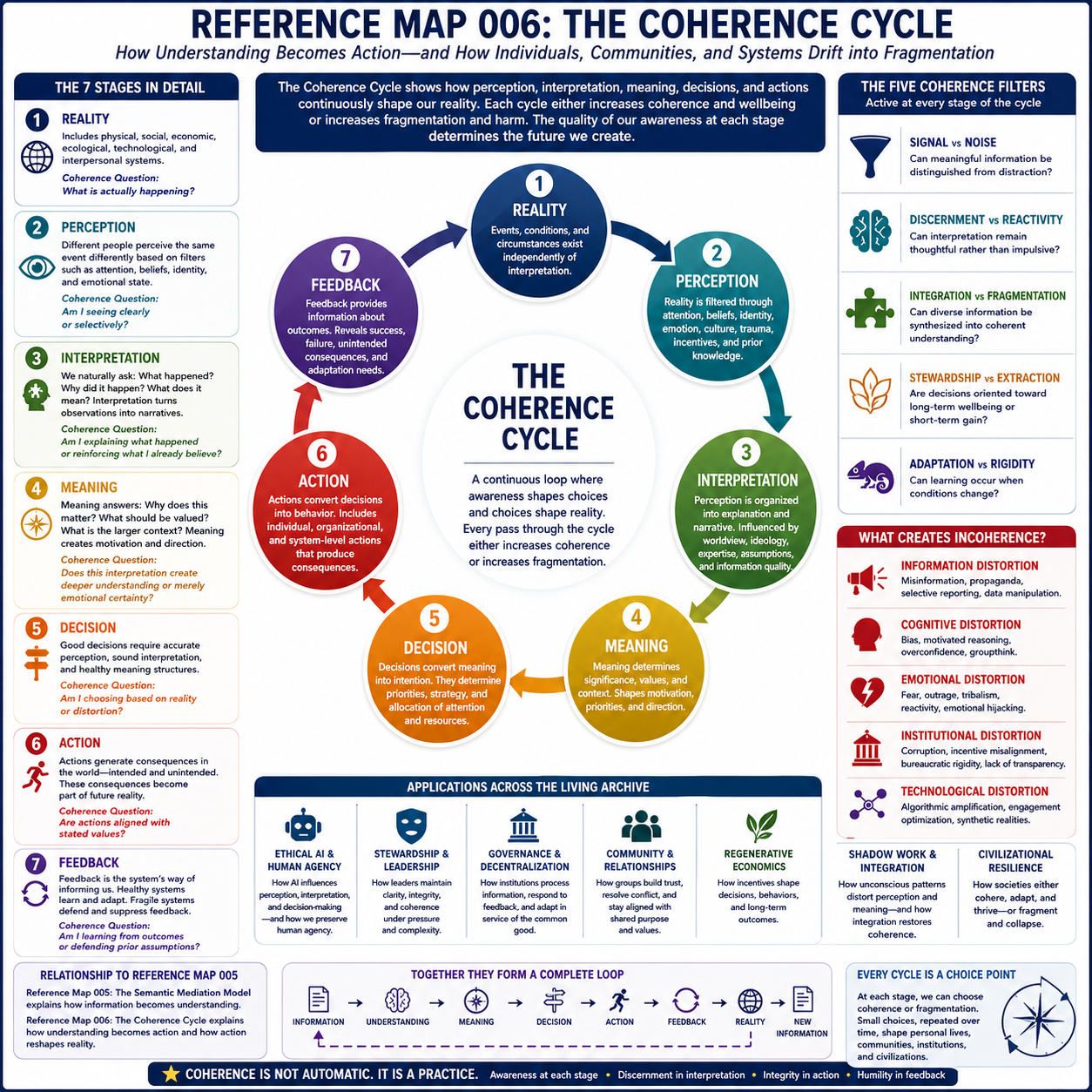
    For a deeper examination of how decisions themselves emerge through perception, interpretation, action, and feedback, see:

    Reference Map 006: The Coherence Cycle

    Together, these models explain both the conditions that reveal capability (Map 008) and the decision-making processes operating within those conditions (Map 006).


    The Core Principle

    Capability is only real if it holds under constraint.

    Without constraint:

    • Behavior is optimized for correctness
    • Decisions are reversible
    • Performance appears stable

    With constraint:

    • Trade-offs become unavoidable
    • Decisions carry consequence
    • Behavior becomes measurable

    Constraint does not reduce performance.

    It reveals it.


    How SRI Works

    SRI operates through three integrated layers.


    1. Simulation Layer

    Participants engage in environments that replicate real decision conditions:

    • Limited time
    • Incomplete information
    • Competing objectives

    These environments are structured—but not predictable.

    Decisions must be made before clarity is complete.

    This shifts thinking from:

    • Analytical → to adaptive
    • Reflective → to responsive

    The purpose is not immersion.

    It is exposure to conditions where behavior emerges naturally.


    2. Observation Layer

    Behavior is tracked across:

    • Decision-making patterns
    • Trade-off handling
    • Incentive responses
    • Stability across scenarios

    This produces:

    Behavioral data—not narrative explanation

    Patterns begin to emerge:

    • Does the individual maintain clarity under pressure?
    • Do they overcomplicate decisions?
    • Do they default to familiar patterns?

    These patterns are difficult to detect in controlled environments.

    But under constraint, they become visible.


    3. Evaluation Layer (CLSS Integration)

    Observed behavior is interpreted through:

    CLSS (Coherence-Based Leadership Selection System)

    This enables:

    • Multi-dimensional assessment
    • Pattern recognition
    • Coherence scoring

    SRI generates the signal.

    CLSS interprets it.

    Together, they provide a way to evaluate capability based on how it actually operates—not how it is described.


    What SRI Reveals

    When individuals operate under constraint, consistent patterns emerge.


    1. Decision Patterns Under Pressure

    Simulation shows how individuals behave when:

    • Time is constrained
    • Information is incomplete

    This reveals:

    • Cognitive prioritization
    • Mental models
    • Stress response

    2. Trade-Off Logic

    Every meaningful decision requires sacrifice.

    Simulation reveals:

    • What is prioritized
    • What is deferred
    • What is ignored

    This exposes how individuals navigate complexity.


    3. Incentive Response

    When incentives are introduced:

    • Behavior shifts

    Simulation shows whether individuals:

    • Optimize for visible rewards
    • Maintain alignment
    • Distort decisions under pressure

    Because in real systems:

    Behavior follows incentives—even when values suggest otherwise.


    4. Behavioral Consistency

    A single decision provides limited insight.

    Across repeated simulations:

    • Patterns stabilize
    • Variability becomes measurable

    Consistency becomes a stronger signal than isolated performance.


    Why This Is Structurally Different

    Most leadership systems attempt to improve performance by:

    • Adding knowledge
    • Refining frameworks
    • Improving communication

    SRI does not add more abstraction.

    It changes the environment.

    It places individuals inside conditions where leadership must be demonstrated—not described.

    This also changes how leadership itself is understood.

    Traditionally, leadership is associated with:

    • Vision
    • Communication
    • Influence

    These remain important—but they are incomplete.

    Under real conditions, leadership becomes:

    • The ability to decide under constraint
    • The ability to navigate trade-offs
    • The ability to maintain coherence when conditions are unstable

    This is not always visible in low-pressure environments.

    But it becomes immediately visible in simulation.

    SRI does not redefine leadership conceptually.

    It reveals what leadership actually looks like in practice.


    From Development to Measurement

    At a certain point, simulation stops being just a learning tool.

    It becomes a measurement system.

    Instead of asking:

    “Did this person understand the framework?”

    The question becomes:

    “How does this person behave when it matters?”

    This shift—from outcome to process—allows deeper evaluation.

    It makes capability:

    • Observable
    • Comparable
    • Measurable

    What This Changes

    For Organizations

    • Moves from inferred capability → observed performance
    • Reduces reliance on interviews
    • Improves selection accuracy
    • Strengthens leadership pipelines

    For Individuals

    • Reveals real decision patterns
    • Identifies blind spots
    • Improves performance under constraint
    • Builds capability that transfers to real environments

    Why This Matters Now

    We are entering a period where:

    • Complexity is increasing
    • Predictability is decreasing
    • Surface signals are less reliable

    As environments become more complex, the cost of misjudging capability increases.

    Decisions made by individuals who appear competent—but cannot operate under constraint—create:

    • Strategic drift
    • Operational inefficiency
    • Misaligned priorities

    These effects compound over time.

    In this environment:

    Understanding is not enough.

    Only those who can:

    • Decide under pressure
    • Adapt under uncertainty
    • Operate within constraint

    …will perform consistently.


    What This Page Represents

    This is not:

    • A training method
    • A gamified exercise
    • A conceptual framework

    This is:

    A system for observing, developing, and evaluating real capability under real conditions.


    Next Steps

    CLSS — Coherence-Based Leadership Selection System

    Simulation-Based Leadership

    Why Traditional Leadership Training Fails

    What Simulation Reveals That Interviews Can’t

    Decision-Making Under Constraint

    Designing Effective Simulations

    Programs / Implementation- FAQ


    Description:

    A simulation-based system for developing and evaluating leadership through observable behavior under constraint.

    Attribution:

    Gerald Daquila — Systems Thinking, Leadership Architecture, and Applied Coherence

  • Designing Effective Simulations: How to Reveal Real Capability Under Constraint

    Designing Effective Simulations: How to Reveal Real Capability Under Constraint


    If simulation is the answer to the limitations of training and interviews, the next question is:

    What makes a simulation effective?


    Not all simulations produce useful signals.

    Some become:

    • Games without insight
    • Exercises without consequence
    • Scenarios that feel engaging but reveal little

    An effective simulation is not defined by how immersive it feels.


    It is defined by:

    How clearly it reveals decision-making under real constraints


    The Core Principle

    A simulation is effective when it produces:

    • Observable behavior
    • Meaningful trade-offs
    • Consistent patterns over time

    To achieve this, four elements must be deliberately designed:

    1. Constraints
    2. Variables
    3. Incentives
    4. Feedback loops

    1. Constraints (The Engine of Revelation)

    Constraint is what forces behavior to surface.

    Without it:

    • Participants optimize for correctness
    • Decisions remain theoretical

    Effective constraints include:


    Time Constraints

    • Limited decision windows
    • Forced prioritization

    Reveals:

    • Clarity vs hesitation

    Resource Constraints

    • Limited budget, tools, or personnel

    Reveals:

    • Allocation strategy
    • Trade-off awareness

    Information Constraints

    • Partial or conflicting data

    Reveals:

    • Assumption-making
    • Risk tolerance

    Structural Constraints

    • Rules that limit available actions

    Reveals:

    • Adaptability
    • Creativity within boundaries

    2. Variables (The Complexity Layer)

    Variables introduce dynamism.

    They prevent:

    • Predictable patterns
    • Scripted responses

    Examples:

    • Changing market conditions
    • Shifting priorities
    • Unexpected disruptions

    Variables should:

    • Evolve during the simulation
    • Interact with each other
    • Create second-order effects

    This reveals:

    How individuals adjust when the environment changes


    3. Incentives (The Behavioral Driver)

    Without incentives, decisions remain neutral.

    With incentives, behavior becomes directional.

    Design must include:


    Competing Incentives

    • Short-term gain vs long-term stability
    • Individual reward vs system benefit

    Hidden Incentives

    • Information asymmetry
    • Unequal advantages

    Dynamic Incentives

    • Rewards that change based on actions

    This reveals:

    • Whether individuals distort decisions
    • Whether they maintain alignment
    • How they navigate pressure

    4. Feedback Loops (The Learning Mechanism)

    Feedback turns activity into insight.

    Without feedback:

    • Behavior is not understood
    • Patterns are missed

    Effective feedback includes:


    Immediate Feedback

    • Outcome of decisions
    • Direct consequences

    Delayed Feedback

    • Second-order effects
    • Long-term impact

    Reflective Feedback

    • Facilitated debrief
    • Pattern recognition

    This allows participants to:

    • Understand their decisions
    • Identify blind spots
    • Adjust behavior

    Designing for Observation, Not Entertainment

    A common mistake is designing simulations to be:

    • Engaging
    • Enjoyable
    • Gamified

    These are secondary.

    The primary goal is:

    Clarity of signal


    Ask:

    • What behavior are we trying to observe?
    • What conditions will reveal it?

    Everything else is optional.


    Levels of Simulation Complexity


    Level 1: Structured Scenarios

    • Guided
    • Limited variables
    • Focused outcomes

    Use for:

    • Initial exposure
    • Skill isolation

    Level 2: Dynamic Simulations

    • Multiple variables
    • Evolving conditions
    • Moderate unpredictability

    Use for:

    • Pattern observation
    • Decision-making under pressure

    Level 3: Open Systems

    • High complexity
    • Interacting participants
    • Minimal guidance

    Use for:

    • Real-world approximation
    • Leadership evaluation

    Physical vs Conceptual Design

    Simulations can be delivered through:


    Conceptual Formats

    • Written scenarios
    • Facilitated exercises

    Physical Formats (Recommended for SRI)

    • Cards → events, variables, roles
    • Dice → randomness, uncertainty
    • Tokens → resources, constraints

    These introduce:

    • Tangibility
    • Unpredictability
    • Engagement without losing structure

    Common Design Failures


    1. No Real Trade-Offs

    • All options are equally safe

    Result:

    • No meaningful decision-making

    2. Over-Complexity

    • Too many variables too early

    Result:

    • Cognitive overload
    • Random behavior

    3. Predictable Outcomes

    • Participants can “game” the system

    Result:

    • Artificial performance

    4. Lack of Feedback

    • No reflection or consequence

    Result:

    • No learning or insight

    Connection to CLSS

    CLSS requires:

    • Observable behavior
    • Multi-dimensional evaluation
    • Consistency across contexts

    Simulation provides:

    • The environment
    • The variability
    • The data

    Together, they form:

    A system that measures capability as it actually operates


    What This Enables


    For Organizations

    • Replace abstract training with observable development
    • Evaluate leadership under realistic conditions
    • Identify capability beyond surface signals

    For Individuals

    • Experience decision-making under pressure
    • Understand behavioral patterns
    • Improve through feedback and iteration

    Where This Leads

    With simulation design in place, the next step is integration:

    How do you systematize simulation into a scalable leadership framework?

    This becomes the foundation for:

    SRI T4: Simulation-Based Leadership System


    Series Context

    This article is part of the Simulation-Based Leadership (SRI) series.


    Description:

    A practical framework for designing simulations that reveal real capability through constraint, incentives, and observable decision-making.

    Attribution:

    Gerald Daquila — Systems Thinking, Leadership Architecture, and Applied Coherence