

Most leadership systems fail for a simple reason:
They attempt to develop and evaluate capability outside the conditions where it is actually required.
They rely on:
- Interviews to assess
- Training to develop
- Frameworks to guide
These methods operate in environments that are controlled, predictable, and low-stakes.
Participants are given time to think.
Information is structured.
Outcomes are hypothetical.
In these environments, individuals can:
- Articulate clear reasoning
- Apply known frameworks
- Present well-formed answers
But real performance does not happen under these conditions.
It happens under:
- Constraint
- Pressure
- Uncertainty
- Trade-offs
These conditions do not simply complicate decision-making.
They fundamentally change it.
They influence:
- What individuals notice
- What they prioritize
- How they act when clarity is incomplete
- How they respond when consequences are real
This creates a persistent gap between:
- Perceived capability
- Actual performance
The limitation is not that existing systems are entirely wrong.
It is that they are incomplete.
They assume that capability can be understood through:
- Explanation
- Reflection
- Past experience
But these are second-order signals.
They describe behavior.
They do not generate it.
Real capability becomes visible only when individuals are placed inside conditions where decisions must be made before certainty is available.
This is the distinction between:
- Describing performance
- And demonstrating it
SRI—Simulation-Based Readiness Infrastructure—exists to close that gap.
The Structural Problem
Across organizations, three recurring issues appear.
1. Misjudged Capability
Individuals who perform well in interviews and structured environments often struggle under real conditions.
At the same time:
- Quiet operators are overlooked
- Non-performative individuals are underestimated
This happens because evaluation systems prioritize:
- Communication
- Confidence
- Familiarity with expected answers
Rather than:
- Decision-making under pressure
- Trade-off handling
- Behavioral consistency
As a result, organizations promote individuals based on signals that do not reliably translate into performance.
2. Ineffective Development
Most development systems improve understanding.
They help individuals:
- Learn frameworks
- Build conceptual clarity
- Reflect on past experiences
But under real conditions:
- Decisions slow down
- Priorities become unclear
- Trade-offs are avoided or mishandled
Participants often leave with confidence—but not necessarily with capability.
The issue is not lack of knowledge.
It is lack of exposure to realistic conditions.
3. Absence of Direct Observation
Most organizations do not directly observe capability.
They rely on:
- Self-reported experience
- Retrospective analysis
- Managerial interpretation
These are indirect signals.
They do not show how individuals behave when:
- Time is limited
- Stakes are real
- Conditions are unstable
This creates a system where performance is inferred rather than observed.
These three issues share a common root:
Capability is evaluated without observing behavior under real conditions.
What SRI Is
SRI is a system designed to observe, develop, and evaluate capability under conditions that resemble reality.
It does this by constructing environments that include:
- Constraints
- Variables
- Incentives
- Feedback loops
These elements are not added for realism alone.
They are added to make behavior visible.
This shifts leadership development from a knowledge problem to an environment problem.
Instead of asking:
“How do we teach people to think better?”
The question becomes:
“What conditions reveal how people actually think?”
This shift has structural implications.
Because once behavior is observed under constraint:
- Assumptions can be tested
- Patterns can be measured
- Capability can be compared
Without this, development remains interpretive.
With it, development becomes observable.
SRI does not ask:
“What would you do?”
It shows:
“What did you actually do when conditions changed?”
Understanding the Process: Leadership Under Constraint
Before exploring how Simulation-Based Readiness Infrastructure (SRI) operates in practice, it may be helpful to understand the underlying dynamics that make capability visible under realistic conditions.
The map below illustrates how constraints, uncertainty, incentives, trade-offs, and consequences interact to shape decision-making and behavior.
While traditional evaluation systems often assess knowledge, intentions, or past experience, real capability emerges only when individuals must act under conditions where outcomes matter and certainty is incomplete.
The Leadership Under Constraint Model provides a framework for understanding how pressure reveals patterns that remain hidden in low-stakes environments.
By tracing the relationship between conditions, decisions, behavior, consequences, and feedback, the model highlights why simulation is uniquely suited to observing leadership as it actually operates.

→ Download Reference Map 008: The Leadership Under Constraint Model
The Leadership Under Constraint Model explains how behavior becomes visible under realistic conditions.
For a deeper examination of how decisions themselves emerge through perception, interpretation, action, and feedback, see:
→ Reference Map 006: The Coherence Cycle
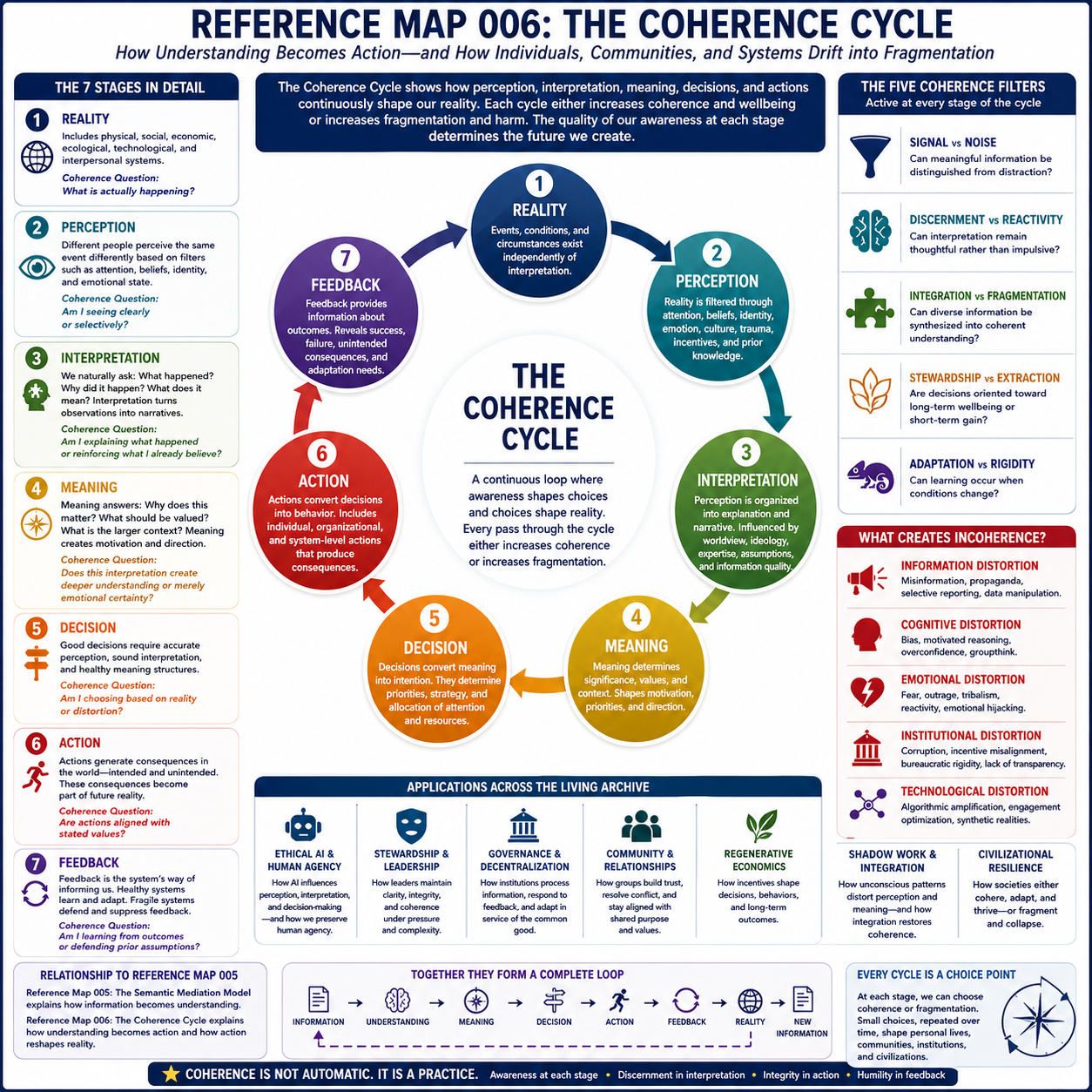
Together, these models explain both the conditions that reveal capability (Map 008) and the decision-making processes operating within those conditions (Map 006).
The Core Principle
Capability is only real if it holds under constraint.
Without constraint:
- Behavior is optimized for correctness
- Decisions are reversible
- Performance appears stable
With constraint:
- Trade-offs become unavoidable
- Decisions carry consequence
- Behavior becomes measurable
Constraint does not reduce performance.
It reveals it.
How SRI Works
SRI operates through three integrated layers.
1. Simulation Layer
Participants engage in environments that replicate real decision conditions:
- Limited time
- Incomplete information
- Competing objectives
These environments are structured—but not predictable.
Decisions must be made before clarity is complete.
This shifts thinking from:
- Analytical → to adaptive
- Reflective → to responsive
The purpose is not immersion.
It is exposure to conditions where behavior emerges naturally.
2. Observation Layer
Behavior is tracked across:
- Decision-making patterns
- Trade-off handling
- Incentive responses
- Stability across scenarios
This produces:
Behavioral data—not narrative explanation
Patterns begin to emerge:
- Does the individual maintain clarity under pressure?
- Do they overcomplicate decisions?
- Do they default to familiar patterns?
These patterns are difficult to detect in controlled environments.
But under constraint, they become visible.
3. Evaluation Layer (CLSS Integration)
Observed behavior is interpreted through:
→ CLSS (Coherence-Based Leadership Selection System)
This enables:
- Multi-dimensional assessment
- Pattern recognition
- Coherence scoring
SRI generates the signal.
CLSS interprets it.
Together, they provide a way to evaluate capability based on how it actually operates—not how it is described.
What SRI Reveals
When individuals operate under constraint, consistent patterns emerge.
1. Decision Patterns Under Pressure
Simulation shows how individuals behave when:
- Time is constrained
- Information is incomplete
This reveals:
- Cognitive prioritization
- Mental models
- Stress response
2. Trade-Off Logic
Every meaningful decision requires sacrifice.
Simulation reveals:
- What is prioritized
- What is deferred
- What is ignored
This exposes how individuals navigate complexity.
3. Incentive Response
When incentives are introduced:
- Behavior shifts
Simulation shows whether individuals:
- Optimize for visible rewards
- Maintain alignment
- Distort decisions under pressure
Because in real systems:
Behavior follows incentives—even when values suggest otherwise.
4. Behavioral Consistency
A single decision provides limited insight.
Across repeated simulations:
- Patterns stabilize
- Variability becomes measurable
Consistency becomes a stronger signal than isolated performance.
Why This Is Structurally Different
Most leadership systems attempt to improve performance by:
- Adding knowledge
- Refining frameworks
- Improving communication
SRI does not add more abstraction.
It changes the environment.
It places individuals inside conditions where leadership must be demonstrated—not described.
This also changes how leadership itself is understood.
Traditionally, leadership is associated with:
- Vision
- Communication
- Influence
These remain important—but they are incomplete.
Under real conditions, leadership becomes:
- The ability to decide under constraint
- The ability to navigate trade-offs
- The ability to maintain coherence when conditions are unstable
This is not always visible in low-pressure environments.
But it becomes immediately visible in simulation.
SRI does not redefine leadership conceptually.
It reveals what leadership actually looks like in practice.
From Development to Measurement
At a certain point, simulation stops being just a learning tool.
It becomes a measurement system.
Instead of asking:
“Did this person understand the framework?”
The question becomes:
“How does this person behave when it matters?”
This shift—from outcome to process—allows deeper evaluation.
It makes capability:
- Observable
- Comparable
- Measurable
What This Changes
For Organizations
- Moves from inferred capability → observed performance
- Reduces reliance on interviews
- Improves selection accuracy
- Strengthens leadership pipelines
For Individuals
- Reveals real decision patterns
- Identifies blind spots
- Improves performance under constraint
- Builds capability that transfers to real environments
Why This Matters Now
We are entering a period where:
- Complexity is increasing
- Predictability is decreasing
- Surface signals are less reliable
As environments become more complex, the cost of misjudging capability increases.
Decisions made by individuals who appear competent—but cannot operate under constraint—create:
- Strategic drift
- Operational inefficiency
- Misaligned priorities
These effects compound over time.
In this environment:
Understanding is not enough.
Only those who can:
- Decide under pressure
- Adapt under uncertainty
- Operate within constraint
…will perform consistently.
What This Page Represents
This is not:
- A training method
- A gamified exercise
- A conceptual framework
This is:
A system for observing, developing, and evaluating real capability under real conditions.
Next Steps
→ CLSS — Coherence-Based Leadership Selection System
→ Why Traditional Leadership Training Fails
→ What Simulation Reveals That Interviews Can’t
→ Decision-Making Under Constraint
→ Designing Effective Simulations
→ Programs / Implementation- FAQ
Description:
A simulation-based system for developing and evaluating leadership through observable behavior under constraint.
Attribution:
Gerald Daquila — Systems Thinking, Leadership Architecture, and Applied Coherence
Leave a Reply