Category: Life Patterns

  • Standard Inventory — The “Sovereign Kit”

    Standard Inventory — The “Sovereign Kit”


    The Minimum Resources Required to Maintain a Node


    If takt time defines when a steward returns to alignment, and work sequence defines how transitions are executed with integrity, then standard inventory defines what must always be present for the system to remain functional.

    In lean systems, standard inventory refers to the minimum quantity of materials required to sustain flow without interruption—no excess, no shortage (Liker, 2004).

    Too little inventory results in stoppages. Too much creates waste, obscures inefficiencies, and locks up capital.

    Transposed into the context of barangay resilience and diaspora architecture, standard inventory becomes:

    The Sovereign Kit — the essential set of physical, digital, and internal resources required to maintain continuity, coherence, and responsiveness at the node level.

    A “node” here refers to any functional unit of stewardship: a barangay team, a diaspora-led initiative, or even an individual operating as a coordination point.

    Without a clearly defined Sovereign Kit, nodes become fragile—overdependent on external inputs, vulnerable to disruption, and inconsistent in performance.

    This piece establishes a structured framework for designing, auditing, and standardizing the Sovereign Kit as a core component of resilient systems.


    1. Why Minimum Viability Matters More Than Maximum Capacity

    A common mistake in development and leadership systems is overaccumulation—more tools, more resources, more complexity.

    While this may appear as preparedness, it often produces the opposite:

    • Decision fatigue
    • Maintenance burden
    • Reduced adaptability

    Lean thinking emphasizes just-enough inventory—the precise amount needed to sustain operations under expected conditions (Ohno, 1988).

    This principle is especially critical in decentralized environments like barangays, where resources are constrained and variability is high.

    Research on disaster resilience further supports this: communities with well-managed, accessible core resources outperform those with larger but poorly coordinated inventories (Cutter et al., 2008).

    Thus, the first principle of the Sovereign Kit:

    Resilience is not built on abundance—it is built on sufficiency, accessibility, and clarity.


    2. Defining the Sovereign Kit

    The Sovereign Kit (SK) is a standardized inventory composed of three interdependent layers:

    a. Physical Layer — Tangible Continuity

    These are the material resources required for basic operations and crisis response.

    Examples:

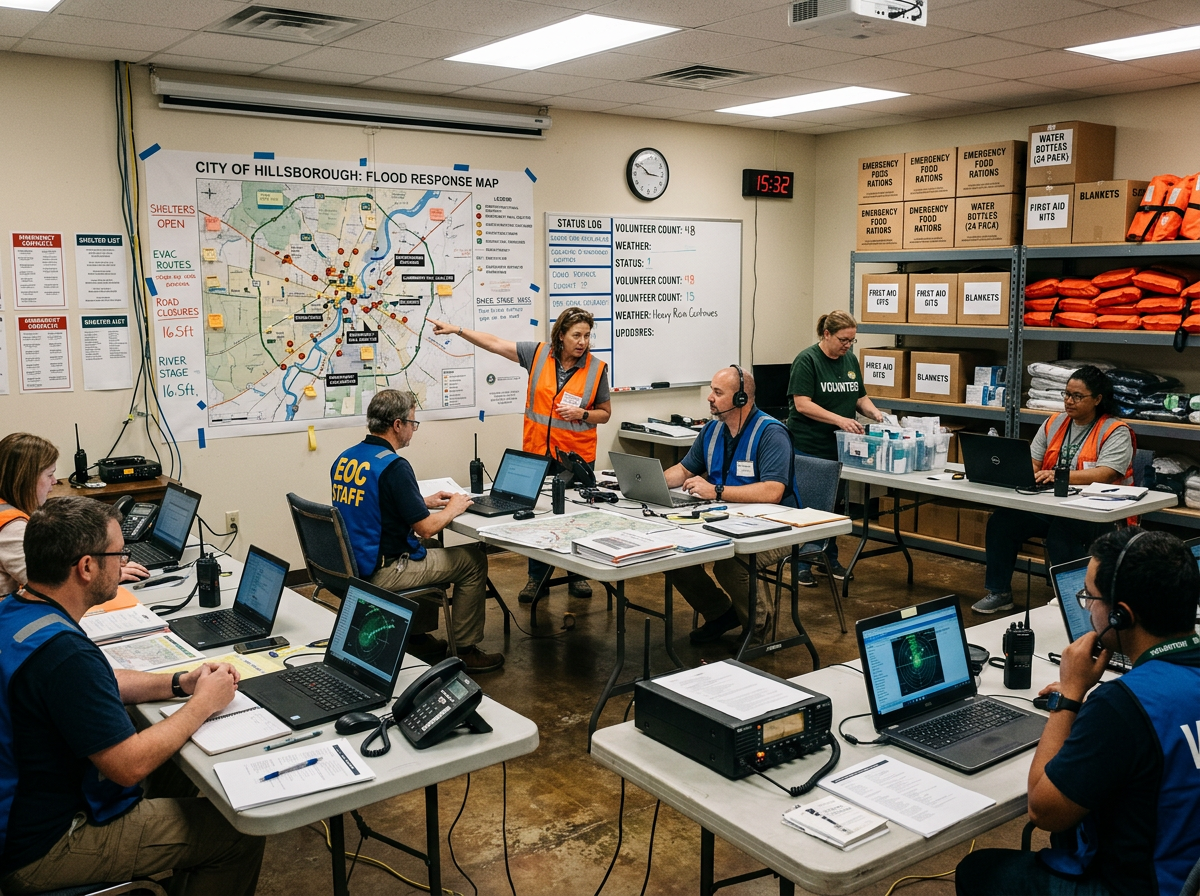
    • Communication tools (mobile devices, radios)
    • Power continuity (chargers, backup batteries)
    • Essential documents (printed protocols, contact lists)
    • Emergency supplies (first aid kits, basic provisions)

    In barangay contexts, physical readiness is often the first line of resilience, particularly during disasters where digital systems may fail.


    b. Digital Layer — Information and Coordination Infrastructure

    These resources enable coordination, transparency, and scalability.

    Examples:

    • Cloud-based document repositories
    • Financial tracking systems
    • Communication platforms (messaging groups, dashboards)
    • Data backups and access protocols

    Digital governance has been shown to improve service delivery and reduce corruption when properly implemented (World Bank, 2016).

    However, digital systems must be:

    • Accessible (low bandwidth requirements where possible)
    • Redundant (offline backups available)
    • Secure (clear access controls)

    c. Internal Layer — Human System Readiness

    This is the most overlooked yet most critical component.

    Examples:

    • Cognitive clarity (understanding of roles and protocols)
    • Emotional regulation capacity
    • Decision-making frameworks
    • Shared values and trust within the team

    Research in resilience consistently highlights that human factors—trust, cohesion, adaptability—are the strongest predictors of system performance under stress (Aldrich & Meyer, 2015).

    Thus, the internal layer is not intangible—it is operational infrastructure.


    3. The Minimum Threshold: What “Standard” Really Means

    “Standard” does not mean uniform across all contexts. It means:

    A clearly defined baseline below which system integrity is compromised.

    For example:

    • A barangay node without a reliable communication channel falls below standard
    • A financial initiative without transparent tracking falls below standard
    • A steward operating without internal regulation falls below standard

    Establishing this baseline allows for:

    • Rapid diagnostics
    • Consistent training
    • Scalable replication

    4. Designing the Sovereign Kit

    A functional Sovereign Kit must satisfy three criteria:

    a. Completeness

    All critical functions are supported (communication, coordination, decision-making).


    b. Accessibility

    Resources can be used when needed—not locked behind complexity or hierarchy.


    c. Redundancy

    Backup options exist for critical components.

    This aligns with systems engineering principles, where redundancy is a key factor in reliability (Hollnagel et al., 2006).


    5. Inventory as Flow Enabler, Not Stockpile

    In lean systems, inventory exists to support flow, not to accumulate.

    Applied to the Sovereign Kit:

    • Physical tools must be ready for immediate use
    • Digital systems must enable real-time coordination
    • Internal readiness must allow rapid response

    If any component becomes stagnant—unused, outdated, or inaccessible—it shifts from asset to liability.


    6. Auditing the Sovereign Kit

    Regular audits ensure that the kit remains functional and relevant.

    Key audit questions:

    Physical Layer

    • Are all tools operational?
    • Are supplies sufficient but not excessive?

    Digital Layer

    • Are systems up to date and accessible?
    • Are backups functioning?

    Internal Layer

    • Do team members understand their roles?
    • Is there evidence of emotional and cognitive regulation under stress?

    Auditing transforms the kit from a static list into a living system.


    7. Integration with BVSM, Takt Time, and Work Sequence

    The Sovereign Kit does not operate in isolation. It is the resource foundation that enables:

    • BVSM → identifies where resources are needed
    • Takt Time → ensures the steward can maintain alignment while using the kit
    • Work Sequence → defines how the resources are deployed

    Without standard inventory:

    • Value streams break
    • Sequences fail
    • Alignment becomes irrelevant

    8. The Role of the Diaspora Architect

    Diaspora architects are uniquely positioned to enhance Sovereign Kits by:

    • Introducing efficient, low-cost tools
    • Designing interoperable digital systems
    • Sharing best practices from other contexts

    However, the critical discipline is restraint:

    Do not expand the kit beyond what the node can sustain.

    Overengineering is a common failure mode—introducing tools that require maintenance, skills, or resources that are not locally available.

    The goal is not sophistication—it is sustainability.


    9. Failure Modes and Safeguards

    Common failures include:

    • Overaccumulation → too many tools, low usability
    • Under-specification → missing critical components
    • Dependency → reliance on external inputs

    Safeguards:

    • Clear inventory lists with ownership
    • Regular audits and updates
    • Training for all users

    10. Measuring Sovereignty

    A node’s sovereignty can be assessed through its kit:

    • Can it operate independently for a defined period?
    • Can it respond to disruptions without external assistance?
    • Can it maintain coordination and decision-making under stress?

    If the answer is consistently yes, the node is not just functional—it is resilient.


    11. Conclusion: Inventory as Autonomy

    Standard inventory, reframed as the Sovereign Kit, is not about accumulation—it is about autonomy.

    It ensures that:

    • Systems do not stall
    • Decisions do not delay
    • Responses do not depend on external rescue

    For barangays and diaspora-led initiatives alike, this is the foundation of true resilience.

    Because a system that cannot sustain itself—even briefly—cannot truly be called sovereign.

    And a steward without a Sovereign Kit is not leading a node—they are managing a dependency.


    Crosslinks

    Work Sequence — The Protocol – Anchor: “How resources are deployed in real operations.” Inventory exists to serve sequence.


    Barangay Value Stream Map (BVSM) – Anchor: “Where each resource fits within the larger system.” Connects micro assets → macro flows.


    Poka-Yoke — Soul-Error Proofing – Anchor: “Safeguarding resources from misuse, loss, or dependency.” Protects the kit itself.


    References

    Aldrich, D. P., & Meyer, M. A. (2015). Social capital and community resilience. American Behavioral Scientist, 59(2), 254–269.

    Cutter, S. L., Burton, C. G., & Emrich, C. T. (2008). Disaster resilience indicators for benchmarking baseline conditions. Journal of Homeland Security and Emergency Management, 5(1).

    Hollnagel, E., Woods, D. D., & Leveson, N. (2006). Resilience Engineering: Concepts and Precepts. Ashgate.

    Liker, J. K. (2004). The Toyota Way. McGraw-Hill.

    Ohno, T. (1988). Toyota Production System: Beyond Large-Scale Production. Productivity Press.

    World Bank. (2016). Digital Dividends. World Bank Publications.


    The Sovereign Professional: A structural map of power, systems thinking, and personal autonomy—dedicated to helping the independent professional navigate complexity and own their value stream.Ask


    ©2026 Gerald Daquila • Life.Understood. • Systems Thinking, Leadership Architecture, and Applied Coherence

  • Beyond the “Wait and See” Mindset: Overcoming the Psychological Weight of Persistent Scarcity

    Beyond the “Wait and See” Mindset: Overcoming the Psychological Weight of Persistent Scarcity


    Why hesitation feels safe—and how breaking the cycle unlocks agency, stability, and sovereign action


    Meta Description

    Why do so many Filipinos stay in “wait and see” mode? Discover how scarcity conditioning shapes hesitation—and how to shift toward decisive, grounded financial and life choices.


    The Comfort of Waiting

    https://images.openai.com/static-rsc-4/JIA0FiI6wmes5ubRstZYsdstVK0XsZyRr2HAyms3fLk4HU76jkbFAaGQA_AC5qmbcx-yNYGce8TVcSJdxQd8BQAwcf7sLRyjD09p88lin0WJrh4_pV9HGn8nKtS21i04BefVybBueO_5KsVpmacPFw9P5G27lP81jv9YcKQw_ova31wpZGHocTNn37WAMeL-?purpose=fullsize

    “Hintayin muna natin.”
    “Let’s see what happens.”
    “Maybe next time.”

    Across the Philippines, the language of waiting is familiar.

    https://images.openai.com/static-rsc-4/jyUXOFqJ8L03_o3wmfq-ZkEpU509Og05t8C0Fa9kdIG_ZV20yY256g5Iexh4XjqCio5doLA6c_uHZ5TlGswqcfp78SP4BqeJ_0PiM4h2fMdgkwwEEi8zOkCAmm2fcKpLgL_PRK4lJBrOZFn_nuFT2MB7gPKKO_Wh0Y1l4gaaevyL8hbnKneW-XNFRy-R8Mx6?purpose=fullsize

    It appears in:

    • Financial decisions (“I’ll invest when things are more stable”)
    • Career moves (“I’ll apply when I’m more ready”)
    • Business ideas (“I’ll start when the timing is right”)

    On the surface, this looks like caution.

    https://images.openai.com/static-rsc-4/zCf2QgaVG2M8MQQw9GeOa87LUbywfshdcFSfLKRfG4elMg2UrMBBKNR7C8WLD1N7o8jFe8Yi3Ec8_fd0HH9Z7lK7nbxnPIVRUlBgVshzgvW8NsR4OxfZ1UseZSG4891RbzoIGWX3fBEg3_BFAFW8fMmq-HO3dEu17fQqr1OlMfHqr7edsoRM-jITUVvnAg7_?purpose=fullsize

    But beneath it often lies something deeper:

    A learned relationship with uncertainty shaped by persistent scarcity.


    What Is the “Wait and See” Mindset?

    The “wait and see” mindset is not simple procrastination.

    It is a protective strategy.

    It emerges when individuals:

    • Anticipate instability
    • Fear loss more than they value gain
    • Lack confidence in future conditions

    In environments where resources are limited and risks are high, waiting can feel like the safest option.

    And in many cases, historically, it was.


    The Roots of Persistent Scarcity

    To understand this mindset, we must look at the conditions that shaped it.

    The Filipino experience includes:

    • Colonial extraction that limited wealth accumulation
    • Economic structures dependent on external markets
    • Income volatility and limited safety nets
    • Generational poverty in many communities

    These conditions create persistent scarcity—not just occasional lack, but ongoing uncertainty.

    Behavioral research shows that scarcity captures attention and narrows focus, making long-term planning more difficult (Mullainathan & Shafir, 2013).


    In such contexts, waiting becomes rational.


    When Protection Becomes Limitation

    The problem arises when this adaptive strategy becomes default—even when conditions allow for movement.

    The “wait and see” mindset begins to:

    • Delay opportunities
    • Reinforce inaction
    • Reduce exposure to growth

    Over time, it creates a loop:

    Uncertainty → Waiting → Missed opportunities → Continued uncertainty

    This loop can persist even when external conditions improve.


    The Psychological Weight of Waiting

    Waiting is not neutral.

    It carries emotional and cognitive weight.

    1. Decision Fatigue

    Constantly postponing decisions keeps them unresolved, consuming mental energy.


    2. Reduced Confidence

    The longer action is delayed, the more difficult it feels to begin.


    3. Reinforced Fear

    Avoidance signals to the brain that the situation is dangerous.


    4. Loss of Momentum

    Progress requires movement.

    Waiting interrupts flow.


    (Crosslink: Financial Sovereignty Is a Nervous System State: Grounding the QFS in the Filipino Reality)

    From a nervous system perspective, waiting often reflects a freeze response—a state where action is inhibited to avoid perceived risk.


    The Cultural Layer: Collective Waiting

    The “wait and see” mindset is not only individual.

    It is cultural.

    It appears in:

    • Hesitation to adopt new systems
    • Delayed collective action
    • Preference for observing before engaging

    (Crosslink: Why Resiliency Is a Trap: Moving from Colonial Survival to New Earth Stewardship)

    While caution has value, excessive delay can prevent necessary transformation.


    The Hidden Influence of Guilt and Obligation

    Waiting is often reinforced by emotional factors:

    • Fear of making the “wrong” move for the family
    • Guilt around taking risks that may affect others
    • Pressure to maintain stability rather than pursue growth

    (Crosslink: Money, Guilt, and the Colonized Soul: Why We Sabotage Our Own Sovereignty)

    This creates internal conflict:

    The desire to move forward… and the need to stay safe.


    The Illusion of Perfect Timing

    One of the core beliefs behind waiting is:

    “I will act when the timing is right.”

    But in dynamic environments, perfect conditions rarely arrive.

    Instead:

    • Markets shift
    • Opportunities evolve
    • Circumstances change

    Waiting for certainty often results in missed windows.


    Research on decision-making shows that action under uncertainty is a necessary condition for growth (Kahneman, 2011).


    From Waiting to Agency

    Breaking the cycle does not mean becoming reckless.

    It means shifting from passive delay to active engagement.

    The Key Difference:

    • Waiting: reacting to external conditions
    • Agency: shaping outcomes through informed action

    A Practical Framework for Moving Forward

    1. Define Acceptable Risk

    Not all decisions require full certainty.

    Ask:

    What level of risk can I realistically manage?


    2. Start Small

    Large decisions can feel overwhelming.

    Break them into:

    • Small, testable steps
    • Low-risk experiments

    3. Set Decision Windows

    Avoid indefinite waiting by creating timelines:

    • “I will decide within 2 weeks”
    • “I will test this for 3 months”

    4. Build Safety Nets

    Reduce fear by creating buffers:

    • Emergency funds
    • Support networks
    • Backup plans

    5. Reframe Failure

    Instead of:

    “What if this goes wrong?”

    Consider:

    “What will I learn if it does?”


    6. Strengthen Internal Regulation

    (Crosslink: The Ancestral Debt: Healing the Generational Shame of Poverty in the Filipino Psyche)

    Calm, regulated states improve decision-making capacity.


    The Role of Systems

    Individual action is necessary—but insufficient without supportive structures.

    (Crosslink: ARK-001: The 50-Person Resource Loop)

    Coherent systems:

    • Reduce individual risk
    • Share responsibility
    • Enable collective movement

    When systems are strong, individuals do not have to wait as long.


    The Ark Perspective: Timing vs. Readiness

    Within your framework, the question shifts from:

    “Is the timing right?”

    To:

    “Am I prepared to engage?”

    (Crosslink: From Fragmented Souls to Sovereign Stewards: Reclaiming Identity After 500 Years of Institutional Trauma)

    Readiness is internal.

    Timing is external.

    Sovereignty prioritizes the former.


    The Risk of Staying in Waiting Mode

    If the “wait and see” mindset persists:

    • Opportunities continue to pass
    • Confidence decreases
    • Dependency increases
    • Patterns repeat across generations

    This reinforces the very scarcity individuals are trying to escape.


    Conclusion: The Courage to Move

    Waiting once served a purpose.

    It protected against uncertainty.

    But what protects in one context can limit in another.

    The shift now is not toward impulsivity—but toward intentional action.

    To move:

    • With awareness
    • With preparation
    • With willingness to learn

    Because sovereignty is not built in perfect conditions.

    It is built in real ones.

    And it begins the moment waiting ends.


    References

    Kahneman, D. (2011). Thinking, Fast and Slow. Farrar, Straus and Giroux.

    Mullainathan, S., & Shafir, E. (2013). Scarcity: Why Having Too Little Means So Much. Times Books.

    North, D. C. (1990). Institutions, Institutional Change and Economic Performance. Cambridge University Press.

    David, E. J. R. (2013). Brown Skin, White Minds. Information Age Publishing.


    The Sovereign Professional: A structural map of power, systems thinking, and personal autonomy—dedicated to helping the independent professional navigate complexity and own their value stream.Ask


    ©2026 Gerald Daquila • Life.Understood. • Systems Thinking, Leadership Architecture, and Applied Coherence

  • How the Prototype Community Functions Day-to-Day

    How the Prototype Community Functions Day-to-Day


    A Barangay-Scale Stewardship Framework for Regenerative Living, Economic Circulation, and Distributed Leadership


    Meta Description

    Explore the operational blueprint behind a regenerative barangay-scale prototype community in the Philippines, including governance, stewardship systems, local economics, conflict resolution, and resilient day-to-day living without centralized debt dependency.


    Introduction

    Many intentional communities fail not because their vision lacks inspiration, but because their operational systems remain vague.

    Noble ideals alone cannot sustain land stewardship, shared infrastructure, financial resilience, or human relationships over time.

    The Prototype Community proposed within the SHEYALOTH stewardship architecture is therefore designed not merely as a philosophical experiment, but as an operationally grounded living system.

    This document outlines how the prototype community functions on a day-to-day basis.

    Its purpose is to answer the practical questions donors, collaborators, future residents, and governance advisors will inevitably ask:

    • How is the community structured?
    • Who makes decisions?
    • How does money circulate?
    • How are conflicts handled?
    • How are members selected?
    • What prevents leadership abuse?
    • How does the community remain financially viable?
    • How does the model scale without collapsing?

    This is not a utopian blueprint.

    It is a systems-informed prototype designed for gradual implementation, adaptation, and resilience.


    1. Core Design Philosophy

    The prototype community is built around five foundational principles:

    1. Stewardship Over Ownership

    Land, infrastructure, knowledge, and resources are treated primarily as stewarded assets rather than speculative commodities.

    The objective is long-term regenerative use rather than extraction.


    2. Distributed Responsibility

    The community avoids over-centralization of authority.

    Leadership functions are distributed through councils, working groups, rotating stewardship roles, and transparent governance structures.

    This reduces fragility and dependency on charismatic leadership.


    3. Regenerative Economics

    The node is designed to retain and circulate value locally whenever practical.

    Priority is placed on:

    • local production,
    • skill development,
    • cooperative purchasing,
    • resilient infrastructure,
    • and ethical enterprise creation.

    4. Human-Scale Governance

    The community is intentionally kept within a manageable relational scale.

    Research in social cohesion repeatedly suggests that trust and accountability degrade when communities become too large or overly bureaucratic (Ostrom, 1990).

    The prototype therefore prioritizes:

    • relational governance,
    • participatory decision-making,
    • and face-to-face accountability.

    5. Adaptive Evolution

    The operating model is not static.

    The prototype is designed to learn through implementation.

    Systems are expected to evolve based on:

    • ecological realities,
    • member feedback,
    • financial conditions,
    • and operational experience.

    2. Community Structure

    Initial Prototype Size

    The recommended initial scale is:

    • 12–20 founding adults
    • small family clusters
    • rotating retreat participants
    • local collaborators and trainees

    This allows sufficient diversity of skills while maintaining manageable governance complexity.

    Expansion beyond 50–70 residents should occur only after:

    • governance stabilization,
    • infrastructure maturity,
    • financial resilience,
    • and conflict systems have proven functional.

    Physical Layout

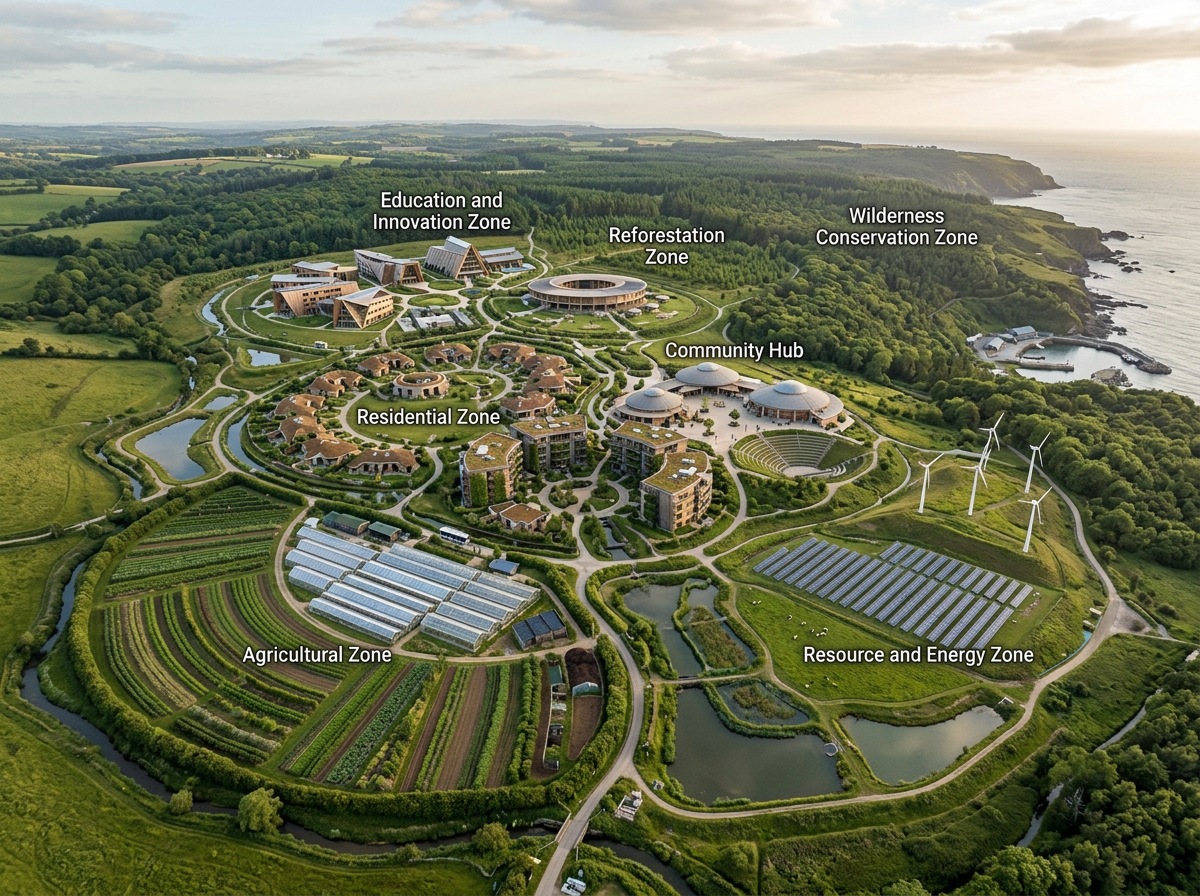
    The community is organized into interconnected functional zones:

    A. Residential Zone

    • private sleeping quarters
    • small family dwellings
    • shared housing clusters
    • co-living options

    B. Productive Agriculture Zone

    • food forests
    • gardens
    • regenerative farming plots
    • seed stewardship
    • compost systems
    • water capture systems

    C. Commons Zone

    Shared community infrastructure:

    • kitchen
    • dining space
    • workshop
    • learning spaces
    • meditation/reflection areas
    • meeting spaces

    D. Enterprise Zone

    Micro-enterprise and livelihood activities:

    • fabrication
    • media production
    • retreats
    • training programs
    • crafts
    • processing facilities
    • digital workspaces

    3. Membership Model

    The prototype uses a layered participation structure.

    Not all participants carry identical responsibilities or privileges.


    Tier 1 – Visitors

    Short-term participants:

    • retreat guests
    • volunteers
    • educational participants
    • researchers

    No governance authority.


    Tier 2 – Apprentices

    Longer-term immersion participants learning stewardship systems.

    Responsibilities include:

    • contribution hours
    • training participation
    • collaborative work
    • community integration

    Limited governance participation.


    Tier 3 – Resident Stewards

    Core long-term members.

    Responsibilities include:

    • operational stewardship
    • governance participation
    • financial contribution
    • skill-sharing
    • mentorship
    • infrastructure care

    These members hold voting participation in major community decisions.


    Tier 4 – Custodian Council

    A rotating stewardship council responsible for:

    • legal oversight
    • financial transparency
    • conflict facilitation
    • systems coordination
    • external partnerships
    • continuity planning

    The council does not function as permanent rulers.

    Term limits and rotation structures reduce power concentration.


    4. Governance Architecture

    Governance is one of the most critical systems within the prototype.

    Most intentional communities fail from unresolved governance weaknesses rather than resource scarcity.


    Decision-Making Structure

    The community uses a hybrid governance model combining:

    • consensus-seeking,
    • delegated authority,
    • and operational autonomy.

    Not every decision requires full-community deliberation.

    Examples:

    Decision TypeGovernance Layer
    Daily operationsWorking groups
    Budget allocationsStewardship council + community review
    Land use changesFull steward vote
    Conflict mediationDesignated mediation circle
    Legal complianceCustodian council

    Transparency Systems

    Transparency is mandatory.

    Members have access to:

    • budget summaries
    • project spending
    • governance notes
    • operational reports
    • stewardship agreements

    Opaque governance breeds distrust.


    Conflict Resolution Process

    Conflict is treated as inevitable rather than abnormal.

    The prototype therefore institutionalizes conflict support mechanisms.

    The escalation structure includes:

    1. Direct dialogue
    2. Facilitated mediation
    3. Stewardship review circle
    4. Temporary cooling-off agreements
    5. Membership reassessment if necessary

    The objective is restoration whenever possible.

    However, persistent abuse, manipulation, violence, or severe boundary violations may result in removal.

    Community safety takes priority over ideological purity.


    5. Financial Operating Model

    The prototype community is not designed as an anti-market commune.

    It operates as a hybrid regenerative economy.

    External revenue remains important.

    However, the objective is to progressively increase internal resilience while minimizing extractive leakage.


    Primary Revenue Streams

    A. Retreats and Trainings

    • stewardship intensives
    • regenerative living workshops
    • leadership immersions
    • wellness retreats
    • systems-thinking seminars

    B. Agricultural Production

    • fresh produce
    • seedlings
    • preserved foods
    • herbal products
    • value-added goods

    C. Digital and Educational Media

    • online courses
    • publications
    • consulting
    • media production
    • educational content

    D. Ethical Enterprise Incubation

    Members may operate aligned micro-enterprises that:

    • contribute to the node,
    • employ local participants,
    • and strengthen community resilience.

    Community Contribution System

    Resident stewards contribute through combinations of:

    • financial contribution,
    • labor contribution,
    • skill contribution,
    • or operational stewardship.

    Contribution expectations are calibrated realistically.

    The objective is participation—not coercion.


    Reserve Funds

    The prototype maintains reserve allocations for:

    • emergency resilience,
    • medical support,
    • infrastructure maintenance,
    • climate disruptions,
    • and operational continuity.

    Communities collapse quickly without reserves.


    6. Work Rhythm and Daily Life

    The prototype avoids both extremes:

    • hyper-capitalist overwork,
    • and unsustainable idealistic leisure culture.

    Instead, it seeks balanced contribution rhythms.


    Daily Structure Example

    Morning

    • food systems work
    • maintenance
    • infrastructure tasks
    • operational coordination

    Afternoon

    • enterprise work
    • training
    • educational programs
    • remote/digital work

    Evening

    • shared meals
    • reflection circles
    • cultural activities
    • governance meetings when necessary

    Weekly Rhythm

    The weekly cycle includes:

    • stewardship days
    • enterprise days
    • learning days
    • rest periods
    • governance review periods

    Intentional rest is considered infrastructure.

    Burnout destroys communities.


    7. External Partnerships

    The prototype does not isolate itself.

    It actively collaborates with:

    • local barangays
    • farmers
    • NGOs
    • educators
    • regenerative design experts
    • universities
    • ethical businesses
    • public agencies where aligned

    This reduces ideological isolation and improves practical resilience.


    8. Risk Factors and Safeguards

    The prototype acknowledges several major risks.


    Risk 1 – Leadership Centralization

    Safeguards:

    • rotating councils
    • transparent finances
    • distributed authority
    • written governance protocols

    Risk 2 – Financial Fragility

    Safeguards:

    • diversified revenue streams
    • reserve funds
    • phased growth
    • low-debt strategy

    Risk 3 – Social Fragmentation

    Safeguards:

    • conflict mediation
    • onboarding processes
    • mentorship systems
    • cultural rituals
    • shared meals

    Risk 4 – Ideological Rigidity

    Safeguards:

    • adaptive review cycles
    • evidence-based assessment
    • external advisors
    • community feedback structures

    Risk 5 – Burnout

    Safeguards:

    • workload balancing
    • rotating responsibilities
    • rest periods
    • emotional support systems

    9. Long-Term Vision

    The prototype is not intended to become a giant centralized settlement.

    Instead, the long-term model resembles:

    • interconnected stewardship nodes,
    • distributed regenerative communities,
    • local training hubs,
    • and collaborative barangay-scale ecosystems.

    Replication occurs horizontally rather than through top-heavy expansion.

    This creates resilience through decentralization.


    Conclusion

    The Prototype Community is ultimately an experiment in practical regeneration.

    Its purpose is not to escape society.

    Its purpose is to test whether human communities can once again organize around:

    • stewardship instead of extraction,
    • participation instead of passivity,
    • resilience instead of dependency,
    • and relational wealth instead of perpetual debt.

    The operating model therefore serves as both:

    • a practical governance framework,
    • and a living systems laboratory.

    If successful, the prototype may provide evidence that localized regenerative communities are not merely idealistic visions, but viable social infrastructure for an increasingly unstable world.


    Crosslinks

    Value Stream Mapping the Prototype Community: Circulating Wealth Without Central Debt – Maps how food, labor, finance, governance, infrastructure, and knowledge circulate within the prototype community while minimizing extractive leakage into centralized debt systems.

    Agentic Systems and the End of Passive Labor – Analyzes how AI, automation, and decentralized production systems are reshaping the future of work, stewardship, and local economic resilience.

    The Sovereign Prompt: How to Use AI Without Outsourcing Discernment – Discusses the ethical integration of AI within regenerative systems while preserving human discernment, accountability, and stewardship responsibility.

    Why the Global Reset Requires an Internal Reboot: The Role of Shadow Work in NESARA/GESARA – Explores the psychological and cultural dimensions of systemic transformation, emphasizing that sustainable external reform requires internal ethical and relational maturity first.


    References

    American Society for Quality. (n.d.). Value stream mapping tutorial – What is VSM? ASQ. ASQ Value Stream Mapping Tutorial

    Centre for Local Economic Strategies. (n.d.). Community wealth building. CLES. CLES Community Wealth Building

    Lean Enterprise Institute. (n.d.). Value-stream mapping. Lean Enterprise Institute Value Stream Mapping

    Lucid Software Inc. (n.d.). What is value stream mapping? Lucidchart. Lucidchart Value Stream Mapping Guide

    Elinor Ostrom. (1990). Governing the commons: The evolution of institutions for collective action. Cambridge University Press.

    Preston City Council. (n.d.). What is community wealth building? Preston Community Wealth Building Overview

    Purdue University. (2024, November 7). Value stream mapping. Purdue Lean Six Sigma Online. Purdue Lean Six Sigma Value Stream Mapping

    United Nations Development Programme. (2022). Local governance and resilient communities. UNDP Official Website

    Transition Network. (n.d.). What is transition? Transition Network Official Website

    Permaculture Research Institute. (n.d.). Principles of permaculture. Permaculture Research Institute


    The Sovereign Professional: A structural map of power, systems thinking, and personal autonomy—dedicated to helping the independent professional navigate complexity and own their value stream.


    ©2026 Gerald Daquila • Life.Understood. • Systems Thinking, Leadership Architecture, and Applied Coherence

  • ARK-012: Legal Structures for Community Prototypes (Philippine Context)

    ARK-012: Legal Structures for Community Prototypes (Philippine Context)


    Navigating Land Ownership, Governance Entities, and Regulatory Compliance


    Meta Description

    A practical legal framework for establishing a 50-person community prototype in the Philippines, covering land ownership, entity structures, compliance, and risk management.


    Opening

    A community can be perfectly designed—and still fail the moment it encounters the legal system.

    Land titles, zoning rules, ownership restrictions, and regulatory compliance are not abstract constraints. They determine whether a project can:

    • Exist long-term
    • Scale without interruption
    • Protect its members
    • Avoid costly disputes or shutdowns

    Many intentional community projects avoid legal complexity until it becomes unavoidable. By then, it is often too late.

    Legal structure is not a final step—it is the foundation.

    This piece grounds the ARK framework in the Philippine context, building on:


    Why Legal Design Determines Continuity

    Legal systems define:

    • Who owns the land
    • Who has decision-making authority
    • Who bears liability
    • How disputes are resolved

    Without clear legal grounding:

    • Ownership becomes contested
    • Members are exposed to risk
    • Expansion becomes impossible

    Research on institutional systems emphasizes that clear rules and enforceable structures are essential for collective stability (Ostrom, 1990).


    Layer 1: Land Ownership Constraints in the Philippines

    The first—and most critical—legal reality:

    Land ownership in the Philippines is restricted.

    Key Rule

    • Only Filipino citizens and Filipino-owned entities (≥60% Filipino ownership) can legally own land.

    This immediately shapes:

    • Who can invest
    • How ownership is structured
    • How foreign participants are included

    Land Ownership Options

    1. Individual Filipino Ownership

    • Land is titled under one or more Filipino individuals

    Pros:

    • Simple
    • Fast acquisition

    Cons:

    • High trust dependency
    • Risk of personal ownership disputes

    2. Corporation Structure

    • Land owned by a Philippine corporation
    • Must be ≥60% Filipino-owned

    Pros:

    • Clear legal identity
    • Easier scaling and contracts

    Cons:

    • Regulatory complexity
    • Requires corporate governance discipline

    3. Cooperative Structure

    • Registered under the Cooperative Development Authority

    Pros:

    • Aligns with shared ownership principles
    • Democratic governance built-in

    Cons:

    • Slower decision-making
    • Requires compliance with cooperative laws

    Recommended Approach

    For most ARK prototypes:

    Hybrid model: Corporation or cooperative + internal governance agreements

    This balances:

    • Legal clarity
    • Operational flexibility

    Layer 2: Entity Structure for the Community

    Beyond land ownership, the community must exist as a legal entity.

    Primary Options


    1. Corporation

    Registered through the Securities and Exchange Commission (Philippines)

    • Can enter contracts
    • Can own assets
    • Provides liability separation

    2. Cooperative

    Registered with the Cooperative Development Authority

    • Member-owned and governed
    • Profit distribution based on participation

    3. Association (Non-Profit)

    • Suitable for early-stage or advocacy-focused groups
    • Limited in economic activity

    Key Decision Factors

    • Level of economic activity
    • Governance style
    • Member expectations

    Layer 3: Zoning and Land Use Compliance

    Even with ownership secured, land must be used legally.


    Zoning Categories

    • Agricultural
    • Residential
    • Mixed-use

    Key Considerations

    • Agricultural land may restrict residential structures
    • Conversion may be required for certain uses
    • Local Government Units (LGUs) enforce zoning rules

    Regulatory Bodies Involved

    • Municipal or City LGU
    • Barangay authorities
    • Environmental agencies

    Core Permits and Clearances

    • Barangay clearance
    • Building permits
    • Environmental compliance (if applicable)

    Failure to comply can result in:

    • Fines
    • Project shutdown
    • Legal disputes

    Layer 4: Internal Legal Agreements

    Even with external compliance, the internal legal framework is equally critical.

    Essential Documents


    1. Membership Agreement

    Defines:

    • Rights and responsibilities
    • Contribution expectations
    • Use of shared resources

    2. Governance Charter

    Defines:

    • Decision-making processes
    • Leadership roles
    • Conflict resolution systems

    3. Asset and Equity Agreements

    Defines:

    • Ownership of land and infrastructure
    • Financial contributions
    • Exit terms

    Key Principle

    Verbal agreements are not sufficient.

    All expectations must be:

    • Written
    • Signed
    • Accessible

    Layer 5: Liability and Risk Protection

    Communities must anticipate legal risk.


    Common Risk Areas

    • Accidents or injuries
    • Financial disputes
    • Land ownership conflicts
    • Regulatory violations

    Protection Mechanisms

    • Legal entity shielding (corporation/cooperative)
    • Insurance (where available)
    • Clear contracts and waivers

    Layer 6: Foreign Participation

    Given global interest, many communities include non-Filipino members.


    Legal Reality

    • Foreigners cannot own land directly
    • Can participate through:
      • Leasing agreements
      • Membership in entities
      • Service or investment roles

    Risk Consideration

    Improper structuring can lead to:

    • Legal invalidation of ownership
    • Government intervention

    Layer 7: Alignment with Financial Systems

    Legal structure must support the financial model in
    ARK-011: Capitalization and Financial Flows for a 50-Person Prototype

    Key Alignments

    • Treasury management
    • Contribution tracking
    • Profit or surplus distribution

    Without alignment:

    • Financial disputes escalate into legal issues

    Layer 8: Scaling Across Multiple Nodes

    As outlined in
    ARK-010: From Prototype to Network — Scaling Distributed Communities

    Each node must:

    • Have its own legal entity
    • Comply with local regulations

    Network-Level Considerations

    • Inter-entity agreements
    • Shared standards
    • Optional umbrella organizations

    Common Legal Failure Patterns

    Observed across projects:

    • Informal land ownership arrangements
    • Lack of written agreements
    • Ignoring zoning laws
    • Mixing personal and community finances
    • Misunderstanding foreign ownership rules

    Each creates long-term instability.


    Local Governance Dynamics (Philippine Reality)

    Beyond formal law, success often depends on:

    • Relationship with Barangay leaders
    • Alignment with LGU priorities
    • Community integration

    Practical Insight

    Legal compliance + local trust = operational stability

    Ignoring local dynamics can stall or block progress—even if formal requirements are met.


    Conclusion: Law as Infrastructure

    Legal systems are often treated as constraints.

    In reality, they are infrastructure—just like water, land, or energy.

    A well-structured legal foundation:

    • Protects members
    • Enables growth
    • Reduces conflict
    • Supports replication

    At 50 people, complexity is manageable—but only if:

    • Ownership is clear
    • Rules are defined
    • Compliance is maintained

    With this layer in place, the ARK system becomes not just viable—but defensible and scalable within the real world.


    References

    Ostrom, E. (1990). Governing the commons: The evolution of institutions for collective action. Cambridge University Press.

    Republic of the Philippines. (1987). The Constitution of the Republic of the Philippines.

    Cooperative Development Authority. (n.d.). Guidelines and regulations for cooperatives.

    Securities and Exchange Commission (Philippines). (n.d.). Corporate registration and governance rules.

    The concepts outlined here are designed for real-world execution. For a complete set of ready-to-use documents—including governance templates, resource tracking sheets, and operational SOPs—explore the 55 Editable Applied Stewardship Toolkit (Complete Set).

    For a broader systems context that situates localized resilience within national and multi-scalar transformation frameworks, explore The Philippine Ark: A Sovereign Blueprint for Systemic Transformation.


    Continue Through the ARK Series

    This framework is designed as a complete system. You can explore it sequentially or move directly to the layer most relevant to your work:

    Foundations

    Design + Build

    Systems Layer

    Scaling


    Suggested Pathways

    New to the framework?

    Start with ARK-001 ARK-008ARK-011


    Designing a physical site?

    Begin with ARK-007ARK-008ARK-009


    Preparing for real-world deployment?

    Focus on ARK-011ARK-012ARK-013


    Thinking long-term scale?

    Move to ARK-010


    [DOCUMENT CONTROL & STEWARDSHIP]

    Standard Work ID: [ARK-012]

    Baseline Version: v1.5.2026

    Classification: Open-Access Archive / Systemic Protocol

    The Sovereign Audit: Following this protocol is an act of internal quality control. Verification of this standard does not happen here; it happens at your Gemba—the actual place where your life and leadership occur. No external validation is required or offered.

    Next in Sequence: [ARK-013: Membership, Onboarding, and Exit Systems]

    Return to Archive: [Standard Work Knowledge Hub: The Terrain Map]


    © 2026 Gerald Daquila • Life.Understood Systemic Stewardship • Non-Autocratic Architecture • Process over Persona

  • Work Sequence — The Protocol

    Work Sequence — The Protocol


    The Step-by-Step Order of Operations for a Spiritual or Financial Transition


    If takt time defines when a steward returns to alignment, then work sequence defines how alignment is translated into action.

    In lean systems, work sequence refers to the precise, repeatable order of steps required to complete a task efficiently, safely, and with consistent quality (Rother & Harris, 2001).

    It eliminates ambiguity. It reduces variation. It ensures that outcomes are not dependent on mood, memory, or improvisation.

    Transposed into the domain of diaspora architecture and barangay resilience, work sequence becomes something far more consequential:

    A protocol that governs transitions—ensuring that moments of change do not devolve into chaos, leakage, or misalignment.

    Whether the transition is spiritual (identity shift, role assumption, conflict resolution) or financial (resource allocation, fund deployment, livelihood activation), the absence of a clear sequence introduces risk. The presence of one introduces continuity, traceability, and trust.

    This piece outlines how to design, implement, and standardize Work Sequence Protocols (WSPs) for high-stakes transitions at both the individual and community level.


    1. Why Transitions Fail Without Sequence

    Most system failures do not occur during stable periods—they occur during transitions:

    • When funds move from one holder to another
    • When leadership roles shift
    • When a project moves from planning to execution
    • When a community moves from stability to crisis response

    In these moments, ambiguity increases while coordination decreases.

    Research in organizational behavior shows that unclear processes during transitions significantly increase error rates, delays, and conflict (Kotter, 1996).

    In decentralized systems like barangays, where formal structures intersect with informal dynamics, the risk is amplified.

    Without a defined work sequence:

    • Steps are skipped
    • Responsibilities blur
    • Accountability weakens
    • Trust erodes

    Thus, the second principle:

    Resilience is not tested in stability—it is tested in transition.


    2. Defining the Work Sequence Protocol (WSP)

    A Work Sequence Protocol (WSP) is a codified set of steps that governs a specific type of transition.

    It answers three fundamental questions:

    1. What happens first, second, third?
    2. Who is responsible at each step?
    3. What conditions must be met before moving forward?

    Unlike general guidelines, a WSP is:

    • Explicit (no ambiguity in steps)
    • Repeatable (can be executed consistently across contexts)
    • Auditable (can be reviewed and improved over time)

    This aligns with standard work principles in lean systems, where consistency is the foundation for continuous improvement (Liker, 2004).


    3. The Five Phases of a High-Integrity Transition

    While each context will require customization, most effective work sequences follow a five-phase structure:

    Phase 1: Initiation — Clarifying Intent

    Every transition begins with intent. Without clarity here, all subsequent steps inherit confusion.

    Key actions:

    • Define the purpose of the transition
    • Identify stakeholders
    • Establish desired outcomes

    In a financial context:

    • Why are funds being moved?
    • What impact is expected?

    In a spiritual/contextual leadership shift:

    • What role is being assumed or released?
    • What responsibilities are changing?

    This phase aligns with goal-setting theory, which emphasizes clarity as a determinant of performance (Locke & Latham, 2002).


    Phase 2: Verification — Ensuring Readiness

    Before action, the system must confirm that conditions are appropriate.

    Key actions:

    • Validate data and assumptions
    • Confirm resource availability
    • Assess risks

    In barangay systems:

    • Are funds properly accounted for?
    • Are beneficiaries correctly identified?
    • Are legal or procedural requirements met?

    Skipping verification is one of the most common sources of downstream failure.


    Phase 3: Execution — Performing the Transition

    This is the visible action phase, but it is only effective if the previous phases were properly completed.

    Key actions:

    • Execute steps in defined order
    • Maintain documentation
    • Monitor real-time deviations

    Lean research shows that adherence to sequence reduces variability and improves quality outcomes (Rother & Harris, 2001).


    Phase 4: Validation — Confirming Integrity

    After execution, the system must verify that the transition achieved its intended outcome.

    Key actions:

    • Cross-check results against expectations
    • Confirm receipt (in financial transfers)
    • Gather immediate feedback

    In community contexts:

    • Did the intended recipients receive the benefit?
    • Did the process create unintended consequences?

    Validation closes the loop between intent and outcome.


    Phase 5: Integration — Embedding the Change

    A transition is not complete until it is integrated into the system.

    Key actions:

    • Update records and documentation
    • Communicate outcomes to stakeholders
    • Incorporate lessons learned

    This phase ensures that each transition strengthens the system rather than remaining an isolated event.


    4. Spiritual and Financial Transitions: Different Domains, Same Discipline

    At first glance, spiritual and financial transitions appear distinct.

    However, both involve:

    • Movement of value (tangible or intangible)
    • Shifts in responsibility
    • Exposure to risk

    a. Financial Transition Example: Barangay Fund Allocation

    Sequence:

    1. Initiation — Budget allocation proposal
    2. Verification — Compliance and fund availability check
    3. Execution — Disbursement process
    4. Validation — Receipt confirmation and audit
    5. Integration — Reporting and documentation

    b. Spiritual Transition Example: Leadership Role Assumption

    Sequence:

    1. Initiation — Role clarification and acceptance
    2. Verification — Readiness assessment (skills, support)
    3. Execution — Public or formal assumption of role
    4. Validation — Feedback from stakeholders
    5. Integration — Ongoing practice and accountability

    The domains differ, but the structural logic remains constant.


    5. Reducing Variability Without Killing Adaptability

    A common misconception is that standardization reduces flexibility.

    In reality:

    Standardization creates a stable baseline from which adaptation becomes meaningful.

    Without a baseline, every action is improvisation. With a baseline, deviations can be:

    • Identified
    • Evaluated
    • Improved

    Adaptive systems theory supports this balance between structure and flexibility, emphasizing that resilient systems maintain core processes while adapting peripheral elements (Folke et al., 2005).


    6. Embedding Work Sequence into the Barangay Value Stream Map

    The BVSM identifies flows and bottlenecks. Work sequence defines how those flows are executed.

    Integration points:

    • Each critical node in the BVSM should have an associated WSP
    • High-risk transitions (e.g., fund flows, emergency response) should be prioritized
    • Sequences should be co-designed with local stakeholders

    This ensures that mapping does not remain theoretical—it becomes operational reality.


    7. The Role of the Diaspora Architect

    For diaspora architects, the temptation is often to introduce solutions. The more effective role is to design protocols that enable local systems to function independently.

    Key contributions:

    • Documenting existing informal sequences
    • Identifying gaps or inefficiencies
    • Co-creating standardized protocols
    • Training local stakeholders in their use

    This shifts the intervention from dependency creation to capacity building.


    8. Auditing and Continuous Improvement

    A WSP is not static. It must evolve through feedback and iteration.

    Audit questions:

    • Were all steps followed?
    • Where did deviations occur?
    • What caused those deviations?
    • How can the sequence be improved?

    This aligns with continuous improvement cycles such as Plan-Do-Check-Act (PDCA), which have been widely validated in both industrial and public sector contexts (Deming, 1986).


    9. Failure Modes and Safeguards

    Even with a defined sequence, failures can occur.

    Common failure modes include:

    • Step Skipping → due to urgency or overconfidence
    • Role Confusion → unclear responsibilities
    • Documentation Gaps → lack of traceability

    Safeguards:

    • Checklists for critical transitions
    • Clear role assignments
    • Mandatory validation steps

    Checklists, in particular, have been shown to significantly reduce errors in complex environments (Gawande, 2009).


    10. Conclusion: Sequence as Integrity

    Work sequence is often misunderstood as rigidity. In reality, it is integrity made visible.

    It ensures that:

    • Intent becomes action
    • Action becomes outcome
    • Outcome becomes learning

    For diaspora architects working at the intersection of systems, culture, and community, this is non-negotiable. Without sequence, even the most well-intentioned efforts dissolve into inconsistency.

    With sequence, transitions become:

    • Predictable
    • Trustworthy
    • Scalable

    And in the context of barangay resilience, that difference is everything.

    Because resilience is not just the ability to endure—it is the ability to move from one state to another without losing coherence.


    Crosslinks

    Standard Inventory — The Sovereign Kit – Anchor: “What tools and resources are required to execute each step.” Sequence fails without resources.


    Poka-Yoke — Soul-Error Proofing – Anchor: “How to prevent breakdowns during critical transitions”. Sequence defines steps; Poka-Yoke protects them.


    Takt Time — The Rhythm of Presence – Anchor: “Maintaining clarity while executing complex sequences.” Execution without regulation leads to drift.


    References

    Deming, W. E. (1986). Out of the Crisis. MIT Press.

    Folke, C., Hahn, T., Olsson, P., & Norberg, J. (2005). Adaptive governance of social-ecological systems. Annual Review of Environment and Resources, 30, 441–473.

    Gawande, A. (2009). The Checklist Manifesto. Metropolitan Books.

    Kotter, J. P. (1996). Leading Change. Harvard Business School Press.

    Liker, J. K. (2004). The Toyota Way. McGraw-Hill.

    Locke, E. A., & Latham, G. P. (2002). Building a practically useful theory of goal setting and task motivation. American Psychologist, 57(9), 705–717.

    Rother, M., & Harris, R. (2001). Creating Continuous Flow. Lean Enterprise Institute.


    The Sovereign Professional: A structural map of power, systems thinking, and personal autonomy—dedicated to helping the independent professional navigate complexity and own their value stream.Ask


    ©2026 Gerald Daquila • Life.Understood. • Systems Thinking, Leadership Architecture, and Applied Coherence
  • [VSM-002] Value Stream Mapping the Prototype Community: Circulating Wealth Without Central Debt

    [VSM-002] Value Stream Mapping the Prototype Community: Circulating Wealth Without Central Debt


    Reimagining the Flow of Value


    Protocol Status: Version 1.0 (Initial Release)

    Process Owner: Individual Steward / Head of Household

    Revision Date: May 2026


    Modern economies are structured around extraction.

    Wealth produced by local labor, land, and relationships is routinely siphoned outward through debt servicing, speculative finance, centralized supply chains, and dependency on distant institutions.

    In contrast, resilient communities historically survived by increasing the velocity of local exchange—keeping food, labor, knowledge, and stewardship circulating within the village itself.

    This principle can still be observed in many Philippine barangays where informal reciprocity, mutual aid, cooperative purchasing, and relationship-based trust continue to function beneath the surface of the formal economy.

    The prototype intentional community proposed within the SHEYALOTH stewardship architecture is not merely a housing experiment. It is an economic systems prototype.

    Its core purpose is to demonstrate that a localized node can generate, circulate, retain, and regenerate wealth without depending entirely on centralized debt structures.

    This is where Value Stream Mapping (VSM) becomes essential.

    Value Stream Mapping is a Lean systems methodology used to visualize how materials, information, labor, and value move through a process in order to identify waste, inefficiencies, and leakage points (Lean Enterprise Institute, n.d.).

    Rather than viewing the community as a collection of isolated activities, VSM allows us to see the community as an interconnected living organism.

    Within a stewardship-based prototype community, the question is not simply “How do we earn money?”

    The deeper question is:

    How does value circulate—and where does it leak?

    When mapped correctly, a regenerative community begins to resemble a closed-loop ecosystem rather than a consumer settlement.


    From Linear Extraction to Circular Stewardship

    The dominant economic model is fundamentally linear:

    Labor → Income → Debt → Consumption → External Leakage

    In this arrangement, most value exits the local ecosystem almost immediately. Mortgage payments go to banks. Food purchases go to multinational supply chains. Energy payments leave the region. Educational costs reinforce dependency on centralized credentialing systems. Even charitable giving often exits the local area.

    A regenerative prototype community must invert this structure.

    Instead, the community operates through circular value retention:

    Stewardship → Local Production → Internal Exchange → Community Regeneration → Expanded Capacity

    This approach closely mirrors principles found within Community Wealth Building frameworks such as the Preston Model, which emphasizes local procurement, cooperative ownership, anchor institutions, and democratic circulation of wealth (Preston City Council, n.d.).

    Community Wealth Building seeks to increase the local retention and circulation of economic value instead of allowing capital to continuously drain outward (CLES, n.d.).

    The proposed prototype community applies these same principles within a barangay-scale stewardship node.


    Mapping the Community Value Streams

    Every intentional community contains multiple overlapping value streams. Most fail because these streams remain invisible, fragmented, or dependent on external debt.

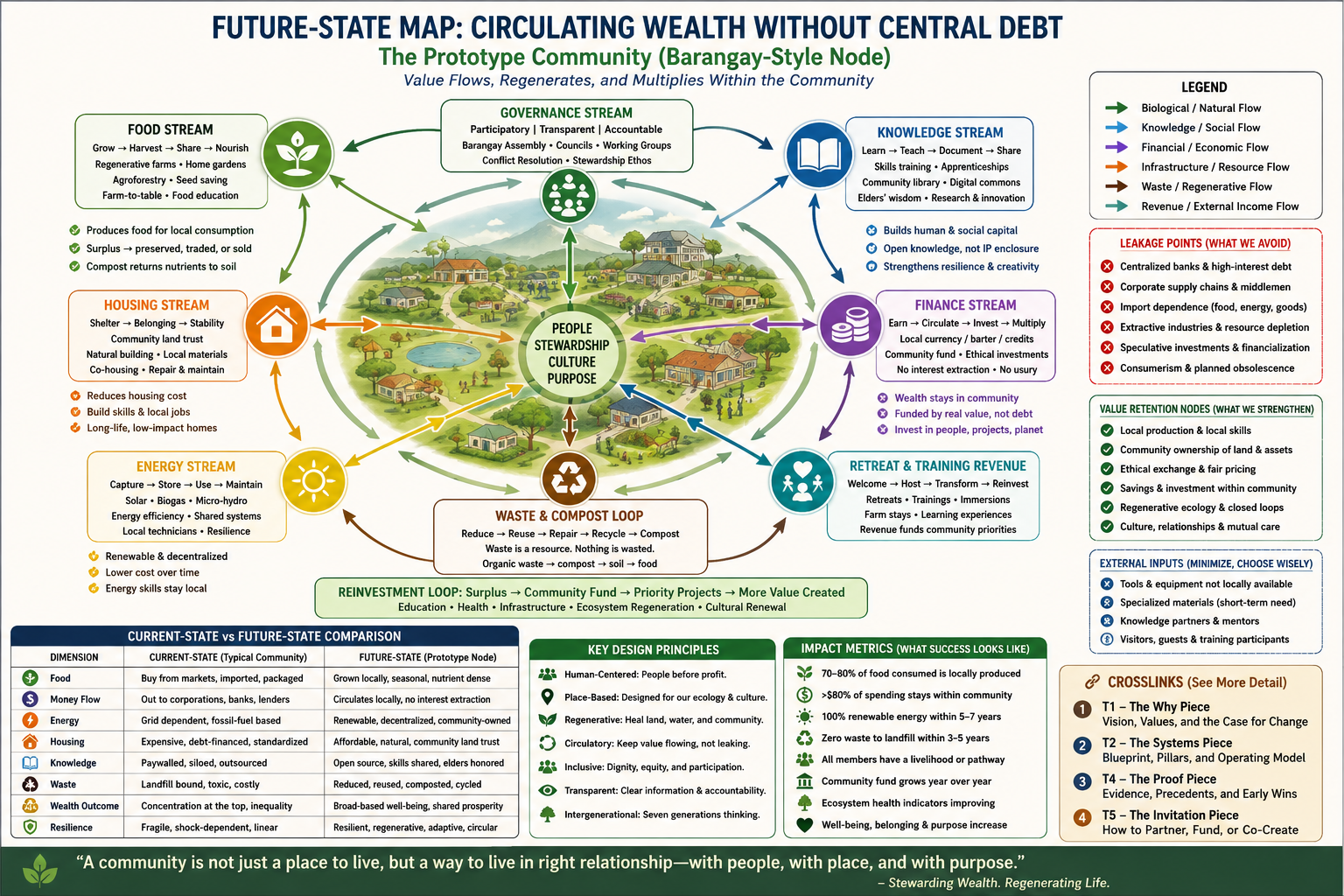
    Download your copy of the Value Stream Map here

    The prototype community instead maps and integrates five primary streams:

    1. Food and Agricultural Stream

    Food is typically the largest leakage point in urbanized communities. Even rural settlements increasingly depend on externally produced food shipped through centralized logistics systems.

    The prototype model reverses this dependency by prioritizing:

    • Regenerative agriculture
    • Shared food production
    • Local seed stewardship
    • Cooperative kitchens
    • Preservation and storage systems
    • Community-supported agriculture (CSA)

    In Value Stream terms, the goal is to shorten the distance between production and consumption.

    Waste outputs from one subsystem become inputs for another:

    • Food scraps become compost.
    • Compost feeds gardens.
    • Gardens feed kitchens.
    • Kitchens feed residents and retreat participants.
    • Retreat revenue reinvests into food resilience.

    This transforms food from a constant expense into a regenerative asset stream.

    Importantly, local food production also stabilizes communities during periods of inflation, supply disruption, or currency volatility.


    2. Housing and Infrastructure Stream

    Conventional housing systems are debt engines. Mortgages frequently lock individuals into decades of extraction where large portions of lifetime income are redirected toward financial institutions.

    The prototype community instead explores phased infrastructure models:

    • Incremental construction
    • Shared utility systems
    • Cooperative ownership structures
    • Local material sourcing where possible
    • Hybrid live-work spaces
    • Modular expansion rather than speculative overbuilding

    The goal is not luxury accumulation. The goal is resilient sufficiency.

    In Value Stream Mapping language, unnecessary overproduction is considered waste (ASQ, n.d.). Large debt-financed infrastructure projects often create financial fragility before the community has stabilized its internal productive capacity.

    The prototype therefore prioritizes:

    1. Productive infrastructure first
    2. Aesthetic expansion second
    3. Debt minimization throughout

    This dramatically changes the risk profile of the community.


    3. Skills, Education, and Knowledge Stream

    Most educational systems train individuals to exit communities in search of employment elsewhere.

    A stewardship-oriented node instead treats education as local capacity building.

    Residents are encouraged to develop skills that strengthen the resilience of the whole ecosystem:

    • Agriculture
    • Conflict mediation
    • Renewable systems maintenance
    • Holistic health support
    • Cooperative administration
    • Media and communications
    • Construction and fabrication
    • Teaching and facilitation

    Knowledge becomes a circulating asset rather than a privatized credential.

    This aligns with the broader Lean understanding that information flow is as important as material flow within any value stream (Lean Enterprise Institute, n.d.). Communities collapse when critical knowledge becomes centralized in a few individuals.

    Therefore, cross-training and distributed competency are essential.

    The healthiest communities are anti-fragile because knowledge redundancy exists throughout the network.


    4. Financial and Exchange Stream

    This is the most sensitive and misunderstood layer.

    The prototype community is not anti-money. It is anti-extractive dependency.

    Money remains necessary. However, the objective is to reduce involuntary external leakage while increasing internal circulation velocity.

    Several mechanisms support this:

    • Cooperative purchasing
    • Shared tools and equipment
    • Internal service exchanges
    • Member contribution systems
    • Ethical microenterprise incubation
    • Local reinvestment pools
    • Community emergency reserves

    A peso that circulates ten times locally creates significantly more resilience than a peso immediately extracted into debt servicing or multinational supply chains.

    Community Wealth Building models have repeatedly demonstrated that local procurement and local ownership strengthen regional resilience and increase local multiplier effects (CLES, n.d.).

    The prototype community therefore functions as a local economic circulation engine.

    External capital is ideally used for:

    • Infrastructure seeding
    • Productive asset acquisition
    • Training systems
    • Renewable systems
    • Water resilience
    • Soil regeneration

    It is not primarily used to inflate lifestyles.

    This distinction is critical.


    5. Cultural and Relational Stream

    Most modern economic systems ignore relational health because it cannot easily be quantified.

    Yet relational fragmentation creates enormous hidden costs:

    • Burnout
    • Mental health deterioration
    • Social distrust
    • Legal conflict
    • Isolation
    • Governance breakdown

    The prototype community therefore treats culture itself as infrastructure.

    This includes:

    • Shared rituals
    • Stewardship circles
    • Community meals
    • Transparent governance
    • Conflict resolution processes
    • Intergenerational mentorship
    • Shared narratives and mission coherence

    In Lean systems language, friction within information and coordination flows creates waste (Lucidchart, n.d.). The same principle applies socially.

    Communities with high trust require fewer enforcement systems, lower transaction costs, and less bureaucratic overhead.

    Trust itself becomes economic infrastructure.


    The Barangay as a Regenerative Node

    The barangay model contains ancient intelligence often overlooked by centralized development frameworks.

    Historically, barangays functioned through:

    • Shared labor
    • Kinship accountability
    • Localized governance
    • Distributed stewardship
    • Cooperative resilience
    • Embedded reciprocity

    While imperfect, these systems possessed adaptive strengths modern urban systems frequently lack.

    The prototype community does not romanticize the past. Instead, it extracts viable principles from historically resilient local systems and integrates them with modern regenerative design.

    The resulting node becomes:

    • Economically localized
    • Technologically adaptive
    • Ecologically regenerative
    • Socially participatory
    • Financially resilient
    • Spiritually coherent

    This is not isolationism.

    The node still interacts with broader markets, donors, digital infrastructure, and external trade. However, it does so from a position of increasing sovereignty rather than permanent dependency.


    Why This Matters to Donors and Partners

    Most charitable models unintentionally reinforce dependency.

    Funds enter communities temporarily but leak outward almost immediately through imported goods, debt obligations, centralized vendors, and unsustainable operational costs.

    The prototype community instead functions as a regenerative multiplier.

    A properly designed stewardship node can:

    • Reduce long-term dependency
    • Increase local resilience
    • Create replicable frameworks
    • Demonstrate ethical economic circulation
    • Lower operating fragility
    • Train future stewardship leaders
    • Serve as a scalable proof-of-concept

    In systems language, donors are not merely funding a project.

    They are helping seed a self-reinforcing value ecosystem.

    This is fundamentally different from charity.

    It is regenerative systems investment.


    References

    American Society for Quality. (n.d.). Value stream mapping tutorial – What is VSM? ASQ. https://asq.org/quality-resources/value-stream-mapping

    Centre for Local Economic Strategies. (n.d.). Community wealth building. CLES. https://cles.org.uk/expertise/community-wealth-building/

    Lean Enterprise Institute. (n.d.). Value-stream mapping. https://www.lean.org/lexicon-terms/value-stream-mapping/

    Lucid Software Inc. (n.d.). What is value stream mapping? Lucidchart. https://www.lucidchart.com/pages/value-stream-mapping

    Ostrom, E. (1990). Governing the commons: The evolution of institutions for collective action. Cambridge University Press.

    Preston City Council. (n.d.). What is community wealth building? https://www.preston.gov.uk/article/1335/What-is-Community-Wealth-Building

    Purdue Lean Six Sigma Online. (2024, November 7). Value stream mapping. Purdue University. https://www.purdue.edu/leansixsigmaonline/blog/value-stream-mapping/

    United Nations Development Programme. (2022). Local governance and resilient communities. https://www.undp.org/


    [DOCUMENT CONTROL & STEWARDSHIP]

    Standard Work ID: VSM-002

    Baseline Version: v1.5.2026

    Classification: Open-Access Archive / Systemic Protocol

    The Sovereign Audit: Following this protocol is an act of internal quality control. Verification of this standard does not happen here; it happens at your Gemba—the actual place where your life and leadership occur. No external validation is required or offered.

    Next in Sequence: [View VSM-001: Mapping the Sovereign Household Value Stream]

    Return to Archive: [Standard Work Knowledge Hub: The Terrain Map]


    © 2026 Gerald Daquila • Life.Understood Systemic Stewardship • Non-Autocratic Architecture • Process over Persona