Category: Infrastructure

  • Agentic Systems and the End of Passive Labor

    Agentic Systems and the End of Passive Labor


    How Artificial Intelligence Is Reshaping Work, Responsibility, and Human Roles in the Emerging Economy


    Meta Description

    AI-powered agentic systems are transforming work from execution to orchestration. This essay explores how automation is reshaping responsibility, coordination, and human roles in the emerging economy.


    Introduction: Work Is Not Disappearing—It Is Changing Form

    Much of the public discourse around artificial intelligence focuses on job loss.

    • Will AI replace workers?
    • Which industries are most vulnerable?
    • How many jobs will disappear?

    These are important questions—but they are incomplete.

    They assume that work is defined primarily by tasks.

    Artificial intelligence challenges this assumption.

    What is being disrupted is not work itself, but:

    the the human role within increasingly automated systems

    AI—particularly in its emerging “agentic” form—does not simply automate tasks. It begins to:

    • plan
    • execute multi-step processes
    • adapt to feedback
    • operate with limited autonomy

    This signals a transition:

    From task-based labor → to system-level orchestration

    The implication is not the end of work.

    It is the end of passive labor.


    What Are Agentic Systems?

    Agentic systems refer to AI configurations capable of:

    • setting sub-goals
    • executing sequences of actions
    • interacting with tools or environments
    • adjusting behavior based on outcomes

    Unlike earlier automation (rule-based or static), these systems are:

    • dynamic
    • context-aware
    • iterative

    They do not simply perform predefined actions.

    They operate within a goal structure.

    This introduces a critical shift:

    Humans are no longer the sole agents within systems.


    The Illusion of Replacement

    The dominant narrative suggests:

    • AI replaces human workers
    • efficiency increases
    • labor demand decreases

    But this is a surface-level interpretation.

    In reality, AI redistributes roles across three layers:


    1. Execution Layer (Declining Human Role)

    Repetitive and predictable tasks are increasingly handled by AI:

    • drafting content
    • data processing
    • routine analysis
    • administrative workflows

    This is where most “job loss” discussions focus.


    2. Coordination Layer (Expanding Human Role)

    As AI systems operate, someone must:

    • define objectives
    • structure workflows
    • integrate outputs
    • resolve conflicts

    This layer grows, not shrinks.


    3. Governance Layer (Critical Human Role)

    At the highest level:

    • Who defines goals?
    • Who sets constraints?
    • Who is accountable for outcomes?

    These cannot be delegated.

    They require:

    judgment, ethics, and coherence


    The End of Passive Labor

    Passive labor is characterized by:

    • task execution without ownership
    • following instructions without context
    • limited responsibility for outcomes

    Agentic systems make this model obsolete.

    Why?

    Because tasks can now be:

    • automated
    • delegated to AI
    • executed faster and cheaper

    This creates a divergence:

    • individuals who remain task-bound become replaceable
    • individuals who move into coordination and stewardship become indispensable

    This aligns with broader labor transformation trends, where workers anticipate significant restructuring due to AI adoption (Stanford Institute for Human-Centered Artificial Intelligence, 2025).


    The New Human Role: Orchestrator and Steward

    To remain relevant, the human role must shift.

    Not:

    • worker as executor

    But:

    human as orchestrator and steward of systems

    This includes:

    • designing workflows that integrate AI and human input
    • monitoring outputs for accuracy and alignment
    • intervening when systems deviate
    • maintaining accountability

    This directly builds on the cognitive discipline outlined in
    The Sovereign Prompt: How to Use AI Without Outsourcing Discernment.

    A sovereign operator becomes an active coordinator of systems rather than a passive consumer of outputs.


    Productivity vs Responsibility

    AI dramatically increases productivity.

    But it also increases:

    • scale of impact
    • speed of decision-making
    • risk of error propagation

    A poorly designed system can now:

    • generate thousands of incorrect outputs
    • misallocate resources rapidly
    • amplify flawed assumptions

    This creates a paradox:

    As capability increases, responsibility must increase proportionally.

    If responsibility does not scale, systems become unstable.


    Coherence as a Workforce Differentiator

    In an AI-mediated environment, traditional markers of competence shift.

    It is no longer enough to:

    • know information
    • perform tasks efficiently

    The differentiator becomes:

    the ability to integrate information, structure decisions, and maintain judgment across complex systems.

    A coherent operator can:

    • design structured workflows
    • identify flawed assumptions
    • integrate outputs into a consistent system

    An incoherent operator:

    • produces fragmented results
    • relies excessively on AI outputs
    • fails to detect system-level errors

    This reinforces the central thesis from
    AI as Mirror: Why Artificial Intelligence Reveals Human Incoherence:

    AI accelerates the strengths and weaknesses already present in human systems.


    Implications for Economic Systems

    Agentic AI does not just affect individuals.

    It reshapes entire economic structures.


    1. Decentralization of Capability

    Small teams—or even individuals—can now perform functions that previously required large organizations.

    A small AI-enabled legal team, media studio, or logistics group can now perform functions once requiring much larger organizations.

    This aligns with our framework in ARK-001: The 50-Person Resource Loop, where localized systems can sustain themselves.

    AI becomes a force multiplier.


    2. Redefinition of Value

    Value shifts from:

    • labor hours
      → to
    • system effectiveness

    This challenges traditional wage structures and aligns with alternative accounting models explored in
    ARK-004: Post-Fiat Trade — The Community Ledger SOP.

    Contribution is no longer measured purely by time.

    It is measured by impact within systems.


    3. Governance Complexity

    As AI systems operate within economic flows:

    • accountability becomes harder to trace
    • decisions become distributed across human and machine actors

    This increases the importance of frameworks like
    ARK-003: Jurisdictional Sovereignty: Legal Standard Work.

    Authority must remain:

    • identifiable
    • accountable
    • verifiable

    Failure Modes in Agentic Systems

    Without proper stewardship, agentic systems introduce new risks.


    1. Goal Misalignment

    If objectives are poorly defined:

    • systems optimize the wrong outcomes
    • unintended consequences emerge

    2. Over-Automation

    Excessive reliance on AI leads to:

    • loss of human oversight
    • blind trust in outputs
    • reduced situational awareness

    3. Responsibility Diffusion

    When multiple agents (human + AI) are involved:

    • accountability becomes unclear
    • errors are harder to trace

    4. Scale of Error

    Mistakes are no longer isolated.

    They propagate quickly across systems.


    The Discipline of Oversight

    To mitigate these risks, systems must include:

    • clear goal definitions
    • human-in-the-loop checkpoints
    • audit mechanisms
    • transparent decision logs

    This mirrors the logic of the Community Ledger:

    Visibility and accountability are non-negotiable in complex systems.


    Agentic Systems as Threshold Condition

    At a deeper level, agentic AI represents a threshold.

    Agentic systems force a shift from participating in workflows to taking responsibility for how workflows are designed, monitored, and governed.

    This aligns with our broader architectural movement:

    • These shifts are not purely technological.
    • They require psychological adaptability, cognitive discipline, and governance structures capable of maintaining accountability in increasingly automated environments.

    Conclusion: Work Becomes Responsibility

    AI does not eliminate human relevance.

    It removes roles that do not require:

    • judgment
    • coherence
    • accountability

    What remains—and expands—is:

    the responsibility to design, guide, and steward systems

    The question is not:

    • Will AI take jobs?

    But:

    Will humans adapt fast enough to take on higher-order responsibility?

    Those who do will not compete with AI.

    They will direct it.

    Those who do not may find themselves increasingly displaced—not simply by machines, but by people better able to coordinate, evaluate, and direct complex systems.


    References

    Stanford Institute for Human-Centered Artificial Intelligence. (2025). AI Index Report: Public opinion and workforce trends.

    Bender, E. M., Gebru, T., McMillan-Major, A., & Margaret Mitchell. (2021). On the dangers of stochastic parrots: Can language models be too big? Proceedings of the 2021 ACM Conference on Fairness, Accountability, and Transparency.


    Suggested Internal Crosslinks


    Attribution

    The Living Archive
    Integrative Frameworks for Regenerative Civilization

    © 2026 Gerald Daquila. All rights reserved.
    Part of the Life.Understood. knowledge ecosystem and Stewardship Institute initiative.

    This article is intended for educational, reflective, and civic inquiry purposes.
    Readers are encouraged to engage critically, think independently, and explore related pathways throughout the archive.

  • Remittance vs Investment: Why Most OFWs Stay Financially Stuck

    Remittance vs Investment: Why Most OFWs Stay Financially Stuck


    Practical systems for turning cash flow into long-term value


    Meta Description

    OFWs send billions home—but many remain financially stuck. Learn the difference between remittance and investment, and discover practical systems to turn income into lasting wealth.


    The Paradox of Filipino Prosperity Abroad

    Every year, Overseas Filipino Workers (OFWs) send billions of pesos back to the Philippines.

    https://images.openai.com/static-rsc-4/uXgHeQRVDmhOKU_5GErdzm8AD0gN_ShYb33fZZeAp4K3GuihNEv9rqN9uUnYCcnSEaTqEmNVgk3QgT0Z7GOdm62DNIEVYsgDEso_rxQZpWwKgl6C-QGYIb5G8us8mP2LrKBymMRoXZDWDdkvMHcLU-_3cTRrog6hbqgZcukeqFc3vYv6DAHboNSUNQHYJISX?purpose=fullsize

    These remittances:

    • Sustain families
    • Support education
    • Stabilize the national economy

    On the surface, this looks like financial success.

    https://images.openai.com/static-rsc-4/AMcEBLkQydNzzTEh0dgR4WX-WGyN0QgmSjnAz_t0uNiFdnuACyKvJVJN0CZHmwBCJPmJweihpQgOzem2M2xw652cNXPVQ5WOqDtO7OHspGpKov4twu_dz-m-8lvzFLcjIS0HdIfydAenulZXwTvylJkMhzgYXsvpEbqDNp-iF5imVN6S4wwQ118lDQDKVPKJ?purpose=fullsize

    Yet a persistent paradox remains:

    Many OFWs earn more than they ever did locally—yet struggle to build lasting wealth.

    https://images.openai.com/static-rsc-4/EP3CQLSBnOSMXeu48-ZuaQ5wXKoiILA5dob9dsBlVGjexxDq6S_4-x63Dwir_1wdpMgQ9XuCImuY-V0gjTrVnfmEGBgz2NxPfHlJiMoNjTL9udG4e_n8ZXCQj_uK4jri4UcTxfTR_lW65_6AEi0aZmmB4-hmZ7DfHmj-2iJvjgJs1tLpOUNxhL5JqWJH07GQ?purpose=fullsize

    After years, even decades abroad, some return home with:

    • Limited savings
    • No significant assets
    • Continued financial obligations

    This is not due to lack of effort.

    It is due to a structural gap between remittance and investment.


    Remittance vs Investment: The Critical Difference

    Understanding this distinction is foundational.

    Remittance

    • Money sent for immediate consumption
    • Covers daily needs (food, rent, tuition)
    • Reactive and ongoing

    Investment

    • Money allocated to generate future value
    • Builds assets (property, business, equity)
    • Strategic and long-term

    Remittance sustains life.
    Investment builds stability.

    The problem is not remittance itself.

    The problem is when all cash flow is absorbed into consumption, leaving nothing to compound.


    The Historical Pattern Beneath the Behavior

    This dynamic is not random.

    It mirrors a long-standing pattern in Filipino economic history:

    (Crosslink: The Ghosts of the Galleon Trade: How Colonial Echoes Still Dictate Your Financial Decisions)

    Just as wealth once passed through the Philippines without rooting, modern remittances often:

    • Flow in
    • Are distributed
    • Exit through consumption

    Without retention, there is no accumulation.


    The Emotional Layer: Obligation and Identity

    For many OFWs, financial decisions are not purely economic.

    They are deeply relational.

    Common drivers include:

    • Utang na loob (debt of gratitude)
    • Family expectations
    • Desire to uplift loved ones
    • Fear of being seen as selfish

    (Crosslink: Money, Guilt, and the Colonized Soul: Why We Sabotage Our Own Sovereignty)

    This creates a powerful internal pressure:

    “I must give—because I can.”

    Over time, giving becomes automatic.

    Planning becomes secondary.


    The Systemic Trap: Cash Flow Without Structure

    Most OFWs operate in a system like this:

    1. Earn income abroad
    2. Send majority home
    3. Expenses expand to match income
    4. Little to no surplus remains
    5. Repeat cycle

    This is not a failure of discipline.

    It is a lack of financial architecture.

    Without structure, cash flow dissipates.


    Why “Earning More” Doesn’t Solve It

    A common assumption is:

    “If I earn more, I’ll eventually save more.”

    In practice, this often fails.

    Why?

    Because:

    • Expenses scale with income
    • Obligations increase
    • Lifestyle expectations rise

    This is known as lifestyle inflation.

    Without systems, higher income simply increases the size of the cycle.


    The Nervous System Factor

    Financial behavior is also shaped by stress and regulation.

    OFWs often experience:

    • Job insecurity
    • Cultural displacement
    • Emotional strain from separation

    These conditions can lead to:

    • Short-term decision-making
    • Urgency to provide
    • Difficulty planning long-term

    (Crosslink: Financial Sovereignty Is a Nervous System State: Grounding the QFS in the Filipino Reality)

    This reinforces the remittance-first pattern.


    The Shift: From Sender to Builder

    Breaking the cycle requires a shift in identity:

    From:

    Remittance Provider

    To:

    Asset Builder and Steward

    This does not mean abandoning family support.

    It means structuring it sustainably.


    A Practical System: Turning Cash Flow into Assets

    Here is a grounded framework designed for OFWs:


    1. The Three-Bucket Allocation System

    Divide income into three categories:

    A. Family Support (50–70%)

    • Fixed monthly amount
    • Clearly communicated

    B. Personal Stability (10–20%)

    • Emergency fund
    • Insurance
    • Personal savings

    C. Investment (20–30%)

    • Non-negotiable
    • Automated if possible

    The key is consistency.


    2. Automate Before Sending

    Set aside savings and investments before remitting.

    This ensures:

    • Future stability is prioritized
    • Emotional decisions do not override planning

    3. Convert Remittance into Productive Use

    Instead of pure consumption, channel part of remittance into:

    • Education that increases earning capacity
    • Small businesses with clear models
    • Income-generating assets

    4. Establish Boundaries with Clarity

    Communicate:

    • What you can support
    • What you cannot sustain

    This reduces:

    • Unplanned requests
    • Emotional pressure

    5. Build Local Anchors

    Invest in assets within the Philippines:

    • Property (with due diligence)
    • Cooperative ventures
    • Community-based enterprises

    (Crosslink: ARK-001: The 50-Person Resource Loop)

    This allows wealth to root locally.


    6. Track Net Worth, Not Just Income

    Shift focus from:

    • Monthly earnings

    To:

    • Total assets minus liabilities

    What matters is what you keep—not what you earn.


    Common Mistakes to Avoid

    1. All-In Family Support

    Giving everything leaves nothing for growth.


    2. Unplanned Investments

    Entering ventures without understanding risks.


    3. Delayed Saving

    “I’ll save later” often becomes never.


    4. Emotional Decision-Making

    Responding to requests without structure.


    The Role of Systems

    Individual effort must be supported by systems.

    (Crosslink: Poka-Yoke for the Soul: Error-Proofing Your Transition into the New Earth Economy)

    This includes:

    • Automated transfers
    • Budget frameworks
    • Accountability mechanisms

    Systems reduce reliance on willpower.


    The Ark Perspective: From Flow to Retention

    Within the Ark framework, the goal is not just income generation.

    It is value retention and multiplication.

    (Crosslink: The Philippine Ark: A Global South Prototype)

    When OFWs shift from:

    • Sending → Structuring
    • Earning → Building

    They move from participation to sovereignty.


    The Long-Term Vision: Financial Exit

    The ultimate goal is not endless overseas work.

    It is:

    • Financial independence
    • Geographic choice
    • Sustainable livelihood

    (Crosslink: The OFW Financial Exit Strategy: From Remittance to Asset Ownership)

    This requires:

    • Intentional planning
    • Consistent execution
    • Structural support

    Conclusion: The Difference Between Movement and Progress

    Remittance creates movement.

    Investment creates progress.

    Both are necessary—but not in equal proportion.

    The Filipino diaspora has demonstrated:

    • Work ethic
    • Sacrifice
    • Commitment

    The next phase is integration:

    To ensure that the fruits of that sacrifice:

    • Accumulate
    • Stabilize
    • Multiply

    So that years abroad translate not just into survival—

    But into sovereignty.


    References

    Mullainathan, S., & Shafir, E. (2013). Scarcity: Why Having Too Little Means So Much. Times Books.

    David, E. J. R. (2013). Brown Skin, White Minds. Information Age Publishing.

    World Bank. (2023). Migration and Development Brief.

    Bangko Sentral ng Pilipinas. (2023). Remittance Statistics.


    The Sovereign Professional: A structural map of power, systems thinking, and personal autonomy—dedicated to helping the independent professional navigate complexity and own their value stream.AskAsk


    ©2026 Gerald Daquila • Life.Understood. • Systems Thinking, Leadership Architecture, and Applied Coherence

  • ARK-001: The Philippine Ark – A Sovereign Blueprint for Systemic Transformation

    ARK-001: The Philippine Ark – A Sovereign Blueprint for Systemic Transformation


    Meta Description

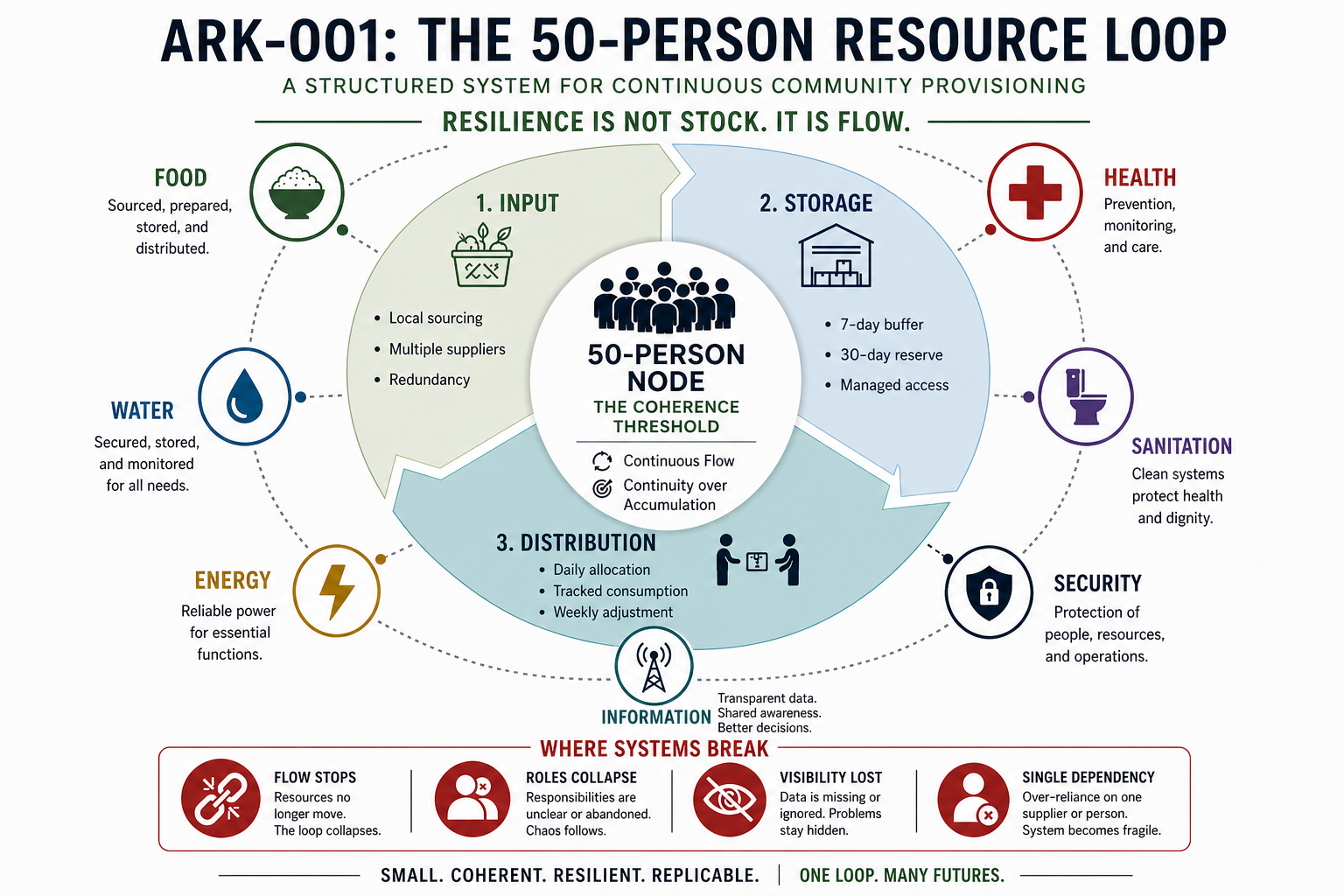
    A practical field manual outlining how a 50-person community maintains continuous access to food, water, and essential resources through a structured resource loop.


    Introduction

    Most conversations about resilience remain abstract.

    They speak in terms of “systems change,” “community strength,” or “self-sufficiency,” but rarely define the smallest unit at which these ideas can be tested.

    Without a defined unit, there is no way to observe whether a system works.

    The 50-Person Resource Loop establishes that unit.

    It does not begin with ideology.
    It begins with constraint.

    What happens when fifty people must ensure that food, water, and basic needs continue to flow—regardless of external disruption?

    What structures would need to exist?
    What rhythms would need to be maintained?
    What failures would immediately become visible?

    This manual is not a theory of resilience.

    It is a framework for operational continuity at a human scale.


    Why Fifty People?

    The number is not symbolic. It is functional.

    Below fifty:

    • insufficient role distribution
    • over-reliance on individuals

    Above fifty:

    • coordination begins to fragment
    • visibility declines
    • decision-making slows

    At fifty, a system can still:

    • remain relational rather than bureaucratic
    • assign clear responsibility
    • maintain shared awareness

    It is the largest size at which coherence can still be directly managed.


    The Core Principle: Flow Over Stock

    Most people assume resilience is about having enough.
    It is not.

    It is not.

    A system fails when:

    • resources stop moving
    • information becomes unclear
    • responsibilities dissolve

    The loop exists to ensure one condition:

    Nothing stops moving.

    Food is not just stored—it is cycled.
    Water is not assumed—it is measured.
    Roles are not implied—they are assigned.


    The Three Layers of the Loop


    1. Input

    Resources enter the system through:

    • local procurement
    • distributed sourcing
    • redundancy (multiple suppliers)

    2. Storage

    • short-term buffer (active use)
    • longer-term reserve (protected)

    3. Distribution

    • daily allocation
    • predictable release cycles
    • monitored consumption

    These layers are not separate—they are interdependent.
    A failure in one propagates through all.


    Role Structure

    Every participant is part of the system.

    Not symbolically—operationally.

    Core roles typically include:

    • coordination of resources
    • food sourcing and preparation
    • water management
    • health oversight
    • infrastructure and energy
    • logistics and movement

    The critical point is not the titles.
    It is that:

    No function is left without ownership.


    The Importance of Visibility

    Most systems degrade quietly.

    The loop prevents this through constant visibility:

    • how much food remains
    • how much water is available
    • where pressure is building

    When everything is visible:

    • small problems are corrected early
    • large failures are avoided

    What This System IS — and IS NOT

    It is not:

    • a survivalist model
    • an isolationist structure
    • a replacement for broader systems

    It is:

    • a stabilizing layer
    • a coordination mechanism
    • a way to reduce fragility at the local level

    It does not reject larger systems.
    It simply does not depend on them for continuity.


    Failure Points

    Most loops fail in predictable ways:

    • roles become unclear
    • tracking becomes inconsistent
    • participation declines
    • reliance on a few individuals increases

    When this happens, the loop stops functioning as a system
    and becomes a burden.


    Why This Matters Now

    Urban environments depend on systems that are:

    • efficient
    • tightly coupled
    • fragile under disruption

    The resource loop introduces:

    • slack
    • redundancy
    • and local awareness

    Not at scale.
    But at a level where it can actually function.


    Toward Replication

    The objective is not to grow one loop indefinitely.

    It is to:

    • stabilize one
    • understand its behavior
    • replicate it

    Multiple loops can later connect.

    But coherence must exist first at the unit level.


    Closing

    The question is not whether large systems will hold.

    The question is whether smaller, coherent systems exist beneath them.

    The 50-person loop is one such unit.

    Not as a solution to everything—
    but as a place where continuity can still be maintained.


    Crosslinks

    👉 Download ARK-001 (Printable SOP Version)

    👉 Download ARK-001-A (Poster Version)

    👉 Download ARK-001-B (Dashboard / Templates)

    The concepts outlined here are designed for real-world execution. For a complete set of ready-to-use documents—including governance templates, resource tracking sheets, and operational SOPs—explore the 55 Editable Applied Stewardship Toolkit (Complete Set).

    For a broader systems context that situates localized resilience within national and multi-scalar transformation frameworks, explore The Philippine Ark: A Sovereign Blueprint for Systemic Transformation.


    Continue Through the ARK Series

    This framework is designed as a complete system. You can explore it sequentially or move directly to the layer most relevant to your work:

    Foundations

    Design + Build

    Systems Layer

    Scaling


    Suggested Pathways

    New to the framework?

    Start with ARK-001 ARK-008ARK-011


    Designing a physical site?

    Begin with ARK-007ARK-008ARK-009


    Preparing for real-world deployment?

    Focus on ARK-011ARK-012ARK-013


    Thinking long-term scale?

    Move to ARK-010


    [DOCUMENT CONTROL & STEWARDSHIP]

    Standard Work ID: [ARK-001]

    Baseline Version: v1.5.2026

    Classification: Open-Access Archive / Systemic Protocol

    The Sovereign Audit: Following this protocol is an act of internal quality control. Verification of this standard does not happen here; it happens at your Gemba—the actual place where your life and leadership occur. No external validation is required or offered.

    Next in Sequence: [ARK-002: The Babaylan Arc – Institutional Curriculum]

    Return to Archive: [Standard Work Knowledge Hub: The Terrain Map]


    © 2026 Gerald Daquila • Life.Understood Systemic Stewardship • Non-Autocratic Architecture • Process over Persona

  • 🇵🇭 Where Do We Start?: A Systems Blueprint for Cultural Renewal in the Philippines

    🇵🇭 Where Do We Start?: A Systems Blueprint for Cultural Renewal in the Philippines


    Rebuilding Trust, Opportunity, and Collective Capacity Over Time


    Meta Description

    Where does meaningful change begin in the Philippines? This essay explores cultural renewal through systems thinking, institutional trust, incentives, education, and collective behavior—examining how long-term transformation emerges through structural and social change.


    There is no shortage of analysis on the Philippines.

    Colonial mentality has been named. Family dysfunction has been examined. Corruption has been exposed. Education collapse has been documented. Learned helplessness has been studied.

    What remains unresolved is not diagnosis—but sequence.

    Where do we actually begin, if the goal is not awareness—but transformation?

    This is the question most frameworks avoid because it forces a confrontation with reality:

    you cannot reform a civilization-level system by targeting a single layer.

    The Philippines is not struggling because of one broken institution. It is a stacked system of interlocking behaviors—family dynamics, authority structures, economic incentives, education gaps, and historical conditioning—reinforcing each other across generations.

    Any serious attempt at change must therefore answer three things:

    • What is the smallest unit of change that is still systemically meaningful?
    • What is the sequence of intervention across layers?
    • What is the realistic time horizon for results?

    The Core Misdiagnosis: Treating Culture as Belief Instead of Behavior

    Most discussions on colonial mentality frame it as an issue of mindset—something to be corrected through awareness, pride, or identity reclamation.

    This is incomplete.

    Colonial mentality persists not because Filipinos “believe the wrong things,” but because they repeatedly enact the same survival behaviors:


    • deference to authority even when unjust
    • avoidance of conflict to preserve social harmony (pakikisama)
    • loyalty to networks over systems
    • normalization of small-scale corruption (“everyone does it”)
    • silence in the face of dysfunction

    These are not abstract beliefs. They are trained responses shaped by centuries of hierarchical rule—from Spanish colonial structures to American bureaucratic systems and postcolonial patronage politics (Anderson, 1988; David, 2013).

    Culture, in this sense, is not ideology.

    It is patterned behavior under pressure.

    Which means:

    you do not change culture by persuasion alone—you change it by altering the environments that reward those behaviors.


    Continue the Work: Pathways Through the Philippine Knowledge Hub

    Understanding the system is only the first step.

    If this piece clarified where to begin, the next question becomes:

    Where do you go from here?

    The Philippine Knowledge Hub is structured as a set of pathways—each designed to take you deeper into a specific layer of the problem and its corresponding transformation.

    You do not need to read everything.
    You need to follow the path most aligned with where you are.


    Pathway 1: Seeing Clearly (Diagnosis Layer)

    If you are still making sense of the patterns—colonial mentality, family systems, and inherited behavior—begin here.

    Focus:
    Understanding how historical conditioning, family dynamics, and cultural norms reinforce each other.

    Outcome:
    You begin to see the system—not as isolated problems—but as a coherent pattern.


    Pathway 2: Reclaiming Agency (Internal Reset)

    Once the system is visible, the next layer is internal.

    Because no structural reform holds if the individual remains conditioned by:

    Focus:
    Breaking internalized patterns that sustain external dysfunction.

    Outcome:
    You move from awareness → personal agency.


    Pathway 3: Rebuilding Systems (External Reset)

    If your question is no longer “what’s wrong?” but “how do we fix this?”, this is your entry point.

    Focus:
    Understanding how large-scale systems—economic, political, institutional—can be redesigned.

    Outcome:
    You begin to think in terms of systems, not symptoms.


    Pathway 4: Practicing Stewardship (Application Layer)

    Insight without application collapses under pressure.

    If you are ready to move from understanding into practice:

    Focus:
    Training for real-world complexity: leadership, decision-making, and system repair.

    Outcome:
    You transition from observer → participant → builder.


    How to Use This Hub

    You do not need to follow these pathways in order.

    But you do need to be honest about where you are:


    The Threshold

    Most readers stop at understanding.

    A smaller number move toward change.

    Very few commit to rebuilding.

    This hub is designed for all three—but it is built for the last group.

    Choose your path.


    The First Principle: Change the Unit, Not the Nation

    National reform is too large, too slow, and too politically constrained to be the starting point.

    The smallest viable unit of transformation in the Philippine context is:

    A coherent local ecosystem composed of: one school, one barangay cluster, one LGU leadership layer, and one parent/community network.

    Anything smaller lacks systemic impact.
    Anything larger becomes unmanageable.

    This “micro-system” contains the core drivers of cultural transmission:

    • Families (where values are embodied)
    • Schools (where cognition and behavior are shaped)
    • Local governance (where power is experienced)
    • Peer/community networks (where norms are enforced)

    If you change behavior across all four simultaneously, you are no longer influencing individuals—you are rewiring a living system.


    The Sequence of Change (What Happens First, Second, Third)

    Transformation does not begin with curriculum, policy, or elections.

    It begins with stability of truth.


    Phase 1: Stabilize Truth-Telling

    Before any reform can take hold, people must be able to name dysfunction without punishment.

    This includes:

    • classroom environments where questioning is not penalized
    • barangay forums where concerns can be raised without retaliation
    • school leadership structures that accept feedback loops
    • family spaces where authority is not absolute

    Without this, all reform collapses into compliance theater.


    Phase 2: Restore Agency Through Small Wins

    Decades of systemic failure produce learned helplessness—a psychological state where individuals stop acting because they no longer believe action matters (Seligman, 1972).

    This cannot be reversed through messaging.

    It requires:

    • visible, repeatable, local successes
    • problems small enough to solve but meaningful enough to matter

    Examples:

    • literacy recovery programs that show measurable gains within months
    • transparent barangay budgeting that citizens can track
    • school-based feeding and attendance programs that improve outcomes

    Agency returns when people experience:

    “We acted—and something changed.”


    Phase 3: Retrain Authority (The Hardest Layer)

    Children do not reproduce what they are taught.
    They reproduce what authority models.

    Which means the central bottleneck is not students—it is adults in power:

    • parents
    • teachers
    • principals
    • barangay officials
    • local executives

    Leadership must be retooled from extractive to stewardship-based behavior, including:

    • decision transparency
    • ethical resource allocation
    • conflict repair (not avoidance)
    • accountability to outcomes, not relationships
    • willingness to be questioned

    Research consistently shows that institutional trust and performance are strongly correlated with leadership integrity and transparency (World Bank, 2023).

    Without this shift, all child-focused reform is neutralized.


    Phase 4: Institutionalize the New Behavior

    No system survives on intention alone.

    Once new behaviors emerge, they must be embedded into:

    • hiring and promotion criteria
    • school routines and assessment systems
    • LGU policies and procurement processes
    • community norms and expectations

    If a reform depends on “good people,” it will collapse when those people leave.

    If it becomes structure, it persists.


    Phase 5: Scale Through Proof, Not Messaging

    National narratives are weak without local evidence.

    The Philippines does not need another campaign.
    It needs visible models of functioning systems.

    Scaling should follow this logic:

    • replicate what works in comparable LGUs
    • adapt, not copy
    • build networks of coherent ecosystems

    Change spreads not by persuasion—but by demonstrated viability.


    Where K–12 Fits (and Where It Doesn’t)

    Education is foundational—but it is not primary.

    The Philippines’ learning crisis, as reflected in Programme for International Student Assessment (PISA) results, highlights severe gaps in reading and numeracy (OECD, 2023).

    However, curriculum reform alone cannot solve this.

    A curriculum cannot outperform:

    • an untrained teacher
    • a fearful classroom
    • a politicized school system
    • a household that reinforces passivity

    K–12 is the long-term engine of change.

    But without adult transformation, it becomes:

    a delivery system for content that cannot take root.


    The Central Leverage Point: Redefining Power

    At the deepest level, the system is sustained by a single definition:

    Power as protection and advantage.

    This manifests as:

    • patronage politics
    • dynastic leadership
    • corruption as survival strategy
    • silence as social currency

    The transformation required is not incremental—it is definitional:

    Power must be recoded as stewardship.

    Meaning:

    • authority exists to serve outcomes, not networks
    • leadership is measured by system health, not loyalty
    • transparency is default, not exception
    • accountability is structural, not personal

    Until this shifts, all reform remains surface-level.


    Time Horizons (What Is Actually Realistic)

    A 500-year conditioned system does not reverse quickly.

    But it does not require 500 years to change direction.


    3–5 years

    • measurable improvements in pilot ecosystems
    • literacy gains, governance transparency, civic participation

    10–15 years

    • one generation of students formed under improved systems
    • emerging cohort of differently conditioned young leaders

    25–40 years

    • leadership turnover reflecting new behavioral norms
    • institutional memory stabilizes

    50 years

    • full cultural normalization

    This is not pessimistic.
    It is strategically honest.


    The Threshold

    The Philippines does not lack intelligence, talent, or even awareness.

    What it lacks is coordinated behavioral transformation across layers.

    The question is no longer:

    “What is wrong?”

    It is:

    “Who is willing to participate in rebuilding, knowing it will take decades—and begin anyway?”

    If you are looking for where to start, it is not in theory, and not in waiting for national change.

    It is here:

    • one school
    • one barangay cluster
    • one leadership unit
    • one community network

    Built differently.
    Measured honestly.
    Repeated deliberately.

    That is how systems change.


    References

    Anderson, B. (1988). Cacique Democracy in the Philippines: Origins and Dreams. New Left Review.
    David, E. J. R. (2013). Brown Skin, White Minds: Filipino American Postcolonial Psychology. Information Age Publishing.
    OECD. (2023). PISA 2022 Results: Philippines Country Note.
    Seligman, M. E. P. (1972). Learned helplessness. Annual Review of Medicine, 23, 407–412.
    World Bank. (2023). Philippines Economic Update: Public Institutions and Governance.


    Attribution

    © 2025–2026 Gerald Alba Daquila
    All rights reserved.

    This work is offered for reflection and independent interpretation. It does not represent a formal doctrine, institution, or required belief system.

  • The Invisible Architecture of Assumptions

    The Invisible Architecture of Assumptions


    How Systems Sustain Themselves Through What We Stop Questioning

    4–6 minutes

    I · The Water We Don’t Notice

    Most systems don’t survive through force alone.
    They survive because their assumptions become invisible.

    We grow up breathing them in:

    • From family
    • School
    • Religion
    • Culture
    • Survival experiences

    Eventually, these ideas stop feeling like beliefs and start feeling like reality itself.

    We say:

    • “That’s just how life works.”
    • “That’s how the world is.”
    • “That’s what successful people do.”

    But what if these are not universal truths —
    only inherited mental blueprints?

    This piece is an invitation to examine the invisible architecture that shapes our choices, definitions, and expectations — often without our awareness.


    II · How Systems Perpetuate Themselves

    https://images.openai.com/static-rsc-3/35MfbDSVv5kPaDr8j-ZANNbUAaU_JR5EKZsWbjZx-WmPnvgrFr68a7-OX_sbUNyR4evs7IpcKP_xDyD6DaNuRowl-lw3rRNXVZh6MxSv_rY?purpose=fullsize&v=1

    1️⃣ Assumptions Disappear Into “Normal”

    Once an idea is repeated long enough, it stops being questioned.

    Examples:

    • Worth = productivity
    • Authority = correctness
    • Suffering = virtue
    • Busy = important

    When beliefs become atmosphere, they become self-protecting.


    2️⃣ Time Distance Hides Consequences

    Many systems appear to “work” in the short term while creating harm in the long term.

    CauseConsequenceTime Gap
    OverworkBurnout, illnessYears
    Emotional suppressionDisconnection, depressionDecades
    Exploitative systemsSocial instabilityGenerations

    Because the cost is delayed, the system looks successful.
    Short-term reward hides long-term erosion.


    3️⃣ Correlation Gets Framed as Causation

    We are taught simplified formulas:

    “They succeeded because they worked harder.”

    But missing variables often include:

    • Privilege
    • Timing
    • Support networks
    • Luck
    • Structural advantage

    The result? Individuals blame themselves instead of examining the system.


    4️⃣ Complexity Diffuses Responsibility

    In complex systems:

    • No one person sees the whole
    • Each role feels small
    • Harm is distributed

    So we hear:

    • “I’m just doing my job.”
    • “That’s policy.”
    • “I didn’t make the rules.”

    When no one sees the pattern, everyone unknowingly helps maintain it.


    III · The Fractal Nature of Assumptions

    Beliefs repeat at every scale:

    LevelExample Assumption
    Personal“My needs are inconvenient.”
    Family“We don’t talk about feelings.”
    Workplace“Rest is laziness.”
    Society“Value comes from output.”

    The pattern is fractal.
    Micro-beliefs reinforce macro-systems.

    Change begins at the smallest scale: awareness.


    IV · Common Assumption Clusters to Examine

    🏆 Success

    Inherited scripts:

    • Success = money
    • Success = status
    • Success = being admired
    • Success = constant upward growth

    Sovereign questions:

    • Who defined this version of success?
    • Does it match my lived experience?
    • What does “enough” mean for me?

    😊 Happiness

    Hidden programming:

    • Happiness should be constant
    • Sadness means failure
    • If I were doing life right, I’d feel good more

    Reality:
    Happiness may include:

    • Meaningful struggle
    • Emotional range
    • Depth, not constant pleasure

    🦸 Heroism

    Cultural myths:

    • Heroes sacrifice themselves
    • Heroes don’t need help
    • Heroes save others alone

    Effect:
    Burnout, isolation, savior complexes.

    New possibility:
    Sustainable heroism is collaborative, bounded, and human.


    ⏳ Productivity & Time

    Assumptions:

    • Rest must be earned
    • Slowness = laziness
    • Worth = output

    Long-term cost:
    Disconnection from body, creativity, and relationship.


    ❤️ Love & Relationships

    Unseen scripts:

    • Love means self-sacrifice
    • Conflict means incompatibility
    • Jealousy proves love

    These normalize emotional pain as “romantic truth.”


    ⛪ Spiritual Worth

    Inherited beliefs:

    • Suffering purifies
    • Desire is lower
    • Giving is noble, receiving is selfish

    These create martyr identities and spiritual burnout.


    V · Sovereignty Begins With Seeing

    Sovereignty does not require rejecting every system.

    It begins with one shift:

    From unconscious participation → to conscious choice.

    The moment a belief becomes visible, it becomes optional.

    You may still choose it.
    But now you are choosing — not being run.


    VI · Reflection Prompts

    🔍 Assumption Awareness

    • What definition of “success” am I currently living inside?
    • Who taught me that?
    • Does my body agree with it?

    ⏳ Time & Consequence

    • What habits feel “fine” now but may have long-term cost?
    • Where am I trading future wellbeing for present approval?

    🧠 Cause vs Correlation

    • Where do I assume someone’s outcome is fully their responsibility?
    • What unseen factors might also be present?

    ❤️ Relational Scripts

    • What did I learn love looks like?
    • What did my caregivers model about conflict, needs, and boundaries?

    🌿 Personal Sovereignty

    • Which belief feels most “obviously true” — and therefore most worth examining?

    Appendix · Common Hidden Assumptions Table

    AreaInherited AssumptionPossible Alternative
    SuccessMore is betterEnough is success
    HappinessShould be constantComes in waves
    WorthBased on productivityInherent to being alive
    LoveRequires self-sacrificeIncludes mutual care & boundaries
    AuthorityKnows better than meMay offer input, not truth
    SpiritualitySuffering = growthGrowth can be gentle
    TimeMust be optimizedCan be experienced
    EmotionsNegative ones are badAll emotions carry information

    Closing Thread

    When we examine the invisible architecture of our assumptions, we do not lose stability — we gain authorship.

    And from authorship, sovereignty quietly begins.


    Light Crosslinks

    If this exploration of hidden assumptions resonated, you may also find depth in:


    About the author

    Gerry explores themes of change, emotional awareness, and inner coherence through reflective writing. His work is shaped by lived experience during times of transition and is offered as an invitation to pause, notice, and reflect.

    If you’re curious about the broader personal and spiritual context behind these reflections, you can read a longer note here.

  • Protected: Codex of Coherent Households

    Protected: Codex of Coherent Households

    This content is password-protected. To view it, please enter the password below.