
Why Times of Uncertainty Often Feel Like Endings—and How History Suggests They May Also Be Beginnings
Meta Description
Are today’s crises signs of societal collapse or systemic transformation? Explore how societies interpret instability, why uncertainty feels overwhelming, and what history reveals about periods of major change.
Periods of instability have a unique ability to reshape how societies understand themselves.
Economic disruptions, political polarization, technological revolutions, institutional distrust, cultural fragmentation, and environmental challenges often generate a common question:
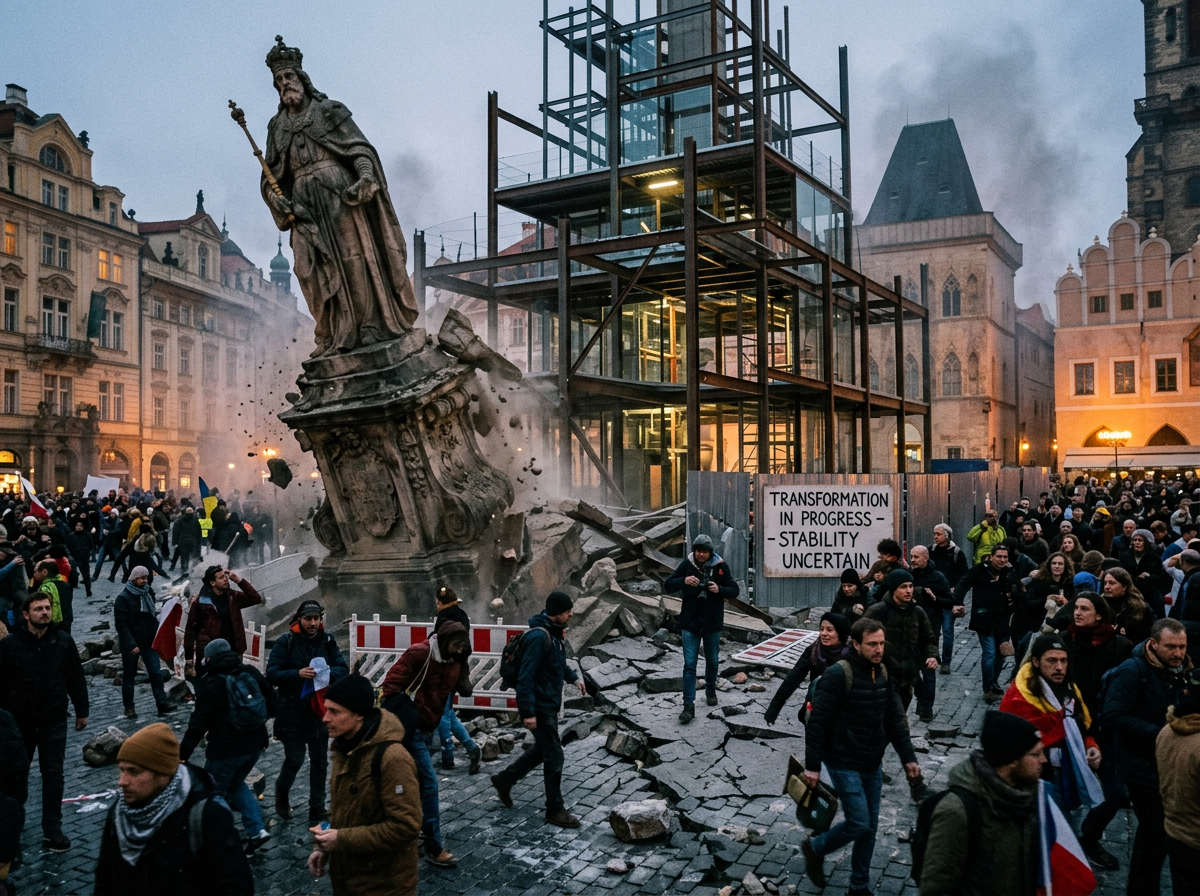
Are we witnessing collapse—or transformation?
The answer is rarely obvious in real time.
History shows that people living through periods of major change often struggle to distinguish between systemic breakdown and systemic adaptation. Existing institutions appear less effective. Familiar assumptions lose credibility. Long-standing narratives begin to fracture.
To those experiencing such transitions, uncertainty can feel indistinguishable from decline.
Yet history also demonstrates that periods perceived as collapse frequently become foundations for new forms of social organization (Tainter, 1988).
The challenge is not simply understanding what is changing.
The challenge is understanding how human beings interpret change itself.
Why Instability Feels Like Collapse
Human beings are pattern-seeking creatures.
Psychologists have long observed that people derive security from predictability, familiarity, and stable expectations (Kahneman, 2011).
When institutions function reliably, most individuals rarely think about them.
- Transportation systems work.
- Supply chains operate.
- Governments maintain order.
- Economic systems appear relatively predictable.
The very stability of these systems makes them largely invisible.
However, when disruptions occur, attention shifts immediately toward uncertainty.
Events that challenge assumptions often receive disproportionate psychological weight because human cognition is particularly sensitive to perceived threats and losses (Kahneman & Tversky, 1979).
As a result, periods of instability frequently feel larger, more permanent, and more catastrophic than they may ultimately prove to be.
This does not mean concerns are unfounded.
It means that perception and reality do not always move at the same speed.
The Historical Pattern of Transitional Eras
Throughout history, societies have repeatedly experienced periods during which old systems weakened before new systems emerged.
Examples include:
- The transition from agrarian to industrial economies
- The decline of empires and emergence of nation-states
- The Industrial Revolution
- The Information Age
- Major political realignments
- Shifts in energy systems and production methods
Importantly, these transitions rarely felt orderly to those living through them.
The Industrial Revolution brought unprecedented innovation, but also social dislocation, labor unrest, urban crowding, and widespread uncertainty (Polanyi, 1944).
Similarly, the transition into the digital era has created remarkable opportunities while simultaneously disrupting industries, professions, and social norms.
Periods of transformation often contain both progress and disruption simultaneously.
This duality makes interpretation difficult.
The Narrative Battle: Decline vs Renewal
Societies rarely agree on what periods of instability mean.
- Different groups often construct competing narratives.
- Some view instability as evidence of decline.
- Others view the same events as signs of necessary transformation.
Political scientist Samuel Huntington observed that periods of rapid change frequently generate competing interpretations regarding the legitimacy and direction of social institutions (Huntington, 1968).
These narratives influence public behavior.
If people believe collapse is inevitable, they may prioritize protection, withdrawal, and short-term survival.
If they believe transformation is possible, they may invest in adaptation, innovation, and institution-building.
The stories societies tell about change can therefore influence how change unfolds.
Why Institutions Struggle During Transitions
Institutions are designed to solve problems that existed when they were created.
- Over time, conditions evolve.
- Technology changes.
- Demographics shift.
- Economic structures transform.
- Cultural expectations evolve.
Yet institutions often adapt more slowly than their environments.
Institutional economist Douglas North argued that formal and informal institutions frequently lag behind changing realities, creating periods of friction and misalignment (North, 1990).
This lag can produce a widespread perception that systems no longer work.
In many cases, institutions are not necessarily failing completely.
Rather, they are operating under assumptions that no longer match present conditions.
The resulting tension contributes significantly to transition fatigue and declining trust.
Complexity Makes Prediction Difficult
- Modern societies are extraordinarily complex.
- Economic systems interact with political systems.
- Political systems interact with media systems.
- Media systems interact with cultural systems.
- Technological innovations influence all of them simultaneously.
Systems theorist Donella Meadows emphasized that complex systems often behave in ways that are difficult to predict because outcomes emerge from numerous interconnected relationships rather than simple linear causes (Meadows, 2008).
This complexity complicates public interpretation.
People naturally seek clear explanations.
Complex systems rarely provide them.
The gap between our desire for certainty and the reality of complexity often fuels anxiety.
The Role of Collective Trauma
Periods of instability are not interpreted in a vacuum.
- Historical experiences matter.
- Societies carrying unresolved collective trauma may be particularly sensitive to signals of disruption.
Past experiences of war, colonization, economic collapse, authoritarian rule, or social upheaval can shape how populations interpret current events (Alexander et al., 2004).
This helps explain why similar challenges may produce very different responses across societies.
Events are filtered through historical memory.
The same disruption may be perceived as manageable adaptation in one context and existential threat in another.
Collective interpretation is influenced not only by present circumstances but also by inherited narratives about survival, loss, and resilience.
The Transformation Perspective
While discussions of instability often focus on risk, transformation perspectives emphasize adaptation.
Complex systems frequently reorganize when existing arrangements become insufficient.
- Ecological systems adapt.
- Economic systems evolve.
- Political systems reform.
- Organizations restructure.
- Communities develop new practices.
Transformation does not imply that disruption is painless.
Nor does it guarantee positive outcomes.
Rather, it recognizes that instability can create opportunities for innovation that stable periods may suppress.
Historian Arnold Toynbee argued that civilizations often develop new capacities when confronted by significant challenges (Toynbee, 1946).
The key variable is not the existence of challenges but how societies respond to them.
Signals of Transformation Already Underway
Many developments frequently interpreted as signs of breakdown may also represent adaptive responses.
Examples include:
- New forms of digital collaboration
- Alternative governance experiments
- Community resilience initiatives
- Regenerative economic models
- Cooperative ownership structures
- Emerging well-being metrics
- Network-based forms of organization
These developments remain incomplete and uneven.
However, they illustrate an important principle.
New systems rarely appear fully formed.
They emerge gradually alongside older systems.
Consequently, transitional periods often contain both decay and innovation simultaneously.
Avoiding False Certainty
One of the greatest dangers during periods of instability is excessive certainty.
- Predictions of inevitable collapse often underestimate human adaptability.
Predictions of inevitable progress often underestimate systemic risks.
- History provides examples of both outcomes.
- Some societies successfully adapt.
- Others experience prolonged decline.
- Most experience mixtures of both.
A more useful perspective may involve maintaining humility regarding forecasts while strengthening capacities that support resilience.
These capacities include:
- Social trust
- Institutional adaptability
- Civic participation
- Community cohesion
- Critical thinking
- Long-term stewardship
Regardless of future outcomes, these qualities improve collective response capacity.
The Importance of Meaning
How people interpret instability depends heavily upon meaning.
- Events themselves do not carry fixed significance.
- Human beings assign significance through stories, values, and collective narratives.
Research in psychology suggests that meaning-making plays a central role in resilience and adaptation (Seligman, 2011).
Communities capable of constructing coherent narratives around challenge often respond more effectively than those overwhelmed by confusion and fragmentation.
Meaning does not eliminate uncertainty.
It helps people navigate it.
Collapse and Transformation Can Occur Together
Perhaps the most important insight is that collapse and transformation are not always opposites.
Often, they occur simultaneously.
- Some institutions decline while others emerge.
- Some industries contract while others expand.
- Certain social norms weaken while new ones develop.
- Transformation frequently involves partial collapse.
Collapse frequently creates conditions for transformation.
- The future is rarely a simple continuation of the past.
- Nor is it a complete rupture.
It is usually a complex reorganization of existing structures into new configurations.
Conclusion
Periods of instability challenge more than institutions.
They challenge interpretation itself.
The question of whether a society is collapsing or transforming is often difficult to answer while events are still unfolding. Human beings naturally seek certainty during uncertain times, yet history suggests that major transitions are rarely linear.
Some systems fail.
Others adapt.
Many evolve.
The most resilient societies may be those capable of acknowledging risks without becoming paralyzed by them and recognizing opportunities without ignoring genuine challenges.
The future is not predetermined.
What matters most may be less whether instability represents collapse or transformation and more how individuals, communities, and institutions choose to respond.
History suggests that the answer often becomes visible only in retrospect.
The responsibility of the present is to build the capacities that make constructive transformation possible.
Related Reading
- Transition Fatigue: Why So Many People Feel the Old Systems No Longer Work
- Trauma and Governance: How Unhealed Societies Create Dysfunctional Institutions
- From Nation-State to Meaning-State: The Future of Collective Identity
- The Post-Scarcity City: Designing Communities Around Human Flourishing
- Why Cooperation Breaks Down: Trust, Competition, and Survival
- The Future of Power: From Domination to Stewardship
- Regenerative Governance Principles
- From Collective Trauma to System Design: A Living Archive Framework for the Philippines
References
Alexander, J. C., Eyerman, R., Giesen, B., Smelser, N. J., & Sztompka, P. (2004). Cultural trauma and collective identity. University of California Press.
Huntington, S. P. (1968). Political order in changing societies. Yale University Press.
Kahneman, D. (2011). Thinking, fast and slow. Farrar, Straus and Giroux.
Kahneman, D., & Tversky, A. (1979). Prospect theory: An analysis of decision under risk. Econometrica, 47(2), 263–291.
Meadows, D. H. (2008). Thinking in systems: A primer. Chelsea Green Publishing.
North, D. C. (1990). Institutions, institutional change and economic performance. Cambridge University Press.
Polanyi, K. (1944). The great transformation: The political and economic origins of our time. Farrar & Rinehart.
Seligman, M. E. P. (2011). Flourish: A visionary new understanding of happiness and well-being. Free Press.
Tainter, J. A. (1988). The collapse of complex societies. Cambridge University Press.
Toynbee, A. J. (1946). A study of history (Abridged ed.). Oxford University Press.
The Living Archive is designed to be explored through pathways, categories, and search. If you’re looking for a specific idea, question, or theme, AI Search can help surface relevant connections across the archive.
Attribution
The Living Archive
Integrative Frameworks for Regenerative Civilization
© 2026 Gerald Daquila. All rights reserved.
Part of the Life.Understood. knowledge ecosystem and Stewardship Institute initiative.
This article is intended for educational, research, and civic inquiry purposes.
Readers are encouraged to engage critically, verify sources independently, and explore related knowledge hubs for broader systems context.
Leave a Reply