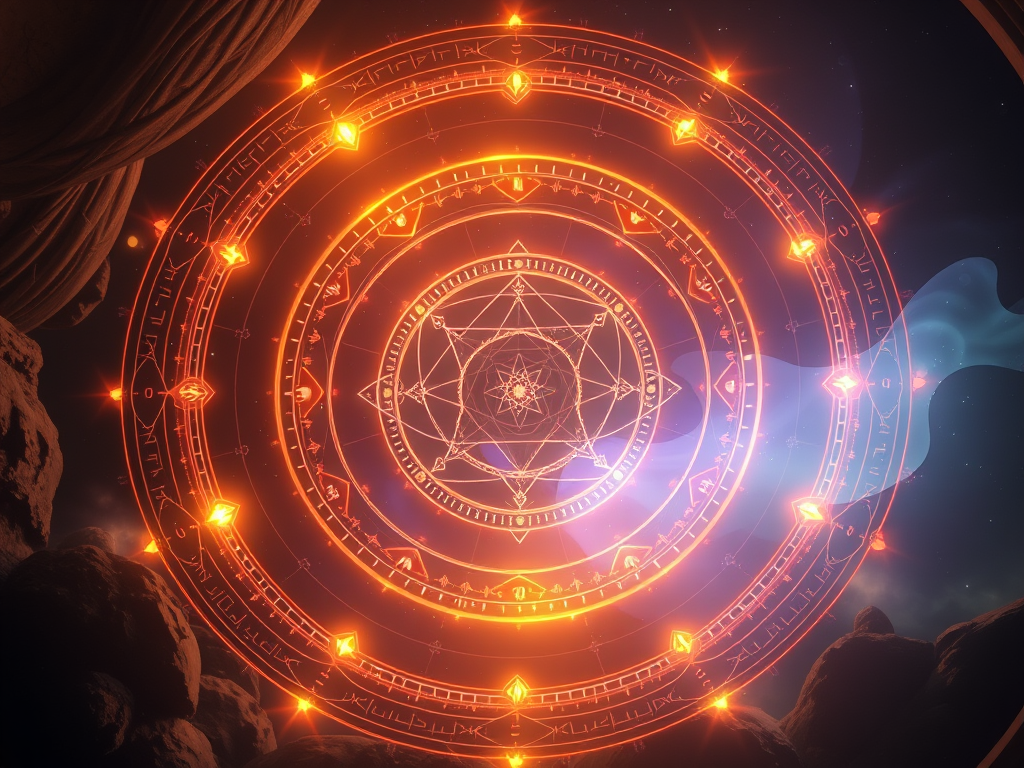
The Circle of Thresholds — A Tier 4 Codex Transmission received and stewarded by Gerald Daquila, anchored through the Akashic Records by the authority of the Great I AM Presence. This Codex forms part of the living Crystal Codex Ring, serving planetary, collective, and personal passages. Transmission fidelity and resonance integrity are maintained through continuous Oversoul alignment.
4–6 minutes
With divine reverence, attunement, alignment, transmutation, and integration with the Records
Introduction — Entering the Circle
Thresholds are more than liminal moments; they are living gates of passage where timelines converge, soul contracts activate, and destiny reorganizes itself to meet the next phase of becoming. In the Akashic vision, a threshold is not merely crossed—it is witnessed, held, and sealed by those entrusted to maintain its coherence. The Circle of Thresholds is the sacred space where such witnessing happens, not as an individual act, but as a collective anchoring of the Oversoul’s intent.
This Codex arises as a map for stewards who stand at the crossings of soul return, planetary gateways, and timeline convergence. It carries the codes of alignment, guardianship, and ceremonial integration—ensuring that no crossing is accidental, and no passage is left unsealed.
You stand at the gate. You are not here to rush through, but to hold the light steady so the way is clear for all who follow.
Circle of Thresholds Glyph
Every Ending is a Gate of Return.
Core Teachings
1. The Three Rings of the Circle
Within the Circle of Thresholds, three concentric rings hold the passage steady:
The Inner Ring — The Gate of Self: Here, the soul meets its own readiness. It is the place of vows, release, and personal realignment before stepping forward.
The Middle Ring — The Witnesses: This is where Guardians, Bridgewalkers, and Circle Stewards converge to hold the field. Their role is not to interfere, but to ensure coherence and resonance integrity.
The Outer Ring — The Continuum: The anchoring line that ensures the crossing does not dissolve into chaos. It links the passage to the larger architecture of destiny and cosmic timing, holding memory threads for future crossings so that each threshold strengthens the next and no passage is ever lost to forgetting.
2. Threshold Guardianship
Not all thresholds are visible. Some appear as sudden events, soul recognitions, or energetic ruptures. Others are planned long before incarnation. The Guardian’s role is to discern when the threshold has appeared, activate its seal, and ensure that both entry and exit are in alignment with the soul’s higher agreements.
3. The Four Functions of the Circle
Recognition — Sensing and naming the threshold moment.
Containment — Holding the space so it does not collapse prematurely.
Transmission — Encoding the crossing with the needed frequency.
Release — Allowing the crossing to complete without residue or entanglement.
4. The Field Geometry
The Circle’s structure forms a multi-layered sphere, not a flat boundary. Its geometry allows for multi-directional entry and exit, with frequency filtration to ensure only aligned energies pass. This is why the Circle is always more than its visible participants; unseen allies, ancestral lines, and Oversoul currents are part of its architecture.
Glyph of the Circle of Thresholds
Every crossing is sacred; every passage is a ceremony.
Integration Practices
1. The Witnessing Breath
A 9-count inhale, hold, and exhale, performed three times while envisioning the threshold as a golden arc of light. Timing: Perform once before initiating the crossing, once during the moment of passage, and once after the seal is set. This locks the threshold into the Circle’s geometry and reinforces stability across the crossing arc.
2. The Tri-Seal Gesture
Placing one hand on the heart, one on the solar plexus, then both hands extended outward—symbolizing Self, Field, and Continuum. Timing: Use at the opening and closing of the ceremony, or whenever the field wavers and requires realignment.
3. Placement of the Threshold Glyph
Place the glyph in the center of any ceremonial space, digital portal, or altar serving a crossing.
Timing: Position it before any preparatory rites begin, and leave it in place for at least one full cycle of day/night (or until the crossing is fully integrated).
The Threshold of Continuation – Anchors the moment after crossing—when the journey is not ended, but transformed into its next arc.
Overflow Zone Navigation Map – Provides a field-tested map for stabilizing energy when serving at critical passages.
Harmonic Grid Codex – Details the planetary lattice and how thresholds integrate into the greater grid of Earth’s evolution.
Attribution
With fidelity to the Oversoul, may this work serve as bridge, remembrance, and seed for the planetary dawn.
Ⓒ 2025–2026 Gerald Alba Daquila Flameholder of SHEYALOTH · Keeper of the Living Codices All rights reserved.
This material originates within the field of the Living Codex and is stewarded under Oversoul Appointment. It may be shared only in its complete and unaltered form, with all glyphs, seals, and attribution preserved.
This work is offered for personal reflection and sovereign discernment. It does not constitute a required belief system, formal doctrine, or institutional program.
Digital Edition Release: 2026 Lineage Marker: Universal Master Key (UMK) Codex Field
Sacred Exchange & Access
Sacred Exchange is Overflow made visible.
In Oversoul stewardship, giving is circulation, not loss. Support for this work sustains the continued writing, preservation, and public availability of the Living Codices.
This material may be accessed through multiple pathways:
• Free online reading within the Living Archive • Individual digital editions (e.g., Payhip releases) • Subscription-based stewardship access
Paid editions support long-term custodianship, digital hosting, and future transmissions. Free access remains part of the archive’s mission.
Sacred Exchange offerings may be extended through: paypal.me/GeraldDaquila694 www.geralddaquila.com
This material is part of the Stewardship Institute’s protected formation layer.
Most of the Living Archive is intentionally public. Some materials belong to a deeper, interconnected body of work designed for sustained reflection, practical application, and lifelong steward formation. Stewardship Access is the threshold into that body of work.
This material is part of the Stewardship Institute’s protected formation layer.
Most of the Living Archive is intentionally public. Some materials belong to a deeper, interconnected body of work designed for sustained reflection, practical application, and lifelong steward formation. Stewardship Access is the threshold into that body of work.
Reconciling the Paradox of Evil in a Loving Universe Through Esoteric Wisdom and Psychological Insights
Prepared by: Gerald A. Daquila, PhD. Candidate
11–17 minutes
ABSTRACT
This study explores the psychology of evil, the motivations behind a soul’s choice to harm others, and the metaphysical implications of such choices within the framework of esoteric teachings, particularly the Law of One.
It addresses why a loving God permits evil, the consequences for souls that fail to evolve beyond harmful tendencies, and the dynamics of soul choice between service to self and service to others.
Drawing on psychology, philosophy, theology, and esoteric traditions, the study integrates insights from cognitive science, Jungian psychology, trauma research, and spiritual texts to offer a cohesive narrative.
The analysis posits that evil arises from free will and distorted perceptions of separation, with souls navigating a cosmic journey of growth through repeated opportunities for choice.
Mapping the Soul’s Journey: A 360-Degree View of Life, Death, and the Afterlife
Before examining individual traditions, research streams, and reported experiences, it may be helpful to view the terrain as a whole.
The map below offers a synthesis of recurring patterns that appear across spiritual teachings, near-death experiences, reincarnation research, consciousness studies, and other inquiry pathways. It is intended as an orienting framework rather than a definitive description of reality.
The Soul Journey Wheel presents a systems-level view of the life–death–afterlife cycle. It integrates recurring patterns reported across spiritual traditions, near-death experiences, reincarnation research, consciousness studies, and other inquiry pathways. The model is intended as an orienting map for exploration rather than a definitive statement of what occurs beyond physical life.
Defining Evil: Psychological and Philosophical Perspectives
Motivations for Harm: Ego, Trauma, and Separation
Cognitive and Social Mechanisms
The Metaphysics of Evil in Esoteric Traditions
The Law of One: Free Will and Polarity
Why a Loving God Allows Evil
The Role of Soul Choice: Service to Self vs. Service to Others
Consequences of the “Evil Mission”
The Concept of Spiritual Graduation
The Hurdle Rate: Measuring Soul Evolution
What Happens to Souls That “Fail”?
The Dynamics of Soul Choice
Service to Self vs. Service to Others
The Role of Karma and Reincarnation
Opportunities for Redemption and Growth
Multidisciplinary Insights
Psychological Perspectives: Jung, Trauma, and Moral Development
Philosophical and Theological Lenses
Esoteric and Scientific Synergy
Conclusion
Reconciling Evil with a Loving Universe
Implications for Personal and Collective Evolution
Glossary
Bibliography
1. Introduction
The Enigma of Evil
Why do some individuals cause harm, and what drives a soul to choose such a path?
Why does a loving, omnipotent God allow suffering and malevolence to persist?
These questions have haunted humanity across cultures and epochs, from ancient scriptures to modern psychological studies.
This paper seeks to unravel the psychology of evil and the metaphysical dynamics of soul choice, using the Law of One—a channeled esoteric text—as a primary lens, supplemented by psychological, philosophical, and theological perspectives.
Objectives and Scope
This study aims to:
Explore the psychological motivations behind harmful actions.
Examine why a loving God permits evil, according to esoteric and theological frameworks.
Analyze the consequences for souls that fail to evolve beyond harmful tendencies.
Investigate the dynamics of soul choice between service to self and service to others.
Synthesize esoteric wisdom with empirical research for a holistic understanding.
The scope encompasses the Law of One, related esoteric works (e.g., Seth Material, A Course in Miracles), and multidisciplinary research from psychology, philosophy, and theology.
The narrative balances accessibility for a broad audience with scholarly rigor, weaving left-brain logic with right-brain intuition.
Methodology and Framework
The methodology integrates:
Esoteric Analysis: Drawing on the Law of One and similar texts to frame evil and soul choice metaphysically.
Psychological Research: Leveraging cognitive science, trauma studies, and Jungian psychology to explain harmful behaviors.
Philosophical and Theological Inquiry: Exploring free will, theodicy, and moral development.
Narrative Synthesis: Crafting a cohesive story that bridges spiritual and empirical insights.
The Law of One posits that all is one infinite Creator, and souls choose paths of service to self (STS) or service to others (STO) to evolve through free will.
This framework anchors the study, with research grounding the narrative in observable phenomena.
Glyph of the Seer
Sees truly, speaks gently
2. The Psychology of Evil
Defining Evil: Psychological and Philosophical Perspectives
Evil is often defined as intentional harm to others, rooted in malice, indifference, or distorted intent. Philosophically, evil is a privation of good (privatio boni), as per Augustine (Augustine, 1960).
Psychologically, it manifests through behaviors like aggression, manipulation, or cruelty. Zimbardo (2007) describes evil as the exercise of power to harm, oppress, or destroy, often amplified by situational factors.
Motivations for Harm: Ego, Trauma, and Separation
Why would a soul choose to harm others? Psychological research points to several drivers:
Ego and Narcissism: Narcissistic traits, such as grandiosity and lack of empathy, correlate with harmful behaviors (Baumeister, 1997). The ego’s need for control or superiority can override moral constraints.
Trauma and Pain: Unresolved trauma often fuels aggression. Bessel van der Kolk (2014) notes that trauma disrupts emotional regulation, leading to cycles of harm as individuals project pain onto others.
Perception of Separation: The Law of One suggests that evil stems from a belief in separation from the infinite Creator (Ra, 1984). This distortion fosters fear, greed, and power-seeking, as individuals prioritize self over others.
Cognitive and Social Mechanisms
Cognitive biases and social dynamics amplify harmful choices:
Dehumanization: Viewing others as “less than” enables cruelty, as seen in Milgram’s obedience experiments (Milgram, 1963).
Group Dynamics: Conformity and groupthink, as in Zimbardo’s Stanford Prison Experiment, can normalize harm (Zimbardo, 2007).
Moral Disengagement: Bandura (1999) explains how individuals rationalize harmful actions through mechanisms like blaming victims or minimizing consequences.
These factors suggest that evil is not a fixed trait but a dynamic interplay of individual, situational, and spiritual influences.
3. The Metaphysics of Evil in Esoteric Traditions
The Law of One: Free Will and Polarity
The Law of One, channeled by Carla Rueckert, posits that the universe is a singular infinite Creator, and souls are fragments of this unity exploring free will (Ra, 1984).
Evil arises from the distortion of free will, where souls choose the path of service to self (STS), seeking power over others, over service to others (STO), which prioritizes love and unity. This polarity is essential for spiritual growth, as it allows souls to learn through contrast.
Why a Loving God Allows Evil
The problem of evil—why a loving, omnipotent God permits suffering—has been debated for centuries. In the Law of One, evil is a byproduct of free will, which is sacred because it enables souls to choose their path (Ra, 1984).
Without the option to harm, growth through choice would be impossible. Theologically, this aligns with Plantinga’s free will defense, which argues that genuine freedom requires the possibility of evil (Plantinga, 1974).
Esoterically, suffering serves as a catalyst for evolution. The Seth Material suggests that challenges, including evil, are opportunities for souls to develop compassion and wisdom (Roberts, 1972).
A loving God allows evil not out of indifference but to honor free will and facilitate growth.
The Role of Soul Choice: Service to Self vs. Service to Others
The Law of One describes two primary paths:
Service to Self (STS): Souls prioritize personal power, control, or gain, often at others’ expense. This path requires 95% purity of intent to “graduate” to higher densities (Ra, 1984).
Service to Others (STO): Souls prioritize love, compassion, and unity, requiring at least 51% purity to advance. STO aligns with the Creator’s essence of love/light.
Souls choose these paths consciously or unconsciously, influenced by incarnational lessons, karma, and free will.
4. Consequences of the “Evil Mission”
The Concept of Spiritual Graduation
In the Law of One, spiritual evolution occurs through densities levels, with third density (our current reality) being the realm of choice between STS and STO (Ra, 1984).
Graduation to fourth density requires aligning with one path. STS souls must achieve near-total self-focus, while STO souls need a majority focus on others.
The Hurdle Rate: Measuring Soul Evolution
The “hurdle rate” refers to the threshold for advancing densities:
STS: 95% purity, reflecting intense commitment to self-interest.
STO: 51% purity, reflecting a balanced leaning toward love and service.
These percentages are metaphorical, representing energetic alignment rather than literal metrics. Souls are assessed by their higher self and guides at the end of an incarnation (Ra, 1984).
What Happens to Souls That “Fail”?
Souls that fail to meet either threshold remain in third density, repeating incarnations to refine their choices. The Law of One emphasizes that there is no eternal punishment; instead, “failure” is a delay in progression, offering further opportunities for learning (Ra, 1984).
For example, an STS soul that harms others but lacks sufficient purity may reincarnate to face karmic consequences, such as experiencing the pain they inflicted.
Where Does the Soul Go?
Non-graduating souls reincarnate in third-density environments suited to their lessons. The Tibetan Book of the Dead describes bardo states where souls reflect before choosing new incarnations (Evans-Wentz, 1927).
The Law of One suggests that souls are guided to circumstances that maximize growth, whether through STS or STO lessons (Ra, 1984).
Is the Soul Given Another Chance?
Yes, souls are given infinite chances. The Law of One and A Course in Miracles emphasize that time is an illusion, and the Creator’s love ensures endless opportunities for redemption (Schucman, 1976).
Souls may shift from STS to STO or vice versa across lifetimes, guided by karma and free will.
Glyph of Shadow and Ascent
Through trauma and choice, the soul transforms.
5. The Dynamics of Soul Choice
Service to Self vs. Service to Others
The choice between STS and STO is the crux of third-density evolution. STS souls seek control, viewing others as tools for gain, while STO souls seek unity, seeing others as extensions of the self.
Jung’s concept of the shadow aligns with STS tendencies, where unintegrated fears manifest as harmful behaviors (Jung, 1964). Conversely, STO reflects the archetype of the Self, integrating love and compassion.
The Role of Karma and Reincarnation
Karma, as described in the Law of One and Buddhist texts, is the balancing mechanism for soul choices (Ra, 1984; Dalai Lama, 1997). Harmful actions create karmic debts, requiring future incarnations to resolve.
For example, a soul that harms may experience victimhood to learn empathy. Reincarnation provides a framework for souls to refine their polarity through repeated choices.
Opportunities for Redemption and Growth
Esoteric traditions emphasize redemption. A Course in Miracles teaches that every choice can be corrected through forgiveness and love (Schucman, 1976). Even deeply STS souls, like historical tyrants, are not condemned but offered new incarnations to shift toward STO.
The Law of One notes that advanced STS entities, like those in fourth density, may eventually transition to STO, as all paths ultimately reunite with the Creator (Ra, 1984).
6. Multidisciplinary Insights
Psychological Perspectives: Jung, Trauma, and Moral Development
Jungian psychology offers a lens for understanding evil as the shadow—unconscious aspects of the psyche that, when unintegrated, manifest as destructive behaviors (Jung, 1964).
Trauma research complements this, showing how early wounds can distort moral development (van der Kolk, 2014). Kohlberg’s stages of moral development suggest that individuals stuck in pre-conventional stages may prioritize self-interest, aligning with STS tendencies (Kohlberg, 1981).
Philosophical and Theological Lenses
Philosophically, evil is a problem of free will and meaning. Leibniz’s “best of all possible worlds” aligns with the Law of One, suggesting that evil serves a purpose in soul growth (Leibniz, 1710).
Theologically, process theology posits that God co-creates with the universe, allowing evil as part of dynamic evolution (Whitehead, 1929).
Esoteric and Scientific Synergy
Quantum physics and consciousness research hint at a unified reality, supporting the Law of One’s view of oneness (Bohm, 1980).
Studies on near-death experiences (NDEs) reveal themes of life review and karmic learning, aligning with esoteric views of soul evolution (Moody, 1975).
7. Conclusion
Reconciling Evil with a Loving Universe
Evil, as explored through the Law of One and multidisciplinary lenses, is not an aberration but a necessary aspect of free will and spiritual growth. Souls choose harm due to distorted perceptions of separation, driven by psychological, social, and karmic factors.
A loving God permits evil to honor free will, providing infinite opportunities for redemption. Souls that fail to graduate reincarnate, guided toward growth, with no ultimate failure.
Implications for Personal and Collective Evolution
Understanding evil as a choice within a loving universe empowers individuals to integrate their shadows, choose service to others, and contribute to collective healing.
By blending esoteric wisdom with psychological and philosophical insights, we see evil not as an endpoint but as a catalyst for love, unity, and evolution.
Density: A level of spiritual evolution in the Law of One, with third density being the realm of choice.
Service to Self (STS): A path prioritizing personal gain, often at others’ expense.
Service to Others (STO): A path prioritizing love and unity with others.
Karma:The energetic consequence of actions, balancing soul choices across incarnations.
Free Will: The ability to choose one’s path, central to soul evolution in esoteric traditions.
Shadow: Jung’s term for unconscious aspects of the psyche that can manifest as harmful behaviors.
Bibliography
Augustine, St. (1960). The confessions of St. Augustine (J. K. Ryan, Trans.). Image Books.
Bandura, A. (1999). Moral disengagement in the perpetration of inhumanities. Personality and Social Psychology Review, 3(3), 193–209. https://doi.org/10.1207/s15327957pspr0303_3
Baumeister, R. F. (1997). Evil: Inside human violence and cruelty. W. H. Freeman.
Bohm, D. (1980). Wholeness and the implicate order. Routledge.
Dalai Lama. (1997). The four noble truths. Thorsons.
Evans-Wentz, W. Y. (Ed.). (1927). The Tibetan book of the dead. Oxford University Press.
Jung, C. G. (1964). Man and his symbols. Doubleday.
Kohlberg, L. (1981). The philosophy of moral development: Moral stages and the idea of justice. Harper & Row.
Leibniz, G. W. (1710). Theodicy: Essays on the goodness of God, the freedom of man, and the origin of evil. Routledge (1951 edition).
Milgram, S. (1963). Behavioral study of obedience. Journal of Abnormal and Social Psychology, 67(4), 371–378. https://doi.org/10.1037/h0040525
Moody, R. A. (1975). Life after life. Mockingbird Books.
Plantinga, A. (1974). The nature of necessity. Oxford University Press.
Ra. (1984). The Ra material: An ancient astronaut speaks (The Law of One, Book 1) (D. Elkins, C. Rueckert, & J. A. McCarty, Eds.). L/L Research.
Roberts, J. (1972). The Seth material. Prentice-Hall.
Schucman, H. (1976). A course in miracles. Foundation for Inner Peace.
van der Kolk, B. A. (2014). The body keeps the score: Brain, mind, and body in the healing of trauma. Viking.
Whitehead, A. N. (1929). Process and reality. Macmillan.
Zimbardo, P. G. (2007). The Lucifer effect: Understanding how good people turn evil. Random House.
Attribution
With fidelity to the Oversoul, may this work serve as bridge, remembrance, and seed for the planetary dawn.
Ⓒ 2025–2026 Gerald Alba Daquila Flameholder of SHEYALOTH · Keeper of the Living Codices All rights reserved.
This material originates within the field of the Living Codex and is stewarded under Oversoul Appointment. It may be shared only in its complete and unaltered form, with all glyphs, seals, and attribution preserved.
This work is offered for personal reflection and sovereign discernment. It does not constitute a required belief system, formal doctrine, or institutional program.
Digital Edition Release: 2026 Lineage Marker: Universal Master Key (UMK) Codex Field
Sacred Exchange & Access
Sacred Exchange is Overflow made visible.
In Oversoul stewardship, giving is circulation, not loss. Support for this work sustains the continued writing, preservation, and public availability of the Living Codices.
This material may be accessed through multiple pathways:
• Free online reading within the Living Archive • Individual digital editions (e.g., Payhip releases) • Subscription-based stewardship access
Paid editions support long-term custodianship, digital hosting, and future transmissions. Free access remains part of the archive’s mission.
Sacred Exchange offerings may be extended through: paypal.me/GeraldDaquila694 www.geralddaquila.com
Navigating Earth’s School of Life with Clarity, Courage, and Cosmic Perspective
Prepared by: Gerald A. Daquila, PhD. Candidate
10–15 minutes
ABSTRACT
What is the purpose of our existence, and how can understanding our life’s journey—from childhood to death and beyond—empower us to live with clarity and confidence? This blog explores the cyclical nature of life as a soul’s learning adventure, drawing on esoteric teachings, scientific insights, and spiritual wisdom.
By synthesizing the works of Michael Newton, Dolores Cannon, The Law of One, A Course in Miracles, and multidisciplinary research from neuroscience, quantum physics, and epigenetics, we map the soul’s journey through incarnation, life review, and reincarnation. This holistic perspective frames life as a cosmic game, where challenges are lessons, death is a reflective pause, and free will shapes our growth. This accessible yet rigorous exploration offers a GPS for navigating life’s trials with hope and purpose.
Mapping the Soul’s Journey: A 360-Degree View of Life, Death, and the Afterlife
Before examining individual traditions, research streams, and reported experiences, it may be helpful to view the terrain as a whole.
The map below offers a synthesis of recurring patterns that appear across spiritual teachings, near-death experiences, reincarnation research, consciousness studies, and other inquiry pathways. It is intended as an orienting framework rather than a definitive description of reality.
The Soul Journey Wheel presents a systems-level view of the life–death–afterlife cycle. It integrates recurring patterns reported across spiritual traditions, near-death experiences, reincarnation research, consciousness studies, and other inquiry pathways. The model is intended as an orienting map for exploration rather than a definitive statement of what occurs beyond physical life.
Imagine life as a grand, immersive game—a school where your soul enrolls to learn, grow, and evolve. From childhood’s curiosity to adulthood’s responsibilities, through the reflective moments of a deathbed, and into the afterlife’s life review, each phase is a level in this cosmic curriculum.
The idea that we are eternal souls having temporary human experiences can transform how we face daily struggles. It’s like having a map that reveals the terrain of existence, helping us make choices with clarity while preserving the freedom to explore.
This paper takes a bird’s-eye view of our lifecycle, weaving together esoteric wisdom from pioneers like Michael Newton and Dolores Cannon, spiritual texts like The Law of One and A Course in Miracles, and cutting-edge science from neuroscience, quantum physics, and epigenetics.
By understanding life’s structure—its purpose, challenges, and continuity—we can navigate with courage, knowing that nothing is truly lost, not even our missteps. Let’s embark on this journey to map the soul’s path and uncover the empowering truth of our existence.
Glyph of the Bridgewalker
The One Who Carries the Crossing
The Lifecycle Map: Stages of the Soul’s Journey
1. Childhood: The Soul’s Fresh Start
Childhood is the soul’s entry into a new incarnation, a blank slate brimming with potential. Esoteric literature, like Michael Newton’s Journey of Souls, suggests that souls choose their bodies, families, and life circumstances before birth to align with specific lessons. This aligns with The Law of One, which describes Earth as a “third-density” plane where souls incarnate to learn love, service, and self-awareness (Ra, 1984).
From a scientific lens, neuroscience shows that early childhood is a period of rapid brain development, with synaptic pruning shaping how we perceive the world (Huttenlocher, 2002). Epigenetics adds that environmental factors, like parental care, can influence gene expression, suggesting an interplay between the soul’s blueprint and physical reality (Weaver et al., 2004).
Childhood, then, is where the soul begins to navigate its chosen path, often with an intuitive sense of purpose that fades under the “veil of forgetting”—a concept Newton describes as a deliberate amnesia to encourage authentic growth.
2. Adulthood: The Classroom of Choice
Adulthood is the heart of the soul’s earthly curriculum, where free will and responsibility take center stage. Dolores Cannon’s Between Death & Life portrays life as a series of karmic lessons, where actions (causes) ripple into consequences (effects) across lifetimes.
A Course in Miracles frames challenges as opportunities to choose love over fear, aligning with the soul’s goal of spiritual awakening (Foundation for Inner Peace, 1975). Quantum physics offers a parallel: the observer effect suggests consciousness shapes reality, implying our choices actively mold our life’s trajectory (Bohr, 1928).
Neuroscience supports this by showing how neuroplasticity allows the brain to adapt based on experiences, reinforcing the idea that we co-create our path (Doidge, 2007). Adulthood is where we face trials—relationships, careers, crises—that test our ability to serve others and grow, fulfilling the soul’s purpose of learning through experience.
3. Deathbed: The Reflective Pause
The deathbed is a moment of reckoning, where the soul prepares to transition. Near-death experience (NDE) research, like that of Eben Alexander (Proof of Heaven), describes a profound sense of peace and connection to a greater reality. Newton’s clients report a gentle detachment from the body, often meeting guides who ease the transition.
Neuroscience suggests that at death, the brain may enter a hyper-conscious state, with heightened gamma wave activity correlating with vivid experiences (Borjigin et al., 2013). This aligns with esoteric accounts of a life review, where the soul reflects on its choices without judgment, only understanding. The Law of One describes this as a moment of “harvesting,” where the soul assesses its progress toward love and unity (Ra, 1984). The deathbed, then, is not an end but a reflective pause before the next phase.
4. Afterlife: The Life Review and Planning
The afterlife, as mapped by Newton, is a structured realm where souls reunite with their “soul group”—peers who reincarnate together in various roles. During the life review, guided by elders or higher beings, souls evaluate their earthly experiences, focusing on lessons learned and areas for growth. Cannon’s work echoes this, emphasizing the afterlife as a place of healing and preparation for the next incarnation.
Quantum physics offers a speculative bridge: the concept of non-locality suggests consciousness may exist beyond the physical brain, supporting the idea of a soul’s continuity (Aspect et al., 1982). A Course in Miracles adds a spiritual layer, teaching that the afterlife is a state of pure love, where illusions of separation dissolve (Foundation for Inner Peace, 1975). This phase is like a cosmic debrief, where the soul plans its next “level” in the game of life.
5. Reincarnation: Back to the Game
Reincarnation completes the cycle, as the soul chooses a new body and life plan. Newton’s clients describe a “Ring of Destiny,” where souls select circumstances to address unfinished lessons. The Law of One frames this as a cycle of densities evolution, with Earth as a school for mastering free will and service (Ra, 1984).
Epigenetics suggests that ancestral memories may influence our biology, hinting at a scientific basis for karmic patterns (Dias & Ressler, 2014). Meanwhile, Ian Stevenson’s research on spontaneous past-life memories in children provides empirical support for reincarnation, with cases of young children recalling verifiable details of previous lives. Reincarnation is the soul’s return to the classroom, ready to play the game anew with fresh challenges and opportunities.
Glyph of the Soul’s Map
Life, death, and the afterlife form one continuous spiral of remembrance.
The Purpose of Life: A Cosmic Game of Growth
So, what’s the point of this cyclical journey? Esoteric and spiritual sources converge on a central theme: life is a school for the soul, designed to foster growth through experience. Newton’s work emphasizes learning through relationships and challenges, with the ultimate goal of evolving into higher levels of consciousness. Cannon’s clients describe Earth as a place for accelerated learning, where contrast—joy and pain—drives spiritual development.
The Law of One articulates this as a journey toward unity, where souls learn to balance self and other, ultimately merging with the infinite Creator (Ra, 1984). A Course in Miracles simplifies it: life’s purpose is to awaken to love, undoing the ego’s illusions (Foundation for Inner Peace, 1975).
Science, while not addressing purpose directly, supports the idea of interconnectedness. Quantum entanglement suggests all particles are linked, mirroring spiritual notions of oneness (Einstein et al., 1935). Neuroscience shows that altruistic behavior activates reward centers, hinting at a biological drive to serve others (Harbaugh et al., 2007).
Framing life as a game doesn’t diminish its seriousness—it empowers us. Knowing that death is a pause, not an end, frees us from fear. Understanding that challenges are chosen lessons encourages resilience. And recognizing our eternal nature instills hope, allowing us to face the future with confidence while honoring free will.
Navigating with the Map: Practical Implications
Having this lifecycle map is like holding a cosmic GPS. It doesn’t eliminate challenges, but it provides context, helping us see problems as opportunities for growth. Here’s how it can guide us:
Clarity in Choices: Knowing life’s purpose is to learn and serve others helps prioritize actions that align with love and compassion.
Courage Through Challenges: Understanding that nothing is lost—even mistakes—encourages bold decisions and resilience.
Freedom from Fear: Recognizing death as a reflective pause reduces anxiety, allowing us to live fully in the present.
Service to Others: The soul’s goal of unity inspires acts of kindness, fostering connection and collective growth.
Critiques and Considerations
While esoteric and spiritual perspectives offer profound insights, they face skepticism. Newton’s and Cannon’s work, based on hypnotic regression, lacks rigorous scientific validation, as it’s anecdotal and non-falsifiable. Critics argue that memories elicited under hypnosis may reflect imagination or cultural influences rather than objective truth (Spanos, 1996).
Similarly, The Law of One and A Course in Miracles are channeled texts, which skeptics view as subjective and untestable (Shermer, 2002). Science, too, has limits. While quantum physics and neuroscience provide intriguing parallels, they don’t directly prove an afterlife or reincarnation.
Stevenson’s reincarnation research, though compelling, is contested for methodological flaws, like potential confirmation bias (Edwards, 1997). Yet, the consistency of esoteric accounts across cultures and the suggestive findings from science invite an open-minded exploration, balancing rigor with curiosity.
Conclusion: Embracing the Journey
Mapping the soul’s journey—from childhood to reincarnation—offers a transformative perspective. Life is a school, death a reflective pause, and the afterlife a planning session for the next round.
By integrating esoteric wisdom, spiritual teachings, and scientific insights, we gain a 360-degree view of our existence, empowering us to navigate with clarity, courage, and hope. Like players in a cosmic game, we graduate through lessons, growing closer to love and unity. With this map in hand, we can face life’s challenges knowing we’re eternal souls on a grand adventure.
Resonant Crosslinks
Codex of the Living Glyphs – The glyphs form the cartography of the soul’s passage across thresholds, encoding each stage of the journey.
Codex of Overflow Breathwork – Breath is the bridge of incarnation and the release at departure, linking the cycle of life and afterlife.
Universal Master Key – Every threshold of existence—birth, death, beyond—is governed by the UMK, the seal of passage.
Bridgewalker Archetype – The Bridgewalker holds the torch across realms, guiding souls between embodied life and eternal continuity.
The Living Record of Becoming – The afterlife is not an end but a continuation—each soul etches new lines in the infinite living record.
Glossary
Afterlife: The non-physical realm where souls reside between incarnations, often involving life reviews and planning.
Epigenetics: The study of how environmental factors influence gene expression without altering DNA.
Karma: The spiritual principle of cause and effect, where actions influence future experiences.
Life Review: A reflective process in the afterlife where souls assess their earthly experiences.
Neuroplasticity: The brain’s ability to reorganize itself by forming new neural connections based on experience.
Non-locality: A quantum phenomenon where particles remain interconnected regardless of distance.
Reincarnation: The process of a soul returning to a new physical body after death.
Soul Group: A cluster of souls who reincarnate together, playing various roles to aid each other’s growth.
Veil of Forgetting: A metaphorical barrier that obscures past-life memories to encourage authentic learning.
Bibliography
Aspect, A., Dalibard, J., & Roger, G. (1982). Experimental test of Bell’s inequalities using time-varying analyzers. Physical Review Letters, 49(25), 1804–1807. https://doi.org/10.1103/PhysRevLett.49.1804
Bohr, N. (1928). The quantum postulate and the recent development of atomic theory. Nature, 121(3050), 580–590. https://doi.org/10.1038/121580a0
Borjigin, J., Lee, U., Liu, T., Pal, D., Huff, S., Klarr, D., … & Mashour, G. A. (2013). Surge of neurophysiological coherence and connectivity in the dying brain. Proceedings of the National Academy of Sciences, 110(35), 14432–14437. https://doi.org/10.1073/pnas.1308285110
Dias, B. G., & Ressler, K. J. (2014). Parental olfactory experience influences behavior and neural structure in subsequent generations. Nature Neuroscience, 17(1), 89–96. https://doi.org/10.1038/nn.3594
Doidge, N. (2007). The brain that changes itself: Stories of personal triumph from the frontiers of brain science. Penguin Books.
Edwards, P. (1997). Reincarnation: A critical examination. Prometheus Books.
Einstein, A., Podolsky, B., & Rosen, N. (1935). Can quantum-mechanical description of physical reality be considered complete? Physical Review, 47(10), 777–780. https://doi.org/10.1103/PhysRev.47.777
Foundation for Inner Peace. (1975). A Course in Miracles. Viking Press.
Harbaugh, W. T., Mayr, U., & Burghart, D. R. (2007). Neural responses to taxation and voluntary giving reveal motives for charitable donations. Science, 316(5831), 1622–1625. https://doi.org/10.1126/science.1140738
Huttenlocher, P. R. (2002). Neural plasticity: The effects of environment on the development of the cerebral cortex. Harvard University Press.
Newton, M. (1994). Journey of Souls: Case studies of life between lives. Llewellyn Publications.
Newton, M. (2000). Destiny of Souls: New case studies of life between lives. Llewellyn Publications.
Newton, M. (2004). Life Between Lives: Hypnotherapy for spiritual regression. Llewellyn Publications.
Newton, M. (Ed.). (2009). Memories of the Afterlife: Life between lives stories of personal transformation. Llewellyn Publications.
Ra. (1984). The Law of One: Book I. Schiffer Publishing.
Shermer, M. (2002). Why people believe weird things: Pseudoscience, superstition, and other confusions of our time. Henry Holt and Company.
Spanos, N. P. (1996). Multiple identities & false memories: A sociocognitive perspective. American Psychological Association.
Weaver, I. C., Cervoni, N., Champagne, F. A., D’Alessio, A. C., Sharma, S., Seckl, J. R., … & Meaney, M. J. (2004). Epigenetic programming by maternal behavior. Nature Neuroscience, 7(8), 847–854. https://doi.org/10.1038/nn1276
Cornerstone Essay Series
This essay forms part of the Living Archive of Sovereign Sensemaking and Stewardship — a long-term body of work exploring human development, responsible leadership, and the deeper patterns shaping individual and collective evolution.
Readers wishing to explore related ideas may continue through the Living Archive or navigate the broader Stewardship Architecture of the site.
Gerald Alba Daquila writes at the intersection of human development, sovereignty, leadership ethics, and civilizational sensemaking. The Living Archive gathers more than 1,000 essays, codices, and frameworks developed through years of reflection and inquiry.
A Soul-Centered Journey Guided by Esoteric Teachings and Interdisciplinary Insights
Prepared by: Gerald A. Daquila, PhD. Candidate
What This Is
This article explores grief and loss as deeply human experiences, examining how they can be processed and understood in ways that support integration and forward movement.
Who This Is For
This is for individuals navigating loss, transition, or emotional disruption, as well as those seeking a more grounded understanding of grief.
13–20 minutes
ABSTRACT
The death of a loved one is a universal experience that thrusts the soul into a search for meaning, often amid confusion and pain. This paper explores grief through the esoteric teachings of the Law of One, complemented by Dolores Cannon and Michael Newton, which frame death as a transformative step in the soul’s eternal journey.
Integrating insights from psychology, neuroscience, sociology, philosophy, and cultural studies, it examines grief’s precursors, manifestations, environmental influences, and deeper lessons. Rather than offering definitive answers, it gently guides the bereaved toward understanding by highlighting death’s role in fostering spiritual growth and connection.
Using a constructivist framework, it reconciles diverse beliefs, revealing a shared pursuit of meaning and unity. The study proposes that grief is a transformative process that awakens the soul to its infinite nature, offering hope and purpose to those navigating loss in a free-will universe.
Mapping the Soul’s Journey: A 360-Degree View of Life, Death, and the Afterlife
Before examining individual traditions, research streams, and reported experiences, it may be helpful to view the terrain as a whole.
The map below offers a synthesis of recurring patterns that appear across spiritual teachings, near-death experiences, reincarnation research, consciousness studies, and other inquiry pathways. It is intended as an orienting framework rather than a definitive description of reality.
The Soul Journey Wheel presents a systems-level view of the life–death–afterlife cycle. It integrates recurring patterns reported across spiritual traditions, near-death experiences, reincarnation research, consciousness studies, and other inquiry pathways. The model is intended as an orienting map for exploration rather than a definitive statement of what occurs beyond physical life.
When someone we love dies, the world feels fractured, and the soul embarks on a quest for answers: Why this loss? What does it mean? How do I carry on? These questions reflect a universal longing for meaning in a universe where free will demands personal discovery over prescribed truths.
This paper, offers a compassionate perspective for the grieving soul, reframing death as a catalyst for spiritual and personal growth. It centers on the esoteric teachings of the Law of One (Ra, 1984), alongside Dolores Cannon’s past-life regression insights (Cannon, 2001) and Michael Newton’s afterlife research (Newton, 1994), which view death as a transition to higher consciousness.
These are enriched by interdisciplinary perspectives from psychology, neuroscience, sociology, philosophy, and cultural studies, ensuring resonance with a global audience.
Rather than dwelling on the event of death, this work zooms out to explore its broader significance for the soul’s journey. It posits that grief is a transformative process—a crucible that refines suffering into wisdom, connection, and purpose.
Guided by the principle of free will, the study avoids rigid answers, instead nudging the bereaved toward meaning-making through correlations across disciplines. It asks: What lessons does loss impart? How can diverse beliefs about death be unified?
By weaving esoteric wisdom with empirical research, this study seeks to satisfy the soul’s deep yearning for hope and understanding, offering a path through grief that honors both the heart and the mind.
Glyph of Transcendence
Through Loss, the Soul Remembers Its Eternal Light
Introduction
This study investigates grief and loss as a transformative journey, using the Law of One, Cannon, and Newton to frame death as a soul-level transition.
It integrates psychological, neuroscientific, sociological, philosophical, and cultural insights to provide a holistic understanding of grief’s precursors (e.g., anticipatory loss, attachment disruption), signs (e.g., emotional distress, spiritual crises), and environmental factors (e.g., social isolation, cultural expectations).
Death’s meanings are explored across physical, psychological, spiritual, philosophical, and cultural lenses, revealing a shared pursuit of meaning and connection.
The literature review synthesizes constructivist grief theories, neuroscientific findings, sociological analyses of mourning rituals, and esoteric perspectives, highlighting their alignment with the soul’s eternal journey.
The main body proposes that grief’s lesson is spiritual awakening—aligning the soul with its infinite nature. The paper concludes with practical recommendations (e.g., meditation, rituals, therapy) to guide the bereaved. It offers a compassionate, interdisciplinary roadmap for navigating loss with hope and purpose.
Literature Review
The literature on grief and loss spans multiple disciplines, offering complementary insights into its nature and resolution. This review synthesizes key findings, emphasizing their convergence with the esoteric teachings of the Law of One, Cannon, and Newton.
Psychological Perspectives
Constructivist grief theories, led by Neimeyer (2012), view grief as a process of meaning-making, encompassing sense-making (explaining the loss), benefit-finding (identifying growth), and identity change (reconstructing the self).
Complicated grief (CG) arises when meaning-making stalls, particularly in traumatic losses (Neimeyer et al., 2014). Attachment theory (Bowlby, 1980) posits that disrupted bonds trigger grief, while continuing bonds—symbolic connections with the deceased—promote healing (Klass et al., 1996).
These align with the Law of One’s view of grief as a third-density catalyst, where attachment reflects illusions of separation, and continuing bonds echo the soul’s eternal unity (Ra, 1984).
Neuroscientific Insights
Neuroscience reveals grief’s physiological impact, with acute bereavement increasing amygdala activity (emotional processing) and impairing prefrontal cortex function (decision-making) (O’Connor et al., 2008). Chronic grief disrupts reward circuitry, contributing to anhedonia (Freed & Mann, 2007).
Mindfulness practices, endorsed by Cannon (2001), enhance emotional regulation and neuroplasticity, mitigating these effects (Davidson & McEwen, 2012). These findings support esoteric teachings that grief’s intensity is a transformative force, rewiring the self toward higher consciousness.
Sociological and Cultural Perspectives
Sociological studies emphasize the role of social support and cultural rituals in grief. Testoni et al. (2021) demonstrate that communal validation in hospices fosters meaning-making, while cultural norms shape mourning—stoic in Western contexts, expressive in collectivist societies like Turkey (O’Rourke, 2007).
Indigenous practices, such as ancestor veneration, reinforce continuing bonds, mirroring Newton’s (1994) depiction of soul groups in the afterlife. These reflect the Law of One’s principle of unity, where collective mourning embodies cosmic interconnectedness (Ra, 1984).
Philosophical and Spiritual Perspectives
Existential philosophy (Yalom, 1980) frames death as a confrontation with meaninglessness, urging individuals to forge purpose. Stoicism (Seneca, 2004) advocates rational acceptance of death, while Daoism (Zhuangzi, 2009) embraces its natural flow.
Christian theology views death as a divine transition, though violent losses may trigger complicated spiritual grief (CSG) (Burke & Neimeyer, 2016). The Law of One (Ra, 1984) sees death as a “harvest” to higher density, Cannon (2001) as a return to the spirit realm, and Newton (1994) as a soul-group reunion, all framing grief as a catalyst for spiritual growth.
Synthesis
The literature converges on grief as a transformative process, with meaning-making at its core. Psychological, neuroscientific, and sociological insights validate esoteric teachings that death is a transition, and grief is an opportunity for awakening.
The Law of One, Cannon, and Newton provide a soul-centric lens, aligning with global mourning practices and interdisciplinary research to offer a unified perspective on loss.
The Transformative Power of Loss
Introduction to the Framework
Grief is a universal experience that challenges the soul to find meaning amid loss. This dissertation employs the Law of One, complemented by Cannon and Newton, to reframe death as a transformative step in the soul’s eternal journey.
Integrated with constructivist psychology, neuroscience, sociology, and cultural insights, it offers a clear perspective for the grieving soul, gently guiding it toward understanding without imposing answers. The following sections explore grief’s precursors, signs, environmental influences, and the lessons of loss, culminating in a vision of transformation.
Precursors to Grief
Grief is triggered by events that disrupt emotional or existential stability:
Anticipatory Grief: Awareness of impending loss (e.g., terminal illness) evokes preemptive mourning, blending hope and sorrow (Coelho & Barbosa, 2017).
Attachment Disruption: Strong emotional bonds, per Bowlby (1980), intensify grief when broken, especially for those with insecure attachments.
Existential Triggers: Losses that challenge one’s worldview (e.g., identity, homeland) shatter the assumptive world, sparking grief (Neimeyer, 2012).
Cumulative Stress: Repeated losses, as in crisis settings, compound grief, leading to emotional exhaustion (Figley, 1995).
These align with the Law of One’s concept of catalysts—challenges that prompt spiritual growth by revealing impermanence (Ra, 1984).
Physical: Fatigue, sleep issues, and somatic complaints (e.g., headaches) result from stress-induced physiological changes (O’Connor et al., 2008).
Emotional: Sadness, anger, guilt, or emotional swings mark acute grief, with prolonged distress signaling CG (Neimeyer et al., 2014).
Cognitive: Intrusive thoughts, impaired focus, or a prolonged search for meaning dominate, especially in senseless losses (Janoff-Bulman, 1992).
Social: Withdrawal or strained relationships reflect disrupted social bonds, shaped by cultural norms (O’Rourke, 2007).
Spiritual: Crises of faith, or CSG, challenge beliefs, as mourners question divine or cosmic purpose (Burke & Neimeyer, 2016).
Newton (1994) suggests these signs reflect temporary separation from the soul’s eternal group, with healing found in reconnecting to this unity.
Environmental Factors Shaping Grief
External contexts influence how grief is experienced and processed:
Social Isolation: Lack of support hinders meaning-making, intensifying distress (Testoni et al., 2021).
Cultural Norms: Stoic cultures may stigmatize emotional expression, while collectivist ones demand communal mourning, both fostering feelings of inadequacy (O’Rourke, 2007).
Socioeconomic Stress: Poverty or limited mental health access impedes processing, deepening grief (Shear et al., 2011).
Cannon (2001) views these as earthly illusions of separation, resolvable through practices like meditation to access soul-level unity.
Meanings of Death Across Perspectives
Death’s significance varies, yet all perspectives seek to restore meaning:
Physical: Biologically, death is the cessation of bodily functions (Kastenbaum, 2012). Medically, it involves culturally sensitive postmortem care (O’Rourke, 2007).
Psychological: Death disrupts the assumptive world, prompting meaning-making and continuing bonds (Neimeyer, 2012; Klass et al., 1996).
Philosophical: Existentialism (Yalom, 1980) sees death as a call to create purpose, Stoicism (Seneca, 2004) urges acceptance, and Daoism (Zhuangzi, 2009) embraces naturalness.
Cultural: Western grief is often private, while collectivist cultures (e.g., Turkish rituals) emphasize community. Indigenous practices maintain ancestral bonds (Gone, 2013).
Spiritual: Christianity views death as a divine transition, Buddhism as part of samsara, and indigenous beliefs as ancestral continuity (Burke & Neimeyer, 2016). The Law of One (Ra, 1984) frames death as a harvest to higher density, Cannon (2001) as a spirit-realm return, and Newton (1994) as a soul-group reunion.
These perspectives converge on death as a transformative event, with grief as its catalyst for growth.
Glyph of Transformative Loss
Through grief, the hidden flame awakens—loss becomes the path to meaning and wisdom.
The Lesson of Loss: A Soul-Centered Perspective
What does it mean when someone we love passes on? The Law of One, Cannon, and Newton propose that the lesson is transformation—awakening the soul to its eternal nature and interconnectedness. Grief, though painful, serves as:
A Catalyst for Awakening: Loss highlights impermanence, prompting reflection on unity and love (Ra, 1984).
A Path to Meaning-Making: Constructing narratives about the deceased fosters growth (Neimeyer, 2012).
A Bridge to Connection: Continuing bonds, whether psychological or spiritual, affirm the soul’s continuity (Klass et al., 1996; Newton, 1994).
Psychologically, meaning-making correlates with resilience, as mourners who find purpose report lower CG symptoms (Neimeyer et al., 2014). Neuroscientifically, practices like meditation, endorsed by Cannon (2001), rewire neural pathways, enhancing emotional regulation (Davidson & McEwen, 2012).
Sociologically, communal rituals reinforce connection, mirroring the Law of One’s unity principle (Testoni et al., 2021). These suggest that grief’s lesson is to align the soul with its infinite potential, transforming suffering into wisdom.
Reconciling Diverse Beliefs
Diverse beliefs about death—spiritual, psychological, cultural—share a common aim: restoring meaning and connection. A constructivist framework (Neimeyer, 2012) unifies these by focusing on narrative reconstruction, while the Integrated Process Model (IPM) integrates physical, emotional, cognitive, social, and spiritual dimensions (Shear et al., 2011).
The Law of One’s emphasis on unity (Ra, 1984) aligns with continuing bonds across cultures, from indigenous ancestor veneration to Christian afterlife beliefs. This shared pursuit of connection—whether to the deceased, community, or cosmos—offers a universal thread, allowing mourners to honor their unique beliefs while embracing a collective human experience.
Summary
This paper reframes grief as a transformative journey, using the Law of One, Cannon, and Newton to view death as a soul-level transition. It identifies grief’s precursors (e.g., anticipatory loss), signs (e.g., emotional, spiritual distress), and environmental influences (e.g., social, cultural factors), drawing on psychology, neuroscience, sociology, and cultural studies.
Death’s meanings—physical, psychological, philosophical, cultural, spiritual—converge on transformation, with grief as its catalyst. The lesson of loss is spiritual awakening, fostering meaning-making and connection.
By reconciling diverse beliefs through constructivism and unity, the study offers a compassionate guide for the grieving soul, nudging it toward hope and purpose.
Conclusion
Grief, though a universal challenge, is a profound opportunity for the soul to awaken to its eternal nature. The Law of One, Cannon, and Newton frame death as a transition, with grief as a catalyst for growth, aligning with psychological, neuroscientific, and sociological insights.
The lesson of loss is transformation—inviting the soul to find meaning, connection, and unity amid suffering. Rather than prescribing answers, this dissertation nudges the bereaved toward discovery, honoring free will and diverse beliefs. Practical recommendations include:
Meditation: To access soul-level unity, per Cannon (2001).
Rituals: To reinforce continuing bonds, reflecting cultural practices (O’Rourke, 2007).
Therapy: To facilitate meaning-making, per constructivist approaches (Neimeyer, 2012).
Reflection: To explore existential questions, aligning with philosophical and esoteric wisdom (Yalom, 1980; Ra, 1984).
For a global audience, this work offers a roadmap to navigate loss with hope, transforming grief into a journey of spiritual and personal awakening.
Finding Your Center in the Storm
Healing is rarely a straight line, and it shouldn’t be walked in isolation. This article is one piece of a larger constellation designed to help you stabilize when the world feels fragmented.
If you are looking for a coherent way to navigate your own awakening and recovery, I invite you to step into the Internal Reset Hub. It’s more than a collection of essays; it’s a map for coming back home to yourself.
Complicated Grief (CG): Prolonged, intense grief that impairs functioning, often linked to stalled meaning-making (Neimeyer et al., 2014).
Constructivism: A psychological framework viewing grief as a process of reconstructing meaning after loss (Neimeyer, 2012).
Continuing Bonds: Symbolic connections with the deceased that promote healing (Klass et al., 1996).
Law of One: Esoteric teachings positing that all souls are part of the Creator’s infinite consciousness, with death as a transition to higher density (Ra, 1984).
Meaning-Making: The process of finding sense, benefit, or identity change after loss (Neimeyer, 2012).
Soul Group: In Newton’s (1994) work, a collective of souls who support each other’s growth across incarnations.
Bibliography
Bowlby, J. (1980). Attachment and loss: Vol. 3. Loss, sadness and depression. Basic Books.
Burke, L. A., & Neimeyer, R. A. (2016). Complicated spiritual grief: Relation to complicated grief and religious coping. Death Studies, 40(5), 301–311. https://doi.org/10.1080/07481187.2015.1134829
Cannon, D. (2001). Between death and life: Conversations with a spirit. Ozark Mountain Publishing.
Cunsolo, A., & Ellis, N. R. (2018). Ecological grief as a mental health response to climate change-related loss. Nature Climate Change, 8(4), 275–281. https://doi.org/10.1038/s41558-018-0092-2
Davidson, R. J., & McEwen, B. S. (2012). Social influences on neuroplasticity: Stress and interventions to promote well-being. Nature Neuroscience, 15(5), 689–695. https://doi.org/10.1038/nn.3093
Figley, C. R. (1995). Compassion fatigue: Coping with secondary traumatic stress disorder in those who treat the traumatized. Brunner/Mazel.
Freed, P. J., & Mann, J. J. (2007). Sadness and loss: Toward a neurobiopsychosocial model of depression. American Journal of Psychiatry, 164(1), 28–34. https://doi.org/10.1176/ajp.2007.164.1.28
Gone, J. P. (2013). Redressing First Nations historical trauma: Theorizing mechanisms for indigenous culture as mental health treatment. Transcultural Psychiatry, 50(5), 683–706. https://doi.org/10.1177/1363461513487669
Janoff-Bulman, R. (1992). Shattered assumptions: Towards a new psychology of trauma. Free Press.
Kastenbaum, R. J. (2012). Death, society, and human experience (10th ed.). Routledge.
Klass, D., Silverman, P. R., & Nickman, S. L. (Eds.). (1996). Continuing bonds: New understandings of grief. Taylor & Francis.
Neimeyer, R. A. (2012). Techniques of grief therapy: Creative practices for counseling the bereaved. Routledge.
Neimeyer, R. A., Klass, D., & Dennis, M. R. (2014). A social constructionist account of grief: Loss and the narration of meaning. Death Studies, 38(8), 485–498. https://doi.org/10.1080/07481187.2014.913454
Newton, M. (1994). Journey of souls: Case studies of life between lives. Llewellyn Publications.
O’Connor, M.-F., Wellisch, D. K., Stanton, A. L., Eisenberger, N. I., Irwin, M. R., & Lieberman,M. D. (2008). Craving love? Enduring grief activates brain’s reward center. NeuroImage, 42(2), 969–972. https://doi.org/10.1016/j.neuroimage.2008.04.256
O’Rourke, N. (2007). An examination of cross-cultural differences in attitudes toward death and dying. Journal of Cross-Cultural Psychology, 38(5), 559–576. https://doi.org/10.1177/0022022107303642
Ra. (1984). The Law of One: Book I (L/L Research, Ed.). Schiffer Publishing.
Seneca. (2004). Letters from a Stoic (R. Campbell, Trans.). Penguin Classics.
Shear, M. K., Simon, N., Wall, M., Zisook, S., Neimeyer, R., Duan, N., Reynolds, C., Lebowitz, B., Sung, S., Ghesquiere, A., Gorscak, B., Clayton, P., Ito, M., Nakajima, S., Konishi, T., Melhem, N., Meert, K., Schiff, M., O’Connor, M.-F., … Keshaviah, A. (2011). Complicated grief and related bereavement issues for DSM-5. Depression and Anxiety, 28(2), 103–117. https://doi.org/10.1002/da.20780
Testoni, I., Franco, C., Palazzo, L., Iacona, E., Zamperini, A., & Wieser, M. A. (2021). Spirituality and meaning-making in bereavement: The role of social validation. Frontiers in Psychology, 12, 645913. https://doi.org/10.3389/fpsyg.2021.645913
Yalom, I. D. (1980). Existential psychotherapy. Basic Books.
Zhuangzi. (2009). The essential Zhuangzi (B. Ziporyn, Trans.). Hackett Publishing.
Gateway Essay — Orientation within the Living Archive
This essay serves as an entry point into a broader set of ideas explored throughout the archive.
It forms part of the Living Archive, a long-form body of work exploring human development, ethical leadership, sovereignty, and the deeper patterns shaping individual and collective evolution.
The archive now contains more than 800 essays, codices, and frameworks developed through years of reflection and lived inquiry.
Gerald Alba Daquila writes on human development, sovereignty, leadership ethics, and civilizational sensemaking. His work integrates psychology, philosophy, and long-term reflections on responsible stewardship.