Category: Culture

  • The Social Physics of Human Tribes

    The Social Physics of Human Tribes


    How Identity, Belonging, Status, and Collective Behavior Shape Human Civilization


    Meta Description

    Explore the social physics of human tribes through psychology, systems thinking, identity formation, collective behavior, and civilizational dynamics. Learn how tribes shape cooperation, conflict, belonging, culture, and institutional stability.


    Introduction

    Human beings are profoundly social creatures.

    Across history, humans have organized themselves into:

    • tribes,
    • families,
    • nations,
    • religions,
    • communities,
    • institutions,
    • movements,
    • and identity groups.

    Modern civilization may appear technologically advanced, but many human behaviors are still deeply shaped by ancient tribal dynamics.

    These dynamics influence:

    • politics,
    • culture,
    • governance,
    • religion,
    • online behavior,
    • organizations,
    • and social conflict.

    Humans seek:

    • belonging,
    • identity,
    • status,
    • recognition,
    • cooperation,
    • and shared meaning.

    Tribal systems evolved because they helped humans survive.

    However, the same mechanisms that create:

    • cohesion,
    • loyalty,
    • and cooperation
      can also generate:
    • polarization,
    • scapegoating,
    • ideological rigidity,
    • and intergroup conflict.

    Understanding the “social physics” of tribes means understanding the invisible forces that shape collective human behavior.

    These forces are not random.

    They emerge from recurring patterns in:

    • psychology,
    • incentives,
    • social signaling,
    • status dynamics,
    • and systems architecture.

    What Is a Human Tribe?

    A tribe is a social identity system organized around:

    • belonging,
    • shared values,
    • collective narratives,
    • and mutual recognition.

    Tribes may form around:

    • ethnicity,
    • nationality,
    • religion,
    • ideology,
    • profession,
    • lifestyle,
    • fandom,
    • political identity,
    • or cultural affiliation.

    Even modern digital communities often function tribally.

    Humans naturally form tribes because tribal belonging historically improved:

    • survival,
    • protection,
    • resource sharing,
    • and social coordination.

    Evolutionary psychology suggests that humans evolved within highly social environments where group membership strongly influenced survival outcomes (Haidt, 2012).

    This means tribal behavior is not merely cultural.
    It is deeply rooted within human social psychology.


    Belonging Is a Powerful Human Need

    One of the strongest human motivations is the desire to belong.

    People often seek:

    • recognition,
    • identity,
    • shared meaning,
    • emotional safety,
    • and social inclusion.

    Belonging provides:

    • psychological stability,
    • emotional reinforcement,
    • social orientation,
    • and identity coherence.

    This is why tribal systems can become emotionally powerful.

    When tribes provide:

    • certainty,
    • identity,
    • community,
    • and shared narratives,
      people may become highly attached to them.

    This attachment can strengthen cooperation within groups,
    but also intensify defensiveness toward outsiders.


    Tribes Create Shared Reality Systems

    Human tribes do not merely share membership.

    They often share:

    • narratives,
    • symbols,
    • language,
    • values,
    • assumptions,
    • and interpretations of reality.

    These shared frameworks help groups coordinate behavior.

    However, they also shape perception itself.

    Social psychology research demonstrates that humans frequently interpret information through:

    • identity filters,
    • group loyalty,
    • confirmation bias,
    • and social reinforcement (Tajfel & Turner, 1979).

    This means tribes can become self-reinforcing reality systems.

    Over time:

    • internal beliefs strengthen,
    • opposing perspectives become caricatured,
    • and social identity becomes increasingly rigid.

    In-Group and Out-Group Dynamics

    One of the core patterns in tribal behavior is the distinction between:

    • “us”
      and:
    • “them.”

    Humans naturally form:

    • in-groups,
    • out-groups,
    • and identity boundaries.

    These distinctions can strengthen:

    • trust,
    • cooperation,
    • loyalty,
    • and collective coordination within groups.

    However, they can also increase:

    • polarization,
    • dehumanization,
    • tribal hostility,
    • and ideological conflict.

    Research in social identity theory demonstrates that even arbitrary group distinctions can generate strong in-group preference and out-group bias (Tajfel & Turner, 1979).

    This reveals how deeply tribal cognition operates within human psychology.


    Status Hierarchies Exist in Nearly Every Tribe

    Human tribes naturally generate status structures.

    These hierarchies may emerge through:

    • competence,
    • charisma,
    • knowledge,
    • influence,
    • wealth,
    • physical ability,
    • or social signaling.

    Even communities that attempt to eliminate hierarchy often develop informal status systems.

    Status matters because it influences:

    • attention,
    • influence,
    • access,
    • and social positioning within groups.

    This is not inherently negative.

    Healthy status systems may reward:

    • wisdom,
    • contribution,
    • stewardship,
    • and competence.

    However, unhealthy systems may reward:

    • dominance,
    • manipulation,
    • performative behavior,
    • or ideological conformity.

    Understanding status dynamics is therefore essential for understanding group behavior.


    Tribal Identity Can Override Individual Reasoning

    Humans often prioritize group belonging over objective analysis.

    This occurs because:

    • social exclusion historically carried survival risks,
    • identity attachment shapes emotional security,
    • and group conformity reinforces social cohesion.

    As a result, people may:

    • defend flawed group narratives,
    • reject contradictory evidence,
    • conform publicly despite private disagreement,
    • or attack perceived threats to tribal identity.

    This does not mean humans are irrational.
    It means human reasoning is strongly shaped by social context.

    Jonathan Haidt (2012) argues that human reasoning frequently functions more like:

    a lawyer defending identity

    than:

    a scientist neutrally evaluating evidence.


    Modern Technology Intensifies Tribal Dynamics

    Digital systems amplify tribal behavior dramatically.

    Algorithms often reward:

    • emotional engagement,
    • outrage,
    • identity signaling,
    • conflict,
    • and tribal reinforcement.

    This creates feedback loops where:

    • emotionally charged content spreads faster,
    • identity polarization intensifies,
    • and nuanced dialogue weakens.

    Online systems may therefore increase:

    • tribal fragmentation,
    • social hostility,
    • and information silos.

    Marshall McLuhan (1964) argued that media environments reshape human social organization itself.

    Modern digital ecosystems increasingly shape:

    • tribal identity formation,
    • social cohesion,
    • and collective perception at civilizational scale.

    Tribalism Is Not Always Negative

    Tribal behavior is not inherently destructive.

    Healthy tribes can provide:

    • belonging,
    • cooperation,
    • mutual aid,
    • cultural continuity,
    • emotional support,
    • and collective resilience.

    Communities often thrive when:

    • trust exists,
    • contribution is valued,
    • accountability is maintained,
    • and shared meaning strengthens cohesion.

    Problems emerge when tribal systems become:

    • rigid,
    • exclusionary,
    • hostile,
    • authoritarian,
    • or disconnected from broader human cooperation.

    The challenge is not eliminating tribes entirely.

    It is designing social systems capable of balancing:

    • identity,
    • belonging,
    • individuality,
    • and broader cooperation.

    Civilization Depends on Expanding Cooperation

    One of civilization’s greatest challenges is scaling cooperation beyond small tribal groups.

    Large societies require humans to cooperate across:

    • ethnic,
    • religious,
    • ideological,
    • geographic,
    • and cultural differences.

    This requires:

    • institutions,
    • shared norms,
    • governance systems,
    • trust infrastructures,
    • and collective coordination mechanisms.

    Civilizations weaken when tribal fragmentation overwhelms:

    • institutional legitimacy,
    • social trust,
    • and cooperative capacity.

    Healthy societies therefore require systems capable of:

    • reducing destructive polarization,
    • preserving social cohesion,
    • and enabling pluralistic coexistence.

    Incentives Shape Tribal Behavior

    Tribal dynamics are heavily shaped by incentives.

    Systems that reward:

    • outrage,
    • fear,
    • conflict,
    • and tribal loyalty
      often intensify polarization.

    Systems that reward:

    • dialogue,
    • cooperation,
    • accountability,
    • and shared stewardship
      can strengthen collective resilience.

    This reveals an important systems principle:

    tribes behave differently under different structural conditions.

    Social outcomes are not determined by human nature alone.
    They are shaped by:

    • institutions,
    • incentives,
    • media environments,
    • governance systems,
    • and cultural norms.

    The Need for Meta-Awareness

    One of the most important capacities in modern civilization is meta-awareness:
    the ability to observe tribal dynamics without becoming completely consumed by them.

    Meta-awareness involves recognizing:

    • identity attachment,
    • emotional reactivity,
    • group conditioning,
    • and social reinforcement patterns.

    This does not require abandoning belonging.

    Humans need community.

    But healthier systems emerge when individuals can maintain:

    • self-awareness,
    • intellectual humility,
    • emotional regulation,
    • and openness beyond rigid tribal identity.

    Tribes as Living Systems

    From a systems-thinking perspective, tribes are adaptive social organisms.

    They evolve through:

    • feedback loops,
    • narratives,
    • incentives,
    • status structures,
    • and environmental pressures.

    Healthy tribes:

    • adapt,
    • cooperate,
    • self-correct,
    • and contribute constructively to broader civilization.

    Unhealthy tribes:

    • radicalize,
    • isolate,
    • fragment,
    • and intensify systemic instability.

    The long-term challenge for civilization is not eliminating tribes,
    but creating systems where:

    • belonging does not require dehumanization,
    • identity does not require hostility,
    • and cooperation can scale beyond narrow group boundaries.

    Conclusion

    Human tribes are among the oldest and most powerful organizing forces in civilization.

    They shape:

    • identity,
    • perception,
    • cooperation,
    • conflict,
    • governance,
    • and collective behavior.

    Understanding tribal dynamics is essential for understanding:

    • modern polarization,
    • institutional trust,
    • cultural fragmentation,
    • and social coordination itself.

    Tribalism becomes dangerous when:

    • identity overrides reality,
    • status outranks truth,
    • and belonging depends upon hostility toward outsiders.

    However, healthy tribes can also strengthen:

    • resilience,
    • meaning,
    • mutual support,
    • and human flourishing.

    The deeper challenge is not whether tribes will exist.

    It is whether civilizations can cultivate systems where tribes remain connected to:

    • accountability,
    • shared humanity,
    • and long-term collective stewardship.

    Suggested Crosslinks


    References

    Haidt, J. (2012). The righteous mind: Why good people are divided by politics and religion. Pantheon Books.

    McLuhan, M. (1964). Understanding media: The extensions of man. McGraw-Hill.

    Tajfel, H., & Turner, J. C. (1979). An integrative theory of intergroup conflict. In W. G. Austin & S. Worchel (Eds.), The social psychology of intergroup relations (pp. 33–47). Brooks/Cole.

    The Living Archive is designed to be explored through pathways, categories, and search. If you’re looking for a specific idea, question, or theme, AI Search can help surface relevant connections across the archive.


    Attribution

    The Living Archive
    Integrative Frameworks for Regenerative Civilization

    © 2026 Gerald Daquila. All rights reserved.
    Part of the Life.Understood. knowledge ecosystem and Stewardship Institute initiative.

    This article is intended for educational, research, and civic inquiry purposes.
    Readers are encouraged to engage critically, verify sources independently, and explore related knowledge hubs for broader systems context.
  • Why Most Intentional Communities Fail

    Why Most Intentional Communities Fail


    The Hidden Social, Psychological, and Governance Dynamics That Undermine Collective Living


    Meta Description

    Why most intentional communities fail despite idealistic visions and shared values. Explore the psychological, governance, social, and systems-thinking dynamics that determine whether communities become resilient, fragmented, or unsustainable.


    Introduction

    For generations, people have attempted to build intentional communities centered around:

    • cooperation,
    • shared values,
    • spiritual alignment,
    • ecological sustainability,
    • collective stewardship,
    • and alternative ways of living.

    Some emerge from spiritual ideals.
    Others from political philosophies, ecological concerns, economic experimentation, or cultural renewal.

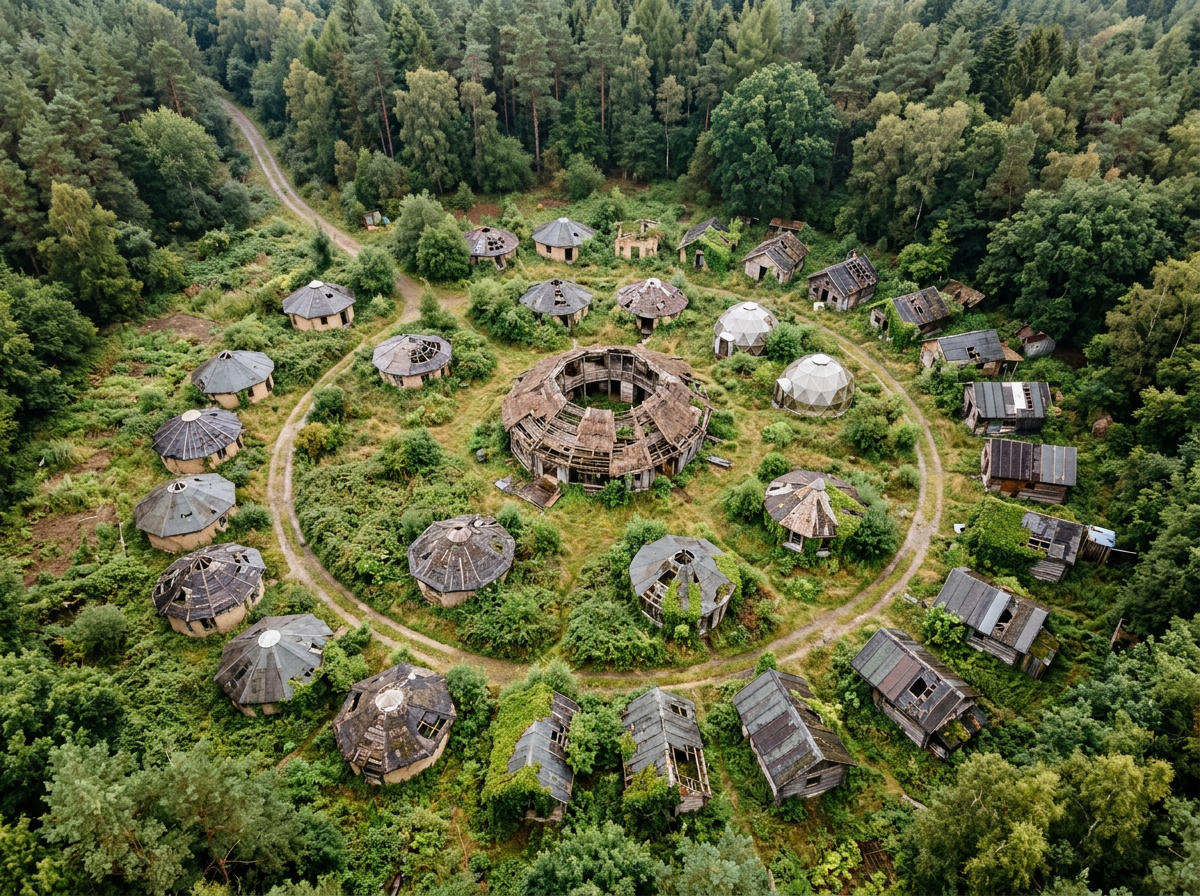
    Yet despite noble intentions, most intentional communities eventually fragment, stagnate, or collapse.

    This pattern appears repeatedly across:

    • communes,
    • ecovillages,
    • cooperative housing projects,
    • spiritual communities,
    • activist collectives,
    • monasteries,
    • decentralized organizations,
    • and utopian social experiments throughout history.

    The failure is rarely caused by idealism alone.

    More often, intentional communities fail because they underestimate the complexity of human systems.

    Shared values are important.

    But values alone cannot sustain long-term collective living without:

    • governance,
    • boundaries,
    • conflict systems,
    • incentive alignment,
    • psychological maturity,
    • operational stewardship,
    • and institutional resilience.

    Intentional communities are not merely social gatherings.
    They are living systems.

    And living systems require structure.


    The Romanticization Problem

    One of the most common failure patterns is excessive idealism combined with insufficient systems design.

    Many communities begin with:

    • inspiration,
    • emotional resonance,
    • shared philosophy,
    • and a desire to escape perceived dysfunction in mainstream society.

    However, inspiration alone does not solve:

    • resource allocation,
    • interpersonal conflict,
    • labor distribution,
    • governance disputes,
    • leadership accountability,
    • psychological projection,
    • or long-term operational sustainability.

    Communities often romanticize:

    • harmony,
    • unity,
    • and collective belonging,
      while underestimating:
    • complexity,
    • human variability,
    • emotional load,
    • and governance requirements.

    This creates a dangerous imbalance:

    high emotional idealism with low structural resilience.

    Without operational foundations, idealism eventually collides with reality.


    Human Psychology Does Not Disappear Inside Communities

    A common misconception is that alternative communities somehow transcend ordinary human behavior.

    In reality, intentional communities often intensify human dynamics because:

    • proximity increases emotional exposure,
    • collective living amplifies interpersonal friction,
    • unresolved psychological patterns become highly visible,
    • and social boundaries become more porous.

    Communities therefore become environments where:

    • shadow dynamics,
    • power struggles,
    • dependency patterns,
    • attachment wounds,
    • projection,
    • and status hierarchies
      can rapidly emerge.

    Research on group psychology consistently demonstrates that humans naturally form:

    • in-groups,
    • hierarchies,
    • identity structures,
    • and social coalitions (Haidt, 2012).

    No amount of idealistic language fully removes these tendencies.

    Healthy communities do not deny human complexity.
    They design systems capable of managing it constructively.


    Governance Failure Is One of the Largest Causes of Collapse

    Many intentional communities resist governance structures because governance is associated with:

    • hierarchy,
    • bureaucracy,
    • control,
    • or institutional rigidity.

    However, the absence of governance rarely eliminates power.
    It often merely obscures it.

    In poorly structured communities:

    • informal power networks emerge,
    • charismatic personalities dominate,
    • decision-making becomes inconsistent,
    • accountability weakens,
    • and conflict resolution becomes unstable.

    This creates what sociologist Jo Freeman (1972) famously described as:

    “the tyranny of structurelessness.”

    Without transparent governance systems:

    • hidden hierarchies often replace explicit structures,
    • emotional influence may override competence,
    • and unclear authority creates chronic instability.

    Healthy communities require governance not because humans are failures,
    but because coordination itself requires structure.


    Conflict Avoidance Destroys Communities

    Conflict itself is not the problem.

    Poor conflict systems are.

    Many intentional communities prioritize:

    • harmony,
    • emotional unity,
    • and social cohesion,
      while avoiding direct confrontation of tension.

    This often creates:

    • passive aggression,
    • resentment accumulation,
    • social fragmentation,
    • scapegoating,
    • and eventual implosion.

    Communities that suppress disagreement frequently become psychologically fragile.

    Healthy systems require:

    • constructive disagreement,
    • transparent communication,
    • accountability,
    • and repair mechanisms.

    Research on resilient organizations consistently shows that adaptive systems depend upon the ability to process tension without collapse (Meadows, 2008).

    Communities unable to metabolize conflict eventually accumulate systemic instability.


    Infrastructure Matters More Than Ideology

    One of the most overlooked realities is that communities often fail from operational weakness rather than philosophical weakness.

    Shared beliefs cannot compensate for:

    • poor financial planning,
    • inadequate food systems,
    • unsustainable labor expectations,
    • weak governance,
    • unclear responsibilities,
    • or infrastructure failure.

    Many communities devote enormous energy toward:

    • philosophy,
    • spirituality,
    • identity,
    • or ideological alignment,
      while underinvesting in:
    • logistics,
    • maintenance,
    • economic resilience,
    • operational stewardship,
    • and institutional continuity.

    However, civilizations survive through infrastructure, not idealism alone.

    Sociologist and systems theorist Jared Diamond (2005) observed that societies frequently collapse not only from external pressure, but from failures in long-term resource management and adaptive coordination.

    Communities are no different.


    Shared Vision Is Not Enough

    A shared vision may initiate a community.


    But sustaining a community requires:

    • competence,
    • stewardship,
    • systems thinking,
    • adaptability,
    • and long-term coordination.

    Over time, communities encounter:

    • leadership transitions,
    • interpersonal fatigue,
    • financial stress,
    • ideological divergence,
    • changing life stages,
    • and resource constraints.

    Without systems capable of adapting to these pressures, communities become increasingly unstable.

    Healthy communities require both:

    • philosophical coherence,
    • and operational maturity.

    This distinction is critical.


    The Problem of Undefined Roles

    Many intentional communities attempt to eliminate hierarchy entirely.

    However, removing formal roles often creates:

    • ambiguity,
    • duplicated labor,
    • unbalanced workloads,
    • and invisible authority structures.

    Healthy systems require:

    • role clarity,
    • stewardship accountability,
    • skill differentiation,
    • and decision-making pathways.

    This does not necessarily require authoritarian control.

    It requires organizational coherence.

    Complex systems function more effectively when:

    • responsibilities are visible,
    • expectations are clear,
    • and stewardship roles are understood.

    Without role clarity, communities often drift into exhaustion and confusion.


    Economic Fragility Undermines Stability

    Many intentional communities underestimate the importance of economic resilience.

    Communities require:

    • food systems,
    • maintenance systems,
    • healthcare access,
    • infrastructure upkeep,
    • financial sustainability,
    • and resource coordination.

    Without stable economic foundations:

    • burnout increases,
    • internal tension escalates,
    • and long-term continuity becomes difficult.

    Economic fragility amplifies every other weakness within a community system.

    Regenerative communities therefore require:

    • resilient economic design,
    • distributed stewardship,
    • practical resource systems,
    • and long-term sustainability planning.

    Healthy Communities Require Boundaries

    Communities often confuse openness with health.

    However, systems without boundaries frequently become unstable.

    Healthy communities require:

    • onboarding standards,
    • shared expectations,
    • behavioral accountability,
    • conflict protocols,
    • exit pathways,
    • and stewardship norms.

    Without boundaries:

    • dysfunction spreads more easily,
    • responsibility becomes diffuse,
    • and social coherence weakens.

    In systems theory, boundaries are not merely restrictive.
    They are part of what allows systems to maintain integrity.


    The Difference Between Fragile and Anti-Fragile Communities

    Fragile communities depend heavily on:

    • emotional momentum,
    • charismatic leadership,
    • ideological purity,
    • or temporary enthusiasm.

    Anti-fragile communities develop:

    • adaptive governance,
    • distributed competence,
    • resilience under stress,
    • operational redundancy,
    • and learning systems.

    They recognize that:

    • conflict will occur,
    • mistakes will happen,
    • leadership will evolve,
    • and conditions will change.

    Rather than attempting to eliminate complexity, resilient communities learn how to adapt to it.


    Intentional Communities as Living Systems

    Systems thinking reveals that intentional communities are not static ideals.

    They are evolving ecosystems of:

    • psychology,
    • governance,
    • economics,
    • infrastructure,
    • relationships,
    • and culture.

    Communities fail when they attempt to operate purely through:

    • idealism,
    • emotional resonance,
    • or philosophical alignment,
      without sufficient structural intelligence.

    Healthy communities integrate:

    • human psychology,
    • governance design,
    • operational stewardship,
    • resilience planning,
    • and adaptive feedback systems.

    This is not a rejection of intentional communities.
    It is an argument for maturity in how they are designed.


    Conclusion

    Most intentional communities do not fail because people lack good intentions.

    They fail because:

    • governance is underdeveloped,
    • conflict systems are weak,
    • infrastructure is neglected,
    • psychological complexity is underestimated,
    • and operational stewardship is insufficient.

    Sustainable communities require more than shared ideals.

    They require:

    • systems literacy,
    • accountability,
    • resilience design,
    • adaptive governance,
    • and long-term stewardship.

    Communities are living systems.

    And like all living systems, they survive not through idealism alone,
    but through their capacity to adapt, coordinate, regenerate, and remain coherent across time.


    Suggested Crosslinks


    References

    Diamond, J. (2005). Collapse: How societies choose to fail or succeed. Viking.

    Freeman, J. (1972). The tyranny of structurelessness. Berkeley Journal of Sociology, 17, 151–164.

    Haidt, J. (2012). The righteous mind: Why good people are divided by politics and religion. Pantheon Books.

    Meadows, D. H. (2008). Thinking in systems: A primer. Chelsea Green Publishing.

    The Living Archive is designed to be explored through pathways, categories, and search. If you’re looking for a specific idea, question, or theme, AI Search can help surface relevant connections across the archive.


    Attribution

    The Living Archive
    Integrative Frameworks for Regenerative Civilization

    © 2026 Gerald Daquila. All rights reserved.
    Part of the Life.Understood. knowledge ecosystem and Stewardship Institute initiative.

    This article is intended for educational, research, and civic inquiry purposes.
    Readers are encouraged to engage critically, verify sources independently, and explore related knowledge hubs for broader systems context.

  • Community Accountability Systems

    Community Accountability Systems


    Building Ethical, Transparent, and Resilient Communities Through Shared Responsibility


    Primary Pillar: Stewardship & Leadership
    Related Hubs: Governance & Decentralization • Shadow Work & Integration • Intentional Community Design


    Meta Description

    Explore how community accountability systems support ethical leadership, transparency, trust, conflict repair, and resilient governance. Learn how healthy communities balance sovereignty, consent, responsibility, and distributed stewardship.


    Excerpt

    Healthy communities are not sustained by charisma, control, or ideology alone.

    Long-term resilience depends upon ethical accountability systems that support transparency, repair, distributed responsibility, and human dignity.


    Introduction

    Every human system eventually encounters conflict, misunderstanding, power imbalance, error, and ethical tension.

    Families experience breakdowns in communication. Organizations struggle with corruption or misaligned incentives. Communities fracture under unresolved grievances. Leadership structures become distorted when accountability weakens.

    The issue is not whether tension emerges.

    The deeper question is:

    How does a community respond when trust becomes strained?

    Many systems fail because they rely excessively upon:

    • charismatic leadership,
    • informal power structures,
    • unspoken expectations,
    • emotional suppression,
    • ideological conformity,
    • or avoidance of difficult conversations.

    Without healthy accountability systems, communities often drift toward:

    • fragmentation,
    • dependency,
    • manipulation,
    • resentment,
    • coercion,
    • institutional decay,
    • or silent disengagement.

    Healthy accountability systems help communities remain:

    • ethical,
    • transparent,
    • adaptive,
    • resilient,
    • and capable of repair.

    Rather than operating through fear or domination, accountability-centered communities cultivate:

    • shared responsibility,
    • mutual respect,
    • clear boundaries,
    • restorative communication,
    • distributed stewardship,
    • and conscious participation.

    This article explores how ethical accountability systems support long-term community health across:

    • intentional communities,
    • organizations,
    • civic networks,
    • decentralized systems,
    • leadership structures,
    • online communities,
    • and regenerative governance models.

    What Is Community Accountability?

    Community accountability refers to the shared processes, agreements, and cultural norms through which individuals and groups maintain ethical responsibility toward one another.

    At its core, accountability is not primarily about punishment.

    It is about:

    • responsibility,
    • transparency,
    • repair,
    • trust preservation,
    • ethical participation,
    • and relational integrity.

    Healthy accountability systems help communities:

    • address harm constructively,
    • maintain trust,
    • prevent power abuse,
    • resolve conflict,
    • support learning and growth,
    • and strengthen long-term resilience.

    Research in organizational psychology consistently demonstrates that psychologically safe environments improve trust, cooperation, and adaptive learning within groups (Edmondson, 1999).

    Similarly, governance scholars have long emphasized that institutions become more stable when accountability mechanisms remain transparent, participatory, and distributed rather than concentrated in isolated power structures (Ostrom, 1990).

    Accountability therefore functions not merely as correction, but as a stabilizing infrastructure for healthy human systems.

    Accountability does not operate in isolation. It functions within a broader governance ecosystem that includes transparency, participation, stewardship, communication, feedback, decision-making, and trust.

    When these elements reinforce one another, communities become more capable of learning, repairing mistakes, and adapting to changing conditions.

    The Governance System Map illustrates how accountability serves as one component within a larger architecture of healthy collective coordination.

    Figure 1. Governance System Map: Governance as Coordination Architecture

    → Download Reference Map: Governance System Map

    A systems framework illustrating how accountability, transparency, stewardship, participation, information flows, feedback mechanisms, and adaptive learning interact within healthy communities and institutions.

    Effective accountability systems strengthen trust, resilience, ethical decision-making, and long-term collective wellbeing by ensuring that responsibility remains visible, distributed, and responsive to feedback.


    Accountability vs Punishment

    Modern culture often conflates accountability with punishment.

    Yet the two are not identical.

    Punitive SystemsAccountability Systems
    Fear-basedResponsibility-based
    ReactiveReflective
    Shame-centeredRepair-oriented
    Hierarchical enforcementShared ethical participation
    Suppression-focusedLearning-focused
    Reputation destructionTrust restoration
    Control-orientedStewardship-oriented

    Punishment may temporarily suppress behavior.

    But healthy accountability seeks deeper outcomes:

    • understanding,
    • repair,
    • transparency,
    • behavioral change,
    • and strengthened trust.

    Restorative justice frameworks similarly emphasize healing, responsibility, dialogue, and community repair rather than purely punitive approaches (Zehr, 2002).

    This does not mean all harmful behavior should be tolerated.

    Healthy accountability systems still require:

    • boundaries,
    • consequences,
    • role clarity,
    • ethical standards,
    • and protection against abuse.

    However, accountability becomes most effective when communities balance:

    • firmness with dignity,
    • responsibility with compassion,
    • and structure with humanity.

    Why Accountability Systems Matter

    1. They Prevent Power Concentration

    Communities become vulnerable when authority becomes insulated from feedback.

    Unchecked power often increases the risk of:

    • corruption,
    • manipulation,
    • dependency dynamics,
    • information control,
    • favoritism,
    • and ethical drift.

    Distributed accountability systems help reduce overreliance upon:

    • charismatic figures,
    • centralized authority,
    • or personality-driven governance.

    Healthy systems build safeguards around power.

    This principle aligns with stewardship-centered leadership, which recognizes that ethical restraint is necessary for long-term institutional health.

    Related: Stewardship & Leadership Hub


    2. They Strengthen Trust

    Trust is not built through branding or ideology alone.

    Trust emerges when communities repeatedly demonstrate:

    • consistency,
    • transparency,
    • honesty,
    • repair capacity,
    • and ethical follow-through.

    Sociological research suggests that high-trust societies often exhibit stronger cooperation, lower transaction costs, and greater social resilience (Fukuyama, 1995).

    When communities possess reliable accountability structures, individuals become more willing to:

    • collaborate,
    • participate honestly,
    • share concerns,
    • and contribute meaningfully.

    3. They Support Conflict Repair

    Conflict is inevitable within any human system.

    The absence of conflict is not a sign of health.

    Often, suppressed conflict simply becomes:

    • resentment,
    • passive aggression,
    • emotional withdrawal,
    • gossip,
    • factionalism,
    • or organizational fragmentation.

    Healthy accountability systems create pathways for:

    • constructive dialogue,
    • emotional regulation,
    • repair processes,
    • boundary clarification,
    • and ethical disagreement.

    Communities capable of repair are generally more resilient than communities attempting to avoid tension entirely.

    Related: Shadow Work & Integration


    4. They Reduce Dependency Cultures

    When accountability becomes centralized in a single authority figure, communities often drift toward:

    • passivity,
    • learned helplessness,
    • emotional dependency,
    • and weakened discernment.

    Healthy systems instead cultivate:

    • distributed leadership,
    • civic participation,
    • shared stewardship,
    • and collective responsibility.

    This aligns with research demonstrating that participatory governance structures often improve long-term institutional adaptability and resilience (Ostrom, 1990).


    Core Principles of Healthy Community Accountability

    1. Transparency

    Transparency helps reduce:

    • secrecy,
    • confusion,
    • misinformation,
    • and power asymmetry.

    Healthy transparency may include:

    • clear communication,
    • accessible governance processes,
    • financial clarity,
    • documented agreements,
    • and role accountability.

    Transparency does not require the elimination of privacy.

    Rather, it seeks proportional openness appropriate to responsibility and trust.


    2. Consent and Participation

    Healthy accountability cannot exist without consent.

    Communities become ethically unstable when participation relies upon:

    • coercion,
    • manipulation,
    • psychological pressure,
    • ideological conformity,
    • or dependency.

    Ethical participation requires:

    • informed consent,
    • freedom of association,
    • autonomy,
    • and the ability to disengage safely.

    Communities grounded in consent tend to develop stronger long-term trust and legitimacy.

    Related: Governance & Decentralization


    3. Distributed Stewardship

    Healthy systems avoid concentrating all responsibility into a single role or personality.

    Instead, stewardship becomes distributed across:

    • teams,
    • councils,
    • rotating responsibilities,
    • peer feedback systems,
    • and shared governance structures.

    Distributed stewardship reduces:

    • burnout,
    • dependency,
    • bottlenecks,
    • and authoritarian drift.

    It also strengthens continuity during leadership transitions.


    4. Repair Culture

    Healthy communities normalize repair.

    Repair culture includes:

    • honest dialogue,
    • accountability after harm,
    • acknowledgment of mistakes,
    • restorative communication,
    • and sincere course correction.

    Research on relational resilience suggests that trust often strengthens when communities effectively navigate conflict and repair rather than avoiding tension altogether (Gottman & Silver, 1999).

    Repair does not guarantee immediate reconciliation.

    However, communities that suppress accountability often accumulate unresolved fractures that destabilize trust over time.


    5. Ethical Boundaries

    Healthy accountability systems require boundaries.

    Without boundaries, communities become vulnerable to:

    • emotional enmeshment,
    • role confusion,
    • coercive dynamics,
    • and exploitation.

    Ethical boundaries may include:

    • role clarity,
    • conflict-of-interest policies,
    • consent protocols,
    • grievance procedures,
    • financial transparency,
    • and leadership limitations.

    Boundaries protect both individuals and the integrity of the system itself.


    Accountability in Digital Communities

    Digital environments introduce additional accountability challenges.

    Online systems can amplify:

    • outrage cycles,
    • mob dynamics,
    • misinformation,
    • parasocial dependency,
    • reputational escalation,
    • and algorithmic manipulation.

    Healthy digital accountability therefore requires:

    • media literacy,
    • discernment,
    • moderation transparency,
    • ethical communication norms,
    • and responsible information stewardship.

    As digital governance increasingly shapes social behavior, accountability systems become essential for preserving human agency and healthy discourse.

    Related: Ethical AI & Human Agency


    Accountability Without Perfectionism

    Healthy accountability does not require moral perfection.

    Human beings remain:

    • imperfect,
    • emotionally complex,
    • adaptive,
    • and continually developing.

    Closing Reflection

    Communities are ultimately shaped not only by their ideals, but by the quality of the systems through which they navigate tension, responsibility, trust, and repair.

    Without accountability, even well-intentioned communities may gradually drift toward fragmentation, dependency, secrecy, or ethical instability.

    Yet accountability rooted solely in fear, punishment, or control can become equally corrosive.

    Healthy stewardship-centered systems seek a more difficult balance:

    • responsibility without domination,
    • transparency without humiliation,
    • boundaries without dehumanization,
    • and repair without denial of harm.

    As societies become increasingly complex, digitally interconnected, and psychologically strained, the need for ethical accountability systems becomes even more important.

    Resilient communities are rarely built through charisma alone.

    They are sustained through:

    • trust,
    • distributed responsibility,
    • honest communication,
    • ethical restraint,
    • and the shared willingness to protect both human dignity and long-term collective wellbeing.

    In this way, accountability becomes more than governance.

    It becomes a living practice of stewardship.


    References

    Edmondson, A. (1999). Psychological safety and learning behavior in work teams. Administrative Science Quarterly, 44(2), 350–383.

    Fukuyama, F. (1995). Trust: The social virtues and the creation of prosperity. Free Press.

    Gottman, J., & Silver, N. (1999). The seven principles for making marriage work. Crown Publishing.

    Ostrom, E. (1990). Governing the commons: The evolution of institutions for collective action. Cambridge University Press.

    Zehr, H. (2002). The little book of restorative justice. Good Books.


    The Sovereign Professional: A structural map of power, systems thinking, and personal autonomy—dedicated to helping the independent professional navigate complexity and own their value stream.Ask


    ©2026 Gerald Daquila • Life.Understood. • Systems Thinking, Leadership Architecture, and Applied Coherence

  • The Digital Barangay: A Structural Framework for Decentralized Diaspora Stewardship

    The Digital Barangay: A Structural Framework for Decentralized Diaspora Stewardship


    Reimagining the Filipino Barangay as a Sovereign Global Support Network


    Meta Description

    Explore how the ancient Filipino Barangay model can evolve into a decentralized digital stewardship system for the global diaspora—creating sovereign nodes that support homeland resilience, economic regeneration, and cultural continuity.


    For centuries, the Filipino barangay functioned not merely as a geographic settlement, but as a living governance architecture rooted in kinship, mutual aid, collective survival, and shared stewardship.

    Before colonial centralization fragmented indigenous systems, the barangay served as a resilient social organism: adaptive, relational, and deeply localized (Jocano, 1998).

    Today, as millions of Filipinos live and work abroad, a new question emerges:

    What if the barangay never disappeared—only evolved?

    In the age of digital infrastructure, decentralized finance, AI coordination systems, and transnational communities, the ancient barangay model may hold the blueprint for a new form of diaspora organization.

    Rather than seeing overseas Filipinos merely as remittance senders or economic migrants, a more coherent framework views them as distributed stewardship nodes capable of supporting homeland resilience in coordinated, ethical, and regenerative ways.

    This emerging model may be called the Digital Barangay: a decentralized network of sovereign Filipino communities abroad functioning as “life-support systems” for cultural continuity, local resilience, and long-term regenerative development in the Philippines.

    Rather than replicating extractive globalization, the Digital Barangay proposes a return to relational infrastructure—updated for the digital age.


    From Tribal Settlement to Distributed Network

    Historically, the barangay was composed of interconnected families governed through reciprocal obligation and participatory leadership.

    Leadership was relational rather than purely bureaucratic, and survival depended upon collective cohesion (Scott, 1994).

    Modern globalization disrupted many of these systems. Colonialism centralized governance, urbanization weakened localized interdependence, and labor export policies dispersed millions of Filipinos across the world (Rodriguez, 2010).

    Yet paradoxically, this dispersion created one of the most globally connected diasporas in human history.

    Today, Overseas Filipino Workers (OFWs), immigrant professionals, entrepreneurs, caregivers, nurses, engineers, and creatives collectively form a vast transnational network capable of moving not only capital—but knowledge, technology, governance practices, and social coordination.

    The challenge is structural:

    Most diaspora engagement remains fragmented, transactional, or reactive.

    The Digital Barangay proposes a shift from:

    • remittance dependency → regenerative coordination,
    • isolated migration → distributed stewardship,
    • individual success → collective resilience.

    This is not merely cultural nostalgia. It is systems architecture.


    What Is a “Sovereign Node”?

    Within the Digital Barangay framework, a Sovereign Node refers to a self-organizing diaspora cluster capable of supporting both its local members abroad and aligned initiatives in the homeland.

    A node may consist of:

    • Filipino professionals in Toronto,
    • caregivers in California,
    • entrepreneurs in Vancouver,
    • educators in New York,
    • regenerative agriculture advocates in Australia,
    • or hybrid digital communities connected through shared mission.

    Unlike traditional organizations that depend heavily on centralized hierarchy, sovereign nodes operate through distributed trust networks, transparent communication, and mission alignment.

    Their purpose is not ideological control or political dominance.

    Rather, they function as:

    • mutual aid ecosystems,
    • cultural continuity circles,
    • educational and mentorship hubs,
    • ethical investment cooperatives,
    • emergency response networks,
    • and regenerative development support systems.

    In systems theory, resilient systems are often decentralized rather than overly centralized because distributed nodes reduce single points of failure (Meadows, 2008).

    The barangay model naturally reflects this principle.

    A healthy sovereign node therefore acts less like a corporation and more like a living organism.

    A sovereign node does not operate in isolation.

    Its effectiveness depends upon the quality of the governance structures, communication pathways, accountability systems, and stewardship practices connecting it to the broader network.

    The Governance System Map illustrates how healthy distributed systems coordinate information, responsibility, participation, and feedback while preserving both local autonomy and collective coherence across larger communities.

    Figure 1. Governance System Map: Governance as Coordination Architecture

    → Download Reference Map 010: Governance System Map

    A systems framework illustrating how distributed communities coordinate through stewardship, accountability, information flows, participation, decision-making, and adaptive feedback.

    Within the Digital Barangay model, sovereign nodes remain locally autonomous while contributing to a larger network of trust, resilience, and shared responsibility.


    The Barangay Logic Applied to the Diaspora

    The Digital Barangay adapts several ancient barangay principles into modern infrastructure:


    1. Relational Stewardship Over Bureaucratic Control

    Traditional barangays operated through relational accountability. Reputation, reciprocity, and communal trust were essential survival mechanisms.

    Modern digital systems often suffer from anonymity, fragmentation, and low social cohesion. Diaspora nodes can restore coherence through:

    • local stewardship councils,
    • transparent decision-making,
    • skill-sharing circles,
    • and community-led governance.

    This mirrors emerging global interest in decentralized autonomous organizations (DAOs), cooperative governance models, and participatory civic systems (Allen & Berg, 2022).

    However, the Digital Barangay differs from purely technological decentralization because it centers human relationships rather than automation alone.

    Technology supports stewardship; it does not replace it.


    2. Distributed Economic Resilience

    The Philippines receives billions annually through remittances from overseas workers. While remittances sustain millions of families, they can also create dependency loops without structural transformation (Opiniano, 2012).

    The Digital Barangay framework asks a deeper question:

    What happens if diaspora capital becomes coordinated toward regenerative infrastructure rather than isolated consumption?

    Examples include:

    • supporting local food systems,
    • funding community land trusts,
    • investing in renewable energy microgrids,
    • sponsoring localized education hubs,
    • and developing cooperative enterprises.

    Instead of temporary relief, sovereign nodes can participate in long-term resilience building.

    This transforms the diaspora from “external labor force” into distributed nation-builders.


    3. Knowledge Transfer as National Infrastructure

    One of the most underutilized resources within the Filipino diaspora is intellectual capital.

    Filipino professionals abroad often gain exposure to:

    • advanced healthcare systems,
    • sustainable architecture,
    • governance innovation,
    • AI systems,
    • renewable energy models,
    • cooperative economics,
    • and trauma-informed education practices.

    Yet these insights rarely flow back into localized Philippine development in structured ways.

    The Digital Barangay proposes ongoing “knowledge return pathways” through:

    • mentorship programs,
    • digital apprenticeship networks,
    • open-source educational systems,
    • and local innovation exchanges.

    In this model, the homeland is not viewed as “behind,” but as a regenerative testing ground for new community systems.


    Why Decentralization Matters

    Many institutional systems fail because they become too centralized, too bureaucratic, and too disconnected from local realities.

    Decentralized systems are often more adaptive during periods of instability because they:

    • distribute responsibility,
    • increase redundancy,
    • enable faster response times,
    • and preserve local autonomy (Taleb, 2012).

    The barangay historically embodied these qualities.

    A Digital Barangay network could therefore strengthen resilience against:

    • economic shocks,
    • climate instability,
    • food insecurity,
    • political volatility,
    • and social fragmentation.

    Importantly, decentralization does not mean disorder.

    Healthy decentralized systems require:

    • shared principles,
    • transparent communication,
    • interoperable structures,
    • and ethical stewardship frameworks.

    Without these, decentralization can devolve into fragmentation.

    Thus, the Digital Barangay is not anti-structure. It is anti-extractive centralization.


    The Role of Technology

    Modern infrastructure now makes transnational barangays possible in ways that were unimaginable even twenty years ago.

    Key enabling technologies include:

    • encrypted communication platforms,
    • cooperative digital banking systems,
    • decentralized finance tools,
    • AI-assisted coordination systems,
    • remote education platforms,
    • and distributed cloud governance.

    However, technological sophistication alone does not create coherence.

    Many digitally connected communities remain emotionally fragmented.

    Thus, the Digital Barangay must integrate:

    • cultural continuity,
    • ethical discernment,
    • intergenerational mentorship,
    • and localized human relationships.

    Technology becomes meaningful only when rooted in shared stewardship values.


    Potential Applications of the Digital Barangay

    Diaspora Emergency Response Systems

    Sovereign nodes could rapidly mobilize localized support during typhoons, earthquakes, or humanitarian crises.

    Rather than relying solely on centralized aid systems, barangay-aligned networks could deploy:

    • direct mutual aid,
    • rapid crowdfunding,
    • local supply coordination,
    • and community logistics.

    Regenerative Provincial Development

    Diaspora-supported nodes could help revitalize rural provinces through:

    • regenerative agriculture,
    • local entrepreneurship,
    • eco-tourism cooperatives,
    • renewable energy infrastructure,
    • and digital livelihood systems.

    This may reduce overconcentration in Metro Manila while strengthening regional resilience.


    Cultural Preservation Networks

    As younger generations abroad become increasingly disconnected from Filipino language and traditions, sovereign nodes can create:

    • cultural learning circles,
    • oral history archives,
    • language preservation projects,
    • and intergenerational mentorship programs.

    The Digital Barangay therefore becomes not only economic infrastructure, but civilizational memory infrastructure.


    Challenges and Ethical Considerations

    The Digital Barangay is not immune to risk.

    Potential challenges include:

    • ideological fragmentation,
    • personality-driven leadership,
    • digital misinformation,
    • financial opacity,
    • and neo-feudal dynamics disguised as “community.”

    Therefore, healthy nodes require:

    • transparency,
    • consent-based participation,
    • distributed accountability,
    • and clear ethical safeguards.

    True stewardship empowers communities rather than creating dependency.

    This distinction is essential.


    Toward a Regenerative Diaspora Civilization

    The Filipino diaspora is often described through sacrifice, separation, and survival.

    But another possibility exists.

    What if the diaspora evolved into a distributed regenerative civilization architecture?

    What if overseas Filipinos became not merely workers abroad, but interconnected stewards participating in the rebuilding of resilient local systems?

    The Digital Barangay offers one possible framework.

    Not as utopian fantasy, but as a practical reapplication of ancient relational intelligence to modern decentralized infrastructure.

    The future may not belong solely to massive centralized institutions.

    It may belong to adaptive networks capable of combining:

    • local autonomy,
    • global coordination,
    • ethical stewardship,
    • and cultural continuity.

    In many ways, the barangay was already doing this long before the modern world rediscovered decentralization.

    The question now is whether the diaspora is prepared to remember.


    Suggested Internal Crosslinks


    References

    Allen, D. W., & Berg, C. (2022). Blockchain governance: Programming our future. Lexington Books.

    Jocano, F. L. (1998). Filipino social organization: Traditional kinship and family organization. Punlad Research House.

    Meadows, D. H. (2008). Thinking in systems: A primer. Chelsea Green Publishing.

    Opiniano, J. M. (2012). Migration and development in the Philippines. Institute of Migration and Development Issues.

    Rodriguez, R. M. (2010). Migrants for export: How the Philippine state brokers labor to the world. University of Minnesota Press.

    Scott, W. H. (1994). Barangay: Sixteenth-century Philippine culture and society. Ateneo de Manila University Press.

    Taleb, N. N. (2012). Antifragile: Things that gain from disorder. Random House.


    The Sovereign Professional: A structural map of power, systems thinking, and personal autonomy—dedicated to helping the independent professional navigate complexity and own their value stream.Ask


    ©2026 Gerald Daquila • Life.Understood. • Systems Thinking, Leadership Architecture, and Applied Coherence

  • The Exile’s Advantage: Why the Diaspora is the R&D Lab for the New Philippine Ark

    The Exile’s Advantage: Why the Diaspora is the R&D Lab for the New Philippine Ark


    Distance Was Never the Failure


    For generations, the Philippine diaspora has often been framed through the language of loss.

    Brain drain.
    Overseas labor.
    Migration necessity.
    Families separated by economics.
    Talent exported to sustain a fragile domestic system.

    The narrative is familiar: the nation loses its best people, while millions of Filipinos scatter across the world in search of opportunity, survival, or stability.

    As of the mid-2020s, overseas Filipinos contribute billions annually through remittances, forming one of the largest diaspora economies on Earth (Bangko Sentral ng Pilipinas [BSP], 2025).

    Yet beneath this familiar framing lies another possibility.

    What if distance from the homeland was not only tragedy?
    What if it was also preparation?


    What if the diaspora unintentionally became the Philippines’ largest distributed research-and-development laboratory?

    The emerging global transition suggests that this question is no longer theoretical.

    As economic systems strain under debt saturation, geopolitical fragmentation, climate pressure, technological disruption, and institutional distrust, many nations are searching for adaptive social models capable of surviving instability (World Economic Forum [WEF], 2025).

    In this environment, diasporic populations possess unusual strategic advantages:

    • cross-cultural fluency,
    • global systems exposure,
    • diversified economic access,
    • adaptive identity structures,
    • and distributed survival intelligence.

    The Filipino diaspora, in particular, may hold a unique position.

    Not because it escaped the homeland.
    But because it learned how multiple systems function from the inside.


    The Diaspora as a Distributed Intelligence Network

    Filipinos abroad are often described economically, but rarely systemically.

    Yet over decades, millions of overseas Filipinos have effectively embedded themselves inside nearly every major global infrastructure:

    • healthcare,
    • shipping,
    • caregiving,
    • hospitality,
    • engineering,
    • finance,
    • education,
    • domestic work,
    • logistics,
    • technology,
    • and energy sectors.

    This matters more than many realize.

    Diasporas do not merely send money home. They transmit operational intelligence.

    A nurse working in Canada observes healthcare administration models.
    An engineer in Singapore witnesses infrastructure efficiency.
    A maritime worker learns global logistics systems.
    An entrepreneur in Dubai studies trade networks.
    A caregiver in Italy experiences aging-population realities firsthand.
    A software developer in the United States adapts to digital innovation ecosystems.

    Over time, this creates something larger than remittance flows.

    It creates a distributed learning field.

    Sociologists studying diaspora systems increasingly recognize that transnational communities can function as “knowledge bridges” between societies, transferring not only capital but practices, governance norms, technical competencies, and adaptive cultural models (Faist, 2010).

    The Philippine diaspora has therefore become something unusual:
    a globally dispersed systems-observation network.

    The irony is that many Filipinos abroad internalized migration as personal sacrifice while failing to recognize that they were simultaneously gathering strategic civilizational intelligence.


    Exile Produces Pattern Recognition

    There is another reason diasporic populations often become powerful transitional actors:

    distance creates comparative vision.

    People immersed entirely within one system frequently normalize its dysfunctions. But those who move between systems develop pattern recognition.

    They begin noticing:

    • what works,
    • what scales,
    • what collapses,
    • what produces dignity,
    • and what quietly erodes social cohesion.

    Exile sharpens contrast.

    A Filipino who has lived abroad may notice inefficiencies in Philippine infrastructure that local residents have long accepted as inevitable. At the same time, they may also recognize forms of social warmth, adaptability, and relational resilience that wealthier societies have lost.

    This dual vision matters.

    Because the future likely does not belong purely to imitation.

    The goal is not simply copying foreign systems into Philippine conditions. Many imported development models fail precisely because they ignore cultural context and local realities (Acemoglu & Robinson, 2012).

    Rather, the emerging opportunity is synthesis:

    • combining global operational intelligence
      with
    • local cultural coherence.

    The diaspora is uniquely positioned to facilitate this synthesis because it has lived inside both worlds.


    Why the “Ark” Requires External Builders

    Historically, transformative national renewal efforts often emerged partly from outside the homeland itself.

    Exiled intellectuals, emigrant communities, and overseas networks have repeatedly contributed to reconstruction movements:

    • Jewish diaspora networks during Israel’s state-building period,
    • overseas Chinese investment during China’s modernization,
    • Irish-American financial and political influence during Irish independence movements,
    • Indian diaspora technology and capital contributions during India’s growth phase.

    Diasporas often possess advantages unavailable domestically:

    • access to diversified capital,
    • lower immediate political pressure,
    • exposure to functioning institutions,
    • international networks,
    • and operational distance from entrenched local systems.

    This does not make the diaspora “superior” to residents within the homeland. Rather, it creates complementary positioning.

    The homeland retains:

    • cultural grounding,
    • local knowledge,
    • relational continuity,
    • and direct lived stakes.

    The diaspora retains:

    • comparative perspective,
    • capital access,
    • global exposure,
    • and adaptive experimentation.

    The “New Philippine Ark” therefore cannot emerge from either side alone.

    It requires bridge architecture.


    The Real Resource is Not Money

    Much discussion surrounding overseas Filipinos centers on remittances. Indeed, the Philippines remains heavily supported by diaspora financial flows, which contribute substantially to household stability and national foreign exchange reserves (BSP, 2025).

    But money alone is insufficient for civilizational transition.

    Without coherent frameworks, capital disperses into:

    • consumption,
    • fragmented investments,
    • speculative behavior,
    • or dependency reinforcement.

    The deeper challenge is blueprint deficiency.

    Many Filipinos abroad possess:

    • resources,
    • competencies,
    • experience,
    • and goodwill,
      but lack a coherent framework through which to channel them toward regenerative nation-building.

    This is where the idea of a “Sovereign Blueprint” becomes important.

    Not sovereignty in the narrow political sense.
    But sovereignty as systemic resilience:

    • food security,
    • local production,
    • ethical enterprise,
    • distributed infrastructure,
    • regenerative communities,
    • educational reform,
    • technological adaptation,
    • cooperative economics,
    • and resilient cultural identity.

    The diaspora does not merely need patriotism.
    It needs operational coherence.

    Without a blueprint, energy dissipates.

    With one, scattered intelligence can converge.


    The Philippines as a Prototype Zone

    The Philippines occupies an unusual position in the emerging global transition.

    It remains economically vulnerable in many respects:

    • infrastructure gaps,
    • governance challenges,
    • disaster exposure,
    • and dependency on external systems.

    Yet these vulnerabilities may paradoxically create adaptability advantages.

    Highly optimized systems often struggle to change because their complexity creates inertia. Meanwhile, societies accustomed to improvisation frequently develop stronger adaptive capacities during volatility.

    Filipino culture has historically demonstrated:

    • relational resilience,
    • community improvisation,
    • multilingual adaptability,
    • emotional intelligence,
    • and distributed family support systems.

    These traits are often undervalued inside industrial-era metrics but may become increasingly valuable in transition-era conditions.

    The Philippines could therefore evolve into a prototype zone for:

    • decentralized community systems,
    • regenerative enterprise models,
    • diaspora-linked development,
    • hybrid local-global economies,
    • and relationally anchored governance experiments.

    But this requires intentionality.

    Not nostalgia.
    Not performative nationalism.
    Not escapist fantasy.

    Design.


    From Remittance Economy to Regenerative Network

    One of the great strategic opportunities ahead is transforming the diaspora relationship from extraction-based economics into regenerative systems architecture.

    Historically, many overseas workers effectively subsidized domestic instability through remittances while receiving little structural participation in national redesign.

    The next phase may require something different:

    • cooperative investment structures,
    • local production ecosystems,
    • ethical land stewardship,
    • distributed education platforms,
    • resilient agriculture,
    • small-scale manufacturing,
    • and values-aligned enterprise incubation.

    In this model, diaspora capital becomes developmental rather than merely consumptive.

    More importantly, diaspora intelligence becomes actionable.

    The question shifts from:

    “How do we send money home?”

    to:

    “How do we help build systems that reduce long-term fragility?”

    This is a fundamentally different orientation.


    Why Distance May Have Been Preparation

    Many Filipinos abroad carry guilt.

    Guilt for leaving.
    Guilt for building lives elsewhere.
    Guilt for becoming culturally hybrid.
    Guilt for watching the homeland from afar.

    But history suggests that exile often produces bridge-builders.

    Distance can generate:

    • broader perspective,
    • adaptive thinking,
    • systems literacy,
    • and comparative wisdom.

    The challenge is ensuring that this distance does not harden into detachment.

    The task ahead is reconnection without romanticization.

    The New Philippine Ark — whatever form it ultimately takes — will likely not emerge from centralized institutions alone. It may instead emerge from distributed nodes:
    families, professionals, builders, educators, technologists, farmers, healers, entrepreneurs, and communities learning to coordinate across borders.

    In that sense, the diaspora may already be functioning as an early prototype field for the future:

    a globally distributed Filipino intelligence network waiting for coherent architecture.

    The resources already exist.

    The deeper need is alignment.


    References

    Acemoglu, D., & Robinson, J. A. (2012). Why nations fail: The origins of power, prosperity, and poverty. Crown Publishers.

    Bangko Sentral ng Pilipinas. (2025). Overseas Filipinos’ remittances report. BSP.

    Faist, T. (2010). Diaspora and transnationalism: Concepts, theories and methods. Amsterdam University Press.

    World Economic Forum. (2025). Global risks report 2025. WEF.


    Related Pathways


    The Sovereign Professional: A structural map of power, systems thinking, and personal autonomy—dedicated to helping the independent professional navigate complexity and own their value stream.Ask


    ©2026 Gerald Daquila • Life.Understood. • Systems Thinking, Leadership Architecture, and Applied Coherence

  • How the Prototype Community Functions Day-to-Day

    How the Prototype Community Functions Day-to-Day


    A Barangay-Scale Stewardship Framework for Regenerative Living, Economic Circulation, and Distributed Leadership


    Meta Description

    Explore the operational blueprint behind a regenerative barangay-scale prototype community in the Philippines, including governance, stewardship systems, local economics, conflict resolution, and resilient day-to-day living without centralized debt dependency.


    Introduction

    Many intentional communities fail not because their vision lacks inspiration, but because their operational systems remain vague.

    Noble ideals alone cannot sustain land stewardship, shared infrastructure, financial resilience, or human relationships over time.

    The Prototype Community proposed within the SHEYALOTH stewardship architecture is therefore designed not merely as a philosophical experiment, but as an operationally grounded living system.

    This document outlines how the prototype community functions on a day-to-day basis.

    Its purpose is to answer the practical questions donors, collaborators, future residents, and governance advisors will inevitably ask:

    • How is the community structured?
    • Who makes decisions?
    • How does money circulate?
    • How are conflicts handled?
    • How are members selected?
    • What prevents leadership abuse?
    • How does the community remain financially viable?
    • How does the model scale without collapsing?

    This is not a utopian blueprint.

    It is a systems-informed prototype designed for gradual implementation, adaptation, and resilience.


    1. Core Design Philosophy

    The prototype community is built around five foundational principles:

    1. Stewardship Over Ownership

    Land, infrastructure, knowledge, and resources are treated primarily as stewarded assets rather than speculative commodities.

    The objective is long-term regenerative use rather than extraction.


    2. Distributed Responsibility

    The community avoids over-centralization of authority.

    Leadership functions are distributed through councils, working groups, rotating stewardship roles, and transparent governance structures.

    This reduces fragility and dependency on charismatic leadership.


    3. Regenerative Economics

    The node is designed to retain and circulate value locally whenever practical.

    Priority is placed on:

    • local production,
    • skill development,
    • cooperative purchasing,
    • resilient infrastructure,
    • and ethical enterprise creation.

    4. Human-Scale Governance

    The community is intentionally kept within a manageable relational scale.

    Research in social cohesion repeatedly suggests that trust and accountability degrade when communities become too large or overly bureaucratic (Ostrom, 1990).

    The prototype therefore prioritizes:

    • relational governance,
    • participatory decision-making,
    • and face-to-face accountability.

    5. Adaptive Evolution

    The operating model is not static.

    The prototype is designed to learn through implementation.

    Systems are expected to evolve based on:

    • ecological realities,
    • member feedback,
    • financial conditions,
    • and operational experience.

    2. Community Structure

    Initial Prototype Size

    The recommended initial scale is:

    • 12–20 founding adults
    • small family clusters
    • rotating retreat participants
    • local collaborators and trainees

    This allows sufficient diversity of skills while maintaining manageable governance complexity.

    Expansion beyond 50–70 residents should occur only after:

    • governance stabilization,
    • infrastructure maturity,
    • financial resilience,
    • and conflict systems have proven functional.

    Physical Layout

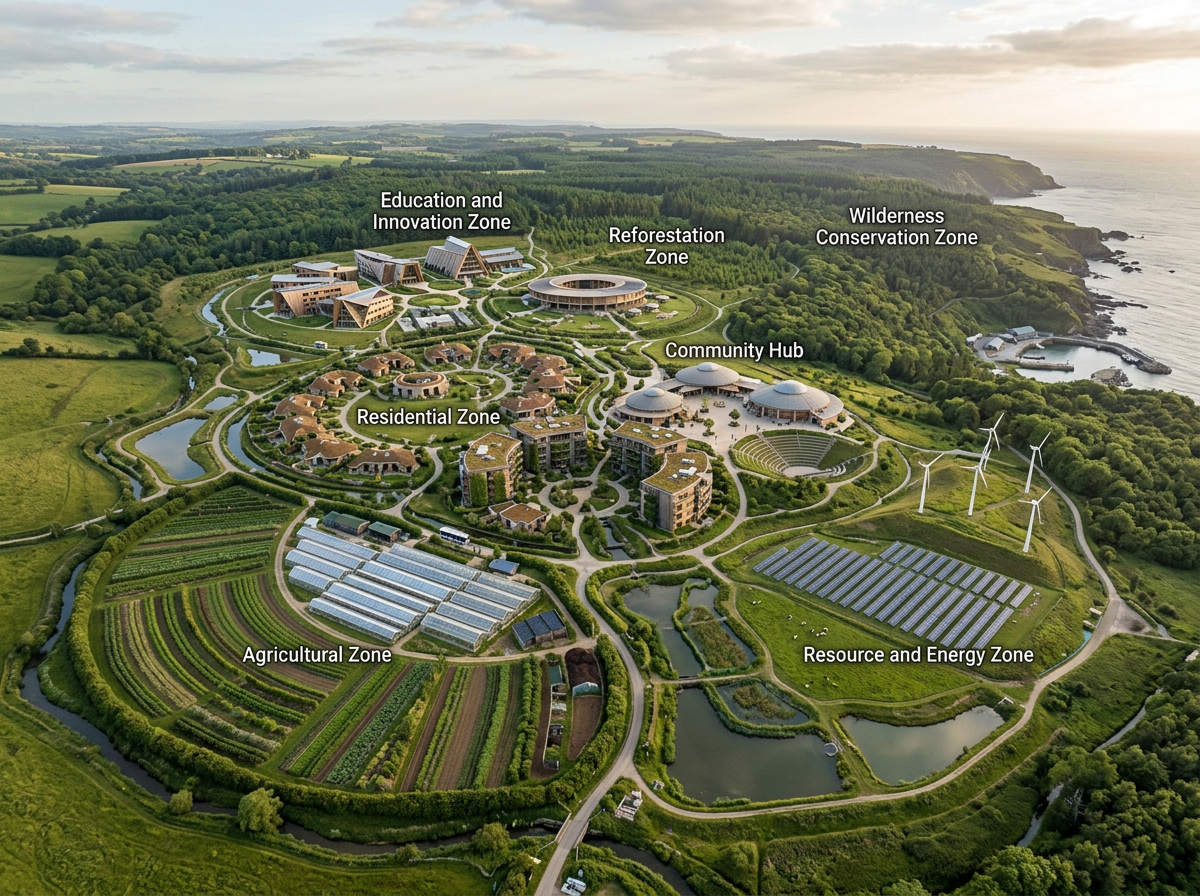
    The community is organized into interconnected functional zones:

    A. Residential Zone

    • private sleeping quarters
    • small family dwellings
    • shared housing clusters
    • co-living options

    B. Productive Agriculture Zone

    • food forests
    • gardens
    • regenerative farming plots
    • seed stewardship
    • compost systems
    • water capture systems

    C. Commons Zone

    Shared community infrastructure:

    • kitchen
    • dining space
    • workshop
    • learning spaces
    • meditation/reflection areas
    • meeting spaces

    D. Enterprise Zone

    Micro-enterprise and livelihood activities:

    • fabrication
    • media production
    • retreats
    • training programs
    • crafts
    • processing facilities
    • digital workspaces

    3. Membership Model

    The prototype uses a layered participation structure.

    Not all participants carry identical responsibilities or privileges.


    Tier 1 – Visitors

    Short-term participants:

    • retreat guests
    • volunteers
    • educational participants
    • researchers

    No governance authority.


    Tier 2 – Apprentices

    Longer-term immersion participants learning stewardship systems.

    Responsibilities include:

    • contribution hours
    • training participation
    • collaborative work
    • community integration

    Limited governance participation.


    Tier 3 – Resident Stewards

    Core long-term members.

    Responsibilities include:

    • operational stewardship
    • governance participation
    • financial contribution
    • skill-sharing
    • mentorship
    • infrastructure care

    These members hold voting participation in major community decisions.


    Tier 4 – Custodian Council

    A rotating stewardship council responsible for:

    • legal oversight
    • financial transparency
    • conflict facilitation
    • systems coordination
    • external partnerships
    • continuity planning

    The council does not function as permanent rulers.

    Term limits and rotation structures reduce power concentration.


    4. Governance Architecture

    Governance is one of the most critical systems within the prototype.

    Most intentional communities fail from unresolved governance weaknesses rather than resource scarcity.


    Decision-Making Structure

    The community uses a hybrid governance model combining:

    • consensus-seeking,
    • delegated authority,
    • and operational autonomy.

    Not every decision requires full-community deliberation.

    Examples:

    Decision TypeGovernance Layer
    Daily operationsWorking groups
    Budget allocationsStewardship council + community review
    Land use changesFull steward vote
    Conflict mediationDesignated mediation circle
    Legal complianceCustodian council

    Transparency Systems

    Transparency is mandatory.

    Members have access to:

    • budget summaries
    • project spending
    • governance notes
    • operational reports
    • stewardship agreements

    Opaque governance breeds distrust.


    Conflict Resolution Process

    Conflict is treated as inevitable rather than abnormal.

    The prototype therefore institutionalizes conflict support mechanisms.

    The escalation structure includes:

    1. Direct dialogue
    2. Facilitated mediation
    3. Stewardship review circle
    4. Temporary cooling-off agreements
    5. Membership reassessment if necessary

    The objective is restoration whenever possible.

    However, persistent abuse, manipulation, violence, or severe boundary violations may result in removal.

    Community safety takes priority over ideological purity.


    5. Financial Operating Model

    The prototype community is not designed as an anti-market commune.

    It operates as a hybrid regenerative economy.

    External revenue remains important.

    However, the objective is to progressively increase internal resilience while minimizing extractive leakage.


    Primary Revenue Streams

    A. Retreats and Trainings

    • stewardship intensives
    • regenerative living workshops
    • leadership immersions
    • wellness retreats
    • systems-thinking seminars

    B. Agricultural Production

    • fresh produce
    • seedlings
    • preserved foods
    • herbal products
    • value-added goods

    C. Digital and Educational Media

    • online courses
    • publications
    • consulting
    • media production
    • educational content

    D. Ethical Enterprise Incubation

    Members may operate aligned micro-enterprises that:

    • contribute to the node,
    • employ local participants,
    • and strengthen community resilience.

    Community Contribution System

    Resident stewards contribute through combinations of:

    • financial contribution,
    • labor contribution,
    • skill contribution,
    • or operational stewardship.

    Contribution expectations are calibrated realistically.

    The objective is participation—not coercion.


    Reserve Funds

    The prototype maintains reserve allocations for:

    • emergency resilience,
    • medical support,
    • infrastructure maintenance,
    • climate disruptions,
    • and operational continuity.

    Communities collapse quickly without reserves.


    6. Work Rhythm and Daily Life

    The prototype avoids both extremes:

    • hyper-capitalist overwork,
    • and unsustainable idealistic leisure culture.

    Instead, it seeks balanced contribution rhythms.


    Daily Structure Example

    Morning

    • food systems work
    • maintenance
    • infrastructure tasks
    • operational coordination

    Afternoon

    • enterprise work
    • training
    • educational programs
    • remote/digital work

    Evening

    • shared meals
    • reflection circles
    • cultural activities
    • governance meetings when necessary

    Weekly Rhythm

    The weekly cycle includes:

    • stewardship days
    • enterprise days
    • learning days
    • rest periods
    • governance review periods

    Intentional rest is considered infrastructure.

    Burnout destroys communities.


    7. External Partnerships

    The prototype does not isolate itself.

    It actively collaborates with:

    • local barangays
    • farmers
    • NGOs
    • educators
    • regenerative design experts
    • universities
    • ethical businesses
    • public agencies where aligned

    This reduces ideological isolation and improves practical resilience.


    8. Risk Factors and Safeguards

    The prototype acknowledges several major risks.


    Risk 1 – Leadership Centralization

    Safeguards:

    • rotating councils
    • transparent finances
    • distributed authority
    • written governance protocols

    Risk 2 – Financial Fragility

    Safeguards:

    • diversified revenue streams
    • reserve funds
    • phased growth
    • low-debt strategy

    Risk 3 – Social Fragmentation

    Safeguards:

    • conflict mediation
    • onboarding processes
    • mentorship systems
    • cultural rituals
    • shared meals

    Risk 4 – Ideological Rigidity

    Safeguards:

    • adaptive review cycles
    • evidence-based assessment
    • external advisors
    • community feedback structures

    Risk 5 – Burnout

    Safeguards:

    • workload balancing
    • rotating responsibilities
    • rest periods
    • emotional support systems

    9. Long-Term Vision

    The prototype is not intended to become a giant centralized settlement.

    Instead, the long-term model resembles:

    • interconnected stewardship nodes,
    • distributed regenerative communities,
    • local training hubs,
    • and collaborative barangay-scale ecosystems.

    Replication occurs horizontally rather than through top-heavy expansion.

    This creates resilience through decentralization.


    Conclusion

    The Prototype Community is ultimately an experiment in practical regeneration.

    Its purpose is not to escape society.

    Its purpose is to test whether human communities can once again organize around:

    • stewardship instead of extraction,
    • participation instead of passivity,
    • resilience instead of dependency,
    • and relational wealth instead of perpetual debt.

    The operating model therefore serves as both:

    • a practical governance framework,
    • and a living systems laboratory.

    If successful, the prototype may provide evidence that localized regenerative communities are not merely idealistic visions, but viable social infrastructure for an increasingly unstable world.


    Crosslinks

    Value Stream Mapping the Prototype Community: Circulating Wealth Without Central Debt – Maps how food, labor, finance, governance, infrastructure, and knowledge circulate within the prototype community while minimizing extractive leakage into centralized debt systems.

    Agentic Systems and the End of Passive Labor – Analyzes how AI, automation, and decentralized production systems are reshaping the future of work, stewardship, and local economic resilience.

    The Sovereign Prompt: How to Use AI Without Outsourcing Discernment – Discusses the ethical integration of AI within regenerative systems while preserving human discernment, accountability, and stewardship responsibility.

    Why the Global Reset Requires an Internal Reboot: The Role of Shadow Work in NESARA/GESARA – Explores the psychological and cultural dimensions of systemic transformation, emphasizing that sustainable external reform requires internal ethical and relational maturity first.


    References

    American Society for Quality. (n.d.). Value stream mapping tutorial – What is VSM? ASQ. ASQ Value Stream Mapping Tutorial

    Centre for Local Economic Strategies. (n.d.). Community wealth building. CLES. CLES Community Wealth Building

    Lean Enterprise Institute. (n.d.). Value-stream mapping. Lean Enterprise Institute Value Stream Mapping

    Lucid Software Inc. (n.d.). What is value stream mapping? Lucidchart. Lucidchart Value Stream Mapping Guide

    Elinor Ostrom. (1990). Governing the commons: The evolution of institutions for collective action. Cambridge University Press.

    Preston City Council. (n.d.). What is community wealth building? Preston Community Wealth Building Overview

    Purdue University. (2024, November 7). Value stream mapping. Purdue Lean Six Sigma Online. Purdue Lean Six Sigma Value Stream Mapping

    United Nations Development Programme. (2022). Local governance and resilient communities. UNDP Official Website

    Transition Network. (n.d.). What is transition? Transition Network Official Website

    Permaculture Research Institute. (n.d.). Principles of permaculture. Permaculture Research Institute


    The Sovereign Professional: A structural map of power, systems thinking, and personal autonomy—dedicated to helping the independent professional navigate complexity and own their value stream.


    ©2026 Gerald Daquila • Life.Understood. • Systems Thinking, Leadership Architecture, and Applied Coherence