
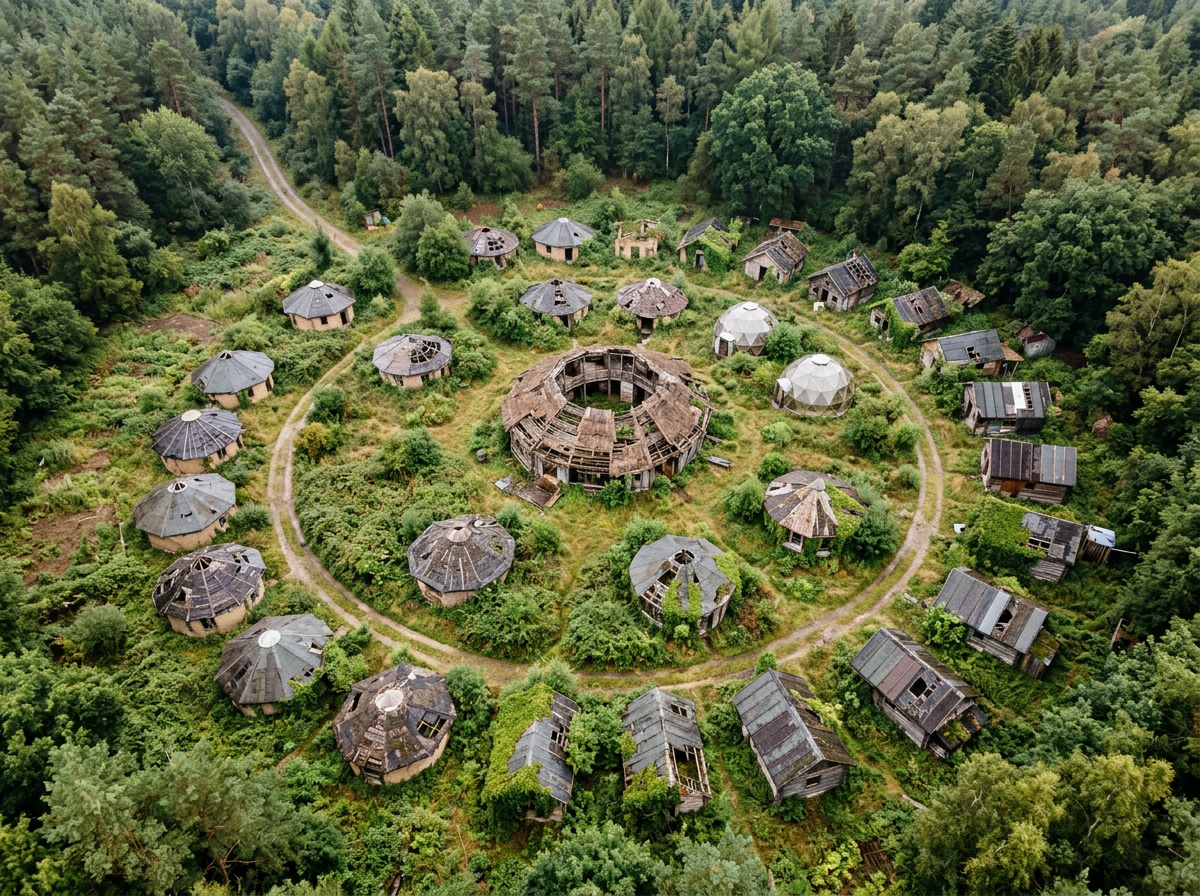
The Hidden Social, Psychological, and Governance Dynamics That Undermine Collective Living
Meta Description
Why most intentional communities fail despite idealistic visions and shared values. Explore the psychological, governance, social, and systems-thinking dynamics that determine whether communities become resilient, fragmented, or unsustainable.
Introduction
For generations, people have attempted to build intentional communities centered around:
- cooperation,
- shared values,
- spiritual alignment,
- ecological sustainability,
- collective stewardship,
- and alternative ways of living.
Some emerge from spiritual ideals.
Others from political philosophies, ecological concerns, economic experimentation, or cultural renewal.
Yet despite noble intentions, most intentional communities eventually fragment, stagnate, or collapse.
This pattern appears repeatedly across:
- communes,
- ecovillages,
- cooperative housing projects,
- spiritual communities,
- activist collectives,
- monasteries,
- decentralized organizations,
- and utopian social experiments throughout history.
The failure is rarely caused by idealism alone.
More often, intentional communities fail because they underestimate the complexity of human systems.
Shared values are important.
But values alone cannot sustain long-term collective living without:
- governance,
- boundaries,
- conflict systems,
- incentive alignment,
- psychological maturity,
- operational stewardship,
- and institutional resilience.
Intentional communities are not merely social gatherings.
They are living systems.
And living systems require structure.
The Romanticization Problem
One of the most common failure patterns is excessive idealism combined with insufficient systems design.
Many communities begin with:
- inspiration,
- emotional resonance,
- shared philosophy,
- and a desire to escape perceived dysfunction in mainstream society.
However, inspiration alone does not solve:
- resource allocation,
- interpersonal conflict,
- labor distribution,
- governance disputes,
- leadership accountability,
- psychological projection,
- or long-term operational sustainability.
Communities often romanticize:
- harmony,
- unity,
- and collective belonging,
while underestimating: - complexity,
- human variability,
- emotional load,
- and governance requirements.
This creates a dangerous imbalance:
high emotional idealism with low structural resilience.
Without operational foundations, idealism eventually collides with reality.
Human Psychology Does Not Disappear Inside Communities
A common misconception is that alternative communities somehow transcend ordinary human behavior.
In reality, intentional communities often intensify human dynamics because:
- proximity increases emotional exposure,
- collective living amplifies interpersonal friction,
- unresolved psychological patterns become highly visible,
- and social boundaries become more porous.
Communities therefore become environments where:
- shadow dynamics,
- power struggles,
- dependency patterns,
- attachment wounds,
- projection,
- and status hierarchies
can rapidly emerge.
Research on group psychology consistently demonstrates that humans naturally form:
- in-groups,
- hierarchies,
- identity structures,
- and social coalitions (Haidt, 2012).
No amount of idealistic language fully removes these tendencies.
Healthy communities do not deny human complexity.
They design systems capable of managing it constructively.
Governance Failure Is One of the Largest Causes of Collapse
Many intentional communities resist governance structures because governance is associated with:
- hierarchy,
- bureaucracy,
- control,
- or institutional rigidity.
However, the absence of governance rarely eliminates power.
It often merely obscures it.
In poorly structured communities:
- informal power networks emerge,
- charismatic personalities dominate,
- decision-making becomes inconsistent,
- accountability weakens,
- and conflict resolution becomes unstable.
This creates what sociologist Jo Freeman (1972) famously described as:
“the tyranny of structurelessness.”
Without transparent governance systems:
- hidden hierarchies often replace explicit structures,
- emotional influence may override competence,
- and unclear authority creates chronic instability.
Healthy communities require governance not because humans are failures,
but because coordination itself requires structure.
Conflict Avoidance Destroys Communities
Conflict itself is not the problem.
Poor conflict systems are.
Many intentional communities prioritize:
- harmony,
- emotional unity,
- and social cohesion,
while avoiding direct confrontation of tension.
This often creates:
- passive aggression,
- resentment accumulation,
- social fragmentation,
- scapegoating,
- and eventual implosion.
Communities that suppress disagreement frequently become psychologically fragile.
Healthy systems require:
- constructive disagreement,
- transparent communication,
- accountability,
- and repair mechanisms.
Research on resilient organizations consistently shows that adaptive systems depend upon the ability to process tension without collapse (Meadows, 2008).
Communities unable to metabolize conflict eventually accumulate systemic instability.
Infrastructure Matters More Than Ideology
One of the most overlooked realities is that communities often fail from operational weakness rather than philosophical weakness.
Shared beliefs cannot compensate for:
- poor financial planning,
- inadequate food systems,
- unsustainable labor expectations,
- weak governance,
- unclear responsibilities,
- or infrastructure failure.
Many communities devote enormous energy toward:
- philosophy,
- spirituality,
- identity,
- or ideological alignment,
while underinvesting in: - logistics,
- maintenance,
- economic resilience,
- operational stewardship,
- and institutional continuity.
However, civilizations survive through infrastructure, not idealism alone.
Sociologist and systems theorist Jared Diamond (2005) observed that societies frequently collapse not only from external pressure, but from failures in long-term resource management and adaptive coordination.
Communities are no different.
Shared Vision Is Not Enough
A shared vision may initiate a community.
But sustaining a community requires:
- competence,
- stewardship,
- systems thinking,
- adaptability,
- and long-term coordination.
Over time, communities encounter:
- leadership transitions,
- interpersonal fatigue,
- financial stress,
- ideological divergence,
- changing life stages,
- and resource constraints.
Without systems capable of adapting to these pressures, communities become increasingly unstable.
Healthy communities require both:
- philosophical coherence,
- and operational maturity.
This distinction is critical.
The Problem of Undefined Roles
Many intentional communities attempt to eliminate hierarchy entirely.
However, removing formal roles often creates:
- ambiguity,
- duplicated labor,
- unbalanced workloads,
- and invisible authority structures.
Healthy systems require:
- role clarity,
- stewardship accountability,
- skill differentiation,
- and decision-making pathways.
This does not necessarily require authoritarian control.
It requires organizational coherence.
Complex systems function more effectively when:
- responsibilities are visible,
- expectations are clear,
- and stewardship roles are understood.
Without role clarity, communities often drift into exhaustion and confusion.
Economic Fragility Undermines Stability
Many intentional communities underestimate the importance of economic resilience.
Communities require:
- food systems,
- maintenance systems,
- healthcare access,
- infrastructure upkeep,
- financial sustainability,
- and resource coordination.
Without stable economic foundations:
- burnout increases,
- internal tension escalates,
- and long-term continuity becomes difficult.
Economic fragility amplifies every other weakness within a community system.
Regenerative communities therefore require:
- resilient economic design,
- distributed stewardship,
- practical resource systems,
- and long-term sustainability planning.
Healthy Communities Require Boundaries
Communities often confuse openness with health.
However, systems without boundaries frequently become unstable.
Healthy communities require:
- onboarding standards,
- shared expectations,
- behavioral accountability,
- conflict protocols,
- exit pathways,
- and stewardship norms.
Without boundaries:
- dysfunction spreads more easily,
- responsibility becomes diffuse,
- and social coherence weakens.
In systems theory, boundaries are not merely restrictive.
They are part of what allows systems to maintain integrity.
The Difference Between Fragile and Anti-Fragile Communities
Fragile communities depend heavily on:
- emotional momentum,
- charismatic leadership,
- ideological purity,
- or temporary enthusiasm.
Anti-fragile communities develop:
- adaptive governance,
- distributed competence,
- resilience under stress,
- operational redundancy,
- and learning systems.
They recognize that:
- conflict will occur,
- mistakes will happen,
- leadership will evolve,
- and conditions will change.
Rather than attempting to eliminate complexity, resilient communities learn how to adapt to it.
Intentional Communities as Living Systems
Systems thinking reveals that intentional communities are not static ideals.
They are evolving ecosystems of:
- psychology,
- governance,
- economics,
- infrastructure,
- relationships,
- and culture.
Communities fail when they attempt to operate purely through:
- idealism,
- emotional resonance,
- or philosophical alignment,
without sufficient structural intelligence.
Healthy communities integrate:
- human psychology,
- governance design,
- operational stewardship,
- resilience planning,
- and adaptive feedback systems.
This is not a rejection of intentional communities.
It is an argument for maturity in how they are designed.
Conclusion
Most intentional communities do not fail because people lack good intentions.
They fail because:
- governance is underdeveloped,
- conflict systems are weak,
- infrastructure is neglected,
- psychological complexity is underestimated,
- and operational stewardship is insufficient.
Sustainable communities require more than shared ideals.
They require:
- systems literacy,
- accountability,
- resilience design,
- adaptive governance,
- and long-term stewardship.
Communities are living systems.
And like all living systems, they survive not through idealism alone,
but through their capacity to adapt, coordinate, regenerate, and remain coherent across time.
Suggested Crosslinks
- Systems Theory & Sensemaking
- Systems, Governance, and Organizational Design: Structure, Incentives, and Stability
- ARC XII — Complexity & Systems Thinking
- Applied Stewardship Toolkit
References
Diamond, J. (2005). Collapse: How societies choose to fail or succeed. Viking.
Freeman, J. (1972). The tyranny of structurelessness. Berkeley Journal of Sociology, 17, 151–164.
Haidt, J. (2012). The righteous mind: Why good people are divided by politics and religion. Pantheon Books.
Meadows, D. H. (2008). Thinking in systems: A primer. Chelsea Green Publishing.
The Living Archive is designed to be explored through pathways, categories, and search. If you’re looking for a specific idea, question, or theme, AI Search can help surface relevant connections across the archive.
Attribution
The Living Archive
Integrative Frameworks for Regenerative Civilization
© 2026 Gerald Daquila. All rights reserved.
Part of the Life.Understood. knowledge ecosystem and Stewardship Institute initiative.
This article is intended for educational, research, and civic inquiry purposes.
Readers are encouraged to engage critically, verify sources independently, and explore related knowledge hubs for broader systems context.
Leave a Reply