
Logo - Life.Understood.

Category: Civic Renewal

  • Collective Nervous Systems: How Cultures Regulate Human Coherence

    Collective Nervous Systems: How Cultures Regulate Human Coherence


    Beyond institutions and individuals, societies develop shared mechanisms that regulate emotion, attention, meaning, and collective behavior.


    Meta Description

    Cultures function as collective nervous systems, helping societies process information, regulate emotion, maintain trust, and coordinate behavior. Explore how cultural coherence influences resilience, social stability, and collective adaptation.


    When people hear the phrase “nervous system,” they typically think of biology.

    A nervous system senses the environment, processes information, coordinates responses, and helps an organism maintain stability amid changing conditions.

    It continuously integrates signals from countless sources while balancing adaptation with continuity.

    What is less commonly recognized is that societies perform similar functions.

    Cultures, institutions, communities, media systems, educational traditions, rituals, symbols, and shared narratives collectively help populations interpret reality, regulate emotion, coordinate behavior, and maintain social cohesion.

    In this sense, every society possesses something resembling a collective nervous system.

    The concept is not biological but systemic.

    Just as individual nervous systems help people navigate complexity, cultural systems help societies navigate uncertainty.

    When these systems function effectively, communities tend to exhibit greater trust, resilience, cooperation, and adaptability.

    When they become fragmented, societies often experience confusion, polarization, institutional distrust, and declining coherence.

    Understanding culture as a collective nervous system offers a useful framework for examining some of the most important challenges of the twenty-first century.


    Beyond Culture as Tradition

    Culture is often reduced to visible expressions such as food, language, music, clothing, festivals, or customs.

    These elements matter.

    Yet culture also performs deeper functions.

    Anthropologists have long observed that cultures serve as systems of meaning that help communities interpret reality and coordinate collective behavior (Geertz, 1973).

    Culture tells people:

    • What matters
    • What is acceptable
    • What is dangerous
    • What is worthy of attention
    • What responsibilities individuals have toward one another
    • How uncertainty should be interpreted

    These functions operate continuously, often beneath conscious awareness.

    Much like the nervous system regulates countless bodily processes without deliberate effort, cultural systems help regulate social life without requiring constant explicit coordination.


    Information Processing at Scale

    One of the primary functions of a nervous system is information processing.

    The same can be said of culture.

    Every day, societies encounter vast quantities of information.

    • Economic developments.
    • Political events.
    • Technological innovations.
    • Environmental changes.
    • Social conflicts.

    No individual can process all of this independently.

    Cultural systems therefore help determine which signals receive attention and which are ignored.

    • Journalists select stories.
    • Educators establish curricula.
    • Communities reinforce values.
    • Institutions define priorities.

    Collectively, these processes shape what societies notice.

    Attention is never neutral.

    What a society pays attention to influences what it becomes capable of responding to.


    Emotional Regulation Beyond the Individual

    Psychologists often discuss emotional regulation as an individual skill.

    Yet emotions are also social phenomena.

    Human beings continuously influence one another’s emotional states through interaction, communication, and shared experience (Hatfield et al., 1994).

    • Cultures play an important role in regulating these dynamics.
    • Rituals provide stability during periods of uncertainty.
    • Shared symbols create belonging.
    • Ceremonies help process grief, celebration, transition, and conflict.
    • Public narratives influence whether events are interpreted primarily through fear, hope, anger, resilience, or cooperation.

    These processes help societies manage collective emotional energy.

    Without such mechanisms, populations may become more vulnerable to volatility, panic, or fragmentation.

    Culture functions partly as a system of emotional coordination.


    Trust as Social Infrastructure

    Healthy nervous systems depend upon reliable signaling.

    When signals become distorted, confusion increases.

    Social systems operate similarly.

    Trust functions as a mechanism that allows information, cooperation, and coordination to occur efficiently.

    Communities with high trust often require fewer formal controls because expectations remain relatively predictable.

    People can cooperate with greater confidence.

    Institutions can function more effectively.

    Collective action becomes easier.

    Research on social capital consistently demonstrates the relationship between trust and societal resilience (Putnam, 2000).

    Trust does not emerge automatically.

    It is cultivated through repeated interactions, shared norms, institutional performance, and cultural expectations.

    In this sense, trust acts as a form of connective tissue within the collective nervous system.

    Trust is only one component of a larger process through which societies maintain coherence.

    Information must circulate, emotions must be regulated, meaning must be shared, and feedback must remain visible if communities are to adapt successfully to change.

    The framework below illustrates how these elements interact within a living social system, helping cultures function as collective nervous systems capable of learning, coordination, and resilience.

    Figure 1. The Cultural Coherence Cycle.

    Download Reference Map 006: The Coherence Cycle

    Healthy societies maintain coherence through continuous interactions among information flow, shared meaning, trust, emotional regulation, feedback, and collective adaptation.

    Like a nervous system, culture helps communities process signals, coordinate responses, preserve continuity, and remain resilient amid changing conditions.


    Coherence Is Not Uniformity

    Discussions about social cohesion sometimes generate concerns about conformity.

    These concerns are understandable.

    Healthy societies require diversity of thought, creativity, disagreement, and innovation.

    Coherence should not be confused with uniformity.

    A healthy nervous system contains countless specialized components performing different functions.

    Its strength comes not from sameness but from coordination.

    The same principle applies to societies.

    Coherent cultures allow diversity while maintaining sufficient shared understanding to enable cooperation.

    Citizens do not need identical beliefs.

    They do need enough common ground to communicate, resolve disagreements, and pursue collective goals.

    The challenge is maintaining this balance as societies become increasingly diverse and interconnected.


    Digital Networks and Cultural Fragmentation

    Modern information technologies have transformed how collective nervous systems operate.

    Historically, communities often shared common information environments.

    Local institutions, educational systems, religious organizations, and media outlets provided relatively stable reference points.

    Digital platforms disrupted this structure.

    Individuals now participate in highly personalized information ecosystems.

    • Algorithms shape attention.
    • Social media accelerates emotional transmission.
    • Competing narratives spread rapidly across networks.
    • These developments create opportunities for learning and connection.
    • They also increase fragmentation.

    People may increasingly inhabit different informational realities while sharing the same physical society.

    The result is often reduced coherence.

    The challenge is not merely disagreement.

    The challenge is maintaining enough shared understanding for collective problem-solving to remain possible.


    Cultural Resilience During Transition

    Periods of civilizational transition place unusual pressure on collective nervous systems.

    • Established narratives weaken.
    • Institutions face declining trust.
    • Technological disruption accelerates change.
    • Economic and social conditions become less predictable.

    Under such circumstances, cultural resilience becomes particularly important.

    Resilient cultures help communities navigate uncertainty without collapsing into chaos.

    They provide continuity amid transformation.

    They preserve identity while allowing adaptation.

    Historian Arnold Toynbee (1946) observed that civilizations often rise or decline based partly upon how effectively they respond to emerging challenges.

    Cultural systems play a crucial role in this process.

    Societies capable of learning, adapting, and maintaining coherence during disruption often demonstrate greater long-term resilience.


    The Importance of Shared Rituals

    One often overlooked feature of collective nervous systems is ritual.

    Modern societies frequently associate ritual with religion or tradition.

    Yet rituals exist in many forms.

    • National commemorations.
    • Graduation ceremonies.
    • Public holidays.
    • Community gatherings.
    • Professional norms.

    Even everyday social practices can function ritualistically.

    Rituals synchronize behavior.

    They reinforce shared values.

    They create moments of collective attention.

    In doing so, they help regulate social coherence.

    As traditional institutions weaken in many societies, questions increasingly arise about what mechanisms will perform these functions in the future.

    A society without rituals may struggle to maintain a sense of collective identity.


    Culture as Adaptive Memory

    Nervous systems do more than respond to immediate conditions.

    They store information from past experiences.

    Cultures perform a similar role.

    Historical memory helps societies avoid repeating mistakes.

    Traditions preserve accumulated knowledge.

    Stories transmit lessons across generations.

    This adaptive memory contributes to resilience.

    Communities that lose contact with their historical experiences often become more vulnerable to repeating familiar patterns.

    At the same time, cultures must balance memory with adaptation.

    A society cannot live entirely within the past.

    The challenge is preserving useful knowledge while remaining open to emerging realities.


    Toward Cultural Stewardship

    Viewing culture as a collective nervous system changes how societal health is understood.

    The focus shifts beyond economics, politics, or technology alone.

    Questions emerge such as:

    • How effectively does a society process information?
    • How well does it regulate collective emotion?
    • How resilient are its trust networks?
    • How capable is it of maintaining coherence amid diversity?
    • How effectively does it learn from experience?

    These are fundamentally cultural questions.

    They are also governance questions.

    And increasingly, they are resilience questions.

    Healthy societies do not merely manage resources.

    They cultivate the conditions that allow human beings to coordinate meaningfully with one another.


    The Future of Human Coherence

    Modern societies face unprecedented complexity.

    • Information flows accelerate.
    • Technologies evolve rapidly.
    • Institutions encounter growing pressures.
    • Traditional narratives continue to fragment.

    These developments place increasing demands on collective nervous systems.

    The challenge is not preserving old forms unchanged.

    Nor is it abandoning coherence entirely.

    The challenge is developing cultural systems capable of integrating diversity, complexity, and change without losing the ability to coordinate collective life.

    This requires trust.

    It requires shared meaning.

    It requires resilient institutions.

    Most importantly, it requires recognizing that human beings do not navigate complexity alone.

    We do so through networks of culture, community, memory, and meaning that shape how reality itself is interpreted.

    These networks function much like a collective nervous system.

    When they are healthy, societies become more adaptive, resilient, and capable of flourishing.

    When they weaken, fragmentation often follows.

    Understanding this dynamic may become one of the most important tasks of the decades ahead.


    Crosslinks


    References

    Geertz, C. (1973). The interpretation of cultures. Basic Books.

    Hatfield, E., Cacioppo, J. T., & Rapson, R. L. (1994). Emotional contagion. Cambridge University Press.

    Putnam, R. D. (2000). Bowling alone: The collapse and revival of American community. Simon & Schuster.

    Toynbee, A. J. (1946). A study of history. Oxford University Press.

    The Living Archive is designed to be explored through pathways, categories, and search. If you’re looking for a specific idea, question, or theme, AI Search can help surface relevant connections across the archive.


    Attribution

    The Living Archive
    Integrative Frameworks for Regenerative Civilization

    © 2026 Gerald Daquila. All rights reserved.
    Part of the Life.Understood. knowledge ecosystem and Stewardship Institute initiative.

    This article is intended for educational, research, and civic inquiry purposes.
    Readers are encouraged to engage critically, verify sources independently, and explore related knowledge hubs for broader systems context.

  • The Collapse of Shared Meaning: Why Societies Fragment Without Coherent Narratives

    The Collapse of Shared Meaning: Why Societies Fragment Without Coherent Narratives


    When common stories lose their ability to organize reality, societies often experience polarization, uncertainty, and declining social cohesion.


    Meta Description

    Shared narratives help societies coordinate behavior, build trust, and create meaning. Explore why the decline of common narratives contributes to fragmentation, polarization, and institutional instability in the modern world.


    Every society operates through stories.

    Not merely myths, legends, or cultural traditions, but shared frameworks of meaning that help people understand who they are, what kind of society they belong to, and where that society is heading.

    • These narratives serve important functions.
    • They provide coherence.
    • They establish expectations.
    • They create a sense of collective identity.
    • They help individuals understand how their personal lives connect to larger social realities.

    Most of the time, these narratives remain largely invisible.

    People rarely think consciously about them because they are embedded within institutions, education systems, cultural norms, media environments, and everyday assumptions.

    Yet when these narratives begin to weaken, societies often experience profound disruption.

    The result is not merely political disagreement or cultural tension.

    • It is a crisis of meaning.
    • A society can survive economic shocks.
    • It can recover from political conflict.
    • It can adapt to technological change.

    What proves more difficult is functioning effectively when citizens no longer share a basic framework for interpreting reality itself.


    Why Shared Meaning Matters

    Human beings are not simply rational actors responding to objective facts.

    People interpret events through stories.

    Narratives help organize complexity into understandable patterns.

    They answer questions such as:

    • Who are we?
    • What matters?
    • What responsibilities do we have toward one another?
    • What does progress look like?
    • What kind of future are we building?

    Sociologist Peter Berger (1967) argued that societies create what he called a “sacred canopy”—a shared symbolic framework that helps individuals make sense of the world around them.

    Whether religious, cultural, civic, or ideological, these frameworks provide coherence.

    • Without them, social life becomes more difficult to coordinate.
    • Institutions depend upon shared assumptions.
    • Communities depend upon shared expectations.
    • Trust depends upon shared understanding.

    Meaning acts as social infrastructure.


    The Historical Role of Grand Narratives

    Throughout history, societies have organized themselves around broad narratives that provided orientation and legitimacy.

    • Religious traditions offered explanations about humanity’s place within the cosmos.
    • National narratives created shared identities among diverse populations.
    • Political philosophies articulated visions of justice, citizenship, and social order.
    • Economic systems provided expectations about prosperity and opportunity.

    These narratives were rarely perfect.

    They often excluded groups, oversimplified reality, or failed to account for complexity.

    Yet they performed an important social function.

    • They reduced uncertainty.
    • They coordinated behavior.
    • They provided common reference points through which disagreements could be negotiated.

    Even when people disagreed, they often disagreed within the same narrative framework.

    The challenge today is that many of these frameworks appear to be weakening simultaneously.


    The Fragmentation of Meaning

    Several developments have contributed to the erosion of shared narratives.

    • Globalization exposed populations to diverse cultures, perspectives, and worldviews.
    • Technological change accelerated social transformation.
    • Institutional trust declined in many regions.
    • Digital media disrupted traditional information systems.

    As these changes accumulated, many societies became increasingly pluralistic.

    Pluralism offers important benefits.

    It encourages diversity, innovation, and intellectual freedom.

    However, it also creates new challenges.

    As the number of competing narratives increases, establishing common meaning becomes more difficult.

    People may occupy the same physical society while inhabiting very different interpretive realities.

    • They consume different media.
    • Trust different institutions.
    • Follow different authorities.
    • Adopt different explanations for the same events.

    The result is not simply disagreement.

    It is fragmentation.


    Information Abundance and Narrative Competition

    Historically, information environments were relatively centralized.

    Newspapers, educational institutions, religious organizations, and public broadcasters often served as common reference points.

    Digital technologies transformed this structure.

    Today, individuals encounter unprecedented volumes of information.

    At first glance, this appears beneficial.

    More information should lead to better understanding.

    Yet information alone does not create meaning.

    Meaning requires interpretation.

    As information expands, so does competition among narratives attempting to explain it.

    The result is a paradox.

    Societies now possess more information than ever before while often struggling to maintain shared understanding.

    The challenge is not a lack of facts.

    The challenge is a surplus of competing interpretations.

    This distinction is increasingly important.


    The Relationship Between Meaning and Trust

    Trust is often discussed as though it were an independent social variable.

    In reality, trust and meaning are closely connected.

    • People trust institutions when they believe those institutions operate within a coherent and legitimate framework.
    • They trust communities when shared norms remain visible.
    • They trust one another when expectations remain reasonably predictable.

    When shared narratives weaken, trust frequently declines as well.

    • Individuals become less certain about collective goals.
    • Institutional legitimacy becomes more contested.
    • Common expectations become harder to sustain.

    The resulting uncertainty often encourages defensive behavior.

    Groups become more protective of their identities.

    Social cooperation becomes more difficult.

    Polarization increases.

    What appears to be a trust crisis is often partly a meaning crisis.


    Polarization as a Meaning Conflict

    Political polarization is frequently explained through differences in ideology, policy preferences, or economic interests.

    These factors matter.

    Yet many contemporary conflicts run deeper.

    Groups are often competing not merely over solutions but over interpretations of reality itself.

    • What is happening?
    • Why is it happening?
    • Who is responsible?
    • What values should guide society?

    Different narratives provide different answers.

    As shared frameworks weaken, conflicts increasingly occur between competing meaning systems.

    This helps explain why some public debates appear unusually intense.

    Participants are not simply defending opinions.

    They are defending identities, values, and worldviews.

    The conflict becomes existential rather than procedural.


    The Human Need for Coherence

    Psychological research suggests that human beings possess a strong need for coherence and meaning (Frankl, 1959/2006).

    People generally prefer environments that feel understandable and predictable.

    When coherence declines, anxiety often increases.

    • Individuals respond in different ways.
    • Some seek stronger group identities.
    • Others embrace ideological certainty.
    • Some withdraw from public life altogether.
    • Others become increasingly engaged in attempts to restore meaning.

    These responses are understandable.

    Meaning is not a luxury.

    It is a psychological necessity.

    The challenge is ensuring that efforts to restore coherence do not sacrifice complexity, nuance, or reality.


    Why Meaning Cannot Be Manufactured

    Recognizing the importance of shared narratives does not mean societies should impose uniform beliefs.

    History demonstrates the dangers of rigid ideological control.

    Meaning imposed through coercion rarely remains durable.

    Authentic shared narratives emerge through participation rather than enforcement.

    They develop through culture, institutions, dialogue, experience, and collective problem-solving.

    • They evolve over time.
    • They remain open to revision.
    • Importantly, they must remain connected to reality.

    Narratives that ignore complexity may temporarily provide comfort.

    Eventually, however, reality reasserts itself.

    Healthy meaning systems balance coherence with adaptability.

    They provide orientation without becoming dogmatic.


    The Search for New Integrative Narratives

    Many contemporary societies appear to be searching for new forms of shared meaning.

    The challenge is not necessarily returning to older narratives.

    • Conditions have changed.
    • Technologies have changed.
    • Institutions have changed.
    • The world itself has become more interconnected.

    Future narratives may therefore need different qualities.

    • They may need to accommodate diversity without collapsing into fragmentation.
    • They may need to embrace complexity without sacrificing coherence.
    • They may need to support local identities while maintaining broader social coordination.

    Most importantly, they may need to provide common purpose without requiring uniformity.

    This is not an easy task.

    Yet history suggests that societies eventually develop new frameworks capable of organizing emerging realities.


    Meaning as Civic Infrastructure

    Modern societies devote enormous resources to physical infrastructure.

    • Roads.
    • Bridges.
    • Power systems.
    • Communications networks.

    These investments are necessary because complex societies cannot function without them.

    Meaning performs a similar function.

    Shared narratives help coordinate behavior, support trust, maintain legitimacy, and foster cooperation.

    Without these foundations, institutions become fragile.

    • Communities become fragmented.
    • Collective action becomes more difficult.
    • Meaning is not merely a cultural concern.
    • It is a civic concern.
    • It is a governance concern.
    • It is a resilience concern.

    Beyond Fragmentation

    The collapse of shared meaning is not simply a cultural phenomenon.

    It is a systems phenomenon.

    Information systems, institutions, communities, technologies, and psychological needs all interact to shape how societies understand themselves.

    The challenge facing modern societies is not eliminating disagreement.

    Disagreement is inevitable.

    Healthy societies require it.

    The challenge is maintaining sufficient coherence to enable cooperation despite disagreement.

    • This requires more than facts.
    • It requires more than information.
    • It requires frameworks capable of connecting individuals to larger purposes while remaining flexible enough to accommodate complexity.

    The future may not belong to societies that achieve perfect consensus.

    Such a condition has rarely existed.

    It may belong to societies capable of developing narratives broad enough to sustain cooperation, resilient enough to adapt to change, and honest enough to remain grounded in reality.

    In an age of fragmentation, the ability to cultivate shared meaning may become one of the most important forms of social infrastructure a civilization can possess.


    Crosslinks


    References

    Berger, P. L. (1967). The sacred canopy: Elements of a sociological theory of religion. Anchor Books.

    Frankl, V. E. (2006). Man’s search for meaning. Beacon Press. (Original work published 1959)

    Harari, Y. N. (2018). 21 lessons for the 21st century. Spiegel & Grau.

    Putnam, R. D. (2000). Bowling alone: The collapse and revival of American community. Simon & Schuster.

    Weick, K. E. (1995). Sensemaking in organizations. Sage Publications.

    The Living Archive is designed to be explored through pathways, categories, and search. If you’re looking for a specific idea, question, or theme, AI Search can help surface relevant connections across the archive.


    Attribution

    The Living Archive
    Integrative Frameworks for Regenerative Civilization

    © 2026 Gerald Daquila. All rights reserved.
    Part of the Life.Understood. knowledge ecosystem and Stewardship Institute initiative.

    This article is intended for educational, research, and civic inquiry purposes.
    Readers are encouraged to engage critically, verify sources independently, and explore related knowledge hubs for broader systems context.

  • Beyond Colonial Narratives: What Was Actually Lost in the Philippines?

    Beyond Colonial Narratives: What Was Actually Lost in the Philippines?


    Moving beyond romanticism and revisionism to examine the institutions, knowledge systems, and social capacities altered by centuries of colonial rule.


    Meta Description

    What was actually lost during the colonial period in the Philippines? Beyond simplistic narratives of decline or progress, this article explores the institutions, knowledge systems, governance structures, and cultural capacities transformed by colonialism.


    Few topics generate as much debate in Philippine history as the legacy of colonialism.

    Some narratives portray the precolonial Philippines as a lost golden age disrupted by foreign conquest.

    Others argue that colonial rule brought the institutions, technologies, and political structures necessary for modernization. Both perspectives contain elements of truth. Both also risk oversimplifying a far more complex reality.

    The challenge is that discussions about colonial history often become trapped between nostalgia and justification.

    One side romanticizes the past.

    The other rationalizes the disruption.

    Neither approach fully answers a more important question:

    What was actually lost?

    Answering this question requires moving beyond ideology and examining the specific systems, capabilities, and social structures that were altered, weakened, replaced, or transformed during centuries of colonial rule.

    The goal is not to assign moral purity to either the precolonial or colonial period.

    The goal is to understand what changed—and why those changes continue to matter today.


    The Philippines Before Colonial Rule

    Prior to Spanish colonization in the sixteenth century, the Philippine archipelago was not a unified nation-state.

    Instead, it consisted of diverse societies connected through trade networks, kinship systems, maritime routes, and cultural exchange (Scott, 1994).

    Communities varied significantly across regions.

    • Some were coastal trading settlements connected to broader Asian commercial networks.
    • Others were agricultural societies organized around local leadership structures.
    • Political authority was often decentralized.
    • Social organization was typically rooted in kinship, reciprocity, customary law, and local governance.

    Contrary to popular misconceptions, precolonial societies were neither primitive nor isolated.

    Archaeological and historical evidence demonstrates extensive interaction with neighboring regions including China, India, the Malay world, and various parts of Southeast Asia (Junker, 2000).

    The question is not whether these societies were perfect.

    They were not.

    The question is what capacities existed that were later disrupted.


    The Loss of Indigenous Governance Systems

    One of the most significant transformations involved governance.

    Precolonial communities possessed locally embedded systems of leadership, dispute resolution, alliance-building, and resource management.

    These structures varied across regions but often operated at a human scale.

    Authority depended heavily upon relationships, reputation, reciprocity, and demonstrated competence rather than distant bureaucratic administration (Scott, 1994).

    Spanish colonial rule gradually replaced many of these structures with centralized governance systems designed to serve imperial objectives.

    Local leadership was often incorporated into colonial administration rather than eliminated outright.

    However, the logic of governance changed.

    Authority increasingly flowed upward toward colonial institutions rather than outward through local networks.

    The result was not merely political change.

    It was a transformation in how communities related to power itself.

    Over time, local governance traditions became less influential while centralized authority became more dominant.


    The Disruption of Maritime Identity

    Perhaps one of the least discussed losses involves maritime orientation.

    • The Philippine archipelago is composed of thousands of islands.
    • For much of precolonial history, the sea functioned as a connector rather than a barrier.
    • Communities traded extensively across maritime routes.

    Economic, cultural, and political relationships often developed through regional networks extending beyond the archipelago itself (Junker, 2000).

    Colonial administration gradually reoriented these relationships.

    • Trade became increasingly organized around imperial priorities.
    • Movement became more regulated.
    • Economic activity became more closely tied to colonial centers.

    Some historians argue that this contributed to a weakening of indigenous maritime traditions and regional trade autonomy (Bankoff, 2007).

    The significance extends beyond economics.

    Maritime societies often develop distinct ways of understanding mobility, exchange, adaptation, and identity.

    The decline of these traditions altered how communities related to the broader region.


    The Transformation of Knowledge Systems

    Knowledge systems were also affected.

    Every society develops methods for transmitting practical, cultural, ecological, and social knowledge across generations.

    These systems include language, oral traditions, apprenticeship structures, agricultural practices, navigation techniques, medicinal knowledge, and customary law.

    Colonial rule introduced new educational frameworks, religious institutions, and administrative structures.

    Some forms of knowledge expanded.

    Others diminished.

    The issue is not that colonial education produced no benefits.

    The issue is that it frequently prioritized external frameworks while reducing the status and transmission of local knowledge systems.

    Many indigenous practices survived.

    Others became fragmented, marginalized, or lost altogether.

    The consequences remain visible today.

    Modern societies often underestimate how much knowledge can disappear when cultural transmission networks weaken.


    Language and Cultural Memory

    Language serves as more than a communication tool.

    It also functions as a repository of cultural memory.

    Concepts, relationships, ecological knowledge, social values, and collective experiences are often embedded within language itself.

    Colonial periods frequently alter linguistic landscapes.

    • New languages gain prestige.
    • Existing languages may lose status within formal institutions.
    • The Philippines experienced these dynamics repeatedly through Spanish, American, and later global influences.

    While linguistic diversity remains one of the country’s strengths, many indigenous languages have experienced decline.

    When languages disappear, unique ways of interpreting reality often disappear with them.

    This is not merely a cultural issue.

    It is a knowledge issue.

    Languages contain information accumulated across generations.

    Their loss reduces the diversity of human understanding.


    The Erosion of Local Institutional Capacity

    Another consequence of colonial rule involved institutional dependency.

    • When decision-making becomes concentrated within external authorities, local communities may gradually lose opportunities to develop governance capabilities independently.
    • This process does not occur because communities lack competence.
    • It occurs because institutional responsibility shifts elsewhere.

    Over time, populations become accustomed to looking upward for solutions rather than outward toward local cooperation.

    This pattern can persist long after colonial rule formally ends.

    Political scientists have observed that institutional legacies often influence development trajectories for generations (North, 1990).

    The challenge is not merely rebuilding infrastructure.

    It is rebuilding institutional confidence and civic capacity.


    What Was Not Lost

    Historical analysis also requires balance.

    Not everything disappeared.

    Many indigenous traditions survived despite centuries of disruption.

    • Kinship networks remained strong.
    • Community reciprocity persisted.
    • Local identities endured.
    • Languages survived.
    • Cultural practices adapted.
    • Religious traditions merged with existing beliefs in uniquely Filipino ways.

    In many cases, traditions evolved rather than vanished.

    This distinction matters.

    The Philippines is not simply a society recovering from loss.

    It is also a society shaped by adaptation.

    Much of what exists today reflects centuries of cultural synthesis rather than straightforward replacement.

    Understanding this complexity helps avoid simplistic narratives of either total destruction or uninterrupted continuity.


    Beyond Nostalgia

    One of the dangers of historical reflection is nostalgia.

    • When societies encounter contemporary challenges, the past can appear more coherent than it actually was.
    • Precolonial communities faced conflict, inequality, environmental pressures, and political competition like all human societies.
    • There was no utopian golden age.

    Yet rejecting romanticism does not require dismissing genuine losses.

    Historical inquiry is most useful when it helps identify capacities that may still hold value today.

    • The goal is not restoration.
    • The goal is learning.
    • What governance practices fostered local accountability?
    • What forms of community cooperation proved resilient?
    • What ecological knowledge remains relevant?
    • What institutional principles deserve renewed attention?

    These questions are more productive than attempts to recreate the past.


    What Recovery Actually Means

    Discussions about decolonization often focus on symbols, narratives, and identity.

    These issues matter.

    Yet meaningful recovery may depend even more upon rebuilding capacities.

    A society cannot recover what it no longer understands.

    The task is therefore not simply remembering history.

    It is understanding the systems embedded within that history.

    Recovery may involve:

    • Strengthening local governance capacity
    • Preserving linguistic diversity
    • Revitalizing ecological knowledge
    • Rebuilding civic participation
    • Supporting community resilience
    • Reconnecting with regional and maritime perspectives

    These efforts are not about rejecting modernity.

    They are about expanding the range of resources available for navigating contemporary challenges.


    A More Useful Question

    The most important question may not be whether colonialism was entirely good or entirely bad.

    History rarely operates through such simple categories.

    A more useful question is:

    What capacities existed before colonial rule that remain relevant today?

    This shift changes the conversation.

    Instead of debating idealized pasts, it encourages examination of practical lessons.

    The Philippines faces many twenty-first-century challenges involving governance, resilience, identity, development, and institutional trust.

    Addressing these challenges requires looking forward.

    Yet looking forward becomes easier when societies understand what historical resources remain available.

    The purpose of studying what was lost is not to remain attached to loss.

    It is to identify what can still be learned, adapted, and renewed.

    In that sense, history becomes less about nostalgia and more about possibility.


    Crosslinks


    References

    Bankoff, G. (2007). Islands at the center of the world: The Philippine archipelago in global history. Ateneo de Manila University Press.

    Junker, L. L. (2000). Raiding, trading, and feasting: The political economy of Philippine chiefdoms. University of Hawai’i Press.

    North, D. C. (1990). Institutions, institutional change and economic performance. Cambridge University Press.

    Scott, W. H. (1994). Barangay: Sixteenth-century Philippine culture and society. Ateneo de Manila University Press.

    The Living Archive is designed to be explored through pathways, categories, and search. If you’re looking for a specific idea, question, or theme, AI Search can help surface relevant connections across the archive.


    Attribution

    The Living Archive
    Integrative Frameworks for Regenerative Civilization

    © 2026 Gerald Daquila. All rights reserved.
    Part of the Life.Understood. knowledge ecosystem and Stewardship Institute initiative.

    This article is intended for educational, research, and civic inquiry purposes.
    Readers are encouraged to engage critically, verify sources independently, and explore related knowledge hubs for broader systems context.

  • The Philippines and Civilizational Transition

    The Philippines and Civilizational Transition


    Why a Fractured Archipelago May Reveal the Future of Human Systems


    Meta Description

    Explore why the Philippines may represent a unique civilizational case study in resilience, diaspora intelligence, post-colonial recovery, governance, and regenerative systems during a period of global transition.


    Introduction

    At first glance, the Philippines may appear an unlikely candidate for civilizational reflection.

    The country is frequently associated with:

    • corruption,
    • weak institutions,
    • infrastructure strain,
    • political dynasties,
    • ecological vulnerability,
    • economic dependency,
    • colonial trauma,
    • and recurring natural disasters.

    By conventional metrics of geopolitical power, it rarely appears at the center of global imagination.

    Yet beneath these visible fractures lies something more complex.

    The Philippines represents one of the world’s most compressed convergence zones of historical layering, ecological pressure, diaspora adaptation, social resilience, and post-colonial transformation.

    It exists simultaneously at the intersection of:

    • East and West,
    • indigenous and colonial systems,
    • tradition and hyper-modernity,
    • local community and global migration,
    • institutional fragility and extraordinary social adaptability.

    This does not make the Philippines “superior.”

    Nor does it romanticize suffering or instability.

    Rather, the Philippines may function as a revealing systems case study for understanding how societies adapt under prolonged pressure while attempting to preserve relational coherence amid accelerating global change.

    In this sense, the Philippines may matter not because it has escaped fracture, but because it reveals what human systems look like inside transition itself.


    A Nation Formed Through Layered Colonial Compression

    Few countries contain as many overlapping civilizational layers compressed into one social body.

    The Philippines carries:

    • pre-colonial indigenous systems,
    • centuries of Spanish colonization,
    • American institutional restructuring,
    • Japanese wartime trauma,
    • Catholic cosmology,
    • Asian regional influence,
    • neoliberal globalization,
    • and contemporary digital hyperconnectivity simultaneously.

    These layers did not disappear when new systems emerged.

    They accumulated.

    As a result, Filipino identity often operates through hybridity rather than singular civilizational continuity.

    This creates both instability and adaptive flexibility.

    Post-colonial theorists note that societies shaped through prolonged colonization frequently experience fragmented institutional identity, cultural discontinuity, and dependency structures persisting long after formal political independence (Fanon, 1963).

    The Philippines reflects many of these conditions.

    Yet it also demonstrates remarkable cultural persistence despite them.


    Fracture as Systems Exposure

    The Philippines experiences multiple forms of overlapping pressure simultaneously.

    These include:

    • typhoons,
    • earthquakes,
    • volcanic activity,
    • economic inequality,
    • migration dependency,
    • governance inconsistency,
    • infrastructure vulnerability,
    • and geopolitical tension.

    From a systems perspective, this creates conditions of continuous adaptive stress.

    Many future global pressures already visible elsewhere in fragmented form appear in concentrated form within the Philippine experience.

    This includes:

    • ecological instability,
    • institutional fragility,
    • information saturation,
    • diaspora fragmentation,
    • and economic precarity.

    As a result, the Philippines may function as a kind of civilizational pressure chamber where emerging global conditions become visible earlier and more intensely.

    The country therefore offers insight not because it has solved modern complexity, but because it lives inside it continuously.


    Social Cohesion Amid Structural Fragility

    One of the most striking features of the Philippines is the persistence of social cohesion despite chronic institutional weakness.

    In many societies, prolonged instability erodes collective trust and relational continuity.

    Yet Filipino society often maintains:

    • strong family systems,
    • interpersonal warmth,
    • communal adaptability,
    • hospitality norms,
    • mutual aid behaviors,
    • and emotional resilience under pressure.

    This social resilience frequently compensates for institutional deficiencies.

    Sociologists have long noted that high-trust relational cultures can preserve social continuity even under material hardship (Fukuyama, 1995).

    The Philippines demonstrates this repeatedly during:

    • natural disasters,
    • economic crises,
    • migration fragmentation,
    • and political instability.

    This does not erase real systemic problems.

    However, it reveals an important civilizational insight:

    Institutional resilience alone does not determine societal survival.

    Relational resilience matters too.


    Diaspora as Distributed Adaptive Intelligence

    The Filipino diaspora is one of the largest and most globally distributed populations in the world.

    Millions of Filipinos live and work across:

    • North America,
    • Europe,
    • the Middle East,
    • Asia,
    • Oceania,
    • and maritime labor systems.

    This diaspora is often discussed economically through remittances.

    Yet its deeper significance may be civilizational.

    Diaspora populations develop:

    • cross-cultural adaptability,
    • multilingual navigation,
    • identity fluidity,
    • distributed survival intelligence,
    • and transnational coordination capacity.

    Filipino workers frequently operate across radically different systems while preserving relational ties to family and homeland.

    This creates a form of globally distributed adaptive consciousness rarely recognized within traditional geopolitical analysis.

    The diaspora becomes not merely labor migration, but a transnational resilience network.


    Ecological Frontline Civilization

    The Philippines exists on the frontline of climate instability.

    Typhoons, flooding, sea-level rise, heat stress, and ecological disruption increasingly shape national reality.

    Many industrialized societies still experience climate instability as future abstraction.

    The Philippines experiences it as present reality.

    This ecological exposure creates difficult conditions.

    Yet it also accelerates adaptation awareness.

    Communities repeatedly forced to respond to instability often develop:

    • improvisational resilience,
    • distributed mutual aid,
    • adaptive flexibility,
    • and local survival intelligence.

    This does not romanticize disaster.

    Rather, it recognizes that ecological instability is becoming a defining civilizational condition globally.

    The Philippine experience may therefore offer insight into how societies psychologically and socially adapt under recurring systemic stress.


    Governance Fragility and Civilizational Lessons

    The Philippines also reveals important lessons regarding governance.

    Persistent challenges include:

    • corruption,
    • bureaucratic inconsistency,
    • political dynasties,
    • infrastructure inequality,
    • weak long-term planning,
    • and uneven institutional trust.

    These realities cannot be ignored or spiritually bypassed.

    However, governance fragility itself becomes part of the systems lesson.

    The Philippines demonstrates how:

    • colonial legacies,
    • economic dependency,
    • elite capture,
    • and fragmented institutional continuity

    can weaken state capacity across generations.

    At the same time, it reveals how populations compensate through informal systems of relational support and adaptive survival.

    This tension between institutional weakness and social resilience is globally important.

    Many societies increasingly face similar pressures as trust in institutions declines worldwide.


    The Global South and Emerging Civilizational Insight

    Much of modern global discourse remains dominated by Western institutional frameworks.

    Yet many Global South societies possess forms of adaptive intelligence developed under conditions of prolonged instability, scarcity, and external pressure.

    The Philippines may represent part of this emerging civilizational perspective.

    Not because suffering itself is desirable.

    But because prolonged exposure to instability often produces heightened sensitivity to:

    • systems fragility,
    • relational dependence,
    • community resilience,
    • ecological reality,
    • and adaptive improvisation.

    Societies accustomed to comfort and abundance sometimes lose resilience capacities that become visible again under stress.

    The Philippines therefore reflects not merely “underdevelopment,” but a different relationship to uncertainty itself.


    Why Symbolic Interpretations Emerge

    Within spiritual and symbolic frameworks, some have described the Philippines metaphorically as a “heart-centered” culture.

    This symbolism does not need to be interpreted literally to hold meaning.

    From a symbolic perspective, the “heart” often represents:

    • relational intelligence,
    • emotional resilience,
    • compassion,
    • adaptability,
    • and connective social capacity.

    In this sense, the metaphor reflects observable social dynamics:

    • warmth despite hardship,
    • hospitality amid instability,
    • relational continuity despite fragmentation,
    • and community persistence under pressure.

    The symbolism becomes less about mystical exceptionalism and more about archetypal interpretation.

    Healthy symbolic frameworks illuminate patterns without abandoning reality.


    Civilizational Transition and the Philippines

    Modern civilization appears increasingly unstable across multiple domains simultaneously:

    • ecological systems,
    • governance systems,
    • economic systems,
    • information systems,
    • and cultural coherence.

    The Philippines exists at the intersection of many of these fractures.

    This makes it an unusually revealing mirror.

    The country reflects:

    • post-colonial recovery,
    • ecological adaptation,
    • diaspora identity,
    • institutional incompleteness,
    • digital acceleration,
    • and relational resilience simultaneously.

    These are not uniquely Philippine conditions.

    They are increasingly global conditions.

    The Philippines simply experiences them in highly concentrated form.

    This may explain why the country occupies an important symbolic and systems-oriented position within frameworks exploring civilizational transition.


    Beyond Romanticism and Despair

    Two distortions should be avoided.

    The first is romantic idealization:

    portraying the Philippines as spiritually superior or uniquely destined.

    The second is reductionist despair:

    viewing the country only through corruption, dysfunction, and instability.

    Both perspectives flatten complexity.

    The Philippines contains:

    • profound beauty,
    • deep fracture,
    • resilience,
    • institutional weakness,
    • creativity,
    • dependency,
    • warmth,
    • and unresolved trauma simultaneously.

    Like many societies in transition, it is internally contradictory.

    Yet contradiction itself may reveal important truths about the human condition during periods of systemic transformation.


    A Living Systems Case Study

    From a systems perspective, the Philippines may best be understood not as utopia, but as a living laboratory of civilizational transition.

    It reveals:

    • how people survive fragmentation,
    • how identity adapts under hybridity,
    • how relational systems compensate for institutional weakness,
    • how ecological pressure reshapes culture,
    • and how communities preserve continuity under instability.

    These dynamics are becoming increasingly relevant globally.

    As climate instability, technological acceleration, governance fragmentation, and economic pressure intensify worldwide, many societies may encounter conditions long familiar to the Philippine experience.

    The Philippines therefore matters not because it has transcended fracture.

    But because it reveals how humanity continues adapting within it.


    Toward Regenerative Futures

    The future may depend less upon returning to idealized stability and more upon developing systems capable of:

    • resilience,
    • relational coherence,
    • adaptive governance,
    • ecological stewardship,
    • and long-term civilizational learning.

    The Philippine experience offers insight into both:

    • the dangers of unresolved systemic fragility,
      and
    • the enduring strength of human relational resilience.

    This combination makes the country uniquely important within conversations about regenerative futures.

    Not as a perfect model.

    But as a revealing threshold.

    A place where the fractures of modern civilization — and the possibilities for more adaptive human systems — become unusually visible at the same time.


    Suggested Crosslinks


    References

    Fanon, F. (1963). The wretched of the earth. Grove Press.

    Fukuyama, F. (1995). Trust: The social virtues and the creation of prosperity. Free Press.

    Meadows, D. H. (2008). Thinking in systems: A primer. Chelsea Green Publishing.

    Senge, P. M. (1990). The fifth discipline: The art and practice of the learning organization. Doubleday.

    The Living Archive is designed to be explored through pathways, categories, and search. If you’re looking for a specific idea, question, or theme, AI Search can help surface relevant connections across the archive.


    Attribution

    The Living Archive
    Integrative Frameworks for Regenerative Civilization

    © 2026 Gerald Daquila. All rights reserved.
    Part of the Life.Understood. knowledge ecosystem and Stewardship Institute initiative.

    This article is intended for educational, research, and civic inquiry purposes.
    Readers are encouraged to engage critically, verify sources independently, and explore related knowledge hubs for broader systems context.

  • Governance Before Spirituality

    Governance Before Spirituality


    Why Stable Societies Require Functional Systems Before Higher Ideals Can Flourish


    Meta Description

    Explore why governance, infrastructure, institutional stability, and social coordination form the foundation upon which spirituality, consciousness, and higher human development can sustainably emerge within civilization.


    Introduction

    Throughout history, human societies have pursued meaning, transcendence, ethics, ritual, philosophy, and spiritual understanding. Yet civilizations are not sustained by ideals alone.

    People require food systems, water systems, infrastructure, governance, conflict mediation, economic coordination, healthcare, energy systems, education, and institutional stability simply to maintain the conditions necessary for collective life.

    Without functioning systems, higher aspirations often collapse beneath survival pressures.

    This does not diminish spirituality.

    Rather, it reveals an important civilizational principle:

    Stable governance frequently forms the substrate upon which higher human development becomes possible.

    When institutions fail, populations tend to shift attention toward immediate survival concerns. Social fragmentation increases. Trust erodes. Cooperation weakens.

    Long-term thinking declines. Under severe instability, even deeply ethical or spiritually oriented communities may struggle to maintain coherence.

    The relationship between governance and spirituality is therefore not oppositional.

    It is structural.

    Civilization requires systems capable of sustaining the conditions under which human flourishing — including philosophical, ethical, artistic, and spiritual flourishing — can emerge.


    Human Needs and Civilizational Stability

    Human beings operate within layered needs.

    Food security, shelter, physical safety, healthcare, and social stability form foundational conditions for psychological and cultural development.

    Abraham Maslow’s hierarchy of needs, while simplified, reflects an important systems reality: survival instability narrows cognitive bandwidth toward immediate pressures.

    Communities facing chronic insecurity often experience:

    • Reduced institutional trust
    • Increased conflict
    • Lower civic participation
    • Shortened time horizons
    • Higher stress and polarization
    • Weakened cooperative capacity

    Under such conditions, societies may struggle to sustain long-term ethical, philosophical, or spiritual development.

    Governance systems therefore matter not merely politically, but developmentally.

    Functional governance stabilizes the environment within which higher-order human capacities can emerge.


    Governance as Coordinated Civilization

    Governance is often misunderstood as merely politics or state power.

    At a deeper level, governance refers to how societies coordinate collective life.

    This includes:

    • Resource distribution
    • Infrastructure management
    • Conflict mediation
    • Legal frameworks
    • Public accountability
    • Economic coordination
    • Information systems
    • Disaster response
    • Institutional continuity

    Without governance, large-scale civilization becomes difficult to sustain.

    Even highly decentralized communities still require forms of governance through norms, agreements, participatory coordination, and stewardship systems.

    Elinor Ostrom’s work demonstrated that stable communities managing shared resources successfully develop governance structures adapted to local conditions (Ostrom, 1990).

    The issue is not whether governance exists.

    The issue is whether governance remains functional, adaptive, accountable, and aligned with societal well-being.


    Spirituality Cannot Substitute for Infrastructure

    One recurring civilizational mistake is assuming that moral aspiration alone can replace institutional competence.

    Good intentions do not maintain electrical grids.

    Consciousness discourse alone does not coordinate food systems, disaster response, public sanitation, transportation infrastructure, or healthcare logistics.

    Spiritual values may influence governance positively, but values alone cannot substitute for systems design.

    Civilizations require operational coherence.

    This includes:

    • Competent administration
    • Functional infrastructure
    • Reliable institutions
    • Adaptive governance
    • Transparent accountability
    • Long-term planning
    • Ecological stewardship
    • Distributed resilience

    Without these foundations, societies often become vulnerable to instability regardless of ideological or spiritual aspiration.

    History repeatedly demonstrates that civilizations collapse not merely because ideals disappear, but because systems fail.


    The Dangers of Escapist Spirituality

    Periods of institutional instability sometimes generate forms of spirituality disconnected from material and civic reality.

    This may appear as:

    • Withdrawal from civic responsibility
    • Rejection of institutional engagement
    • Overreliance on individual enlightenment narratives
    • Magical thinking replacing structural analysis
    • Avoidance of governance complexity
    • Passive optimism amid systemic deterioration

    Such tendencies may provide psychological comfort while leaving structural problems unresolved.

    Systems blindness can emerge when populations focus exclusively upon personal transcendence while neglecting the infrastructures supporting collective survival.

    A civilization cannot meditate its way out of failing water systems, collapsing institutions, ecological overshoot, or economic fragmentation without corresponding structural action.

    Spiritual maturity therefore includes engagement with reality rather than escape from it.


    Governance Failure Alters Consciousness Itself

    Institutional conditions shape psychological conditions.

    When governance systems become unstable, populations often experience:

    • Chronic stress
    • Fear-based cognition
    • Scarcity mentality
    • Social fragmentation
    • Reduced trust
    • Polarization
    • Emotional exhaustion

    Under such conditions, higher-order cognitive and ethical capacities may weaken.

    Neuroscience and psychology increasingly recognize that chronic instability affects attention, cognition, emotional regulation, and social cooperation.

    Governance therefore influences consciousness indirectly through environmental conditions.

    Stable systems expand the possibility space for creativity, ethical reflection, philosophical inquiry, and spiritual exploration.

    Fragile systems compress awareness toward survival pressures.


    Historical Examples of Stability and Flourishing

    Many periods of major cultural, philosophical, and spiritual development emerged during relative civilizational stability.

    Examples include:

    • Classical Athens
    • The Islamic Golden Age
    • Song Dynasty China
    • Renaissance Florence
    • Various periods of stable indigenous stewardship systems

    These civilizations were not perfect.

    However, they possessed sufficient governance continuity, economic coordination, and institutional infrastructure to support intellectual and spiritual development beyond immediate survival.

    Periods of extreme collapse, by contrast, often narrow societal focus toward resource competition and instability management.

    This does not mean spiritual insight disappears during hardship.

    In fact, crisis often deepens existential inquiry.

    However, sustainable collective flourishing typically requires both meaning systems and functional systems.


    Governance and Ethical Civilization

    Good governance is not merely administrative efficiency.

    It also concerns ethics.

    Governance systems shape:

    • Fairness
    • Opportunity
    • Resource access
    • Institutional trust
    • Public accountability
    • Social cohesion
    • Ecological stewardship

    Poor governance may generate corruption, extraction, inequality, and systemic fragility even within societies rich in spiritual rhetoric.

    Ethical civilization therefore requires alignment between values and structures.

    If institutions reward exploitation while societies preach compassion, contradiction eventually erodes legitimacy.

    Systems ultimately operationalize values.

    This is why governance design matters profoundly.


    The Role of Civic Responsibility

    Healthy societies require more than competent leadership alone.

    They also depend upon civic participation.

    Citizens shape governance through:

    • Community engagement
    • Institutional accountability
    • Public discourse
    • Cooperative behavior
    • Long-term stewardship
    • Local resilience building

    Governance is not merely something imposed from above.

    It emerges through collective participation across systems.

    Societies that abandon civic responsibility while expecting institutional stability often experience gradual erosion of governance quality.

    Spiritual maturity may therefore involve not only inward development, but participation in maintaining the systems supporting collective life.


    Technology, Complexity, and Governance Capacity

    Modern societies operate at unprecedented scale and complexity.

    Digital systems, financial networks, energy infrastructures, global supply chains, and information ecosystems require enormous coordination capacity.

    This complexity increases the importance of competent governance.

    Without adaptive institutions capable of processing complexity, societies may experience:

    • Infrastructure fragility
    • Institutional overload
    • Information chaos
    • Economic instability
    • Ecological mismanagement
    • Social fragmentation

    Governance today increasingly requires systems thinking rather than purely ideological approaches.

    Civilizations capable of integrating technological sophistication with ethical stewardship may prove more resilient than systems relying upon either technocracy or idealism alone.


    Governance and Spirituality Need Not Conflict

    The relationship between governance and spirituality is often framed unnecessarily as a binary opposition.

    Healthy civilizations may integrate both.

    Governance provides structural coherence.

    Spirituality may provide ethical orientation, meaning, and moral imagination.

    One stabilizes systems.

    The other helps guide purpose.

    Problems emerge when either dimension becomes disconnected from the other:

    • Governance without ethics risks becoming extractive technocracy.
    • Spirituality without structural engagement risks becoming detached idealism.

    Sustainable civilization may require both operational competence and ethical depth.


    Toward Mature Civilization

    Mature societies recognize that human flourishing depends upon multiple interconnected layers:

    • Ecological stability
    • Institutional resilience
    • Economic coordination
    • Social trust
    • Ethical culture
    • Meaning systems
    • Civic participation
    • Adaptive governance

    No single layer alone is sufficient.

    Civilization is relational infrastructure.

    Governance before spirituality does not mean governance instead of spirituality.

    It means recognizing that stable systems often create the conditions within which deeper dimensions of human development can sustainably flourish.

    The future may increasingly belong to societies capable of integrating:

    • Competent governance
    • Ecological stewardship
    • Distributed resilience
    • Ethical responsibility
    • Civic maturity
    • Cultural meaning
    • Long-term systems awareness

    Because higher consciousness without functioning civilization remains fragile.

    And civilization without ethical depth eventually loses direction.


    Suggested Crosslinks


    References

    Maslow, A. H. (1943). A theory of human motivation. Psychological Review, 50(4), 370–396.

    Ostrom, E. (1990). Governing the commons: The evolution of institutions for collective action. Cambridge University Press.

    Senge, P. M. (1990). The fifth discipline: The art and practice of the learning organization. Doubleday.

    Weber, M. (1978). Economy and society: An outline of interpretive sociology. University of California Press.

    The Living Archive is designed to be explored through pathways, categories, and search. If you’re looking for a specific idea, question, or theme, AI Search can help surface relevant connections across the archive.


    Attribution

    The Living Archive
    Integrative Frameworks for Regenerative Civilization

    © 2026 Gerald Daquila. All rights reserved.
    Part of the Life.Understood. knowledge ecosystem and Stewardship Institute initiative.

    This article is intended for educational, research, and civic inquiry purposes.
    Readers are encouraged to engage critically, verify sources independently, and explore related knowledge hubs for broader systems context.
  • Local Resilience Economies

    Local Resilience Economies


    Rebuilding Community Stability Through Distributed and Regenerative Systems


    Meta Description

    Explore how local resilience economies strengthen communities through regenerative systems, cooperative structures, distributed infrastructure, local production, and adaptive economic resilience in an age of systemic uncertainty.


    Local Resilience Economies

    Modern economies are increasingly interconnected through global finance, multinational supply chains, digital infrastructures, and centralized production systems.

    While these systems have generated extraordinary technological advancement and material abundance, they have also created growing vulnerability to systemic disruption.

    Economic shocks, inflation, supply chain failures, ecological instability, housing pressures, labor precarity, and institutional fragility have revealed an important reality:

    Communities dependent entirely upon distant systems often possess limited resilience when larger systems become unstable.

    In response, growing attention is turning toward the concept of local resilience economies.

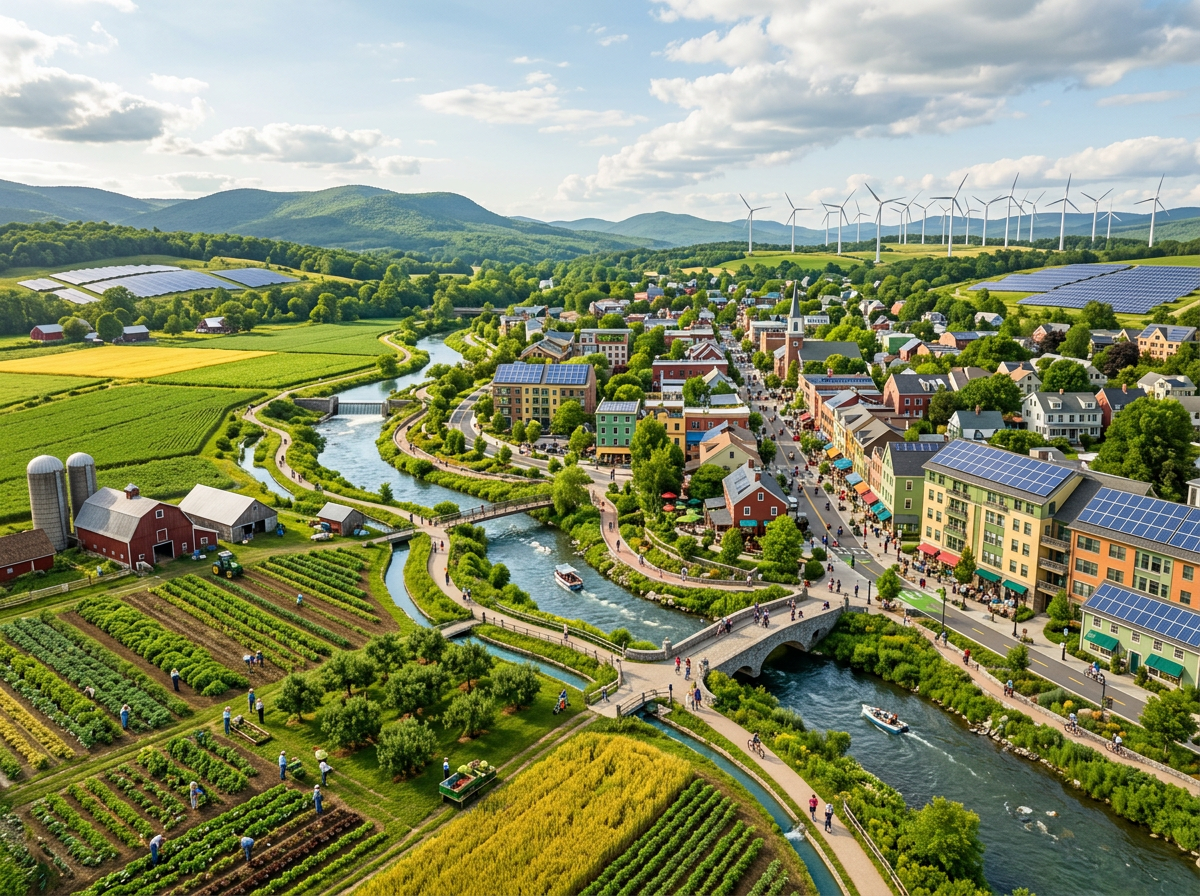
    A local resilience economy is not simply a “small local economy.” It is an adaptive economic ecosystem intentionally designed to strengthen community stability, regenerative capacity, and long-term resilience amid uncertainty.

    Such economies seek to balance global participation with local capability.

    They aim to cultivate systems capable of maintaining social and economic continuity even when external conditions become volatile.

    This shift is not merely economic.

    It reflects a broader civilizational question:

    How can communities organize resources, infrastructure, governance, and cooperation in ways that strengthen long-term adaptability rather than deepen fragility?


    What Is a Local Resilience Economy?

    A local resilience economy is an economic system structured to increase a community’s capacity to withstand, adapt to, and recover from disruption.

    This includes strengthening:

    • Local production capacity
    • Food resilience
    • Energy resilience
    • Community enterprise
    • Distributed infrastructure
    • Cooperative networks
    • Ecological stewardship
    • Skills diversity
    • Regional supply systems
    • Social trust

    Unlike highly extractive or centralized economic systems, resilience economies emphasize durability, adaptability, and regenerative circulation of value within communities.

    The goal is not complete isolation from global systems.

    Rather, it is reducing dangerous overdependence upon fragile external systems beyond local control.

    Healthy resilience economies often combine:

    • Local capability
    • Regional cooperation
    • Strategic interdependence
    • Distributed participation
    • Ecological sustainability

    Resilience therefore exists on a spectrum.

    The question is not whether communities engage with larger economies, but whether they retain enough local capacity to remain adaptive during instability.


    The Fragility of Hyper-Globalized Systems

    Over recent decades, economic systems have become increasingly centralized and globally interconnected.

    Supply chains stretch across continents. Food systems rely heavily upon industrial logistics. Communities depend upon distant manufacturing centers for essential goods. Financial systems operate through tightly coupled global infrastructures.

    While globalization improved efficiency and scale, it also concentrated vulnerability.

    The COVID-19 pandemic revealed how rapidly disruptions can cascade through interconnected systems affecting:

    • Transportation
    • Healthcare
    • Labor markets
    • Food distribution
    • Manufacturing
    • Energy systems
    • Local businesses

    Communities lacking local redundancy often struggled most severely.

    This exposed a key systems principle:

    Extreme efficiency frequently reduces resilience.

    When systems optimize solely for cost reduction and speed, they often eliminate redundancy, local capacity, and adaptive buffers.

    As a result, local resilience economies increasingly seek to restore balance between efficiency and stability.


    Why Local Production Matters

    Communities become more resilient when they retain some capacity to locally produce essential goods and services.

    This may include:

    • Regional agriculture
    • Local manufacturing
    • Skilled trades
    • Community energy systems
    • Water stewardship
    • Distributed digital infrastructure
    • Local entrepreneurship

    Local production strengthens resilience in several ways:

    Reduced Dependency

    Communities become less vulnerable to distant disruptions.

    Faster Adaptation

    Local systems often respond more quickly to changing conditions.

    Economic Circulation

    More value remains within the regional economy.

    Skills Retention

    Communities maintain practical knowledge and productive capability.

    Social Cohesion

    Local participation strengthens relationships and civic engagement.

    Historically, communities with stronger local productive capacity often adapted more effectively during periods of wider systemic instability.


    Community Wealth and Economic Circulation

    One defining feature of resilient local economies is circulation rather than extraction.

    In extractive systems, wealth continuously flows outward through:

    • Corporate consolidation
    • Debt servicing
    • External ownership
    • Financial speculation
    • Resource monopolization

    This weakens local resilience because communities lose the ability to reinvest in their own infrastructure, businesses, and social systems.

    Resilience economies instead emphasize local circulation of value through:

    • Cooperative enterprises
    • Local investment
    • Community-owned businesses
    • Regional financial systems
    • Ethical entrepreneurship
    • Distributed ownership structures

    When value circulates locally, communities often experience:

    • Greater economic stability
    • Stronger social cohesion
    • Increased adaptive capacity
    • More durable local infrastructure

    Economic resilience depends not merely upon wealth generation, but upon how wealth flows through systems.

    Resilient local economies depend upon more than production and exchange.

    They emerge from the stewardship of interconnected forms of capital including ecological health, community trust, practical capability, local enterprise, infrastructure, and shared responsibility.

    The framework below illustrates how regenerative systems strengthen these capacities simultaneously, creating economic ecosystems capable of renewal rather than depletion.

    Figure 1. Regenerative Stewardship and Community Resilience.

    Download Reference Map 007: Stewardship Field Map

    Local resilience economies strengthen long-term stability by cultivating interconnected forms of ecological, social, economic, and institutional capital.

    Rather than maximizing short-term extraction, regenerative systems focus on renewal, circulation, stewardship, and the continuous development of community capacity.


    Cooperative Structures and Shared Stewardship

    Local resilience economies frequently integrate cooperative structures balancing individual initiative with collective stewardship.

    Examples include:

    • Worker cooperatives
    • Credit unions
    • Community-supported agriculture
    • Cooperative housing
    • Shared production systems
    • Mutual aid networks
    • Participatory budgeting
    • Local resource stewardship

    Elinor Ostrom’s research demonstrated that communities can effectively manage shared resources through participatory governance systems adapted to local realities (Ostrom, 1990).

    Cooperative systems often increase resilience because they distribute responsibility, knowledge, and participation across communities rather than concentrating control within distant institutions.

    Importantly, cooperation does not eliminate entrepreneurship or innovation.

    Rather, it may strengthen long-term stability by aligning incentives with community well-being.


    Ecological Stewardship as Economic Infrastructure

    Local resilience economies recognize that human economies remain fully dependent upon ecological systems.

    Healthy soil, stable water systems, biodiversity, energy access, forests, fisheries, and climate stability all support economic continuity.

    Industrial systems frequently externalize ecological costs in pursuit of short-term growth.

    However, ecological degradation often returns later as systemic instability through:

    • Food insecurity
    • Water scarcity
    • Disaster vulnerability
    • Infrastructure stress
    • Rising insurance costs
    • Economic volatility

    Resilience economies increasingly integrate regenerative approaches such as:

    • Regenerative agriculture
    • Watershed restoration
    • Renewable energy systems
    • Circular material flows
    • Bioregional planning
    • Ecological restoration projects

    Economic resilience and ecological resilience are increasingly inseparable.

    Communities that restore ecological stability often strengthen long-term economic adaptability as well.


    Energy Resilience and Infrastructure Sovereignty

    Modern economies depend heavily upon centralized energy systems.

    However, concentrated infrastructure can create vulnerability during disruptions.

    Local resilience economies increasingly explore distributed energy systems including:

    • Solar microgrids
    • Community energy cooperatives
    • Local battery storage
    • Distributed renewable infrastructure
    • Hybrid regional systems

    Distributed infrastructure may increase resilience by reducing dependence upon singular centralized points of failure.

    Infrastructure sovereignty also applies to:

    • Water systems
    • Communication systems
    • Transportation systems
    • Food systems
    • Digital infrastructure

    The goal is not eliminating interconnected systems.

    It is ensuring communities retain enough local capacity to maintain continuity during disruption.


    Skills Resilience and Human Capability

    Economies are ultimately human coordination systems.

    Communities become fragile when practical knowledge is narrowly concentrated or entirely outsourced.

    Local resilience economies therefore value distributed capability.

    Important resilience skills may include:

    • Food cultivation
    • Repair and maintenance
    • Ecological stewardship
    • Financial literacy
    • Conflict mediation
    • Civic participation
    • Local governance
    • Energy management
    • Cooperative organization

    Distributed knowledge increases adaptive flexibility.

    Historically, communities with broader practical competence often reorganized more effectively during instability.


    Social Trust as Economic Infrastructure

    Trust functions as invisible infrastructure within resilient economies.

    Communities with strong social trust often demonstrate:

    • Greater cooperation
    • Faster crisis response
    • Lower coordination costs
    • Stronger local enterprise ecosystems
    • Higher civic participation
    • Greater adaptive capacity

    Francis Fukuyama (1995) described trust as a form of social capital enabling large-scale coordination.

    Without trust, economic systems become increasingly transactional, fragmented, and fragile.

    Local resilience economies therefore depend not only upon infrastructure, but upon relationships.

    Social cohesion strengthens resilience.


    Technology and Distributed Resilience

    Technology can either strengthen or weaken local resilience depending upon implementation.

    Resilience-oriented technologies often:

    • Increase local capability
    • Improve distributed coordination
    • Strengthen information access
    • Support decentralized production
    • Reduce infrastructure vulnerability

    Examples include:

    • Open-source technologies
    • Distributed manufacturing
    • Community communication networks
    • Local digital marketplaces
    • Decentralized energy systems

    However, technologies that increase dependency upon distant monopolized infrastructures may deepen fragility.

    The critical question is whether technological systems strengthen community adaptability or increase systemic dependence.


    Resilience Is Not Isolationism

    Local resilience economies are not anti-global.

    They do not require complete self-sufficiency or economic isolation.

    Healthy resilience balances:

    • Local production with global exchange
    • Regional cooperation with local sovereignty
    • Innovation with sustainability
    • Efficiency with redundancy
    • Adaptability with coordination

    The objective is not withdrawal from civilization.

    It is reducing dangerous fragility within civilization.

    Communities capable of maintaining partial local autonomy during periods of disruption may become more stable than systems entirely dependent upon centralized coordination.


    Toward Regenerative Economic Futures

    The twenty-first century is increasingly shaped by systemic uncertainty.

    Economic volatility, technological disruption, ecological instability, and institutional fragility are interacting across interconnected systems.

    Under such conditions, local resilience economies may become increasingly important as stabilizing foundations for communities.

    This transition may involve:

    • Rebuilding local production systems
    • Expanding cooperative structures
    • Investing in regenerative infrastructure
    • Supporting ethical entrepreneurship
    • Strengthening ecological stewardship
    • Cultivating distributed leadership
    • Restoring civic trust
    • Reinforcing community adaptability

    Resilient economies are not simply wealth-generating systems.

    They are life-support systems.

    They shape whether communities can maintain dignity, stability, cooperation, and continuity under changing conditions.

    The future may increasingly belong not to the most centralized economies, but to the communities most capable of balancing interconnectedness with resilience.


    Suggested Crosslinks


    References

    Fukuyama, F. (1995). Trust: The social virtues and the creation of prosperity. Free Press.

    Ostrom, E. (1990). Governing the commons: The evolution of institutions for collective action. Cambridge University Press.

    Tooze, A. (2021). Shutdown: How COVID shook the world’s economy. Viking.

    The Living Archive is designed to be explored through pathways, categories, and search. If you’re looking for a specific idea, question, or theme, AI Search can help surface relevant connections across the archive.


    Attribution

    The Living Archive
    Integrative Frameworks for Regenerative Civilization

    © 2026 Gerald Daquila. All rights reserved.
    Part of the Life.Understood. knowledge ecosystem and Stewardship Institute initiative.

    This article is intended for educational, research, and civic inquiry purposes.
    Readers are encouraged to engage critically, verify sources independently, and explore related knowledge hubs for broader systems context.