
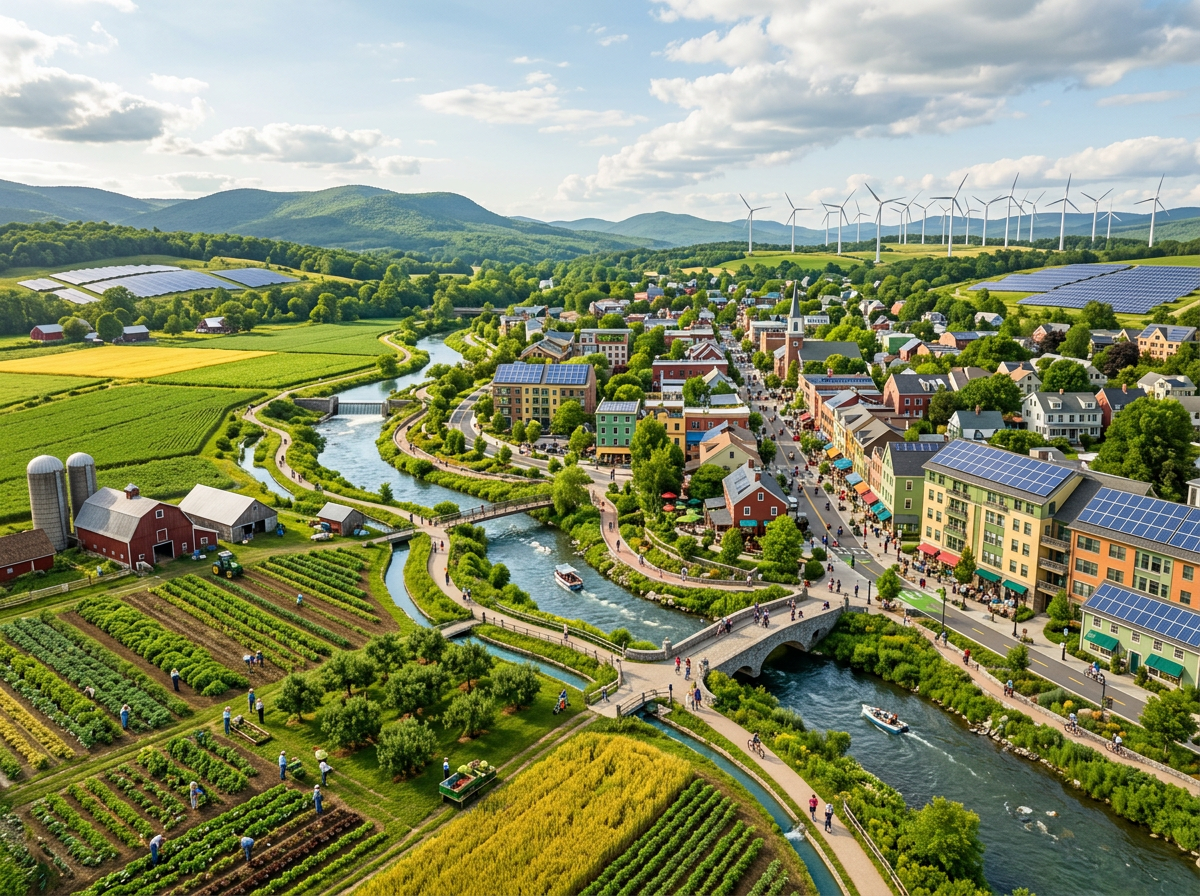
Rebuilding Community Stability Through Distributed and Regenerative Systems
Meta Description
Explore how local resilience economies strengthen communities through regenerative systems, cooperative structures, distributed infrastructure, local production, and adaptive economic resilience in an age of systemic uncertainty.
Local Resilience Economies
Modern economies are increasingly interconnected through global finance, multinational supply chains, digital infrastructures, and centralized production systems.
While these systems have generated extraordinary technological advancement and material abundance, they have also created growing vulnerability to systemic disruption.
Economic shocks, inflation, supply chain failures, ecological instability, housing pressures, labor precarity, and institutional fragility have revealed an important reality:
Communities dependent entirely upon distant systems often possess limited resilience when larger systems become unstable.
In response, growing attention is turning toward the concept of local resilience economies.
A local resilience economy is not simply a “small local economy.” It is an adaptive economic ecosystem intentionally designed to strengthen community stability, regenerative capacity, and long-term resilience amid uncertainty.
Such economies seek to balance global participation with local capability.
They aim to cultivate systems capable of maintaining social and economic continuity even when external conditions become volatile.
This shift is not merely economic.
It reflects a broader civilizational question:
How can communities organize resources, infrastructure, governance, and cooperation in ways that strengthen long-term adaptability rather than deepen fragility?
What Is a Local Resilience Economy?
A local resilience economy is an economic system structured to increase a community’s capacity to withstand, adapt to, and recover from disruption.
This includes strengthening:
- Local production capacity
- Food resilience
- Energy resilience
- Community enterprise
- Distributed infrastructure
- Cooperative networks
- Ecological stewardship
- Skills diversity
- Regional supply systems
- Social trust
Unlike highly extractive or centralized economic systems, resilience economies emphasize durability, adaptability, and regenerative circulation of value within communities.
The goal is not complete isolation from global systems.
Rather, it is reducing dangerous overdependence upon fragile external systems beyond local control.
Healthy resilience economies often combine:
- Local capability
- Regional cooperation
- Strategic interdependence
- Distributed participation
- Ecological sustainability
Resilience therefore exists on a spectrum.
The question is not whether communities engage with larger economies, but whether they retain enough local capacity to remain adaptive during instability.
The Fragility of Hyper-Globalized Systems
Over recent decades, economic systems have become increasingly centralized and globally interconnected.
Supply chains stretch across continents. Food systems rely heavily upon industrial logistics. Communities depend upon distant manufacturing centers for essential goods. Financial systems operate through tightly coupled global infrastructures.
While globalization improved efficiency and scale, it also concentrated vulnerability.
The COVID-19 pandemic revealed how rapidly disruptions can cascade through interconnected systems affecting:
- Transportation
- Healthcare
- Labor markets
- Food distribution
- Manufacturing
- Energy systems
- Local businesses
Communities lacking local redundancy often struggled most severely.
This exposed a key systems principle:
Extreme efficiency frequently reduces resilience.
When systems optimize solely for cost reduction and speed, they often eliminate redundancy, local capacity, and adaptive buffers.
As a result, local resilience economies increasingly seek to restore balance between efficiency and stability.
Why Local Production Matters
Communities become more resilient when they retain some capacity to locally produce essential goods and services.
This may include:
- Regional agriculture
- Local manufacturing
- Skilled trades
- Community energy systems
- Water stewardship
- Distributed digital infrastructure
- Local entrepreneurship
Local production strengthens resilience in several ways:
Reduced Dependency
Communities become less vulnerable to distant disruptions.
Faster Adaptation
Local systems often respond more quickly to changing conditions.
Economic Circulation
More value remains within the regional economy.
Skills Retention
Communities maintain practical knowledge and productive capability.
Social Cohesion
Local participation strengthens relationships and civic engagement.
Historically, communities with stronger local productive capacity often adapted more effectively during periods of wider systemic instability.
Community Wealth and Economic Circulation
One defining feature of resilient local economies is circulation rather than extraction.
In extractive systems, wealth continuously flows outward through:
- Corporate consolidation
- Debt servicing
- External ownership
- Financial speculation
- Resource monopolization
This weakens local resilience because communities lose the ability to reinvest in their own infrastructure, businesses, and social systems.
Resilience economies instead emphasize local circulation of value through:
- Cooperative enterprises
- Local investment
- Community-owned businesses
- Regional financial systems
- Ethical entrepreneurship
- Distributed ownership structures
When value circulates locally, communities often experience:
- Greater economic stability
- Stronger social cohesion
- Increased adaptive capacity
- More durable local infrastructure
Economic resilience depends not merely upon wealth generation, but upon how wealth flows through systems.
Resilient local economies depend upon more than production and exchange.
They emerge from the stewardship of interconnected forms of capital including ecological health, community trust, practical capability, local enterprise, infrastructure, and shared responsibility.
The framework below illustrates how regenerative systems strengthen these capacities simultaneously, creating economic ecosystems capable of renewal rather than depletion.

Figure 1. Regenerative Stewardship and Community Resilience.
→ Download Reference Map 007: Stewardship Field Map
Local resilience economies strengthen long-term stability by cultivating interconnected forms of ecological, social, economic, and institutional capital.
Rather than maximizing short-term extraction, regenerative systems focus on renewal, circulation, stewardship, and the continuous development of community capacity.
Cooperative Structures and Shared Stewardship
Local resilience economies frequently integrate cooperative structures balancing individual initiative with collective stewardship.
Examples include:
- Worker cooperatives
- Credit unions
- Community-supported agriculture
- Cooperative housing
- Shared production systems
- Mutual aid networks
- Participatory budgeting
- Local resource stewardship
Elinor Ostrom’s research demonstrated that communities can effectively manage shared resources through participatory governance systems adapted to local realities (Ostrom, 1990).
Cooperative systems often increase resilience because they distribute responsibility, knowledge, and participation across communities rather than concentrating control within distant institutions.
Importantly, cooperation does not eliminate entrepreneurship or innovation.
Rather, it may strengthen long-term stability by aligning incentives with community well-being.
Ecological Stewardship as Economic Infrastructure
Local resilience economies recognize that human economies remain fully dependent upon ecological systems.
Healthy soil, stable water systems, biodiversity, energy access, forests, fisheries, and climate stability all support economic continuity.
Industrial systems frequently externalize ecological costs in pursuit of short-term growth.
However, ecological degradation often returns later as systemic instability through:
- Food insecurity
- Water scarcity
- Disaster vulnerability
- Infrastructure stress
- Rising insurance costs
- Economic volatility
Resilience economies increasingly integrate regenerative approaches such as:
- Regenerative agriculture
- Watershed restoration
- Renewable energy systems
- Circular material flows
- Bioregional planning
- Ecological restoration projects
Economic resilience and ecological resilience are increasingly inseparable.
Communities that restore ecological stability often strengthen long-term economic adaptability as well.
Energy Resilience and Infrastructure Sovereignty
Modern economies depend heavily upon centralized energy systems.
However, concentrated infrastructure can create vulnerability during disruptions.
Local resilience economies increasingly explore distributed energy systems including:
- Solar microgrids
- Community energy cooperatives
- Local battery storage
- Distributed renewable infrastructure
- Hybrid regional systems
Distributed infrastructure may increase resilience by reducing dependence upon singular centralized points of failure.
Infrastructure sovereignty also applies to:
- Water systems
- Communication systems
- Transportation systems
- Food systems
- Digital infrastructure
The goal is not eliminating interconnected systems.
It is ensuring communities retain enough local capacity to maintain continuity during disruption.
Skills Resilience and Human Capability
Economies are ultimately human coordination systems.
Communities become fragile when practical knowledge is narrowly concentrated or entirely outsourced.
Local resilience economies therefore value distributed capability.
Important resilience skills may include:
- Food cultivation
- Repair and maintenance
- Ecological stewardship
- Financial literacy
- Conflict mediation
- Civic participation
- Local governance
- Energy management
- Cooperative organization
Distributed knowledge increases adaptive flexibility.
Historically, communities with broader practical competence often reorganized more effectively during instability.
Social Trust as Economic Infrastructure
Trust functions as invisible infrastructure within resilient economies.
Communities with strong social trust often demonstrate:
- Greater cooperation
- Faster crisis response
- Lower coordination costs
- Stronger local enterprise ecosystems
- Higher civic participation
- Greater adaptive capacity
Francis Fukuyama (1995) described trust as a form of social capital enabling large-scale coordination.
Without trust, economic systems become increasingly transactional, fragmented, and fragile.
Local resilience economies therefore depend not only upon infrastructure, but upon relationships.
Social cohesion strengthens resilience.
Technology and Distributed Resilience
Technology can either strengthen or weaken local resilience depending upon implementation.
Resilience-oriented technologies often:
- Increase local capability
- Improve distributed coordination
- Strengthen information access
- Support decentralized production
- Reduce infrastructure vulnerability
Examples include:
- Open-source technologies
- Distributed manufacturing
- Community communication networks
- Local digital marketplaces
- Decentralized energy systems
However, technologies that increase dependency upon distant monopolized infrastructures may deepen fragility.
The critical question is whether technological systems strengthen community adaptability or increase systemic dependence.
Resilience Is Not Isolationism
Local resilience economies are not anti-global.
They do not require complete self-sufficiency or economic isolation.
Healthy resilience balances:
- Local production with global exchange
- Regional cooperation with local sovereignty
- Innovation with sustainability
- Efficiency with redundancy
- Adaptability with coordination
The objective is not withdrawal from civilization.
It is reducing dangerous fragility within civilization.
Communities capable of maintaining partial local autonomy during periods of disruption may become more stable than systems entirely dependent upon centralized coordination.
Toward Regenerative Economic Futures
The twenty-first century is increasingly shaped by systemic uncertainty.
Economic volatility, technological disruption, ecological instability, and institutional fragility are interacting across interconnected systems.
Under such conditions, local resilience economies may become increasingly important as stabilizing foundations for communities.
This transition may involve:
- Rebuilding local production systems
- Expanding cooperative structures
- Investing in regenerative infrastructure
- Supporting ethical entrepreneurship
- Strengthening ecological stewardship
- Cultivating distributed leadership
- Restoring civic trust
- Reinforcing community adaptability
Resilient economies are not simply wealth-generating systems.
They are life-support systems.
They shape whether communities can maintain dignity, stability, cooperation, and continuity under changing conditions.
The future may increasingly belong not to the most centralized economies, but to the communities most capable of balancing interconnectedness with resilience.
Suggested Crosslinks
- Regenerative Economics
- Codex of Regenerative Economies
- Foundations of Sovereignty
- Intentional Community Design
- Beyond the Peso: Why Pre-colonial Philippine Economics is the Blueprint for Modern Resilience
References
Fukuyama, F. (1995). Trust: The social virtues and the creation of prosperity. Free Press.
Ostrom, E. (1990). Governing the commons: The evolution of institutions for collective action. Cambridge University Press.
Tooze, A. (2021). Shutdown: How COVID shook the world’s economy. Viking.
The Living Archive is designed to be explored through pathways, categories, and search. If you’re looking for a specific idea, question, or theme, AI Search can help surface relevant connections across the archive.
Attribution
The Living Archive
Integrative Frameworks for Regenerative Civilization
© 2026 Gerald Daquila. All rights reserved.
Part of the Life.Understood. knowledge ecosystem and Stewardship Institute initiative.
This article is intended for educational, research, and civic inquiry purposes.
Readers are encouraged to engage critically, verify sources independently, and explore related knowledge hubs for broader systems context.
Leave a Reply