Category: Society

  • [PY-002] Poka-Yoke for the Soul: Error-Proofing Your Transition into the New Earth Economy

    [PY-002] Poka-Yoke for the Soul: Error-Proofing Your Transition into the New Earth Economy


    How Filipino stewards can design environments that prevent self-sabotage and enable consistent, sovereign action


    Meta Description

    Struggling to stay consistent in your financial or life transitions? Discover how Poka-Yoke—error-proofing systems—can help Filipinos align behavior, reduce self-sabotage, and build sustainable sovereignty.


    Why Good Intentions Keep Failing

    Many Filipinos today are no longer lacking awareness.

    They know:

    • The importance of saving and investing
    • The need for long-term planning
    • The value of building systems, not just reacting

    And yet, a familiar pattern persists:

    Plans are made… then abandoned.
    Strategies are learned… then inconsistently applied.
    Momentum builds… then quietly collapses.

    This is not a knowledge problem.

    It is a design problem.


    What Is Poka-Yoke?

    Poka‑Yoke is a Japanese concept popularized in lean manufacturing. It refers to designing processes in such a way that errors become difficult—or impossible—to make.

    Examples include:

    • A USB that only fits one way
    • A car that won’t start unless it’s in park
    • Forms that require mandatory fields before submission

    The principle is simple:

    Do not rely on perfect behavior. Design for imperfect humans.


    Translating Poka-Yoke to the Inner World

    When applied to personal and financial life, Poka-Yoke becomes:

    Designing environments, systems, and structures that prevent self-sabotage

    Because most breakdowns are predictable:

    • Spending when stressed
    • Avoiding difficult decisions
    • Breaking routines under pressure
    • Defaulting to old habits

    (Crosslink: Financial Sovereignty Is a Nervous System State: Grounding the QFS in the Filipino Reality)

    These are not random.

    They are patterned.

    And what is patterned can be designed for.


    The Filipino Context: Why Design Matters More

    In the Philippine setting, the need for error-proofing is amplified by:

    • Income variability
    • Strong family obligations
    • Cultural pressure to give and support
    • Limited institutional safety nets

    This creates environments where:

    • One mistake can have cascading effects
    • Consistency is harder to maintain
    • Emotional decisions carry higher stakes

    (Crosslink: Money, Guilt, and the Colonized Soul: Why We Sabotage Our Own Sovereignty)

    In such contexts, relying on willpower alone is insufficient.


    The New Earth Economy (Grounded Interpretation)

    Rather than treating the “New Earth economy” as a distant future, it can be understood practically as:

    • Systems that prioritize sustainability over extraction
    • Economies that reward value creation and retention
    • Communities that share responsibility and risk
    • Individuals who act with long-term coherence

    (Crosslink: Why Resiliency Is a Trap: Moving from Colonial Survival to New Earth Stewardship)

    But for these systems to function, individuals must behave consistently within them.

    This is where Poka-Yoke becomes essential.


    The Gap Between Intention and Execution

    Most people operate in this loop:

    1. Insight – “I should do this.”
    2. Action – Initial effort
    3. Disruption – Stress, distraction, obligation
    4. Regression – Return to old patterns

    The missing layer is error-proofing.

    Without it, even the best intentions degrade under pressure.


    Designing Poka-Yoke for the Soul

    Error-proofing your transition involves designing across three layers:


    1. Behavioral Poka-Yoke (Habit Design)

    Reduce the chance of breaking positive behaviors.

    Examples:

    • Automate savings instead of relying on manual transfers
    • Use spending limits or separate accounts
    • Schedule fixed decision times

    These reduce reliance on motivation.


    2. Environmental Poka-Yoke (Context Design)

    Shape your surroundings to support desired actions.

    Examples:

    • Keep investment platforms easily accessible
    • Limit exposure to impulsive spending triggers
    • Surround yourself with people aligned to growth

    Environment influences behavior more than intention.


    3. Emotional Poka-Yoke (Trigger Awareness)

    Anticipate emotional states that lead to poor decisions.

    Examples:

    • Delay financial decisions when stressed
    • Create rules: “No major decisions when tired or pressured”
    • Build pause mechanisms

    (Crosslink: Beyond the “Wait and See” Mindset: Overcoming the Psychological Weight of Persistent Scarcity)

    This transforms reaction into response.


    The Role of Systems Thinking

    Poka-Yoke is not about isolated fixes.

    It is about designing interconnected systems.

    (Crosslink: ARK-001: The 50-Person Resource Loop)

    For example:

    • Income flows into structured accounts
    • Spending is pre-allocated
    • Investments are automated
    • Support obligations are planned

    Each part supports the others.


    From Fragility to Stability

    Without error-proofing:

    • One disruption can derail progress

    With error-proofing:

    • Systems absorb shocks

    This is the difference between:

    • Fragile progress
    • Resilient (and evolving) systems

    The Nervous System Connection

    Poka-Yoke also reduces cognitive and emotional load.

    When systems are in place:

    • Fewer decisions are required
    • Stress decreases
    • Consistency increases

    Research shows that reducing decision fatigue improves long-term adherence to goals (Kahneman, 2011).

    In other words:

    Good systems calm the nervous system.


    The Steward’s Role: Designing for Others

    At a higher level, Poka-Yoke extends beyond the individual.

    Stewards design systems that:

    • Reduce errors for communities
    • Create fairness by structure, not intention
    • Enable participation without requiring perfection

    (Crosslink: From Informer to Steward: Why True Leadership Begins with Owning Our Shared Shadow)

    This is how sovereignty scales.


    Common Failure Points (and How to Error-Proof Them)

    1. Inconsistent Saving

    Fix: Automate transfers immediately after income receipt


    2. Emotional Spending

    Fix: Introduce a 24-hour delay rule for non-essential purchases


    3. Over-Giving

    Fix: Set fixed support budgets rather than reactive giving


    4. Avoidance of Planning

    Fix: Schedule non-negotiable monthly financial reviews


    5. Loss of Momentum

    Fix: Use visible tracking systems (charts, dashboards)


    The Risk of Ignoring Design

    Without Poka-Yoke:

    • Old patterns resurface
    • Progress remains fragile
    • Frustration increases

    This leads to the belief that:

    “I just lack discipline”

    When in reality:

    The system was never designed to support success.


    The Ark Perspective: Error-Proofing Sovereignty

    Within the Ark framework, sovereignty is not achieved through isolated effort.

    It is engineered through systems.

    (Crosslink: From Fragmented Souls to Sovereign Stewards: Reclaiming Identity After 500 Years of Institutional Trauma)

    Poka-Yoke becomes:

    • The practical layer of stewardship
    • The bridge between insight and execution
    • The structure that holds transformation in place

    Conclusion: Design Over Willpower

    The transition into a new economic reality—whether personal or collective—will not be sustained by awareness alone.

    It will require:

    • Systems that support behavior
    • Structures that reduce error
    • Environments that enable consistency

    Poka-Yoke offers a simple but powerful principle:

    Do not expect yourself to be perfect.
    Design your life so you don’t have to be.

    This is how:

    • Insight becomes action
    • Action becomes habit
    • Habit becomes identity

    And identity becomes sovereignty.


    References

    Kahneman, D. (2011). Thinking, Fast and Slow. Farrar, Straus and Giroux.

    Mullainathan, S., & Shafir, E. (2013). Scarcity: Why Having Too Little Means So Much. Times Books.

    Ohno, T. (1988). Toyota Production System: Beyond Large-Scale Production. Productivity Press.

    North, D. C. (1990). Institutions, Institutional Change and Economic Performance. Cambridge University Press.


    The Sovereign Professional: A structural map of power, systems thinking, and personal autonomy—dedicated to helping the independent professional navigate complexity and own their value stream.Ask


    ©2026 Gerald Daquila • Life.Understood. • Systems Thinking, Leadership Architecture, and Applied Coherence

  • The Digital Barangay: A Structural Framework for Decentralized Diaspora Stewardship

    The Digital Barangay: A Structural Framework for Decentralized Diaspora Stewardship


    Reimagining the Filipino Barangay as a Sovereign Global Support Network


    Meta Description

    Explore how the ancient Filipino Barangay model can evolve into a decentralized digital stewardship system for the global diaspora—creating sovereign nodes that support homeland resilience, economic regeneration, and cultural continuity.


    For centuries, the Filipino barangay functioned not merely as a geographic settlement, but as a living governance architecture rooted in kinship, mutual aid, collective survival, and shared stewardship.

    Before colonial centralization fragmented indigenous systems, the barangay served as a resilient social organism: adaptive, relational, and deeply localized (Jocano, 1998).

    Today, as millions of Filipinos live and work abroad, a new question emerges:

    What if the barangay never disappeared—only evolved?

    In the age of digital infrastructure, decentralized finance, AI coordination systems, and transnational communities, the ancient barangay model may hold the blueprint for a new form of diaspora organization.

    Rather than seeing overseas Filipinos merely as remittance senders or economic migrants, a more coherent framework views them as distributed stewardship nodes capable of supporting homeland resilience in coordinated, ethical, and regenerative ways.

    This emerging model may be called the Digital Barangay: a decentralized network of sovereign Filipino communities abroad functioning as “life-support systems” for cultural continuity, local resilience, and long-term regenerative development in the Philippines.

    Rather than replicating extractive globalization, the Digital Barangay proposes a return to relational infrastructure—updated for the digital age.


    From Tribal Settlement to Distributed Network

    Historically, the barangay was composed of interconnected families governed through reciprocal obligation and participatory leadership.

    Leadership was relational rather than purely bureaucratic, and survival depended upon collective cohesion (Scott, 1994).

    Modern globalization disrupted many of these systems. Colonialism centralized governance, urbanization weakened localized interdependence, and labor export policies dispersed millions of Filipinos across the world (Rodriguez, 2010).

    Yet paradoxically, this dispersion created one of the most globally connected diasporas in human history.

    Today, Overseas Filipino Workers (OFWs), immigrant professionals, entrepreneurs, caregivers, nurses, engineers, and creatives collectively form a vast transnational network capable of moving not only capital—but knowledge, technology, governance practices, and social coordination.

    The challenge is structural:

    Most diaspora engagement remains fragmented, transactional, or reactive.

    The Digital Barangay proposes a shift from:

    • remittance dependency → regenerative coordination,
    • isolated migration → distributed stewardship,
    • individual success → collective resilience.

    This is not merely cultural nostalgia. It is systems architecture.


    What Is a “Sovereign Node”?

    Within the Digital Barangay framework, a Sovereign Node refers to a self-organizing diaspora cluster capable of supporting both its local members abroad and aligned initiatives in the homeland.

    A node may consist of:

    • Filipino professionals in Toronto,
    • caregivers in California,
    • entrepreneurs in Vancouver,
    • educators in New York,
    • regenerative agriculture advocates in Australia,
    • or hybrid digital communities connected through shared mission.

    Unlike traditional organizations that depend heavily on centralized hierarchy, sovereign nodes operate through distributed trust networks, transparent communication, and mission alignment.

    Their purpose is not ideological control or political dominance.

    Rather, they function as:

    • mutual aid ecosystems,
    • cultural continuity circles,
    • educational and mentorship hubs,
    • ethical investment cooperatives,
    • emergency response networks,
    • and regenerative development support systems.

    In systems theory, resilient systems are often decentralized rather than overly centralized because distributed nodes reduce single points of failure (Meadows, 2008).

    The barangay model naturally reflects this principle.

    A healthy sovereign node therefore acts less like a corporation and more like a living organism.

    A sovereign node does not operate in isolation.

    Its effectiveness depends upon the quality of the governance structures, communication pathways, accountability systems, and stewardship practices connecting it to the broader network.

    The Governance System Map illustrates how healthy distributed systems coordinate information, responsibility, participation, and feedback while preserving both local autonomy and collective coherence across larger communities.

    Figure 1. Governance System Map: Governance as Coordination Architecture

    → Download Reference Map 010: Governance System Map

    A systems framework illustrating how distributed communities coordinate through stewardship, accountability, information flows, participation, decision-making, and adaptive feedback.

    Within the Digital Barangay model, sovereign nodes remain locally autonomous while contributing to a larger network of trust, resilience, and shared responsibility.


    The Barangay Logic Applied to the Diaspora

    The Digital Barangay adapts several ancient barangay principles into modern infrastructure:


    1. Relational Stewardship Over Bureaucratic Control

    Traditional barangays operated through relational accountability. Reputation, reciprocity, and communal trust were essential survival mechanisms.

    Modern digital systems often suffer from anonymity, fragmentation, and low social cohesion. Diaspora nodes can restore coherence through:

    • local stewardship councils,
    • transparent decision-making,
    • skill-sharing circles,
    • and community-led governance.

    This mirrors emerging global interest in decentralized autonomous organizations (DAOs), cooperative governance models, and participatory civic systems (Allen & Berg, 2022).

    However, the Digital Barangay differs from purely technological decentralization because it centers human relationships rather than automation alone.

    Technology supports stewardship; it does not replace it.


    2. Distributed Economic Resilience

    The Philippines receives billions annually through remittances from overseas workers. While remittances sustain millions of families, they can also create dependency loops without structural transformation (Opiniano, 2012).

    The Digital Barangay framework asks a deeper question:

    What happens if diaspora capital becomes coordinated toward regenerative infrastructure rather than isolated consumption?

    Examples include:

    • supporting local food systems,
    • funding community land trusts,
    • investing in renewable energy microgrids,
    • sponsoring localized education hubs,
    • and developing cooperative enterprises.

    Instead of temporary relief, sovereign nodes can participate in long-term resilience building.

    This transforms the diaspora from “external labor force” into distributed nation-builders.


    3. Knowledge Transfer as National Infrastructure

    One of the most underutilized resources within the Filipino diaspora is intellectual capital.

    Filipino professionals abroad often gain exposure to:

    • advanced healthcare systems,
    • sustainable architecture,
    • governance innovation,
    • AI systems,
    • renewable energy models,
    • cooperative economics,
    • and trauma-informed education practices.

    Yet these insights rarely flow back into localized Philippine development in structured ways.

    The Digital Barangay proposes ongoing “knowledge return pathways” through:

    • mentorship programs,
    • digital apprenticeship networks,
    • open-source educational systems,
    • and local innovation exchanges.

    In this model, the homeland is not viewed as “behind,” but as a regenerative testing ground for new community systems.


    Why Decentralization Matters

    Many institutional systems fail because they become too centralized, too bureaucratic, and too disconnected from local realities.

    Decentralized systems are often more adaptive during periods of instability because they:

    • distribute responsibility,
    • increase redundancy,
    • enable faster response times,
    • and preserve local autonomy (Taleb, 2012).

    The barangay historically embodied these qualities.

    A Digital Barangay network could therefore strengthen resilience against:

    • economic shocks,
    • climate instability,
    • food insecurity,
    • political volatility,
    • and social fragmentation.

    Importantly, decentralization does not mean disorder.

    Healthy decentralized systems require:

    • shared principles,
    • transparent communication,
    • interoperable structures,
    • and ethical stewardship frameworks.

    Without these, decentralization can devolve into fragmentation.

    Thus, the Digital Barangay is not anti-structure. It is anti-extractive centralization.


    The Role of Technology

    Modern infrastructure now makes transnational barangays possible in ways that were unimaginable even twenty years ago.

    Key enabling technologies include:

    • encrypted communication platforms,
    • cooperative digital banking systems,
    • decentralized finance tools,
    • AI-assisted coordination systems,
    • remote education platforms,
    • and distributed cloud governance.

    However, technological sophistication alone does not create coherence.

    Many digitally connected communities remain emotionally fragmented.

    Thus, the Digital Barangay must integrate:

    • cultural continuity,
    • ethical discernment,
    • intergenerational mentorship,
    • and localized human relationships.

    Technology becomes meaningful only when rooted in shared stewardship values.


    Potential Applications of the Digital Barangay

    Diaspora Emergency Response Systems

    Sovereign nodes could rapidly mobilize localized support during typhoons, earthquakes, or humanitarian crises.

    Rather than relying solely on centralized aid systems, barangay-aligned networks could deploy:

    • direct mutual aid,
    • rapid crowdfunding,
    • local supply coordination,
    • and community logistics.

    Regenerative Provincial Development

    Diaspora-supported nodes could help revitalize rural provinces through:

    • regenerative agriculture,
    • local entrepreneurship,
    • eco-tourism cooperatives,
    • renewable energy infrastructure,
    • and digital livelihood systems.

    This may reduce overconcentration in Metro Manila while strengthening regional resilience.


    Cultural Preservation Networks

    As younger generations abroad become increasingly disconnected from Filipino language and traditions, sovereign nodes can create:

    • cultural learning circles,
    • oral history archives,
    • language preservation projects,
    • and intergenerational mentorship programs.

    The Digital Barangay therefore becomes not only economic infrastructure, but civilizational memory infrastructure.


    Challenges and Ethical Considerations

    The Digital Barangay is not immune to risk.

    Potential challenges include:

    • ideological fragmentation,
    • personality-driven leadership,
    • digital misinformation,
    • financial opacity,
    • and neo-feudal dynamics disguised as “community.”

    Therefore, healthy nodes require:

    • transparency,
    • consent-based participation,
    • distributed accountability,
    • and clear ethical safeguards.

    True stewardship empowers communities rather than creating dependency.

    This distinction is essential.


    Toward a Regenerative Diaspora Civilization

    The Filipino diaspora is often described through sacrifice, separation, and survival.

    But another possibility exists.

    What if the diaspora evolved into a distributed regenerative civilization architecture?

    What if overseas Filipinos became not merely workers abroad, but interconnected stewards participating in the rebuilding of resilient local systems?

    The Digital Barangay offers one possible framework.

    Not as utopian fantasy, but as a practical reapplication of ancient relational intelligence to modern decentralized infrastructure.

    The future may not belong solely to massive centralized institutions.

    It may belong to adaptive networks capable of combining:

    • local autonomy,
    • global coordination,
    • ethical stewardship,
    • and cultural continuity.

    In many ways, the barangay was already doing this long before the modern world rediscovered decentralization.

    The question now is whether the diaspora is prepared to remember.


    Suggested Internal Crosslinks


    References

    Allen, D. W., & Berg, C. (2022). Blockchain governance: Programming our future. Lexington Books.

    Jocano, F. L. (1998). Filipino social organization: Traditional kinship and family organization. Punlad Research House.

    Meadows, D. H. (2008). Thinking in systems: A primer. Chelsea Green Publishing.

    Opiniano, J. M. (2012). Migration and development in the Philippines. Institute of Migration and Development Issues.

    Rodriguez, R. M. (2010). Migrants for export: How the Philippine state brokers labor to the world. University of Minnesota Press.

    Scott, W. H. (1994). Barangay: Sixteenth-century Philippine culture and society. Ateneo de Manila University Press.

    Taleb, N. N. (2012). Antifragile: Things that gain from disorder. Random House.


    The Sovereign Professional: A structural map of power, systems thinking, and personal autonomy—dedicated to helping the independent professional navigate complexity and own their value stream.Ask


    ©2026 Gerald Daquila • Life.Understood. • Systems Thinking, Leadership Architecture, and Applied Coherence
  • [VSM-002] Value Stream Mapping the Prototype Community: Circulating Wealth Without Central Debt

    [VSM-002] Value Stream Mapping the Prototype Community: Circulating Wealth Without Central Debt


    Reimagining the Flow of Value


    Protocol Status: Version 1.0 (Initial Release)

    Process Owner: Individual Steward / Head of Household

    Revision Date: May 2026


    Modern economies are structured around extraction.

    Wealth produced by local labor, land, and relationships is routinely siphoned outward through debt servicing, speculative finance, centralized supply chains, and dependency on distant institutions.

    In contrast, resilient communities historically survived by increasing the velocity of local exchange—keeping food, labor, knowledge, and stewardship circulating within the village itself.

    This principle can still be observed in many Philippine barangays where informal reciprocity, mutual aid, cooperative purchasing, and relationship-based trust continue to function beneath the surface of the formal economy.

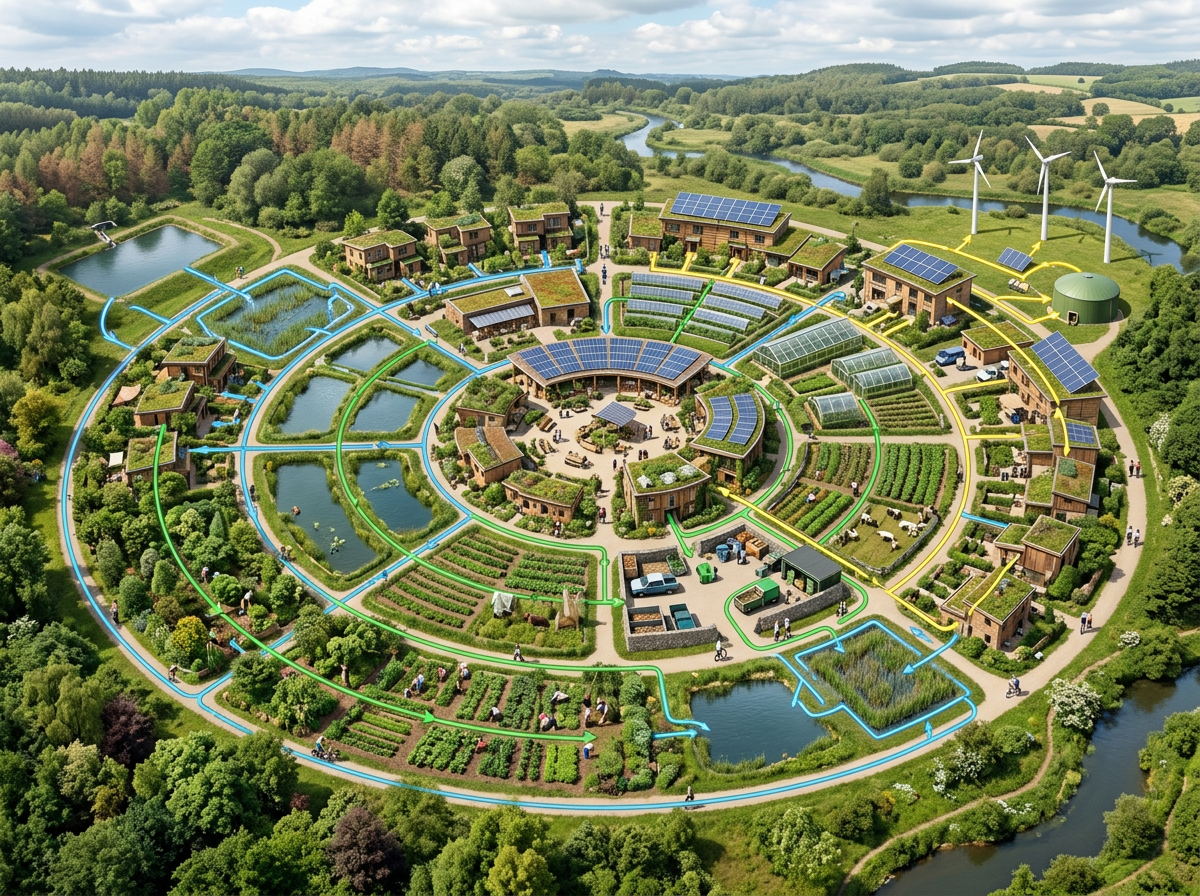
    The prototype intentional community proposed within the SHEYALOTH stewardship architecture is not merely a housing experiment. It is an economic systems prototype.

    Its core purpose is to demonstrate that a localized node can generate, circulate, retain, and regenerate wealth without depending entirely on centralized debt structures.

    This is where Value Stream Mapping (VSM) becomes essential.

    Value Stream Mapping is a Lean systems methodology used to visualize how materials, information, labor, and value move through a process in order to identify waste, inefficiencies, and leakage points (Lean Enterprise Institute, n.d.).

    Rather than viewing the community as a collection of isolated activities, VSM allows us to see the community as an interconnected living organism.

    Within a stewardship-based prototype community, the question is not simply “How do we earn money?”

    The deeper question is:

    How does value circulate—and where does it leak?

    When mapped correctly, a regenerative community begins to resemble a closed-loop ecosystem rather than a consumer settlement.


    From Linear Extraction to Circular Stewardship

    The dominant economic model is fundamentally linear:

    Labor → Income → Debt → Consumption → External Leakage

    In this arrangement, most value exits the local ecosystem almost immediately. Mortgage payments go to banks. Food purchases go to multinational supply chains. Energy payments leave the region. Educational costs reinforce dependency on centralized credentialing systems. Even charitable giving often exits the local area.

    A regenerative prototype community must invert this structure.

    Instead, the community operates through circular value retention:

    Stewardship → Local Production → Internal Exchange → Community Regeneration → Expanded Capacity

    This approach closely mirrors principles found within Community Wealth Building frameworks such as the Preston Model, which emphasizes local procurement, cooperative ownership, anchor institutions, and democratic circulation of wealth (Preston City Council, n.d.).

    Community Wealth Building seeks to increase the local retention and circulation of economic value instead of allowing capital to continuously drain outward (CLES, n.d.).

    The proposed prototype community applies these same principles within a barangay-scale stewardship node.


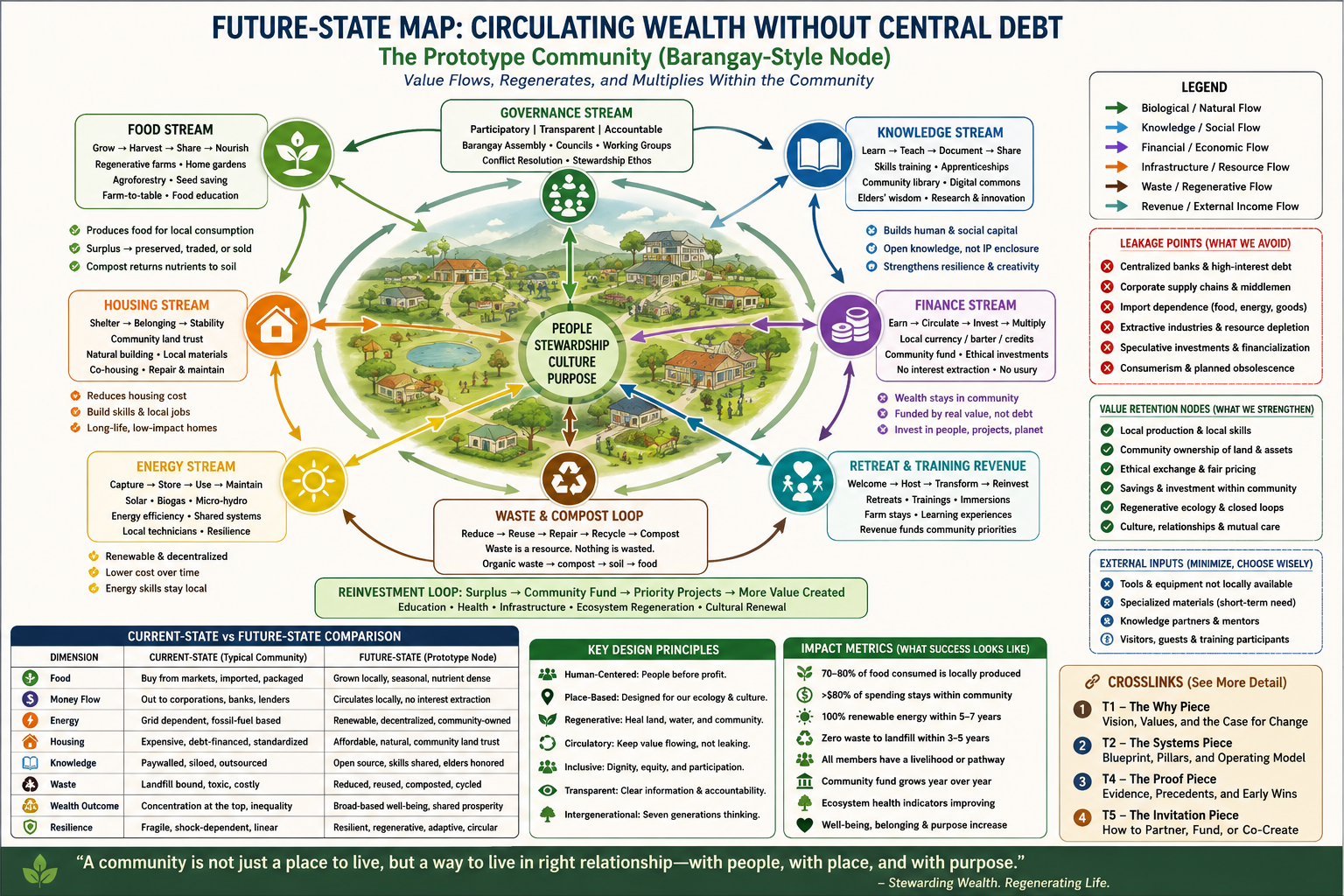
    Mapping the Community Value Streams

    Every intentional community contains multiple overlapping value streams. Most fail because these streams remain invisible, fragmented, or dependent on external debt.

    Download your copy of the Value Stream Map here

    The prototype community instead maps and integrates five primary streams:

    1. Food and Agricultural Stream

    Food is typically the largest leakage point in urbanized communities. Even rural settlements increasingly depend on externally produced food shipped through centralized logistics systems.

    The prototype model reverses this dependency by prioritizing:

    • Regenerative agriculture
    • Shared food production
    • Local seed stewardship
    • Cooperative kitchens
    • Preservation and storage systems
    • Community-supported agriculture (CSA)

    In Value Stream terms, the goal is to shorten the distance between production and consumption.

    Waste outputs from one subsystem become inputs for another:

    • Food scraps become compost.
    • Compost feeds gardens.
    • Gardens feed kitchens.
    • Kitchens feed residents and retreat participants.
    • Retreat revenue reinvests into food resilience.

    This transforms food from a constant expense into a regenerative asset stream.

    Importantly, local food production also stabilizes communities during periods of inflation, supply disruption, or currency volatility.


    2. Housing and Infrastructure Stream

    Conventional housing systems are debt engines. Mortgages frequently lock individuals into decades of extraction where large portions of lifetime income are redirected toward financial institutions.

    The prototype community instead explores phased infrastructure models:

    • Incremental construction
    • Shared utility systems
    • Cooperative ownership structures
    • Local material sourcing where possible
    • Hybrid live-work spaces
    • Modular expansion rather than speculative overbuilding

    The goal is not luxury accumulation. The goal is resilient sufficiency.

    In Value Stream Mapping language, unnecessary overproduction is considered waste (ASQ, n.d.). Large debt-financed infrastructure projects often create financial fragility before the community has stabilized its internal productive capacity.

    The prototype therefore prioritizes:

    1. Productive infrastructure first
    2. Aesthetic expansion second
    3. Debt minimization throughout

    This dramatically changes the risk profile of the community.


    3. Skills, Education, and Knowledge Stream

    Most educational systems train individuals to exit communities in search of employment elsewhere.

    A stewardship-oriented node instead treats education as local capacity building.

    Residents are encouraged to develop skills that strengthen the resilience of the whole ecosystem:

    • Agriculture
    • Conflict mediation
    • Renewable systems maintenance
    • Holistic health support
    • Cooperative administration
    • Media and communications
    • Construction and fabrication
    • Teaching and facilitation

    Knowledge becomes a circulating asset rather than a privatized credential.

    This aligns with the broader Lean understanding that information flow is as important as material flow within any value stream (Lean Enterprise Institute, n.d.). Communities collapse when critical knowledge becomes centralized in a few individuals.

    Therefore, cross-training and distributed competency are essential.

    The healthiest communities are anti-fragile because knowledge redundancy exists throughout the network.


    4. Financial and Exchange Stream

    This is the most sensitive and misunderstood layer.

    The prototype community is not anti-money. It is anti-extractive dependency.

    Money remains necessary. However, the objective is to reduce involuntary external leakage while increasing internal circulation velocity.

    Several mechanisms support this:

    • Cooperative purchasing
    • Shared tools and equipment
    • Internal service exchanges
    • Member contribution systems
    • Ethical microenterprise incubation
    • Local reinvestment pools
    • Community emergency reserves

    A peso that circulates ten times locally creates significantly more resilience than a peso immediately extracted into debt servicing or multinational supply chains.

    Community Wealth Building models have repeatedly demonstrated that local procurement and local ownership strengthen regional resilience and increase local multiplier effects (CLES, n.d.).

    The prototype community therefore functions as a local economic circulation engine.

    External capital is ideally used for:

    • Infrastructure seeding
    • Productive asset acquisition
    • Training systems
    • Renewable systems
    • Water resilience
    • Soil regeneration

    It is not primarily used to inflate lifestyles.

    This distinction is critical.


    5. Cultural and Relational Stream

    Most modern economic systems ignore relational health because it cannot easily be quantified.

    Yet relational fragmentation creates enormous hidden costs:

    • Burnout
    • Mental health deterioration
    • Social distrust
    • Legal conflict
    • Isolation
    • Governance breakdown

    The prototype community therefore treats culture itself as infrastructure.

    This includes:

    • Shared rituals
    • Stewardship circles
    • Community meals
    • Transparent governance
    • Conflict resolution processes
    • Intergenerational mentorship
    • Shared narratives and mission coherence

    In Lean systems language, friction within information and coordination flows creates waste (Lucidchart, n.d.). The same principle applies socially.

    Communities with high trust require fewer enforcement systems, lower transaction costs, and less bureaucratic overhead.

    Trust itself becomes economic infrastructure.


    The Barangay as a Regenerative Node

    The barangay model contains ancient intelligence often overlooked by centralized development frameworks.

    Historically, barangays functioned through:

    • Shared labor
    • Kinship accountability
    • Localized governance
    • Distributed stewardship
    • Cooperative resilience
    • Embedded reciprocity

    While imperfect, these systems possessed adaptive strengths modern urban systems frequently lack.

    The prototype community does not romanticize the past. Instead, it extracts viable principles from historically resilient local systems and integrates them with modern regenerative design.

    The resulting node becomes:

    • Economically localized
    • Technologically adaptive
    • Ecologically regenerative
    • Socially participatory
    • Financially resilient
    • Spiritually coherent

    This is not isolationism.

    The node still interacts with broader markets, donors, digital infrastructure, and external trade. However, it does so from a position of increasing sovereignty rather than permanent dependency.


    Why This Matters to Donors and Partners

    Most charitable models unintentionally reinforce dependency.

    Funds enter communities temporarily but leak outward almost immediately through imported goods, debt obligations, centralized vendors, and unsustainable operational costs.

    The prototype community instead functions as a regenerative multiplier.

    A properly designed stewardship node can:

    • Reduce long-term dependency
    • Increase local resilience
    • Create replicable frameworks
    • Demonstrate ethical economic circulation
    • Lower operating fragility
    • Train future stewardship leaders
    • Serve as a scalable proof-of-concept

    In systems language, donors are not merely funding a project.

    They are helping seed a self-reinforcing value ecosystem.

    This is fundamentally different from charity.

    It is regenerative systems investment.


    References

    American Society for Quality. (n.d.). Value stream mapping tutorial – What is VSM? ASQ. https://asq.org/quality-resources/value-stream-mapping

    Centre for Local Economic Strategies. (n.d.). Community wealth building. CLES. https://cles.org.uk/expertise/community-wealth-building/

    Lean Enterprise Institute. (n.d.). Value-stream mapping. https://www.lean.org/lexicon-terms/value-stream-mapping/

    Lucid Software Inc. (n.d.). What is value stream mapping? Lucidchart. https://www.lucidchart.com/pages/value-stream-mapping

    Ostrom, E. (1990). Governing the commons: The evolution of institutions for collective action. Cambridge University Press.

    Preston City Council. (n.d.). What is community wealth building? https://www.preston.gov.uk/article/1335/What-is-Community-Wealth-Building

    Purdue Lean Six Sigma Online. (2024, November 7). Value stream mapping. Purdue University. https://www.purdue.edu/leansixsigmaonline/blog/value-stream-mapping/

    United Nations Development Programme. (2022). Local governance and resilient communities. https://www.undp.org/


    [DOCUMENT CONTROL & STEWARDSHIP]

    Standard Work ID: VSM-002

    Baseline Version: v1.5.2026

    Classification: Open-Access Archive / Systemic Protocol

    The Sovereign Audit: Following this protocol is an act of internal quality control. Verification of this standard does not happen here; it happens at your Gemba—the actual place where your life and leadership occur. No external validation is required or offered.

    Next in Sequence: [View VSM-001: Mapping the Sovereign Household Value Stream]

    Return to Archive: [Standard Work Knowledge Hub: The Terrain Map]


    © 2026 Gerald Daquila • Life.Understood • Systemic Stewardship • Non-Autocratic Architecture • Process over Persona

  • [SWI-003] Standard Work for Sovereign Wealth: A Protocol for Transitioning from Digital Fiat to Crystalline Assets

    [SWI-003] Standard Work for Sovereign Wealth: A Protocol for Transitioning from Digital Fiat to Crystalline Assets


    Protocol Status: Version 1.0 (Initial Release)

    Process Owner: Individual Steward / Head of Household

    Revision Date: May 2026


    Reframing Wealth in an Age of Institutional Fracture

    The 21st century global economy is entering a period of profound transition.

    Across multiple regions, trust in institutions is being tested by debt expansion, inflationary pressure, widening inequality, ecological instability, geopolitical fragmentation, and the accelerating digitization of money itself.

    Sovereign wealth, once understood primarily as state-controlled reserves and financial instruments, is now increasingly being reconsidered through the lenses of resilience, transparency, ethics, locality, and long-term stewardship.

    At the same time, new conversations are emerging around alternative forms of value storage and exchange. These include decentralized financial systems, tokenized assets, renewable energy-backed economies, cooperative ownership structures, data sovereignty, and emerging concepts sometimes described metaphorically as “crystalline assets.”

    Within this framework, the term crystalline assets should not be interpreted as mystical currency or magical material wealth. Rather, the phrase can serve as a symbolic and systems-oriented metaphor for assets characterized by:

    • transparency;
    • structural integrity;
    • traceability;
    • ethical coherence;
    • long-term resilience;
    • low corruption entropy;
    • regenerative value creation; and
    • alignment between human, ecological, and institutional systems.

    In this sense, crystalline assets stand in contrast to extractive or opaque financial structures that depend heavily on speculative leverage, institutional opacity, or unsustainable debt expansion.

    This article proposes a “standard work” framework — a practical protocol for individuals, communities, organizations, and emerging sovereign networks seeking to transition portions of their economic orientation away from fragile digital fiat dependency and toward resilient, transparent, and regenerative asset ecosystems.


    Understanding Digital Fiat Systems

    Modern fiat currencies derive value primarily from government backing, taxation authority, and collective trust rather than direct commodity convertibility (Mishkin, 2022).

    Over the past several decades, digital banking infrastructure and electronic monetary systems have further abstracted money away from tangible assets and local production.

    Digital fiat systems offer many advantages:

    • liquidity;
    • scalability;
    • rapid transaction capability;
    • international interoperability; and
    • institutional coordination.

    However, they also introduce vulnerabilities when detached from productive, ecological, and social realities.

    Critics of highly financialized economies note that excessive speculative expansion can produce systemic fragility, debt dependence, asset bubbles, and wealth concentration (Piketty, 2014).

    In emerging economies and post-colonial societies, these dynamics can become even more pronounced when external debt structures, currency instability, or institutional capture weaken local sovereignty.

    As a result, many communities worldwide are exploring hybrid models that combine digital systems with more grounded forms of value:

    • local production;
    • cooperative infrastructure;
    • renewable energy systems;
    • land stewardship;
    • food resilience;
    • distributed ownership;
    • transparent ledgers;
    • ethical enterprise;
    • knowledge commons; and
    • community trust networks.

    The transition described here is therefore not a rejection of modern finance entirely, but an attempt to rebalance economic systems toward durability, accountability, and real-world value generation.


    Defining Crystalline Assets

    Crystalline assets may be understood as assets that exhibit structural coherence across multiple dimensions:

    DimensionCrystalline Characteristic
    EconomicDurable, productive, low-speculation value
    EcologicalRegenerative rather than extractive
    SocialCommunity-benefiting and trust-building
    InformationalTransparent and verifiable
    InstitutionalResistant to corruption and opacity
    PsychologicalReduces fear-based scarcity behavior
    CulturalPreserves identity, continuity, and stewardship

    Examples may include:

    • regenerative agricultural land;
    • renewable energy infrastructure;
    • community-owned utilities;
    • ethical cooperative enterprises;
    • educational archives and knowledge systems;
    • decentralized but transparent financial ledgers;
    • resilient local supply chains;
    • open-source technological ecosystems;
    • culturally rooted production networks; and
    • tokenized systems backed by real-world productive assets.

    Importantly, not every digital asset qualifies as crystalline merely because it is decentralized or blockchain-based.

    Many speculative digital assets replicate the same extractive behaviors present within traditional financial systems.

    The critical distinction lies not in technological novelty alone, but in whether the asset structure contributes to long-term resilience, accountability, and regenerative capacity.


    Why Sovereign Wealth Must Evolve

    Traditional sovereign wealth models often focus heavily on:

    • foreign currency reserves;
    • bonds;
    • extractive resource exports;
    • centralized investment vehicles; and
    • large-scale institutional capital deployment.

    While these tools remain important, the global environment is changing rapidly.

    The World Bank (2024) notes that climate instability, supply chain fragmentation, and geopolitical shifts are increasingly influencing economic resilience. Meanwhile, technological acceleration is redistributing power away from exclusively centralized institutions toward hybrid public-private-community ecosystems.

    In this context, sovereign wealth may need to evolve beyond purely financial metrics toward broader measures of societal resilience, including:

    • food security;
    • energy independence;
    • digital sovereignty;
    • educational capacity;
    • ecological stability;
    • community trust;
    • transparent governance; and
    • adaptive infrastructure.

    Countries and communities that fail to diversify beyond fragile financial abstractions may become increasingly vulnerable during periods of global instability.


    A Standard Work Protocol for Transition

    The following framework is not a rigid doctrine but a practical orientation model.


    1. Conduct a Sovereign Asset Audit

    The first step is identifying what forms of value already exist.

    Many societies underestimate their true wealth because they measure only financial liquidity rather than:

    • ecological assets;
    • human capability;
    • cultural continuity;
    • local knowledge;
    • agricultural productivity;
    • diaspora networks;
    • social trust; and
    • cooperative capacity.

    An asset audit should therefore include:

    • land and ecological resources;
    • energy infrastructure;
    • educational systems;
    • digital infrastructure;
    • food production capacity;
    • institutional integrity;
    • cultural archives;
    • public trust metrics; and
    • local enterprise ecosystems.

    This creates a broader picture of sovereign resilience.


    2. Reduce Dependency Concentration

    Systems become fragile when too much value depends on a single point of failure.

    Communities and institutions should evaluate overdependence on:

    • external debt systems;
    • imported essentials;
    • centralized digital platforms;
    • speculative asset exposure;
    • monopolized supply chains; and
    • unstable geopolitical arrangements.

    Resilience emerges through diversification and redundancy.

    This may include:

    • local agriculture initiatives;
    • distributed energy systems;
    • cooperative manufacturing;
    • community finance structures;
    • open-source technologies; and
    • local knowledge preservation.

    3. Anchor Value to Real Production

    One of the central critiques of hyper-financialized economies is the detachment of wealth accumulation from productive contribution.

    Crystalline-oriented systems seek stronger alignment between:

    • value creation;
    • labor;
    • ecological regeneration;
    • social benefit; and
    • tangible production.

    This does not eliminate digital systems. Rather, it reconnects them to measurable real-world outputs.

    Potential examples include:

    • tokenized renewable energy production;
    • agricultural cooperatives;
    • ethical manufacturing;
    • knowledge infrastructure;
    • distributed educational platforms; and
    • regenerative land stewardship systems.

    4. Build Transparent Ledger Systems

    Transparency is foundational to trust.

    Emerging ledger technologies can improve:

    • accountability;
    • traceability;
    • anti-corruption measures;
    • public auditing; and
    • participatory governance.

    However, transparency alone is insufficient without ethical governance and informed civic participation.

    Technology cannot substitute for stewardship.

    The strongest systems combine:

    • transparent infrastructure;
    • ethical leadership;
    • institutional checks;
    • civic literacy; and
    • distributed accountability.

    5. Develop Regenerative Wealth Metrics

    Gross Domestic Product (GDP) remains a dominant economic metric globally, yet many economists argue that GDP alone fails to capture societal wellbeing, ecological health, or long-term resilience (Stiglitz et al., 2010).

    A crystalline wealth framework may therefore incorporate broader indicators such as:

    • ecological restoration;
    • educational access;
    • food resilience;
    • local ownership ratios;
    • trust indices;
    • corruption reduction;
    • renewable energy capacity;
    • mental health outcomes; and
    • intergenerational sustainability.

    These metrics help align economic systems with human flourishing rather than pure extraction.


    6. Preserve Human Meaning and Cultural Continuity

    Economic systems are not merely transactional structures. They shape identity, meaning, belonging, and collective direction.

    Communities undergoing rapid digitization or financial transition often experience psychological fragmentation when cultural continuity is lost.

    Therefore, sovereign wealth transition should also preserve:

    • language;
    • memory;
    • ancestral knowledge;
    • local traditions;
    • ethical frameworks; and
    • community cohesion.

    In post-colonial societies especially, economic sovereignty and cultural sovereignty are deeply intertwined.


    The Philippine Context

    The Philippines occupies a uniquely complex position within the global transition landscape.

    It is simultaneously:

    • deeply integrated into global labor migration;
    • highly digitized in communication culture;
    • vulnerable to climate instability;
    • shaped by colonial history;
    • rich in human adaptab

    References

    Mishkin, F. S. (2022). The economics of money, banking, and financial markets (13th ed.). Pearson.

    Piketty, T. (2014). Capital in the twenty-first century. Harvard University Press.

    Stiglitz, J. E., Sen, A., & Fitoussi, J.-P. (2010). Mismeasuring our lives: Why GDP doesn’t add up: The report by the Commission on the Measurement of Economic Performance and Social Progress. The New Press.

    World Bank. (2024). Global economic prospects: Broadening the scope of debt sustainability. World Bank Publications.


    Crosslinks


    [DOCUMENT CONTROL & STEWARDSHIP]

    Standard Work ID: SWI-003

    Baseline Version: v1.5.2026

    Classification: Open-Access Archive / Systemic Protocol

    The Sovereign Audit: Following this protocol is an act of internal quality control. Verification of this standard does not happen here; it happens at your Gemba—the actual place where your life and leadership occur. No external validation is required or offered.

    Next in Sequence: [SWI-002: The 72-Hour Protocol]

    Return to Archive: [Standard Work Knowledge Hub: The Terrain Map]


    © 2026 Gerald Daquila • Life.Understood • Systemic Stewardship • Non-Autocratic Architecture • Process over Persona

  • From Fragmented Souls to Sovereign Stewards: Reclaiming Identity After 500 Years of Institutional Trauma

    From Fragmented Souls to Sovereign Stewards: Reclaiming Identity After 500 Years of Institutional Trauma


    How Filipinos can move from inherited fragmentation to integrated leadership in a post-colonial world


    Meta Description

    After 500 years of colonization and institutional disruption, how can Filipinos reclaim identity and sovereignty? Explore the path from fragmentation to stewardship through psychological integration, cultural recovery, and systems design.


    Understanding the Landscape: The Sovereignty Ladder

    Before exploring the themes of sovereignty, stewardship, and governance in greater detail, it may be helpful to view the broader developmental landscape.

    The map below presents a framework for understanding how responsibility, agency, and contribution can expand across increasing circles of concern and longer time horizons. It is intended as an orienting framework rather than a measure of status, achievement, or personal worth.

    The Sovereignty Ladder illustrates how responsibility may expand from personal survival and stability toward stewardship, custodianship, and legacy across broader circles of concern and longer time horizons.

    →Download Reference Map 002: The Sovereignty Ladder


    The Long Arc of Fragmentation

    To understand the present Filipino condition, we must first acknowledge the scale of its disruption.

    Over the past five centuries, the archipelago now known as the Philippines has moved through successive waves of external control—from the arrival of Ferdinand Magellan’s expedition to the Philippines, through more than 300 years of Spanish rule, followed by American colonization, Japanese occupation during World War II, and a post-independence era shaped by global economic dependence.

    https://images.openai.com/static-rsc-4/xPYUKIuryyn-nccxm9Th9Z19ldeDdnwmjUcZpJWupA0epfsPIkL7SxF-wRC_ducQGYIfodAqH3_uONwxu9IqWS84W79i0eCs_kT7gjmQuPplJFmexPDPRksaBNbDtcK6G8gaNajWtbLmbJbe6gGzjZWyWWnBgLFwu3wR8yqXCpxlPKD1yHFPkR4K2xkgxFi-?purpose=fullsize

    Each period introduced new systems:

    • Governance structures
    • Educational frameworks
    • Religious paradigms
    • Economic models

    But rarely were these transitions integrated.

    Instead, they layered over one another—often replacing rather than reconciling what came before.

    The result is not simply historical complexity.

    It is institutional trauma—a condition where repeated systemic disruptions fracture continuity across generations.


    What Is Institutional Trauma?

    Institutional trauma occurs when the systems meant to provide stability—government, education, economy—become sources of disruption, extraction, or inconsistency.

    In the Filipino experience, this has meant:

    • Repeated shifts in authority and values
    • Displacement of indigenous knowledge systems
    • Dependence on externally designed structures
    • Interrupted narratives of identity

    Psychologically, such conditions contribute to collective fragmentation—where identity is no longer cohesive but distributed across conflicting influences (Alexander, 2004).

    This is not theoretical.

    It is lived.


    The Fragmented Self: A National Pattern

    Fragmentation expresses itself both individually and collectively.

    At the personal level:

    • Identity shifts depending on context (local vs. global, home vs. abroad)
    • Conflicting values coexist without resolution
    • Self-perception fluctuates between pride and inadequacy

    At the national level:

    • Policies change with leadership cycles
    • Institutions lack continuity
    • Collective goals remain inconsistent

    (Crosslink: Naming the Unspoken: A Guide to Navigating the Hidden Fractures of Our National Identity)

    These are not isolated issues.

    They are symptoms of a deeper lack of integration.


    The Shadow Beneath Fragmentation

    Fragmentation is sustained by what remains unprocessed.

    This includes:

    • Colonial mentality
    • Generational shame around poverty
    • Distrust in institutions
    • Dependency on external validation

    (Crosslink: The Ancestral Debt: Healing the Generational Shame of Poverty in the Filipino Psyche)

    (Crosslink: From Informer to Steward: Why True Leadership Begins with Owning Our Shared Shadow)

    Without engaging this shadow, attempts at reform remain surface-level.


    Why Identity Must Be Reclaimed Before Systems Can Stabilize

    A common assumption is that fixing systems will fix society.

    But systems are downstream of identity.

    If identity remains fragmented:

    • Policies are inconsistently applied
    • Leadership lacks coherence
    • Public trust remains fragile

    Research in institutional development shows that durable systems require alignment between cultural values, social norms, and governance structures (North, 1990).

    In simple terms:
    You cannot build stable systems on unstable identity.


    The Transition: From Fragmentation to Integration

    Reclaiming identity is not about returning to a pre-colonial past.

    It is about integration.

    This involves:

    • Acknowledging all historical layers
    • Retaining what is functional
    • Releasing what is harmful
    • Synthesizing a coherent present identity

    This process mirrors what psychology calls integration—the unification of previously disjointed aspects of the self into a coherent whole (Siegel, 2012).

    At a national scale, this becomes a civilizational task.


    The Emergence of the Sovereign Steward

    From integration emerges a new archetype:

    The Sovereign Steward

    Unlike traditional leadership models, the sovereign steward:

    • Does not derive authority from position alone
    • Does not depend on external validation
    • Does not replicate inherited dysfunctions

    Instead, they:

    • Hold responsibility for their domain
    • Align inner values with external action
    • Build systems that reflect coherence

    This is the evolution beyond both victimhood and imitation.


    The Three Layers of Sovereign Stewardship

    1. Inner Coherence

    The steward begins with self-integration:

    • Awareness of inherited patterns
    • Emotional and psychological maturity
    • Alignment between belief and behavior

    2. Cultural Grounding

    Identity is anchored—not borrowed.

    This includes:

    • Re-engagement with local knowledge
    • Respect for indigenous frameworks
    • Contextual adaptation rather than blind adoption

    3. Systems Design

    (Crosslink: ARK-003: Jurisdictional Sovereignty: Legal Standard Work)

    Stewardship becomes tangible through:

    • Governance models
    • Economic systems
    • Community structures

    These must be:

    • Coherent
    • Replicable
    • Sustainable

    The Stewardship Field

    The transition from sovereignty to stewardship requires more than independence or self-determination. It requires the ability to hold responsibility in service of a larger whole.

    The Stewardship Field provides a framework for understanding how vision, responsibility, service, and inheritance remain in balance as individuals, communities, and institutions participate in the work of long-term renewal.

    Rather than presenting stewardship as a position or achievement, the map illustrates it as a living field sustained through awareness, discernment, participation, contribution, and custodianship.

    In the context of post-colonial recovery, it offers a lens for understanding how personal integration, cultural coherence, and systems design become interconnected expressions of responsible stewardship.

    → Download Reference Map 007: The Stewardship Field


    The Ark Perspective: The Philippines as a Living Prototype

    Within the Ark framework, the Philippines is not simply recovering.

    It is demonstrating.

    (Crosslink: The Philippine Ark: A Global South Prototype)

    A nation that has experienced:

    • Deep fragmentation
    • Cultural layering
    • Global dispersion

    Has the potential to model:

    How integration can occur in complex, post-colonial environments

    This is not about perfection.

    It is about process.


    Practical Pathways to Reclaiming Identity

    1. Integrate, Don’t Erase

    Avoid extremes:

    • Not total rejection of the past
    • Not blind preservation

    Seek synthesis.


    2. Build Coherence in Small Units

    (Crosslink: ARK-001: The 50-Person Resource Loop)

    Large-scale change begins with:

    • Families
    • Communities
    • Local systems

    3. Practice Responsibility Over Blame

    Historical awareness is important.

    But transformation requires ownership.


    4. Align Across Levels

    Ensure consistency between:

    • Personal values
    • Cultural expression
    • Institutional design

    Misalignment creates instability.


    5. Commit to Long-Term Integration

    Fragmentation took centuries.

    Integration will take time.

    But it can begin now.


    The Risk of Remaining Fragmented

    If fragmentation persists:

    • Leadership remains inconsistent
    • Systems remain unstable
    • Identity remains externally defined

    This leads to continuous cycles of:

    Reform → Regression → Reset → Repeat


    Conclusion: The Return to Wholeness

    The Filipino journey is not simply one of recovery.

    It is one of reconstruction.

    From:

    • Fragmented identity
    • Inherited trauma
    • External dependence

    To:

    • Integrated self
    • Cultural coherence
    • Sovereign stewardship

    The past 500 years cannot be undone.

    But they can be integrated.

    And from that integration emerges something new:

    Not a return to what was.
    But the creation of what has not yet existed.

    A people who know who they are.
    A nation that can sustain what it builds.

    The shift from fragmented souls to sovereign stewards is not inevitable.

    But it is possible.

    And it begins with coherence.


    References

    Alexander, J. C. (2004). Cultural trauma and collective identity. American Sociological Review, 69(1), 1–30.

    David, E. J. R. (2013). Brown Skin, White Minds. Information Age Publishing.

    North, D. C. (1990). Institutions, Institutional Change and Economic Performance. Cambridge University Press.

    Siegel, D. J. (2012). The Developing Mind. Guilford Press.

    Constantino, R. (1975). The Philippines: A Past Revisited. Tala Publishing Services.

    The Living Archive is designed to be explored through pathways, categories, and search. If you’re looking for a specific idea, question, or theme, AI Search can help surface relevant connections across the archive.


    ©2026 Gerald Daquila • Life.Understood. • Systems Thinking, Leadership Architecture, and Applied Coherence

  • From Informer to Steward: Why True Leadership Begins with Owning Our Shared Shadow

    From Informer to Steward: Why True Leadership Begins with Owning Our Shared Shadow


    Moving beyond awareness into responsibility in the Filipino path to sovereign leadership


    Meta Description

    True leadership begins where awareness ends. Discover why owning the shared shadow—colonial wounds, systemic patterns, and cultural contradictions—is the foundation of Filipino stewardship and national renewal.


    The Age of Awareness Is Ending

    We live in a time where information is abundant.

    Filipinos today are more aware than ever—of corruption, inequality, colonial history, and systemic dysfunction. Social media, independent journalism, and global exposure have made it nearly impossible to remain uninformed.

    And yet, despite this surge in awareness, something remains unchanged.

    The same cycles persist:

    • Corruption is condemned, then repeated
    • Systems are criticized, then replicated
    • Leaders are questioned, but rarely transformed

    This reveals a critical gap:

    Awareness does not equal leadership.

    There is a difference between being an informer—one who names problems—and a steward—one who takes responsibility for transformation.


    The Informer Archetype: Necessary but Incomplete

    The informer plays an essential role.

    They expose truth.
    They challenge narratives.
    They disrupt silence.

    Without informers, the unspoken remains hidden.

    (Crosslink: Naming the Unspoken: A Guide to Navigating the Hidden Fractures of Our National Identity)

    But the informer archetype has a limitation: it often stops at exposure.

    It says:

    • “This is broken.”
    • “This is wrong.”
    • “This must change.”

    Yet it rarely answers:

    • Who will change it?
    • How will it be rebuilt?
    • What must I embody differently?

    Without this transition, informing can become a loop—one that generates outrage without resolution.


    The Shared Shadow: What We Inherit and Reenact

    To understand why this loop persists, we must confront a deeper layer: the shared shadow.

    In psychological terms, the “shadow” refers to the parts of ourselves we deny, suppress, or disown (Jung, 1959). At a collective level, this becomes the cultural shadow—patterns that societies unconsciously carry and reenact.

    In the Filipino context, this shadow includes:

    • Internalized inferiority from colonial history
    • Dependency on external validation
    • Avoidance of conflict disguised as harmony
    • Short-term survival thinking over long-term design
    • Distrust in institutions coupled with participation in their dysfunction

    These are not abstract concepts. They appear in everyday decisions:

    • Cutting corners “because everyone does it”
    • Avoiding difficult conversations to maintain surface peace
    • Seeking foreign approval while dismissing local capacity

    As Carl Jung warned, “Until you make the unconscious conscious, it will direct your life and you will call it fate” (Jung, 1959).

    At a national scale, this becomes destiny mistaken for inevitability.


    Why Leadership Begins with Ownership

    True leadership does not begin with authority.

    It begins with ownership.

    Ownership means recognizing that:

    The systems we criticize are, in part, sustained by the behaviors we tolerate, participate in, or fail to transform.

    This is not about blame. It is about agency.

    Research on adaptive leadership emphasizes that complex societal problems cannot be solved by technical fixes alone—they require shifts in values, behaviors, and collective mindset (Heifetz, Grashow, & Linsky, 2009).

    In other words:
    The problem is not only “out there.” It is also “in here.”


    From Critique to Stewardship

    The shift from informer to steward is a shift in posture.

    The Informer Asks:

    “What is wrong?”


    The Steward Asks:

    “What is mine to hold, repair, and build?”

    This shift has three dimensions:


    1. Inner Stewardship (Self-Leadership)

    Before systems can be transformed, patterns within the self must be addressed.

    This includes:

    • Not replicating corruption in small, personal ways
    • Practicing integrity even when inconvenient
    • Developing emotional and psychological maturity

    Leadership without inner coherence produces outer inconsistency.


    2. Relational Stewardship (Family and Community)

    Cultural patterns are reinforced at the relational level.

    This means:

    • Addressing unhealthy family dynamics (e.g., silence, obligation without boundaries)
    • Modeling new forms of communication and accountability
    • Building trust through consistent action

    Small relational shifts create ripple effects.


    3. Structural Stewardship (Systems and Institutions)

    This is where stewardship becomes visible.

    It involves:

    • Designing systems that reduce corruption by design
    • Creating feedback loops and accountability mechanisms
    • Building sustainable economic and governance models

    (Crosslink: ARK-003: Jurisdictional Sovereignty: Legal Standard Work)

    Without structural expression, awareness remains abstract.

    The transition from informer to steward can be understood not only as a change in mindset, but as a shift into a different relationship with responsibility itself.


    The Stewardship Field

    The Stewardship Field provides a visual framework for understanding the transition from awareness to responsible participation. While informers help societies recognize problems, stewards help societies build what comes next.

    The map illustrates how stewardship emerges through the ongoing balance of vision, responsibility, service, and inheritance, supported by the practices of awareness, discernment, participation, contribution, and custodianship.

    In the Filipino context, it offers a lens for understanding how personal responsibility, community trust, institutional renewal, and long-term nation-building are connected through a shared commitment to responsible care for the whole.

    The Stewardship Field presents stewardship as a living field of balance rather than a ladder to climb or a destination to reach. By integrating vision, responsibility, service, and inheritance, it offers a framework for understanding how individuals, communities, institutions, and nations cultivate continuity, resilience, and responsible action across generations.

    → Download Reference Map 007: The Stewardship Field


    The Filipino Threshold: Stewardship as Destiny

    Within the Ark framework, the Philippines is not simply navigating dysfunction—it is being positioned for demonstration.

    (Crosslink: The Philippine Ark: A Global South Prototype)

    A post-colonial nation with deep diaspora networks, cultural resilience, and adaptive intelligence has the potential to model a new kind of leadership:

    Stewardship-based leadership.

    Not authority imposed from above.
    Not charisma-driven leadership.
    But grounded, distributed responsibility.

    This form of leadership:

    • Is less visible, but more durable
    • Is slower, but more stable
    • Is quieter, but more transformative

    Practical Framework: Becoming a Steward

    Transitioning from informer to steward is not abstract. It can be practiced.

    1. Move from Exposure to Construction

    For every problem identified, ask:

    What is one concrete solution I can help build?


    2. Audit Personal Alignment

    Where do your actions contradict your stated values?

    Alignment is credibility.


    3. Take Responsibility Within Your Sphere

    You do not need to fix the nation.

    You need to steward your domain:

    • Your work
    • Your family
    • Your community

    Scale emerges from coherence, not ambition.


    4. Build with Others

    Stewardship is not solitary.

    It requires:

    • Collaboration
    • Shared standards
    • Mutual accountability

    5. Commit to Long-Term Thinking

    Stewards think in decades, not cycles.

    They ask:

    Will this decision strengthen or weaken future generations?


    The Risk of Not Transitioning

    If awareness does not evolve into stewardship, three risks emerge:

    1. Chronic Cynicism – Endless critique without action leads to disengagement
    2. Performative Activism – Visibility replaces substance
    3. Systemic Stagnation – Nothing fundamentally changes

    At that point, awareness becomes a form of paralysis.


    Conclusion: Leadership as Responsibility, Not Identity

    Leadership is often framed as a position.

    In reality, it is a function.

    A function that begins the moment we stop asking,
    “Who is responsible?”
    and start asking,
    “What is mine to steward?”

    The Filipino story does not need more informers.

    It needs stewards.

    Those willing to:

    • Name the shadow
    • Own their participation in it
    • Build beyond it

    This is where true leadership begins.

    Not in visibility.
    But in responsibility.


    References

    Heifetz, R. A., Grashow, A., & Linsky, M. (2009). The Practice of Adaptive Leadership. Harvard Business Press.

    Jung, C. G. (1959). Aion: Researches into the Phenomenology of the Self. Princeton University Press.

    David, E. J. R. (2013). Brown Skin, White Minds: Filipino-/American Postcolonial Psychology. Information Age Publishing.

    Fanon, F. (1963). The Wretched of the Earth. Grove Press.


    The Sovereign Professional: A structural map of power, systems thinking, and personal autonomy—dedicated to helping the independent professional navigate complexity and own their value stream.Ask


    ©2026 Gerald Daquila • Life.Understood. • Systems Thinking, Leadership Architecture, and Applied Coherence