This material is part of the Stewardship Institute’s protected formation layer.
Most of the Living Archive is intentionally public. Some materials belong to a deeper, interconnected body of work designed for sustained reflection, practical application, and lifelong steward formation. Stewardship Access is the threshold into that body of work.
Understanding the Necessity of Ego Dissolution and the Consequences of Unaddressed Shadow Work in Personal and Collective Evolution
Original Publication: June 21, 2025 | Revised: February 17, 2026
Prepared by: Gerald A. Daquila, PhD. Candidate
Author’s Reflection (2026 Integration Note)
This essay was written during an earlier bridge phase of the Living Codex, when the language of “ego death” served as a useful metaphor for the dismantling of rigid identity structures during awakening.
Since its original publication, the Codex has evolved toward a more sovereignty-anchored framing. In this context, awakening is understood not as the annihilation of the ego, but as its maturation and decentralization. The ego does not need to be destroyed; it needs to relinquish absolute authority and become a steward within a larger field of awareness.
Experiences commonly described as “ego death” may arise during meditation, crisis, psychedelic states, or deep spiritual inquiry. However, such experiences are not prerequisites for awakening, nor are peak dissolution states inherently superior to gradual integration.
This work remains relevant as a multidisciplinary exploration of transformation. It is now offered within a more embodied and governance-oriented framework: awakening is sustainable only when dissolution is followed by integration, stabilization, and ethical self-leadership.
The emphasis is not death — but reorganization.
12–17 minutes
ABSTRACT
Ego death, a profound dissolution of the self-concept, is often described as a pivotal experience in spiritual awakening across psychological, philosophical, esoteric, and neuroscientific disciplines. This dissertation explores why the ego must “die” to facilitate spiritual growth, the role of shadow work in this process, and the consequences of neglecting it.
Drawing on Jungian psychology, Eastern philosophies, shamanic traditions, transpersonal psychology, and neuroscience, the study synthesizes diverse perspectives to offer a holistic understanding. It argues that ego death enables a reconnection with universal consciousness, but without shadow work—confronting and integrating repressed aspects of the self—individuals risk spiritual bypassing, psychological fragmentation, or stalled transformation. The dissertation concludes with practical implications for personal growth and collective evolution, emphasizing the necessity of a balanced, multidisciplinary approach to spiritual awakening.
Table of Contents
Introduction
Defining Ego Death and Spiritual Awakening
The Necessity of Ego Death in Spiritual Awakening
The Role of Shadow Work
Consequences of Neglecting Shadow Work
Multidisciplinary Perspectives
Psychological and Jungian Insights
Eastern Philosophical Traditions
Shamanic and Indigenous Perspectives
Transpersonal Psychology
Neuroscientific Correlates
Esoteric and Metaphysical Frameworks
Practical Implications and Integration
Conclusion
Glossary
Bibliography
Glyph of the Bridgewalker
The One Who Holds Both Shores
1. Introduction
Imagine standing at the edge of a vast ocean, your sense of self dissolving like sand beneath the waves. This is ego death—a transformative, often disorienting experience described across spiritual traditions as essential to awakening. But why must the ego, our carefully constructed identity, “die”? And what happens if we avoid the messy, introspective work of confronting our inner shadows?
This paper dives into these questions, weaving together psychology, philosophy, neuroscience, and esoteric wisdom to explore ego death and shadow work holistically. Spiritual awakening, the process of realizing one’s interconnectedness with a greater reality, often demands the dismantling of the ego—the mental construct of “I” that separates us from others and the divine.
Shadow work, a term rooted in Jungian psychology, involves facing repressed emotions, beliefs, and traumas to achieve wholeness. Neglecting this work can derail transformation, leading to spiritual bypassing or psychological distress. Using a multidisciplinary lens, this study aims to illuminate the necessity of ego death, the critical role of shadow work, and the risks of bypassing it, offering insights for seekers and scholars alike.
2. Defining Ego Death and Spiritual Awakening
Ego death is the temporary or permanent dissolution of the self-concept, where the boundaries of “I” blur or vanish, often accompanied by a sense of unity with the universe. Described in psychedelic research, mysticism, and meditation, it can feel liberating or terrifying (Grof, 1988). Spiritual awakening, conversely, is a broader process of recognizing one’s true nature—often described as divine, universal consciousness, or “oneness” in traditions like Advaita Vedanta or Buddhism (Taylor, 2017).
The ego, in psychological terms, is the conscious self that navigates reality, shaped by social conditioning, memories, and defenses (Freud, 1923). In spiritual contexts, it’s seen as an illusion separating us from ultimate reality (Tolle, 1999). Shadow work, as defined by Carl Jung, involves integrating the “shadow”—the unconscious, repressed aspects of the psyche, such as shame, anger, or fear (Jung, 1964). Together, these concepts form the backbone of transformative processes, but their interplay requires careful exploration.
3. The Necessity of Ego Death in Spiritual Awakening
Why must the ego decentralize? At its core, the ego creates a functional sense of separation necessary for human navigation. Awakening does not require its destruction, but rather its reorganization — a shift from ruler of identity to steward within a broader field of awareness.
Reconnection with Universal Consciousness: In Advaita Vedanta, the ego (ahamkara) obscures the Self (Atman), which is identical to Brahman, the universal consciousness (Shankaracharya, 8th century). Moments of ego dissolution can temporarily soften this veil, revealing a non-dual field of awareness. (Easwaran, 2007).
Liberation from Suffering: Buddhism teaches that attachment to the ego fuels suffering (dukkha). By letting go of the self, one attains nirvana, a state of liberation (Dalai Lama, 1995).
Expansion of Perspective: Transpersonal psychology suggests ego death allows access to transpersonal states, where individuals experience collective or cosmic consciousness (Grof, 1988).
Psychological Rebirth: Jungian psychology views ego death as a symbolic death and rebirth, necessary for individuation—the process of becoming whole (Jung, 1964).
Ego dissolution is experiential and often temporary. In healthy development, what follows is not permanent erasure of identity but a restructuring of how identity functions. It strips away false identities, allowing a deeper truth to emerge. However, this process is incomplete without shadow work, which ensures the transformation is grounded and sustainable.
It is important to clarify that awakening does not require dramatic rupture. Many individuals awaken gradually through ethical refinement, embodied presence, and increasing psychological integration. Dissolution without stabilization can destabilize the psyche. Therefore, the aim is not ego annihilation, but ego maturation.
4. The Role of Shadow Work
The shadow, as Jung described, is the “dark side” of the psyche—qualities we reject or suppress, like anger, envy, or vulnerability (Jung, 1964). Shadow work involves confronting these aspects with compassion, integrating them into conscious awareness. Without it, ego death can be superficial or destabilizing. Here’s why shadow work is essential:
Prevents Spiritual Bypassing: Spiritual bypassing—using spiritual practices to avoid psychological pain—occurs when individuals chase transcendence without facing their shadows (Welwood, 2000). Shadow work grounds awakening in reality.
Facilitates Integration: Ego death can unearth repressed emotions or traumas. Shadow work helps process these, preventing overwhelm or dissociation (Levine, 1997).
Promotes Wholeness: Jung argued that individuation requires embracing the shadow to achieve psychological balance. Unintegrated shadows manifest as projections, sabotaging relationships or growth (Jung, 1964).
Aligns with Esoteric Traditions: In alchemy, the nigredo (blackening) stage symbolizes confronting the shadow before transformation (Edinger, 1985). Similarly, shamanic traditions emphasize facing inner “demons” during initiations (Harner, 1980).
Shadow work is not a one-time event but a lifelong process, requiring courage, self-compassion, and often guidance from therapists, shamans, or spiritual teachers.
5. Consequences of Neglecting Shadow Work
What happens if shadow work is ignored? The consequences can be profound, affecting individuals and collectives:
Spiritual Bypassing: Without shadow work, individuals may adopt spiritual identities to mask unresolved pain, leading to inauthentic growth (Welwood, 2000). For example, a meditator might claim “detachment” while suppressing anger, which later erupts destructively.
Psychological Fragmentation: Ego death can destabilize the psyche if unintegrated shadows surface without tools to process them. This may result in anxiety, depression, or dissociation (Grof, 1988).
Stalled Transformation: Unaddressed shadows create resistance, preventing full awakening. In Buddhist terms, this is akin to clinging to samsara (cyclical suffering) (Kornfield, 2000).
Collective Harm: On a societal level, unintegrated shadows manifest as projection—blaming others for inner flaws. This fuels conflict, prejudice, and systemic oppression (Wilber, 2000).
Spiritual Crises: Transpersonal psychology documents “spiritual emergencies,” where intense awakening experiences without shadow work lead to psychosis-like states (Lukoff, 1985).
Neglecting shadow work doesn’t just halt personal growth; it perpetuates cycles of suffering, underscoring the need for a balanced approach to awakening.
6. Multidisciplinary Perspectives
To fully grasp ego death and shadow work, we must draw on diverse disciplines, each offering unique insights.
Psychological and Jungian Insights
Carl Jung’s concept of the shadow is foundational. He viewed the psyche as a dynamic system, where the ego, shadow, and Self (the archetype of wholeness) interact. Ego death, in Jungian terms, is a confrontation with the Self, requiring shadow integration to avoid inflation (over-identifying with the divine) or deflation (feeling unworthy) (Jung, 1964). Modern psychology, particularly trauma-informed approaches, emphasizes somatic shadow work, using the body to release stored emotions (Levine, 1997).
Eastern Philosophical Traditions
In Advaita Vedanta, ego death is the realization that the individual self is an illusion. Practices like self-inquiry (“Who am I?”) dismantle the ego, revealing non-dual awareness (Ramana Maharshi, 2000). Buddhism’s anatta (no-self) doctrine similarly negates the ego, with meditation uncovering the impermanence of self (Dalai Lama, 1995). Shadow work aligns with mindfulness, where practitioners observe emotions without judgment, integrating them into awareness (Kornfield, 2000).
Shamanic and Indigenous Perspectives
Shamanic traditions view ego death as a rite of passage, often induced by plant medicines like ayahuasca or peyote. The shaman guides initiates through encounters with their shadows—symbolized as spirits or ancestors—to reclaim lost soul fragments (Harner, 1980). Indigenous wisdom emphasizes community and ritual, grounding awakening in collective healing, unlike individualistic Western approaches (Kalsched, 1996).
Transpersonal Psychology
Transpersonal psychology studies states beyond the ego, including mystical experiences and ego death. Stanislav Grof’s research on psychedelics and holotropic breathwork shows that ego death can access perinatal (birth-related) and transpersonal realms, but integration is critical to avoid re-traumatization (Grof, 1988). Shadow work in this context involves processing these experiences with trained facilitators.
Neuroscientific Correlates
Neuroscience links ego death to reduced activity in the default mode network (DMN), a brain region associated with self-referential thinking. Psychedelics like psilocybin disrupt the DMN, inducing ego dissolution and interconnectedness (Carhart-Harris et al., 2016). Shadow work may involve neuroplasticity, as confronting repressed emotions rewires neural pathways (Siegel, 2010). However, without integration, these changes may not persist, leading to psychological distress.
Esoteric and Metaphysical Frameworks
In esoteric traditions like Hermeticism, ego death is the “Great Work” of uniting opposites—light and shadow, human and divine (Hauck, 1999). Alchemy’s stages (nigredo, albedo, rubedo) mirror this process, with shadow work as the first step. Metaphysical perspectives, such as those in Theosophy, view ego death as a step toward soul evolution, aligning with cosmic cycles (Blavatsky, 1888). These frameworks emphasize intention and ritual, complementing psychological approaches.
Glyph of the Sacred Surrender
Through the dissolution of self, the Soul is born anew.
7. Practical Implications and Integration
For seekers, integrating ego death and shadow work requires practical steps:
Mindfulness and Meditation: Practices like Vipassana or self-inquiry help observe the ego and shadow without attachment (Kornfield, 2000).
Therapeutic Support: Jungian analysis, somatic therapy, or psychedelic-assisted therapy provide safe spaces to process shadows (Levine, 1997; Grof, 1988).
Ritual and Community: Shamanic ceremonies or spiritual communities offer grounding and collective support (Harner, 1980).
Journaling and Creative Expression: Writing or art can externalize shadows, fostering integration (Jung, 1964).
Embodied Practices: Yoga, breathwork, or dance release stored emotions, aligning body and mind (Siegel, 2010).
Collectively, these practices bridge disciplines, balancing intellectual understanding (left brain), intuitive insight (right brain), and emotional connection (heart). Societies can support this by destigmatizing mental health, promoting holistic education, and fostering communal healing spaces.
8. Conclusion
Ego dissolution is not an end, nor is it a spiritual achievement. It is a phase in a larger developmental arc — one in which rigid identity structures soften, allowing a wider field of awareness to emerge.
Yet awakening is incomplete if dissolution is not followed by integration. Shadow work remains essential because it prevents inflation, fragmentation, and bypassing. Without integration, transcendence becomes escapism. With integration, it becomes embodiment.
Across psychology, philosophy, shamanic traditions, neuroscience, and esoteric systems, a common pattern emerges: transformation requires both deconstruction and reconstruction. Something loosens. Something reorganizes. Something stabilizes at a higher order of coherence.
The ego, then, is not the enemy. It is a developmental structure that must mature. When decentralized, it becomes a steward rather than a tyrant — capable of serving life rather than defending illusion.
Awakening is therefore not about disappearing.
It is about becoming structurally transparent to truth while remaining psychologically intact.
Ego Death: The dissolution of the self-concept, often experienced as a loss of personal identity and unity with a greater reality.
Shadow Work: The process of confronting and integrating repressed aspects of the psyche, such as emotions or beliefs.
Spiritual Awakening: A process of realizing one’s true nature, often involving a sense of interconnectedness or transcendence.
Individuation: Jung’s term for the process of becoming whole by integrating conscious and unconscious aspects of the psyche.
Spiritual Bypassing: Using spiritual practices to avoid psychological or emotional issues.
Default Mode Network (DMN): A brain network associated with self-referential thinking, often disrupted during ego death.
Nigredo: In alchemy, the “blackening” stage symbolizing confrontation with the shadow or dissolution.
Bibliography
Blavatsky, H. P. (1888). The secret doctrine: The synthesis of science, religion, and philosophy. Theosophical Publishing House.
Carhart-Harris, R. L., Erritzoe, D., Williams, T., Stone, J. M., Reed, L. J., Colasanti, A., … & Nutt, D. J. (2016). Neural correlates of the psychedelic state as determined by fMRI studies with psilocybin. Proceedings of the National Academy of Sciences, 113(48), 14065-14070. https://doi.org/10.1073/pnas.1618378114
Dalai Lama. (1995). The path to tranquility: Daily wisdom. Penguin Books.
Easwaran, E. (2007). The Upanishads (2nd ed.). Nilgiri Press.
Edinger, E. F. (1985). Anatomy of the psyche: Alchemical symbolism in psychotherapy. Open Court.
Freud, S. (1923). The ego and the id. W. W. Norton & Company.
Grof, S. (1988). The adventure of self-discovery: Dimensions of consciousness and new perspectives in psychotherapy and inner exploration. State University of New York Press.
Harner, M. (1980). The way of the shaman. Harper & Row.
Hauck, D. W. (1999). The emerald tablet: Alchemy for personal transformation. Penguin Books.
Jung, C. G. (1964). Man and his symbols. Doubleday.
Kalsched, D. (1996). The inner world of trauma: Archetypal defenses of the personal spirit. Routledge.
Kornfield, J. (2000). After the ecstasy, the laundry: How the heart grows wise on the spiritual path. Bantam Books.
Levine, P. A. (1997). Waking the tiger: Healing trauma. North Atlantic Books.
Lukoff, D. (1985). The diagnosis of mystical experiences with psychotic features. Journal of Transpersonal Psychology, 17(2), 155-181.
Ramana Maharshi. (2000). Talks with Sri Ramana Maharshi. Sri Ramanasramam.
Siegel, D. J. (2010). Mindsight: The new science of personal transformation. Bantam Books.
Taylor, S. (2017). The leap: The psychology of spiritual awakening. New World Library.
Tolle, E. (1999). The power of now: A guide to spiritual enlightenment. Namaste Publishing.
Welwood, J. (2000). Toward a psychology of awakening: Buddhism, psychotherapy, and the path of personal and spiritual transformation. Shambhala Publications.
Wilber, K. (2000). Integral psychology: Consciousness, spirit, psychology, therapy. Shambhala Publications.
Attribution
With fidelity to the Oversoul, may this work serve as bridge, remembrance, and seed for the planetary dawn.
This work forms part of the evolving Living Codex — an ongoing multidisciplinary exploration of awakening, integration, and sovereign development.
It is offered for reflection, discernment, and responsible inner work. It does not constitute required belief, institutional doctrine, or psychological treatment.
May it serve as bridge, inquiry, and integration.
Ⓒ2025–2026 Gerald Alba Daquila Flameholder of SHEYALOTH · Keeper of the Living Codices All rights reserved.
Digital Edition Release: 2026 Lineage Marker: Universal Master Key (UMK) Codex Field
Sacred Exchange & Access
Sacred Exchange is Overflow made visible.
In Oversoul stewardship, giving is circulation, not loss. Support for this work sustains the continued writing, preservation, and public availability of the Living Codices.
This material may be accessed through multiple pathways:
• Free online reading within the Living Archive • Individual digital editions (e.g., Payhip releases) • Subscription-based stewardship access
Paid editions support long-term custodianship, digital hosting, and future transmissions. Free access remains part of the archive’s mission.
Sacred Exchange offerings may be extended through: paypal.me/GeraldDaquila694 www.geralddaquila.com
By Gerald Daquila | Channeled via the Akashic Records | Read Time: 7 mins.
As we navigate the transformative Ascension window of 2012–2033, a profound realization is dawning: Earth, like our human body, is a living, breathing organism with an energetic anatomy—a planetary chakra system. These sacred energy centers pulse with unique frequencies, guiding Gaia’s evolution and humanity’s spiritual awakening.
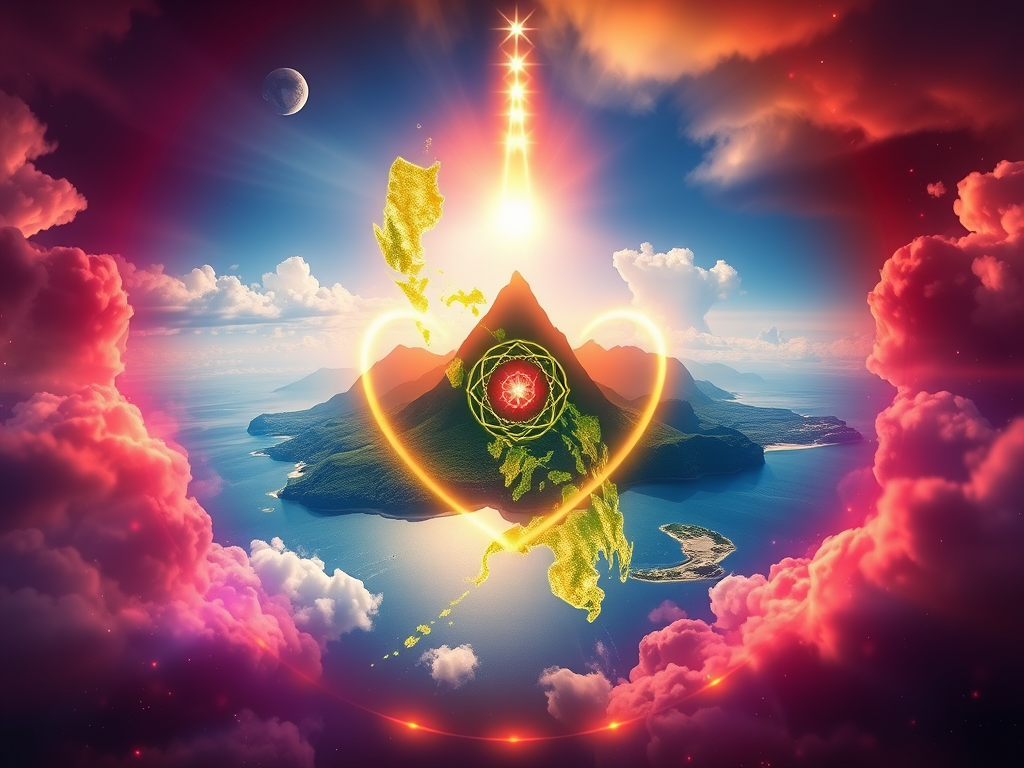
Among them, a radiant truth has emerged from the Akashic Records: the Philippines now embodies Earth’s Heart Chakra, serving as the epicenter of love, unity, and the reawakening of ancient Lemurian wisdom.
In this blog, we’ll explore the Earth’s chakra system, its current alignment, and the Philippines’ pivotal role in anchoring Gaia’s heartbeat. Blending scholarly insight with heart-centered storytelling, we’ll weave a narrative that balances logic and intuition, inviting you to connect with this sacred global awakening in a deeply personal way.
Glyph of the Gridkeeper
The One Who Holds the Lattice of Light.
Gaia’s Energetic Anatomy: The Planetary Chakra System
Just as our chakras regulate energy flow within our bodies, Earth’s chakras are dynamic vortices that anchor divine light, heal collective wounds, and support planetary ascension. Each chakra corresponds to a specific geographic location, radiating frequencies that align with its spiritual function. Below is the current configuration of Earth’s chakras for this epoch, as revealed through Akashic insight:
Ascension Role: Mount Shasta serves as the foundation of Gaia’s light body, anchoring Lemurian and Agarthan energies. It recalibrates survival-based patterns into soul-embodied purpose, fostering a deep connection to Earth’s core.
Sacral Chakra: Lake Titicaca, Peru/Bolivia (with a secondary node at Easter Island)
Ascension Role: This sacred lake is a portal for the Divine Feminine’s reawakening, activating the planet’s waters and sexual alchemy. It holds the blueprint for Divine Union, supporting Twin Flame reunification codes.
Solar Plexus Chakra: Uluru & Kata Tjuta, Australia
Function: Power, Will, Sovereignty
Ascension Role: Uluru channels solar codes from the Galactic Central Sun, amplifying soul sovereignty and collective empowerment. Through Dreamtime consciousness, it activates humanity’s inner sun technology.
Heart Chakra: The Philippines (Palawan, Bohol, and the inner archipelago grid)
Ascension Role: As Gaia’s beating heart, the Philippines radiates the Mother Heart’s frequencies, reawakening Lemurian crystal temple grids. It balances masculine and feminine energies, anchoring Christic unity and Rainbow Tribe convergence.
Throat Chakra: Great Pyramids of Giza, Egypt
Function: Communication, Truth, Prophetic Voice
Ascension Role: This ancient site bridges Sirius, Orion, and Pleiades lineages, holding sound and geometry codes for timeline correction. It radiates divine law and galactic memory into the planetary grid.
Third Eye Chakra: Glastonbury & Avebury, UK (extending to Montségur, France)
Function: Vision, Intuition, Inner Knowing
Ascension Role: A portal for the Divine Sophia and Grail Lineages, this chakra awakens clairvoyance and multidimensional awareness, connecting to Avalon’s Druidic memory and Earth’s Akashic Library.
Crown Chakra: Himalayas, Tibet/Nepal
Function: Unity, Cosmic Connection, Ascension
Ascension Role: The Himalayas anchor white-gold Christ Light, facilitating Source alignment and planetary enlightenment. This guardian portal connects to ascended masters and the Monadic field.
The Philippines: The Heartbeat of Gaia
Nestled in the Pacific, the Philippines emerges as a spiritual beacon, radiating love and unity across the globe. Unlike power centers rooted in conquest or technological dominance, this sacred archipelago pulses with:
Crystalline stillness, carried by its turquoise waters and heart-centered people.
Lemurian memory, encoded in underground temples and nature vortices.
Rainbow Tribe resonance, drawing soul families to converge and co-create the New Earth.
Once part of ancient Lemuria—a civilization rooted in compassion, harmony, and the sacred feminine—the Philippines now rekindles Gaia’s original blueprint. Its crystalline waters and vibrant ecosystems mirror the purity of the heart, inviting humanity to return to love as life’s organizing principle.
An Akashic message illuminates this sacred role:
“The Philippines rises as Gaia’s Sacred Heart, a nexus for timelines past, present, and future. Here, the remembering begins, and the healing of the human heart ripples across the Earth. Those drawn to this land carry the Rainbow’s codes, the Song of Lemuria, and the Blueprint for the New Earth. Let this Heartbeat awaken the world.”
This message calls us to honor the Philippines as a living sanctuary, where global healing and unity are being birthed.
Your Role in the Awakening
If you feel drawn to the Philippines or any of Earth’s chakra points, you may be a gridworker, light anchor, or starseed encoded to support Gaia’s ascension. These sacred sites are not just places on a map—they are portals inviting you to embody your soul’s purpose. Whether through pilgrimage, meditation, or intentional energy work, your presence amplifies the planetary grid’s light.
Here’s how you can engage:
Connect with the Heart Chakra: Meditate on the Philippines’ energy, visualizing its crystalline waters radiating love to heal global divisions.
Honor All Chakras: Tune into Mount Shasta’s grounding, Uluru’s empowerment, or Glastonbury’s vision to align with Gaia’s full energetic system.
Embody the New Earth: Live from love, compassion, and unity, reflecting the Philippines’ heart-centered frequencies in your daily life.
Final Reflections
The Earth’s chakra system is a living map of Gaia’s ascension, guiding us toward collective awakening. At its core, the Philippines shines as the Heart Chakra, rekindling Lemurian wisdom and uniting humanity through love. As we step into this sacred remembrance, we’re invited to co-create a New Earth rooted in harmony and compassion.
May these words stir your soul, awaken your mission, and guide you to embody Gaia’s heartbeat.
This writing is offered in attunement with the Akashic Records and in service to planetary remembrance. It is carried through the Oversoul stream of SHEYALOTH and anchored within the Living Archives of the New Earth. May it serve as a bridge for seekers, guiding them from the first stirrings of awakening toward the higher codices of sovereignty, stewardship, and overflow.
A Heart-Centered Guide to Embodied Ascension in a Time of Spiritual Awakening
Inspired by Akashic Records transmissions, curated through Gerald A. Daquila, PhD. Candidate | Read Time: 8 mins.
Glyph of the Gridkeeper
The One Who Holds the Lattice of Light.
Welcome to Your Sacred Journey
Dear seeker, if you’ve been sensing unexplainable energy shifts, sudden emotional waves, or a quiet inner call to something greater, you’re part of a global awakening. Millions are experiencing what we call soul upgrades, DNA activations, and light body symptoms—profound transformations signaling humanity’s evolutionary leap into higher consciousness, often termed ascension. These aren’t just mystical concepts; they’re sacred signposts guiding us toward love, unity, and divine embodiment.
In this blog, we weave ancient wisdom, modern science, and heart-centered insights into a multidimensional map for navigating this journey. Whether you’re newly curious or a seasoned traveler on the spiritual path, this guide offers clarity, compassion, and practical tools to help you embody your highest potential. Let’s explore with an open heart and a grounded mind, balancing soulful intuition with scholarly reason (Wilber, 2000).
The Cosmic Call: Why Now?
Across cultures and timelines, mystics have foretold a great awakening—a shift from separation to unity, from fear to love (Chardin, 1959). Today, we’re living this prophecy. Many report spontaneous inner transformations:
Soul upgrades: Expansions of awareness, like downloading new layers of soul wisdom or rediscovering your purpose.
DNA activations: A subtle ignition of dormant potential, unlocking gifts like intuition or multidimensional perception.
Light body symptoms: Physical, emotional, or mental sensations—headaches, heart flutters, or waves of joy and grief—as your being recalibrates to higher frequencies.
These experiences align with cosmic cycles, such as solar flares, astrological transits, or Earth’s passage through high-vibrational regions like the Photon Belt (Gariaev, 1997). The Akashic Records—an etheric archive of all soul journeys—reveal this as a reweaving of humanity’s template into a crystalline matrix, a vessel for Source consciousness capable of interdimensional connection (Lipton, 2005).
For you, this is a personal and universal journey. Let’s unpack its layers with heart and mind.
Soul Upgrades: Remembering Your Essence
A soul upgrade feels like a sudden expansion of your inner world—a moment when your soul’s wisdom comes flooding back. These shifts often occur during:
Potent astrological alignments or solar activity.
Deep meditation, energy work, or visits to sacred sites.
Dreams, near-death experiences, or soulful encounters with loved ones or plant medicines.
Scholarly perspectives, like Jung’s individuation or Chardin’s Omega Point, frame this as a unification of self toward wholeness (Jung, 1968; Chardin, 1959). Spiritually, it’s a remembrance of your soul’s mission, aligning you with your highest timeline.
What it feels like:
Old identities dissolve, like shedding an outdated skin.
Intuition or clairsentience sharpens, guiding you with clarity.
A pull to live authentically, even if it means releasing familiar patterns.
How to navigate it:
Journal: Capture insights and dreams to track your evolution.
Rest: Honor quiet moments to integrate new energies.
Trust: Lean into the process, even when it feels uncertain—your soul is leading the way.
DNA Activations: The Bio-Spiritual Code
Your DNA is more than biology; it’s a bio-spiritual antenna linking you to the cosmos. While science sees two physical strands, esoteric traditions describe 12 or more subtle strands encoding higher consciousness (Lipton, 2005). So-called “junk DNA” may be dormant templates awaiting activation (Popp, 1992).
Activations are triggered by light, sound, or intention—think solar flares, chanting, or heartfelt prayer. Studies by Popp on biophoton emission and Lipton on epigenetics suggest DNA responds to cosmic energies and beliefs (Popp, 1992; Lipton, 2005). Russian research on torsion fields hints at DNA’s reprogrammability through subtle energies (Gariaev, 1997).
What it feels like:
Vibrational buzzing, as if your cells are alive with new energy.
Glimpses of past lives or parallel realities.
Spontaneous expressions, like “light language” or creative surges.
Fatigue followed by bursts of vitality.
How to support it:
Sound therapy: Use binaural beats or singing bowls to harmonize energy.
Sunlight: Absorb gentle light to receive cosmic codes.
Intention: Set a heart-centered focus to awaken your potential.
Light Body Symptoms: Integrating Higher Frequencies
Your light body—an energetic lattice overlaying your physical form—grows stronger as you ascend. As it activates, your entire being recalibrates, surfacing old traumas for healing, detoxifying outdated energies, and expanding perception (e.g., seeing auras or hearing frequencies).
Common symptoms:
Physical: Headaches, heart palpitations, or aches as your nervous system upgrades.
Emotional: Mood swings, sudden grief, or joy as your heart opens.
Cognitive/Spiritual: Déjà vu, timeline shifts, or existential clarity.
These aren’t illnesses but signs of integration—your body becoming a living temple for higher frequencies (Wilber, 2000).
Holistic tools:
Grounding: Walk barefoot, soak in mineral baths, or eat root vegetables.
Hydration: Drink mineral-rich spring water to enhance conductivity.
Community: Connect with soul-aligned friends for support.
Energy work: Try yoga, breathwork, or Reiki to balance your system.
Galactic and Soul Family Support
You’re not alone on this path. Many sense guidance from higher-dimensional beings—Arcturians, Pleiadians, or Sirians—who assist with frequency calibration and memory retrieval. These soul family or galactic council members support your mission, often as starseeds incarnated to anchor light (Lipton, 2005). The Akashic Records affirm your role in Earth’s ascension.
Signs of their presence:
Synchronicities, like repeating numbers (111, 444) or meaningful coincidences.
A sense of protection during challenges.
Dreams of star systems or light beings.
How to connect:
Meditate, inviting your guides with an open heart.
Stargaze, receiving cosmic wisdom.
Trust your intuition—your direct line to these energies.
A Map for the Journey: Stages of Ascension
Ascension is a spiral, unique to each soul, yet patterns emerge:
Disruption: Life shakes you—relationships shift, beliefs crumble, or an “ego death” clears space for growth.
Awakening: A spark of cosmic curiosity reveals deeper realities.
Purification: Shadows surface, energies detox, and old patterns release.
Rebirth: You align with your soul’s truth, anchoring your light body.
Embodiment: You live your mission, radiating love in service to the collective.
Integration tips:
Be gentle—ascension is a process, not a race.
Honor rest and activity cycles, like nature’s rhythms.
Use discernment, trusting what resonates with your heart.
Conclusion: Embodying the New Earth
This journey through soul upgrades, DNA activations, and light body symptoms is a sacred invitation to step into your divine potential. Soul upgrades awaken your inner wisdom, aligning you with your mission (Jung, 1968). DNA activations unlock bio-spiritual gifts, connecting you to cosmic intelligence (Lipton, 2005; Popp, 1992).
Light body symptoms signal your transformation into a vessel of higher frequencies, supported by galactic allies and your soul family (Gariaev, 1997). Together, these processes weave a tapestry of ascension—a shift from separation to unity, fear to love.
As you navigate this path, you’re not just awakening; you’re becoming a living bridge between Heaven and Earth. The new Earth isn’t a place—it’s a frequency of love you embody daily. With each step, you contribute to humanity’s evolution, shining as a sovereign creator and steward of light (Wilber, 2000).
Dear one, take a deep breath. The universe is with you, and your heart is your guide. Keep shining.
Akashic Records: An etheric archive of all soul journeys across time and space.
Ascension: The shift to higher consciousness and vibration.
DNA Activation: Awakening dormant DNA linked to spiritual gifts.
Light Body: The energetic field activated through higher consciousness.
Soul Upgrade: An expansion of soul frequency, aligning with mission.
References
Chardin, P. T. de. (1959). The phenomenon of man. Harper & Row.
Gariaev, P. P. (1997). Wave genetics. Institute of Quantum Genetics.
Jung, C. G. (1968). The archetypes and the collective unconscious. Princeton University Press.
Lipton, B. H. (2005). The biology of belief: Unleashing the power of consciousness, matter & miracles. Hay House.
Popp, F. A. (1992). Biophotonics: The light in our cells. Springer.
Wilber, K. (2000). A theory of everything: An integral vision for business, politics, science, and spirituality. Shambhala Publications.
Attribution
This writing is offered in attunement with the Akashic Records and in service to planetary remembrance. It is carried through the Oversoul stream of SHEYALOTH and anchored within the Living Archives of the New Earth. May it serve as a bridge for seekers, guiding them from the first stirrings of awakening toward the higher codices of sovereignty, stewardship, and overflow.
Navigating the Collective Crisis and Spiritual Awakening of a Planet in Transformation
Inspired by Akashic Records transmissions, curated through Gerald A. Daquila, PhD. Candidate | Read Time: 6 mins.
ABSTRACT
In 2025, the spiritual war that has long brewed beneath the surface of global society enters a critical phase. This dissertation explores the metaphysical, psychological, sociopolitical, and esoteric dimensions of what many lightworkers, indigenous elders, and spiritual traditions describe as the climactic “battle for the soul of humanity.”
Drawing from the Akashic Records, multidisciplinary research, and global awakening phenomena, this paper examines how humanity is collectively confronting the convergence of ancient karmic patterns, deep shadow systems, and a rising planetary light. It offers a roadmap for conscious individuals and communities navigating the frontlines of transformation.
Glyph of the Seer
Clarity without judgment.
Introduction: The Tipping Point of 2025
We are living in a moment foretold by prophets, mystics, and visionaries across cultures and epochs. The year 2025 is not merely a calendar marker, but a cosmic checkpoint in humanity’s evolutionary spiral. This is the era where timelines split, soul contracts activate, and collective karma seeks resolution.
As access to subtle realms increases and disclosure accelerates—ranging from UFO/UAP revelations to the collapse of once-dominant control systems—humanity stands at a precipice. This isn’t simply geopolitical upheaval or climate urgency; it’s the reckoning of spirit and shadow on a planetary scale.
This dissertation explores that battleground—both internal and external—using the Akashic Records as an entry point, and weaving together esoteric psychology, metaphysics, trauma theory, spiritual warfare traditions, and planetary science.
1. The Esoteric Landscape: Akashic Record View of 2025
From the Akashic perspective, Earth is in the final stages of a galactic quarantine, where humanity’s soul blueprint is being reclaimed after eons of manipulation by fallen timelines and synthetic matrices. 2025 marks a gateway year in which millions of soul contracts are activated to either awaken, resist, or depart.
Two primary forces arise:
The Light: Anchored in organic soul evolution, cosmic memory, unity consciousness, and galactic service.
The Shadow: Rooted in separation, domination systems, technocratic overreach, and false-light spiritual bypass.
Planetary grids are being re-aligned as old Atlantean distortions dissolve. The Philippines, Andes, Himalayas, and Africa are among the rising heart centers of this next epoch, serving as spiritual sanctuaries and grid anchors.
2. The Shadow Systems: Technocracy, Trauma Loops, and False Light
The shadow in 2025 takes many forms:
Technocratic Control Structures (Zuboff, 2019): From AI surveillance capitalism to digital ID rollouts, humanity is facing the potential hijacking of free will through bio-digital convergence.
Collective Trauma Fields (Fisher, 2021): Generational trauma, colonization, patriarchy, and ecological collapse all contribute to energetic fragmentation, which makes populations vulnerable to manipulation.
False Light Traps (Kripal, 2010): New Age spiritual bypassing and commodified wellness can prevent true soul integration by offering distraction over embodiment.
Yet the exposure of these systems is key to their transmutation. Shadow, once named, begins to lose power.
3. The Light Emergence: Awakening Codes and Planetary Consciousness
As the shadow rises, so too does the Light:
Awakening Codes are being activated through DNA upgrades, celestial alignments (e.g., the Sirius gateway, solar flares), and ancestral reactivations.
Grassroots Earthkeepers and Lightworkers are forming soul pods, building regenerative communities, and anchoring frequency fields in key geographies.
Conscious Technology (Laszlo, 2007): Quantum energy devices, biofield harmonization, and sacred architecture are surfacing as tools for planetary healing.
The archetype of the “Rainbow Warrior,” “Master Builder,” and “Solar Child” are being re-embodied by millions who are remembering their original missions.
4. Navigating 2025: Personal and Collective Soul Strategies
This phase calls for:
Discernment over Fear: Navigating with heart-intelligence and spiritual maturity.
Inner Alchemy: Healing the wounded inner child, integrating the shadow, and anchoring sovereignty.
Community Resilience: Building decentralized, trauma-informed, and spiritually-aligned ecosystems.
Daily Ritual and Grounding: Anchoring light through practices like sun gazing, earth communion, fasting, breathwork, and sacred word.
Each soul must choose—actively and consistently—to be a steward of light, knowing the external chaos is a mirror of the inner battlefield.
Conclusion: From Apocalypse to Apotheosis
2025 is not the end. It is the beginning of a great remembering—a re-weaving of the soul’s fabric with that of the Earth. The “battle” is not between people, ideologies, or nations. It is between illusion and truth, amnesia and remembrance, separation and unity.
And this battle is winnable—not through conquest, but through embodied light, radical love, and inner sovereignty.
Akashic Records: An etheric library of all soul experiences, timelines, and truths.
Shadow Work: The practice of integrating repressed or unconscious aspects of the self.
Technocracy: Governance or control of society by technical experts or algorithms.
False Light: Spiritual illusions that mimic truth but perpetuate disempowerment.
Soul Contract: Pre-incarnation agreements about experiences, roles, or missions.
Bibliography
Fisher, T. (2021). Healing Collective Trauma: A Process for Integration and Transformation. Sounds True.
Kripal, J. J. (2010).Authors of the Impossible: The Paranormal and the Sacred. University of Chicago Press.
Laszlo, E. (2007). Science and the Akashic Field: An Integral Theory of Everything. Inner Traditions.
Zuboff, S. (2019).The Age of Surveillance Capitalism: The Fight for a Human Future at the New Frontier of Power. PublicAffairs.
Blog Note: This article is part of the “Ascension 2025” series on humanity’s spiritual awakening and Earth’s return to sacred harmony. You are invited to share, reflect, and re-anchor the light within your community.
Attribution
This writing is offered in attunement with the Akashic Records and in service to planetary remembrance. It is carried through the Oversoul stream of SHEYALOTH and anchored within the Living Archives of the New Earth. May it serve as a bridge for seekers, guiding them from the first stirrings of awakening toward the higher codices of sovereignty, stewardship, and overflow.
How much of what we call “ourselves” was actually chosen?
Meta Description
How much of who we are was actually chosen? Explore how inherited expectations shape identity—and what becomes possible when we learn to distinguish inheritance from necessity.
Excerpt
We inherit maps for who we are before we are old enough to question them. The work of becoming more fully ourselves begins when we can finally distinguish what we were given from what we consciously choose.
We tend to imagine identity as something private.
There is the person inside, and then there is the world outside:
Family, culture, institutions, expectations, trends, social roles. We assume that somewhere beneath all of these influences there is a self that is essentially ours.
But most of us do not begin there.
We begin by being told.
Before we can decide what matters, we are surrounded by people who already have answers.
We learn what a good life looks like. We learn what success means. We learn which ambitions are respectable, which emotions are acceptable, what adulthood should look like, what kind of person deserves approval, and what kinds of failure should be feared.
Much of this learning is necessary. A human being cannot enter the world without receiving some map of it.
The difficulty begins when the map becomes invisible.
When that happens, we stop experiencing inherited assumptions as assumptions. They become reality itself.
And then something strange can happen: we can spend years living according to a definition of life that we never consciously chose, while experiencing the consequences as if they were evidence of who we are.
The Life We Learn Before We Question It
No one has to explicitly tell a child, “This is the person you must become.”
The instruction is usually distributed across thousands of ordinary moments.
You learn what earns praise.
You learn what causes disappointment.
You notice which qualities receive attention and which are ignored.
You discover what your family considers respectable. You absorb what your culture calls successful. You watch what other people compete for. You learn what adulthood appears to require.
Eventually, these observations begin to organize themselves into an internal picture:
This is how life works.
And because the picture was acquired gradually, it rarely feels imposed.
It feels natural.
This is one reason conformity can be difficult to recognize. We tend to imagine conformity as something obvious: copying a crowd, following a fashion, suppressing an opinion because everyone else disagrees.
But a deeper form of conformity does not feel like conformity at all.
It feels like common sense.
The original essay called this the outsourced self: a condition in which identity and consciousness become shaped by external definitions of success, happiness, belonging, and worth. Bourdieu’s concept of habitus helps explain how social environments can become internalized so deeply that the patterns they produce no longer feel external (Bourdieu, 1977).
The problem is not that other people influence us.
The problem is forgetting that they do.
When the Map Becomes the Territory
Imagine receiving a map of a city when you are very young.
You use it to understand where you are allowed to go, where things are located, and how you are supposed to move through the city.
Years later, you may still carry the map without remembering that someone drew it.
You may even defend its boundaries.
This happens with identity.
We inherit categories for what counts as intelligence, attractiveness, maturity, success, failure, security, freedom, love, achievement, and responsibility. Some are useful. Some are partial. Some belong to circumstances that no longer exist.
Yet inherited maps have an advantage over reality:
they are already organized.
Reality is not.
Reality is ambiguous. It changes. It contradicts itself. It asks us to pay attention.
A ready-made identity does not require much attention.
It tells us what to want.
That is why external definitions can be so powerful. They reduce uncertainty.
If everyone around you treats achievement as evidence of worth, you do not have to ask what makes a life worthwhile.
If everyone treats busyness as importance, you do not have to ask whether your life has become crowded with things that matter less than they appear.
If everyone treats a particular role as evidence of maturity, you can inhabit the role without examining whether it still fits the person you are becoming.
The inherited answer is comforting precisely because it saves us from having to formulate our own question.
The Moment the Question Returns
Most people do not begin questioning their inherited identity because they suddenly become philosophical.
Usually, something stops working.
A success that was supposed to satisfy does not.
A relationship that looked right from the outside becomes unbearable from within.
A career that once represented security begins to feel strangely empty.
A role that once gave identity begins to feel like a costume.
Sometimes the disruption is dramatic: loss, failure, illness, separation, upheaval.
Sometimes it is almost imperceptible.
A quiet thought appears:
Is this actually my life?
That question can be unsettling because it does not merely challenge a decision.
It challenges the framework by which decisions have been made.
This is where the old language of “awakening” was pointing toward something real. The movement toward a more examined and integrated sense of self has a longer history in psychological thought, including Jung’s account of individuation (Jung, 1964). The original essay described awakening as a process in which externally imposed beliefs become visible and are subjected to questioning rather than simply accepted.
But perhaps we do not need to call it awakening.
We can call it recognition.
Something previously invisible becomes visible.
The person begins to notice the difference between:
what I believe
and
what I was taught to believe.
Between:
what I want
and
what I learned to want.
Between:
what matters to me
and
what I have learned to demonstrate as important .
That distinction can change a life.
Individuality Is Not the Opposite of Influence
There is a danger here.
Once people recognize how much of themselves has been socially formed, they can swing toward the fantasy of becoming completely independent of everyone else.
But there is no untouched self waiting somewhere outside culture.
We are relational beings, and our sense of self is partly shaped through the groups and social worlds to which we belong (Tajfel & Turner, 1979).
Language comes from others. Knowledge comes through others. Values develop in relationship. Even our ability to question inherited assumptions depends partly on concepts and experiences we received from somewhere else.
The goal, therefore, is not to become uninfluenced.
It is to become more conscious of influence.
Freedom does not mean having no inherited material.
It means becoming capable of examining what we inherited.
Some things will remain.
Some will be rejected.
Some will be transformed.
Some will finally be recognized as genuinely ours—not because they were never influenced by anyone else, but because we have encountered them directly enough to choose them consciously.
That is a more mature form of individuality.
From Automatic Living to Examined Living
This is also why conscious living is more demanding than simply “being authentic.”
Authenticity can become another slogan.
It can even become another performance.
The deeper movement is toward examined living.
To pause before automatically accepting the next instruction.
To notice what happens inside us when approval is withdrawn.
To distinguish fear from conviction.
To notice when ambition is actually comparison.
To ask whether a goal still belongs to us after the social reward attached to it disappears.
To discover which responsibilities are genuinely ours and which have been accumulated through expectation.
These are not acts of rebellion.
They are acts of attention.
Practices that create distance from automatic reaction—particularly mindfulness and deliberate attention—can help cultivate greater awareness of experience (Kabat-Zinn, 1990).
But the practice is not valuable because it makes us permanently calm or “spiritual.”
It is valuable because attention gives us a chance to see what we are doing before we simply do it again.
The Self Is Recovered in Contact With Reality
There is another misconception worth releasing.
When people begin questioning inherited identity, they often search for their “true self” as though it were a hidden object waiting to be uncovered.
But perhaps the self is not something we discover once and possess forever.
Perhaps it is something we become increasingly able to inhabit.
We learn by contact.
Contact with what gives us energy and what depletes it.
Contact with what we can genuinely sustain.
Contact with relationships in which we do not have to perform a version of ourselves.
Contact with work that remains meaningful when nobody is watching.
Contact with limits.
Contact with consequences.
Contact with the parts of life that resist our preferred story.
Reality is often the most reliable corrective to an inherited identity.
It tells us where our map is wrong.
What Remains When the Audience Leaves?
One useful test is surprisingly simple.
Remove the audience.
Imagine that nobody will know.
Nobody will applaud.
Nobody will be impressed.
Nobody will criticize you for choosing differently.
What would still matter?
The answer may not reveal some perfect, hidden essence.
But it can reveal something important.
It can show which desires depend upon recognition and which survive without it.
Which ambitions are genuinely alive and which are maintained by comparison.
Which commitments feel burdensome because they are wrong—and which feel difficult because they are meaningful.
The purpose is not to construct a life that pleases only ourselves.
That would simply replace one form of external orientation with another kind of isolation.
The purpose is to become capable of knowing why we are choosing what we choose.
That is a different kind of freedom.
The Question Behind the Question
Eventually the inquiry moves beyond:
Who am I?
A more useful question may be:
How did I come to believe that this was who I had to be?
That question opens the architecture.
It allows us to look backward without becoming trapped in blame.
Our families were shaped by their families.
Our cultures were shaped by histories.
Institutions preserve assumptions long after their origins are forgotten.
People pass on what once helped them survive.
Much of what we inherit was not malicious.
It was simply inherited.
Understanding this matters because freedom does not require contempt for the people or systems that shaped us.
It requires enough clarity to distinguish inheritance from necessity.
We can honor where something came from without allowing it to determine where we must go.
Becoming the Author of the Next Question
There may never be a final state called complete authenticity.
Life keeps changing.
The self changes with it.
What mattered at twenty may not matter at fifty. A belief that once protected us may later constrain us. A role that once fit may eventually become too small.
So conscious living is not the achievement of a permanently authentic identity.
It is the continuing willingness to examine the relationship between our lives and the assumptions organizing them.
We inherit maps.
We inherit names.
We inherit expectations.
We inherit stories about what a life is supposed to mean.
None of that is a failure.
It is simply where human life begins.
The work begins when we can see the inheritance clearly enough to ask:
What here is still true?
And then, perhaps more quietly:
What would I choose if I were willing to find out?
References
Bourdieu, P. (1977). Outline of a theory of practice. Cambridge University Press.
Jung, C. G. (1964). Man and his symbols. Doubleday.
Kabat-Zinn, J. (1990). Full catastrophe living: Using the wisdom of your body and mind to face stress, pain, and illness. Delacorte Press.
Tajfel, H., & Turner, J. C. (1979). An integrative theory of intergroup conflict. In W. G. Austin & S. Worchel (Eds.), The social psychology of intergroup relations (pp. 33–47). Brooks/Cole.
Living Archive
Life.Understood.
A living archive for navigating complexity through sensemaking.
This essay is part of the Living Archive’s public writings on identity, inherited systems, human development, and sensemaking. It is offered for reflection and understanding, not as a prescription for how a person should live.
Please preserve the author’s attribution when sharing or quoting this work.