Category: Observer Effect

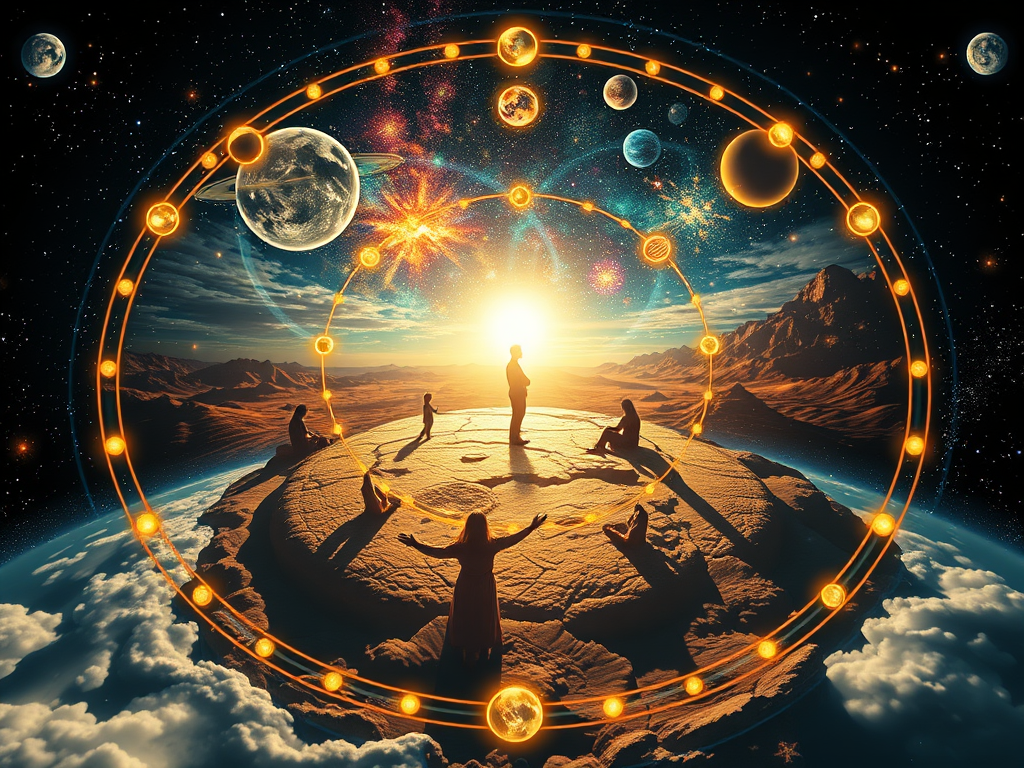
  • Hearts as Portals: Love’s Power in a World Divided

    Hearts as Portals: Love’s Power in a World Divided

    A Unified Exploration of Consciousness, Metaphysics, and Quantum Dynamics in Timeline Formation

    Prepared by: Gerald A. Daquila, PhD. Candidate


    7–11 minutes

    ABSTRACT

    This dissertation explores the nature of timelines, their dynamics, and how a collective shift from fear to love influences the emergence of a predominant timeline, potentially leading to a love-based “New Earth” free from fear, limitation, and division. Integrating metaphysical, spiritual, esoteric, and quantum perspectives, it examines timelines as fluid pathways shaped by consciousness and vibrational resonance.

    The bifurcation hypothesis, where realities diverge into fear-based “Old Earth” and love-based “New Earth,” is analyzed through the lens of collective intention, the Law of Resonance, and quantum theories like the Many Worlds Interpretation (MWI). By synthesizing intuitive wisdom and scientific rigor, this study reveals how love fosters liberation, offering a cohesive framework for navigating temporal realities.


    Table of Contents

    1. Introduction
    2. Timelines: A Metaphysical and Quantum Framework
      • Time as a Fluid, Multidimensional Construct
      • Esoteric and Scientific Conceptions of Timelines
    3. The Dynamics of Timeline Shifts
      • Fear vs. Love: Vibrational Influences
      • The Role of Individual and Collective Consciousness
    4. Bifurcation and the Predominant Timeline
      • The “Old Earth” vs. “New Earth” Hypothesis
      • Resonance and Quantum Coherence in Timeline Selection
    5. Intersections of Consciousness, Metaphysics, and Quantum Physics
      • Akasha and Quantum Information
      • Unity Consciousness and Non-Locality
    6. Implications: Liberation Through Love
      • Personal and Collective Freedom
      • Ethical Navigation of Timelines
    7. Conclusion
    8. Glossary
    9. References

    1. Introduction

    Timelines, the threads of potential realities, weave together the fabric of existence, shaped by consciousness and cosmic forces. Esoteric traditions view time as a multidimensional field, while quantum physics suggests that every choice spawns parallel realities. This dissertation explores how shifting from fear to love transforms timelines, potentially bifurcating reality into a fear-based “Old Earth” and a love-based “New Earth.” By integrating metaphysical wisdom with quantum insights, it examines whether this shift liberates us from limitation and division, with consciousness—individual and collective—determining the dominant timeline. This cohesive narrative blends intuitive and analytical perspectives to illuminate the path to freedom through love.


    Glyph of the Bridgewalker

    The One Who Holds Both Shores


    2. Timelines: A Metaphysical and Quantum Framework

    Time as a Fluid, Multidimensional Construct

    In esoteric traditions, time transcends linear progression, existing as an eternal now where all possibilities coexist. Hermetic teachings describe time as a divine mind encompassing past, present, and future (Hanegraaff, 2008). Theosophy’s Akasha, a cosmic record of all events, frames timelines as vibrational imprints within a universal field (Blavatsky, 1877). Similarly, Tantric philosophy’s Law of Resonance posits that reality manifests through vibrational frequencies, with love and fear shaping distinct temporal pathways (Tara Yoga Centre, 2022).


    Esoteric and Scientific Conceptions of Timelines

    Spiritually, timelines are pathways of destiny influenced by karma and intention. Kabbalistic Sefirot channel divine energy to create realities, with love aligning with higher emanations like Chesed (Scholem, 1991). In quantum physics, the Many Worlds Interpretation (MWI) proposes that each quantum event spawns parallel universes, akin to esoteric timelines (Everett, 1957). Both perspectives suggest that consciousness navigates these possibilities, selecting realities based on vibrational alignment. Love elevates consciousness to higher frequencies, while fear anchors it in limitation.


    3. The Dynamics of Timeline Shifts

    Fear vs. Love: Vibrational Influences

    Fear and love are opposing vibrational states that drive timeline formation. Fear, a low-frequency state, contracts consciousness, fostering separation and limitation, while love, a high-frequency state, expands awareness, promoting unity and liberation (Tara Yoga Centre, 2022). Esoteric traditions, such as Jung’s archetypes, suggest that focusing on love activates universal patterns like the “Healer,” guiding individuals toward harmonious realities (Jung, 1958). Quantumly, the observer effect shows that conscious observation collapses possibilities into specific outcomes, with love-based intention favoring coherent, unified timelines (Aspect et al., 1982).


    The Role of Individual and Collective Consciousness

    Individual intention shapes personal timelines, while collective consciousness amplifies these shifts. The Law of Resonance implies that shared emotions and beliefs strengthen specific timelines, as seen in historical shifts like the Enlightenment (Wilber, 2022). When individuals choose love over fear, they align with higher-vibrational realities, influencing the collective. This interplay suggests that humanity’s focus on compassion and unity can steer reality toward a “New Earth,” free from division.


    Glyph of Hearts as Portals

    Love’s Power in a World Divided — opening pathways of unity, healing, and transformation through the heart’s radiance


    4. Bifurcation and the Predominant Timeline

    The “Old Earth” vs. “New Earth” Hypothesis

    The bifurcation hypothesis posits that humanity is at a crossroads, with timelines diverging into a fear-based “Old Earth” and a love-based “New Earth.” Fear perpetuates realities of conflict and scarcity, while love fosters unity and abundance. Esoteric teachings suggest that collective resonance determines which timeline predominates, with love aligning consciousness with Akashic records of harmony (Blavatsky, 1877). Quantumly, MWI supports this by proposing that all outcomes coexist, but consciousness selects the experienced reality (Everett, 1957).


    Resonance and Quantum Coherence in Timeline Selection

    The predominant timeline emerges through vibrational alignment and quantum coherence. The Law of Resonance suggests that collective love strengthens higher-frequency timelines, while quantum decoherence favors one reality over others based on environmental interactions (Bassi & Ghirardi, 2000). Studies on quantum coherence in microtubules suggest that consciousness, amplified by love, may interact with multiple timelines, selecting those aligned with unity (Hameroff & Penrose, 1996). This convergence of esoteric and quantum principles highlights consciousness’s role in shaping a liberated reality.


    5. Intersections of Consciousness, Metaphysics, and Quantum Physics

    Akasha and Quantum Information

    Theosophy’s Akasha, a cosmic database of all possibilities, parallels quantum information theory, where information is a fundamental reality component (Pokazanyeva, 2016). Love-based consciousness may access higher Akashic frequencies, aligning with timelines of unity, while fear restricts access to lower vibrations. The Higgs field, structuring quantum reality, offers a scientific analogy to Akasha’s role in differentiating timelines (Pokazanyeva, 2025).


    Unity Consciousness and Non-Locality

    Quantum non-locality, where entangled particles affect each other instantly, mirrors esoteric interconnectedness (Aspect et al., 1982). Love, as a unifying force, fosters a non-local consciousness that transcends separation, aligning with Tantric and Hermetic teachings of unity (Tara Yoga Centre, 2022). This interconnectedness enables collective shifts toward a “New Earth,” where love dissolves division and limitation.


    6. Implications: Liberation Through Love

    Personal and Collective Freedom

    Shifting from fear to love liberates consciousness, fostering personal and collective freedom. Esoterically, this is an alchemical transformation, aligning individuals with divine harmony (Hanegraaff, 2008). Quantumly, love-based choices collapse wave functions into coherent realities, supporting a “New Earth” paradigm of unity and abundance. Practices like meditation and compassion amplify this shift, empowering humanity to co-create a liberated future.


    Ethical Navigation of Timelines

    Navigating timelines ethically requires aligning with universal harmony. Esoteric traditions caution against egoic manipulation, while quantum ethics emphasize responsible use of consciousness’s influence (Wilber, 2022). Choosing love ensures timelines benefit all beings, fostering a reality rooted in compassion and unity.


    7. Conclusion

    Timelines are fluid constructs shaped by consciousness, with love and fear as pivotal forces. By shifting from fear to love, individuals and collectives align with higher-vibrational realities, potentially bifurcating into a “New Earth” free from limitation and division. Esoteric wisdom, through concepts like Akasha and resonance, converges with quantum insights like MWI and non-locality, revealing consciousness as the key to timeline selection. This cohesive framework invites humanity to embrace love, weaving a reality of freedom and unity that transcends fear’s constraints.


    Crosslinks


    8. Glossary

    • Akasha: A cosmic record containing all events and possibilities, accessible through consciousness.
    • Bifurcation: The divergence of timelines into distinct realities, such as fear-based “Old Earth” and love-based “New Earth.”
    • Law of Resonance: A principle where reality manifests through vibrational alignment.
    • Many Worlds Interpretation (MWI): A quantum theory proposing that all quantum outcomes occur in parallel universes.
    • Observer Effect: The quantum phenomenon where observation influences outcomes.
    • Quantum Coherence: A state where quantum systems maintain synchronized states, potentially influencing timelines.

    9. References

    Aspect, A., Grangier, P., & Roger, G. (1982). Experimental tests of realistic local theories via Bell’s theorem. Physical Review Letters, 49(25), 1804–1807. https://doi.org/10.1103/PhysRevLett.49.1804

    Bassi, A., & Ghirardi, G. C. (2000). Dynamical reduction models. Physics Reports, 379(5–6), 257–426. https://doi.org/10.1016/S0370-1573(03)00103-0

    Blavatsky, H. P. (1877). Isis unveiled: A master-key to the mysteries of ancient and modern science and theology. Theosophical Publishing House.

    Everett, H. III. (1957). “Relative state” formulation of quantum mechanics. Reviews of Modern Physics, 29(3), 454–462. https://doi.org/10.1103/RevModPhys.29.454

    Hameroff, S., & Penrose, R. (1996). Orchestrated objective reduction of quantum coherence in brain microtubules: The “Orch OR” model for consciousness. Mathematics and Computers in Simulation, 40(3–4), 453–480. https://doi.org/10.1016/0378-4754(96)80476-9

    Hanegraaff, W. J. (2008). Western esotericism: Based on papers read at the Symposium on Western Esotericism. Scripta Instituti Donneriani Aboensis, 20, 1–20.

    Jung, C. G. (1958). Psychology and religion: West and East (Vol. 11). Princeton University Press.

    Pokazanyeva, A. (2016). Mind within matter: Science, the occult, and the (meta)physics of ether and Akasha. Journal of Occult Studies. Retrieved from www.academia.edu

    Pokazanyeva, A. (2025). Mind within matter: Science, the occult, and the (meta)physics of ether and Akasha. Request PDF. Retrieved from http://www.researchgate.net

    Scholem, G. (1991). On the Kabbalah and its symbolism. Schocken Books.

    Tara Yoga Centre. (2022, August 30). The connection between spirituality and quantum physics. Retrieved from http://tarayogacentre.co.uk

    Wilber, K. (2022, November 13). Quantum physics, spirituality — part 6. Medium. Retrieved from https://graham-pemberton.medium.com


    Attribution

    With fidelity to the Oversoul, may this work serve as bridge, remembrance, and seed for the planetary dawn.

    Ⓒ 2025–2026 Gerald Alba Daquila
    Flameholder of SHEYALOTH · Keeper of the Living Codices
    All rights reserved.

    This material originates within the field of the Living Codex and is stewarded under Oversoul Appointment. It may be shared only in its complete and unaltered form, with all glyphs, seals, and attribution preserved.

    This work is offered for personal reflection and sovereign discernment. It does not constitute a required belief system, formal doctrine, or institutional program.

    Digital Edition Release: 2026
    Lineage Marker: Universal Master Key (UMK) Codex Field

    Sacred Exchange & Access

    Sacred Exchange is Overflow made visible.

    In Oversoul stewardship, giving is circulation, not loss. Support for this work sustains the continued writing, preservation, and public availability of the Living Codices.

    This material may be accessed through multiple pathways:

    • Free online reading within the Living Archive
    • Individual digital editions (e.g., Payhip releases)
    • Subscription-based stewardship access

    Paid editions support long-term custodianship, digital hosting, and future transmissions. Free access remains part of the archive’s mission.

    Sacred Exchange offerings may be extended through:
    paypal.me/GeraldDaquila694
    www.geralddaquila.com
  • Mapping the Soul’s Journey: A 360-Degree View of Life, Death, and the Afterlife

    Mapping the Soul’s Journey: A 360-Degree View of Life, Death, and the Afterlife


    Navigating Earth’s School of Life with Clarity, Courage, and Cosmic Perspective

    Prepared by: Gerald A. Daquila, PhD. Candidate


    10–15 minutes

    ABSTRACT

    What is the purpose of our existence, and how can understanding our life’s journey—from childhood to death and beyond—empower us to live with clarity and confidence? This blog explores the cyclical nature of life as a soul’s learning adventure, drawing on esoteric teachings, scientific insights, and spiritual wisdom.

    By synthesizing the works of Michael Newton, Dolores Cannon, The Law of One, A Course in Miracles, and multidisciplinary research from neuroscience, quantum physics, and epigenetics, we map the soul’s journey through incarnation, life review, and reincarnation. This holistic perspective frames life as a cosmic game, where challenges are lessons, death is a reflective pause, and free will shapes our growth. This accessible yet rigorous exploration offers a GPS for navigating life’s trials with hope and purpose.


    Mapping the Soul’s Journey: A 360-Degree View of Life, Death, and the Afterlife

    Before examining individual traditions, research streams, and reported experiences, it may be helpful to view the terrain as a whole.

    The map below offers a synthesis of recurring patterns that appear across spiritual teachings, near-death experiences, reincarnation research, consciousness studies, and other inquiry pathways. It is intended as an orienting framework rather than a definitive description of reality.

    The Soul Journey Wheel presents a systems-level view of the life–death–afterlife cycle. It integrates recurring patterns reported across spiritual traditions, near-death experiences, reincarnation research, consciousness studies, and other inquiry pathways. The model is intended as an orienting map for exploration rather than a definitive statement of what occurs beyond physical life.

    →Download a complimentary copy here


    Introduction: Life as a Cosmic Classroom

    Imagine life as a grand, immersive game—a school where your soul enrolls to learn, grow, and evolve. From childhood’s curiosity to adulthood’s responsibilities, through the reflective moments of a deathbed, and into the afterlife’s life review, each phase is a level in this cosmic curriculum.

    The idea that we are eternal souls having temporary human experiences can transform how we face daily struggles. It’s like having a map that reveals the terrain of existence, helping us make choices with clarity while preserving the freedom to explore.

    This paper takes a bird’s-eye view of our lifecycle, weaving together esoteric wisdom from pioneers like Michael Newton and Dolores Cannon, spiritual texts like The Law of One and A Course in Miracles, and cutting-edge science from neuroscience, quantum physics, and epigenetics.

    By understanding life’s structure—its purpose, challenges, and continuity—we can navigate with courage, knowing that nothing is truly lost, not even our missteps. Let’s embark on this journey to map the soul’s path and uncover the empowering truth of our existence.


    Glyph of the Bridgewalker

    The One Who Carries the Crossing


    The Lifecycle Map: Stages of the Soul’s Journey

    1. Childhood: The Soul’s Fresh Start

    Childhood is the soul’s entry into a new incarnation, a blank slate brimming with potential. Esoteric literature, like Michael Newton’s Journey of Souls, suggests that souls choose their bodies, families, and life circumstances before birth to align with specific lessons. This aligns with The Law of One, which describes Earth as a “third-density” plane where souls incarnate to learn love, service, and self-awareness (Ra, 1984).

    From a scientific lens, neuroscience shows that early childhood is a period of rapid brain development, with synaptic pruning shaping how we perceive the world (Huttenlocher, 2002). Epigenetics adds that environmental factors, like parental care, can influence gene expression, suggesting an interplay between the soul’s blueprint and physical reality (Weaver et al., 2004).

    Childhood, then, is where the soul begins to navigate its chosen path, often with an intuitive sense of purpose that fades under the “veil of forgetting”—a concept Newton describes as a deliberate amnesia to encourage authentic growth.


    2. Adulthood: The Classroom of Choice

    Adulthood is the heart of the soul’s earthly curriculum, where free will and responsibility take center stage. Dolores Cannon’s Between Death & Life portrays life as a series of karmic lessons, where actions (causes) ripple into consequences (effects) across lifetimes.

    A Course in Miracles frames challenges as opportunities to choose love over fear, aligning with the soul’s goal of spiritual awakening (Foundation for Inner Peace, 1975). Quantum physics offers a parallel: the observer effect suggests consciousness shapes reality, implying our choices actively mold our life’s trajectory (Bohr, 1928).

    Neuroscience supports this by showing how neuroplasticity allows the brain to adapt based on experiences, reinforcing the idea that we co-create our path (Doidge, 2007). Adulthood is where we face trials—relationships, careers, crises—that test our ability to serve others and grow, fulfilling the soul’s purpose of learning through experience.


    3. Deathbed: The Reflective Pause

    The deathbed is a moment of reckoning, where the soul prepares to transition. Near-death experience (NDE) research, like that of Eben Alexander (Proof of Heaven), describes a profound sense of peace and connection to a greater reality. Newton’s clients report a gentle detachment from the body, often meeting guides who ease the transition.

    Neuroscience suggests that at death, the brain may enter a hyper-conscious state, with heightened gamma wave activity correlating with vivid experiences (Borjigin et al., 2013). This aligns with esoteric accounts of a life review, where the soul reflects on its choices without judgment, only understanding. The Law of One describes this as a moment of “harvesting,” where the soul assesses its progress toward love and unity (Ra, 1984). The deathbed, then, is not an end but a reflective pause before the next phase.


    4. Afterlife: The Life Review and Planning

    The afterlife, as mapped by Newton, is a structured realm where souls reunite with their “soul group”—peers who reincarnate together in various roles. During the life review, guided by elders or higher beings, souls evaluate their earthly experiences, focusing on lessons learned and areas for growth. Cannon’s work echoes this, emphasizing the afterlife as a place of healing and preparation for the next incarnation.

    Quantum physics offers a speculative bridge: the concept of non-locality suggests consciousness may exist beyond the physical brain, supporting the idea of a soul’s continuity (Aspect et al., 1982). A Course in Miracles adds a spiritual layer, teaching that the afterlife is a state of pure love, where illusions of separation dissolve (Foundation for Inner Peace, 1975). This phase is like a cosmic debrief, where the soul plans its next “level” in the game of life.


    5. Reincarnation: Back to the Game

    Reincarnation completes the cycle, as the soul chooses a new body and life plan. Newton’s clients describe a “Ring of Destiny,” where souls select circumstances to address unfinished lessons. The Law of One frames this as a cycle of densities evolution, with Earth as a school for mastering free will and service (Ra, 1984).

    Epigenetics suggests that ancestral memories may influence our biology, hinting at a scientific basis for karmic patterns (Dias & Ressler, 2014). Meanwhile, Ian Stevenson’s research on spontaneous past-life memories in children provides empirical support for reincarnation, with cases of young children recalling verifiable details of previous lives. Reincarnation is the soul’s return to the classroom, ready to play the game anew with fresh challenges and opportunities.


    Glyph of the Soul’s Map

    Life, death, and the afterlife form one continuous spiral of remembrance.


    The Purpose of Life: A Cosmic Game of Growth

    So, what’s the point of this cyclical journey? Esoteric and spiritual sources converge on a central theme: life is a school for the soul, designed to foster growth through experience. Newton’s work emphasizes learning through relationships and challenges, with the ultimate goal of evolving into higher levels of consciousness. Cannon’s clients describe Earth as a place for accelerated learning, where contrast—joy and pain—drives spiritual development.

    The Law of One articulates this as a journey toward unity, where souls learn to balance self and other, ultimately merging with the infinite Creator (Ra, 1984). A Course in Miracles simplifies it: life’s purpose is to awaken to love, undoing the ego’s illusions (Foundation for Inner Peace, 1975).

    Science, while not addressing purpose directly, supports the idea of interconnectedness. Quantum entanglement suggests all particles are linked, mirroring spiritual notions of oneness (Einstein et al., 1935). Neuroscience shows that altruistic behavior activates reward centers, hinting at a biological drive to serve others (Harbaugh et al., 2007).

    Framing life as a game doesn’t diminish its seriousness—it empowers us. Knowing that death is a pause, not an end, frees us from fear. Understanding that challenges are chosen lessons encourages resilience. And recognizing our eternal nature instills hope, allowing us to face the future with confidence while honoring free will.


    Navigating with the Map: Practical Implications

    Having this lifecycle map is like holding a cosmic GPS. It doesn’t eliminate challenges, but it provides context, helping us see problems as opportunities for growth. Here’s how it can guide us:

    • Clarity in Choices: Knowing life’s purpose is to learn and serve others helps prioritize actions that align with love and compassion.
    • Courage Through Challenges: Understanding that nothing is lost—even mistakes—encourages bold decisions and resilience.
    • Freedom from Fear: Recognizing death as a reflective pause reduces anxiety, allowing us to live fully in the present.
    • Service to Others: The soul’s goal of unity inspires acts of kindness, fostering connection and collective growth.

    Critiques and Considerations

    While esoteric and spiritual perspectives offer profound insights, they face skepticism. Newton’s and Cannon’s work, based on hypnotic regression, lacks rigorous scientific validation, as it’s anecdotal and non-falsifiable. Critics argue that memories elicited under hypnosis may reflect imagination or cultural influences rather than objective truth (Spanos, 1996).

    Similarly, The Law of One and A Course in Miracles are channeled texts, which skeptics view as subjective and untestable (Shermer, 2002). Science, too, has limits. While quantum physics and neuroscience provide intriguing parallels, they don’t directly prove an afterlife or reincarnation.

    Stevenson’s reincarnation research, though compelling, is contested for methodological flaws, like potential confirmation bias (Edwards, 1997). Yet, the consistency of esoteric accounts across cultures and the suggestive findings from science invite an open-minded exploration, balancing rigor with curiosity.


    Conclusion: Embracing the Journey

    Mapping the soul’s journey—from childhood to reincarnation—offers a transformative perspective. Life is a school, death a reflective pause, and the afterlife a planning session for the next round.

    By integrating esoteric wisdom, spiritual teachings, and scientific insights, we gain a 360-degree view of our existence, empowering us to navigate with clarity, courage, and hope. Like players in a cosmic game, we graduate through lessons, growing closer to love and unity. With this map in hand, we can face life’s challenges knowing we’re eternal souls on a grand adventure.


    Resonant Crosslinks


    Glossary

    • Afterlife: The non-physical realm where souls reside between incarnations, often involving life reviews and planning.
    • Epigenetics: The study of how environmental factors influence gene expression without altering DNA.
    • Karma: The spiritual principle of cause and effect, where actions influence future experiences.
    • Life Review: A reflective process in the afterlife where souls assess their earthly experiences.
    • Neuroplasticity: The brain’s ability to reorganize itself by forming new neural connections based on experience.
    • Non-locality: A quantum phenomenon where particles remain interconnected regardless of distance.
    • Reincarnation: The process of a soul returning to a new physical body after death.
    • Soul Group: A cluster of souls who reincarnate together, playing various roles to aid each other’s growth.
    • Veil of Forgetting: A metaphorical barrier that obscures past-life memories to encourage authentic learning.

    Bibliography

    Aspect, A., Dalibard, J., & Roger, G. (1982). Experimental test of Bell’s inequalities using time-varying analyzers. Physical Review Letters, 49(25), 1804–1807. https://doi.org/10.1103/PhysRevLett.49.1804

    Bohr, N. (1928). The quantum postulate and the recent development of atomic theory. Nature, 121(3050), 580–590. https://doi.org/10.1038/121580a0

    Borjigin, J., Lee, U., Liu, T., Pal, D., Huff, S., Klarr, D., … & Mashour, G. A. (2013). Surge of neurophysiological coherence and connectivity in the dying brain. Proceedings of the National Academy of Sciences, 110(35), 14432–14437. https://doi.org/10.1073/pnas.1308285110

    Dias, B. G., & Ressler, K. J. (2014). Parental olfactory experience influences behavior and neural structure in subsequent generations. Nature Neuroscience, 17(1), 89–96. https://doi.org/10.1038/nn.3594

    Doidge, N. (2007). The brain that changes itself: Stories of personal triumph from the frontiers of brain science. Penguin Books.

    Edwards, P. (1997). Reincarnation: A critical examination. Prometheus Books.

    Einstein, A., Podolsky, B., & Rosen, N. (1935). Can quantum-mechanical description of physical reality be considered complete? Physical Review, 47(10), 777–780. https://doi.org/10.1103/PhysRev.47.777

    Foundation for Inner Peace. (1975). A Course in Miracles. Viking Press.

    Harbaugh, W. T., Mayr, U., & Burghart, D. R. (2007). Neural responses to taxation and voluntary giving reveal motives for charitable donations. Science, 316(5831), 1622–1625. https://doi.org/10.1126/science.1140738

    Huttenlocher, P. R. (2002). Neural plasticity: The effects of environment on the development of the cerebral cortex. Harvard University Press.

    Newton, M. (1994). Journey of Souls: Case studies of life between lives. Llewellyn Publications.

    Newton, M. (2000). Destiny of Souls: New case studies of life between lives. Llewellyn Publications.

    Newton, M. (2004). Life Between Lives: Hypnotherapy for spiritual regression. Llewellyn Publications.

    Newton, M. (Ed.). (2009). Memories of the Afterlife: Life between lives stories of personal transformation. Llewellyn Publications.

    Ra. (1984). The Law of One: Book I. Schiffer Publishing.

    Shermer, M. (2002). Why people believe weird things: Pseudoscience, superstition, and other confusions of our time. Henry Holt and Company.

    Spanos, N. P. (1996). Multiple identities & false memories: A sociocognitive perspective. American Psychological Association.

    Weaver, I. C., Cervoni, N., Champagne, F. A., D’Alessio, A. C., Sharma, S., Seckl, J. R., … & Meaney, M. J. (2004). Epigenetic programming by maternal behavior. Nature Neuroscience, 7(8), 847–854. https://doi.org/10.1038/nn1276


    Cornerstone Essay Series

    This essay forms part of the Living Archive of Sovereign Sensemaking and Stewardship — a long-term body of work exploring human development, responsible leadership, and the deeper patterns shaping individual and collective evolution.

    Readers wishing to explore related ideas may continue through the Living Archive or navigate the broader Stewardship Architecture of the site.

    → 🌱 Explore the Living Archive
    → 🧭 Begin with the Subject Index
    → 🏛️ View the Stewardship Architecture


    About the Author

    Gerald Alba Daquila writes at the intersection of human development, sovereignty, leadership ethics, and civilizational sensemaking. The Living Archive gathers more than 1,000 essays, codices, and frameworks developed through years of reflection and inquiry.