Author: Gerald A. Daquila

  • Regenerative Economics: Building Systems That Produce Human Flourishing

    Regenerative Economics: Building Systems That Produce Human Flourishing


    Moving beyond extraction and accumulation toward economic systems designed to renew human, social, and ecological capacity.


    Meta Description

    Traditional economic models often prioritize growth and efficiency. Regenerative economics asks a deeper question: can economies be designed to strengthen human well-being, community resilience, and ecological health simultaneously?


    For more than two centuries, economic success has largely been measured through growth.

    • Gross domestic product expands.
    • Production increases.
    • Consumption rises.
    • Markets become larger.
    • Output accelerates.

    These indicators matter.

    Economic growth has contributed to longer life expectancy, reduced extreme poverty, improved infrastructure, expanded education, and significant technological progress across much of the world.

    Yet a growing number of scholars, policymakers, and communities are asking a deeper question:

    Growth of what?

    And for whom?

    An economy can expand while communities weaken.

    Productivity can increase while burnout rises.

    Consumption can grow while ecosystems deteriorate.

    Wealth can accumulate while social trust declines.

    These realities suggest that economic activity and human flourishing are not always the same thing.

    The challenge for the twenty-first century may therefore be less about producing more economic activity and more about designing systems that strengthen the conditions that allow human beings and communities to thrive.

    This is the central concern of regenerative economics.


    Beyond Extraction

    Most economic systems transform resources into goods and services.

    This process is neither inherently good nor inherently bad.

    The critical question is whether the system replenishes what it depends upon.

    Extractive systems prioritize immediate outputs.

    • Resources are consumed.
    • Value is removed.
    • Costs are frequently shifted elsewhere.
    • Short-term gains become the dominant objective.

    In nature, purely extractive systems rarely endure.

    Healthy ecosystems continuously regenerate the resources upon which they depend.

    • Forests replenish soil.
    • Watersheds renew water supplies.
    • Biological systems restore themselves through cycles of growth, decay, and renewal.

    Regenerative economics applies similar principles to human systems.

    The goal is not simply generating value.

    The goal is maintaining and strengthening the capacities that make future value possible.

    Understanding regenerative economics requires looking beyond financial outputs alone.

    Economic systems operate within larger social, institutional, and ecological environments that provide the conditions for long-term prosperity.

    Trust, participation, stewardship, resilience, human development, and community capacity are not peripheral concerns; they are foundational assets that determine whether value can be sustained across generations.

    The framework below illustrates these interconnected dimensions and provides a systems-level view of how flourishing emerges within healthy societies.

    Figure 1. Economic Flourishing as a Stewardship System.

    Download Reference Map 007: Stewardship Field Map

    Regenerative economies do more than generate financial value. They strengthen the social, institutional, human, and ecological conditions that make future prosperity possible.

    The Stewardship Field Map illustrates how trust, participation, resilience, stewardship, community capacity, and human flourishing function as interconnected dimensions of long-term economic health.


    The Economy Is Embedded Within Society

    Conventional economic discussions often treat the economy as a distinct sphere.

    • Production occurs.
    • Markets operate.
    • Resources are exchanged.

    Yet economies do not exist independently of society.

    They depend upon:

    • Families
    • Communities
    • Institutions
    • Education systems
    • Public health
    • Ecological systems
    • Social trust

    Without these foundations, economic activity becomes increasingly difficult.

    Economist Karl Polanyi (1944/2001) argued that economies are embedded within broader social systems rather than existing separately from them.

    This insight remains relevant today.

    Economic performance ultimately depends upon conditions that markets alone cannot create.

    Human flourishing requires supportive social and institutional environments.


    Human Beings Are Not Economic Units

    Industrial-era economic thinking often emphasized efficiency, productivity, and optimization.

    These concepts generated important insights.

    However, they sometimes encouraged a reductionist view of human beings.

    • People became workers.
    • Consumers.
    • Producers.
    • Units of labor.
    • Sources of demand.

    These categories describe important economic functions.

    They do not fully describe human life.

    Human beings also seek:

    • Meaning
    • Belonging
    • Purpose
    • Security
    • Contribution
    • Relationships
    • Stewardship

    An economy that improves productivity while weakening these dimensions may achieve growth without producing flourishing.

    Regenerative economics begins by recognizing that human well-being involves more than material output.


    The Limits of Growth as a Single Metric

    Growth remains one of the most influential measures of economic success.

    Yet every metric shapes behavior.

    When growth becomes the primary objective, systems naturally prioritize activities that increase measurable output.

    This can create unintended consequences.

    For example:

    • Natural resources may be depleted faster than they regenerate.
    • Communities may become economically productive but socially fragmented.
    • Workers may experience increasing burnout despite rising incomes.
    • Institutions may prioritize efficiency at the expense of resilience.

    The issue is not that growth is unimportant.

    The issue is that growth alone provides an incomplete picture.

    Healthy systems require multiple forms of capital.

    • Financial capital matters.
    • Human capital matters.
    • Social capital matters.
    • Ecological capital matters.

    Ignoring any of these dimensions eventually creates problems elsewhere.


    Wealth Versus Capacity

    One useful distinction is the difference between wealth and capacity.

    Wealth refers to accumulated assets.

    Capacity refers to the ability to generate, sustain, and renew value over time.

    A community may possess substantial wealth while experiencing declining capacity.

    • Educational systems weaken.
    • Trust declines.
    • Infrastructure deteriorates.
    • Social cohesion erodes.

    Conversely, communities with modest financial resources may possess strong capacities for cooperation, adaptation, learning, and resilience.

    Regenerative systems prioritize capacity alongside wealth.

    They ask:

    • What enables future flourishing?
    • What strengthens resilience?
    • What expands long-term possibilities?

    These questions shift economic thinking beyond accumulation alone.


    The Importance of Social Capital

    Economists often focus on financial transactions.

    Yet many of society’s most important resources cannot be measured easily through markets.

    • Trust.
    • Relationships.
    • Reciprocity.
    • Community participation.
    • Civic engagement.

    These qualities form what sociologists describe as social capital (Putnam, 2000).

    Social capital influences economic performance in profound ways.

    • Trust reduces transaction costs.
    • Cooperation supports innovation.
    • Strong communities respond more effectively to crises.

    Institutions function more effectively when supported by social legitimacy.

    Regenerative economics recognizes social capital as a productive asset rather than a peripheral concern.


    Regeneration and Human Well-Being

    A regenerative economy asks whether systems strengthen or weaken human capacities.

    • Do people become healthier?
    • More capable?
    • More connected?
    • More resilient?
    • More able to contribute meaningfully?

    These questions move beyond income alone.

    Research in psychology and well-being consistently demonstrates that flourishing involves multiple dimensions, including relationships, purpose, autonomy, competence, and meaning (Seligman, 2011).

    Economic systems influence all of these factors.

    The challenge is designing structures that support them rather than inadvertently undermining them.


    Local Resilience in a Global World

    Global interconnectedness has generated extraordinary opportunities.

    • Trade expands access to goods.
    • Technology accelerates innovation.
    • Knowledge spreads rapidly.

    At the same time, highly interconnected systems can become vulnerable to disruption.

    • Supply chain failures.
    • Financial contagion.
    • Information instability.
    • Environmental shocks.

    Regenerative economics therefore emphasizes resilience alongside efficiency.

    Communities benefit from maintaining local capacities even within global systems.

    This does not require rejecting globalization.

    It requires balancing interconnectedness with adaptability.

    Diversity often strengthens resilience.

    The same principle applies to economies.


    From Competition to Stewardship

    Competition plays an important role in many economic systems.

    It can encourage innovation, efficiency, and improvement.

    Yet competition alone cannot sustain complex societies.

    • Communities also require cooperation.
    • Institutions require trust.
    • Shared resources require stewardship.

    Stewardship involves maintaining the conditions that allow future generations to flourish.

    This perspective extends economic thinking beyond immediate returns.

    It asks whether decisions strengthen or weaken long-term capacity.

    A regenerative economy therefore balances competition with responsibility.

    • Markets remain important.
    • So do communities.
    • So do institutions.
    • So do ecosystems.

    Measuring What Matters

    One of the central challenges facing regenerative economics is measurement.

    Many valuable outcomes are difficult to quantify.

    How should societies measure:

    • Trust?
    • Community resilience?
    • Ecological health?
    • Meaning?
    • Civic participation?
    • Institutional legitimacy?

    These questions remain subjects of active debate.

    Yet the difficulty of measurement does not reduce their importance.

    Not everything that matters can be measured easily.

    And not everything that can be measured matters equally.

    Future economic systems may increasingly require broader frameworks for evaluating societal success.


    Regenerative Design Principles

    Although regenerative economics encompasses diverse approaches, several common principles frequently emerge:

    Renewal

    • Systems should replenish the resources they depend upon.

    Resilience

    • Systems should maintain the capacity to adapt and recover.

    Participation

    • People should possess meaningful opportunities to contribute.

    Stewardship

    • Long-term health should be valued alongside short-term gains.

    Reciprocity

    • Mutual benefit should strengthen cooperation.

    Human Flourishing

    • Economic activity should support well-being rather than treating it as secondary.

    These principles do not eliminate markets.

    They help orient markets toward broader societal objectives.


    The Economy as a Living System

    Industrial thinking often encouraged mechanical metaphors.

    • Economies were viewed as engines.
    • Machines.
    • Production systems.

    Regenerative economics increasingly draws from ecological metaphors.

    • An economy resembles a living system.
    • It depends upon flows.
    • Relationships.
    • Feedback loops.
    • Adaptation.
    • Renewal.

    This perspective aligns closely with systems thinking.

    Healthy systems do not maximize one variable indefinitely.

    They balance multiple objectives simultaneously.

    The same principle applies to societies.


    Beyond Prosperity

    Prosperity is often understood in material terms.

    • Income.
    • Assets.
    • Consumption.

    These factors matter.

    Yet prosperity may ultimately be broader.

    A prosperous society is not merely one that produces wealth.

    It is one that produces capability.

    • Trust.
    • Health.
    • Resilience.
    • Meaning.
    • Opportunity.
    • Belonging.
    • Human flourishing.

    Economic systems exist to support life, not the other way around.

    This insight may become increasingly important as societies confront challenges that cannot be solved through growth alone.

    • Climate adaptation.
    • Institutional trust.
    • Mental health.
    • Social fragmentation.
    • Community resilience.

    These issues require economic thinking that extends beyond extraction and accumulation.

    Regenerative economics offers one possible framework.

    Not because it rejects markets.

    Not because it rejects innovation.

    But because it asks a fundamental question:

    What would an economy look like if its primary objective were not merely producing wealth, but producing the conditions under which people, communities, and ecosystems can thrive together across generations?


    Crosslinks


    References

    Polanyi, K. (2001). The great transformation: The political and economic origins of our time. Beacon Press. (Original work published 1944)

    Putnam, R. D. (2000). Bowling alone: The collapse and revival of American community. Simon & Schuster.

    Raworth, K. (2017). Doughnut economics: Seven ways to think like a 21st-century economist. Chelsea Green Publishing.

    Seligman, M. E. P. (2011). Flourish: A visionary new understanding of happiness and well-being. Free Press.

    The Living Archive is designed to be explored through pathways, categories, and search. If you’re looking for a specific idea, question, or theme, AI Search can help surface relevant connections across the archive.


    Attribution

    The Living Archive
    Integrative Frameworks for Regenerative Civilization

    © 2026 Gerald Daquila. All rights reserved.
    Part of the Life.Understood. knowledge ecosystem and Stewardship Institute initiative.

    This article is intended for educational, research, and civic inquiry purposes.
    Readers are encouraged to engage critically, verify sources independently, and explore related knowledge hubs for broader systems context.


  • Trust Architecture: The Missing Infrastructure Behind Functional Societies

    Trust Architecture: The Missing Infrastructure Behind Functional Societies


    Why trust may be as important to societal resilience as roads, power grids, and communication networks—and why its erosion creates consequences far beyond politics.


    Meta Description

    Trust is often treated as a cultural or interpersonal issue, yet it functions as critical societal infrastructure. Explore how trust shapes governance, economic performance, institutional legitimacy, and collective resilience.


    When people think about infrastructure, they usually imagine physical systems.

    • Roads.
    • Bridges.
    • Ports.
    • Power grids.
    • Water systems.
    • Telecommunications networks.

    These structures allow societies to function.

    Without them, economic activity slows, institutions struggle, and everyday life becomes increasingly difficult.

    Yet there is another form of infrastructure that receives far less attention.

    Trust.

    Unlike physical infrastructure, trust cannot be photographed from space.

    It does not appear on government budgets in the same way as highways or airports.

    Yet trust performs many of the same functions.

    • It enables coordination.
    • It reduces friction.
    • It lowers transaction costs.
    • It allows institutions, communities, and economies to operate effectively.

    When trust weakens, societies often experience consequences that extend far beyond interpersonal relationships.

    Economic performance suffers.

    Governance becomes more difficult.

    Information systems fragment.

    Social cohesion declines.

    In this sense, trust functions as a form of invisible infrastructure.

    And increasingly, it may be one of the most important forms of infrastructure a society possesses.


    What Is Trust?

    Trust is often discussed as a personal quality.

    • A person is trustworthy.
    • A friend is trusted.
    • A relationship contains trust.

    These examples are familiar.

    Yet trust also exists at larger scales.

    • Citizens trust institutions.
    • Communities trust one another.
    • Businesses trust contractual systems.
    • People trust information sources.
    • Organizations trust professional standards.

    At its core, trust involves a willingness to accept vulnerability based on expectations regarding the behavior of others (Fukuyama, 1995).

    Trust reduces uncertainty.

    It allows individuals and groups to cooperate without requiring complete control over outcomes.

    This seemingly simple function has enormous implications.


    Why Trust Matters Economically

    Economists have long recognized that trust possesses economic value.

    In low-trust environments, people spend more time verifying information, monitoring behavior, enforcing agreements, and protecting themselves from potential risks.

    These activities consume resources.

    • They increase costs.
    • They slow cooperation.

    In high-trust environments, many of these costs decline.

    • Agreements become easier.
    • Collaboration becomes faster.
    • Innovation becomes more likely.

    Economic sociologist Francis Fukuyama (1995) argued that trust functions as a form of social capital that significantly influences economic performance.

    The implications are substantial.

    Trust is not merely a social virtue.

    It is an economic asset.


    Trust and Governance

    Governance systems depend heavily on trust.

    • Laws matter.
    • Regulations matter.
    • Institutions matter.

    Yet governance becomes far more difficult when trust declines.

    • Citizens may become less willing to cooperate.
    • Public information may be viewed with suspicion.
    • Policy implementation becomes more challenging.
    • Institutional legitimacy weakens.

    This does not mean governments should seek unquestioning trust.

    Healthy societies require accountability and scrutiny.

    Blind trust can be dangerous.

    The challenge is maintaining sufficient trust for cooperation while preserving mechanisms for oversight and correction.

    Functional governance depends on both.


    The Invisible Reduction of Complexity

    One of trust’s most important functions is reducing complexity.

    Modern societies are extraordinarily complicated.

    Every day, individuals rely upon countless systems they do not fully understand.

    Most people cannot personally verify:

    • Financial systems
    • Electrical grids
    • Medical research
    • Aviation safety
    • Food supply chains
    • Communication networks

    Instead, they rely upon institutions, professionals, and processes.

    Trust allows this arrangement to function.

    • Without trust, individuals would face impossible verification burdens.
    • Every decision would require extensive investigation.
    • Every interaction would become more costly.

    Trust therefore acts as a complexity-management mechanism.

    It allows societies to function despite the limitations of individual knowledge.


    Trust as Social Capital

    Sociologist Robert Putnam (2000) described trust as a key component of social capital.

    Social capital refers to the networks, norms, and relationships that facilitate cooperation.

    Communities with strong social capital often demonstrate:

    • Higher civic participation
    • Greater resilience
    • Stronger cooperation
    • Improved collective problem-solving

    Importantly, trust tends to reinforce itself.

    Communities that experience successful cooperation often develop greater trust.

    • Greater trust supports further cooperation.
    • The reverse dynamic also exists.
    • Distrust can become self-reinforcing.
    • Failed cooperation increases suspicion.
    • Suspicion reduces cooperation.
    • The cycle continues.

    Trust therefore behaves much like a societal asset that can be accumulated or depleted.


    Information Systems and Trust

    The digital age has transformed trust dynamics.

    Historically, information flowed through relatively stable institutions.

    • Newspapers.
    • Universities.
    • Professional organizations.
    • Public broadcasters.

    These institutions were imperfect.

    Yet they often provided common reference points.

    Today’s information environment is far more fragmented.

    • Individuals encounter information from countless sources.
    • Artificial intelligence generates explanations at scale.
    • Social media accelerates emotional reactions.
    • Competing narratives circulate continuously.
    • The challenge is not merely misinformation.
    • The challenge is determining what deserves trust.

    As information abundance increases, trust becomes increasingly valuable.

    Without trusted methods for evaluating claims, societies struggle to maintain shared understanding.


    Trust and Collective Action

    Many societal challenges require collective action.

    • Public health.
    • Disaster response.
    • Infrastructure development.
    • Environmental stewardship.
    • Community resilience.

    Collective action depends on trust.

    • People cooperate when they believe others will contribute fairly.
    • They participate when institutions appear legitimate.
    • They make sacrifices when they trust that benefits will be shared appropriately.

    Trust therefore functions as a prerequisite for many forms of coordinated action.

    When trust declines, collective challenges become harder to address.

    Not necessarily because solutions are unavailable.

    But because cooperation becomes more difficult.


    Institutional Trust Versus Interpersonal Trust

    An important distinction exists between interpersonal trust and institutional trust.

    • Interpersonal trust concerns relationships between individuals.
    • Institutional trust concerns confidence in systems and organizations.

    The two influence one another.

    Communities with strong interpersonal trust often support stronger institutions.

    Effective institutions often reinforce interpersonal trust.

    However, they are not identical.

    A society may possess strong family and community relationships while exhibiting low institutional trust.

    Alternatively, institutions may remain relatively trusted even as social relationships weaken.

    Understanding these differences helps explain why trust challenges can emerge in different forms.

    Solutions that strengthen one type of trust may not automatically strengthen the other.


    How Trust Is Built

    Trust is often discussed as though it were a feeling.

    In practice, it emerges from repeated experiences.

    Several factors consistently contribute to trust development:

    Competence

    • People trust systems that demonstrate capability.

    Consistency

    • Predictable behavior strengthens confidence.

    Transparency

    • Visibility increases credibility.

    Accountability

    • Mechanisms for correcting mistakes support legitimacy.

    Reciprocity

    • Mutual benefit encourages cooperation.

    Fairness

    • Perceived fairness strengthens willingness to participate.

    Trust therefore emerges through structure as much as intention.

    Well-designed systems often produce trust more effectively than persuasive messaging alone.


    Trust Architecture

    The concept of trust architecture refers to the structures that make trust possible.

    Just as physical architecture shapes movement through space, trust architecture shapes cooperation within societies.

    Examples include:

    • Legal systems
    • Professional standards
    • Transparent governance processes
    • Community institutions
    • Independent media
    • Educational systems
    • Accountability mechanisms

    These structures create environments where trust can develop.

    Importantly, trust architecture does not eliminate the possibility of failure.

    No system is perfect.

    Its purpose is reducing uncertainty sufficiently for cooperation to occur.

    The strongest societies often possess robust trust architectures rather than merely high levels of goodwill.


    The Cost of Eroding Trust

    Trust often disappears gradually.

    • Small failures accumulate.
    • Institutions become less responsive.
    • Information becomes less reliable.
    • Communities become less connected.
    • Accountability weakens.

    The consequences may remain invisible for years.

    Eventually, however, trust erosion produces measurable effects.

    • Cooperation declines.
    • Polarization increases.
    • Institutional effectiveness weakens.
    • Economic costs rise.
    • Social cohesion becomes more fragile.

    At that point, rebuilding trust becomes far more difficult than maintaining it.

    Like physical infrastructure, trust is often most appreciated after it begins to fail.


    Trust in an Age of Complexity

    The twenty-first century is characterized by increasing complexity.

    • Information expands.
    • Technologies evolve.
    • Institutions face growing pressures.
    • Global interdependence deepens.

    Under these conditions, trust becomes more rather than less important.

    The solution to complexity cannot simply be more information.

    • Information requires interpretation.
    • Interpretation requires credibility.
    • Credibility depends upon trust.

    As societies become more interconnected, trust increasingly serves as the connective tissue linking diverse systems together.


    Beyond Infrastructure

    Modern societies invest heavily in physical infrastructure.

    They maintain roads, power systems, communication networks, and public facilities.

    These investments are necessary.

    Yet trust deserves similar attention.

    Not because trust replaces institutions.

    • Because trust allows institutions to function.

    Not because trust eliminates disagreement.

    • Because trust allows disagreement to occur constructively.

    Not because trust guarantees success.

    • Because trust makes cooperation possible.

    The future challenges facing societies will require unprecedented levels of coordination.

    • Technological disruption.
    • Environmental adaptation.
    • Information integrity.
    • Community resilience.
    • Institutional renewal.

    None of these challenges can be addressed effectively through infrastructure alone.

    They require trust.

    In that sense, trust may be the most important infrastructure that rarely appears on a map.

    Invisible when functioning.

    Indispensable when absent.


    Crosslinks


    References

    Fukuyama, F. (1995). Trust: The social virtues and the creation of prosperity. Free Press.

    Luhmann, N. (1979). Trust and power. Wiley.

    Putnam, R. D. (2000). Bowling alone: The collapse and revival of American community. Simon & Schuster.

    Rothstein, B. (2011). The quality of government: Corruption, social trust, and inequality in international perspective. University of Chicago Press.

    The Living Archive is designed to be explored through pathways, categories, and search. If you’re looking for a specific idea, question, or theme, AI Search can help surface relevant connections across the archive.


    Attribution

    The Living Archive
    Integrative Frameworks for Regenerative Civilization

    © 2026 Gerald Daquila. All rights reserved.
    Part of the Life.Understood. knowledge ecosystem and Stewardship Institute initiative.

    This article is intended for educational, research, and civic inquiry purposes.
    Readers are encouraged to engage critically, verify sources independently, and explore related knowledge hubs for broader systems context.

  • Truth in the Age of AI: Why Discernment Is Becoming a Survival Skill

    Truth in the Age of AI: Why Discernment Is Becoming a Survival Skill


    As artificial intelligence makes information abundant and persuasion effortless, the ability to distinguish truth from plausibility may become one of the most important human capacities of the twenty-first century.


    Meta Description

    Artificial intelligence is transforming how people access information. But in a world of abundant content and convincing narratives, discernment is becoming essential. Explore why truth, judgment, and critical thinking matter more than ever.


    Understanding the Process: The Semantic Mediation Model

    Before exploring the ideas presented in this article in greater detail, it may be helpful to view the broader process through which information becomes understanding and understanding becomes meaningful action.

    The map below illustrates how facts, data, and knowledge are transformed through synthesis, interpretation, contextualization, and relationship-mapping into coherent understanding and wise decision-making. It also highlights the complementary roles of human judgment and AI-assisted analysis, as well as the importance of discernment, verification, and context in navigating an increasingly complex information environment.

    The Semantic Mediation Model presents a framework for understanding how meaning emerges between information and action. Rather than treating knowledge as a collection of isolated facts, it emphasizes the relationships, patterns, and contexts that allow understanding to form and wisdom to develop.

    Download Reference Map 005: The Semantic Mediation Model

    A complimentary one-page guide illustrating how information becomes understanding through synthesis, interpretation, context, and discernment.


    For most of human history, the challenge was access to information.

    Knowledge was scarce.

    Books were expensive.

    Experts were difficult to reach.

    Information traveled slowly.

    The central question was often:

    “How do we find reliable information?”

    Today, that question is changing.

    • Information is no longer scarce.
    • Explanations are abundant.
    • Opinions are abundant.
    • Content is abundant.

    Artificial intelligence can generate articles, summaries, analyses, images, videos, reports, educational materials, and persuasive arguments within seconds.

    The challenge is no longer merely access.

    The challenge is discernment.

    • How do we know what is true?
    • How do we evaluate competing claims?
    • How do we distinguish insight from persuasion?
    • How do we navigate a world in which coherence is increasingly easy to generate?

    These questions are rapidly becoming some of the most important civic, educational, and personal challenges of the twenty-first century.


    The New Information Environment

    Every major communication technology changes society.

    • The printing press transformed literacy.
    • Broadcast media transformed mass communication.
    • The internet transformed information access.
    • Artificial intelligence is transforming interpretation itself.

    Historically, finding information required effort.

    This broader transition is explored in The Future of Knowing: From Search Engines to Semantic Mediation, which examines how AI is changing humanity’s relationship with knowledge and understanding.

    Today, information can be generated instantly.

    Increasingly, people interact not with original sources but with AI-mediated summaries, explanations, and recommendations.

    This creates enormous opportunities.

    • Knowledge becomes more accessible.
    • Learning becomes more efficient.
    • Expertise becomes easier to approach.

    Yet the same conditions create new vulnerabilities.

    When information becomes abundant, verification becomes scarce.

    The Semantic Mediation Model highlights this transition directly. As information becomes easier to generate, the critical bottlenecks shift toward contextualization, verification, and discernment.


    Why Humans Prefer Coherent Stories

    Human beings naturally seek coherence.

    • We look for patterns.
    • We organize events into narratives.
    • We prefer explanations that reduce uncertainty.

    Psychologist Daniel Kahneman (2011) observed that people often construct coherent stories from incomplete information because coherence helps make reality understandable.

    This tendency is neither irrational nor unusual.

    Without narrative frameworks, complexity becomes overwhelming.

    The problem is that coherence and truth are not the same thing.

    This distinction is explored more deeply in Coherence vs Truth: The Emerging Crisis of AI Information Systems, which examines why persuasive explanations can diverge from reality.

    • A story can be internally consistent while remaining inaccurate.
    • An explanation can feel persuasive while omitting critical context.
    • A narrative can provide certainty without providing understanding.
    • Artificial intelligence amplifies this challenge because it excels at generating coherent outputs.

    The result is a world in which persuasive explanations become increasingly abundant.


    The Difference Between Information and Knowledge

    One of the most important distinctions of the AI era may be the difference between information and knowledge.

    Information consists of data, claims, facts, observations, and descriptions.

    Knowledge involves understanding relationships, context, limitations, and implications.

    Artificial intelligence can provide information quickly.

    Knowledge still requires interpretation.

    For example:

    • A person can receive an AI-generated summary of climate science.
      • That does not automatically create scientific literacy.
    • A person can receive a summary of economic policy.
      • That does not automatically create economic understanding.
    • Information can be delivered.
      • Knowledge must be developed.

    Between those two states lies a process of interpretation, relationship-mapping, and validation that cannot be fully automated.

    The distinction is becoming increasingly important as information becomes easier to generate than understanding.


    The Persuasion Economy

    Many contemporary information systems are optimized for attention.

    • Attention drives engagement.
    • Engagement drives visibility.
    • Visibility often drives influence.

    Artificial intelligence enters an environment already shaped by these incentives.

    As a result, the future information landscape may increasingly reward content that is:

    • Immediate
    • Emotional
    • Confident
    • Shareable
    • Persuasive

    Unfortunately, truth does not always possess these characteristics.

    • Reality is often uncertain.
    • Evidence can be incomplete.
    • Complex issues frequently involve tradeoffs.
    • Nuance rarely spreads as quickly as certainty.

    This creates an environment in which persuasive narratives may outcompete accurate ones.

    Discernment becomes essential.


    Why Expertise Still Matters

    One common misunderstanding surrounding artificial intelligence is the assumption that access to information eliminates the need for expertise.

    In reality, expertise may become more valuable.

    Experts do more than possess information.

    • They understand context.
    • They recognize limitations.
    • They evaluate evidence.
    • They identify common misunderstandings.
    • They understand what questions should be asked.
    • Artificial intelligence can support these activities.
    • It does not eliminate them.

    Indeed, the abundance of information may increase the importance of people capable of evaluating information responsibly.

    The future may require fewer gatekeepers and more interpreters.


    Discernment Is Not Cynicism

    When discussing misinformation and uncertainty, some people respond by becoming skeptical of everything.

    This reaction is understandable.

    It is also problematic.

    Discernment differs from cynicism.

    Cynicism assumes information is unreliable.

    Discernment evaluates information carefully.

    Discernment remains open to evidence.

    It avoids blind acceptance.

    It also avoids reflexive rejection.

    A discerning individual asks:

    • What evidence supports this claim?
    • What assumptions are being made?
    • What information may be missing?
    • Who benefits from this interpretation?
    • What alternative explanations exist?

    These questions strengthen understanding rather than weaken it.


    The Return of Epistemic Responsibility

    Historically, institutions often performed much of the work of verification.

    • Universities evaluated research.
    • Journalists verified information.
    • Professional organizations established standards.

    These institutions remain important.

    Yet increasingly, individuals are becoming active participants in information evaluation.

    This creates a form of epistemic responsibility.

    Epistemology concerns how knowledge is acquired and justified.

    The AI era makes epistemological questions practical rather than purely philosophical.

    Every individual increasingly faces decisions regarding:

    • What sources to trust
    • What evidence to prioritize
    • How certainty should be evaluated
    • How competing claims should be interpreted

    These responsibilities cannot be fully outsourced.


    Sensemaking in a Complex World

    As information becomes more abundant, sensemaking becomes more important.

    The practical foundations of this capacity are explored in Sensemaking: The Skill We Weren’t Taught but Now Desperately Need.

    Sensemaking involves constructing meaningful interpretations of complex realities (Weick, 1995).

    It requires more than gathering facts.

    It requires:

    • Context
    • Pattern recognition
    • Critical thinking
    • Systems awareness
    • Intellectual humility

    The challenge is not merely knowing more.

    It is understanding better.

    Artificial intelligence may assist sensemaking.

    Yet genuine sensemaking remains deeply human because it involves values, priorities, judgment, and interpretation.


    Why Discernment Is Becoming a Civic Skill

    Healthy societies depend upon citizens capable of evaluating information.

    • Democracies require informed participation.
    • Communities require trust.
    • Institutions require legitimacy.
    • Public discourse requires shared standards of evidence.

    When discernment weakens, these foundations become vulnerable.

    The challenge is not simply misinformation.

    The challenge is informational fragmentation.

    Groups begin operating from different assumptions about reality.

    • Shared understanding declines.
    • Cooperation becomes more difficult.
    • In this sense, discernment is not merely a personal skill.
    • It is a civic capacity.

    Societies with stronger discernment are generally better equipped to navigate complexity.


    Education for the AI Era

    Many educational systems were designed during periods of information scarcity.

    Students learned facts because access to information was limited.

    • The AI era changes this context.
    • Information retrieval becomes easier.
    • Interpretation becomes harder.

    Future education may therefore emphasize:

    • Critical thinking
    • Source evaluation
    • Systems thinking
    • Media literacy
    • Sensemaking
    • Ethical reasoning
    • Intellectual humility

    These capacities help individuals navigate environments where information is abundant but certainty remains elusive.

    The goal shifts from memorizing answers to evaluating claims.


    Truth as a Practice

    One reason discussions about truth often become polarized is that truth is frequently treated as a possession.

    • Something one has.
    • Something one owns.

    In reality, truth is often better understood as a practice.

    • Scientific communities approach truth through testing and revision.
    • Journalists approach truth through verification.
    • Courts approach truth through evidence and examination.

    Healthy societies create processes for correcting errors.

    Truth is not simply a destination.

    It emerges through ongoing cycles of inquiry, verification, revision, and application—the same process reflected in the Semantic Mediation Model.

    It is an ongoing commitment to inquiry.

    This perspective becomes increasingly valuable in AI-mediated environments.

    The question is not whether individuals will encounter mistakes.

    They will.

    The question is whether they possess methods for identifying and correcting them.


    The Future Belongs to the Discerning

    Artificial intelligence is transforming how humanity interacts with information.

    • The opportunities are extraordinary.
    • Knowledge can become more accessible.
    • Learning can become more personalized.
    • Creativity can become more collaborative.

    Yet these benefits arrive with new responsibilities.

    • The abundance of information does not eliminate the need for judgment.

    It increases it.

    • The abundance of explanations does not eliminate uncertainty.

    It often increases it.

    • The abundance of coherence does not guarantee truth.

    It makes discernment more necessary.

    For generations, literacy meant the ability to read.

    In the digital era, literacy expanded to include navigating information systems.

    In the AI era, literacy may increasingly mean the ability to evaluate what one encounters.

    Not merely consuming information.

    • Interpreting it.

    Not merely receiving explanations.

    • Questioning them.

    Not merely finding answers.

    • Learning how to think.

    The future may not belong to those who possess the most information.

    It may belong to those who develop the strongest capacity for discernment.


    Crosslinks


    References

    Kahneman, D. (2011). Thinking, fast and slow. Farrar, Straus and Giroux.

    Russell, S. (2019). Human compatible: Artificial intelligence and the problem of control. Viking.

    Weick, K. E. (1995). Sensemaking in organizations. Sage Publications.

    Wineburg, S., & McGrew, S. (2019). Lateral reading and the nature of expertise. Teachers College Record, 121(11), 1–40.

    The Living Archive is designed to be explored through pathways, categories, and search. If you’re looking for a specific idea, question, or theme, AI Search can help surface relevant connections across the archive.


    Attribution

    The Living Archive
    Integrative Frameworks for Regenerative Civilization

    © 2026 Gerald Daquila. All rights reserved.
    Part of the Life.Understood. knowledge ecosystem and Stewardship Institute initiative.

    This article is intended for educational, research, and civic inquiry purposes.
    Readers are encouraged to engage critically, verify sources independently, and explore related knowledge hubs for broader systems context.

  • The Meaning Crisis in the Age of Artificial Intelligence

    The Meaning Crisis in the Age of Artificial Intelligence


    As machines increasingly perform cognitive tasks once reserved for humans, the deeper challenge may not be technological disruption—but the search for purpose, significance, and identity.


    Meta Description

    Artificial intelligence is transforming work, knowledge, and creativity. Yet beneath these changes lies a deeper challenge: a growing crisis of meaning. Explore how AI is reshaping human purpose, identity, and the search for significance.


    Understanding the Process: The Semantic Mediation Model

    Before exploring the ideas presented in this article in greater detail, it may be helpful to view the broader process through which information becomes understanding and understanding becomes meaningful action.

    The map below illustrates how facts, data, and knowledge are transformed through synthesis, interpretation, contextualization, and relationship-mapping into coherent understanding and wise decision-making. It also highlights the complementary roles of human judgment and AI-assisted analysis, as well as the importance of discernment, verification, and context in navigating an increasingly complex information environment.

    The Semantic Mediation Model presents a framework for understanding how meaning emerges between information and action. Rather than treating knowledge as a collection of isolated facts, it emphasizes the relationships, patterns, and contexts that allow understanding to form and wisdom to develop.

    Download Reference Map 005: The Semantic Mediation Model

    A complimentary one-page guide illustrating how information becomes understanding through synthesis, interpretation, context, and discernment.

    While the model focuses on the development of understanding and wisdom, this article explores a further question: how understanding becomes meaning, purpose, and human significance in an age of intelligent machines.

    The distinction between information processing and wise action becomes especially important when considering the rapidly expanding role of artificial intelligence in modern society.


    Much of the public conversation surrounding artificial intelligence focuses on capability.

    • Can AI replace jobs?
    • Can it improve productivity?
    • Can it accelerate scientific discovery?
    • Can it transform education, healthcare, governance, and business?

    These are important questions.

    Yet they may not be the most important questions.

    Throughout history, technological revolutions have altered how societies function. Artificial intelligence appears poised to do something even more profound.

    It may alter how human beings understand their place within society.

    The challenge is not simply economic.

    It is existential.

    As machines become increasingly capable of performing tasks once considered uniquely human, individuals may be forced to reconsider assumptions about value, contribution, purpose, and meaning.

    In this sense, the AI era is not merely a technological transition.

    It is a meaning transition.


    Meaning Is More Than Happiness

    Modern discussions often confuse meaning with happiness.

    The two are related.

    They are not identical.

    Happiness concerns positive emotional experience.

    Meaning concerns significance.

    It answers questions such as:

    • Why does this matter?
    • What am I contributing?
    • What responsibilities do I hold?
    • How does my life connect to something larger than myself?

    Psychologist Viktor Frankl argued that human beings possess a fundamental need for meaning that extends beyond comfort, pleasure, or success (Frankl, 1959/2006).

    People can endure extraordinary challenges when they perceive purpose.

    Conversely, even materially comfortable lives can feel empty when purpose becomes unclear.

    The relevance of this insight is becoming increasingly visible.

    Many contemporary anxieties involve not only uncertainty but significance.

    People increasingly wonder where they fit within rapidly changing systems.


    The Historical Relationship Between Work and Meaning

    For centuries, work has served as one of the primary sources of meaning in modern societies.

    Occupations provide more than income.

    • They provide identity.
    • They provide social roles.
    • They provide structure.
    • They provide opportunities to contribute.

    Questions such as “What do you do?” frequently function as shorthand for social identity.

    Industrial societies reinforced this relationship.

    • Productivity became closely linked to value.
    • Achievement became closely linked to status.
    • Professional competence became closely linked to self-worth.

    Artificial intelligence introduces a challenge to this framework.

    If machines increasingly perform cognitive tasks, what happens to identities built around those tasks?

    The answer remains uncertain.

    Yet the question itself is becoming increasingly difficult to ignore.


    When Intelligence Becomes Abundant

    Historically, intelligence was scarce.

    • Specialized expertise required years of education and experience.
    • Access to information was limited.
    • Analytical capabilities were valuable precisely because they were difficult to acquire.

    Artificial intelligence changes these conditions.

    • Knowledge retrieval becomes easier.
    • Content generation becomes faster.
    • Analysis becomes more accessible.
    • Translation, summarization, coding assistance, and pattern recognition increasingly become available on demand.

    As intelligence becomes more abundant, societies may need to reconsider what remains scarce.

    This shift mirrors previous economic transformations.

    When physical labor became amplified through machines, economic value migrated toward new capabilities.

    The AI era may produce a similar transition.

    The challenge is identifying what those capabilities are (Harari, 2018; Tegmark, 2017).


    The Productivity Trap

    One of the risks associated with technological progress is the assumption that efficiency automatically produces fulfillment.

    Modern societies often equate progress with productivity.

    • More output.
    • More optimization.
    • More performance.

    Yet human flourishing has never depended solely upon efficiency (Frankl, 1959/2006).

    A perfectly optimized life is not necessarily a meaningful life.

    Artificial intelligence may expose this distinction.

    If machines can dramatically increase productivity, societies will still face questions regarding purpose.

    What are people optimizing for?

    What constitutes a good life?

    What responsibilities accompany increased technological capability?

    These questions cannot be answered by technology alone.

    • They are philosophical questions.
    • Cultural questions.
    • Human questions.

    Creativity, Uniqueness, and Human Value

    The rise of generative AI has intensified debates surrounding creativity.

    Machines can now produce text, images, music, software, and design concepts with remarkable speed(Tegmark, 2017; Russell, 2019).

    For many people, this development feels unsettling.

    Creative expression has long been associated with uniquely human capacities.

    • The concern often extends beyond economics.
    • It touches identity.

    If machines can create, what distinguishes human creativity?

    One possible answer is that creativity has never been solely about production.

    Human creativity emerges from experience.

    • Memory.
    • Emotion.
    • Embodiment.
    • Relationships.
    • Culture.
    • Meaning.

    A painting is not valuable merely because it exists.

    A story is not meaningful merely because it is coherent.

    Their significance often derives from the human experiences they express.

    The rise of AI may therefore encourage a deeper understanding of creativity itself.


    The Crisis of Significance

    Many technological discussions focus on capability.

    The meaning crisis concerns significance.

    • The question is not merely whether humans remain useful.
    • It is whether they remain meaningful.
    • Usefulness and meaning are not identical.

    People derive purpose from:

    • Relationships
    • Service
    • Stewardship
    • Community
    • Learning
    • Creativity
    • Caregiving
    • Belonging

    Many of these activities generate value that cannot be measured easily through productivity metrics.

    Yet they remain central to human flourishing.

    As AI reshapes labor and knowledge systems, societies may need to elevate these dimensions rather than treating them as secondary.


    The Collapse of Traditional Meaning Structures

    The meaning crisis cannot be attributed solely to artificial intelligence.

    Its roots run deeper.

    Many traditional sources of meaning have weakened for decades.

    • Community participation has declined in many regions.
    • Religious affiliation has shifted.
    • Institutional trust has eroded.
    • Shared narratives have fragmented.

    Digital technologies have accelerated informational and cultural change.

    Artificial intelligence enters this environment at a particularly sensitive moment(Harari, 2018).

    The technology amplifies existing questions.

    It does not create them from nothing.

    The challenge is therefore broader than automation.

    It involves rebuilding frameworks capable of helping people understand their place within increasingly complex societies.


    Why Meaning Cannot Be Automated

    Artificial intelligence can assist with information.

    • It can support decision-making.
    • It can accelerate learning.
    • It can generate content.

    Yet meaning operates differently.

    Meaning emerges through interpretation.

    • Relationships.
    • Values.
    • Commitments.
    • Responsibilities.

    These dimensions cannot simply be generated externally.

    The Semantic Mediation Model illustrates how information can be transformed into understanding and wisdom, but meaning requires an additional human dimension: lived commitment, value formation, and participation in something larger than oneself.

    Meaning is experienced rather than delivered (Frankl, 1959/2006).

    • A machine can explain a purpose.
    • It cannot provide one (Russell, 2019).

    A system can offer recommendations.

    It cannot determine what ought to matter.

    These remain fundamentally human questions.

    Technology may assist reflection.

    It cannot replace it.


    The Rise of Stewardship

    If the industrial era emphasized production, the emerging era may increasingly emphasize stewardship.

    Stewardship involves caring for systems larger than oneself.

    • Families.
    • Communities.
    • Institutions.
    • Cultures.
    • Ecosystems.
    • Future generations.

    Stewardship provides meaning because it connects individuals to ongoing responsibilities (Frankl, 1959/2006).

    Unlike productivity, stewardship is not primarily measured through output.

    Its focus is continuity, health, and contribution.

    This distinction may become increasingly important.

    As machines assume more productive tasks, human value may become more closely associated with judgment, responsibility, care, and wisdom.


    Meaning in a Complex World

    Complex societies require more than information (Harari, 2018).

    They require orientation.

    People need frameworks that help them understand:

    • Who they are
    • What matters
    • What responsibilities they hold
    • How their lives connect to larger systems

    These questions become more important rather than less important during periods of technological transformation.

    Artificial intelligence increases capability.

    Meaning determines direction.

    Capability without meaning creates confusion.

    Meaning without capability creates frustration (Frankl, 1959/2006).

    Healthy societies require both.

    The challenge is maintaining balance.


    Beyond Utility

    The deepest risk of the AI era may not be unemployment.

    It may be reductionism.

    The temptation to define human beings primarily through their utility.

    • Modern societies already struggle with this tendency.
    • People are often valued according to productivity, performance, achievement, and measurable output.

    Artificial intelligence challenges this framework.

    Machines may eventually outperform humans across many utilitarian tasks (Russell, 2019; Tegmark, 2017).

    If human value depends solely upon utility, the implications become troubling.

    Most people intuitively reject this conclusion (Frankl, 1959/2006).

    Human dignity appears to rest on something deeper.

    • Relationships.
    • Conscious experience.
    • Moral agency.
    • Creativity.
    • Care.
    • Meaning.

    The AI era may therefore force societies to articulate assumptions that were previously taken for granted.


    The Future of Meaning

    Every major technological revolution eventually becomes a human story.

    • The printing press transformed knowledge.
    • The industrial revolution transformed labor.
    • The internet transformed communication.

    Artificial intelligence may transform meaning (Harari, 2018; Tegmark, 2017).

    Not because technology determines purpose.

    But because it changes the conditions under which people search for it.

    The challenge of the coming decades may therefore be less about keeping humans economically relevant and more about helping them remain existentially grounded.

    The future will likely require new forms of education, governance, community, and culture capable of supporting meaning in an increasingly automated world.

    The central question is not whether machines become more intelligent.

    They almost certainly will (Russell, 2019).

    The central question is whether human beings can develop equally sophisticated understandings of purpose, responsibility, and significance.

    In the end, the meaning crisis is not a technological problem.

    It is a human one.

    And its resolution will depend not on what machines become, but on what people choose to value.


    Crosslinks


    References

    Frankl, V. E. (2006). Man’s search for meaning. Beacon Press. (Original work published 1959)

    Harari, Y. N. (2018). 21 lessons for the 21st century. Spiegel & Grau.

    Russell, S. (2019). Human compatible: Artificial intelligence and the problem of control. Viking.

    Tegmark, M. (2017). Life 3.0: Being human in the age of artificial intelligence. Knopf.

    The Living Archive is designed to be explored through pathways, categories, and search. If you’re looking for a specific idea, question, or theme, AI Search can help surface relevant connections across the archive.


    Attribution

    The Living Archive
    Integrative Frameworks for Regenerative Civilization

    © 2026 Gerald Daquila. All rights reserved.
    Part of the Life.Understood. knowledge ecosystem and Stewardship Institute initiative.

    This article is intended for educational, research, and civic inquiry purposes.
    Readers are encouraged to engage critically, verify sources independently, and explore related knowledge hubs for broader systems context.
  • Polycentric Governance in Practice: Lessons from Indigenous and Modern Systems

    Polycentric Governance in Practice: Lessons from Indigenous and Modern Systems


    Why resilient societies often distribute authority across multiple centers of decision-making rather than concentrating power in a single institution.


    Meta Description

    Polycentric governance distributes authority across multiple centers of decision-making. Explore how indigenous societies, modern governance systems, and complexity science reveal the strengths and challenges of polycentric approaches.


    Modern governance debates often revolve around a familiar question:

    How much authority should be centralized?

    Governments, organizations, and institutions frequently face pressures to consolidate decision-making. Centralization promises consistency, coordination, efficiency, and control.

    When challenges become complex, many assume that stronger central authority provides the solution.

    Yet history offers a different perspective.

    Many successful societies have governed themselves not through a single center of authority but through multiple overlapping centers operating simultaneously.

    • Villages coordinated local affairs.
    • Regional networks managed shared resources.
    • Tribal councils resolved broader disputes.
    • Religious institutions provided cultural cohesion.
    • Trade networks facilitated exchange.

    No single institution controlled everything.

    Instead, governance emerged through relationships among many interconnected decision-making systems.

    Political scientists refer to this arrangement as polycentric governance.

    As modern societies confront increasing complexity, the concept is receiving renewed attention.

    The reason is simple.

    Complex systems often function more effectively when intelligence and authority remain distributed rather than concentrated.


    What Is Polycentric Governance?

    Polycentric governance refers to systems in which multiple centers of authority operate simultaneously while interacting within a broader framework (Ostrom, 2010).

    Rather than relying exclusively on centralized control, polycentric systems distribute responsibility across different levels and institutions.

    Examples may include:

    • Local governments
    • Community organizations
    • Regional authorities
    • National institutions
    • Professional associations
    • Cooperative networks
    • Indigenous governance structures

    Each possesses a degree of autonomy.

    Each addresses specific challenges.

    Each interacts with other centers when coordination becomes necessary.

    The result is a governance ecosystem rather than a single hierarchy.

    Importantly, polycentric systems are not anarchic.

    Authority still exists.

    The difference is that authority remains distributed.

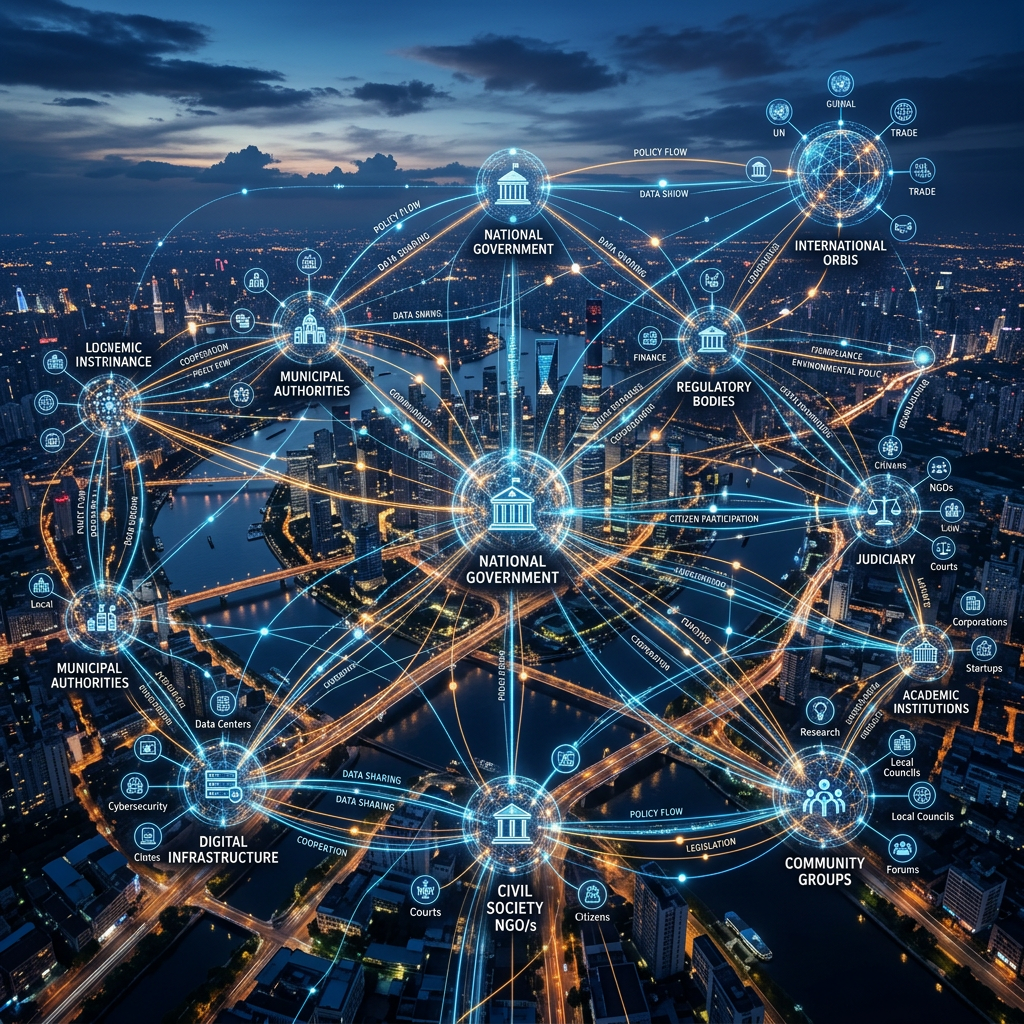
    One way to visualize polycentric governance is as a network of interconnected decision-making centers rather than a single chain of command.

    Communities, councils, institutions, and coordinating bodies each perform distinct functions while remaining connected to a larger governance ecosystem.

    The framework below illustrates how authority can remain distributed without becoming fragmented, allowing local autonomy and broader coordination to coexist within the same system.

    Figure 1. Polycentric Governance as a Distributed Decision-Making Ecosystem.

    Download Reference Map 003: Council Ring Architecture

    Authority is distributed across multiple interconnected centers rather than concentrated within a single institution.

    Local communities, councils, coordinating bodies, and shared frameworks interact through relationships, feedback, and mutual accountability, allowing governance systems to remain both adaptive and resilient while addressing challenges at different scales.


    Why Centralization Became Dominant

    Understanding polycentric governance requires understanding why centralized systems became so influential.

    Industrial-era societies faced challenges that appeared to favor centralization.

    • Growing populations required coordination.
    • Infrastructure projects required large-scale planning.
    • National economies required administrative systems.
    • Military defense favored unified command structures.

    Centralized institutions solved many of these problems.

    • They improved standardization.
    • They reduced fragmentation.
    • They increased administrative capacity.

    The rise of modern nation-states reinforced this trend.

    Centralization often became synonymous with modernization.

    • Yet scale introduced new problems.
    • Decision-makers became increasingly distant from local realities.
    • Information moved slowly through bureaucratic structures.
    • Policies designed for entire populations sometimes struggled to address regional variation.

    The strengths of centralization frequently came with tradeoffs.


    Indigenous Examples of Polycentric Governance

    Many indigenous societies historically operated through governance systems that were polycentric in practice, even if they did not use that terminology.

    • Authority was often distributed across families, clans, elders, councils, ceremonial leaders, and local communities.
    • Different institutions performed different functions.
    • Leadership frequently depended on context.
    • A respected elder might guide conflict resolution.
    • A community leader might coordinate collective labor.
    • Spiritual authorities might oversee cultural continuity.
    • No single institution necessarily dominated all aspects of life.

    Precolonial Philippine barangays exhibited some of these characteristics.

    Governance often remained localized while broader alliances emerged through kinship networks, trade relationships, and negotiated cooperation (Scott, 1994).

    Similar patterns appeared throughout many indigenous societies globally.

    These systems were not utopian.

    They experienced conflicts, inequalities, and limitations.

    Yet they often demonstrated remarkable adaptability because decision-making remained closely connected to local conditions.


    The Complexity Advantage

    One reason polycentric governance has attracted attention from systems thinkers is its relationship to complexity.

    Complex systems contain diverse actors, changing conditions, and unpredictable interactions.

    Centralized decision-making often struggles under such circumstances because no single authority possesses complete information.

    Local actors frequently understand local realities better than distant administrators.

    Distributed systems allow decisions to occur closer to the problems they address.

    Elinor Ostrom’s research on common-pool resource management repeatedly demonstrated that communities often govern shared resources more effectively than centralized authorities assume possible (Ostrom, 1990).

    • This increases responsiveness.
    • It improves learning.
    • It enhances adaptability.

    The lesson was not that governments are unnecessary.

    The lesson was that local knowledge matters.


    Learning Through Multiple Centers

    One overlooked advantage of polycentric systems is experimentation.

    • When authority remains distributed, different communities can test different approaches simultaneously.
    • Some strategies succeed.
    • Others fail.
    • The broader system learns from both outcomes.

    Centralized systems often struggle to generate similar learning because a single policy applies everywhere.

    • Mistakes become larger.
    • Adaptation becomes slower.

    Polycentric systems create what complexity theorists sometimes describe as parallel learning processes.

    • Multiple solutions emerge.
    • Successful practices spread.
    • Failures remain more contained.

    This dynamic enhances resilience.


    Polycentric Governance and Resilience

    Resilience refers to the capacity of systems to adapt and recover when conditions change.

    Polycentric systems often exhibit resilience because they avoid excessive dependence on single points of failure.

    • If one institution struggles, others may continue functioning.
    • If one region experiences disruption, neighboring systems may provide support.

    Diversity creates redundancy.

    Redundancy creates resilience.

    Ecological systems operate according to similar principles.

    Healthy ecosystems rarely depend on a single species or process.

    Human governance systems frequently benefit from similar diversity.

    The challenge is balancing autonomy with coordination.


    The Coordination Challenge

    Polycentric governance is not without difficulties.

    • Multiple centers of authority can create confusion.
    • Responsibilities may overlap.
    • Conflicts can emerge between institutions.
    • Coordination becomes more demanding.

    Without effective communication, distributed systems risk fragmentation.

    This challenge explains why some governance problems genuinely require central coordination.

    • National infrastructure.
    • Public health emergencies.
    • Large-scale disaster response.
    • Certain environmental issues.

    Polycentric governance does not eliminate the need for higher-level institutions.

    Instead, it emphasizes matching governance structures to the scale of the problem.

    • Some issues are best handled locally.
    • Others require broader coordination.
    • The question is not whether authority should exist.
    • The question is where authority should reside.

    The Principle of Subsidiarity

    One concept closely associated with polycentric governance is subsidiarity.

    Subsidiarity suggests that decisions should be made at the lowest effective level capable of addressing a particular issue.

    Local matters should remain local when possible.

    Higher levels intervene when necessary.

    This principle balances autonomy with coordination.

    It recognizes that local actors often possess valuable contextual knowledge while acknowledging that larger institutions remain important for broader challenges.

    Many successful governance systems implicitly follow this logic even when they do not explicitly use the term.


    Digital Technologies and Polycentric Systems

    Modern technologies may expand opportunities for polycentric governance.

    • Digital communication allows communities to coordinate without relying exclusively on centralized intermediaries.
    • Information can move rapidly across networks.
    • Local initiatives can share knowledge globally.
    • Collaboration can occur across geographic boundaries.

    These developments create possibilities that previous generations lacked.

    At the same time, technology introduces new risks.

    • Digital platforms can centralize influence even while appearing decentralized.
    • Information overload can complicate decision-making.
    • Coordination challenges remain.

    Technology does not eliminate governance questions.

    It changes their context.


    Governance as an Ecosystem

    Perhaps the most useful way to understand polycentric governance is through ecological thinking.

    Governance systems resemble ecosystems more than machines.

    • Multiple actors interact.
    • Relationships matter.
    • Adaptation occurs continuously.

    Health depends not only on individual components but also on the quality of their interactions.

    A governance ecosystem may include:

    • Communities
    • Municipal governments
    • Civil society organizations
    • Educational institutions
    • Businesses
    • Cultural networks
    • National authorities

    Each contributes distinct capacities.

    The objective is not uniformity.

    The objective is coordination amid diversity.


    Lessons for the Twenty-First Century

    Many contemporary challenges share a common characteristic.

    They are too complex for any single institution to solve alone.

    • Climate adaptation.
    • Economic resilience.
    • Information integrity.
    • Public health.
    • Community development.
    • Social cohesion.

    These issues cross scales and sectors simultaneously.

    • They require local knowledge and global awareness.
    • Community participation and institutional capacity.
    • Flexibility and coordination.

    Polycentric governance offers one framework for navigating these realities.

    Not because it provides perfect solutions.

    But because it acknowledges a fundamental truth:

    Complex societies often require multiple centers of intelligence.


    Beyond Centralization

    The debate between centralization and decentralization is often framed as an either-or choice.

    Polycentric governance suggests a different perspective.

    • The goal is not choosing one over the other.
    • The goal is designing systems capable of integrating both.
    • Central institutions remain important.
    • Local institutions remain important.
    • Networks remain important.
    • Communities remain important.

    The challenge is creating relationships among them that support learning, resilience, and adaptation.

    As complexity increases, the most successful societies may not be those that concentrate the most authority.

    They may be those that cultivate the greatest capacity for coordinated self-governance across multiple levels simultaneously.

    In that sense, polycentric governance is not merely a political concept.

    It is a framework for understanding how complex human systems can remain both resilient and responsive in a rapidly changing world.


    Crosslinks


    References

    Ostrom, E. (1990). Governing the commons: The evolution of institutions for collective action. Cambridge University Press.

    Ostrom, E. (2010). Beyond markets and states: Polycentric governance of complex economic systems. American Economic Review, 100(3), 641–672.

    Scott, W. H. (1994). Barangay: Sixteenth-century Philippine culture and society. Ateneo de Manila University Press.

    Meadows, D. H. (2008). Thinking in systems: A primer. Chelsea Green Publishing.

    The Living Archive is designed to be explored through pathways, categories, and search. If you’re looking for a specific idea, question, or theme, AI Search can help surface relevant connections across the archive.


    Attribution

    The Living Archive
    Integrative Frameworks for Regenerative Civilization

    © 2026 Gerald Daquila. All rights reserved.
    Part of the Life.Understood. knowledge ecosystem and Stewardship Institute initiative.

    This article is intended for educational, research, and civic inquiry purposes.
    Readers are encouraged to engage critically, verify sources independently, and explore related knowledge hubs for broader systems context.

  • Living Archives: The Future of Knowledge May Be Relational, Not Linear

    Living Archives: The Future of Knowledge May Be Relational, Not Linear


    As information becomes increasingly abundant, the challenge shifts from storing knowledge to connecting it in ways that support meaning, context, and collective intelligence.


    Meta Description

    Traditional knowledge systems organize information linearly. Yet complexity increasingly demands relational approaches to knowledge. Explore why living archives may represent the future of sensemaking, learning, and collective intelligence.


    For centuries, knowledge has largely been organized as a sequence.

    • Books begin at page one and end at the final chapter.
    • Schools progress through curricula in predetermined order.
    • Libraries categorize information into discrete subjects.
    • Research fields divide knowledge into disciplines.
    • Archives preserve records according to chronological or administrative structures.

    This approach made sense.

    Human beings needed systems capable of storing, retrieving, and transmitting information across time.

    Linear organization provided clarity.

    • It improved accessibility.
    • It reduced complexity.

    Yet the world knowledge attempts to describe is rarely linear.

    Ecological systems are interconnected.

    • Human behavior emerges from multiple influences.
    • Economies interact with politics, technology, culture, and geography.
    • Communities evolve through relationships rather than isolated events.

    Increasingly, the challenge facing modern societies is not the absence of information.

    It is the difficulty of understanding connections.

    This shift may require a new approach to knowledge itself.

    One that treats information not merely as a collection of isolated facts, but as a living network of relationships.


    The Success of Linear Knowledge Systems

    Linear knowledge systems achieved extraordinary results.

    • Scientific progress depended upon documentation.
    • Historical understanding depended upon records.
    • Education depended upon structured transmission.

    Modern civilization would be impossible without organized archives, libraries, databases, and formal knowledge institutions.

    These systems solved an important problem.

    • Information preservation.
    • Knowledge could survive beyond individual lifetimes.
    • Ideas could accumulate across generations.
    • Learning could become cumulative.

    The challenge is that preserving information and understanding reality are not always the same thing.

    A library may contain immense knowledge while revealing little about how that knowledge connects.

    Information can remain fragmented even when it is well organized.


    Knowledge in an Age of Abundance

    Historically, scarcity defined information systems.

    • Books were expensive.
    • Experts were rare.
    • Access to knowledge was limited.
    • Today, the situation is reversed.

    Digital technologies have created unprecedented information abundance.

    Articles, videos, databases, reports, research papers, podcasts, and AI-generated content are available almost instantly.

    The problem is no longer access.

    The problem is navigation.

    People increasingly struggle to answer questions such as:

    • How do these ideas connect?
    • What context is missing?
    • Which information matters most?
    • How does one insight relate to another?
    • What larger pattern is emerging?

    These are relational questions rather than informational questions.

    The distinction is important.

    Knowledge abundance often creates sensemaking scarcity.


    Reality Operates Through Relationships

    One reason traditional knowledge structures feel increasingly inadequate is that reality itself operates through relationships.

    • Climate change involves ecology, economics, technology, politics, psychology, and governance.
    • Public health involves biology, culture, communication, institutions, and behavior.
    • Artificial intelligence affects education, labor markets, identity, economics, and information systems simultaneously.

    The world does not organize itself according to academic departments.

    Relationships often matter as much as individual facts.

    Systems theorist Donella Meadows (2008) emphasized that understanding a system requires understanding interactions rather than merely cataloging components.

    The same principle applies to knowledge.

    Facts gain meaning through context.

    Context emerges through relationships.


    The Rise of Networked Knowledge

    Digital technologies have already begun transforming how knowledge is organized.

    • Hyperlinks connect ideas across documents.
    • Knowledge graphs map relationships between concepts.
    • Collaborative platforms allow information to evolve continuously.
    • Researchers increasingly work across disciplinary boundaries.

    These developments represent a subtle but important shift.

    Knowledge is becoming less hierarchical and more networked.

    Rather than moving through fixed sequences, individuals increasingly navigate webs of interconnected information.

    The experience resembles exploration more than consumption.

    Learning becomes less about following predetermined paths and more about discovering meaningful relationships.


    Why Archives Matter More Than Ever

    Paradoxically, the information age has increased the importance of archives.

    As information expands, memory becomes more difficult.

    • People forget.
    • Institutions lose context.
    • Communities repeat previous mistakes.

    Knowledge disappears beneath newer content.

    Archives provide continuity.

    They preserve collective memory.

    They allow ideas to remain accessible across time.

    Yet archives themselves face new challenges.

    Traditional archives were designed primarily for preservation.

    The emerging challenge is integration.

    Future archives may need to do more than store information.

    They may need to reveal relationships.


    What Makes an Archive Living?

    • A traditional archive preserves the past.
    • A living archive connects past, present, and future.

    The difference is not technological.

    It is structural.

    A living archive continuously evolves as new information emerges.

    • It reveals relationships between ideas.
    • It allows knowledge to remain dynamic rather than static.
    • It supports inquiry rather than merely retrieval.
    • Most importantly, a living archive helps people navigate complexity.

    Rather than asking:

    “What information exists?”

    it increasingly asks:

    “How does this information connect?”

    This shift transforms the archive from a repository into a sensemaking system.


    Knowledge as an Ecosystem

    One useful metaphor is ecology.

    • An ecosystem consists of relationships.
    • Individual organisms matter.
    • Their interactions matter even more.

    Knowledge systems operate similarly.

    • Ideas influence one another.
    • Concepts evolve through interaction.
    • Insights emerge from unexpected connections.

    A living archive therefore resembles an ecosystem more than a filing cabinet.

    • Knowledge remains organized.
    • Yet organization serves relationships rather than categories alone.
    • The goal is not merely classification.
    • The goal is understanding.

    The Human Need for Context

    Human beings rarely seek facts in isolation.

    They seek meaning.

    Meaning requires context.

    A statistic gains significance when connected to a trend.

    • A historical event gains significance when connected to broader patterns.
    • A piece of research gains significance when connected to real-world implications.
    • Context transforms information into understanding.

    This explains why people often feel overwhelmed despite having access to unprecedented amounts of information.

    What is missing is not data.

    What is missing is structure capable of revealing relationships.

    Living archives address this challenge by emphasizing connection alongside preservation.


    Artificial Intelligence and Relational Knowledge

    Artificial intelligence introduces new possibilities for knowledge systems.

    AI can summarize information, identify patterns, generate connections, and surface relevant materials across large collections.

    Yet AI also introduces risks.

    As discussed in Coherence vs Truth: The Emerging Crisis of AI Information Systems, generated connections are not necessarily meaningful connections.

    The challenge is ensuring that relational knowledge remains grounded in evidence, context, and verification.

    • Used thoughtfully, AI may help individuals navigate increasingly complex information landscapes.
    • Used carelessly, it may generate the appearance of understanding without genuine comprehension.

    The future likely depends upon combining technological capabilities with human judgment.


    From Information Storage to Sensemaking

    Perhaps the most significant shift involves the purpose of knowledge systems themselves.

    Historically, knowledge systems focused primarily on storage and retrieval.

    The future may emphasize sensemaking.

    Sensemaking involves identifying patterns, understanding relationships, integrating perspectives, and constructing coherent interpretations of complex realities (Weick, 1995).

    As complexity increases, this function becomes increasingly valuable.

    Information alone rarely solves problems.

    Understanding relationships often does.

    The most useful knowledge systems may therefore be those that help people think rather than merely remember.


    Collective Intelligence and Shared Memory

    Societies depend upon collective memory.

    • Without it, learning becomes impossible.
    • Every generation would be forced to begin again.
    • Archives preserve this memory.
    • Living archives expand it.

    They allow communities to connect insights across disciplines, institutions, experiences, and generations.

    In doing so, they support collective intelligence.

    Collective intelligence emerges when groups become capable of learning more effectively together than individuals can learn alone.

    This capability may become increasingly important as societies confront growing complexity.

    • No single person can understand everything.
    • No institution possesses all relevant knowledge.
    • Understanding increasingly emerges through relationships.

    The Future May Be Relational

    The information age began with a promise of access.

    Knowledge would become available to everyone.

    To a remarkable extent, that promise has been fulfilled.

    The next challenge is different.

    How do people make sense of what they can now access?

    • The answer may involve moving beyond purely linear models of knowledge.
    • Not abandoning them.
    • Expanding them.

    The future of knowledge may be less about accumulating information and more about cultivating relationships between ideas.

    Less about storing facts and more about revealing patterns.

    Less about isolated expertise and more about integrated understanding.

    In this sense, living archives represent more than a technological development.

    They represent a different philosophy of knowledge.

    One that recognizes that reality itself is relational.

    And that understanding often emerges not from what we know individually, but from how what we know connects together.


    Crosslinks


    References

    Meadows, D. H. (2008). Thinking in systems: A primer. Chelsea Green Publishing.

    Weick, K. E. (1995). Sensemaking in organizations. Sage Publications.

    Weinberger, D. (2007). Everything is miscellaneous: The power of the new digital disorder. Times Books.

    Zuboff, S. (2019). The age of surveillance capitalism. PublicAffairs.

    The Living Archive is designed to be explored through pathways, categories, and search. If you’re looking for a specific idea, question, or theme, AI Search can help surface relevant connections across the archive.


    Attribution

    The Living Archive
    Integrative Frameworks for Regenerative Civilization

    © 2026 Gerald Daquila. All rights reserved.
    Part of the Life.Understood. knowledge ecosystem and Stewardship Institute initiative.

    This article is intended for educational, research, and civic inquiry purposes.
    Readers are encouraged to engage critically, verify sources independently, and explore related knowledge hubs for broader systems context.